The Burning Side Summary, Characters and Themes
The Burning Side by Sarah Damoff is a multigenerational family drama about marriage, memory, parenthood, and the difficult forms love can take after trust has been damaged. A house fire forces April and Leo Torres to confront the collapse of their marriage just as April’s father receives an Alzheimer’s diagnosis.
Moving between past and present, the novel shows how private histories shape present choices. It examines postpartum depression, childhood abandonment, infidelity, caregiving, class differences, and the fear of losing both people and places, while asking whether damaged relationships can become something new rather than returning to what they once were.
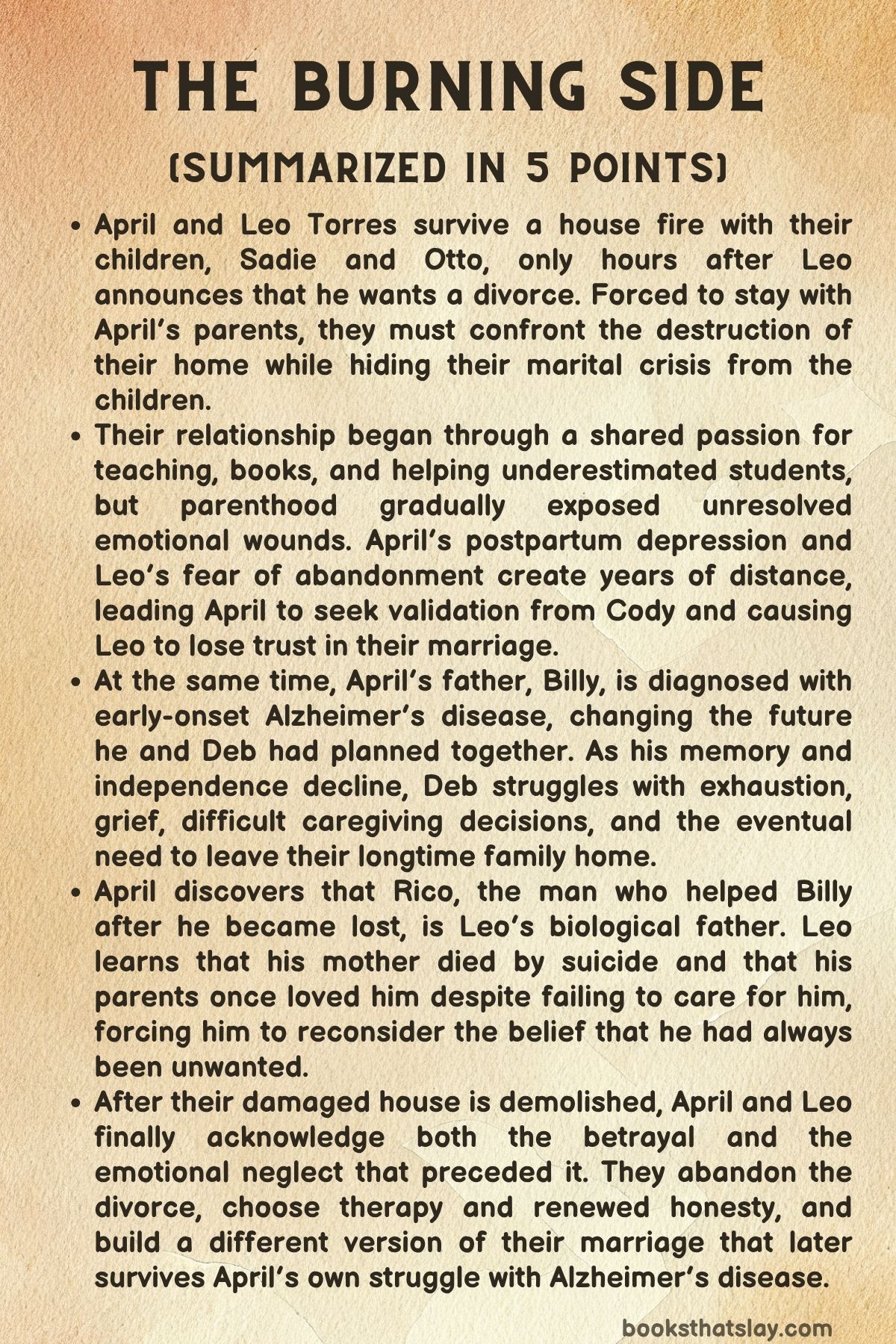
Summary
In June 2022, April Torres wakes to find her house burning and escapes with her baby, Otto, while carrying a copy of Seventh City, the novel written by her husband, Leo. Leo rescues their daughter, Sadie, and the entire family survives, but the fire destroys their home only hours after Leo tells April that he wants a divorce.
The fire appears to have started in the kitchen, where April may have left a burner on after becoming distracted by Leo’s announcement. With nowhere else to go, the family moves temporarily into the home of April’s parents, Deb and Billy Russo, where April and Leo must pretend to function as a family while hiding their separation from the children and most of the relatives.
The story returns to 2011, when twenty-two-year-old April meets Leo at Argyle High School. April is tutoring Jonathan Gutierrez, a dyslexic student whom others have underestimated, while Leo is beginning work as a history teacher.
April and Leo connect through their shared belief that young people deserve dignity, challenging books, and serious attention. Their first meeting leads to dinner, romance, and a relationship built around education, literature, and their desire to improve the lives of students.
Two years later, Leo asks Deb and Billy for their blessing before proposing. Because he grew up without dependable parents, their affection and generosity give him his first real sense of permanent family belonging.
April and Leo purchase an old house in Argyle and begin renovating it together. Their playful work represents the future they believe they are building, although an argument concerning Jonathan reveals an important difference between them.
April wants Jonathan to achieve the kind of success she imagines for him, while Leo believes honest work should not be treated as failure. He warns that April’s efforts to help sometimes carry hidden expectations about gratitude and transformation, exposing the class privilege beneath some of her generosity.
After the fire, April and Leo return to the house and find the destruction far worse than expected. The collapsed roof, smoke damage, shattered glass, and ruined rooms force them to confront the loss of the physical space that once represented security and partnership.
April asks whether Leo truly wants a divorce, but he believes the question ignores her betrayal. Their shared relief at finding Sadie’s stuffed bear briefly brings them closer, although neither can move beyond the hurt separating them.
At Deb and Billy’s home, another family crisis becomes visible. Billy has recently been diagnosed with early-onset Alzheimer’s disease, but Deb has hidden the diagnosis from their children because she is frightened of what it will mean.
Billy’s confusion becomes impossible to conceal when he mistakes Sadie for a young Josie. Deb finally tells April that Billy’s condition may be hereditary and that his memory will continue deteriorating, leaving April terrified for her father and for the future of the entire family.
The past reveals that Deb and Billy’s marriage did not begin as the perfect love story their children believe it to be. Deb became pregnant with April, and Billy married her out of responsibility even though they were not yet in love.
Their early marriage was filled with resentment, financial stress, and conflict. Over time, Billy’s patience, reliability, and devotion to April allowed Deb to trust him, and affection slowly became a lasting partnership.
Leo’s childhood offers a darker history. His young parents, Ana and Rico, lived in severe poverty, and after the death of their infant daughter, Mirabel, Ana fell into overwhelming grief.
Leo was sent to live with his aunt Izzy and uncle Nacho, where he felt unwanted and learned to protect himself through secrecy, emotional withdrawal, and the expectation that people would eventually abandon him. He never tells April the full truth about these years, even after they marry.
April and Leo initially create a loving domestic life, but the birth of Sadie changes April’s sense of herself. She experiences postpartum depression, physical alienation, exhaustion, and isolation, while Leo continues teaching and writing.
Although Leo attempts to help, he does not understand how completely April feels erased by motherhood. April hides the severity of her suffering, and Leo interprets her emotional distance as evidence that she no longer wants him.
During the COVID-19 pandemic, their existing problems intensify. Leo finds purpose helping struggling students, while April becomes increasingly depressed at home.
Leo’s fear of being an unwanted burden causes him to withdraw when April needs him most. April sees his absence as proof that his work and independence matter more than their family, while he sees her unhappiness as rejection.
When April becomes seriously ill with COVID-19, Leo cares for her and likely prevents her condition from becoming life-threatening. Their intimacy returns, and they decide to have another child, mistakenly believing their renewed closeness has resolved the problems they never fully discussed.
After Otto’s traumatic birth, April’s postpartum depression becomes severe. She feels invisible, ashamed, and overwhelmed, while Leo again seeks safety in work, exercise, and writing.
Leo helps April find tutoring work, where she meets Cody, a polished colleague who treats her as intelligent, attractive, and professionally valuable. Cody’s admiration restores qualities April believes she has lost, and she allows their emotional connection to become sexual.
On April’s birthday, Leo forgets the occasion while Cody remembers it, gives her a meaningful gift, and offers professional advancement. April permits Cody’s attention to escalate, but Leo enters before they have intercourse and witnesses enough to consider the marriage irreparably betrayed.
April ends the relationship immediately and admits that she never loved Cody. She wanted validation and proof that she still existed beyond motherhood, but she knows her loneliness does not excuse her decision.
Leo moves into Otto’s room and begins considering divorce. His discovery of April with Cody confirms the deepest belief formed in childhood: that anyone he loves will eventually decide he is not enough.
The night he announces his intention to divorce, the house catches fire. The resulting displacement forces April and Leo to remain near one another even as their emotional separation becomes more definite.
Meanwhile, Billy’s Alzheimer’s progresses rapidly. He becomes lost while attempting to buy champagne for Cameron and Rachel’s engagement celebration and is found hours away in Waco by a hardware-store manager named Ricardo.
The incident ends Billy’s ability to drive and work as a dentist. Deb begins managing his appointments, movements, confusion, and practical responsibilities while privately grieving the retirement and future they expected to share.
Cameron and Rachel prepare for marriage despite the possibility that Cameron may have inherited the Alzheimer’s-related mutation. Josie chooses genetic testing and learns that she does not carry the known mutation, leaving April and Cameron with continuing uncertainty.
The family also learns that Deb and Billy married because Deb was pregnant. This revelation destroys the children’s idealized version of their parents’ marriage but shows that enduring love can grow from an imperfect beginning through repeated acts of loyalty.
April and Leo continue cleaning the damaged property while waiting for insurance decisions. During a storm, they discover Nathaniel, a homeless man, sheltering inside the house.
Leo responds with empathy because he once slept in abandoned places after leaving his relatives. April realizes how little she knows about the experiences that formed his attitudes toward poverty, help, pride, and belonging.
Although the couple speaks more honestly about Cody and their earlier emotional distance, they remain unable to agree on where the destruction began. Leo believes the affair broke the marriage, while April believes years of depression, silence, and emotional abandonment created the conditions surrounding her betrayal.
The insurance settlement is insufficient to rebuild the house, and Leo moves into a temporary trailer on the property. Living there repeats the insecurity of his childhood, while leaving the Russo home makes him fear that divorce will cost him not only April but the first extended family that ever accepted him.
April later realizes that Ricardo, the man who helped Billy in Waco, is Leo’s biological father, Rico. She meets him before telling Leo, hoping to determine whether contact will help or harm her husband.
Rico explains that Ana died by suicide after Leo was sent away. He claims that Nacho prevented contact and that he never knew how to find his son, but Leo cannot immediately accept explanations for years of absence.
Learning about Ana’s death destroys Leo’s hope of ever confronting or reconciling with her. His pain initially turns into anger toward April for reopening his past, but she finally resists her habit of trying to solve suffering and simply stays near him.
Deb later tells Leo that no child can be responsible for a parent’s depression, addiction, poverty, abandonment, or death. Billy, even in confusion, gives Leo a note telling him that he will always be welcome, assuring him that his place in the Russo family does not depend entirely on his marriage.
Deb faces her own moral crisis when Billy reveals that he has obtained medication intended to end his life once dementia becomes unbearable. He asks Deb to administer it so that she will not lose the rest of her life caring for someone who no longer recognizes her.
Deb eventually flushes the pills. She accepts that caregiving may be exhausting and unfair, but refuses to view Billy’s continued life as a burden that must be removed.
She also discovers letters showing that Billy once loved another woman, Patsy, but ended that relationship to marry Deb and take responsibility for April. The knowledge confirms that their marriage became meaningful not because it was perfect, but because Billy repeatedly chose the family they created.
Jonathan Gutierrez publishes a novel called Identity and acknowledges both April and Leo for helping him. Reading it together allows Leo to understand postpartum depression more clearly and recognize how his withdrawal contributed to April’s isolation, even though her affair remains her responsibility.
Rico later apologizes directly to Leo without claiming that grief or poverty erases his failures. Leo learns that the lion tattoo on Rico’s arm commemorated his birth, proving that he was loved even though that love failed to produce dependable parenting.
At Cameron and Rachel’s wedding, the couple chooses commitment without genetic certainty. Their decision affects Leo because he has been treating divorce as a way to eliminate the possibility of future pain, even though no relationship can offer such protection.
April signs the divorce petition and removes her wedding ring, but she and Leo continue reading Jonathan’s novel together. Leo admits that his fear of abandonment caused him to abandon April emotionally whenever he sensed distance, while April accepts that depression does not remove her responsibility for choosing Cody’s attention.
The damaged Argyle house is declared unsalvageable and demolished. Searching through what remains, Leo retrieves their marriage certificate from a fireproof box and discovers that a typographical mistake dates their marriage to 2031 rather than 2013.
The incorrect future date changes his perspective. Instead of viewing the marriage only as a ruined past, he begins to consider whether it can become a future choice.
Leo asks April whether she truly wants the divorce, and she says that she does not. He admits that he also wants to remain married, although neither pretends that reconciliation will erase betrayal, depression, resentment, or fear.
They burn the divorce papers and choose one another again. Rather than restoring their old marriage, they agree to create a more honest relationship that includes individual therapy, couples counselling, clearer communication, and acknowledgment of the wounds each has tried to hide.
Deb and Billy move into Greenwood Hills, where increasing support will allow Deb to remain Billy’s wife rather than becoming his only caregiver. At Christmas, Rico joins the family and begins forming a relationship with Leo’s children.
Thirty years later, April has Alzheimer’s disease. Leo remains beside her, preparing food and reading aloud when she can no longer read for herself.
Their children and granddaughter surround them, while photographs of April’s former students preserve a life she cannot consciously remember. The story ends by returning to 2013, when Leo lights a hearth fire before proposing, transforming fire from an image of destruction into one of warmth, danger, hope, and welcome.
Characters
April Torres
At the center of The Burning Side, April is compassionate, intelligent, determined, and deeply invested in helping others, yet her desire to repair suffering sometimes prevents her from respecting the limits of what she can control. She approaches students, relatives, Leo, and even strangers with the assumption that enough effort, knowledge, or emotional attention can create a better outcome.
Her work with Jonathan shows the best side of this instinct. Because she understands dyslexia personally, she refuses to lower expectations for him and recognizes his ability before many other adults do.
At the same time, April’s approach to helping can contain unconscious privilege. Her disappointment over Jonathan’s possible pest-control job reveals that she sometimes defines success according to her own economic and educational expectations rather than the dignity or preferences of the person receiving help.
Motherhood profoundly disrupts April’s identity. She loves Sadie and Otto, but postpartum depression leaves her isolated from her body, work, confidence, and former sense of purpose.
Her suffering is intensified by shame because she believes a loving mother should feel grateful and fulfilled. Rather than admitting how badly she is struggling, she conceals her depression until loneliness begins shaping her judgment.
April’s involvement with Cody is her most damaging choice. His attention becomes attractive because it reflects the intelligent and desirable woman she fears has disappeared, but she knowingly permits that need for validation to cross a marital boundary.
She does not excuse the betrayal, even when she argues that the marriage was already emotionally damaged. Her eventual growth depends on accepting that Leo’s withdrawal helps explain her loneliness but does not remove her responsibility.
April also changes in the way she responds to other people’s pain. When Leo learns about Ana’s suicide, she initially defends her decision to find Rico, but finally understands that grief cannot always be repaired through action.
By remaining nearby without demanding conversation, April learns to offer presence instead of solutions. Her later reconciliation with Leo is therefore based not on proving that she can fix the marriage, but on accepting uncertainty, accountability, and sustained emotional work.
Leo Torres
Within The Burning Side, Leo is shaped by the belief that love is temporary and belonging can be withdrawn without warning. His intelligence, compassion, humor, and commitment to teaching exist alongside defensive habits created by poverty, neglect, and childhood abandonment.
Leo’s work with students gives him a clear identity. In the classroom, he can recognize need, provide practical help, and see measurable results, making education far safer than the emotional uncertainty of marriage.
His connection to the Russo family is equally important. Deb, Billy, Josie, and Cameron give him the warmth and acceptance he never received consistently from Ana, Rico, Nacho, or Izzy.
Because this belonging matters so much, the possibility of divorce threatens more than his relationship with April. He fears losing the first parents, siblings, home, and family traditions that ever made him feel permanently included.
Leo’s greatest weakness is his tendency to withdraw before another person can reject him. When April becomes depressed and emotionally distant, he interprets her suffering through the lens of his childhood and assumes that she no longer wants him.
Instead of asking what she needs, he protects himself through work, exercise, writing, and silence. His withdrawal then confirms April’s fear that she has become invisible, creating the abandonment he is attempting to avoid.
Catching April with Cody validates Leo’s deepest insecurity. His anger is justified, but he initially uses the betrayal to create a simplified version of the marriage in which April alone caused the destruction.
Reading Jonathan’s novel and learning more about postpartum depression force him to reconsider this account. He comes to understand that recognizing his failures does not excuse April’s choice, just as recognizing Ana and Rico’s suffering does not erase their failure to protect him.
Leo’s reunion with Rico becomes central to his growth. Discovering that he was loved but still abandoned teaches him that sincere love and serious failure can exist together.
This understanding allows him to consider that April’s betrayal does not mean every year of their marriage was false. By choosing reconciliation, therapy, and renewed communication, Leo accepts that emotional safety cannot be achieved by leaving first whenever loss becomes possible.
Deb Russo
Deb is the emotional organizer of the Russo family, using food, hospitality, planning, and constant attention to create a sense of safety. Her caretaking is generous, but it is also connected to childhood grief and her belief that feeding or serving people can keep them alive.
After her mother’s death, Deb attempts to rescue her grieving father through cooking. That experience teaches her to connect usefulness with love, making it difficult for her to distinguish freely chosen care from exhausting self-sacrifice.
Her marriage to Billy begins as an obligation rather than a romance. Pregnant with April, she enters the relationship expecting to endure it temporarily, but Billy’s steady devotion gradually teaches her that love can be formed through ordinary loyalty.
Deb later protects the idealized version of their marriage because she wants her children to believe their family began securely. Billy’s illness exposes how carefully she has shaped their shared memories and how vulnerable those stories become when one person can no longer protect them.
Her response to Alzheimer’s is neither endlessly patient nor falsely optimistic. She resents the future being taken from her, fears becoming consumed by caregiving, and occasionally wishes she did not have to be the person everyone depends upon.
Billy’s request that she help end his life creates her greatest moral conflict. Flushing the pills represents Deb’s decision that love will not be measured solely by convenience, recognition, or reciprocity.
Her move to Greenwood Hills shows further maturity. Rather than treating professional support as personal failure, she accepts that preserving her relationship with Billy requires limits, shared responsibility, and freedom from a home she can no longer manage alone.
Billy Russo
Billy is introduced as a warm, humorous, dependable father whose declining memory threatens the role he has occupied for decades. His Alzheimer’s diagnosis gradually removes professional independence, accurate recognition, and control over his future, but it does not erase the emotional importance of his relationships.
His marriage to Deb reveals his capacity for patient commitment. Although he once loved Patsy, he chooses to marry pregnant Deb, care for April, and build a life without using his sacrifice to demand gratitude.
Billy’s devotion is expressed through quiet consistency rather than dramatic declarations. He remembers anniversaries, cares for the children, supports Josie’s ambitions, welcomes Leo, and attends to countless household responsibilities Deb does not fully notice until he can no longer perform them.
As Alzheimer’s progresses, Billy becomes separated from chronological reality. He may remember affection while forgetting identity, confuse Sadie with Josie, or recognize that someone matters without knowing the nature of the relationship.
His request for life-ending medication reveals his fear of losing dignity and becoming a burden. Although he describes the plan as protection for Deb, it places an unbearable moral responsibility upon the person he claims to be protecting.
Billy’s most important quality survives even when factual memory fails. He continues expressing welcome, tenderness, humor, and love, suggesting that emotional attachment can endure in fragments after names and dates have disappeared.
Sadie Torres
Sadie represents the emotional consequences of family crisis on a child who cannot fully understand its causes. She knows that her home has burned and senses tension between her parents, but she is initially protected from the knowledge that they are considering divorce.
Her panic when flames rise from Billy’s grill shows that the fire has changed her physical sense of safety. What adults treat as an ordinary backyard moment becomes, for Sadie, proof that disaster may return without warning.
Bear Bear functions as an important source of continuity for her. Recovering the toy from the damaged house reassures Sadie that something familiar can survive destruction, just as her parents later attempt to preserve family security across two homes.
Sadie repeatedly draws April and Leo back into cooperative parenthood. Her lost tooth, desire for family outings, wedding dancing, and daily routines remind them that their conflict exists alongside a child’s need for celebration and dependable love.
She does not directly repair the marriage, nor should that responsibility belong to her. Instead, her presence reveals that April and Leo remain capable of tenderness, teamwork, humor, and shared attention even while they are emotionally separated.
Otto Torres
Otto is too young to understand the fire, divorce, Alzheimer’s diagnosis, or family history unfolding around him. His dependence nevertheless intensifies the pressures on April and Leo, particularly because his birth is followed by April’s severe postpartum depression.
As a baby, Otto represents both exhaustion and possibility. He requires constant care at the same time that his existence connects several generations affected by abandonment, caregiving, memory, and inherited illness.
His first birthday places his growth beside Billy’s decline. Otto is beginning to develop language and memory while his grandfather is losing both, creating a powerful contrast between the beginning and ending stages of family life.
In the later future, Otto remains part of the family surrounding April during her Alzheimer’s disease. His continued presence shows that care moves across generations, eventually returning to those who once provided it.
Josie Russo
Josie is independent, expressive, theatrical, and determined to create a life that does not follow conventional expectations. She rejects her parents’ assumption that marriage and motherhood are necessary measures of fulfilment, treating the stage as a genuine vocation rather than a temporary adventure.
Her disappointment after losing a role is initially dismissed by April, but Leo understands that grief does not have to be catastrophic to deserve respect. This moment demonstrates Josie’s vulnerability beneath her confident performance.
Josie’s decision to undergo genetic testing reflects her desire for control through knowledge. She would rather know whether she carries the Alzheimer’s-related mutation than organize her life around indefinite fear.
Her negative result brings relief but also creates emotional distance from April and Cameron, who remain uncertain. Josie cannot remove their fear, and the unequal distribution of risk shows that even loving siblings may occupy very different emotional futures.
She also provides humor, honesty, and practical support during April’s marital crisis. Although April initially hides the truth from her, Josie remains one of the people capable of reminding her sister that uncertainty does not automatically mean abandonment.
Cameron Russo
Cameron is the youngest Russo sibling and initially appears less burdened by family responsibility than April or Josie. His engagement to Rachel, however, places him at the center of the family’s questions about commitment, heredity, and uncertain futures.
Deb reacts negatively because Cameron’s age reminds her of her own unplanned pregnancy and hurried marriage. Cameron distinguishes his decision from his parents’ beginning by making clear that he is choosing Rachel freely and does not require permission.
His decision not to undergo genetic testing before marriage is not simple denial. He and Rachel accept that Cameron may never develop Alzheimer’s and refuse to let a possible illness become the organizing principle of their relationship.
Cameron’s wedding becomes an important contrast to April and Leo’s divorce. He commits without certainty, while Leo initially seeks separation because certainty cannot be guaranteed.
Cameron also provides practical stability as Billy’s condition worsens. His effort to remain geographically close suggests that his independence does not require emotional distance from the family.
Rachel
Rachel enters the Russo household during one of its most unstable moments and becomes a symbol of family expansion amid loss. Deb immediately recognizes Cameron’s love for her, even though the timing of their engagement initially causes anxiety.
Rachel’s willingness to marry Cameron despite his possible hereditary risk demonstrates mature commitment. She understands that the future may include illness, caregiving, or difficult reproductive decisions, but she does not treat uncertainty as a reason to avoid love.
Her presence also mirrors Leo’s earlier entrance into the Russo family. Unlike Leo, however, Rachel comes from a loving background and does not experience acceptance as rescue from abandonment.
This difference helps reveal why Leo’s bond with the Russos carries unusual emotional weight. Rachel can join the family without believing her entire sense of belonging depends upon remaining connected to it.
Jonathan Gutierrez
Jonathan begins as a student whose dyslexia, financial hardship, and limited opportunities cause adults to underestimate him. April and Leo recognize his intelligence and offer him demanding books rather than simplified expectations.
His early difficulties reveal the differences between April and Leo’s ideas about help. April wants education to produce visible advancement, while Leo understands that survival, honest employment, and dignity may not match her preferred definition of success.
Jonathan’s eventual publication of Identity validates the faith both teachers placed in him, but his significance is greater than professional achievement. His novel becomes the medium through which April and Leo finally understand one another more accurately.
By writing about identity, depression, loss, and forgiveness, Jonathan indirectly teaches the adults who once taught him. His development therefore reverses the usual direction of mentorship and shows that education creates relationships whose effects cannot always be predicted.
Cody
Cody is less important as a romantic figure than as a source of validation for April. He appears during a period when she feels physically undesirable, professionally irrelevant, and emotionally abandoned.
His attention is polished, deliberate, and connected to the qualities April fears motherhood has erased. By remembering her birthday, praising her work, and offering advancement, he reflects an image of competence and desirability that Leo no longer communicates.
Cody does not cause the marital crisis, but he provides an available route for April’s loneliness to become betrayal. His presence exposes vulnerabilities that already exist without relieving April of responsibility for crossing the boundary.
April’s admission that she never loved him makes the affair more painful for Leo. She risked the family not for another lasting relationship, but for temporary confirmation that she still possessed value.
Rico Torres
Rico is first encountered as the compassionate hardware-store manager who protects Billy after he becomes lost. His later identification as Leo’s biological father transforms a seemingly minor act of kindness into evidence of a much larger family history.
As a young man, Rico loves Ana and celebrates Leonardo’s birth, but poverty, grief, shame, and conflict overwhelm his ability to provide dependable care. His affection is real, yet it does not prevent abandonment.
Rico’s adult apologies are meaningful because he does not claim that hardship removes responsibility. He explains Ana’s depression, Nacho’s interference, and his own failed attempts at contact while acknowledging that Leo still grew up believing he was unwanted.
The lion tattoo commemorating Leo’s birth becomes proof that Rico once felt pride and love for his son. This fact does not erase decades of absence, but it weakens Leo’s belief that he was rejected from the moment he entered the world.
Rico also recognizes the danger in allowing shame to become permanent separation. By urging Leo not to abandon the family he has created, he uses his own failures as a warning rather than presenting himself as an authority.
Ana Torres
Ana is remembered primarily through the consequences of her absence, yet the later account of her youth restores her as a full person. She is a loving, hopeful teenage mother whose poverty, exhaustion, and grief eventually become unbearable.
The death of Mirabel changes Ana’s relationship with Leo and with life itself. Her depression causes emotional withdrawal, unpredictable affection, and eventual separation from her son.
Her suicide leaves Leo without the possibility of direct explanation. He must accept that the mother whose abandonment wounded him was also a suffering young woman who lacked adequate support.
Understanding Ana’s pain does not erase the harm done to Leo. Her character instead demonstrates how untreated grief and mental illness can damage both the person suffering and the children who interpret that suffering as rejection.
The account of Leonardo’s birth is essential because it proves Ana wanted and loved him. Her later collapse is not the complete truth of their relationship, even though it becomes the part that most powerfully shapes his life.
Nacho and Izzy
Nacho and Izzy provide shelter after Ana and Rico can no longer care for Leo, but they do not give him the emotional security he needs. Their home teaches him to remain quiet, conceal vulnerability, and avoid becoming a burden.
The cheap wedding card they send years later reflects their limited understanding of his past. Their relief that his “wild days” are over ignores the loneliness and instability that contributed to his adolescent behaviour.
Rico’s account suggests that Nacho also blocked attempts at contact. Whether motivated by anger, protectiveness, or control, this decision deprives Leo of information about his parents and reinforces his belief that they simply chose life without him.
Their role shows that providing physical housing is not the same as creating belonging. Leo survives in their care, but he does not develop the confidence that his needs, grief, or presence are welcome.
Nathaniel
Nathaniel appears briefly when April and Leo discover him sheltering inside their storm-damaged house. April initially sees an intruder, while Leo recognizes a frightened person seeking safety.
His presence allows Leo to reveal that he once slept in abandoned buildings. This disclosure helps April understand that his attitudes toward homelessness and assistance are grounded in lived humiliation rather than abstract political beliefs.
Nathaniel also exposes the difference between rescue and respectful help. April and Leo eventually provide food, transportation, and temporary shelter without treating him as an object through which they can prove their goodness.
His encounter becomes one of the first situations in which the couple speaks from the histories beneath their arguments. He therefore functions as a catalyst for honesty rather than merely a symbol of poverty.
Kim
Kim is Leo’s colleague and represents the world in which he feels useful, respected, and emotionally competent. April suspects that their closeness may contain an intimacy missing from the marriage, although the story provides no evidence that Leo has an affair.
Her presence matters because April experiences Leo’s professional relationships as proof that he can communicate and engage everywhere except at home. Leo, in contrast, finds workplace relationships safer because their expectations are clearer than the needs created by depression and parenthood.
Kim therefore serves as a mirror rather than a romantic rival. She reflects the widening distance between Leo’s public identity as a responsive teacher and his private withdrawal as a husband.
Patsy
Patsy appears through old letters revealing that Billy loved someone else before marrying Deb. Her existence changes Deb’s understanding of the beginning of her marriage and the sacrifices Billy made without demanding recognition.
She represents the life Billy might have chosen. By ending that relationship and accepting responsibility for April, he gives up one possible future in order to build another.
Patsy’s role does not reduce Billy and Deb’s marriage to obligation. Instead, she confirms that commitment often involves paths not taken, private losses, and choices whose cost may remain invisible for decades.
Themes
Love as a Repeated Choice
In The Burning Side, love is not presented as a permanent emotion that guarantees loyalty, understanding, or happiness. It is shown as a sequence of decisions made under changing conditions, often after disappointment has removed the comfort of certainty.
Deb and Billy begin their marriage without romantic love, yet years of caregiving, patience, parenting, and ordinary attention gradually transform obligation into devotion. Their relationship becomes meaningful because they continue choosing one another, not because its beginning was ideal.
April and Leo follow the opposite path at first. Their marriage begins with passion, shared purpose, and confidence, but emotional withdrawal, untreated depression, and betrayal reveal that a loving beginning cannot sustain a relationship without continued effort.
Their reconciliation does not restore innocence. April must accept responsibility for Cody, while Leo must acknowledge that fear caused him to abandon the emotional work of marriage long before he physically left.
Cameron and Rachel provide another model by choosing commitment despite hereditary uncertainty. Their decision reminds Leo that avoiding love cannot eliminate future suffering; it only guarantees the loss of whatever the relationship might have become.
Love therefore requires risk rather than certainty. The characters cannot promise that illness, betrayal, resentment, or grief will never return, but they can decide how they will respond when those realities appear.
Memory, Identity, and the Fear of Disappearance
Memory gives the characters continuity, yet it is shown to be incomplete, selective, and vulnerable. Billy’s Alzheimer’s makes this visible, but nearly every major character has built an identity around a partial version of the past.
Deb constructs a romantic story about her marriage because she wants her children to believe they began within security. Billy’s illness breaks this shared narrative by revealing facts without preserving the emotional reasons those facts were hidden.
Leo remembers his childhood primarily as proof that he was unwanted. Learning that Rico carried a tattoo celebrating his birth and that Ana once loved him does not erase abandonment, but it forces him to admit that his history contains affection as well as failure.
April fears disappearance in a different form. Postpartum depression makes her feel erased by motherhood, and Cody’s attention becomes dangerous because it confirms that the woman she remembers still exists.
Physical objects preserve identity when memory becomes unreliable. Seventh City, Sadie’s bear, the marriage certificate, family letters, Jonathan’s novel, houses, photographs, and student collages all carry emotional history after people can no longer recall every detail.
The future scene in which April has Alzheimer’s completes this exploration. Leo reads to her, cooks familiar food, and remains beside her even when conscious recognition weakens, suggesting that identity is held not only within the individual mind but also within the people who remember, serve, and love that person.
Abandonment and Emotional Self-Protection
Leo’s childhood teaches him that emotional dependence is dangerous. Because his parents disappear from his life and his relatives make him feel burdensome, he learns to withdraw before others can reject him.
This defence helps him survive unstable circumstances, but it becomes destructive in marriage. When April’s depression makes her less emotionally available, Leo assumes that she no longer wants him and retreats into activities where he feels competent.
April experiences his retreat as abandonment. Her loneliness then drives her toward Cody’s attention, and the resulting betrayal confirms Leo’s original expectation that people eventually choose someone else.
The pattern becomes self-fulfilling because Leo’s attempt to protect himself creates the distance he fears. His decision to divorce gives him control over how the relationship ends, but it also repeats the behaviour that has hurt him most: leaving when connection becomes frightening.
April also protects herself through concealment. She hides the severity of her depression, her need for validation, and the truth about Cody because shame convinces her that being fully known may lead to rejection.
Growth begins when both characters stop treating self-protection as emotional wisdom. Leo contacts Rico, admits his role in the marital distance, and risks trusting April again, while April speaks honestly about depression and accepts help without attempting to control every outcome.
Home, Fire, and Rebuilding
The destruction of the Argyle house externalizes the collapse of April and Leo’s marriage. The kitchen burns at the moment their separation becomes explicit, joining domestic ruin with emotional devastation.
The house once represented security, shared labour, parenthood, and Leo’s escape from homelessness. Its loss is especially painful because he believed property and marriage could guarantee that he would never again be without a place to belong.
April experiences the damaged objects as containers of memory. Her distress over discarding them increases after Billy’s diagnosis because she fears that losing physical reminders will make family history disappear more quickly.
The novel refuses to restore the house. Engineers declare it unsalvageable, forcing April and Leo to accept demolition rather than pretending every damaged structure can return to its former condition.
Their marriage follows a related process. Reconciliation becomes possible only after they stop trying to recover the relationship exactly as it was and agree to build another form through therapy, responsibility, and clearer communication.
Deb’s decision to sell the Lexington Avenue house reinforces the idea that home cannot depend entirely on place. Her family’s memories remain meaningful even when another family occupies the rooms, while love must become portable enough to survive relocation, illness, and altered relationships.
Fire finally carries two meanings. It destroys the Torres home and exposes everything the couple has avoided, but the closing image of Leo lighting a hearth fire before proposing restores its connection to warmth, welcome, danger, and the courage required to invite another person inside.