The Bone Door Summary, Characters and Themes
The Bone Door by Frances White is a dark fantasy novel about identity, trauma, memory, and the difficult difference between kindness and denial. It follows Hop, a nameless boy who awakens inside a deadly labyrinth with blood on his clothes and no knowledge of what he has done.
As he gathers other wounded children and searches for the Bone Door, each room restores pieces of a shared past shaped by religion, violence, and divine possession. The story combines an imaginative quest with a careful examination of abuse, consent, guilt, chosen family, and the possibility of becoming more than the role imposed on you.
Summary
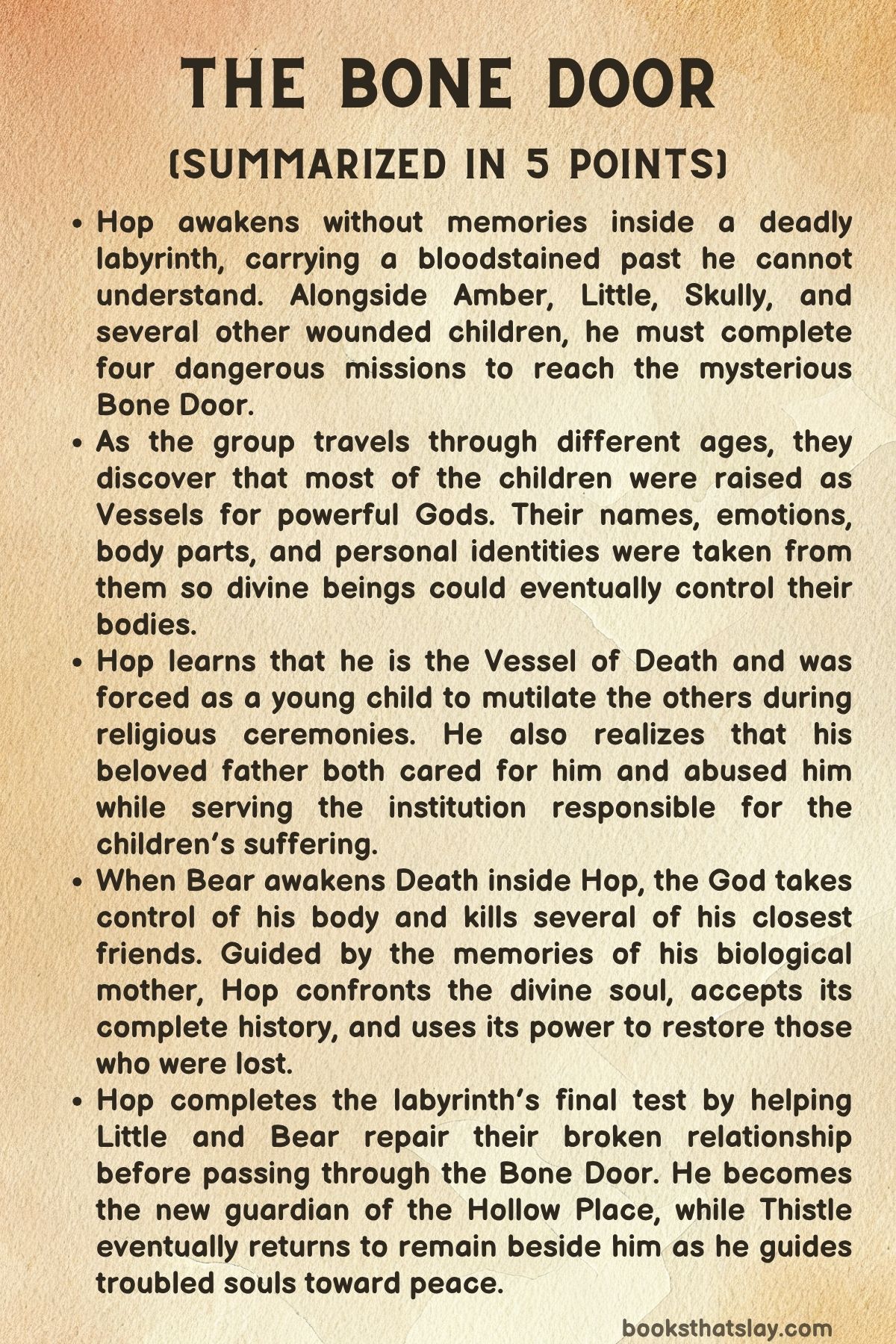
Hop awakens at eleven years old in a snow-filled chamber surrounded by corpses, shattered objects, and blood staining his white robes. He has no name or memories, and whenever frightening images surface, he injures his fingers and repeats the lesson that fear is bad and goodness must always be found.
He discovers a suffering skull, names it Skully, and meets a fourteen-year-old girl whose eyes have been replaced with amber-like shells. They name each other Hop and Amber, then escape a supernatural flood of spiders only after Hop rescues a burned, feral, tongueless child whom he later calls Little.
The children reach a refuge cared for by Dolores, a huge, sharp-tongued owl. She explains that they are trapped in a labyrinth made from memories and can reach the Bone Door only by completing four dangerous missions, although the rooms may restore truths someone deliberately removed.
The first mission commands them to claim a golden egg in an ancient world filled with sacrificial killings, giants, haunts, and strange creatures. A pale Shadow-man calls Hop “Buttercup” and seems to know him, while Amber loses a finger to a monster that tracks her blood.
Hop gathers more lost children during the journey. He names mutilated twins Storm and Sunny, then befriends Bear, a large boy whose ears were removed and whose threatening behaviour hides fear, gentleness, and a strong instinct to care for others.
While crossing a haunted marsh, Hop nearly drowns after following an apparition of his father. He remembers being locked in darkness whenever he cried, yet he still insists that Father loved him and that the punishments were meant to make him good.
The group reaches Caoránach, the wyrm who owns the golden egg. Hop refuses to trade one of his friends for it, steals the egg, and escapes with the others, though Sunny briefly behaves as if another personality has taken control of him.
As they return, divine beings called the God-folk destroy the ancient creatures under the claim of saving the world. Hop realizes that beautiful saviours can be destroyers and that beings labelled monsters may also be victims of history.
The second mission sends them into the God Times with the command to bring the moon. They witness a baby being killed so that the God Darkness can awaken inside it, and they meet Thistle, a noseless boy who hates the Gods and believes they must be destroyed before they consume more children.
Evidence beneath Providence’s temple reveals that the children’s mutilations match the wounds of particular Gods. Amber, Storm, Sunny, Thistle, and Bear appear to be Vessels prepared to carry Providence, Earth, Flame, Darkness, and Remedy, while Hop’s connection remains hidden.
Hop saves Thistle from a haunt by cutting himself and covering the boy with his own blood. His action shows both the courage and danger of his compassion, because he repeatedly treats his own suffering as an acceptable price for keeping everyone else alive.
To complete the mission, Hop forces Thistle to touch the exit and use his connection to Darkness. The group survives, but Thistle condemns Hop for overriding his consent, teaching him that rescue can become another form of control when the person being saved is denied a choice.
Dolores confirms that the labyrinth’s rooms are connected memories and that her master is Death, once called Ichor. She also reveals that haunts are discarded mortal hosts of the Gods, while Hop hides his growing fear that Death is the being waiting inside him.
The third mission returns them to the monastery where the children were raised during the Calm Times. There, Vessels are denied names, touch, emotion, speech, and individuality so that divine souls can eventually occupy them without resistance.
Hop recognizes the Church’s feared executioner, Scythe, as the man he remembers as Father. He sees Scythe punish and kill in service of the institution, yet he keeps searching for proof that the man’s private tenderness excuses or explains the harm.
The monastery exposes further abuse, including Lorcan’s sexual exploitation of Thistle and the Church’s mutilation of Little. Hop then remembers being forced, at about three years old, to cut away the other children’s body parts with a golden blade, revealing that he is Death’s Vessel.
Thistle challenges Hop’s habit of turning every horror into something positive. Hop begins to understand that hope becomes harmful when it refuses to name abuse, demands forgiveness, or treats pain as meaningful before the victim is ready.
Scythe’s mind deteriorates, and he asks Hop to end his life before he loses himself completely. Hop gives him poisoned wine and learns that Scythe loved him, abused him, protected parts of his personality, and betrayed Death by refusing to raise him as a completely empty Vessel.
When the monastery burns, Hop returns for Thistle and helps him face the memory of Lorcan’s abuse without asking him to suppress it. Thistle discovers that Darkness can produce light, proving that a Vessel’s identity can reshape the power intended to erase him.
The final mission returns them to Children’s Day, when Death gathered a city and tore the souls from every firstborn child. The hour repeats until Hop understands that Little is a ghost and that her adult self became the revolutionary Red Flame after her daughter was murdered in the massacre.
Through Little’s memories, Hop learns that the Red Flame planned to cast the Vessels into the labyrinth and force the Gods to destroy one another. She also used her son Bear as a weapon meant to strangle Hop and awaken Death if the rebellion failed.
Hop remembers the monastery’s fall, when his biological mother tried to protect him and the Red Flame killed her before mutilating Hop so Death could never create another Vessel. Amber admits that she helped the rebels enter and erased the children’s memories afterward, believing forgetfulness would protect them.
Bear reveals that he remembered his mission all along and strangles Hop despite loving him. Death awakens, takes control of Hop’s body, and kills Bear, Sunny, Storm, Thistle, and Amber while Hop remains trapped inside his own mind and forced to witness every death.
A fragment of Skully allows Hop to discover that she is his biological mother. Chosen as Death’s consort, assaulted, and forced to bear him, she nevertheless escaped execution and secretly worked with Scythe to give Hop language, music, touch, curiosity, and love.
Her memories restore Hop’s belief that his kindness is real. He then enters Death’s many lives and discovers an earlier Ichor who created the Bone Door and the Hollow Place because he wanted to help suffering souls reach peace.
Hop refuses both to destroy the divine soul and to surrender to it. He accepts its full history, joins with it willingly, declares himself both Death and Life, separates several children from their Gods, and restores Amber, Thistle, Sunny, and Storm.
The final task is to save Little. Hop gives the Red Flame and Bear an imagined lifetime together in which they can apologize, experience ordinary love, and repair the relationship that grief and revolution turned into a weapon.
Mother and son pass through the Bone Door together, and Hop becomes the new master of the Hollow Place. He sends his living friends back to rebuild the mortal world but remains behind to guide trapped souls toward rest.
Seven years later, Hop has helped hundreds of souls and rebuilt Skully’s skull. Thistle returns to choose a life beside him, and Hop eventually releases his mother through the Bone Door, accepting that grief, tears, love, and hope can exist together.
Characters
Hop
Hop is the emotional and moral centre of The Bone Door, beginning as a frightened child who survives by insisting that every terrible experience must contain something good. His warmth draws damaged strangers together, but his kindness is complicated by denial, guilt, self-harm, and an instinct to rescue people without always respecting what they want.
His development depends on learning that hope cannot require silence about abuse. Thistle teaches him to name cruelty directly, Amber teaches him that love can survive conflict, and his mother’s memories show that compassion was deliberately preserved inside him despite the Church’s effort to create an empty Vessel.
Hop’s final union with Ichor does not erase Death’s violence or reject the divine soul entirely. Instead, he accepts contradiction and chooses to direct power toward understanding, restoration, and the dignity of the dead, proving that identity is shaped by repeated choices rather than inherited purpose.
Amber
Amber is fierce, suspicious, loyal, and emotionally guarded. Her missing eyes make her physically vulnerable, yet she often sees Hop’s situation more clearly than he does, especially when she identifies Father’s treatment as abuse and refuses to accept his excuses.
Her fear that everyone eventually leaves explains her jealousy of Bear and her intense attachment to Hop. She wants exclusivity because abandonment has taught her that affection is unstable, but she gradually accepts Hop’s belief that love can expand without replacing anyone.
Amber also carries serious guilt because she helped the rebels reach the monastery and later erased the children’s memories. As Providence’s Vessel, she is more completely joined with her God than the others, making her future especially complex because freedom for her cannot mean simple separation from divine identity.
Thistle
Thistle is defensive, angry, perceptive, and deeply wounded. His hostility is not simple unpleasantness but a survival strategy developed through confinement, sexual abuse, religious control, and terror that Darkness will erase him.
He serves as the strongest challenge to Hop’s early understanding of kindness. Thistle insists that unwanted rescue can become domination and that optimism can invalidate suffering when it forces victims to forgive, improve, or discover meaning before they are ready.
His ability to create light from Darkness reflects his central transformation. He does not become gentle by forgetting what happened; he becomes freer by facing it, refusing the identity imposed on him, and eventually choosing to return to Hop because love has become a decision rather than another prison.
Bear
Bear first appears intimidating because of his size, strength, silence, and damaged ears, but he is gentle, nurturing, and instinctively drawn to cooking. Hop’s decision to call him a brother gives Bear a role based on affection rather than usefulness.
His hidden identity as the Red Flame’s son changes the meaning of his behaviour. He remembers that he was sent into the Hollow Place to awaken Death by strangling Hop, and his final betrayal comes from believing his mother’s cause matters more than his own needs or relationships.
Bear remains tragic because he apologizes while committing the act and immediately understands the personal cost. Hop later saves him by giving him the ordinary childhood and maternal love he was denied, allowing Bear to be recognized as a child rather than a failed weapon.
Storm
Storm is energetic, aggressive, practical, and fiercely protective of Sunny. Her early willingness to eat strangers reflects the brutal conditions of the ancient room rather than natural cruelty, and Hop’s trust gives her the first opportunity to imagine a life beyond survival.
Her bravado hides fear about the twins’ shared past and Sunny’s unexplained changes. She worries that their mutilations and dormant powers mean they are becoming dangerous, yet she also shows emotional depth when she cries privately and admits that she cannot protect her brother from everything.
As Earth’s Vessel, Storm’s grief creates immense destructive power after Sunny’s death. Her story shows how strength can be both a shield and a burden, particularly for a child who has learned to equate responsibility with constant readiness for violence.
Sunny
Sunny is quieter and more withdrawn than Storm, but his reserve should not be mistaken for passivity. His moments of possession, his creation of air beneath the water, and his later connection to Flame reveal a powerful inner life that he cannot initially understand or control.
He depends heavily on Storm, yet the twins’ opposite injuries and contrasting personalities suggest that they were shaped as a pair by the institution that mutilated them. Sunny’s unexplained attack on Hop reflects the unstable boundary between a child’s consciousness and the divine being waiting inside him.
After Hop separates him from Flame, Sunny receives the possibility of an independent life. His survival represents the novel’s rejection of the belief that a child’s body, purpose, or future can be owned by religious authority.
Little and the Red Flame
Little appears as a feral, burned, tongueless child who steals, bites, and longs for her father. Her behaviour expresses a life formed by hunger, abandonment, institutional cruelty, and the need to survive without speech.
The revelation that she is the ghost of the adult Red Flame transforms her from a dependent child into one of the novel’s most morally complicated figures. Her daughter’s murder on Children’s Day turns grief into revolutionary purpose, but her rebellion repeats the same logic she opposes by treating other children, including Bear and Hop, as tools.
She is neither reduced to victimhood nor condemned as a simple villain. Hop saves her by giving her space to face what she did, repair her bond with Bear, and experience the childhood and motherhood that violence denied her.
Skully and Hop’s Mother
Skully initially provides humour, comfort, and companionship through her sharp voice and constant pain. Her inability to move without suffering makes Hop’s habit of holding her both a practical kindness and an early symbol of the tenderness that defines him.
Her identity as Hop’s biological mother gives the story one of its most important emotional revelations. She was selected as Death’s consort, assaulted, forced into pregnancy, and marked for execution, yet she escaped and chose to protect the child created through that violence.
Her secret meetings with Hop preserved his language, curiosity, music, touch, and capacity for love. By remaining attached to her burned bones after death, she keeps her promise that he will not be alone, and her eventual passage through the Bone Door shows that love can remain powerful without requiring endless suffering.
Scythe
Scythe is one of the most morally complicated figures in the book. As Death’s former executioner and the Church’s feared enforcer, he mutilates, punishes, imprisons, and kills in service of a system that treats children as empty containers.
At the same time, he privately loves Hop and betrays Death by allowing him flowers, curiosity, affection, and traces of individuality. His care does not cancel his abuse, and his abuse does not make every expression of love false.
His mental deterioration exposes the unstable mixture of indoctrination, illness, guilt, tenderness, and cruelty within him. Hop’s decision to help him die is not forgiveness or revenge but an acceptance that Scythe contained incompatible truths that must be acknowledged together.
Death and Ichor
Death is the central threat within The Bone Door, but the divine soul is not presented as permanently or naturally evil. The murderous incarnation fears rebellion, worships control, uses bodies as vessels, and commits mass killing because he treats power as protection from vulnerability.
Earlier memories reveal another Ichor who heard the dead, wanted to ease their suffering, and sacrificed himself to create the Bone Door. The same soul therefore contains mercy and tyranny, showing how repeated lives, fear, institutional worship, and unexamined violence can corrupt an original purpose.
Hop defeats Death by refusing the choice between total rejection and total surrender. His willing union with the complete soul creates a new identity capable of holding life and death together without allowing cruelty to define either.
Dolores
Dolores is sharp-tongued, knowledgeable, impatient, and far more caring than she initially admits. As caretaker of the Hollow Place, she protects the rules of the labyrinth and tests every successor who may inherit Ichor’s power.
Her refusal to make the missions easy is not simple coldness. She understands that immense authority requires moral judgement, empathy, restraint, and the ability to face painful memories without allowing them to control every decision.
Dolores also becomes a stable adult presence for Hop after the truth about Father, Death, and the Church is exposed. Her final acceptance of him as master recognizes not his purity but his capacity to learn from harm and use power responsibly.
Providence
Providence is distant, cryptic, and difficult to classify as either ally or threat. Her knowledge of time, memory, and possible futures allows her to recognize the children and their divine connections long before they understand themselves.
Her complete integration with Amber suggests a relationship between Vessel and God that differs from simple possession. Providence’s history with Death also reveals that divine beings once shared affection and cooperation before fear and violence destroyed their bonds.
She represents memory as both guidance and burden. Through her, the novel suggests that knowledge alone does not guarantee moral action, because understanding the future still requires courage, consent, and responsibility in the present.
Lorcan
Lorcan embodies institutional hypocrisy and the abuse of authority. He presents himself as a guardian of divine order while secretly violating the rules he imposes on others and using his position to exploit vulnerable children.
His abuse of Thistle is especially damaging because it is disguised through religious language, secrecy, and claims of affection. The system around him protects power rather than victims, allowing suffering to be treated as disobedience and resistance to be labelled corruption.
Lorcan matters less as an individual villain than as proof that sacred institutions can become shelters for private cruelty. His conduct shows how rules about purity and obedience often protect abusers when children are denied names, voices, and ownership of their bodies.
Fi
Fi is kind to Hop and helps protect him during the monastery’s fall, but she is also part of the institution that harms the Vessels. Her presence demonstrates that personal compassion can exist inside a corrupt system without automatically making participation innocent.
She sought refuge after rejection by her brother and found partial acceptance within the Church. That history explains her loyalty but does not erase her complicity, making her another example of a person who is both harmed by an institution and involved in maintaining it.
Cathal
Cathal initially appears cruel because he burns Hop and participates in the monastery’s punishments. His behaviour is shaped by Lorcan’s secret parentage, shame, manipulation, and the pressure of surviving within a system built on fear.
During the rebellion, however, he helps disguise and defend Hop. His final actions reveal that a person may participate in harm and still make a meaningful choice against it, even when that choice comes late and cannot repair everything already done.
Ríona
Ríona is shaped by grief, political violence, and changing loyalties. She offers information about the Gods and later helps the children reach the hidden statues, but Shay’s death turns her sympathy into anger and blame.
Her response shows how personal loss can harden into ideology. She is neither consistently supportive nor purely hostile, and her instability reflects the wider society’s struggle to understand whether the Gods are protectors, oppressors, or both.
Shay
Shay is a healer whose knowledge helps the children understand the six God-folk and the cycles of divine incarnation. His death gives the political conflict a personal cost and demonstrates how ordinary people are destroyed by struggles conducted in the name of Gods, rebellion, and historical destiny.
Although his role is brief, his relationship with Ríona influences later events. Through him, the story shows that even characters without divine power can shape the moral direction of those who survive them.
Caoránach
Caoránach is an ancient wyrm who guards the golden eggs required for the first mission. Her demand for a companion in exchange for the egg places the group before the logic of sacrifice that dominates the wider novel.
Hop’s refusal to surrender anyone establishes an important principle, even though his theft creates danger for everyone. Caoránach therefore functions as both a physical threat and an early test of whether freedom can be purchased through another person’s life.
The Cailleach
The Cailleach provides one of the earliest warnings that the children’s moral categories are too simple. She explains that the ancient monsters belong to a natural order and that the returning God-folk will destroy far more than the creatures people fear.
Hop hides her warning because it threatens his belief that defeating monsters must be good. Her role prepares him to understand that history changes depending on who survives, who is worshipped, and whose suffering is treated as necessary.
The Spider-Child
The spider-child is born from the golden egg and appears monstrous, predatory, and dangerous. Dolores expects its nature to determine its actions, while Hop insists that origin and instinct do not eliminate the possibility of choice.
Its decision to release Bear proves Hop’s belief without pretending that transformation is easy or guaranteed. The creature becomes a living argument against judging morality through appearance, species, inherited violence, or the expectations of others.
Themes
Hope, Denial, and Honest Healing
Hope in The Bone Door begins as both a survival skill and a form of emotional imprisonment. Hop’s father teaches him that fear and sadness are choices, so the child learns to smile, search for goodness, and injure himself whenever painful memories threaten to surface.
This habit allows him to comfort Amber, unite strangers, and survive situations that might otherwise overwhelm him. It also prevents him from recognizing abuse, accepting anger, or listening fully when another person needs suffering to be named without being improved.
Thistle forces Hop to understand that positivity can become cruel when it demands gratitude, meaning, forgiveness, or emotional progress from someone who has been harmed. A person who says that every pain contains something good may unintentionally protect the abuser by shifting attention away from what was done.
The story therefore does not reject hope. It reshapes hope into the willingness to remain present with grief, believe another person’s account, and support recovery without controlling its form or pace.
Hop’s later actions show this change clearly. He helps Thistle by acknowledging abuse, allows himself to cry when his friends leave, and guides ghosts toward rest by witnessing their complete lives rather than forcing them into comforting stories.
Identity, Choice, and Inherited Purpose
Nearly every child is assigned an identity before being allowed to form one. The Church removes names, emotions, body parts, relationships, and personal desires so that the Vessels can become empty spaces for divine beings.
The Gods also inherit roles across lifetimes, but their repeated existence does not create a stable moral nature. Ichor can be a compassionate guide of the dead in one age and a murderous tyrant in another, while Darkness can produce light and Flame can create water.
These contradictions show that identity is not a fixed essence hidden beneath experience. It is created through the relationship between memory, power, trauma, affection, and repeated decisions.
Hop’s greatest fear is that being Death’s Vessel means every act of kindness is false. His mother’s history proves the opposite, because love, language, curiosity, and touch gave him the ability to choose differently even while carrying the same divine soul.
The children’s freedom arrives when they stop being treated as containers for inherited purpose. Hop separates several of them from their Gods, yet his own resolution comes through integration, showing that liberation can mean removal for one person and conscious acceptance for another.
Consent, Rescue, and the Ethics of Care
Hop wants to save everyone, but the novel repeatedly questions whether rescue is automatically moral. His refusal to abandon others is admirable, yet he often assumes that his judgement of what is best gives him permission to ignore their wishes.
The clearest example occurs when he forces Thistle to touch the mission door. Hop preserves the group’s lives, but he also violates Thistle’s consent after the boy has explicitly explained that unwanted rescue can repeat the experience of being controlled.
This conflict gives care a more demanding definition. Genuine care requires listening, recognizing another person’s agency, and accepting that love does not create ownership over someone else’s body or choices.
The theme also appears in the Church’s treatment of Vessels, the Red Flame’s use of Bear, Death’s occupation of mortal bodies, and Scythe’s belief that emotional repression protects Hop. Each character justifies control through a supposedly greater purpose, whether survival, revolution, religion, or love.
Hop matures when he stops measuring goodness only by intention. He begins to judge actions by their effects, apologize without demanding immediate forgiveness, and offer support that allows others to choose their own futures.
Trauma, Memory, and Moral Responsibility
The labyrinth is built from memory because the past cannot be escaped simply by forgetting it. The children’s amnesia protects them temporarily, but it also leaves them vulnerable to repeating patterns they cannot name or understand.
Recovered memories are not perfectly objective records. Dolores explains that history changes through perspective, trauma, interpretation, and the needs of those who preserve it, which is why the same God may appear as saviour, monster, victim, or tyrant.
The novel distinguishes responsibility from simple blame. Hop harmed the other children with the golden blade, but he was a very young child coerced by adults; the Red Flame suffered terrible losses, but her suffering does not excuse using Bear and mutilating Hop.
Scythe loved Hop and also abused him, while Amber erased memories to protect the children and also deprived them of truth and choice. These contradictions prevent trauma from becoming either a complete excuse or a permanent moral stain.
Healing requires full recognition of what happened, who held power, what choices were available, and what harm followed. By recording every soul he guides through the Bone Door, Hop ensures that people are remembered as complete lives rather than reduced to their worst action, deepest wound, or assigned role.