The Cinnamon Spice Inn Summary, Characters and Themes
The Cinnamon Spice Inn by Harper Graham is a warm, contemporary romance set in the charming Midwestern town of Maple Falls. It follows Madison Kelly, a fast-paced New York food writer who returns to her struggling family inn after receiving an anonymous letter.
What begins as a short visit turns into a journey of rediscovery, love, and belonging. Madison confronts the decay of her childhood home, rekindles her relationship with her first love, Zach, and learns that sometimes, the recipe for happiness is found not in ambition or escape but in rebuilding the roots you once left behind.
Summary
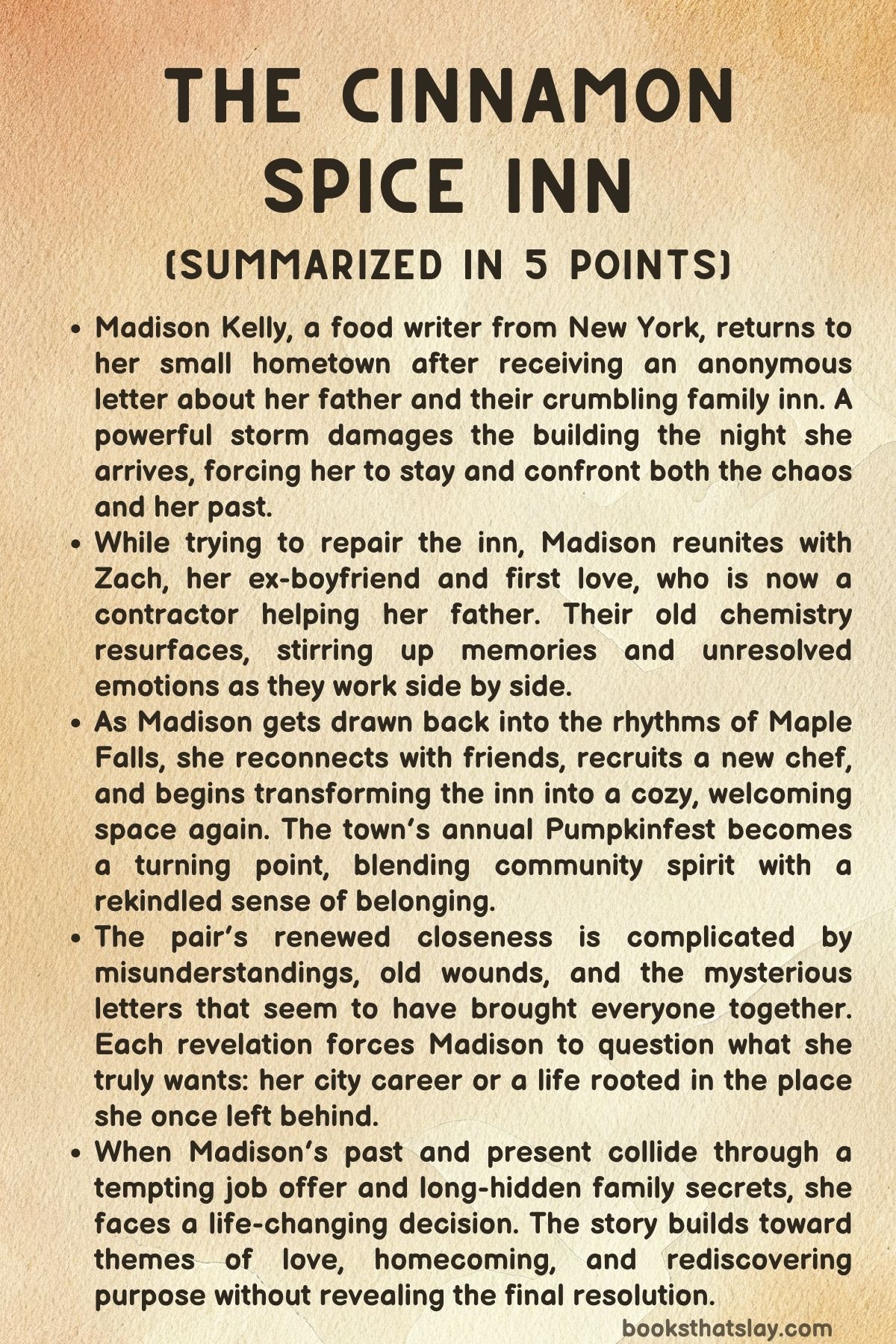
Madison Kelly, a successful food writer in New York City, receives a mysterious, sandalwood-scented letter urging her to return home to help her father at the Cinnamon Spice Inn, her family’s once-beloved bed-and-breakfast in Maple Falls. Reluctant but curious, she plans a brief visit, hoping to stabilize the business and return to her city life quickly.
However, the night she arrives, a fierce autumn storm tears through the town, and a massive maple tree crashes through the inn’s dining room roof. Her father, George, remains unbothered, insisting he “has a guy” to fix it.
When that “guy” turns out to be Zach, Madison’s ex-boyfriend and first love, the reunion is as charged as it is awkward.
The initial days are chaotic. Madison struggles with the inn’s disrepair and her father’s casual optimism, while Zach, now a contractor, focuses on restoring the roof and trying to avoid reopening old wounds.
Both are drawn back into memories of their shared past—love, loss, and a painful misunderstanding that drove them apart years earlier. As they navigate the storm’s aftermath, the old chemistry between them resurfaces.
Madison’s practical city mindset clashes with Zach’s grounded, small-town loyalty, yet both realize they are still deeply connected.
As the cleanup continues, Madison learns more about the inn’s decline. The chef has retired, guest bookings have dried up, and George has been serving gas-station pastries for breakfast.
Determined to help, Madison takes charge of renovations and operations. During a walk through the picturesque town, she reconnects with old friends, including Emily, who now owns the local bakery, and Kit Riker, a talented chef Madison hires to revive the inn’s dining service.
Together, they plan an ambitious relaunch tied to Maple Falls’ annual Pumpkinfest celebration.
Meanwhile, Zach, pressured by his mother Anita, agrees to stay in the inn’s lakeside honeymoon cabin while working on repairs. The proximity forces Madison and Zach to confront their shared history.
Both recall the night that ended their relationship—Madison had seen him laughing with another woman and, feeling betrayed, left for New York. Zach, too hurt and proud to explain, let her go.
The emotional distance created by that silence lingers between them even now.
Their tension turns to attraction one evening when a heated argument leads to an impulsive kiss in the inn’s pantry. But Zach quickly retreats, believing Madison has someone new in her life after glimpsing suggestive texts from a contact named “Jo.” Hurt and confused, Madison throws herself into preparations for the Pumpkinfest reopening, trying to ignore the ache of unfinished feelings.
When they later discover that multiple people—including Zach’s mother and George—received similar anonymous letters urging them to help the inn, curiosity grows about who orchestrated Madison’s return. Madison denies sending any letters, but the mystery deepens.
In quieter moments, she begins to see the town and the inn with new eyes, recognizing what she’s missed during her years away.
Zach, still tormented by what he saw on Madison’s phone, eventually learns the truth: “Jo” is Jolene, Madison’s best friend, and the messages were a joke. The misunderstanding clears the air, and Zach finally lowers his guard.
In the refurbished honeymoon cabin—now symbolic of renewal—they reconcile and reignite their love. As autumn deepens, the inn becomes alive again with local events, Kit’s inventive menu, and Madison’s creative touch.
During Pumpkinfest, Madison and Zach’s rekindled romance becomes public after a playful pumpkin-slingshot competition ends in a spontaneous kiss that delights the crowd.
The festival marks a turning point for the inn and for them both. Later that day, Zach is auctioned off for a charity handyman event, and Madison boldly bids to win him, cementing their partnership in front of the whole town.
The day ends with laughter, teamwork, and shared dreams as they prepare for the inn’s relaunch.
However, the following morning brings a complication. Madison receives a life-changing offer from Plated, a leading food magazine: a full-time editorial position and a cookbook contract inspired by Maple Falls, with an advance large enough to rescue the inn financially.
Excited but torn, Madison hesitates to tell Zach, and when he overhears fragments of her conversation, he assumes she’s leaving for New York again. The misunderstanding reignites their old fears—his that she will always choose ambition, hers that she cannot balance love and success.
As she searches for clarity, Madison visits the mayor, who reveals that years earlier, he secretly purchased the inn from her parents to cover debts and her college tuition, allowing the family to stay afloat. Shocked, Madison resolves to buy the inn back using the advance from Plated.
Though her motives are pure, the decision distances her from Zach, who believes she’s walking away once again. When she visits his farmhouse—a place he’s been quietly renovating with her in mind—Zach confesses that he loves her but cannot keep chasing someone who always leaves.
Devastated, Madison drives away, uncertain of her future.
On Halloween night, the Cinnamon Spice Inn reopens to a full house and glowing praise. The event is a triumph, though Madison feels the weight of Zach’s absence.
Her grandmother, Gram, slyly ensures that Zach is called to the inn under the pretext of fixing a railing. When he arrives, Madison seizes the chance to set things right.
She explains the truth about the mayor’s secret ownership and her plan to buy back the inn. Most importantly, she reveals that she negotiated with Plated to work remotely, choosing to live in Maple Falls while writing and managing the inn.
She confesses her love and assures Zach she’s done running. Finally believing her, Zach forgives her, and they reunite, sealing their promise for a shared life.
Later that night, after the guests leave and peace returns, Madison discovers a final letter in her late mother’s handwriting. It reveals that her mother had written the anonymous notes that brought everyone together, asking them to help Madison find her way home.
Gram admits she delivered the letters at the right time, fulfilling her daughter’s wish. Madison, overwhelmed, feels her mother’s presence guiding her, confirming that the inn—and Maple Falls—are truly where she belongs.
In the epilogue, the town has settled into early winter. The Cinnamon Spice Inn is thriving once again, and Madison and Zach live between the inn and the farmhouse, building a shared future.
Together, they plant a new maple tree to replace the one lost in the storm—a living symbol of renewal, love, and the deep roots they’ve rediscovered. With steaming mugs of coffee and laughter in the crisp morning air, they affirm that they’ve found their way back to each other and that home isn’t a place you run from—it’s the one you finally choose to stay in.
Characters
Madison Kelly
Madison Kelly, the protagonist of The Cinnamon Spice Inn, is a woman of dualities—ambitious yet sentimental, restless yet yearning for belonging. As a successful New York food writer, Madison initially represents modern independence and self-sufficiency, someone who escaped her small-town roots to build a life defined by career and control.
Yet, the anonymous letter summoning her home to Maple Falls triggers an emotional and spiritual reckoning. Through her journey, she transitions from seeing the inn as a crumbling burden to recognizing it as a living symbol of her family’s love, memory, and identity.
Madison’s internal conflict between ambition and attachment forms the core of her character arc. Her relationship with Zach reawakens long-buried vulnerabilities and desires, forcing her to confront how fear of pain—and success—has dictated her choices.
Madison’s rediscovery of home and purpose, culminating in her choice to balance her career with her heart, reflects her evolution into a woman grounded in love, courage, and authenticity.
Zach Reynolds
Zach Reynolds, Madison’s first love and eventual partner, embodies steadiness and emotional resilience. A local contractor and lifelong resident of Maple Falls, he contrasts Madison’s cosmopolitan energy with earthy reliability.
Yet beneath his calm exterior lies a man shaped by heartbreak and quiet yearning. Zach’s restraint—his tendency to avoid confrontation and let things go unresolved—initially marks him as passive, even self-protective.
However, as the narrative progresses, he learns to articulate vulnerability, confronting both his own mistakes and Madison’s. His renovation of the inn and the honeymoon cabin mirrors his emotional reconstruction—he rebuilds not only structures but trust and connection.
Zach’s love is patient but deeply rooted; when he risks his heart again, it signals profound growth. In the end, Zach’s character stands for home itself—imperfect, weathered, but enduring—a mirror to the town’s and Madison’s renewal.
George Kelly
George Kelly, Madison’s father, provides warmth, humor, and steadfast optimism in contrast to his daughter’s guarded pragmatism. His cheerful obliviousness—serving burnt breakfasts and dismissing the inn’s dire state with a grin—initially frustrates Madison but ultimately reveals his philosophy of faith and endurance.
George represents an older generation’s view of home and tradition: one that prioritizes emotional over material value. His decision to secretly sell the inn years earlier out of love for his family underscores his selflessness, even when misguided.
George’s relationship with Madison deepens as she learns to appreciate his quiet sacrifices and emotional wisdom. His scenes often carry a bittersweet tenderness, especially when connected to the memory of Madison’s late mother, showing that his hope is not naïveté but a refusal to let grief define him.
Edith “Gram” Kelly
Gram is the story’s moral compass and emotional architect. Witty, insightful, and quietly strategic, she acts as the unseen hand guiding reconciliation and renewal.
Her decision to deliver the anonymous letters—echoes of Madison’s late mother’s wishes—places her at the center of the novel’s emotional mystery. Gram’s understanding of timing, love, and legacy bridges the past and the present, ensuring that the family’s story continues to evolve rather than stagnate.
Her humor disarms tension, but beneath it lies deep wisdom about loss and healing. Gram represents generational continuity—the keeper of the inn’s spirit and the embodiment of love’s persistence.
Through her, The Cinnamon Spice Inn gains its spiritual dimension: that home is not a place but the people who keep its heart alive.
Anita Reynolds
Anita Reynolds, Zach’s mother, plays a subtle yet pivotal role as a figure of community and compassion. Practical and intuitive, she orchestrates the first steps that bring Madison and Zach back into each other’s orbit, responding to the mysterious letter with both heart and strategy.
Her café serves as a gathering place, a microcosm of Maple Falls’ warmth and interdependence. Anita’s wisdom complements Gram’s; she bridges the two families and highlights the theme that love often needs gentle intervention.
Her understated support reinforces the story’s belief in small-town strength and the value of human connection.
Kit Riker
Kit Riker, the chef Madison hires, injects freshness, creativity, and a sense of partnership into the inn’s revival. Vibrant and confident, Kit symbolizes new beginnings and female solidarity.
Her culinary vision—seasonal, local, and full of warmth—mirrors the novel’s emotional flavor. Kit’s dynamic energy helps Madison rediscover the joy of collaboration and trust.
She also provides comic relief and balance during Madison’s emotional turmoil, serving as both friend and grounding influence. Kit’s presence underscores the story’s message that healing often requires community effort and that passion, when shared, becomes transformative.
Jo (Jolene)
Jo, Madison’s best friend in New York, exists mostly through messages and calls but plays a crucial emotional role. Her teasing, candid exchanges with Madison reveal their deep friendship and highlight the world Madison built away from home.
The misunderstanding surrounding Jo’s messages catalyzes Zach’s insecurities and brings the lovers’ unresolved trust issues to the surface. Jo represents the life Madison might have led permanently in the city—a reminder of ambition, freedom, and self-definition.
Yet her friendship ultimately supports Madison’s return to authenticity, as she encourages her to follow both her love and her purpose.
Mayor Bloomfield
Mayor Bloomfield embodies the town’s moral complexity—both benevolent and pragmatic. His secret purchase of the inn years earlier reveals a protective impulse but also underscores how paternalism can obscure truth.
By keeping the sale secret, he preserves the inn but unintentionally burdens Madison with guilt and confusion. His actions serve as a catalyst for Madison’s final transformation, forcing her to confront her inheritance—literal and emotional.
The mayor’s relationship with Gram adds warmth and gentle humor to the closing chapters, signaling forgiveness, renewal, and the enduring value of trust within a close-knit community.
Cocoa
Cocoa, the rescue puppy, operates as a living metaphor for unconditional love and the instinct to protect. Introduced during the storm, Cocoa binds the family and softens Madison’s guardedness.
The dog’s playful loyalty connects Madison, George, and Zach, symbolizing innocence, new beginnings, and the nurturing aspects of home. In a story about rebuilding, Cocoa represents the small, everyday joys that ground emotional recovery—a reminder that even amidst chaos, love finds its way through simple, wordless gestures.
Themes
Homecoming and Reconnection
Returning to Maple Falls transforms Madison’s understanding of home in The Cinnamon Spice Inn, turning what she once saw as a place of failure into one of rediscovery and belonging. Her initial goal is practical—stabilize the inn, fulfill her duty, and leave—but the setting itself quietly resists her detachment.
Each broken roof beam, burnt breakfast, and storm-drenched hallway forces her to confront how much of her identity is intertwined with the place she fled. Home here is not only physical; it’s emotional reclamation.
Through George’s optimism, Gram’s wry affection, and the community’s stubborn warmth, Madison faces the gap between who she became in New York and who she once was in Maple Falls. The return is painful—haunted by her mother’s death and the fallout with Zach—but it also becomes restorative, a process of stitching together past and present selves.
The inn’s decay mirrors Madison’s emotional neglect of her roots; its revival parallels her healing. The anonymous letters, later revealed to be from her mother, frame homecoming as an act of courage rather than regression, suggesting that true growth sometimes requires circling back.
By the novel’s end, Madison’s decision to stay signifies that home is not simply inherited—it’s chosen, maintained, and renewed through love and labor.
Love, Loss, and Second Chances
The relationship between Madison and Zach embodies the fragility and resilience of love shaped by misunderstanding and time. Their story is not one of instant forgiveness but of gradual rebuilding.
Past wounds—the misread flirtation, Zach’s silence, Madison’s pride—linger like physical debris in the inn, blocking progress until confronted. Through forced proximity and shared responsibility, the emotional barriers between them begin to soften, revealing that hurt often conceals enduring care.
What gives their romance depth is its realism: attraction coexists with resentment, forgiveness requires vulnerability, and love demands accountability. The rekindling of their relationship unfolds through everyday moments—renovation work, shared meals, town gatherings—where tenderness returns not through confession but familiarity.
Their love matures from the impulsive heat of youth into something grounded in partnership. The final reconciliation, symbolized by the new maple tree they plant, frames love as cyclical renewal.
The novel ultimately argues that second chances are not about erasing mistakes but transforming them into foundations for deeper understanding. Madison’s decision to stay in Maple Falls is as much a choice for Zach as for herself—a recognition that love is both a comfort and a commitment to rebuild what was once lost.
Identity, Ambition, and Fulfillment
At its core, the novel explores the tension between professional ambition and personal contentment. Madison’s identity as a successful New York food writer is tested by the intimate, unglamorous demands of the Cinnamon Spice Inn.
Her struggle reflects a broader modern dilemma: whether success measured by recognition and salary can outweigh fulfillment rooted in relationships and community. Initially, she defines herself through career milestones, distancing from the perceived smallness of her hometown.
Yet, the return exposes how ambition detached from emotional grounding can become hollow. The Plated magazine offer—lucrative, prestigious, and seemingly life-changing—forces her to confront what fulfillment truly means.
By choosing to negotiate remote work and stay in Maple Falls, Madison redefines success not as escape but as integration. The novel frames ambition not as something to suppress but to redirect: creativity and purpose thrive when aligned with love and belonging.
Her evolution from restlessness to rootedness reflects a journey toward wholeness, where identity is no longer split between city and home, writer and daughter, lover and professional.
Family, Legacy, and Generational Connection
Family in The Cinnamon Spice Inn operates as both comfort and complication. Madison’s relationship with her father, George, exposes the quiet sacrifices and miscommunications that often underlie love between generations.
His cheerful incompetence masks years of quiet grief and endurance after her mother’s death, while Madison’s frustration reveals her guilt for abandoning him. The inn itself functions as a living heirloom—its rooms holding echoes of her mother’s cooking, her childhood laughter, and the town’s collective history.
The eventual revelation that the anonymous letters originated from her mother’s words deepens this theme, transforming the entire plot into a posthumous act of guidance. Through this device, the novel examines how family legacy is not confined to property or tradition but to emotional inheritance.
The act of restoring the inn becomes an act of continuing her mother’s love, translating memory into motion. The inclusion of Gram and the small-town community further widens the definition of family to include chosen bonds and generational continuity.
By the end, Madison realizes that maintaining legacy requires active stewardship, not nostalgia. Planting the new maple tree encapsulates that insight—a gesture of continuity, growth, and renewal that binds past, present, and future into one enduring home.