The City of Brass Summary, Characters and Themes
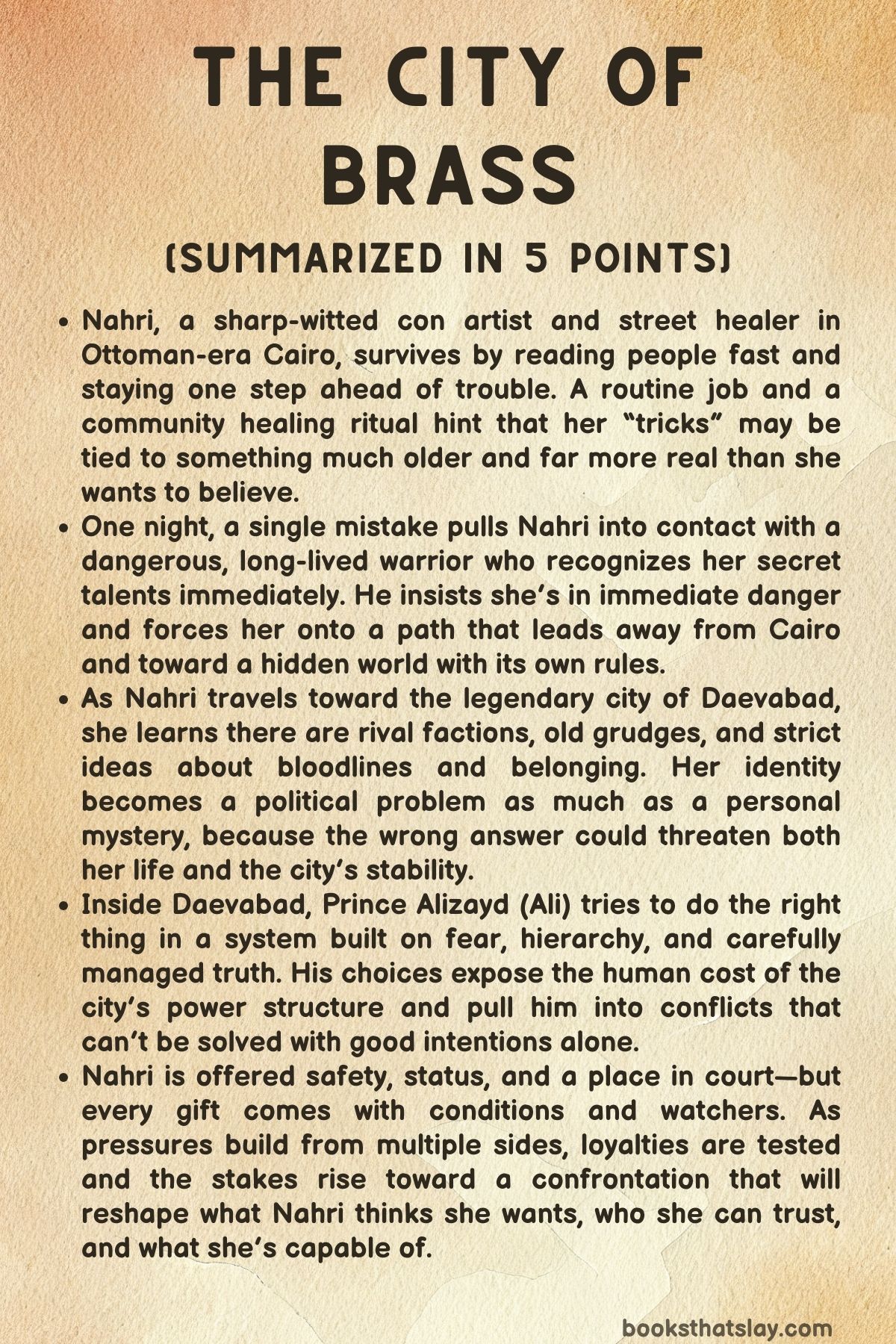
The City of Brass by S. A. Chakraborty is a historical fantasy that begins in 18th-century Cairo and quickly opens into a hidden world of djinn politics, old grudges, and dangerous magic. The story follows Nahri, a street-smart con artist who survives by posing as a healer—until a ritual goes wrong and exposes that her talents may be real.
Pulled from the human world and brought toward Daevabad, a legendary city veiled from ordinary sight, Nahri is forced to navigate court intrigue, prejudice, and a legacy tied to a slaughtered line of healers. Power, identity, and survival collide as alliances form and fracture. It’s the first book of The Daevabad Trilogy.
Summary
Nahri makes her living in Cairo as a clever scammer and street healer. Before dawn she sets up in an alley stall and uses confidence tricks, folk remedies, and sharp observation to win money from anxious clients.
One morning two Turkish men arrive: an older, wealthy official and his younger brother, Arslan. The official is convinced he is sick despite doctors insisting otherwise.
Nahri pretends she can’t understand Turkish, listens to their argument, and performs a staged divination with tea leaves. She breaks the cup on purpose and announces the omen is dire.
Then she pretends to refuse payment, which only makes the official panic and offer more. Nahri claims the man suffers from the evil eye and prescribes an elaborate cure that conveniently requires him to leave Cairo for days, buy costly supplies from Yaqub the apothecary, and follow strict instructions.
The official pays generously and even gives her a gold ring.
Arslan stays behind and corners Nahri. He warns that witchcraft is a serious crime, especially under Ottoman rule, and he threatens her with future punishment once Cairo’s politics shift.
Nahri keeps her face calm, but she notices something in Arslan’s breath and voice that suggests illness, and she privately judges he won’t live long.
After the men leave, Nahri counts her winnings and regrets drawing Arslan’s attention because she had planned to rob the official’s villa while it was empty. She goes to Yaqub’s apothecary to ensure the ingredients she demanded are being sold.
Yaqub, an older Jewish pharmacist, complains about the Turkish customers and the ridiculous shopping list Nahri invented. Still, he watches out for her.
He warns that Cairo is unstable under occupation and that people without protection can vanish in wartime. Nahri brushes off his concern, insisting she can take care of herself.
Yaqub also scolds her for leading zars—possession ceremonies—because he fears djinn and darker beings. Nahri insists magic isn’t real.
To her, the zar is just theater, music, and psychology used to calm suffering people and get paid.
That night Nahri travels to a poorer neighborhood to conduct a zar for a twelve-year-old girl named Baseema, who has been acting disturbed and unreachable. The courtyard fills with women, gossip, offerings of coins and small jewelry, and musicians ready to play.
Nahri sets the ritual in motion with incense, drumming, chanting, and her practiced soothing touch. Baseema gradually relaxes into the dance, and the crowd believes the spirit is being appeased.
Then something slips out of Nahri that surprises even her. She begins singing the zar lyrics in a language she has always known instinctively but never named.
As she sings, Baseema freezes and stares directly at her. A voice seems to speak inside Nahri’s mind: “WHO ARE YOU?” The moment breaks, and Baseema resumes dancing as if nothing happened, but Nahri is shaken.
She finishes the ceremony, offers the expected sacrifice, gives the family instructions meant to reassure them, and collects her payment. Baseema’s final stare follows her like a warning.
Later, Nahri sits in a coffeehouse replaying the incident and trying to convince herself it was stress, heat, or imagination. A strange man approaches, and she reacts by slamming her dagger down.
The man vanishes, and the sudden commotion sends Nahri fleeing into streets darkened by curfew. She gets lost near the cemetery known as the City of the Dead.
Trying to orient herself, she follows the cemetery’s edge and senses she’s being followed. She hides behind a tomb.
Baseema appears again—but not as the frightened child from earlier. Now she moves with eerie confidence and speaks clearly for the first time.
She demands that Nahri speak that language again. Nahri notices blood on the girl and the smell of smoke, as if something has burned its way through her.
Baseema snatches Nahri’s dagger with impossible speed and claims connection to powerful fire spirits. She accuses Nahri of using “human magic” and asks who Nahri sang for.
Then Baseema panics, saying the being Nahri called is dead, and runs as storm clouds gather unnaturally overhead.
A blinding crack of light explodes through the cemetery. When Nahri can see again, a robed, armed figure stands in the alley, furious and speaking Nahri’s mysterious language fluently.
He demands to know who summoned him. Nahri tries to slip away, but her coin basket betrays her.
The figure hunts her, wounds her with an arrow, and interrogates her with cold intensity. He is shocked that she appears human yet understands his language.
When he touches her, her injuries begin to heal fast enough to unsettle him even more. He presses her about her origins and whether she can heal others, not just herself.
Before he can get answers, the cemetery turns deadly. Ghouls rise and swarm, drawn by magic and blood.
Baseema returns again, but now the presence inside her speaks with authority, claiming control over servants among the dead. The robed warrior recognizes the being as an ifrit and threatens to tear it from the girl’s body.
The ghouls attack in waves. Nahri is seized by skeletal hands and almost dragged away, and the warrior yanks her free.
They run through crumbling tombs, the ground shaking under the pressure of the summoning and the creatures closing in. The warrior fights with brutal efficiency, breaking locks with gestures, cutting down attackers, and unleashing a violent blast of sand that tears through a crowd of ghouls.
They take refuge in a tomb, but Nahri is grabbed again and mauled. Teeth and nails tear into her throat, and she begins to die.
The warrior kills the ghouls and carries her away. Nahri fades in and out of consciousness, feeling herself placed on something soft, then lifted into motion, weightless as if flying.
She wakes in daylight at a desert oasis far from Cairo. The warrior watches her beside a fire.
Up close, his features are unmistakably not human: strange ears, ageless eyes, and a beauty that feels unsettling rather than comforting. He tells her he carried her east and that returning to Cairo isn’t an option.
He says the being that used Baseema would have burned through the girl and that killing the host was mercy, though he’s not sure he killed the ifrit itself. He refuses to give his true name, allowing only the title “Afshin,” and identifies himself as Daeva, not djinn in the way humans use the word.
Nahri demands answers. She admits she has no family and no clear origin story.
She has always known the strange language and can understand other languages instinctively. The Daeva tests this and confirms it’s real.
He is baffled that she has lived as a small-time healer and thief despite abilities that, in his view, could reshape kingdoms. Nahri snaps back that survival as an orphan required secrecy and pragmatism, not ambition.
A winged, birdlike creature arrives: a peri named Khayzur. Khayzur greets the Daeva as “Dara,” exposing that “Afshin” is a role and not the man’s personal name.
Khayzur conjures tea with a snap, and when Nahri drinks it, warmth and nourishment flood her body. Dara explains what he saw in the cemetery: Nahri healed at an impossible speed, and that suggests she might carry Nahid blood, tied to a line of legendary healers believed wiped out.
Khayzur is stunned, because the Nahids’ destruction is treated as settled history. They conclude that Nahri’s safest place is Daevabad, a hidden city protected by a veil that ifrit cannot cross.
Dara resists because Daevabad’s politics are dangerous and its people are his enemies, but he agrees she’ll die if she stays unprotected.
Nahri travels with Dara on an enchanted carpet toward this hidden world. Along the way she tries to escape, but her attempts collapse under the realities Dara explains: ifrit can track her, the human world is not safe anymore, and her abilities make her a target.
At one stop she tries to steal Dara’s emerald ring, and the moment she touches it, she is hit by violent visions—memories of Dara’s past under magical compulsion, committing slaughter while bound to human masters. Dara wakes in panic, believing he is enslaved again, and nearly kills her.
Nahri realizes Dara was once a bound servant forced to grant wishes, and the ring is tied to that history.
They flee danger again, crossing a river despite Dara’s fear of water. Dara explains the deeper history: daevas were once powerful shapeshifters until Suleiman stripped them; those who submitted became mortal-bodied djinn, while those who refused became immortal ifrit bent on revenge.
The Nahids descend from a line connected to Suleiman’s trusted vizier and possess abilities that can undo magic. The ifrit hunted them down, killing the last known siblings about twenty years earlier.
If Nahri truly carries that blood, she may be the last.
Meanwhile, in Daevabad, Prince Alizayd al Qahtani moves through the city before dawn to meet a shafit preacher, Sheikh Anas Bhatt, whom Ali has secretly funded. Ali is uneasy because rumors accuse Anas’s organization, the Tanzeem, of violence and smuggling.
After prayer Ali demands proof the money is used for charity. Anas, offended, agrees only to show Ali the truth if Ali meets him that night in disguise.
Ali goes, altering his appearance to pass as a noble. Anas brings him to a covert operation: a slaver in the Daeva Quarter is trafficking shafit children.
Ali witnesses a bruised young girl forced to serve men, and a baby being sold as if it were pureblood. A Tanzeem agent confirms the baby is actually shafit, marked in a way most refuse to see.
Ali is horrified to learn the practice has been going on for centuries, with stolen children raised under false identities. When Ali tries to help, the situation collapses into a trap.
The tavern is sealed, the Royal Guard arrives, and violence erupts. Anas sacrifices himself to buy time while Ali and others flee with the children over rooftops, pursued by soldiers and arrows.
Ali is dragged into the palace’s brutal machinery. The king, Ghassan al Qahtani, makes a public spectacle of Anas’s death, using an ancient method of execution and the authority of Suleiman’s seal to suppress magic.
Ali watches the cruelty and feels something inside him break. Later he confronts his father and tries to resign from his role in the guard.
Ghassan shuts him down, reveals he has discovered Ali’s secret donations, and threatens him into obedience, ordering him to befriend a new arrival to the court.
That arrival is Nahri. Dara brings her through Daevabad’s gates as riots flare outside the Daeva Quarter.
When a mob threatens violence, Dara animates the city’s brass guardian statues, sending them into motion to scatter the crowd until soldiers regain control. Nahri and Dara are taken to the palace, where Nahri is stunned by the wealth and living magic.
In the audience hall, King Ghassan sees Nahri and reacts with shock, briefly calling her by another name. He tests the room with his power, forcing pain and weakness through the hall, and Dara collapses under it.
Nahri demands the king stop, and her defiance marks her immediately.
In private, Ghassan, his sons, and his grand wazir question Nahri and Dara. Nahri learns that Manizheh—an influential woman linked to the Nahids—died twenty years earlier, supposedly murdered by ifrit.
The court insists the Nahids’ deaths were proven and final. Dara reveals his full name, Darayavahoush e-Afshin, and his identity carries political weight and fear because of his role in old wars and atrocities.
Ghassan offers a bargain: if Dara swears loyalty and peace, Nahri will be recognized as Manizheh’s daughter, given status, and protected. Nahri agrees because refusal would leave her exposed and powerless.
Nahri is escorted into palace life, surrounded by servants who fear both her and the court. She meets Zaynab, a princess who treats Nahri as a fashionable prize and tries to humiliate her with food, wine, and gossip.
Nahri is rescued from the worst of it by Nisreen, Manizheh’s former aide, who becomes her guide and warns her that court kindness has sharp edges. Nahri begins intense training in Nahid medicine and magical ailments, but when she tries to treat a high-status patient afflicted by a parasitic fire creature, her inexperience and frustration make the situation worse.
The creature reacts violently, and only Nisreen’s intervention saves the patient. Nahri flees in panic, realizing that intention and emotion can shape outcomes in this world in ways she doesn’t yet control.
Ali and Nahri’s paths cross when Ali comes to her infirmary late at night with reopened wounds. Nahri helps him, and they talk enough for Nahri to see that he carries guilt and compassion beneath his royal mask.
Then Dara storms in, sees Ali inside, and assumes betrayal. A violent fight erupts between Dara and Ali, with weapons and magic tearing the room apart.
Nahri tries to stop them, and when Ali is injured, Nahri heals him with her hands, sealing his bleeding. The noise draws attention.
Dara realizes he will be executed if captured, and he makes a desperate choice: he binds Ali, threatens his life, and forces Nahri to flee with him through hidden tunnels.
As they escape, Ali reveals truths Nahri didn’t fully grasp: he had supported the Tanzeem, he opposed the court’s cruelty, and his father ordered him to push Nahri toward a political marriage with Ali’s brother, Muntadhir. Nahri feels betrayed, but she also sees that Ali is trapped.
Dara leads them to a hidden boat that rises from the water when Nahri’s blood touches his blade, proving again that her bloodline is the key to old magic.
They emerge into an ambush of Qahtani warships. Muntadhir appears, enraged, and soldiers aim at Nahri.
To prevent slaughter, Nahri offers herself as leverage, saying she will submit to marriage if they spare Dara. Her wish for Dara to live triggers something dangerous in him through the ring and the pressure of old magic.
Dara loses control and attacks the warship with overwhelming force, killing soldiers and turning the battle into a massacre. Nahri boards the ship to stop him, and in the chaos Dara shoots Ali, sending him into the cursed lake.
Nahri begs Dara to save Ali, but Dara’s frenzy fades too late. Muntadhir attacks Dara, and the fight turns savage until Nahri stops Dara again, refusing to let him become only a weapon.
Then Ali returns from the lake changed—marked by something ancient and terrible, with Suleiman’s seal carved into his cheek and a presence inside him that bends the air. The seal strips Nahri’s power and freezes Dara.
Ali cuts off Dara’s hand, severing the ring, and Dara crumbles into ash.
Ali later wakes alive but altered, water still pouring from him as if the lake never released its claim. Ghassan hides the truth, smuggles Ali away, and forces Nahri into a public condemnation of Dara.
Nahri delivers the scripted testimony and is pressured into agreeing to marry Muntadhir, but even in compliance she sees signs that Ghassan’s control is not absolute. The Daevas quietly bow to her, a gesture of defiance and hope tied to what she represents.
In the aftermath, the court’s factions scramble. Kaveh seeks advantage, Jamshid lies wounded, and Nisreen recovers Dara’s emerald ring.
The possibility hangs in the air that Nahri’s bloodline and that ring together could change what everyone assumes is permanent. The story closes with Daevabad’s peace looking fragile, Nahri trapped in a palace marriage plan, Ali hidden away with a dangerous new condition, and the legacy of Dara and the Nahids still unfinished.
Characters
Nahri
Nahri begins as a pragmatic survivor in Cairo—an orphaned con artist who uses performance, psychology, and genuine medical skill to stay fed in a city strained by occupation and shifting power. Her “healing” is initially framed as hustle and harm reduction: she manipulates fear (the evil eye), but she also diagnoses pregnancies, calms anxious minds, and keeps vulnerable people afloat with what tools she has.
What makes Nahri compelling is the tension between her insistence that magic is not real and the steady evidence that something in her is profoundly other: her instinctive grasp of languages, her mysterious native tongue, and the involuntary way her voice can call forces that terrify even those who live among the supernatural. As she enters Daevabad, her identity becomes a political object—valuable, disputed, and dangerous—yet she never stops being a person with sharp instincts and a street-honed distrust of power.
Her arc in this summary is the collision between autonomy and destiny: she wants simple freedom and safety, but her bloodline and abilities pull her into court intrigue, ethnic hierarchies, and centuries-old violence. Even her healing is shown as morally complex—her intention and emotions can worsen an ailment, and the palace’s medical traditions demand humility she hasn’t had the luxury to learn.
By the end, Nahri is forced into public complicity to survive, but she also learns that symbolic power can be real: the silent bowing of the Daevas signals that her presence has shifted the board in ways even the king cannot fully control.
Dara
Dara enters like a myth made flesh—an armed, fire-linked warrior who arrives in lightning and speaks Nahri’s language with furious certainty—but the more time he spends on the page, the more he reads as a man shaped by trauma, ideology, and long captivity. His initial hardness isn’t just cruelty; it’s a soldier’s reflex in a world where names, bloodlines, and summoning can be lethal.
He insists on rules, titles, and hierarchy (Afshin as a mantle), yet he also repeatedly chooses protection—pulling Nahri from ghouls, dragging her to safety, and insisting Daevabad is the only place she can live. The turning point in his characterization is the ring and the visions: Dara is not simply a heroic guardian but someone who has been enslaved, compelled, and used as a weapon, carrying guilt that he cannot neatly separate from coercion.
This history creates his central contradiction: he wants honor and a restored Daeva pride, but he is haunted by what that pride once cost, and by the humiliations of being someone else’s instrument for centuries. In Daevabad, his presence is politically radioactive; he embodies past rebellion and atrocity, and the court reads him through propaganda and inherited fear.
His bond with Nahri is part protector, part nationalist hope, and part desperate grasp at meaning after unimaginable loss. His later betrayal—binding Ali, dragging Nahri away—does not come from simple villainy so much as panic, distrust, and the belief that the state will inevitably crush him, leaving flight as the only “choice” he recognizes.
The summary culminates in Dara’s most frightening facet: when Nahri’s wish centers his survival, the ring amplifies something feral and catastrophic, exposing how thin his self-control can become when power, grief, and old compulsions intersect. His fall—paralyzed by Suleiman’s seal and reduced to ash—lands not only as a defeat, but as a tragedy of a man who could not escape being turned into a symbol and a weapon again.
Baseema
Baseema is first introduced as a suffering child in a poor neighborhood, defined by her family’s worry and the community ritual meant to soothe her—yet she becomes the story’s early warning that unseen forces are already circling Nahri. Her possession is written as a rupture: the girl’s ordinary vulnerability is overwritten by an intelligence that is cold, targeted, and invasive, asking “WHO ARE YOU?” as if Nahri is the true anomaly in the room.
Baseema’s shifting presence—lucid confidence, impossible speed, blood and smoke—turns her into an eerie threshold figure between human life and djinn predation. Importantly, Baseema is not treated as a villain in herself; she is a battleground.
The ifrit using her body demonstrates contempt for human fragility and a ruthless practicality about hosts being “burned through,” which reframes Baseema’s earlier suffering as the residue of exploitation. Even when she reappears to taunt and threaten, the summary keeps the tragedy intact: the child’s body is the cost of supernatural conflict, and her agency is repeatedly stolen.
Baseema’s role is brief but structural—she is the mechanism by which Nahri’s denial collapses, and the first proof that Nahri’s voice and bloodline are legible to beings who treat humans as disposable vessels.
Yaqub
Yaqub functions as Nahri’s grounded moral counterweight in Cairo: a pragmatic, elderly Jewish apothecary who knows the difference between survival tricks and needless risk. Unlike many around Nahri, he does not romanticize her gifts; he worries about consequences—Ottoman law, French occupation, war—and he represents a kind of ordinary courage that is easily overlooked in a story of djinn and kings.
His skepticism about zars and fear of djinn is not merely superstition; it signals how the city’s folk practices sit near something real and dangerous, even if Nahri refuses to believe it. Yaqub’s relationship with Nahri also highlights her dual nature: she is capable of tenderness and competence (correcting diagnoses, helping the cobbler’s wife), even while she is planning theft and leveraging fear for money.
In short, Yaqub is one of the few figures who sees her as a young woman who could still choose a different life, and his urging that she leave Cairo reads as both practical advice and an unheeded warning that the world is about to expand far beyond anything his apothecary remedies can protect her from.
Khayzur
Khayzur arrives briefly but with outsized narrative impact as a peri who moves through the supernatural world with casual competence and a sense of ancient networks. His ability to conjure tea and assess danger quickly makes him feel like a messenger from a wider, older ecosystem of beings—one where information travels fast and alliances are layered.
He is also the character who names and frames what Dara and Nahri cannot fully articulate yet: the possibility of Nahid blood, the significance of healing, and the strategic necessity of Daevabad as a refuge protected by a veil. Khayzur’s dynamic with Dara suggests a history of hard-earned trust—he greets him by a true name, warns him about reliance on enchanted tools, and pushes him toward choices Dara resists.
While he does not dominate scenes, Khayzur embodies a kind of worldly clarity: he understands that Nahri is not just a person in danger but a political catalyst, and he treats relocation to Daevabad as the least catastrophic option rather than a triumphant homecoming.
Prince Alizayd al Qahtani (Ali)
Ali is defined by conscience in a system built to punish it. As Qaid and prince, he has power, education, and legitimacy, but those assets become traps the moment he uses them to aid the oppressed.
His secret funding of the Tanzeem is not mere rebellion; it is an attempt to reconcile personal morality with institutional violence, and the summary repeatedly shows how the state converts his empathy into leverage against him. Ali’s night with Anas and Hanno shatters his sheltered assumptions—he learns the trafficking of shafit children is not an aberration but a normalized engine of social control, and his horror reads as the painful awakening of someone raised inside propaganda.
Yet Ali is not naïve goodness; he can fight, he can command, and he can make ugly choices under pressure, including participating in executions. The bronze boat scene crystallizes his tragedy: he is forced to be the face and voice of cruelty, and when he finally breaks by granting the boy mercy through violence, it underscores how thoroughly the regime has warped the meaning of “duty.” His relationship with Nahri is likewise tangled—he is ordered to befriend her as punishment, but genuine regard grows anyway, making his eventual role in the trap feel like self-betrayal as much as political maneuvering.
His transformation after the cursed lake marks the most brutal twist of all: even escape becomes possession, even survival becomes contamination, and his body becomes evidence of a power the court must hide. Ali ends as a living indictment of his father’s rule—scarred, secreted away, and used as a tool again, even when he thought he had finally acted decisively.
Sheikh Anas Bhatt
Anas is a leader whose faith is inseparable from strategy, and whose righteousness is sharpened by the knowledge that the state will call any resistance “terrorism.” He appears at first as a preacher funded by a conflicted prince, but he is quickly revealed as an organizer willing to risk illegal entry, deception, and confrontation to save trafficked children. Anas’s offense at Ali’s demand for records signals more than pride; it shows the asymmetry of trust between oppressed networks and privileged benefactors—Ali can afford suspicion, while Anas cannot afford exposure.
His greatest strength is clarity: he knows exactly how the palace will respond, and he warns Ali that truth will be met with death and riot-control propaganda. When he chooses to sacrifice himself, it is not theatrical martyrdom but calculated containment—he tries to keep the movement alive by severing the thread that leads back to Ali and the children.
His death in the arena also reveals the regime’s psychology: the king does not want quiet justice; he wants spectacle, fear, and a pretext to purge. Anas’s final curse functions as moral prophecy in the narrative, asserting that power purchased through brutality inevitably extracts a personal cost.
Hanno
Hanno is the most slippery kind of ally: deeply committed to the Tanzeem’s mission, but impatient with privilege and willing to kill to protect secrets. His rare shapeshifting ability is not just a magical talent; it is a thematic marker of shafit survival—passing, disguise, and the necessity of becoming what the world will accept to avoid being crushed.
Hanno’s contempt for Ali’s sheltered worldview is sharp, but it is rooted in lived knowledge: he understands how systems erase shafit identities, up to and including raising stolen children as pureblood without anyone noticing. His willingness to kill the guard and Turan is framed as a grim calculus—exposure would destroy the rescue and likely spark mass retaliation—but it also makes him frightening, because his moral horizon is shaped by war rather than law.
Hanno’s role in the rooftop escape highlights another side: he is physically daring, fiercely protective, and capable of logistical brilliance under pressure. Still, he remains a reminder that resistance movements often require people who can do what idealists cannot, and that such people rarely emerge unscarred or gentle.
Turan
Turan is the face of predation made banal: a Daeva slaver operating through taverns, private rooms, and quiet transactions that depend on the assumption that shafit suffering will never matter. His cruelty is not theatrical; it is transactional, expressed through bruised children and the casual logic of ownership.
What makes Turan narratively potent is that he represents a long-standing infrastructure—centuries of trafficking normalized enough that even the revelation of a pureblood-passing baby feels like routine business rather than scandal. He is also a mirror to the state: the same society that publicly condemns “troublemakers” quietly benefits from the erasure and assimilation he facilitates.
Turan’s death at Hanno’s hands is not redemptive; it is the cleanup of a symptom, not the disease.
King Ghassan al Qahtani
Ghassan is an architect of stability who maintains peace through fear, spectacle, and selective mercy that always serves power. He presents himself as a sovereign balancing fractious quarters, but his actions reveal an authoritarian instinct: he uses Suleiman’s seal to enforce helplessness, turns executions into theater, welcomes riots as excuses for purges, and treats truth as a commodity to be controlled.
His reaction to Nahri—mistaking her for Manizheh, then rapidly converting her into a political solution by arranging marriage—shows how he processes people primarily as pieces in a legitimacy machine. Even his “bargain” with Dara and Nahri is less reconciliation than domestication: he offers status and pardon in exchange for oaths that neutralize threats and consolidate his line.
Ghassan’s cruelty is not impulsive; it is procedural, which makes it colder. He audits Ali’s accounts, weaponizes his son’s compassion, and threatens him with orchestrated moral torture, proving he understands exactly how to break a conscience.
Yet Ghassan is not portrayed as ignorant; he recognizes the ifrit threat, understands symbolism, and fears what he cannot explain about Nahri’s curse. That combination—strategic intelligence plus moral emptiness—is what makes him the most dangerous kind of ruler in this world.
Emir Muntadhir
Muntadhir is the heir shaped by entitlement, militarism, and the belief that order is won through domination. He is positioned as the “political unity” match for Nahri, but his behavior during the warship confrontation reveals his core: he is willing to target Nahri to force compliance, uses Ali’s captivity as leverage, and responds to Dara with rage and humiliation rather than policy.
His taunting of Dara about murdered family is especially telling—it is cruelty deployed for tactical psychological collapse, the kind of violence that doesn’t require a sword to draw blood. After Dara is neutralized and Ali is changed, Muntadhir helps craft the official narrative, reinforcing the regime’s commitment to controlling perception.
As a character, he illustrates how an empire reproduces itself: the heir inherits not only a throne but the emotional habits—contempt, certainty, and vindictiveness—that keep oppressive structures intact.
Grand Wazir Kaveh e-Pramukh
Kaveh operates as a political technician—an elite strategist who translates fear into policy and policy into consolidation. He supports the public spectacle around Anas’s death, pushes Daeva self-defense logic that conveniently expands power, and treats unrest as an opportunity to restructure the city in his faction’s favor.
Unlike Ghassan, whose authority is personal and monarchical, Kaveh’s authority is administrative and institutional; he is the voice of “reasonable necessity” that makes brutality seem like governance. His late actions around Jamshid and the emerald ring show another key trait: adaptability.
Kaveh is willing to pivot, preserve assets, and quietly pocket symbols of power when the public line shifts. Even his curiosity about resurrecting Dara through the ring suggests how he thinks—every tool is worth testing, every legend is potentially usable, and sentiment only matters insofar as it moves outcomes.
Jamshid e-Pramukh
Jamshid appears as a disciplined captain whose authority is both military and factional, arriving at moments where crowds might turn into uncontrolled violence. His intervention at the gate—stopping soldiers from arresting Dara, recognizing the temple mark, and redirecting events toward the king—shows a man skilled at reading power dynamics quickly and acting to preserve the hierarchy that benefits his side.
Later, his role in the warship formation and the confrontation with Dara positions him as a state instrument: he helps execute the trap that corners Dara and forces choices under fire. His grievous wounding in the epilogue and the denial of care suggest the cold truth of court politics: even loyal enforcers can become expendable when narratives and factions demand a scapegoat.
Jamshid’s arc in this summary is therefore a cautionary one—competence and loyalty do not guarantee protection in a system where survival depends on being useful right now.
Princess Zaynab
Zaynab is court social warfare personified: charming, playful, and ruthlessly strategic beneath the veneer. She approaches Nahri with flattery and “companionship,” but her real objective is control through humiliation—getting Nahri drunk, steering her into taboos, and turning the palace’s social gaze into a weapon.
Zaynab’s power is not in armies or seals; it’s in narrative, reputation, and access. She understands that a newcomer’s legitimacy can be undermined by a single scandal, especially when the newcomer sits at the intersection of ethnic anxiety and political marriage.
The warning about her mother’s hatred of the Nahids frames Zaynab as an inheritor of factional grudges, using personal cruelty to serve broader political animosities. Even when she is not physically dangerous, she is structurally dangerous because she can shape how everyone else interprets Nahri.
Nisreen e-Kinshur
Nisreen functions as both guardian and historian—someone who carries institutional memory of Manizheh, understands the palace’s traps, and tries to keep Nahri alive without stripping her agency entirely. Her rescue of Nahri from Zaynab’s ploy and her competence during the infirmary crisis highlight a key contrast: Nahri has raw healing potential, but Nisreen has trained skill and composure under pressure.
Nisreen’s loyalty is not blind devotion to the throne; it is devotion to the Nahid legacy and to the person Nahri might become if she survives the court’s machinery. Her willingness to challenge Kaveh and secretly pass Dara’s ring indicates a subtle boldness—she plays a long game, gathering leverage and preserving possibilities when the official story is closing doors.
Nisreen embodies a quieter form of resistance: not street rebellion like the Tanzeem, and not martial defiance like Dara, but careful stewardship of knowledge, tools, and people the state would rather absorb or erase.
Arslan
Arslan is a small role with sharp thematic edges: he is the enforcer of Ottoman moral order who threatens Nahri with law and punishment, embodying the precariousness of survival for someone like her under shifting regimes. His presence also underscores Nahri’s unsettling diagnostic intuition—she reads illness in him and foresees his death even as he postures with authority.
In this way, Arslan becomes an early signal that Nahri’s perception exceeds ordinary observation, hinting that her “street healer” persona rests atop something uncanny. He also represents the kind of everyday menace that predates djinn politics: before Nahri ever meets Dara or Ghassan, she is already living under the threat of powerful men who can destroy her with a single accusation.
Wajed
Wajed serves as the professional face of enforcement: the Qaid of the Royal Guard who delivers messages of impending purge with the calm of someone used to translating political will into violence. He is not characterized through personal cruelty so much as through function—he is the conveyor belt between the king’s decisions and the city’s suffering.
His presence reinforces one of the summary’s bleakest ideas: oppression does not require constant passion; it can run smoothly through bureaucracy, uniforms, and routine summons to the Citadel.
Shams and Rana
Shams and Rana appear as working musicians within the zar ceremony, grounding the supernatural intrusion in community life. They represent the social ecosystem Nahri moves through in Cairo—the informal networks of performers, neighbors, and women whose rituals blend care, belief, and survival economics.
Their role is important because it shows that, for many people, healing is not only medicine but also rhythm, shared attention, and collective meaning-making. In a story that later becomes dominated by kings and ancient wars, Shams and Rana briefly preserve the sense that ordinary people build their own tools for endurance long before anyone offers them justice.
Hatset
Hatset is present mostly through reputation, but that reputation matters: as Zaynab’s mother and a figure who hated the Nahids, she represents inherited factional hostility that predates Nahri’s arrival. Her role is a reminder that court politics are not only about current decisions; they are about grudges, bloodlines, and narratives passed down until they feel like law.
Even without direct scenes, Hatset’s implied influence helps explain why Nahri’s identity triggers not just curiosity but coordinated social sabotage.
Manizheh
Manizheh exists in the summary as absence turned into gravitational force. She is the missing Nahid whose death shaped a generation of policy and fear, and whose face Nahri echoes closely enough to make a king drop a goblet and whisper her name.
Through what others say about her—her refusal to marry, her insistence on leaving the walls to treat a blight, the contested claims about who killed her—Manizheh becomes a symbol contested by every faction: saintly healer, political threat, cautionary tale, martyr. The uncertainty around her end is narratively crucial because it mirrors Nahri’s uncertainty about herself; both women are treated less as individuals than as carriers of meaning that others want to own.
In the context of The City of Brass, Manizheh’s legacy is the template the court tries to press Nahri into, and the wound that never properly healed in Daevabad’s political body.
Rustam
Rustam appears as part of the tragedy surrounding Manizheh and the Nahids, named as someone whose death was displayed as mockery and folded into the city’s factional mythology. Even in brief mention, he functions as evidence of how violently the ifrit conflict has reached into individual lives, and how the court weaponizes those deaths to justify isolationism and control.
Rustam’s narrative function is to sharpen the sense that Nahri is not simply “rediscovered” but emerging from a bloodline marked for eradication, with losses so severe they became public trophies.
Themes
Identity as Survival and Self-Definition
Nahri’s life in Cairo is built on shaping perception. She learns to read people quickly, perform confidence, and create a version of herself that fits whatever situation keeps her fed and alive.
Her cons and “healing” are not just tricks for money; they are practiced roles that protect her from a city where power shifts by the hour and the wrong attention can be fatal. That habit of self-invention follows her into Daevabad, where the stakes change but the pressure to perform only increases.
The moment she is placed in royal rooms, dressed in luxury, and spoken about as someone else’s daughter, her identity becomes a political object. She is treated less like a person and more like a symbol that can stabilize a regime, unite a faction, or justify old claims.
At the same time, Nahri’s internal experience refuses to match the labels being placed on her. She has lived as an orphan with no history, yet her body and instincts carry a history she cannot name.
The language she speaks without learning, the healing that happens through her hands, and the way supernatural beings react to her presence all suggest a lineage that is real even if her memory is empty. That mismatch creates a constant tension: she wants control over her own story, but the world keeps insisting her story belongs to others.
Even when she agrees to the palace bargain, it is not a clean acceptance of that new identity—it is a strategy, another form of survival. The theme becomes less about “discovering who she truly is” and more about who gets to decide what her identity means, and how she can claim agency when every faction tries to define her for its own ends.
Power, Law, and the Architecture of Oppression
The book’s conflicts show power as something enforced through systems, not just violence. In Cairo, the threat of Ottoman law and the uncertainty of occupation make ordinary life fragile, especially for people without protection.
Nahri understands that vulnerability: she can’t afford to be caught, and she can’t rely on institutions to be fair. When the setting shifts to Daevabad, the scale grows, but the logic stays familiar.
Authority is centralized in the king and reinforced by ritual, policing, propaganda, and public punishment. Executions become political theater.
“Justice” is not presented as a search for truth; it is presented as a tool to maintain order and discourage dissent.
Ali’s storyline makes that machinery visible from the inside. He is not naïve about cruelty, but he wants to believe law can be moral.
What he learns is that the system is designed to protect certain bloodlines and control everyone else. The Tanzeem’s efforts to rescue trafficked children reveal how long exploitation can persist when it benefits the powerful.
Even when Ali tries to act ethically, his position forces him to participate in brutality, and the punishment he oversees becomes a turning point that breaks his sense of loyalty. The king’s reaction to dissent is not reform; it is escalation—more surveillance, more fear, more staged violence, and calculated pressure on those close to him.
This theme shows oppression as something that can look orderly and ceremonial while still being monstrous. It also shows how quickly moral compromise becomes routine when a state treats entire groups as disposable, and how hard it is to resist when resistance itself is framed as treason.
Faith, Ritual, and the Limits of Skepticism
Nahri begins from a position of practical disbelief. She leads ceremonies and sells cures as performance, and she treats spiritual claims as tools people use to make sense of pain.
That skepticism is not shallow; it is a shield formed by hardship. Believing in unseen forces can be terrifying when you already live without safety.
But the events surrounding Baseema force a confrontation with the fact that rituals can be more than theater. The ceremony is framed as a social practice that comforts a community, yet it also becomes a doorway into a reality Nahri cannot control.
Her singing in Divasti is not a planned trick. It calls attention from beings who treat language as power and identity as a signal.
In Daevabad, faith becomes institutional and political. Religious devotion is not only personal; it is organized into movements, accusations, surveillance, and martyrdom.
Anas and the Tanzeem operate in a world where prayer and charity exist alongside secrecy and risk, and where being a preacher can be treated like sedition. Ali’s involvement shows the tension between sincere belief and the state’s fear of organized moral criticism.
The king’s use of Suleiman’s seal is especially important: it suggests a sanctioned “holy” authority that can suppress magic, bodies, and resistance alike. Rather than presenting faith as automatically noble or automatically corrupt, the story shows how belief can comfort the powerless and threaten the powerful, and how rulers try to control spiritual narratives to stabilize their rule.
Nahri’s journey complicates skepticism without turning her into a simple believer. She remains practical, but she can no longer deny that spiritual and magical forces exist, and that communities use ritual both to heal and to survive systems designed to crush them.
Moral Compromise and the Cost of Choosing “The Lesser Evil”
Many characters act under pressure and justify choices as necessary. Nahri cons people to survive and tells herself it is better than starvation, and often it is.
But the story keeps showing how survival strategies can slide into harm, especially when circumstances shift. When she enters Daevabad, she continues making calculations: agreeing to the king’s bargain, accepting protection, keeping secrets, hiding jewelry, trying to secure a future before the palace consumes her.
Those choices are understandable, but they also place her inside a system that harms others. She becomes a figurehead while shafit are executed.
Even when she disagrees, she is trapped by the consequences of resistance. Her forced testimony against Dara is a clear example of coerced complicity: speaking the lie keeps her alive, but it strengthens the regime’s version of events.
Ali’s arc is built around this theme. He wants to do good, but his position turns him into an instrument of violence.
His attempt to help the Tanzeem is genuine, yet it brings deadly consequences for Anas and endangers innocent children. The execution scene shows how moral injury forms when a person is forced to perform cruelty in the name of law, and how that injury can fracture identity.
Dara represents another side: he sees the world as hostile and chooses decisive violence because hesitation can mean death. His betrayal of Nahri and his treatment of Ali are shaped by fear and strategy, but they also cross moral lines that cannot be undone.
The tragedy is that these compromises do not stay contained. “The lesser evil” grows teeth.
Each strategic surrender makes the next one easier to demand. The story’s power comes from refusing clean purity tests: it shows how oppressive systems trap people into harming others, and how even sincere attempts to protect someone can become the reason everything collapses.
Freedom, Enslavement, and What It Means to Belong
Enslavement appears in literal and symbolic forms, and the story makes both feel immediate. Dara’s history as a bound servant establishes a world where even supernatural power can be reduced to ownership through rules and spells.
That past echoes forward in how others treat him: suspicion, mockery, and the assumption that he exists to serve a ruler’s needs. The fact that he was once forced to grant wishes and commit atrocities under compulsion complicates simple judgments about his violence.
His fear of being controlled again shapes his every move, including his insistence on secrecy, his harshness, and his readiness to strike first.
The trafficking of shafit children reveals a more domestic form of enslavement: lives stolen quietly, identities erased, and bodies turned into commodities. The horror is not only the act of kidnapping but the social acceptance that allows it to persist for centuries.
That plotline ties directly to the question of belonging. If a child can be raised as pureblood and never know, then belonging is less about blood and more about who claims you and who protects you.
Nahri’s own situation mirrors that uncertainty. She has gifts and lineage but no home.
Cairo is not truly hers, yet it is where she built a life. Daevabad offers luxury and status, but the welcome is conditional and often manipulative.
Even her potential marriage is framed as political cement, not personal choice.
Ali’s eventual transformation after the lake shows belonging taking a darker form. In desperation and betrayal, he becomes connected to an ancient presence, and that bond marks him physically and socially.
He is hidden away, controlled, and used as a secret weapon. The theme suggests that “belonging” can mean safety, but it can also mean possession.
Characters keep reaching for a place where they are not hunted or controlled, and the story keeps asking what freedom costs when every community has its own gates, rules, and exclusions.