The Cozy Nook Bookshop Summary, Characters and Themes
The Cozy Nook Bookshop by Jeannie Chin is a contemporary small-town romance about second chances, emotional healing, and the courage to build a life around personal happiness.
Set in the picturesque Vermont town of Heart’s Hope Crossing, the novel follows Emma Rogers-Li, a disgraced marketing executive who finds an unexpected new beginning at a local bookstore. Her developing relationship with Hunter Hall, a solitary park ranger who fears emotional attachment, challenges both characters to reconsider their beliefs about love. Through supportive friendships, professional reinvention, and the town’s curious matchmaking traditions, the story explores how people discover their deepest desires and learn to embrace uncertain futures. It’s the 1st book in the Heart’s Hope Crossing series.
Summary
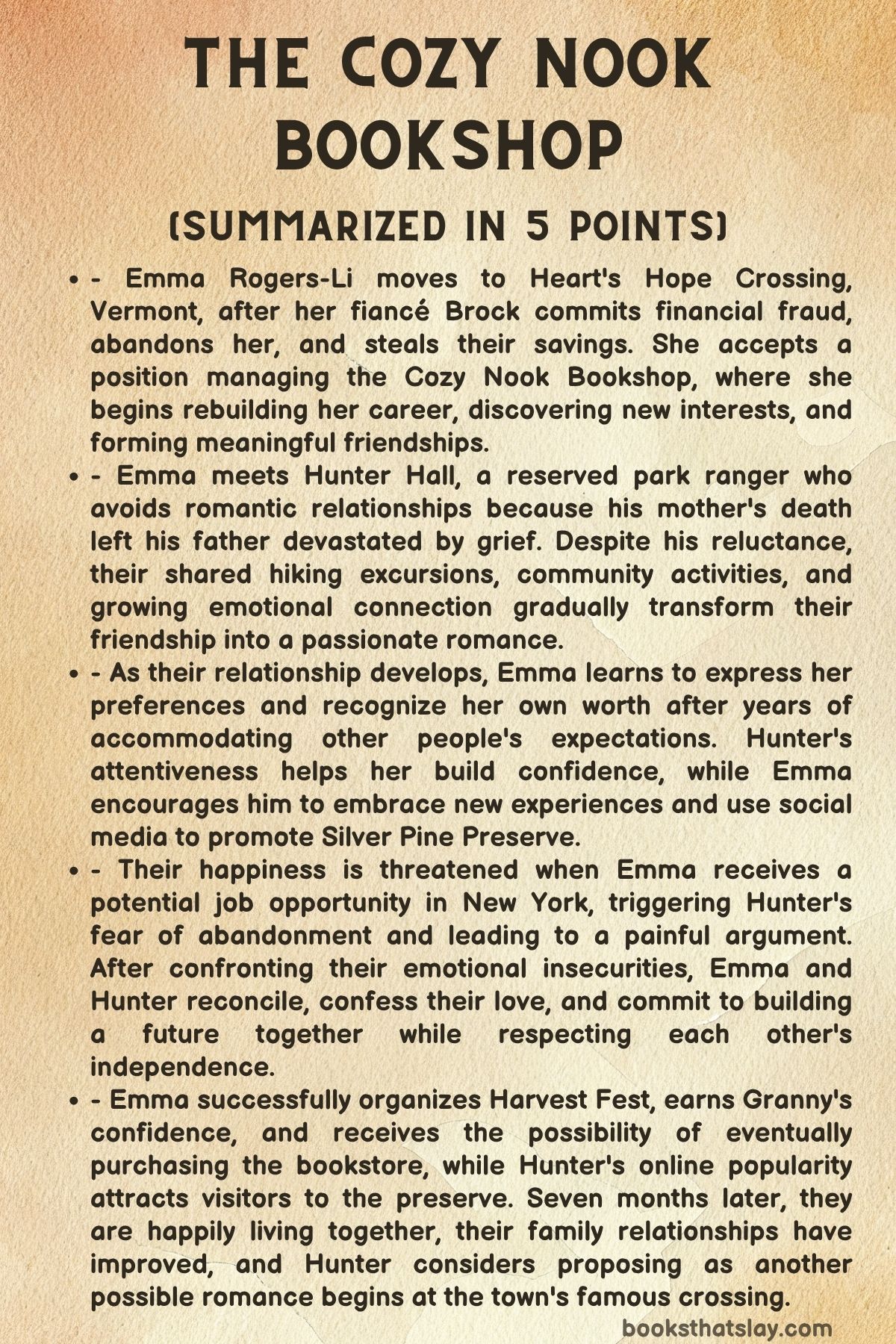
Emma Rogers-Li’s carefully constructed life collapses when her fiancé, Brock, commits financial fraud at his family’s publishing company, forcing the business into bankruptcy. As Brock disappears with their joint savings, Emma loses her job, her professional reputation, and the financial stability she believed their relationship had secured.
Unable to find employment in New York because of her association with the scandal, Emma discovers an advertisement for a bookstore manager in Heart’s Hope Crossing, Vermont. The generous salary and accommodation offered by the owner, Alamea Smith, persuade her to accept the position and begin again in an unfamiliar town.
Arriving at the Cozy Nook Bookshop, Emma discovers that its doors are locked and accidentally collides with an attractive stranger while searching for another entrance. The man, Hunter Hall, reacts sharply before realizing that she is the woman his grandmother has hired to manage the store.
Their encounter occurs at the intersection of Heart Street and Hope Road, where local legend promises that strangers who meet will help each other discover their hearts’ secret hopes. Hunter dismisses the superstition, believing that love offers no protection against the suffering caused by loss.
Granny Smith introduces Emma to the bookstore and the furnished apartment upstairs, where she will live. She also encourages Hunter to help unload Emma’s belongings, beginning a series of encounters that gradually undermine his determination to avoid romantic relationships.
Emma soon discovers that Heart’s Hope Crossing offers a very different existence from the competitive environment she left behind. The townspeople welcome her enthusiastically, and she develops friendships with Hattie, Abby, Toni, and Christopher while exploring activities she previously neglected.
Managing the bookstore presents considerable challenges because Granny relies on outdated technology, informal procedures, and an inefficient inventory system. Emma begins considering improvements but initially hesitates to exercise her professional judgment without explicit permission.
Meanwhile, Hunter works as a ranger at Silver Pine Preserve, where declining visitor numbers threaten future funding. His responsibilities provide the solitude he prefers, although his interactions with Emma gradually make him question whether isolation is genuinely satisfying.
When Emma expresses interest in exploring the surrounding countryside, Granny and Mayor Thompson encourage Hunter to introduce her to Mount Darcy. He reluctantly agrees to take her on an inspection hike, creating an opportunity for them to spend several uninterrupted hours together.
During their excursion, Hunter explains the town’s matchmaking legend and reveals why he distrusts promises of romantic happiness. His parents met at the famous crossing and shared a loving marriage, but his mother’s death devastated his father, Charles, leaving Hunter convinced that attachment inevitably exposes people to unbearable suffering.
Emma reveals her own painful history, describing Brock’s financial misconduct and abandonment. Their shared experiences establish an unexpected understanding, although Hunter insists that he has no intention of pursuing a serious relationship.
As they explore the preserve, Emma suggests that Hunter could use social media to attract visitors and promote conservation. Her marketing expertise offers a practical solution to the preserve’s problems, while their developing professional collaboration provides another reason to remain in contact.
Their growing attraction becomes increasingly apparent when Hunter unexpectedly attends a local line dancing class. Although he initially resists the activity, encouragement from his friend Lucas brings him to the community center, where he discovers that spending time with Emma matters more than his discomfort.
Emma notices Hunter’s attentiveness, particularly when he recognizes that she dislikes a drink and immediately offers to replace it. Such seemingly ordinary consideration affects her deeply because Brock rarely acknowledged her preferences, prompting her to reconsider what she should expect from a partner.
Afterward, Hunter walks Emma home, and their conversation nearly culminates in a kiss. He ultimately kisses her cheek, choosing temporary restraint even as their affectionate text exchanges establish an increasingly important emotional connection.
Their relationship advances when Granny and Lucas arrange for them to attend the same cooking class at the Sunny Days Diner. Preparing a Greek meal together leads to intimate conversations about their families, and their attraction finally produces a passionate kiss away from the other participants.
Hunter subsequently invites Emma to his cabin for dinner and an experiment involving homemade desserts. Their evening becomes increasingly romantic, and Emma discovers that his attentiveness extends to every aspect of their relationship, including his willingness to ask what makes her comfortable and happy.
After their first intimate encounter, Emma unexpectedly begins crying because his consideration exposes how thoroughly she has learned to disregard her own needs. She explains that caring for her ill grandmother shaped her childhood, teaching her to avoid inconveniencing her parents, while Brock reinforced her habit of accommodating other people.
Hunter reassures her that her desires matter and admits that their connection has become much more meaningful than he anticipated. Their conversation strengthens their trust, and Emma begins developing the confidence to communicate her preferences without apologizing for them.
Together, they establish a social media account for Hunter, sharing educational videos about hiking, conservation, and responsible outdoor behavior. The project becomes increasingly successful, creating excitement about the preserve while reinforcing Emma’s belief in her professional abilities.
When Emma injures her ankle during another hiking excursion, Hunter immediately abandons their plans to help her return safely. He takes her to a medical clinic and subsequently brings her to his cabin, where his affectionate care makes their developing domestic compatibility increasingly apparent.
However, an unexpected visit from Charles unsettles Hunter when his father admits that seeing him care for Emma recalls his late wife. Hunter recognizes the depth of his own attachment and becomes frightened that he might someday experience the same devastating loss.
At the same time, Emma receives an unexpected message from Ji-An, a former friend and colleague who abandoned her during Brock’s scandal. Ji-An apologizes and introduces the possibility of returning to New York for a marketing position at another publishing company.
Although Emma has established friendships and professional fulfillment in Vermont, Hunter becomes increasingly anxious about the possibility that she might leave. His fears intensify when she begins undertaking responsibilities independently, reminding him that her growing confidence gives her the freedom to determine her future.
Meanwhile, Emma successfully modernizes the bookstore’s appearance and operations, introducing attractive displays, improved promotional activities, and updated technology. Granny praises these improvements upon returning from vacation, confirming that Emma’s initiative has benefited the business.
A crisis nevertheless emerges when Emma discovers that an important shipment of books for the upcoming Harvest Fest never arrived because of the old ordering system. She arranges to collect the books from a New Jersey warehouse, and Hunter accompanies her on the exhausting journey.
During their return, Hunter tentatively offers Emma a place in his cabin if she ever loses her job, but their conversation becomes strained when she mentions the New York opportunity. Although Emma expresses her attachment to Heart’s Hope Crossing, Hunter cannot stop imagining that her new independence might eventually lead her away from him.
The tension reaches its breaking point when Hunter questions whether Emma genuinely knows what she wants. Suggesting that she might simply be adapting herself to another person’s expectations, he unintentionally attacks the personal growth she has worked so hard to achieve.
Deeply hurt, Emma challenges his inability to trust her feelings, and their disagreement threatens to destroy the relationship. Alone afterward, she receives an unexpected call from Brock, who wants her assistance recovering information connected to a cryptocurrency wallet.
Rather than accommodating him, Emma recognizes how consistently their relationship revolved around his needs and refuses to cooperate on his terms. A subsequent conversation with her mother becomes equally important when Emma finally explains how overlooked she felt throughout childhood and how desperately she needed parental support during her recent difficulties.
These confrontations help Emma understand that expressing her needs is essential to maintaining healthy relationships. She also acknowledges that she loves Hunter and decides that she must communicate her commitment clearly rather than expect him to overcome his fears without reassurance.
Hunter independently confronts his own limitations after witnessing a disagreement between his teenage colleague Alix and her mother, Greta. His realization that Alix admires his isolated lifestyle makes him question whether avoiding emotional attachment has truly protected him or merely restricted his opportunities.
A conversation with his sister Kyra further challenges his beliefs about their father’s grief. Kyra reminds him that their parents enjoyed many happy years together and that Charles would never willingly erase their marriage simply to avoid the pain of losing his wife.
Hunter finally understands that refusing love cannot eliminate suffering and that the possibility of loss does not invalidate the happiness a relationship can provide. Videos from his social media account, showing Emma looking at him with unmistakable affection, reinforce his realization that she has been sincere throughout their relationship.
He visits Emma, apologizes for questioning her feelings, and admits that he loves her. Emma reciprocates, and their reconciliation becomes an opportunity to discuss their future openly rather than allowing unspoken fears to dictate their choices.
Emma also reveals that Brock’s recent contact enabled her to recover access to a cryptocurrency wallet containing fifty thousand dollars. The money gives her the financial freedom to return to New York, but she has already rejected Ji-An’s employment opportunity because she genuinely wants to remain in Vermont.
Hunter finally accepts that Emma is choosing both him and the life she has created for herself. They exchange keys and discuss eventually living together, recognizing that commitment does not require immediate answers to every question about their future.
Harvest Fest subsequently becomes a tremendous success, with the bookstore’s booth attracting enthusiastic crowds and selling nearly all its featured books and merchandise. Granny praises Emma’s leadership, rewards her with a raise, and suggests that she might eventually purchase the business when Granny retires.
Hunter’s online popularity also benefits Silver Pine Preserve by attracting new visitors and increasing awareness of conservation. Their achievements demonstrate how their relationship has strengthened their individual ambitions rather than forcing either person to sacrifice personal fulfillment.
Seven months later, Emma and Hunter are living together in his transformed cabin, now filled with books, plants, artwork, and comfortable furnishings. Their family relationships have also improved, while Emma continues managing the bookstore and Hunter maintains his successful educational platform.
During a Memorial Day barbecue, Hunter reflects on how completely his life has changed and privately considers proposing to Emma. Surrounded by friends and family, he recognizes that the relationships he once feared have become essential to his happiness.
The gathering concludes with Hattie announcing that she has encountered an attractive stranger at the town’s famous intersection. When the stranger turns out to be Nick Chiu, the new tenant in Emma’s former apartment, Emma and Hunter recognize a familiar beginning and happily entertain the possibility that the crossing’s romantic legend may be working once again.
Characters
Emma Rogers-Li
Emma Rogers-Li is the central female protagonist of The Cozy Nook Bookshop, whose journey involves rebuilding her professional identity, rediscovering her individuality, and learning to prioritize her own happiness. Her experiences demonstrate how personal growth often requires questioning beliefs and behavioral patterns that have shaped an entire lifetime.
At the beginning of the novel, Emma is devastated by the collapse of her engagement and career. Brock’s fraudulent activities leave her financially vulnerable and professionally disgraced, although she has committed no wrongdoing herself.
Her decision to move to Heart’s Hope Crossing initially emerges from desperation rather than a deliberate desire for personal reinvention. Nevertheless, the unfamiliar environment gradually gives her opportunities to explore interests, establish friendships, and make decisions without accommodating another person’s expectations.
Emma’s tendency to suppress her preferences originates in her childhood. Growing up in a household where her grandmother required extensive care, she learned to avoid creating additional difficulties for her parents and developed an identity centered on being agreeable.
Her relationship with Brock reinforces these tendencies because he frequently dismisses her interests and expects her to accommodate his wishes. His abandonment eventually forces Emma to confront how little consideration she has received from someone she intended to marry.
Hunter becomes an important influence because he consistently demonstrates that her preferences deserve attention. His willingness to accommodate her needs initially overwhelms her, revealing how unfamiliar she has become with receiving uncomplicated affection.
However, Emma’s development does not depend entirely on romantic companionship. Her professional achievements at the bookstore, growing social confidence, and willingness to establish boundaries with her parents demonstrate that she is developing independence across several areas of her life.
Her confrontation with Hunter represents an especially significant moment because she refuses to accept his suggestion that she does not understand her own desires. Rather than sacrificing her individuality to preserve their relationship, she insists that he recognize her ability to make authentic choices.
By the novel’s conclusion, Emma has obtained financial security, established a fulfilling career, and developed lasting friendships. Her decision to remain in Vermont demonstrates that she is no longer allowing fear, financial necessity, or romantic dependency to determine the direction of her life.
Hunter Hall
Hunter Hall is the central male protagonist, a dedicated ranger whose preference for solitude conceals a profound fear of emotional attachment. His character arc in The Cozy Nook Bookshop explores the difference between protecting oneself from potential suffering and denying oneself opportunities for happiness.
Hunter’s understanding of relationships is shaped by the death of his mother and the prolonged grief experienced by his father. Having witnessed Charles struggle to rebuild his life, Hunter concludes that romantic love creates vulnerabilities that are best avoided.
His work at Silver Pine Preserve reinforces his solitary lifestyle. The natural environment provides emotional stability and allows him to remain useful without exposing himself to the complications of intimate relationships.
Despite his guarded personality, Hunter demonstrates compassion, responsibility, and considerable emotional sensitivity. His concern for Emma during their hikes, his attentive behavior during intimate moments, and his willingness to care for her after her injury reveal qualities that contradict his insistence that he is unsuitable for relationships.
His developing affection for Emma gradually exposes the limitations of his protective philosophy. He discovers that ordinary experiences, including cooking, dancing, exchanging messages, and sharing domestic routines, become more enjoyable when experienced with someone he loves.
Nevertheless, Hunter’s fear of abandonment creates significant difficulties. When Emma receives an employment opportunity in New York, he interprets the possibility of her departure as evidence that their happiness may be temporary.
His greatest mistake occurs when he questions whether Emma genuinely understands her desires. By allowing his fear to undermine her autonomy, he reproduces the emotional disregard that she has worked to overcome.
His transformation requires recognizing that love cannot provide guarantees against future suffering. Conversations with Kyra, his experiences mentoring Alix, and the unmistakable affection visible in Emma’s videos help him understand that avoiding relationships does not eliminate loneliness.
Hunter’s eventual willingness to express his love represents a rejection of the restrictions he previously imposed on himself. By embracing companionship, friendship, and family responsibilities, he discovers that emotional openness can expand his life rather than threaten it.
Alamea “Granny” Smith
Granny Smith is the owner of the Cozy Nook Bookshop and one of the most influential supporting characters in The Cozy Nook Bookshop. Her generosity, unconventional business practices, and enthusiasm for matchmaking help create the circumstances that bring Emma and Hunter together.
Granny recognizes Emma’s professional abilities before they have been validated by anyone in Heart’s Hope Crossing. By offering her employment and accommodation, she provides the practical foundation that allows Emma to rebuild her life.
Her approach to business is distinctly informal. She relies on outdated equipment, established habits, and personal relationships, often creating difficulties for Emma as she attempts to understand the bookstore’s operations.
Nevertheless, Granny’s resistance to conventional organization does not mean that she lacks business judgment. She recognizes the value of Emma’s improvements and ultimately supports changes that will protect the store’s future.
Her matchmaking activities reveal both affection and a willingness to interfere in other people’s lives. By arranging opportunities for Emma and Hunter to meet, she attempts to encourage a relationship that neither initially feels prepared to pursue.
Granny’s importance extends beyond romance because she also becomes a source of professional recognition. Her decision to offer Emma a raise and discuss the possibility of selling her the bookstore demonstrates genuine confidence in her abilities.
Her character embodies the idea that older generations can support younger people by providing opportunities rather than insisting that established practices remain unchanged.
Charles Hall
Charles Hall is Hunter’s father, whose prolonged grief following his wife’s death profoundly influences his son’s understanding of romantic attachment. His character provides the emotional foundation for one of the central conflicts in The Cozy Nook Bookshop.
Charles experienced a loving marriage that ended in devastating loss. Although the relationship provided years of happiness, his difficulty recovering from his wife’s death convinces Hunter that emotional commitment inevitably produces suffering.
His withdrawal also affects the wider family. His limited involvement with his grandchildren demonstrates how grief can alter relationships long after the original loss.
Charles’s unexpected visit to Hunter’s cabin becomes particularly significant when he observes his son caring for Emma. The domestic scene reminds him of his own marriage, revealing that his memories remain closely connected to ordinary expressions of affection.
Although his reaction unsettles Hunter, Charles is not presented as someone who deliberately discourages his son from loving another person. Instead, his unresolved sorrow becomes an example that Hunter interprets through his own fears.
Kyra subsequently provides a different perspective, explaining that their father would never willingly surrender the happiness of his marriage simply to avoid its painful conclusion. This interpretation allows Hunter to distinguish Charles’s grief from a rejection of the love he experienced.
By the end of the novel, Charles begins participating more actively in family gatherings. His gradual improvement suggests that emotional recovery may involve learning to maintain meaningful relationships while continuing to remember someone who has died.
Lucas
Lucas is Hunter’s best friend and the owner of the local hardware store. His outgoing personality contrasts with Hunter’s reserved nature, allowing him to challenge his friend’s assumptions about relationships and social activities.
Lucas recognizes Hunter’s attraction to Emma before Hunter is willing to acknowledge it openly. Rather than treating every romantic possibility as a serious commitment, he encourages Hunter to enjoy companionship without immediately worrying about its potential consequences.
His matchmaking efforts include recruiting friends for the line dancing class and arranging Hunter’s unexpected participation in the cooking class. Although Hunter finds these interventions irritating, Lucas acts from a desire to see his friend experience greater happiness.
Lucas also demonstrates an understanding of Hunter’s emotional defenses. He recognizes that Hunter’s repeated objections often conceal uncertainty rather than genuine disinterest.
His character illustrates the influence of friendships that challenge established habits while continuing to offer acceptance and support.
Hattie
Hattie is one of Emma’s closest friends in Heart’s Hope Crossing and an important representative of the welcoming community depicted in The Cozy Nook Bookshop. Her friendliness, humor, and enthusiasm for local activities help Emma establish a sense of belonging.
She introduces Emma to knitting and encourages her to participate in activities beyond her professional responsibilities. These experiences help Emma recognize that personal enjoyment does not need to be justified through productivity or someone else’s approval.
Hattie also participates in the town’s matchmaking efforts, expressing considerable interest in Emma’s developing relationship with Hunter. Her teasing is affectionate, although it occasionally adds to Emma’s discomfort with the community’s attention.
Her friendship becomes especially valuable after Emma injures her ankle. Rather than allowing Emma to struggle alone, Hattie offers practical assistance and encourages her to acknowledge when she needs help.
She subsequently contributes to the preparations for Harvest Fest, demonstrating that her friendship extends beyond social entertainment. Her willingness to assist during a professional crisis reinforces Emma’s growing understanding of reciprocal support.
Hattie’s encounter with Nick Chiu at the famous crossing provides the novel’s closing romantic possibility. Her initial embarrassment creates a humorous parallel with Emma’s first meeting with Hunter and suggests that Hattie may be approaching a similarly transformative relationship.
Abby
Abby is another important member of Emma’s friendship circle, providing companionship, encouragement, and practical assistance during her adjustment to small-town life.
Alongside Hattie, she introduces Emma to knitting and helps her become comfortable experimenting with unfamiliar activities. Her patient encouragement contrasts with Emma’s previous tendency to interpret mistakes as personal failures.
Abby also recognizes the growing attraction between Emma and Hunter. Her teasing contributes to the lighthearted atmosphere surrounding their relationship, although she respects Emma’s need to determine its direction independently.
When Emma’s ankle injury disrupts her routine, Abby offers assistance without making her feel inadequate. Her support helps Emma understand that accepting help can strengthen friendships rather than diminish personal independence.
Her participation in the Harvest Fest preparations further establishes her reliability. Although she receives less individual development than the protagonists, Abby represents the consistent everyday care that makes Emma’s new community meaningful.
Brock
Brock is Emma’s former fiancé and the principal figure associated with the collapse of her previous life. His financial misconduct, disappearance, and theft of their savings establish the circumstances that force Emma to seek a new beginning.
His treatment of Emma also reveals the emotional limitations of their relationship. He routinely dismisses her interests, overlooks her preferences, and encourages a dynamic in which his wishes take precedence.
Brock’s behavior reinforces Emma’s childhood habit of accommodating others. Because she rarely challenges him, their relationship appears functional until his betrayal exposes how little mutual understanding exists between them.
His unexpected telephone call near the end of the novel demonstrates that he continues to prioritize his own interests. Rather than expressing meaningful remorse, he expects Emma to help him recover information connected to a cryptocurrency wallet.
Emma’s refusal to accommodate his demands represents an important demonstration of her developing confidence. She recognizes that she can reject an unreasonable request without becoming responsible for the other person’s disappointment.
Brock functions as a contrast to Hunter, particularly regarding consideration, emotional responsiveness, and respect for Emma’s individuality. His role also makes clear that Emma’s transformation involves rejecting unhealthy patterns rather than merely replacing one romantic partner with another.
Ji-An
Ji-An is Emma’s former friend and colleague, whose relationship with Emma is damaged by the scandal surrounding Brock’s financial misconduct.
When the publishing company collapses, Ji-An blames Emma and withdraws from their friendship. Her reaction contributes to Emma’s isolation during a period when she desperately needs understanding and support.
Her later attempt to reconnect demonstrates that relationships damaged by misunderstanding can sometimes be repaired. By apologizing, Ji-An acknowledges the unfairness of her previous response.
Ji-An also introduces Emma to an employment opportunity at a boutique publishing company in Brooklyn. This offer creates a practical alternative to Emma’s new life in Vermont and becomes an important test of her developing independence.
Although Emma does not accept the position, Ji-An’s intervention helps establish that returning to New York is a genuine possibility rather than an imagined threat.
Her character ultimately provides Emma with an opportunity to reconsider an important friendship while making an independent decision about her professional future.
Alix
Alix is Hunter’s teenage colleague at Silver Pine Preserve, whose disagreements with her mother reflect the novel’s broader concerns about independence, expectations, and personal choice.
She enjoys working outdoors and resists Greta’s insistence that she attend college. Her objections emerge from a genuine attachment to her current lifestyle, although she initially interprets higher education as a threat to her autonomy.
Alix admires Hunter’s independence and appears attracted to his preference for solitude. Her attitude eventually forces Hunter to recognize that his lifestyle may not provide an appropriate model for someone who has yet to explore many possible futures.
Hunter encourages Alix to distinguish between considering an opportunity and surrendering control over her decisions. His advice becomes significant because he must acknowledge the restrictions he has imposed on his own life.
By the conclusion, Alix has reached a compromise involving a gap year, national park internships, and college credits. Her decision demonstrates that personal autonomy can coexist with practical planning and family compromise.
Greta
Greta is Alix’s mother, whose concern about her daughter’s future creates tension within their family.
She believes that higher education will provide Alix with broader opportunities and encourage her to experience life beyond Heart’s Hope Crossing. Her insistence, however, makes Alix feel that her own aspirations are being dismissed.
Greta’s disagreement with Hunter emerges when she suspects that his isolated lifestyle has influenced her daughter’s reluctance to attend college. Although her concerns are understandable, the conflict reveals the difficulties that arise when parental protection becomes difficult to distinguish from control.
Her eventual compromise with Alix suggests that effective parenting requires recognizing a young person’s developing independence. Greta’s relationship with her daughter parallels Emma’s difficulties with her parents, although their circumstances are different.
Kyra Hall
Kyra is Hunter’s sister and one of the most important influences on his eventual emotional transformation. Unlike Hunter, she does not interpret their father’s prolonged grief as evidence that romantic attachment should be avoided.
Her perspective emerges from the same family history but produces a different understanding of their parents’ marriage. She recognizes the suffering that followed their mother’s death while continuing to value the happiness their parents experienced together.
When Hunter visits the family, Kyra challenges his belief that emotional attachment inevitably represents a mistake. She explains that Charles would never willingly erase his marriage simply to avoid the pain of losing his wife.
Her argument helps Hunter recognize that grief cannot invalidate the love that preceded it. By showing him footage of Emma’s unmistakable affection, Kyra also provides evidence that his current relationship deserves consideration on its own terms.
Kyra functions as a compassionate corrective to Hunter’s fearful interpretation of his childhood. Her character demonstrates how members of the same family can respond differently to shared experiences of loss.
Emma’s Mother
Emma’s mother is a loving but imperfect parent whose extensive caregiving responsibilities contributed to her daughter’s emotional development.
During Emma’s childhood, much of the family’s attention centered on her grandmother’s health. Although her parents did not intentionally neglect her, Emma learned to minimize her own needs because she recognized how heavily burdened they were.
Her mother’s inability to interrupt planned travel after Emma’s ankle injury revives these longstanding feelings. Emma interprets the situation through her childhood experiences, once again feeling that her needs are less important than other responsibilities.
Their later telephone conversation becomes a turning point when Emma finally communicates her disappointment directly. Rather than continuing to conceal her feelings, she explains how much she needed parental attention during Brock’s disappearance and her subsequent difficulties.
By the novel’s conclusion, Emma’s parents are making greater efforts to participate in her life. Her mother’s character demonstrates that even affectionate family relationships may require difficult conversations to overcome longstanding emotional patterns.
Emma’s Father
Emma’s father is a supporting family figure whose experiences parallel those of Emma’s mother. He shares the responsibilities associated with caring for Emma’s grandmother and later enjoys greater freedom following retirement.
His role is primarily established through Emma’s recollections and descriptions of her parents’ travel plans. These details suggest that his commitment to family responsibilities sometimes prevented him from recognizing the emotional needs of his daughter.
Although he receives less individual development than Emma’s mother, his presence contributes to the explanation of Emma’s childhood behavior. His later participation in family gatherings suggests that the relationship between Emma and her parents is becoming more balanced.
Hunter’s intention to speak with him before proposing also establishes his continuing importance in Emma’s adult family life.
Toni
Toni is a member of the local crafting group who helps welcome Emma into Heart’s Hope Crossing.
Her participation in the group’s activities contributes to the supportive atmosphere that allows Emma to develop friendships outside her professional life. These gatherings provide opportunities for conversation, experimentation, and companionship.
Toni also volunteers to assist with Harvest Fest when Emma faces the unexpected shipment crisis. Her willingness to contribute demonstrates the practical significance of the friendships Emma has established.
Although Toni receives limited individual development, she contributes to the novel’s portrayal of community relationships built through shared interests and mutual assistance.
Christopher
Christopher belongs to the crafting group that welcomes Emma after her arrival in Vermont. His presence helps establish the group’s inclusive character and the variety of relationships available within the town.
He participates in the informal social network that encourages Emma to experiment with unfamiliar activities. These experiences contrast with her previous life, in which her personal interests were often subordinated to Brock’s preferences.
Christopher subsequently assists with preparations for Harvest Fest, demonstrating the same willingness to support Emma that characterizes her other local friendships.
His character reinforces the importance of ordinary community participation in creating a sense of belonging.
Mayor Thompson
Mayor Thompson is a prominent representative of Heart’s Hope Crossing and an enthusiastic participant in the town’s social activities.
He welcomes Emma and expresses interest in her adjustment to the community. His friendliness establishes the town as a place where newcomers receive personal attention rather than remaining anonymous.
Alongside Granny, he encourages Hunter to introduce Emma to the surrounding countryside. His matchmaking efforts demonstrate how the town’s residents view romantic relationships as matters of collective interest.
His later compliments regarding the bookstore’s improvements provide Emma with additional professional recognition. Although his involvement is sometimes intrusive, he contributes to the sense of communal acceptance that distinguishes Emma’s new environment.
Jerry Smith
Jerry is Granny Smith’s husband and a quieter supporting character whose presence helps establish the stability of her family life.
Their extended vacation creates the circumstances in which Emma must assume independent responsibility for managing the bookstore. This temporary absence becomes essential to Emma’s professional development.
Jerry’s shared enthusiasm for traveling also influences Granny’s eventual consideration of retirement. Their desire to enjoy more time together creates the possibility that Emma might someday purchase the business.
Although Jerry receives little individual attention, his relationship with Granny provides another example of companionship that supports personal growth and changing ambitions.
Daniel
Daniel is one of Hunter’s friends and a participant in the social circle centered around Lucas.
He joins the group activities that encourage Hunter to become more socially involved, including the line dancing outing. His presence makes these experiences feel less like romantic obligations and more like ordinary opportunities for friendship.
Daniel also participates in conversations that reveal Hunter’s changing attitude toward Emma. His character helps demonstrate that Hunter has existing friendships capable of supporting his transition toward a more emotionally open lifestyle.
Owen
Owen is a supporting figure associated with Emma’s daily routine at the bookstore.
When Emma becomes absorbed in struggling with the shop’s unreliable computer, Owen encourages her to stop working and prepare for her evening with Hunter. This small intervention reflects the importance of maintaining boundaries between professional responsibilities and personal enjoyment.
His presence also contributes to the sense that the bookstore is becoming a supportive environment rather than merely a place of employment.
Chef
Chef is the instructor who leads the cooking class at the Sunny Days Diner.
His enthusiasm creates an inviting atmosphere in which participants can experiment with new skills and enjoy a shared experience. Although he is unaware of every detail behind the matchmaking arrangement, his class provides the setting for an important development in Emma and Hunter’s relationship.
The cooking activities encourage cooperation and conversation, allowing the couple to develop emotional intimacy through an ordinary domestic experience. Chef therefore plays a modest but significant role in moving their relationship beyond the limitations of friendship.
Dr. Nguyen
Dr. Nguyen is the medical professional who examines Emma after she injures her ankle while hiking.
The examination confirms that Emma has suffered a sprain and is expected to recover. This reassurance allows the couple to focus on her recovery without uncertainty about the seriousness of the injury.
Although Dr. Nguyen appears only briefly, the medical consultation helps establish Hunter’s responsible approach to Emma’s well-being. His decision to seek professional care demonstrates that his concern extends beyond emotional reassurance.
TJ
TJ is Kyra’s husband and a member of Hunter’s extended family.
His presence at the Memorial Day gathering helps establish the family environment that Hunter has gradually become more willing to embrace. Alongside Kyra and their children, TJ represents the ordinary domestic companionship that contrasts with Hunter’s earlier isolation.
Although his individual personality is not explored extensively, he contributes to the portrayal of a family whose relationships continue developing despite the loss they have experienced.
Nick Chiu
Nick Chiu is a newcomer to Heart’s Hope Crossing who works remotely and rents Emma’s former apartment above the bookstore.
His arrival demonstrates that Emma has completed an important transition, moving from temporary accommodation into a permanent shared home with Hunter. The apartment that once represented her uncertain new beginning has become available to another newcomer.
Nick becomes especially significant in the closing scene when Hattie reveals that she encountered an attractive stranger at the famous intersection.
Their unexpected reunion at the barbecue recalls Emma and Hunter’s first meeting. Nick’s role introduces the possibility of another romantic relationship influenced by the town’s traditions.
Mercutio
Mercutio is Granny’s enormous and energetic dog, whose behavior creates a humorous challenge for Emma during Granny’s absence.
Although Emma expects a manageable responsibility, she discovers that walking him requires considerably more physical control than she anticipated. Hunter’s assistance transforms the situation into another opportunity for the couple to spend time together.
Mercutio contributes to the novel’s domestic humor while illustrating how everyday responsibilities can encourage companionship and cooperation.
Themes
Personal Independence and the Rediscovery of Identity
Emma’s experiences demonstrate how a person’s individuality can become obscured by the expectations of family members, romantic partners, and professional environments. Her journey in The Cozy Nook Bookshop involves recognizing these influences and gradually developing the confidence to make decisions according to her own values.
During childhood, Emma learns to suppress her preferences because her grandmother’s medical needs place considerable demands on the family. She becomes accustomed to minimizing her desires, believing that being agreeable is an essential part of maintaining harmony.
Her engagement to Brock reinforces this behavior because their relationship consistently prioritizes his interests. Even when Emma possesses professional abilities and personal ambitions, she allows his preferences to influence how she spends her time and directs her life.
Moving to Vermont disrupts these established patterns. Without Brock’s influence, Emma begins experimenting with activities, developing friendships, and discovering interests that she previously considered unimportant.
Her professional responsibilities become equally important to this transformation. As she modernizes the bookstore, she gradually recognizes that her judgment deserves consideration and that making independent decisions does not require constant reassurance.
The conflict with Hunter tests the strength of her developing confidence. When he suggests that she may be adapting herself to his expectations, Emma refuses to allow another romantic partner to determine the validity of her feelings.
Her eventual financial independence reinforces this development. Recovering the money from Brock gives her the practical freedom to pursue another career, yet she chooses to remain in Heart’s Hope Crossing because the life she has created genuinely satisfies her.
The novel therefore distinguishes independence from isolation. Emma’s growth does not require rejecting relationships, but it does require ensuring that companionship supports rather than replaces her individuality.
Her eventual happiness emerges from discovering that personal fulfillment can involve professional ambition, friendship, family reconciliation, and romantic commitment without making any single relationship the foundation of her entire identity.
Love, Grief, and the Courage to Accept Uncertainty
Hunter’s resistance to romantic attachment originates in his belief that the possibility of loss makes love inherently dangerous. His experiences demonstrate how grief can influence not only the person who has suffered a bereavement but also the people who witness that suffering.
The death of Hunter’s mother permanently changes his family. Watching Charles struggle to recover convinces Hunter that the happiness of a loving marriage may ultimately be outweighed by the devastation of losing a partner.
Consequently, Hunter organizes his adult life around emotional self-protection. His preference for solitude allows him to avoid situations in which another person’s absence might seriously disrupt his happiness.
His growing affection for Emma challenges this philosophy because companionship begins providing pleasures he had not previously considered essential. Their conversations, shared activities, and developing domestic routines gradually reveal the emotional limitations of his isolation.
Nevertheless, his fear becomes more intense as his attachment deepens. Rather than simply appreciating Emma’s presence, he begins imagining the circumstances under which she might leave.
The possibility of her returning to New York exposes the central contradiction in his outlook. Although Hunter wants emotional closeness, he attempts to protect himself by questioning Emma’s commitment before she has actually abandoned him.
His conversations with Kyra eventually provide an alternative interpretation of their father’s grief. Charles’s suffering does not mean that his marriage was a mistake, because the happiness he experienced remains valuable despite its painful conclusion.
This realization allows Hunter to recognize that uncertainty is an unavoidable feature of meaningful relationships. No amount of emotional withdrawal can guarantee protection against suffering, while excessive caution can prevent people from experiencing companionship.
Hunter’s transformation does not require him to forget his mother or dismiss his father’s pain. Instead, he learns that grief and gratitude can coexist, and that loving someone does not become irrational merely because the relationship might someday end.
His eventual commitment to Emma demonstrates the courage involved in accepting happiness without demanding certainty about the future.
Emotional Communication, Mutual Care, and Healthy Relationships
Emma and Hunter begin their relationship with different emotional difficulties, yet both struggle to communicate their needs directly. Their experiences demonstrate that affection alone cannot sustain a relationship when important fears and expectations remain unspoken.
Emma’s problem involves suppressing her desires to avoid disappointing other people. Because she has spent much of her life accommodating others, she initially finds it difficult to believe that a romantic partner might genuinely want to understand her preferences.
Hunter experiences the opposite difficulty. Although he recognizes his own feelings, he avoids expressing them because acknowledging emotional dependence would challenge his commitment to remaining unattached.
Their early relationship progresses through ordinary expressions of consideration. Hunter notices Emma’s preferences, respects her comfort, and refuses to treat her needs as inconveniences.
His behavior becomes especially meaningful after Emma’s ankle injury. Rather than blaming her for disrupting their excursion, he reassures her that her well-being matters more than completing their plans.
However, the novel does not suggest that kindness automatically eliminates emotional conflict. Hunter’s fear of abandonment eventually leads him to question Emma’s sincerity, demonstrating how insecurity can undermine an otherwise caring relationship.
Emma’s response represents an important development because she refuses to conceal her hurt simply to preserve harmony. She explains why his accusations are painful and insists that he respect her ability to make independent decisions.
Her conversations with Brock and her mother reinforce the same principle. By expressing feelings she previously suppressed, Emma begins challenging longstanding relationships in which her emotional needs received insufficient attention.
The eventual reconciliation between Emma and Hunter depends on both characters accepting responsibility for their behavior. Hunter acknowledges that his fear caused him to treat Emma unfairly, while Emma communicates her love and commitment without surrendering her autonomy.
Their decision to exchange keys while postponing larger commitments demonstrates a balanced approach to intimacy. They recognize that a healthy relationship requires mutual affection, honest communication, respect for personal boundaries, and the freedom to make important decisions together.
Community, Belonging, and the Possibility of New Beginnings
Heart’s Hope Crossing functions as more than the setting of The Cozy Nook Bookshop because its residents actively influence the protagonists’ opportunities for personal development. The town provides an environment in which established relationships, shared traditions, and everyday generosity make new beginnings possible.
Emma initially arrives as an outsider whose previous life has collapsed. Her experiences in New York have left her professionally isolated and emotionally uncertain, making the town’s enthusiastic welcome both unfamiliar and reassuring.
The friendships she develops through crafting groups and community activities gradually change her understanding of belonging. Rather than measuring relationships through status or professional usefulness, she discovers the satisfaction of participating in ordinary shared experiences.
These connections become especially meaningful when difficulties arise. After Emma injures her ankle, her friends provide practical assistance, allowing her to recognize that requesting help does not make her inadequate.
Their support during Harvest Fest further demonstrates the importance of community cooperation. What initially appears to be an overwhelming professional crisis becomes manageable when Emma accepts assistance and delegates responsibilities.
The town also influences Hunter, although he initially resists its social expectations. Granny, Lucas, and other residents repeatedly encourage him to participate in activities that challenge his preference for isolation.
Their matchmaking efforts can be intrusive, but they also create opportunities for connection that Hunter might otherwise avoid. Ultimately, his relationship succeeds because he and Emma choose one another rather than because the community determines their future.
The bookstore itself becomes a symbol of continuity and renewal. Emma preserves its welcoming character while introducing changes that support its future, demonstrating that tradition and innovation need not be opposing forces.
Her successful management eventually creates the possibility of business ownership, linking her personal reinvention with the town’s long-term development. Hunter’s social media project produces a similar result by connecting the local preserve with a wider audience.
The closing Memorial Day gathering demonstrates how the protagonists’ lives have expanded through their relationships with friends and family. Hattie’s encounter with Nick at the famous crossing then suggests that the town’s traditions will continue providing opportunities for new connections.
The novel ultimately presents belonging as something created through participation, generosity, and personal choice. Emma and Hunter discover that building a permanent home does not require abandoning independence, but rather finding a community in which their individual lives can continue developing.