Rings Of Fate Summary, Characters and Themes
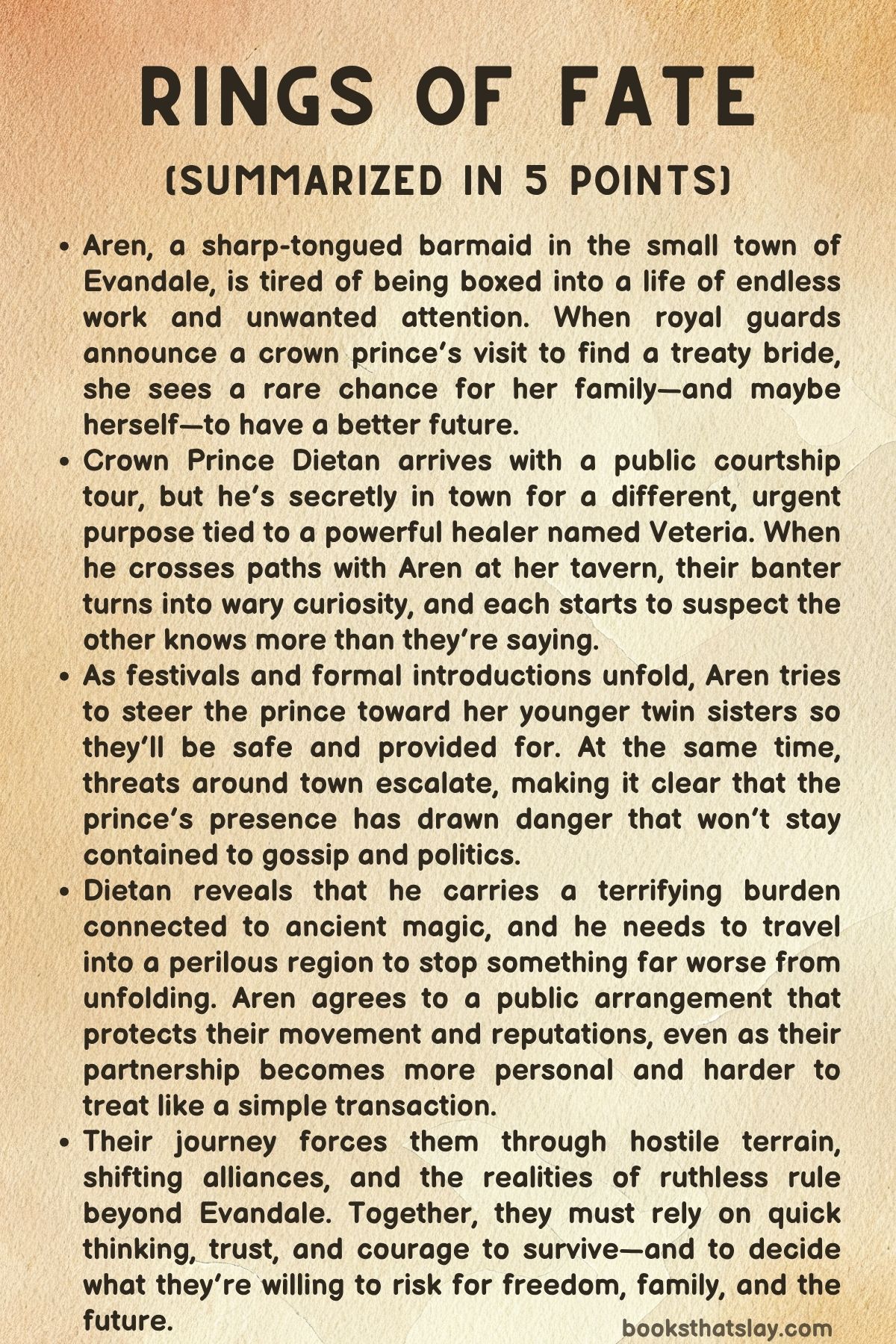
Rings Of Fate by Melissa De la Cruz is a fantasy romance-adventure set in a tense world where royal politics, looming war, and dangerous magic collide. Aren, a tired but tough barmaid in a small town, has spent years sacrificing her own future to keep her family afloat.
When Crown Prince Dietan arrives on a public tour to “find a bride,” Aren sees a possible escape—but Dietan is hiding a far more urgent purpose. He carries the Rings of Fate, relics fused into his body that link him to violent wind power and shadowy killers. Their forced partnership becomes a risky journey that turns both of their lives inside out. The book kickstarts the Curses and Crowns series by the author.
Summary
Aren runs the Raven’s Beak Tavern in Evandale, working herself to the bone while enduring constant attention from drunk men who think marriage is something they can demand. She has no interest in becoming someone’s unpaid servant, and she makes that clear—especially when Shephard Belmis tries proposing again.
Aren publicly shames him using the tavern’s rules: anyone who breaks a rule buys the whole bar a round. The room loves it.
Aren’s sharp tongue and refusal to bow make her both admired and resented, especially by the local nobleman, Lord Breadalbane, who once suggested she become his mistress and now watches her with open hostility.
Rumors of war swirl through the tavern: the Usurper King of Penrith is gathering fighters, borders feel unsafe, and people vanish on the roads near the Great Waste of Estyrion. Aren listens, stores the information, and keeps working, because survival in Evandale depends on routine.
Then Loegrian royal guards storm into the tavern and announce that Crown Prince Dietan of Loegria will arrive soon as part of a treaty arrangement—traveling the kingdom in search of a bride. The room erupts in jokes, but Aren hears something else: a chance.
If her younger twin sisters, Sonja and Ophelia, marry well, her father will be cared for and Aren can finally stop living only for other people.
At home, Aren pours her remaining energy into her sisters’ future. Their mother died when Aren was nine, and Aren became the one who held the family together.
She sews Sonja and Ophelia extraordinary dresses from rare mulberry silk, embellishing them with precious scraps saved from their mother’s trousseau. She hurts her thumb finishing the hems, but she doesn’t stop.
She wants her sisters dazzling when the prince arrives, because she believes beauty and attention might buy them safety in a harsh world.
Prince Dietan arrives in Evandale on schedule, performing charm for crowds and enduring formal meetings with local nobles. His friend Jared, a duke with a biting sense of humor, mocks the “bride search” as theater.
Dietan plays along publicly, but privately he is hunting someone else: Veteria, a powerful healer-sorceress rumored to live in the forest. That night, Dietan slips away in disguise and visits the Raven’s Beak as “Dario,” hoping to ask locals about Veteria without revealing his identity.
Inside the tavern, Dietan witnesses Aren humiliating yet another suitor, and he is instantly curious. Aren serves him food and ale and sizes him up with the wary instincts of someone who has spent years reading strangers.
When he asks about Veteria, Aren warns him that Veteria can’t be found unless she wants to be, and that a nobleman searching for her would put anyone in danger. Dietan’s need is not casual.
Hidden beneath his clothes, fused into his back since childhood, are the Rings of Fate—ancient relics connected to violent earth-and-wind magic called the Whisting. Dietan suffers nightmares, sudden surges of power, and a sense that disaster is approaching.
He believes removing the rings is the only way to survive what’s coming.
The next day, the public “bride event” begins. Women line up to be noticed.
Sonja and Ophelia appear in their stunning gowns, drawing admiration. When Dietan asks who made the dresses, the twins proudly name Aren.
Aren steps forward without hesitation and casually calls him “Dario,” revealing she recognizes him from the tavern. The marquis bristles at her “disrespect,” but Dietan’s reaction is more complicated.
Instead of simple amusement, he becomes alert—wondering what she knows and how she might connect to his search for Veteria.
Aren, meanwhile, is determined Dietan will choose one of her sisters. She argues with him, pushes back against the entire idea of princes shopping for wives, and refuses to act impressed.
Dietan seems entertained by her defiance, winking and baiting her with humor. Aren doesn’t trust him.
She also doesn’t trust the marquis, whose anger toward her grows sharper as her presence draws attention away from his own family.
During the harvest festival, Aren realizes her plan isn’t working. Ophelia is attracted to Jared, not the prince.
Sonja is drawn to General Marcus Marcellus, Dietan’s commander. Aren’s careful strategy starts slipping away.
Then the marquis corners Aren, presses a hand over her drink, insults her, and leaves her shaken. Soon after, Aren becomes dizzy.
She realizes she has been drugged.
On the way back toward the closed tavern, the marquis and a henchman attack her. Even half-poisoned, Aren fights, striking and kneeing her attacker, refusing to go quietly.
The marquis uses stronger poison and tries to smother her with a cloth. Then an unnatural wind explodes through the alley.
A stranger attacks the marquis with brutal efficiency and warns he will kill him if he ever touches Aren again. Aren recognizes the voice—Dietan—and passes out in his arms.
Dietan carries Aren to her home and meets her father, who is wary but grateful. Dietan stays close while Aren vomits out the poison and slowly steadies.
When Aren’s sisters return, Aren downplays the truth, not wanting scandal or panic. Dietan leaves, but the night changes something in him; Aren’s family feels real to him in a way court life never has.
Aren returns to work with bruises hidden under her mother’s kerchief. Dietan finds her again, and their conversations shift between teasing and tension.
Aren suspects he plans to go into the forest searching for Veteria, and Dietan hints that an engagement announcement is coming. Soon, royal invitations arrive—Ophelia and Sonja are summoned privately.
Aren is excluded, and she immediately suspects the marquis’s influence. At the gathering, Jared shocks everyone by proposing to Ophelia.
She accepts, delighted. Sonja’s bond with Marcus deepens.
Aren sees the future rearranging itself without her control, and it stings—especially because the safety she wanted for her sisters is arriving through paths she didn’t plan.
While the town focuses on engagement celebrations, Dietan goes into the stormy forest and gets lost searching for Veteria. Aren goes after him, unwilling to let him die out there.
Veteria appears, knocks Dietan unconscious, and brings both of them to her hidden home. She reveals grim truths: Dietan’s curse is real, the dark forces called the Kilandrar are returning, and only the bearer of the Rings can stand against what’s coming.
Dietan admits the rings branded into his body when he was a child. He wants them removed.
Veteria warns them never to seek King Osian of Engel, reacting with sudden fury at the name. Dietan decides he will go anyway, using a public “wedding march” as cover to travel toward the Great Waste and reach the knowledge he needs.
Back in Evandale, Dietan drinks hard, trying to silence fear. Aren finds him broken and furious, and he pushes a plan onto her: he will propose publicly, she will accept privately as a fake betrothal, and together they will travel under protection and distraction.
Aren publicly refuses his proposal at an engagement party and storms out, furious at the humiliation. In private, Dietan explains the bargain: payment, freedom from real marriage, and a mission with lives at stake.
Before they can settle it, a Kilandrar attacks—an unnatural shadow creature that steals breath. Aren reacts without hesitation, smashing it with her iron skillet long enough for Dietan to drive it back with steel and magic.
The danger becomes undeniable.
Aren sees ring-shaped scars on Dietan’s back and finally understands he isn’t playing games. Still, she resists leaving her father.
Dietan tries to push her away for her own safety. Then a guardsman is found dead, killed by the Kilandrar.
Travel becomes even more dangerous, and the town is placed under tight control. Aren chooses.
She arrives with a packed rucksack and agrees to the fake engagement—on her terms. Dietan announces it publicly, and Evandale cheers as the prince and the barmaid become a story everyone wants to believe.
As they travel, Dietan admits the truth behind his secrecy: nightmares, sudden visions, and the sense that the Kilandrar are being directed by a larger enemy tied to the coming war. Aren learns that blood can disrupt the Whisting’s hold, and she refuses to be treated as fragile cargo.
In a tent at night, their flirtation keeps colliding with honest fear and the fact that they’re beginning to matter to each other. Aren falls asleep believing Dietan would never choose to harm her.
They reach Alba, a city near the Great Waste, silent and broken with signs of flight and illness. At the temple of the Oracle of Alba, a priest performs a blessing and reacts violently when he touches Aren.
He claims a vision has been sent: Aren must never leave Dietan’s side, because Dietan alone ends in darkness and death. Under pressure, Aren promises she won’t abandon him.
As part of the rite, Dietan kisses her, intending it as performance, but it becomes unmistakably real, leaving both shaken.
At the bridge into Estyrion, evidence suggests explosives were used nearby. As they cross, the structure collapses behind them, cutting off retreat and separating Dietan and Aren from most of their soldiers.
Kilandrar appear. Dietan orders Aren to go, but she refuses.
Dietan unleashes the Whisting in a violent storm, dragging the creatures down into the chasm by destroying part of the bridge. The power nearly overwhelms him, triggering visions and loss of control.
He creates a vacuum and can’t breathe. Blood magic fails.
Aren brings him back by cracking him in the head with her skillet—painful, blunt, effective. They survive, but they are trapped on the far side of the bridge, alone in the Waste.
In Estyrion, illusions distort reality. A shimmering “city” turns out to be mirage masking endless desert.
Their supplies run low, and heat and cold grind them down until they are caught and taken by armed strangers. They are forced to drink dosed water that compels truth, and Dietan blurts out his identity and mission: the Rings of Fate, the Whisting, the Kilandrar, and his need to find King Osian for answers.
The captor reveals herself as Princess Katharine of Penrith, alive in exile, with her wife Jingu. Katharine warns that Osian is allied with the Usurper and runs Engel through forced service and coercion.
Her own son disappeared after going there. Even so, she helps them—food, medicine, clothes, horses, goggles that pierce illusions, and a precautionary vial for Dietan.
They ride onward toward Engel’s distant light and are overtaken by a massive sandstorm. As they struggle in ruins and begin to be buried alive, time seems to stop.
Sand freezes midair. A calm young man walks through the suspended storm, releases it harmlessly, and addresses Dietan by name, confirming they have reached the edge of something powerful and controlled.
After further flight and danger, they end up at Sirona’s House of Healing, where temple staff hide them from the king’s men. Soldiers search the building, threatening violence, but the staff hold firm until the danger passes.
The helpers provide food, supplies, disguises, and a route to a safe house. Aren and Dietan hide in a supply wagon and reach the location—only to be trapped inside by someone slamming the door.
Dietan reacts instantly, knife ready, until the “attacker” reveals himself: Marcus. Jared is there too, injured but alive.
Their reunion is emotional and urgent.
They exchange grim news. Dietan’s staged death was discovered.
The king—Osian, revealed as Namreth of Alarice—declared an alarm and killed people in rage, including a man named Bing who tried to stall him. Many others died trying to escape as the city locked down.
With the gates sealed and Namreth aligned with the Usurper, Dietan changes the mission: they must remove Namreth from power. War is coming, and leaving Namreth in control means disaster for Loegria and beyond.
They plan an assassination during Namreth’s massive banquet, when the castle will be crowded with coerced workers and distracted leadership. Dietan disguises himself as a commoner, darkening his hair, and he and Aren enter among suppliers.
They witness the regime’s cruelty firsthand when a guard casually executes a man as a warning. In the servant searches, people are groped and humiliated.
Aren and Dietan endure it, keeping their heads down long enough to reach the kitchens. They’re given masks for the banquet: Aren a fox, Dietan a white wolf.
Aren quietly arms trusted staff with knives and prepares desserts meant to poison key targets.
The plan collapses early when a general eats too much of the poisoned food and dies too fast, drawing attention before they’re ready. A concealed weapon is exposed, alarms ring, and chaos erupts.
Servants and rebels fight with small blades, but Namreth remains calm, killing with wind magic as if people are nothing—crushing bodies and stealing breath. Aren is seized and unmasked.
She searches frantically for Dietan and finds him surrounded. Namreth recognizes them and begins choking Aren with the Unseen Death.
Dietan’s Whisting surges back and throws Namreth across the hall, triggering a full storm clash.
Dietan realizes he may have to die to stop Namreth. He tells Aren to take the Rings to his father and admits he loves her.
Namreth gains the upper hand, suffocating Dietan. Aren breaks free and runs into the storm, breathing into Dietan’s lungs in a kiss—an act of rescue, not display.
It stabilizes him enough to regain control. The Rings manifest, encircling Namreth and stripping his magic.
Namreth rapidly ages into a frail old man and dies, ending his rule in a single brutal shift. The surviving crowd erupts, stunned and relieved.
Dietan orders remaining soldiers to lay down their arms and go home. Aren publicly declares the truth: Osian was Namreth of Alarice, and Engel and Estyrion have been freed from his control.
People kneel to Dietan. He refuses to let Aren kneel.
Instead, he kneels to her and places a gold ring on her finger while wearing a silver one himself, asking her to become his wife for real.
Two weeks later at Lundenwic Castle, Aren reunites with Sonja and Ophelia, and Marcus and Jared reunite with them as well. The danger has changed everyone.
Dietan shows Aren the castle, and in private he asks again for her answer. Aren, no longer trapped behind a tavern bar or living only for her family’s survival, says yes.
She tells Dietan she loves him, and he returns the words. They fall asleep together engaged, alive, and finally facing a future that belongs to both of them.
Characters
Aren Bellamore
Aren is the story’s grounded center: a fiercely competent working-class woman whose sharp tongue and stricter-than-law tavern rules are less “attitude” and more survival strategy. At twenty-five, she’s been forced into adulthood early—mother dead, father ill, twins to raise—and that history shows in how she measures every choice by duty and consequences rather than romance.
Her deepest conflict isn’t simply “freedom vs. love,” but freedom vs.
the guilt of leaving people behind; she wants out of Evandale, yet she has built her identity around being the one who holds everything together. What makes Aren compelling is that her defiance is practical, not performative: she negotiates, sets terms, and refuses to be purchased—whether by drunk suitors, predatory nobles, or even a prince’s charm.
Over the journey, her courage evolves from local resistance into world-shaping bravery, and she becomes a partner in power rather than a passenger in a royal narrative. By the end of Rings Of Fate, Aren’s acceptance of love is not a surrender of autonomy; it’s a decision made with full agency after she has proven—most importantly to herself—that she can be both responsible and free.
Crown Prince Dietan of Loegria
Dietan is a prince built on contradiction: publicly polished, privately exhausted, and internally haunted by magic that is both weapon and wound. His “bride tour” persona is performance and camouflage, but his deeper mask is emotional—he uses wit, flirtation, and aristocratic detachment to keep people from noticing how frightened he is of the Rings embedded in his body and the havoc they can unleash.
The Rings make him a classic reluctant-chosen figure, yet the story sharpens that trope by framing his power as invasive: it branded him as a child, fused into flesh, and ties him to nightmares, visions, and predatory forces like the Kilandrar. His instinct is to isolate and sacrifice himself, repeatedly trying to push Aren away, which reveals both genuine protectiveness and a learned belief that he is inherently dangerous to love.
The turning point in his arc is not simply “learning to control magic,” but learning to accept partnership—letting Aren see the scars, trusting her judgment, and ultimately allowing intimacy to steady him when his breath and control are stolen. Dietan’s final victory over Namreth is therefore more than a magical triumph; it’s a personal reorientation from solitary martyrdom to shared responsibility, culminating in a proposal that finally aligns with truth rather than strategy in Rings Of Fate.
Lord Jared Gruffudd Mackenzie, Duke of Glamorgan
Jared begins as Dietan’s irreverent counterweight: a privileged noble who mocks the “bumpkin bride” premise and treats the tour like theater, which initially paints him as cynical or shallow. Yet his humor is also a form of loyalty—he needles Dietan, but he stays close, helping carry the burden of politics and danger.
His quick, public proposal to Ophelia reframes him as someone capable of decisive sincerity, the kind of man who chooses openly rather than hedging behind courtly ambiguity. Jared’s arc reads as a move from spectator to participant: he stops treating events as an amusing royal inconvenience and becomes someone willing to bleed for the cause, surviving hardship, captivity, and the brutal realities of Engel.
In a narrative crowded with prophecy and power, Jared’s importance is thematic—he demonstrates that love can be bold without being possessive, and that bravery doesn’t require magic, only commitment.
General Marcus Marcellus
Marcus is discipline given a human face: a soldier who enters the Raven’s Beak expecting obedience, only to learn quickly that authority in Evandale is earned—and that Aren commands a room without a sword. His defining trait is professionalism under pressure; he resists Breadalbane’s bribes, manages volatile crowds, and keeps the prince moving even when Dietan resists the tour’s demands.
What makes Marcus more than a “stern general” is his capacity to adapt his loyalty from protocol to people: he backs Aren when the Oracle’s warning places moral weight on her presence, and he continues fighting for Dietan beyond the clean lines of royal travel, enduring the harsh route to Engel and coordinating survival in a city under tyranny. His connection with Sonja also adds texture, suggesting a man who can be gentle without losing authority.
Marcus embodies the story’s idea that honor is not blind obedience but steadfast protection of what is right, even when the plan becomes impossible.
Lord Breadalbane, Marquis of Evandale
Breadalbane is predation dressed as nobility: a local ruler who uses status to excuse entitlement, from the “mistress” proposition to Aren to his attempts to buy influence with bribes and social intimidation. He represents the everyday danger Aren has lived with far longer than magical threats—men who believe women’s bodies and futures are negotiable if the price is high enough.
His obsession with control is exposed in how he reacts to Aren’s defiance: he tries to publicly discredit her, then escalates to drugging and assault when social power fails. Breadalbane’s cruelty also functions as a narrative hinge; his attack triggers Dietan’s intervention and makes the stakes personal, proving that the story’s villains are not only supernatural.
Even when larger antagonists emerge, Breadalbane’s role remains significant because he reveals the world’s baseline corruption—an environment in which a woman’s “no” is treated as a challenge until force makes it final.
Bonnie
Bonnie is the closest thing Aren has to a peer inside the tavern—a younger coworker whose curiosity about marriage and gossip highlights the small-town pressures Aren rejects. She functions as a mirror for what a “normal” life path in Evandale looks like: settling, choosing among local men, treating rumor as social currency.
Yet Bonnie isn’t portrayed simply as naïve; she’s observant enough to warn Aren about Breadalbane’s presence and predatory attention, and her questions pull Aren into articulating what she wants beyond mere escape. In that sense, Bonnie gives voice to the community’s expectations while also quietly validating Aren’s instinct to be cautious, grounding the early chapters in human realism before the magical plot takes over.
Shephard “Shep” Belmis
Shep is a small-scale antagonist who illustrates the everyday sexism Aren navigates: repeated public proposals that are framed as persistence but function as pressure, humiliation, and entitlement. His refusal to respect Aren’s boundary—even when it’s literally written as a tavern rule—shows how “nice guy” insistence can become coercion when a woman’s comfort is treated as irrelevant.
Aren’s bell-and-round punishment is not just comedic; it’s her way of reclaiming power in a space where saying “no” is rarely accepted the first time. Shep matters because he sets the tone: before princes and monsters, Aren’s first battle is against the assumption that her life is available for the taking.
Sonja Bellamore
Sonja is defined by grace and possibility: she’s the twin who captivates a room through beauty and talent, most notably when she dances at the harvest festival. Yet the summary also shows her as more than decorative—she’s perceptive enough to be drawn toward Marcus, indicating an attraction based on character and steadiness rather than glamour.
The mulberry silk dress Aren sews for her becomes symbolic: Sonja wears her sister’s sacrifice stitched into elegance, and her desirability in the “bride search” underscores how women are displayed as assets in political bargaining. Sonja’s trajectory suggests a quieter coming-of-age, moving from dreaming about a prince to recognizing a different kind of strength in Marcus, and potentially stepping into a life shaped by partnership rather than pageantry.
Ophelia Bellamore
Ophelia’s defining feature is her emotional clarity—she knows what she wants sooner than the others expect, and it isn’t the prince. Her interest in Jared disrupts Aren’s carefully constructed plan, forcing Aren to confront the limits of control even when her intentions are loving.
Ophelia’s acceptance of Jared’s dramatic proposal also signals bravery: she steps into a larger world not because she’s dazzled by status, but because she chooses a person who chooses her loudly, publicly, and without shame. In contrast to Aren’s long resistance to marriage, Ophelia shows a version of commitment that doesn’t feel like captivity, widening the story’s view of what love and agency can look like for women.
Aren’s Father
Aren’s father is less a fully dramatized character in the summary and more the emotional anchor of Aren’s duty. His illness and dependence shape Aren’s entire worldview: she runs the Raven’s Beak, raises the twins, and delays her own life because someone must keep the family from collapsing.
His presence humanizes Aren’s reluctance to leave and prevents her from reading as simply restless or ambitious; her desire for freedom is always counterweighted by care. When Dietan carries Aren home and meets her father, that domestic encounter becomes a quiet test of Dietan’s character, and it also exposes what Aren is protecting—ordinary love, fragile stability, and a home built out of constant labor.
Veteria
Veteria is the story’s gatekeeper of truth: a healer-sorceress who cannot be approached through entitlement or noble demand, only through need and circumstance. Her power is presented as both mystical and grounded—she heals, she calms storms, and she understands the deeper metaphysics of the Rings and the Kilandrar, but she also sets boundaries fiercely, appearing only when she chooses.
Veteria’s role is crucial because she punctures the romantic-adventure veneer with prophecy and consequence, naming Dietan’s curse and tying personal suffering to national fate. Her explosive reaction to Osian reveals trauma and history that the summary hints at but does not fully unpack, implying past encounters with dark power and the cost of seeking it.
Veteria is not merely an exposition device; she embodies the story’s warning that knowledge has a price, and that some doors, once opened, do not close cleanly.
Princess Katharine of Penrith
Katharine is a living contradiction to the rumor-mill of politics: presumed lost, she survives in exile with hardened pragmatism and a clear-eyed understanding of tyranny. Her introduction flips the power dynamic—she captures Aren and Dietan, forces truth with henbane cactus, and controls the situation not through royal ceremony but through competence and caution.
Katharine’s bitterness is purposeful; she has paid for trust with loss, including the disappearance of her son, and she refuses to romanticize dangerous quests or charismatic kings. Yet she is not closed off to mercy—she heals them, equips them, and still helps despite warning them that Osian’s domain is a trap.
Katharine widens the moral landscape of the story by revealing that “enemy kingdoms” contain victims and resistors too, and that survival can require alliances built on shared wounds rather than shared banners.
Jingu
Jingu’s presence, though less elaborated in the summary, is significant in what it quietly asserts: partnership can exist as sanctuary and strength in a brutal world. As Katharine’s wife, she signals that this exile is not merely a political hideout but a chosen life with loyalty at its core.
Jingu’s armed, veiled introduction also contributes to the atmosphere of earned trust—she is not there to soothe the protagonists, but to help keep them alive, reinforcing the idea that love in this setting often looks like preparedness and protection rather than softness.
Namreth of Alarice, revealed as “Osian”
Namreth is tyranny with a magician’s precision: a ruler who maintains power through fear, coercion, and the casual spectacle of execution, turning governance into an ongoing demonstration of dominance. His deception—being “Osian” while aligned with the Usurper—makes him both political and existential threat, because he weaponizes not only armies but also belief, misinformation, and forced service to build an indentured machine.
His wind magic mirrors Dietan’s in a way that makes their conflict feel like a corrupted reflection: both command storms, but Namreth uses power to erase personhood, choking and crushing as if people are obstacles, not lives. What makes him especially chilling is composure; even when chaos erupts, he kills effortlessly, implying long practice and emotional vacancy.
His rapid aging and death when stripped of magic is thematically sharp—his authority was never rooted in legitimacy or loyalty, only in stolen force, and once that force is removed, there is nothing left to sustain him.
The Kilandrar
The Kilandrar are less “characters” in a human sense and more a predatory presence with intent—shadowy beings that steal breath, induce terror, and function as hunters keyed to the Rings and the Whisting. Their attacks are intimate and horrifying because they target something fundamental: air, voice, life itself, turning suffocation into a symbol of being erased.
Narratively, they externalize Dietan’s internal fear—his power calls danger, his body is marked, and his very existence attracts violence. They also escalate the story from social threat to supernatural war, forcing Aren and Dietan into choices that can’t be postponed or negotiated away.
Even without individual personalities, the Kilandrar carry thematic weight as agents of a larger darkness closing in on kingdoms and futures.
Sister Dosha
Sister Dosha embodies moral courage under occupation: she lies calmly to armed men, holds her ground under threats of destruction, and protects fugitives not because it is safe but because it is right. Her authority comes from spiritual discipline and community trust rather than weapons, and the contrast between her composed denial and the soldiers’ brutality underscores how resistance can be quiet yet formidable.
By offering a safe house and making hard choices about what the temple can and cannot risk, she also represents responsible leadership—careful with lives, not reckless with ideals. In the summary’s later shift toward rebellion and assassination, Sister Dosha is a reminder that defiance has many forms, and not all heroes fight with blades or magic.
Siena
Siena is urgency and heart: she moves fast, warns Aren and Dietan, helps hide them, and then refuses to flee because her purpose is rooted where the suffering is. Her choice to stay makes her brave in a different register than the protagonists—she’s not chasing a quest, she’s enduring a regime daily and choosing to remain useful.
The goodbye hug with Aren carries emotional weight because it shows Aren forming bonds beyond blood family, and it frames resistance as a network of ordinary people deciding, again and again, to protect someone else at personal risk.
Priest of the Oracle of Alba
The priest serves as a hinge between doubt and destiny: a ritual functionary who becomes a messenger of warning when he reacts violently to touching Aren’s head and claims a vision. Whether one reads him as truly prophetic or as a conduit for larger forces, his pronouncement reframes Aren from “tagalong fiancé for cover” into a necessary counterbalance to Dietan’s darkness.
Importantly, his intervention also compels commitment; Aren’s promise not to leave Dietan’s side becomes a moral contract that later shapes her choices on the bridge and beyond. The priest’s role highlights how the story uses faith and institutions not only as tradition, but as mechanisms that can redirect power and responsibility toward the person least interested in being “chosen.”
Arnfried
Arnfried appears as part of Aren’s later circle in Engel, positioned as a practical ally in the safe house—someone who reads maps, shares intelligence, and participates in planning rather than spectacle. Even with limited detail in the summary, Arnfried’s presence signals that Aren’s courage inspires community; she is no longer acting alone, and the struggle against Namreth is being carried by a coalition of people willing to risk everything.
Arnfried functions as one thread in that collective resistance, emphasizing that liberation is never achieved by a single destined hero.
Lambert
Lambert is the connective tissue of survival logistics: he is associated with the safe house network and the group’s coordination after infiltration and escape routes collapse. He represents the kind of competence that keeps rebellions alive—contacts, timing, shelter, and the ability to turn chaos into a plan.
In stories dominated by royalty and magic, Lambert’s significance lies in the reminder that revolutions depend on people who can organize, not just people who can fight.
Tess
Tess is the voice of hard news and earned realism: she reports deaths, likely escapes, and the regime’s crackdown with the bluntness of someone who has already watched hope get people killed. Her testimony about Bing’s death and the city locking down raises the moral stakes of Dietan’s choices—every plan has collateral, and every delay costs lives.
Tess also contributes to Aren’s arc by expanding Aren’s empathy beyond her family; Aren begins the story trying to secure only her sisters, but by Engel she is grieving strangers and weighing decisions for entire communities.
Bing
Bing’s role is tragically brief but emotionally sharp: he tries to stall Namreth and is killed instantly, illustrating just how lethal and casual the tyrant’s violence is. Bing represents the countless unnamed helpers who make resistance possible and pay for it first—kitchen workers, servants, bystanders who become heroes for a moment because a moment is all they have.
His death also strips any remaining illusion that this is merely a royal adventure; it is war under a boot, and survival is never guaranteed.
Nelson and Rosamond
Nelson and Rosamond function as uncertain hope—figures who “likely escaped,” suggesting that in the story’s darkest stretch, even partial survival feels like victory. Their mention broadens the sense of community around Aren and Dietan and underscores the cost of closed gates and mass panic.
They are narrative reminders that outcomes ripple outward: every plan affects people we may only glimpse, and the aftermath of tyranny is measured not only in defeated villains but in who manages to get out alive.
Lydia
Lydia is present mostly through implication—her kidnapping and death are referenced as part of the pattern Dietan believes connects the Kilandrar and the larger enemy force. Even without details, she serves as a haunting signpost: people have been paying the price for these secrets long before Aren entered the prince’s orbit.
Lydia’s absence adds gravity to Dietan’s fear that he brings harm wherever he goes, and it reinforces the idea that the Rings’ curse is not personal tragedy alone but a widening circle of loss.
King Elgar of Alarice
King Elgar is mentioned more than shown, but he represents the “official” political order that is under strain—raising hazard wages, responding to instability, and existing in a landscape where identities and loyalties are not always what they seem. His presence in rumor and policy sets up how nations are preparing for conflict, and it makes Namreth’s deception more potent because it implies rot or manipulation close to the heart of governance.
Elgar’s limited depiction keeps him symbolic: a reminder that kingdoms are systems, and systems can be exploited by the ambitious and the monstrous.
Themes
Autonomy, Labor, and the Price of Survival
Aren’s daily reality in Rings Of Fate is defined by work that never ends and choices that rarely feel like hers. Running the Raven’s Beak is not romantic “small-town life”; it is constant physical and emotional labor, made heavier by the way men treat her presence as public property.
The repeated proposals are not flattering interruptions but reminders that her body and future are assumed to be available for negotiation. Aren’s tavern rules, especially the public penalty for marriage proposals, become her way of reclaiming control in a space where she is expected to accommodate everyone else.
It is not simply humor or toughness; it is a strategy for survival that turns humiliation back onto the people who try to reduce her to a prize. Even her home life reinforces how limited her freedom has been.
After her mother’s death, Aren effectively becomes a parent while still a child, and the responsibility hardens into an identity: caretaker, provider, problem-solver. She measures security in practical terms—her sisters’ marriages, her father’s wellbeing, steady income—because she has learned that safety is something you build with your hands, not something granted by fate or romance.
That is why the prince’s arrival matters so sharply. The “bride search” is presented as spectacle, but Aren reads it as an exit route and immediately calculates how to use it.
Her plan to position her sisters for the match can look controlling on the surface, yet it comes from a lifetime of being denied the right to want something purely for herself. She believes she can only earn her freedom by arranging everyone else’s stability first, and that belief becomes both her strength and her trap.
Later, when she agrees to the fake engagement, she does not do it as a swooning romantic; she negotiates terms and asserts boundaries. The story keeps returning to the idea that autonomy is not a mood or a slogan.
For Aren, it is a hard-won practice: choosing risk with open eyes, refusing to be cornered by social expectations, and deciding what she will trade—and what she will not—no matter who is asking.
Power, Secrecy, and the Burden of Inherited Violence
Dietan’s magic and the Rings fused into his body push power into a darker, more complicated place than simple “special hero” status. Power is portrayed as something that can injure the person who holds it and everyone nearby, even when that person is trying to do the right thing.
Dietan’s nightmares, surges, and the fear of losing control show how authority and danger sit in the same seat. The Rings are not an object he can lock away; they are part of his flesh, meaning there is no clean separation between self and weapon.
That detail changes the moral weight of his choices. When he drinks, isolates himself, or tries to push Aren away, it is not only emotional immaturity.
It is also the defensive posture of someone who expects his presence to cause harm. He treats closeness as a liability because the world has trained him to think of himself as a walking disaster.
Secrecy becomes the language of survival for him: fake rings, false names, staged performances for crowds, and a public romance that is initially nothing but cover. Yet the story keeps showing the cost of hiding.
The more he withholds, the more he risks making decisions alone, and the more easily enemies can shape events around him. The guards’ warnings, the spies, the political theater, and the way rumors travel through taverns all reinforce that information is a weapon in this world.
Dietan’s hidden mission is not only personal; it is geopolitical. His body carries a resource others want to control, and that creates a constant pressure toward exploitation.
When the Kilandrar attack and when the regime in Engel uses cruelty as routine governance, the narrative suggests that violence does not need chaos to thrive; it can become policy, tradition, and inheritance.
What makes this theme land is that power is never framed as cleanly heroic. Dietan’s wind magic can save lives, but it also nearly kills him, and it draws predators like a beacon.
The story repeatedly asks what it means to be responsible for force you did not ask for. It answers by showing responsibility as exhausting, imperfect, and often lonely.
Dietan’s real challenge is not learning to produce power, but learning when to trust others with the truth, how to share risk without treating self-sacrifice as the only form of leadership, and how to stop believing that pain is the required price of protecting others.
Consent, Predation, and Social Systems That Enable Harm
The marquis’s behavior toward Aren is not an isolated villain subplot; it is a lens on how social rank can normalize coercion. Predation is shown as something that often arrives wearing entitlement rather than masks.
Breadalbane’s offer of making Aren a mistress, his public shaming, his attempts to bribe authority, and the eventual drugging and assault all function as escalating proof that he sees women as possessions and consequences as optional. What is most disturbing is not only his willingness to hurt Aren, but how confident he is that he can rewrite the story afterward.
The setting supports that confidence: a small town where rumors travel fast, where a barmaid’s reputation is fragile, where powerful men can hint she is “trouble” and expect others to agree. The danger is social before it is physical.
Aren understands that a single narrative controlled by someone like Breadalbane can destroy her livelihood, her sisters’ prospects, and her ability to move safely through her own town.
The book also shows how predation thrives through complicity and convenience. The marquis tries to influence the general with money, attempts to manage who is invited to private audiences, and leverages public manners to frame Aren as disrespectful.
These are not dramatic spells; they are everyday methods powerful people use to shape reality. When violence finally breaks through the surface—drugged drink, henchman, cloth over the mouth—it feels like the end point of a system that has been quietly granting him permission for years.
The narrative refuses to treat Aren’s resistance as symbolic. She fights, claws for space, stays alert to shifts in tone, and later hides bruises because she knows visibility can be dangerous.
Even when Dietan intervenes, the story does not turn the moment into a simple rescue fantasy. Aren’s fear and anger remain centered, and the aftermath includes silence, calculation, and the need to keep working the next day.
This theme also expands beyond sexual threat into political coercion in Engel, where servants are groped during searches, random executions are used as “lessons,” and forced service is treated as a resource pipeline. The same logic runs through both environments: power assumes access to bodies.
By placing Aren’s personal danger alongside state violence, the story argues that consent violations are not “private issues” separate from politics. They are part of how regimes and hierarchies maintain control, and resisting them requires more than bravery—it requires refusing the stories that justify them.
Chosen Loyalty and Love Built Through Shared Risk
The relationship between Aren and Dietan develops in a way that emphasizes trust as action rather than declaration. They start from mutual suspicion: Aren is alert to noble games and wary of being used, while Dietan is cautious because he fears what she might know about Veteria and because he assumes closeness will get her hurt.
Their early exchanges are sharp because both are testing boundaries. Aren refuses to be charmed into surrendering judgment, and Dietan refuses to reveal more than he thinks is safe.
What changes the shape of their connection is not a single confession but repeated moments where each chooses the other under pressure. Dietan carries Aren home and treats her recovery with care, yet he also tries to keep emotional distance.
Aren chooses to go with him only after weighing responsibilities and setting terms, which establishes that partnership for her must include agency. Their fake engagement becomes a forcing function: it places them in situations where they must coordinate, improvise, and protect each other while everyone watches.
Aren’s loyalty is never passive. She does not follow because she has nowhere else to go; she follows because she decides the mission matters and because she refuses the idea that fear should make her small.
On the bridge and in the Waste, her devotion shows up as practicality and nerve: the skillet strike that brings Dietan back to breath is almost comic on the surface, yet it captures the kind of love the book values—imperfect, embodied, and willing to look ridiculous if it keeps someone alive. Dietan’s loyalty, in turn, is complicated by self-protection instincts that resemble self-punishment.
He keeps trying to send her away “for her safety,” but those attempts also reveal his belief that he alone should absorb harm. The Oracle’s warning pushes against that belief by turning Aren’s presence into something necessary, not optional.
From there, their bond becomes a test of whether they can accept care without turning it into ownership.
The climax in Engel makes this theme explicit: Aren’s act of restoring Dietan’s breath is both intimate and tactical, a moment where love is also survival. Their partnership defeats a tyrant not through solitary heroism, but through coordination—her steadiness and his power finally working in the same direction.
By the time Dietan kneels to Aren, the gesture matters because it recognizes what the story has been building: loyalty that is chosen daily, love that respects strength, and a future that is not granted by title or prophecy but earned through shared decisions and shared danger.