Ralph’s Party Summary, Characters and Themes
Ralph’s Party by Lisa Jewell is a London-set relationship novel that follows the residents of a single house on Almanac Road as their private hopes collide in public, messy ways. The story starts small—two flatmates in a basement looking for a new tenant—but quickly becomes a close look at longing, self-deception, and the strange ways people use one another to feel chosen.
Through sharp social scenes, awkward intimacy, and one unforgettable party, the book tracks how a household’s routines are disrupted when a new person arrives and everyone’s unspoken desires start showing.
Summary
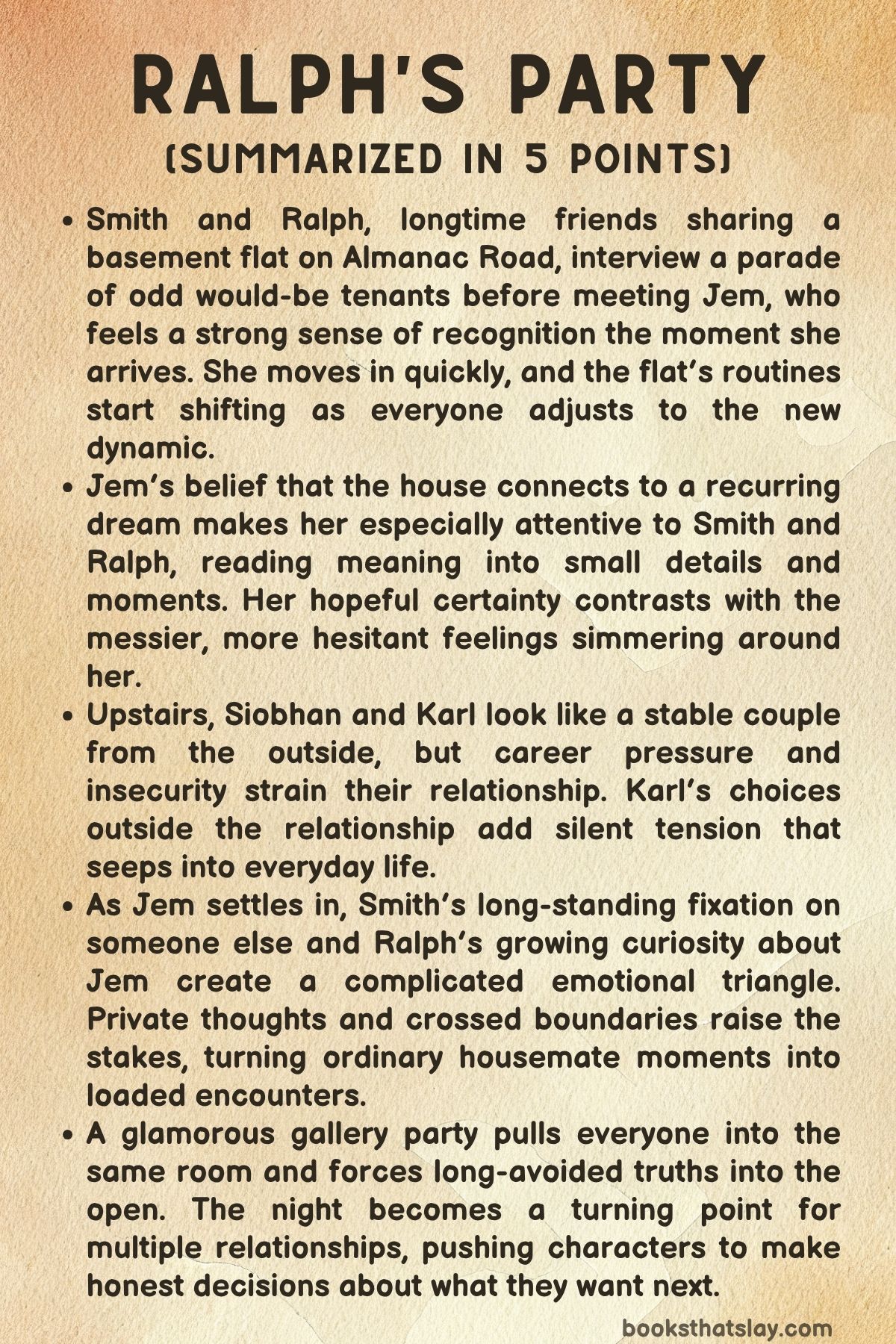
Smith and Ralph have lived for years in a basement flat on Almanac Road, sharing the kind of friendship built on habit: television, cigarettes, and the comfort of not asking too much of each other. They need a new flatmate and interview a parade of mismatches—people who are too intense, too strange, too damaged, or simply wrong.
When Jem calls and says she’s coming to see the room, Smith expects another disappointment. Instead, Jem arrives with an eerie certainty.
She feels she has been here before, because for years she has dreamed of this exact street and a tall house with a basement window where she sees a man sitting on a sofa. When she looks through the window and sees Smith inside, the shock of recognition convinces her that this is where she is meant to be.
She takes the room immediately and moves in, brightening the flat with her energy and curiosity.
Upstairs, the rest of the house has its own secrets. Siobhan lives with her partner Karl, who is thrilled to land a prime-time “Drive Time” radio slot.
Siobhan smiles for him, but privately she feels threatened by his momentum and ashamed of her weight and stalled ambitions. Unknown to her, Karl has been sleeping with Cheri, the athletic, confident blonde in the top flat.
Cheri has also become the fixed point of Smith’s life: for five years he has nursed an obsession with her, interpreting every small interaction as proof that she might one day choose him. He has done nothing to move closer, but he has also done nothing to let go.
Jem’s arrival shifts the balance. Ralph, who has long chased women with more hope than success, becomes fascinated by the idea of living with a woman who isn’t a girlfriend.
One day, alone and restless, he slips into Jem’s room and reads her diary. He learns that Jem believes the basement flat is her destiny and that the man from her dream could be either Smith or Ralph.
She describes Smith as tense and controlled, and Ralph as lean and exciting. Ralph puts everything back carefully, but the knowledge sticks to him.
He starts watching Jem more closely, feeling both flattered and unsettled.
Jem tries to bond with her new flatmates by cooking dinner. She shops in Chinatown, imagining her future falling into place.
Smith arrives home stressed from work but strangely attentive, bringing wine and flowers. They eat, drink, and talk late into the night.
Jem speaks openly about her recurring dream and admits she believes one of them is the person she’s been waiting for. She asks Smith for a hug, and the closeness tips into sex.
For Jem, it feels like fate finally showing its hand. For Smith, it is an impulsive act that immediately triggers panic—less because of Jem, and more because he feels he has betrayed his fantasy of Cheri.
The next day Jem calls with happy confidence, assuming their night means something real. Smith, cornered by her certainty and his own cowardice, doesn’t correct her.
Ralph is stunned and jealous when he realizes Jem has slept with Smith almost as soon as she moved in. His envy pushes him deeper into invasion.
He reads more of Jem’s diaries, not just the recent pages but her older entries, absorbing her past and turning her private self into something he thinks he understands better than Smith ever could. Meanwhile, Karl’s situation begins to rot.
Cheri ends the affair casually and drops a bomb: she was pregnant, had an abortion, and never told him. Karl’s rage is less about losing Cheri and more about losing the baby, especially because Siobhan has been told she can’t conceive.
He starts carrying his grief like a weapon and looks for someone to punish.
As weeks pass, Jem settles into a relationship with Smith that she reads as “right” because it lacks drama. She tells herself she has finally found someone stable.
Smith even admits he has been celibate for years, which Jem treats as further proof that she is the turning point in his life. Yet Smith remains emotionally elsewhere, still orbiting Cheri whenever he can.
Ralph, pushed to the margins by Jem and Smith’s couplehood, begins spending time with Jem alone. One night they cook together, laugh, get stoned, and turn the kitchen into a chaos of spices, music, and dares.
For a brief stretch, Jem and Ralph feel like equals—easy, teasing, understood. When Ralph accidentally kisses Jem on the lips, the moment hits him with clarity: he is in love with her.
Upstairs, Siobhan spirals into insecurity, then claws her way toward change. After a painful confrontation with Karl, she finally names what has been happening inside her—jealousy, shame, and fear that Karl will leave her behind.
Karl tries to reassure her, carrying the guilt of his betrayal while still refusing to confess it. For a while they reconnect, talk, and even begin pursuing fertility treatment again.
Siobhan joins Weight Watchers and builds a new sense of purpose by restarting her dressmaking work. Karl attempts to reinvent their home and his own image, trying to look like a man ready for marriage and fatherhood.
On the surface, they appear to be recovering.
Then the truth surfaces through a tape recorder that captured talk of Karl and Cheri’s affair and the abortion. Siobhan confronts Karl and throws him out.
Karl crumples, begging, but the damage is too large for tears to erase. Siobhan, furious and newly self-protective, moves into a different life that includes Rick, Karl’s producer, who has offered her support.
Ralph, meanwhile, makes a risky decision. Unable to tolerate watching Jem build a future with Smith while Smith quietly uses her, Ralph sets a trap.
He invites Cheri to be his date to a gallery party where his paintings will be shown. Cheri agrees for her own reasons—she enjoys power, and she senses a chance to shape the story in her favor.
Invitations go out in mysterious red envelopes, drawing the whole house toward one night.
At the gallery, tension rises quickly. Jem arrives dressed up, hoping for a fun evening, only to be belittled by Smith’s moodiness.
Karl arrives drunk and unstable. Siobhan shows up unexpectedly, looking transformed and confident.
When Jem finally finds Ralph, he introduces Cheri as his guest. Smith reacts with sudden heat—tongue-tied, flushed, pulled toward Cheri like a magnet.
Karl explodes, accusing Cheri of destroying his life. Outside, Karl and Siobhan end up talking through their wreckage, each shocked by what the other has become.
Inside, Ralph reveals the core of his work: painting after painting of Jem—portraits and still lifes linked to her presence in his life. Jem is overwhelmed, embarrassed, and suddenly aware that Ralph has been seeing her in a way Smith never has.
At the same time, she watches Smith cling to Cheri, acting like Jem is an inconvenience. The night turns public and brutal when Smith, drunk and desperate, drops to his knees and proposes to Cheri in front of everyone, declaring love he has been hiding for years.
Jem breaks, screams, and runs.
Ralph follows Jem into the street and finally tells her the truth: Smith’s long obsession, the way he has used Jem as a stand-in, and the silence Ralph was pressured into keeping. Jem’s humiliation turns into anger, then into recognition.
She sees that Ralph’s actions, however manipulative, came from real love and from a refusal to keep watching her be lied to. Jem admits what she has been trying not to feel: she loves Ralph.
The night’s fallout continues as Karl lashes out physically, attacking Rick in the street, and Ralph is struck while trying to stop the fight. Eventually the chaos drains into exhaustion.
Smith is found collapsed and sick in a bathroom, the final image of a man whose fantasies have eaten his dignity. Everyone returns to Almanac Road in a silent cab, carrying the wreckage of what they revealed.
Back at the house, Jem and Ralph share a quiet moment that feels like the end of confusion and the beginning of something honest. Under the full moon, Ralph sits on the sofa in the basement exactly as in Jem’s recurring dream.
Jem sees him through the window, the image finally matching what her mind has been chasing for years. She runs inside and kisses him, accepting that what she thought was destiny was real—but not with the person she first chose.
Characters
Smith
Smith is presented as a man who has built his adult life around safety, habit, and quiet control, and the arrival of Jem destabilizes that carefully managed routine. Although he appears reliable—he works in financial PR, owns the basement flat, and plays the role of steady host—his inner life is dominated by avoidance and fixation.
His five-year obsession with Cheri is less a romantic bond than a self-protective fantasy: by clinging to an unattainable woman, he never has to risk being truly seen, rejected, or required to change. When Jem enters the flat with warmth and belief in “destiny,” Smith responds physically and emotionally in the moment, but afterward he panics because intimacy threatens the narrative he has used to organize his life.
His relationship with Jem becomes morally ugly not because he dates her, but because he uses her as a tool—proof of desirability, a strategy to provoke Cheri, and a substitute for the woman he actually wants. Under stress, his worst traits intensify: self-pity, entitlement, and cowardice.
His public proposal to Cheri at the gallery is the climax of that entitlement—an attempt to force a fantasy into reality—followed immediately by humiliation that exposes how little dignity or self-knowledge he truly has.
Ralph McLeary
Ralph begins as the charismatic counterpart to Smith: more socially fluent, more open to experience, and seemingly lighter on his feet, yet his charm hides a deep restlessness and a fear of being left behind. In Ralph’s Party, he is a stalled artist whose identity is bruised by unrealized promise, and that long, quiet disappointment shapes how he moves through friendships and romance.
His relationship with Claudia reveals his weakness for convenience and validation, even when he knows he doesn’t love her, and his early curiosity about Jem carries the same hunger to feel chosen. The turning point is his invasion of Jem’s privacy—reading her diary—which is both a moral failure and a revealing act of loneliness: he cannot bear being excluded from the emotional center of the flat, so he steals intimacy rather than earning it.
Yet Ralph also grows more than anyone expects, because guilt, jealousy, and love force him to become deliberate. His love for Jem isn’t simply desire; it becomes purpose, motivating him to end a hollow relationship, attempt maturity, and ultimately take an active risk to break the illusion Smith is sustaining.
Even his orchestration of Cheri’s presence at the gallery is ethically messy, but it comes from a desperate belief that the truth must finally be made undeniable. By the end, Ralph’s arc resolves into earned recognition: he becomes the man in Jem’s dream not by fate alone, but because he finally stops living passively and chooses to be emotionally honest.
Jemima Catterick (Jem)
Jem arrives as an engine of narrative momentum: she carries a private mythology—recurring dreams of the house and the man in the basement—and she walks into Almanac Road already primed to interpret coincidence as destiny. Her defining trait is not naivety but meaning-making: she wants the world to have a pattern that includes her, and she has the imaginative intensity to make that pattern feel real.
This longing makes her generous and alive—she cooks, connects, encourages vulnerability—yet it also makes her vulnerable to projection, because she sometimes loves the role a person can play in her story before she fully understands the person themselves. With Smith, she confuses his emotional restraint for stability and “the One,” reading his distance as evidence he won’t become controlling like past boyfriends.
As the story progresses, Jem is repeatedly forced to confront the gap between her romantic interpretation and other people’s motives: Smith’s evasions, Ralph’s hidden suffering, and the ways desire can be selfish. What makes her compelling is that she does not remain trapped in her fantasy; humiliation shatters her illusions, but it also clarifies her instincts.
When the truth is finally spoken aloud, she recognizes not only Smith’s manipulation but also Ralph’s consistent emotional presence beneath his flaws. Jem’s ending feels like a reconciliation between fate and choice: she still believes in the dream, but now she chooses the person who has shown up honestly rather than the person she once tried to fit into the dream’s silhouette.
Claudia
Claudia functions as a pressure point—a character whose demands expose the weak boundaries and emotional evasions of others, especially Ralph. She is portrayed as controlling and draining, but her role is more than simply antagonistic: she embodies a kind of relationship built on need, performance, and leverage rather than mutual tenderness.
Ralph stays with her not because she fulfills him, but because she provides a familiar structure and proof that someone wants him, even if the wanting is coercive. Claudia’s anger and tears when Ralph ends things underline how entangled they are in dependency rather than love, and her presence early on sharpens the contrast between the life Ralph has settled for and the life he begins to want once Jem arrives.
She is less a fully explored inner world than a mirror held up to Ralph’s immaturity, making his later attempt at “mature and available” feel like an intentional break from the version of himself that accepts emotional bargains just to avoid being alone.
Siobhan
Siobhan is the novel’s most psychologically intimate portrait of insecurity and reinvention, and the story treats her self-image as a living thing shaped by love, fear, and social comparison. At the start she is defined by unease: Karl’s success expands his world while she feels herself shrinking, physically and emotionally, into the flat.
Her weight gain and infertility diagnosis are not just plot details; they become symbols of a life she fears is closing in on her, and she internalizes the belief that she is becoming unworthy of desire. Her jealousy around Cheri is therefore not shallow rivalry but terror—terror that she is replaceable, that youth and confidence will always win, that she has missed her chance to become who she imagined.
What makes Siobhan’s arc powerful is the way it swings from collapse to agency. When she discovers the affair, her rage is also clarity; she stops negotiating with doubt and demands reality.
Her subsequent transformation—new independence, changed appearance, a willingness to go alone, a refusal to be emotionally trapped by someone else’s apology—shows her choosing herself without becoming cruel. Even when she reconciles emotionally with the complexity of her history, she does not return to the same dependency.
Siobhan ends as a woman who understands that love must not require self-erasure, and her presence elevates the story beyond romance into a study of dignity.
Karl
Karl is a character built from appetites and anxiety: he wants admiration, excitement, and a sense of being exceptional, yet he also wants the comfort of being loved without consequences. His new radio success should be a stabilizing reward, but instead it becomes a destabilizer because it amplifies every weakness in his relationship with Siobhan and in his own integrity.
His affair with Cheri begins through seduction and opportunity, but his continued participation reveals a pattern of moral laziness—he lies easily, compartmentalizes, and convinces himself he can manage the damage. The abortion revelation triggers his most unsettling trait: he frames loss and betrayal around himself, becoming furious not primarily over Cheri’s choices but over the symbolic child he wanted, especially because Siobhan is infertile.
That reaction exposes how he turns women’s bodies and futures into emotional props for his own longing. Yet Karl is not portrayed as irredeemably monstrous; his guilt is real, and his desire to fix things is genuine, even if it arrives too late.
His downfall at the gallery and the violent eruption afterward show what happens when shame, grief, and helplessness combine without maturity. Karl ultimately becomes a tragic figure of self-sabotage: someone who wanted adulthood, love, and family, but chose shortcuts and secrecy until the life he valued could no longer survive him.
Cheri
Cheri is the most catalytic presence in Ralph’s Party, a character who exerts outsized gravitational pull because others project onto her what they want most. To Smith she is the perfect, unattainable prize, a fantasy of transformation: if she chose him, he could believe he was worth choosing.
To Karl she is both thrill and threat, a woman who awakens desire while refusing to be managed by his conscience. To Siobhan she is the embodied fear of replacement, the physical representation of youth, attention, and sexual confidence.
Cheri’s own actions complicate the “temptress” label: she ends the affair abruptly, reveals the pregnancy and abortion with chilling casualness, and later maneuvers with calculation when she breaks into Karl’s flat to get Siobhan’s address. She is pragmatic, self-protective, and sometimes cruel, but also unusually honest about the transactional nature of desire.
What makes her fascinating is that she refuses the emotional narratives others try to force onto her; she will not be anyone’s redemption arc. Even at the gallery, when Smith collapses into public devotion, she becomes the unwilling stage for someone else’s fantasy, and her reaction emphasizes her core function in the story: she is a mirror reflecting the desperation, entitlement, and insecurity of the people around her.
Cheri is not “the villain” so much as the character who proves how dangerous it is to confuse attraction with meaning.
Rick de Largy
Rick operates as a destabilizing outsider who nonetheless becomes a strange instrument of truth. As Karl’s producer, he represents the adult, corporate pressure of the radio world—metrics, performance, “personality”—but on a personal level he becomes the unexpected witness to the cracks in Karl and Siobhan’s relationship.
His presence in Scotland and the complicated incident by the loch shore set off consequences that ripple through the plot, especially through the tape recorder that later exposes Karl’s affair. Rick is not portrayed as purely predatory or purely noble; he exists in a morally gray space where kindness, opportunism, and poor judgment overlap.
What distinguishes him is that he becomes a path for Siobhan’s reinvention, offering a version of life in which she is not waiting to be chosen by her partner’s attention. His beating at the gallery’s end underscores a key theme: men’s shame and rage often seek a target, and Rick becomes the body onto which Karl offloads his unbearable realization that Siobhan has actually moved on.
Jeff
Jeff is a compact but revealing figure of institutional power, representing the impersonal machinery that turns human identity into entertainment product. His demands—more mainstream choices, more “zany” content, more personality—reduce Karl’s taste and self-concept to ratings anxiety.
Jeff’s function is to show how quickly external success can become another form of suffocation, and how public performance pressures private collapse. He matters not because of deep interiority, but because he pushes Karl into situations that strip away control, increasing Karl’s volatility and making the personal catastrophes more likely to detonate.
Philippe
Philippe, the gallery man, embodies the theatrical surface of art-world status, fussing over details and staging the exhibition as spectacle. His role is to heighten the contrast between curated appearance and messy truth: the gallery is dressed in flowers and champagne while relationships unravel in real time.
Philippe helps turn Ralph’s private longing into public display—portraits and symbolic still lifes—creating the setting where secrets cannot stay private. He functions like a master of ceremonies for collapse, not because he causes it, but because his world is built for performances, and the characters arrive already primed to perform until they break.
Siobhan’s mother
Siobhan’s mother appears primarily as a refuge and a moral anchor, a place Siobhan can retreat when the relationship becomes intolerable. That refuge matters because it gives Siobhan a practical exit from chaos, making her independence possible rather than merely emotional.
Even without extensive presence, she represents a life line: the reminder that Siobhan is not trapped, that she has somewhere to go, and therefore the power to demand better.
Pete
Pete functions as a brief, surreal interlude character, guiding Jem and Ralph into a night that feels like a fever dream of London—touristy wandering, odd encounters, and the rotating waterbed spectacle. His significance is less personal depth and more catalytic atmosphere: he helps create an in-between space where Jem and Ralph loosen their usual roles, allowing intimacy to surface without the usual domestic boundaries of the flat.
Pete’s flat becomes a symbolic detour into adult randomness and sexual possibility, making the tension between Jem and Ralph feel both more dangerous and more inevitable.
Tom and Debbie
Tom and Debbie serve as small markers of ordinary couplehood and social normalcy, the kind of stable companionship that contrasts with the volatility elsewhere. Their dinner presence helps frame Karl’s decision to propose as an attempt to solidify adulthood and commitment, and they underscore the novel’s repeated question of what “grown-up” life is supposed to look like versus what these characters are actually living.
Themes
Desire, Projection, and the Stories People Attach to Each Other
Jem arrives on Almanac Road with a fully formed belief that she is stepping into a life already written for her. The recurring dream gives her more than a sense of comfort; it gives her permission to treat ordinary details as proof.
When she sees Smith through the basement window, she does not read his real personality first, she reads the role he might play. That difference matters, because the relationship begins with certainty on her side and avoidance on his.
Smith, meanwhile, has been living inside a projection of his own for years, holding Cheri at the center of his emotional world without building a real relationship with her. He treats Jem as both a distraction and a tool, a way to feel chosen, attractive, and powerful, and also a way to provoke visibility from Cheri.
The painful part is not only that he misleads Jem, but that he convinces himself he is “in control,” using the language of casual fun while relying on Jem’s hope and sincerity.
The book keeps returning to how desire becomes dangerous when it is fed by fantasy rather than knowledge. Ralph’s shift is revealing: he begins with curiosity and jealousy, then escalates into trespass when he reads Jem’s diary.
What he finds is not just information; it becomes fuel for longing, because he now believes he knows her inner life. Yet even that knowledge is incomplete, since a diary is a curated self, written for comfort, explanation, or drama in the moment.
Karl’s desire operates in a more reckless direction. With Cheri, attraction becomes a private world that demands lies to survive, and those lies rot his relationship with Siobhan from the inside.
Across these relationships, desire keeps slipping into substitution: Smith substitutes Jem for Cheri, Karl substitutes secrecy for honesty, and Ralph initially substitutes surveillance for vulnerability. The result is a chain of humiliations that exposes what projection really does: it turns people into symbols, and then punishes them for failing to behave like the symbol.
When the gallery party forces everyone’s private fantasies into public view, it is not simply scandal; it is the moment where the stories people told themselves stop being sustainable, because real bodies, real hurt, and real choices finally take over.
Privacy, Boundaries, and the Ethics of Looking
The basement flat is full of thin walls, shared spaces, and half-open doors, which makes it an ideal setting for questions about what people think they are entitled to know. Ralph’s decision to enter Jem’s room and read her diaries is a clear violation, but the theme goes beyond the act itself.
The book shows how quickly curiosity can turn into a habit, then into a form of control. Ralph tells himself he is only looking for understanding, yet the reading becomes an emotional dependency.
He starts spending time in her room when he feels lonely, using her private space as a substitute for closeness he has not earned through honest conversation. The ethical problem is not only that he steals information; it is that he builds a relationship in his own mind using material Jem never consented to share.
That false intimacy alters how he behaves around her, how he interprets her gestures, and how he measures his chances against Smith.
Smith’s boundary violations are different but related. He keeps critical truths from Jem while letting her invest in him, and he uses silence strategically by pressuring Ralph to stay quiet about the Cheri obsession.
In Ralph’s Party, secrecy is not just a private choice; it becomes a social weapon. The story also shows how public spaces can become another kind of exposure.
The gallery party is staged as a glamorous event, yet it functions like a spotlight that strips away control. Portraits of Jem displayed without her expectation or preparation turn her into an object of attention, even if Ralph’s intention is devotion.
Karl’s secret life is pulled into the open through a tape recorder and secondhand testimony, demonstrating how technology and gossip can turn private actions into public evidence with brutal speed.
What makes the theme compelling is that the book does not treat privacy as a simple moral rule where one side is pure and the other is corrupt. Jem herself participates in a softer version of boundary crossing by treating destiny as a permission slip, assuming meaning and access before trust is built.
Cheri’s lock-picking and information theft adds a colder, more tactical form of intrusion, showing how privacy can be violated for advantage rather than emotional need. The cumulative effect is a portrait of intimacy under pressure: people want closeness, but they often chase it by taking rather than asking.
The story keeps asking, through consequences rather than lectures, what it costs to treat another person’s inner life as something you can access without invitation.
Insecurity, Self-Worth, and the Performance of Being “Enough”
Siobhan’s relationship with her own body and self-image becomes a constant background tension, especially as Karl’s career advances and his world expands. Her fear is not only that he will cheat, but that he will outgrow her, leaving her behind as evidence of a smaller life.
That fear shapes how she reads everyday moments: a party becomes a comparison arena, Cheri becomes a symbol of everything Siobhan believes she is not, and sex becomes a situation where she imagines being replaced even when Karl is physically present. The infertility diagnosis deepens this theme because it frames “enough” in biological terms as well.
Siobhan is not just worried about attractiveness; she is worried about the future she pictured, the family she assumed would happen, and the possibility that she is failing at adulthood as she understands it.
Ralph carries his own version of “not enough” through his stalled art career and his pattern of disappointment. Being “once-promising” is a particular kind of weight: it makes every quiet day feel like evidence of decline.
Claudia’s demanding presence amplifies that insecurity because it turns love into evaluation, where he is always being found lacking. Smith’s insecurity is more masked but equally intense.
He has chosen safety for years by avoiding dating, and his obsession with Cheri is a controlled form of longing because it does not require him to risk real rejection. When Jem enters his life and wants him directly, it triggers panic rather than pride, because her desire asks him to be present and accountable rather than hidden behind fantasy.
Karl’s insecurity is tied to status: he wants his radio persona to succeed, but the demands of the job make him feel replaceable, and that anxiety spills into his personal life as irritability, secrecy, and moments of aggression.
Self-worth often appears as performance. People try to look confident, successful, desirable, or mature, while privately measuring themselves against imagined rivals.
Siobhan’s later shift—seeking treatment options, joining Weight Watchers, building dressmaking work—is not framed as a simple makeover. It reads more like an attempt to reclaim agency after living in reaction to other people’s attention.
Karl’s sudden push to buy adult furniture and propose also fits the pattern: a gesture meant to stabilize identity through symbols. The book suggests that insecurity is not solved by admiration alone, because admiration can be doubted, dismissed, or feared.
What changes people is when they stop treating love as a verdict on their worth and start treating it as a space where truth can be spoken without punishment. When that doesn’t happen, they chase reassurance through control, secrecy, or spectacle, and those strategies eventually collapse.
Manipulation, Consequences, and the Limits of Control
Many characters attempt to steer outcomes as if relationships were puzzles to solve rather than bonds to nurture. Smith tries to manage Jem’s expectations by calling the relationship “fun” while benefiting from her devotion, and he tries to manage Ralph by demanding silence.
Karl tries to manage his guilt by controlling the narrative with Siobhan, insisting certain people are unimportant, while hiding the facts that would let her decide for herself. Cheri treats information as currency, collecting details like Siobhan’s address and using access as leverage.
Ralph’s manipulation is the most elaborate: he designs the gallery party not simply as a celebration of his work, but as a trap meant to expose Smith and force Jem to see the truth. His motive includes genuine love, but the method still involves staging humiliation as a kind of proof.
What the book demonstrates is that control always produces extra consequences. Smith’s attempt to keep Cheri as a private obsession while enjoying Jem’s affection results in a public collapse that is far worse than honest rejection would have been.
Karl’s decision to lie creates a situation where Siobhan’s eventual discovery becomes catastrophic rather than painful-but-manageable. Cheri’s opportunism makes her seem powerful, yet it also shows her dependence on chaos; she remains safest when everyone else is unstable.
Ralph’s plan succeeds in one sense, but it also escalates the night into violence, confusion, and collateral damage. The story is clear that “getting what you want” through engineered outcomes is rarely clean.
People do not behave like predictable pieces on a board, especially when shame and anger enter the room.
A key part of this theme is how manipulation often begins as avoidance. Instead of admitting fear, people design strategies.
Instead of risking an honest conversation, they set up tests. Jem’s belief in destiny functions similarly: it allows her to skip uncertainty, because fate feels less scary than choice.
Yet fate becomes another form of control when it is used to justify leaps that other people did not agree to take. The final convergences show that truth can be forced into the open, but it cannot be controlled once it is there.
The gallery scene breaks several illusions at once, and the aftermath is messy because human dignity, pride, and grief do not resolve neatly. The book ends with a romantic alignment, but it earns that moment through wreckage: it suggests that real connection becomes possible only after the attempts at control have failed, and after people are left with the simpler, harder task of choosing each other without props, secrets, or staged outcomes.