The Dark in Her Veins Summary, Characters and Themes
The Dark in Her Veins by M. K. Lobb is a dark fantasy novel that combines supernatural horror, religious oppression, political deception, and a dangerous romantic relationship.
Set in a society where wrongdoing manifests as a fatal disease called the Bloodrot, the story follows Talin Keller, an assassin whose desperate search for freedom brings her into conflict with the powerful religious institution that controls her life. Her encounter with a mysterious diabolist challenges everything she has been taught about morality, monsters, and salvation. Through its morally complicated characters, the novel explores survival, religious manipulation, personal autonomy, and the consequences of violence.
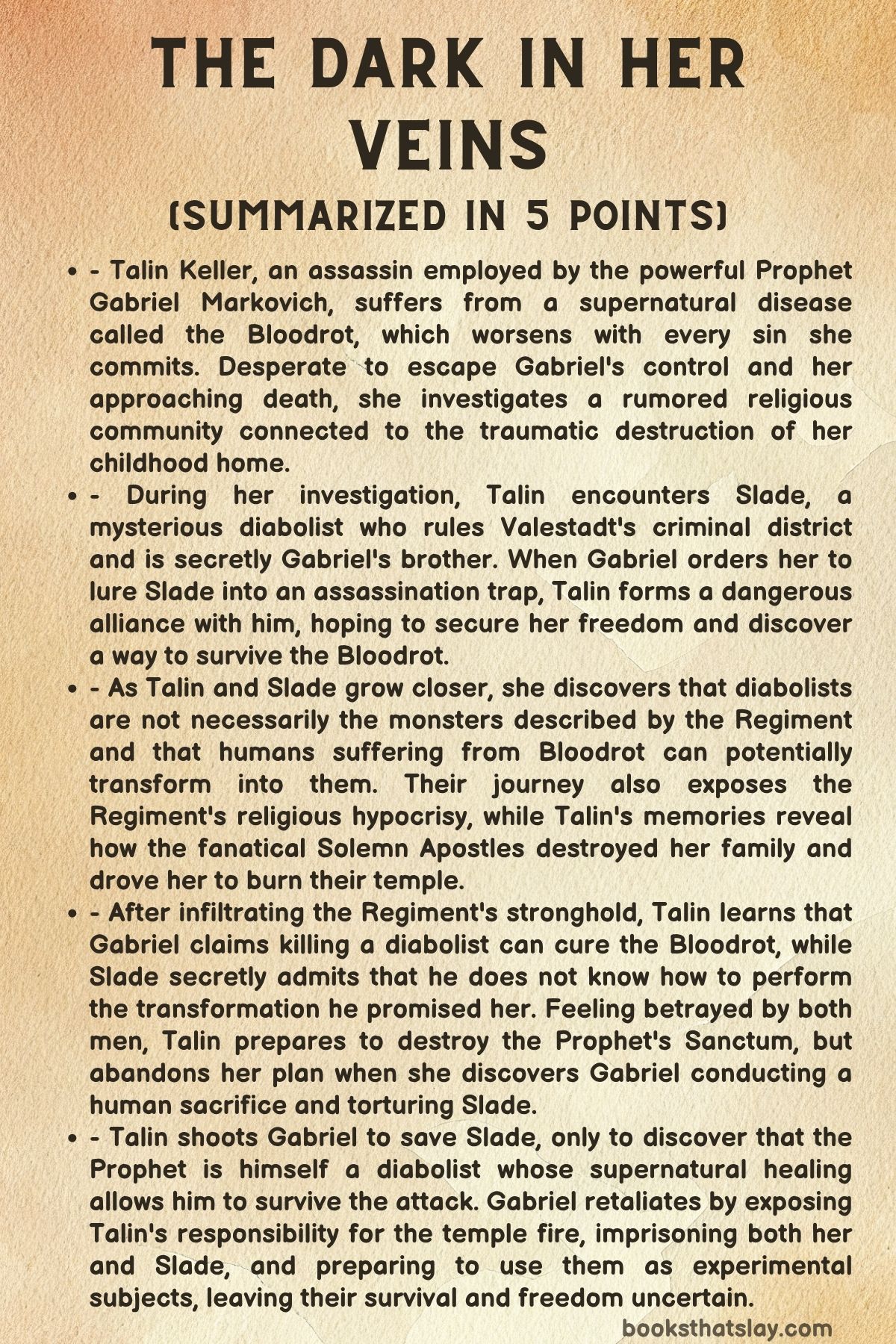
Summary
Talin Keller survives by killing people for Gabriel Markovich, the Prophet of the Regiment, a powerful religious institution governing Sundbourg. Every murder accelerates the Bloodrot spreading through her veins, bringing her closer to a painful death.
Her latest assignment requires her to assassinate Malte Pietersen, a former Regiment agent possessing dangerous government secrets. Although she completes the killing, discovering that Pietersen has a wife and infant leaves her disturbed by the suffering Gabriel knowingly creates.
Talin understands that her employment has become another form of imprisonment. Three years earlier, she escaped the Solemn Apostles, a fanatical religious community whose practices destroyed her family, only to become dependent on the Prophet who offered her protection.
Gabriel subsequently orders Talin to investigate reports that another Apostles community has emerged near the Brevanian border. The assignment revives memories of the temple fire that killed seventy-three people, including her parents and pregnant younger sister, Ilse.
Despite her objections, Gabriel insists that she obey him. Talin reluctantly travels to the Trench, a neglected district of Valestadt where criminals, religious dissenters, and people suffering from advanced Bloodrot live beyond the Regiment’s effective authority.
At an illegal drinking establishment called Tuonela’s, Talin encounters a striking stranger named Slade. His confidence, unusual appearance, and apparent knowledge of the district persuade her that he might possess information about the Apostles.
Their conversation becomes increasingly intimate, but Talin recognizes that his influence over her emotions is unnatural. When she reveals the Markovich family crest around her neck, Slade reacts with immediate hostility.
A violent confrontation reveals that Slade is the Warden of the Trench and, more astonishingly, a diabolist. These supernatural beings supposedly feed on human sins and possess extraordinary strength, healing abilities, and the power to encourage confessions.
The discovery contradicts Gabriel’s celebrated claim that he exterminated the last diabolist. Talin escapes after shooting Slade twice, although his rapid recovery demonstrates that ordinary weapons cannot easily kill him.
Preparing to flee Valestadt, Talin is intercepted by Gabriel, who reveals that Slade is his younger brother. He claims that Slade murdered their mother and that their longstanding arrangement allows the diabolist to control the Trench while remaining outside the Regiment’s official reach.
Talin realizes that Gabriel has previously murdered people to conceal this family secret. Knowing that she could become his next victim, she proposes infiltrating Slade’s confidence and persuading him to participate in an assassination attempt against the Prophet.
Gabriel agrees to release her from his employment if she delivers Slade to the Reaches, where the annual Congregation will take place.
Talin returns to Tuonela’s and convinces Slade that her deteriorating health has driven her to betray Gabriel. Although suspicious, he recognizes an opportunity to confront his brother and agrees to cooperate.
Slade demands a supernatural confession as proof of her sincerity. Talin recounts a previous murder but successfully pretends that the experience has erased her memory, preserving a degree of independence from his influence.
He takes her to his secluded residence, where their uneasy alliance becomes increasingly personal. Talin discovers that Slade’s apparent hospitality conceals another form of control, while he remains convinced that she might betray him.
Their relationship develops through mutual attraction, arguments, threats, and encounters that test their boundaries. Slade’s acceptance of her Bloodrot appeals to Talin, who has spent years believing that her diseased body makes her repulsive.
Nevertheless, Slade can also be deliberately cruel. When he estimates that she has only months remaining, his words expose how deeply she fears dying before experiencing freedom.
Meanwhile, Talin’s memories gradually reveal the circumstances of her childhood.
Her parents joined the Solemn Apostles when she was twelve, abandoning their home and possessions for an isolated forest community. The Apostles demanded unquestioning obedience, condemned imagination, and treated visible Bloodrot as evidence of spiritual corruption.
Talin resisted their teachings, but Ilse gradually embraced them. Their relationship deteriorated after Talin attacked Vicar Johannes’s son to protect her sister and developed her first visible signs of Bloodrot.
As the years passed, Ilse became devoted to the community and eventually became pregnant with Johannes’s child. Talin recognized the exploitation underlying the relationship, but her sister defended the Vicar and condemned Talin’s disbelief.
In the present, Talin’s situation becomes more dangerous when she encounters Darva, another of Gabriel’s hired sinners. Darva reveals that she has secretly been working for Slade and attempts to murder Talin near a railway station.
Slade intervenes and kills Darva, saving Talin’s life.
During their subsequent journey into the Outskirts, Slade reveals that humans suffering from Bloodrot can sometimes transform into diabolists. He promises to help Talin undergo this transformation if their mission succeeds.
For the first time in years, Talin begins imagining a future.
They travel to the home of Slade’s old friends, Ceri and Emeric, who are also diabolists. Their affectionate relationship with Slade challenges Talin’s assumption that he is incapable of genuine attachment.
However, she discovers a Solemn Apostles ceremonial sash inside their home and violently confronts Ceri.
Emeric explains that he found the garment in a Regiment temple. He suspects that the institution has been encouraging extremist communities so their beliefs can gradually influence public opinion and government policy.
His revelations suggest that the Apostles’ growing influence is connected to a larger political strategy.
Ceri also reveals that she was once human and survived the transformation Slade has promised Talin. The process requires enduring the final stages of Bloodrot and a subsequent condition called Bloodlust.
Although dangerous, it offers a possible escape from certain death.
Ceri explains that the diabolist who transformed her, Augustus, manipulated her affection because he wanted to create an army of supernatural followers. Her experience demonstrates that salvation offered by a powerful individual can conceal exploitation.
Talin secretly contacts Gabriel, who orders her to arrange Slade’s arrival at the Prophet’s Sanctum. His instructions convince her that he intends to trap his brother.
The group prepares to infiltrate the Reaches. Emeric and Ceri will enter through the guarded bridge, while Talin and Slade will hijack a supply vessel.
Slade intends to impersonate Felix Astor, a Regiment chaplain who resembles him, while Talin poses as his hired sinner.
Before they depart, Slade discovers that Talin has maintained contact with Gabriel. She admits that her original mission involved delivering him to the Prophet, although she insists that her loyalties have changed.
Slade reluctantly continues their mission, recognizing that the opportunity to confront Gabriel outweighs the danger.
During the crossing, Talin nearly drowns because she cannot swim, forcing Slade to rescue her. They subsequently seize the vessel, kill its crew, and reach the Reaches under their assumed identities.
Once inside, they discover the enormous wealth and influence concentrated among the Regiment’s leadership.
At a formal reception, Slade finally explains his mother’s death. She and Gabriel had planned to murder him because he was a diabolist, and she attempted to burn him alive while he slept.
He survived the attack and subsequently killed her. Gabriel transformed the incident into a story portraying Slade as a monstrous murderer.
The revelation strengthens Talin’s identification with Slade because both have suffered betrayal by people who claimed religious or familial authority.
Their investigation leads them into an underground fighting arena where senior Regiment members privately enjoy the violence they publicly condemn.
Talin is forced to fight an experienced sinner named Vanya. She survives by killing her opponent, but the murder brings her closer to the Bloodrot’s final stages.
Shortly afterward, Gabriel approaches Talin and introduces another possibility for curing her disease.
He claims that a sinner can become purified by personally killing a diabolist. He intends to arrange Slade’s death so Talin can deliver the fatal blow.
Now Talin faces two competing promises of survival.
Slade offers transformation into a creature she has been taught to fear, while Gabriel offers purification through murder. Neither man has demonstrated that his proposed cure can be trusted.
Talin nevertheless grows closer to Slade. She voluntarily offers him confessions when he becomes weakened by hunger, discovering that speaking about her wrongdoing without immediate condemnation provides an unfamiliar sense of relief.
Their intimacy becomes increasingly genuine.
The following morning, however, Talin overhears Slade admitting that he does not know how to transform a human into a diabolist.
His promise was a deception intended to secure her cooperation.
Devastated, Talin decides that she must create her own means of survival. She secretly prepares the Prophet’s Sanctum for destruction, intending to burn Gabriel and Slade inside.
Her plan echoes the catastrophe that ended her childhood.
Memories reveal that the Apostles selected Talin for ritual sacrifice. Her mother knew what was happening but refused to challenge Johannes, leaving Talin to understand that obedience would mean accepting her own murder.
Talin secretly prepared the temple for a devastating fire, choosing a ceremony when the community’s children would be absent.
She attempted to persuade Ilse to meet her outside, hoping that her sister would escape with her. Ilse never appeared.
Talin ignited the building, killing seventy-three people, including her parents and pregnant sister.
Although she survived, the catastrophe left her burdened by guilt, grief, and the knowledge that her freedom had required extraordinary violence.
In the present, Talin approaches the Prophet’s Sanctum with Ceri. Their investigation reveals that Gabriel is conducting a secret ceremony attended by powerful Regiment officials.
Inside, Talin witnesses Gabriel sacrifice a drugged boy.
Slade is subsequently brought before the congregation, drugged and restrained. Gabriel reveals that Regiment researchers have developed a substance capable of suppressing diabolist abilities.
He intends to use his brother for experimentation and for a ritual supposedly capable of purifying sinners.
Watching Slade suffer, Talin abandons her plan to burn the building.
She emerges from hiding and shoots Gabriel in the head.
Instead of dying, Gabriel begins healing, and black blood spills from his wound.
The Prophet is himself a diabolist.
Gabriel immediately presents his survival as divine protection, and the assembled officials accept his explanation. Regiment agents restrain Talin and overpower Slade.
When the guards discover Talin’s matches, Gabriel realizes that she intended to destroy the Sanctum.
He retaliates by revealing that she deliberately caused the Apostles’ temple fire.
Slade attempts to protect Talin by claiming responsibility, but Gabriel rejects his confession. He also exposes Talin’s original assignment to betray his brother.
Their mutual deceptions now stand revealed, even as their concern for one another remains unmistakable.
Gabriel finally explains that Felix Astor had discovered the Regiment’s experiments and threatened to expose them. The chaplain’s resemblance to Slade helped Gabriel construct the elaborate trap.
With Slade imprisoned, Gabriel intends to use him as a subject for further research.
Talin will also become an experimental subject in the institution’s attempts to cure the Bloodrot.
The novel ends with Gabriel maintaining control over both captives. Talin’s desperate struggle for freedom has exposed the corruption surrounding her, but she remains imprisoned, with her future and Slade’s survival uncertain.
Characters
Talin Keller
Talin Keller is the protagonist of The Dark in Her Veins, a young assassin whose experiences reveal the complicated relationship between survival, violence, guilt, and personal freedom. Her Bloodrot makes mortality an immediate concern, while her employment under Gabriel prevents her from escaping the behavior that accelerates the disease.
Talin’s defining characteristic is her refusal to surrender her independence, even when circumstances make resistance dangerous. As a child, she questions the Solemn Apostles’ teachings, rejects their rigid moral categories, and refuses to accept religious authority simply because her family demands obedience.
Her rebellion develops alongside an intense protective instinct, especially concerning Ilse. She attacks Johannes’s son to defend her sister, and years later attempts to arrange Ilse’s escape before destroying the temple.
However, Talin’s protective instincts coexist with an extraordinary capacity for violence. Her decision to burn the Apostles’ sanctuary demonstrates that her determination to survive can lead her to sacrifice others, even people she once loved.
This contradiction prevents her from becoming a conventional innocent heroine. She is a victim of religious abuse and manipulation, but she is also responsible for numerous deaths.
Her relationship with Gabriel reflects the difficulty of escaping a powerful abuser who has made himself indispensable. Although Talin recognizes his cruelty, she remains vulnerable to his occasional tenderness because he once offered her safety when she had nowhere else to turn.
Slade introduces another possibility for her life, but her attraction to him does not eliminate her distrust. She is drawn toward his acceptance of her body and his understanding of social rejection, while fearing that he might become another person who controls her through promises.
Talin’s final decisions demonstrate both her growth and her continuing moral instability. She recognizes that neither Gabriel nor Slade can automatically be trusted, yet her attempt to secure independence through another mass killing shows how deeply violence has shaped her understanding of survival.
Her decision to save Slade from Gabriel nevertheless reveals that compassion remains possible despite her history. Even after discovering his deception, she refuses to abandon him to torture and experimentation.
Slade Markovich
Slade is the mysterious Warden of the Trench and one of the central figures in The Dark in Her Veins. As a diabolist, he possesses supernatural strength, rapid healing, and the ability to influence people toward confessing their sins.
His apparent immortality and unsettling confidence initially establish him as a dangerous presence. He enjoys intimidating Talin and regularly tests her willingness to resist his authority.
Beneath his intimidating behavior, however, Slade carries the consequences of severe familial betrayal. His mother attempted to murder him because of his supernatural nature, while Gabriel used the resulting tragedy to construct his own religious reputation.
These experiences explain Slade’s hostility toward the Regiment and his reluctance to trust people. His creation of the Trench represents an attempt to build a domain beyond his brother’s control.
Yet Slade’s authority is not entirely benevolent. He deliberately attracts sinners because their wrongdoing provides the nourishment he requires, turning a supposed refuge into a system that also serves his personal interests.
His relationship with Talin exposes the conflict between his desire for attachment and his instinct to manipulate others. He genuinely becomes concerned for her safety, but his false promise of transformation demonstrates that he will exploit her vulnerability to prevent her from leaving.
His friendship with Ceri and Emeric provides evidence that he can sustain meaningful relationships. Their anger over his disappearance suggests that his tendency to withdraw emotionally causes suffering even among those he values.
Slade’s decision to continue toward Gabriel despite recognizing the trap reflects his determination to confront the brother who has controlled his public identity.
By the end of the novel, his physical power has been neutralized, leaving him dependent on the very people he previously attempted to control. His imprisonment exposes the vulnerability beneath his supernatural abilities.
Gabriel Markovich
Gabriel Markovich is the principal antagonist of The Dark in Her Veins, the Prophet whose religious authority conceals an extensive system of deception and exploitation. His public identity depends on the claim that he defeated the last diabolist and protects society from supernatural corruption.
In reality, Gabriel’s relationship with Slade reveals that his reputation was established through manipulating the truth about his own family. His willingness to conceal his brother’s existence demonstrates that maintaining authority matters more to him than public honesty.
Gabriel’s treatment of Talin is especially revealing. He rescues her after the temple fire and provides her with shelter and employment, but gradually turns her dependence into an instrument of control.
His occasional declarations of affection complicate their relationship without diminishing the harm he causes. He understands Talin’s loneliness and uses that knowledge to make obedience feel inseparable from gratitude.
His conduct toward the Regiment’s followers demonstrates an even greater degree of manipulation. He publicly condemns violence and supernatural corruption while secretly arranging executions, religious sacrifices, and experiments on living subjects.
The revelation that Gabriel is himself a diabolist fundamentally changes the meaning of his religious identity. He has built his public reputation around eliminating a form of existence that he secretly shares.
His survival after Talin shoots him shows how effectively he can manipulate perception. Rather than allowing his black blood and supernatural healing to expose him, he immediately presents the incident as evidence of divine intervention.
Gabriel’s greatest weapon is therefore not physical power but control over information. He decides which truths remain concealed, which people become expendable, and how extraordinary events should be interpreted.
His victory at the novel’s conclusion demonstrates the strength of the institution supporting him. Even after his deception is exposed to the reader and Talin, he retains the authority to imprison his enemies and continue his research.
Ilse Keller
Ilse is Talin’s younger sister and one of the most emotionally significant characters in The Dark in Her Veins. Her gradual transformation from an affectionate child into a devoted follower of the Solemn Apostles forms a central part of Talin’s traumatic history.
During their early childhood, Ilse and Talin share games, imaginary adventures, and an affectionate relationship. Ilse is more obedient and anxious than her sister, but their differences initially strengthen Talin’s protective instincts.
The Apostles gradually destroy this intimacy by teaching Ilse that questioning religious authority threatens her salvation. Her refusal to hold Talin’s hand during prayer symbolizes the emotional distance developing between them.
Ilse’s relationship with Vicar Johannes demonstrates the vulnerability of a young person raised within an authoritarian religious community. Her pregnancy is presented as the consequence of a relationship shaped by profound differences in age, authority, and personal autonomy.
When Talin attempts to explain the exploitation involved, Ilse defends Johannes. Her response illustrates how thoroughly she has absorbed the beliefs that justify his behavior.
Her condemnation of Talin’s Bloodrot is particularly painful because it transforms familial affection into religious judgment. She comes to interpret her sister’s refusal to conform as evidence of spiritual corruption.
Ilse’s eventual death is tragic partly because Talin had attempted to save her. Her decision to remain inside the temple leaves Talin with an unresolved mixture of grief, guilt, anger, and love.
Although Ilse dies before the principal events of the novel, her influence persists throughout Talin’s decisions. The inability to save her sister shapes Talin’s fear of intimacy and her determination never again to surrender control over her life.
Ceri
Ceri is an important supporting character in The Dark in Her Veins, offering Talin an alternative understanding of what it means to live as a diabolist. Her friendliness, confidence, and affection for Slade challenge the terrifying image of supernatural beings promoted by the Regiment.
Unlike Slade, Ceri was originally human. After losing her parents to the Bloodrot, she became a hired sinner and eventually entered an arrangement with a diabolist named Augustus.
Her decision to undergo transformation was shaped by her affection for Augustus and her desperation to survive. She later discovered that he had manipulated her because he wanted to produce more diabolists for his own purposes.
This history establishes Ceri as someone who understands the danger of confusing affection with salvation. Her experience closely parallels Talin’s vulnerability to the promises offered by Gabriel and Slade.
Ceri’s relationship with Emeric provides a contrasting example of partnership. Their affection appears grounded in shared experience, mutual concern, and a willingness to protect one another.
She also displays considerable courage and competence. She helps plan the mission against Gabriel, enters the Reaches under a false identity, and kills a guard when necessary to protect the group.
Her growing friendship with Talin becomes especially meaningful because she accepts the younger woman’s damaged body and violent history without immediately condemning her.
The trust Ceri expresses before Talin enters the Sanctum intensifies Talin’s guilt about her secret plan. Through Ceri, the novel demonstrates that genuine acceptance creates responsibilities as well as comfort.
Emeric
Emeric is Ceri’s partner, Slade’s longtime friend, and an important source of information about the Regiment. His background as a chaplain gives him knowledge of the institution that the other characters cannot easily obtain.
He initially approaches Slade’s return with anger, reflecting the pain caused by his friend’s unexplained disappearance. Nevertheless, his willingness to help demonstrates that their relationship has survived years of separation.
Emeric discovered his supernatural nature while studying for the priesthood. This revelation forced him to reconsider religious teachings that classified beings like himself as inherently monstrous.
Instead of abandoning his position, he continued working within the institution. His ability to feed on confessions also allowed him to gather information, turning a traditional religious practice into a means of survival and investigation.
His discovery of an Apostles ceremonial sash inside a Regiment temple leads him to suspect that the institution has deliberately encouraged extremist religious movements. This theory reveals his understanding of how religious ideology can become an instrument of political power.
Emeric also serves as a practical organizer. He explains the Reaches’ layout, arranges accommodation, and helps develop the plan for reaching Gabriel.
His treatment of Talin’s injuries demonstrates a willingness to help someone he barely knows, while his relationship with Ceri establishes him as capable of sustained affection.
Unlike Gabriel, Emeric does not use religious knowledge solely to acquire authority over others. His character illustrates how an individual can question a corrupt institution while retaining knowledge and practices acquired within it.
Darva
Darva is one of Gabriel’s hired sinners and a dangerous opponent for Talin. Her advanced Bloodrot establishes her as someone whose life has already been severely shortened by her involvement in violence.
She resents Talin’s favored position with Gabriel, apparently viewing the Prophet’s attention as an advantage denied to others.
Her secret employment under Slade reveals that she has been pursuing interests beyond her official responsibilities. However, her decision to attack Talin demonstrates that changing employers does not necessarily produce a change in moral behavior.
Darva possesses considerable combat experience and easily overpowers Talin during their confrontation at the railway station. Her attempt to make the murder appear connected to Talin’s failing health shows both tactical intelligence and personal ruthlessness.
Her death at Slade’s hands exposes the instability of alliances among the hired sinners. The people who employ them regard their lives as expendable, while competition and resentment undermine solidarity between them.
Darva functions as a possible reflection of Talin’s future: a highly capable woman whose violence has left her dying and whose remaining choices are shaped by powerful employers.
Yannick
Yannick is another of Gabriel’s hired sinners, specializing in extortion and torture. His work demonstrates the Regiment’s willingness to employ methods that contradict its public condemnation of wrongdoing.
Like Darva, Yannick resents Talin’s privileged relationship with Gabriel. This hostility reveals the competitive atmosphere the Prophet maintains among his employees.
His professional specialization suggests that the Regiment’s secret activities extend beyond assassination into intimidation and the extraction of information.
Although Yannick does not receive extensive personal development, his presence helps establish the institutional nature of Gabriel’s corruption. Talin is not an isolated exception but one member of a larger network of criminals operating under religious authority.
Vicar Johannes
Vicar Johannes is the leader of the Solemn Apostles and the principal representative of the religious oppression that destroys Talin’s childhood. His authority allows him to control the community’s beliefs, daily behavior, and understanding of salvation.
He condemns imagination, demands obedience, and supports punishments designed to suppress independence. His teachings encourage followers to treat doubt as moral failure.
His relationship with Ilse represents an especially severe abuse of authority. As an older religious leader, he exercises control over a young girl who has been taught that resisting him would threaten her spiritual future.
Johannes also presides over a community willing to conduct ritual sacrifices. His religious leadership ultimately places Talin in a position where she believes murder is the only means of avoiding her own death.
His significance extends beyond the historical events because Gabriel’s secret ceremony reproduces practices associated with the Apostles. The similarities suggest that the supposedly isolated extremist community reflects tendencies present within the larger religious institution.
Talin and Ilse’s Mother
The sisters’ mother initially appears as an affectionate parent who reads stories to her daughters and introduces them to religious traditions. Her early tenderness makes her later behavior particularly disturbing.
After joining the Apostles, she increasingly places religious obedience above her children’s emotional and physical safety. She participates in the destruction of their possessions and refuses to intervene when Talin experiences abusive treatment.
Her failure becomes most serious when she learns that Talin has been selected for ritual sacrifice. Although she responds with grief, she does not challenge the community’s decision.
This distinction between emotional attachment and protective action defines her character. She may continue loving her daughter, but her submission to religious authority prevents her from fulfilling her responsibilities as a parent.
Her death in the temple fire leaves Talin with a complicated inheritance of affection, betrayal, and guilt.
Talin and Ilse’s Father
The sisters’ father demonstrates the destructive consequences of unquestioning commitment to religious authority. His conversion transforms the family’s ordinary domestic life into an existence governed by prohibition and fear.
He destroys Talin’s illustrated books because the Apostles regard imaginative stories as sinful. He also burns the family car after their arrival at the forest settlement, symbolically eliminating their connection with their previous lives.
His physical punishment of Talin during religious services establishes that his new beliefs have altered his treatment of his children.
Although his actions may originate in a desire to secure his family’s salvation, he becomes an instrument of the community’s authoritarian practices.
His eventual death in the temple fire demonstrates how completely the family’s commitment to the Apostles has destroyed the relationships and security they once possessed.
Johannes’s Eldest Son
Johannes’s eldest son appears in Talin’s childhood memories when he discovers Talin and Ilse playing imaginary games near a stream.
He threatens to report their behavior, relying on his father’s religious authority to intimidate the sisters. His conduct illustrates how the Apostles’ teachings encourage children to police one another.
When Talin attacks him, he refuses to retaliate because he fears developing the Bloodrot.
This encounter demonstrates that the community’s moral rules can discourage violence even while encouraging other forms of cruelty and intimidation.
The incident is especially consequential because Talin subsequently develops visible signs of Bloodrot, changing how Ilse perceives her.
Augustus
Augustus is the diabolist who transforms Ceri and becomes a significant figure in her history. Initially, he provides her with an arrangement through which she can earn money by offering confessions.
Their relationship develops into romance, and Ceri agrees to undergo the dangerous transformation that will preserve her life.
However, Augustus has concealed his actual intentions. He wants to create additional diabolists and regards Ceri as a means of expanding his power.
His exploitation demonstrates that supernatural beings are not automatically more compassionate than the humans who fear them.
Augustus also provides an important comparison with Slade. Both men offer vulnerable women the possibility of escaping death, but their promises become entangled with deception and unequal power.
Malte Pietersen
Malte Pietersen is a former Regiment agent whose possession of sensitive government information makes him a target for Gabriel.
His assassination establishes Talin’s role as an instrument of the Prophet’s secrecy. He is killed not because Talin has a personal grievance against him but because his knowledge threatens the institution.
His existence also raises questions about what he discovered during his employment. Although the precise information he possesses is not fully revealed, his death demonstrates that Gabriel is willing to eliminate former associates who become liabilities.
Pietersen’s family gives the killing its emotional significance for Talin, forcing her to confront consequences that extend beyond the person she was ordered to murder.
Pietersen’s Wife and Child
Pietersen’s wife and infant represent the innocent people affected by Gabriel’s secret operations. Their presence transforms what initially appears to be an ordinary assassination into an encounter with the suffering left behind.
The wife’s discovery of her husband’s body and her attempt to shoot Talin demonstrate the immediate human consequences of the murder.
For Talin, learning that Pietersen was a husband and father produces anger toward Gabriel. She recognizes that he deliberately concealed information that might have made the assignment more difficult for her to complete.
Although the wife and child occupy little space in the novel, they establish the moral problem underlying Talin’s profession: the consequences of her work cannot be limited to the targets she kills.
Felix Astor
Felix Astor is a Regiment chaplain whose physical resemblance to Slade makes him central to the plan for entering the Reaches.
His position and employment of a hired sinner provide an identity that Slade and Talin can imitate without immediately attracting suspicion.
However, Astor possesses dangerous knowledge of the Regiment’s experiments and threatens to expose them.
Gabriel exploits the resemblance between Astor and Slade in constructing the operation designed to capture his brother.
Astor’s role illustrates how the institution manipulates identities and controls information. His knowledge makes him dangerous to Gabriel, while his appearance makes him useful to both sides of the conflict.
Tomas Nielssen
Tomas Nielssen is a young Regiment agent encountered during the reception at the Citadel. When he overhears Talin and Slade discussing the Prophet’s Sanctum, he offers to guide them.
Instead, he brings them to an underground fighting arena frequented by the Regiment’s elite.
His actions introduce Talin to the institution’s secret culture of organized violence. The arena contradicts the moral behavior the Regiment publicly demands from ordinary citizens.
Tomas later appears entering the Sanctum in ceremonial clothing, connecting him to the hidden religious activities surrounding Gabriel.
Although his personal convictions remain largely unexplored, his participation demonstrates how younger institutional members can become involved in practices concealed from the general population.
Marcus Wagner
Marcus Wagner is a Regiment figure who recognizes the identity Slade has assumed and expects him to participate in the underground fighting arena’s activities.
His acquaintance with the real Felix Astor threatens to expose Slade’s disguise.
By insisting that the supposed chaplain’s hired sinner fight his champion, Marcus creates a dangerous situation that Talin cannot easily avoid.
His participation in the arena illustrates the privileges enjoyed by Regiment elites, who privately engage in violent entertainment while maintaining public moral authority.
Vanya
Vanya is an experienced fighter suffering from advanced Bloodrot who confronts Talin in the underground arena.
Her strength and skill initially give her an advantage, and the appearance of a knife transforms the contest into a potentially fatal confrontation.
Talin eventually kills her with Slade’s assistance.
Vanya’s role demonstrates the exploitation of people already condemned by the disease. Rather than receiving protection or treatment, she participates in deadly entertainment for privileged spectators.
Her death also increases Talin’s suffering because another killing accelerates the Bloodrot.
The confrontation therefore makes Vanya both an immediate antagonist and another example of the institution’s broader cruelty toward sinners.
Themes
Religious Authority and the Manipulation of Faith
Religious authority shapes nearly every aspect of Talin’s life, determining how she understands morality, her body, her family, and her prospects for survival.
In The Dark in Her Veins, religious institutions repeatedly claim to possess absolute knowledge of salvation while concealing practices that contradict their public teachings.
The Solemn Apostles establish the earliest example of this contradiction. Their leaders demand obedience, condemn imaginative freedom, and teach followers that visible Bloodrot proves spiritual corruption.
These beliefs encourage Talin’s parents to abandon their former lives and submit their children to an increasingly abusive environment.
The community’s influence becomes especially disturbing through Ilse’s relationship with Vicar Johannes. Religious authority enables him to exploit a young girl who has been conditioned to regard obedience as a sacred obligation.
Ilse’s defense of Johannes demonstrates how indoctrination can reshape a victim’s understanding of personal autonomy.
Gabriel represents a broader, more sophisticated application of similar methods. His authority depends on his supposed victory over the last diabolist, even though he secretly shares the supernatural identity he publicly condemns.
His ability to present his healing after a gunshot as divine intervention reveals that religious power can depend on controlling the interpretation of events.
Emeric’s discoveries suggest that the Regiment may also encourage extremist communities as a means of gradually transforming public morality and political expectations.
This possibility connects private religious abuse to wider institutional ambitions.
The novel does not simply equate religious belief with wrongdoing. Instead, it examines what happens when religious institutions claim unquestionable authority and prevent followers from challenging the people who speak in the name of the divine.
Talin’s struggle becomes a rejection of the belief that another person has the right to determine the value of her existence.
Survival, Violence, and Moral Responsibility
Talin’s experiences repeatedly force her to confront the difference between actions committed for survival and actions that can be morally justified.
The Bloodrot gives this conflict a physical dimension. Every act of wrongdoing threatens to shorten her life, making the consequences of violence visible on her body.
Nevertheless, the disease does not establish a complete or reliable measure of morality.
Talin develops her first signs of Bloodrot after attacking a boy who threatens Ilse. Although her actions are violent, they originate in her desire to protect someone she loves.
This incident demonstrates the inadequacy of reducing human behavior to a simple distinction between goodness and sin.
Her destruction of the Apostles’ temple presents a much more difficult moral problem.
Talin has been selected for ritual sacrifice and understands that remaining within the community means accepting her own murder.
Her decision to destroy the building is therefore connected to self-preservation.
However, she deliberately prepares a fire that kills seventy-three people, including her family. Her intentions cannot erase the suffering caused by her actions.
The distinction between survival and justification becomes increasingly important as she grows older.
Her employment under Gabriel requires further killings, creating a situation in which earning a living also accelerates her death.
When she subsequently considers burning Gabriel and Slade inside the Sanctum, she repeats the destructive strategy that once allowed her to escape captivity.
This repetition reveals how trauma can establish patterns of behavior that remain powerful long after the original danger has passed.
Yet Talin’s decision to spare Slade demonstrates that these patterns are not entirely beyond her control.
She retains the capacity to interrupt violence, even when doing so places her own survival at risk.
The novel therefore presents moral responsibility as something more complicated than obedience to rules or the absence of wrongdoing.
Freedom, Control, and the Cycle of Exploitation
Talin’s desire for freedom develops within a succession of relationships that promise protection while restricting her independence.
Her childhood among the Apostles establishes the first form of captivity. Her parents surrender their authority to religious leaders, leaving Talin with little control over her education, beliefs, or physical safety.
The temple fire provides an escape from this environment, but freedom proves temporary.
Gabriel approaches Talin when she is traumatized, isolated, and desperate for security. His offer of shelter and employment initially appears compassionate.
Over time, however, their relationship becomes structured around dependence.
Gabriel understands that Talin has few alternatives and uses her gratitude to justify continued obedience. Her worsening Bloodrot intensifies this dependence because the very work he demands threatens her survival.
Slade initially seems to offer an escape from Gabriel’s authority.
Unlike the Prophet, he does not automatically condemn Talin’s diseased body or violent history. He also promises a supernatural transformation that could preserve her life.
Yet his deception reproduces the essential structure of her relationship with Gabriel.
Both men possess knowledge and resources Talin desperately needs, and both exploit her vulnerability to secure her cooperation.
Ceri’s history with Augustus reinforces this pattern. Her transformation begins with a promise of love and survival but conceals another diabolist’s ambition to increase his power.
These relationships demonstrate that exploitation is not confined to a particular institution or supernatural identity.
It emerges whenever one person converts another’s vulnerability into a means of control.
Talin’s development involves recognizing that affection and protection do not automatically establish trustworthiness.
Her attempt to take control of the Sanctum operation represents a desperate effort to break the cycle.
However, the violence of her proposed solution raises another question: whether genuine freedom can be achieved through the same coercive methods that previously deprived her of independence.
Monstrosity, Identity, and the Possibility of Acceptance
The distinction between humans and monsters becomes increasingly unstable as Talin discovers the truth about diabolists.
In The Dark in Her Veins, supernatural identity is initially presented through the Regiment’s teachings as evidence of inherent corruption. Diabolists supposedly manipulate ordinary people, consume their sins, and threaten the established moral order.
Slade appears to confirm aspects of this reputation through his supernatural abilities and intimidating behavior.
However, his personal history reveals that he was also the victim of an attempted murder motivated by fear of his nature.
His mother regarded his existence as unacceptable, while Gabriel transformed the resulting violence into evidence supporting his own religious authority.
The discovery that Gabriel is himself a diabolist further undermines the distinction between supposedly monstrous creatures and supposedly virtuous humans.
His cruelty is not explained by his supernatural identity alone. It is expressed through deliberate deception, institutional exploitation, and his willingness to sacrifice vulnerable people.
Meanwhile, Ceri and Emeric demonstrate that diabolists can establish affectionate relationships and extend kindness to others.
Their acceptance of Talin challenges her belief that her Bloodrot makes her unworthy of love.
Nevertheless, the novel avoids replacing one simplistic moral category with another.
Slade remains capable of manipulation, Augustus exploits Ceri, and Talin herself commits acts of extraordinary violence despite being human.
The characters’ identities do not determine their moral behavior.
This complexity also shapes Talin’s relationship with her own body. She has been taught to regard the Bloodrot as proof that she is becoming something fundamentally unacceptable.
Slade’s willingness to look at her disease without disgust provides an experience of acceptance that her family and religious community denied her.
The possibility of becoming a diabolist therefore represents more than physical survival.
It raises the possibility that Talin might construct an identity beyond the categories imposed on her by the Regiment.
Yet the novel’s unresolved ending preserves the uncertainty surrounding that possibility. Talin has begun questioning the definitions of humanity, sin, and monstrosity that govern her world, but she has not yet escaped the people who use those definitions to control her.