The Devil Knows Her Name Summary, Characters and Themes
The Devil Knows Her Name by C. N. Vair is a supernatural horror novel that explores the dangerous relationship between survival, independence, and the sacrifices people make to protect what they love.
Set in the declining town of Burrsville, the story follows Tess Wynne, an aging witch whose unnatural longevity and extraordinary powers originate from a bargain with the devil. When a mysterious fawn enters her life and a religious leader threatens her woodland sanctuary, Tess faces a conflict that challenges her understanding of love, morality, and freedom. Combining folk horror, psychological tension, and supernatural fantasy, the novel examines how the desire for security can transform someone into the very danger they once feared.
Summary
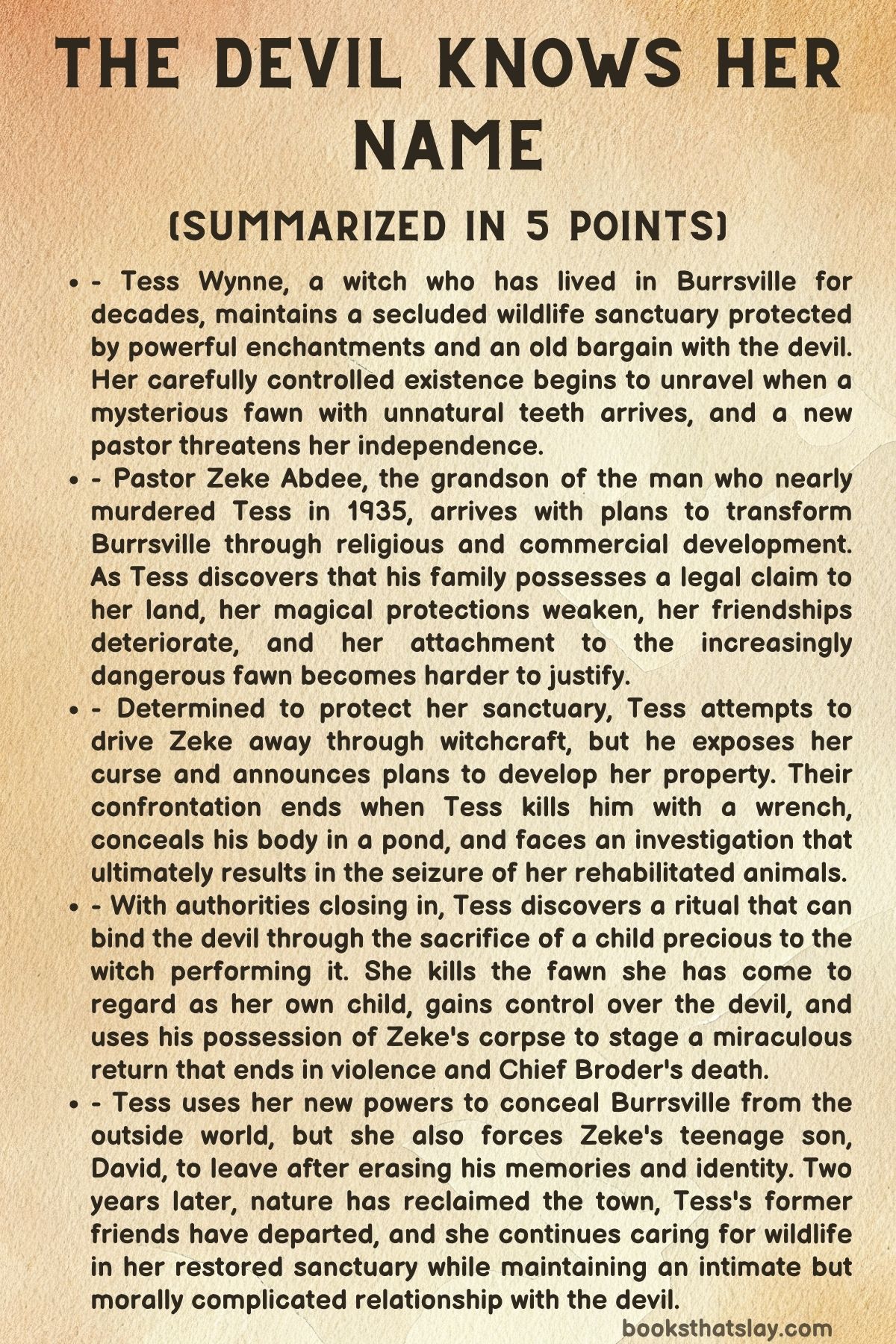
Tess Wynne has spent decades living in a secluded woodland sanctuary outside Burrsville, where she rehabilitates injured wildlife and maintains an extensive network of magical protections. Her extraordinary longevity and influence over the surrounding community originate from a supernatural bargain she made many years earlier, although she has never entirely accepted the devil’s claim over her life.
Every autumn equinox, the devil visits Tess, bringing familiarity, temptation, and reminders of their complicated relationship. During one such visit, he suggests that she surrender control of her sanctuary in exchange for his protection, but Tess refuses because the land represents the independence she has fought to preserve.
That evening, Tess celebrates Mabon with her closest friends, including Christine, Max, Georgie, Evelyn, and Paul. Their gathering reveals Burrsville’s continuing economic decline, particularly when Paul announces his decision to sell his farm and leave town.
Tess secretly strengthens her magical influence over her companions through enchanted candles, food, and household charms, ensuring that they overlook the contradictions created by her unnatural longevity. Nevertheless, a candle associated with generosity and community repeatedly extinguishes itself, suggesting that something is beginning to interfere with the magical order she has maintained for decades.
Her anxiety is connected to a traumatic event from 1935, when she was an eighteen-year-old witch living with her mother. Tess became romantically involved with Norman Abdee, a visiting logger who was already engaged to another woman, Laura Macoun.
After their relationship became sexual, Norman accused Tess of using witchcraft to seduce him and violently held her underwater in the family pond. As she faced death, Tess desperately wished to survive, and the devil answered her plea, establishing the bargain that would shape the rest of her existence.
Although Tess survived, Norman fled Burrsville believing that he had murdered her. Over the following years, Tess used increasingly powerful enchantments to conceal her unusual existence, protect her inherited property, and establish the woodland sanctuary that became the center of her life.
Her mother eventually died from cancer, leaving Tess vulnerable to men who wanted to acquire the family land. Tess responded by using her mother’s remains in protective rituals, strengthening her magical defenses and gradually extending her influence through enchanted roses planted around Burrsville.
The arrival of an unusual fawn begins disrupting this carefully maintained existence. Police Chief Broder contacts Tess after a local woman named Sarah takes the newborn animal into her home, even though its appearance so late in autumn is biologically inexplicable.
Tess discovers that the fawn smells of decomposition despite appearing healthy, and Sarah’s bandaged hands suggest that the animal has already injured her. After bringing it to the sanctuary, Tess learns that its mouth contains a complete set of sharp, grooved teeth, while the other animals respond to its presence with unmistakable fear.
Rather than treating the creature as a threat, Tess begins caring for it with increasing affection. She recognizes something of herself in its unnatural existence and refuses to punish it merely because it does not conform to ordinary expectations.
Meanwhile, a new Pentecostal pastor named Zeke arrives in Burrsville with his wife, Rachel, and teenage son, David. Tess is horrified to discover that Zeke is Norman Abdee’s grandson, while David bears an even stronger resemblance to the man who nearly killed her.
Zeke immediately expresses contempt for Tess’s wildlife rehabilitation work, arguing that troublesome animals should be destroyed. David, however, shows sincere interest in the sanctuary and expresses a desire to volunteer, creating the possibility of an unexpected friendship between Tess and a descendant of her former attacker.
The devil continues visiting Tess, renewing his offer to protect her land and hinting that the mysterious fawn may have supernatural origins. During one encounter, he rescues Tess and the animal from the pond where Norman attempted to murder her, but she again rejects his attempt to gain control over her sanctuary.
Tess’s problems intensify when she discovers that someone has uprooted several of her oldest enchanted roses, destroying much of the magical network sustaining her power. The devil blames Zeke, claiming that the pastor possesses enough spiritual awareness to detect her enchantments, but Tess suspects that the devil himself may be engineering the crisis to make her dependent on him.
Determined to resist both men, Tess attempts to rebuild her protections while continuing her wildlife rehabilitation work. David visits with an injured infant squirrel, and their conversations reveal his restrictive upbringing, his father’s controlling behavior, and the possibility that Norman’s descendants possess a legal claim to part of Tess’s sanctuary.
Tess eventually prepares a malicious hex using her blood, hair, blackwood, and the remains of the squirrel that David brought her. She secretly places the hex bag inside the parsonage, hoping to frighten Zeke and his family into abandoning Burrsville.
Meanwhile, the fawn becomes increasingly aggressive, biting Tess and frightening the sanctuary’s other inhabitants. Although its behavior raises serious concerns, Tess finds herself emotionally incapable of rejecting it, even as the animal’s presence complicates her already overwhelming responsibilities.
Seeking answers about her future, Tess performs a dangerous divination ritual involving belladonna and her mother’s bones. Her visions reveal the destruction of the sanctuary through extensive construction, while another disturbing image shows someone killing the fawn with a knife.
The ritual leaves Tess severely disoriented, and her responsibilities become increasingly difficult to manage as injured animals arrive in greater numbers. Her friendships deteriorate, particularly when Evelyn questions her relationship with David and suggests that Tess should show greater consideration for the pastor’s family.
The conflict reaches a turning point when Zeke organizes a community meeting at his church. Before the assembled townspeople, he reveals Tess’s hex bag and announces plans for an enormous religious and commercial development that would occupy the land surrounding her sanctuary.
Tess recognizes the proposed landscape from her prophetic vision and flees, convinced that her home is approaching destruction. Her despair deepens when she discovers that the fawn has escaped its enclosure and killed several infant squirrels, yet she cannot bring herself to destroy the creature.
David subsequently returns to help Tess with her animals, but the fawn attacks him and injures his hand. Tess persuades him to conceal the incident, creating another conflict with his parents and eventually causing her friendships with Evelyn and Christine to collapse.
When Zeke arrives at the sanctuary carrying Norman’s original property deed, Tess learns that his family’s claim to the land threatens her ownership directly. Their confrontation becomes violent, and Tess strikes him repeatedly with a wrench, killing him before she fully comprehends what she has done.
Terrified of losing everything, Tess conceals the murder by staging an accident involving Zeke’s truck and sinking his weighted corpse into the pond where Norman once attempted to drown her. Her efforts become complicated when the fawn escapes and apparently kills a local family’s cat, attracting further attention from Chief Broder.
The subsequent investigation exposes the growing fragility of Tess’s position. Environmental authorities revoke her wildlife rehabilitation license and remove nearly all the animals from her care, while Broder discovers a bloodstained eyeglass lens belonging to Zeke and begins investigating the Abdee family’s property records.
Tess uses her remaining magic to conceal the fawn and interfere with the authorities, but her defenses are deteriorating. When police divers attempt to search the pond, its unnatural darkness temporarily protects Zeke’s body, although Broder remains convinced that Tess is responsible for his disappearance.
Facing the destruction of her sanctuary and possible imprisonment, Tess discovers a hidden ritual in her grandmother’s grimoire. The instructions describe a method of binding the devil through the blood of a child precious to the witch performing the spell.
Tess realizes that the fawn, although not human, has become the closest thing she has to a child. Understanding that her earlier vision foretold its death, she takes the animal into the orchard and sacrifices it, using its blood to summon and bind the devil.
The ritual gives Tess access to extraordinary power, allowing her to command the landscape and impose her will upon the supernatural being who once controlled her fate. Although the devil insists that he would have helped her willingly, Tess refuses to depend on his generosity and forces him to obey her terms.
Together, they retrieve Zeke’s body from the pond, and Tess prepares it for a ritual that allows the devil to inhabit the corpse. They enter the church during a prayer vigil, where the apparent return of the missing pastor astonishes the congregation and horrifies Rachel, who recognizes that something monstrous is wearing her husband’s face.
The devil presents his return as a miracle and drives the worshippers into an increasingly violent frenzy. During the chaos, Chief Broder is trampled to death, eliminating the investigator closest to establishing Tess’s responsibility for Zeke’s murder.
Tess finds David amid the terrified congregation and leads him away, but her apparent rescue soon becomes another demonstration of her absolute authority. She uses the surrounding vegetation to carry him toward Burrsville’s boundary, where her new magic has created a veil capable of concealing the entire town from outsiders.
Although David begs to return to his mother, Tess decides that he must leave Burrsville permanently. She erases his memories of his family, his hometown, and even his own identity before sending him beyond the veil, believing that the uncertain freedom of the outside world offers him a better future.
Two years later, Burrsville has undergone a dramatic transformation. Vegetation overtakes buildings and roads, wildlife moves freely, and the supernatural veil prevents outsiders from remembering or locating the town.
The accepted account of the Abdee family’s fate is that Zeke returned, murdered Rachel, and died when the church bell tower collapsed, while David disappeared without explanation. Most of Tess’s former friends have also departed, leaving her increasingly isolated from the human community she once manipulated to preserve.
Despite these losses, Tess continues caring for wildlife in her renewed sanctuary, where living greenery forms the animal enclosures and creatures may remain for as long as they need protection. She also recovers Shadow, a crow seized during the earlier raid, and returns him to the woman who had cared for him.
The devil remains part of Tess’s existence, visiting frequently and sharing her home and bed. As another Mabon celebration approaches, Tess welcomes him through her sanctuary gate, having secured the world she wanted through a sacrifice that permanently transformed her relationship with love, freedom, and power.
Characters
Tess Wynne
Tess Wynne is the protagonist of The Devil Knows Her Name, a witch whose extraordinary longevity allows her to survive generations of change while remaining physically and emotionally connected to the land surrounding Burrsville. Her defining characteristics are independence, determination, resourcefulness, and an intense protective instinct toward vulnerable creatures.
Her devotion to wildlife rehabilitation reflects a genuine desire to preserve life, particularly the lives of animals that other people consider inconvenient or undesirable. However, this compassion exists alongside a willingness to manipulate human beings, interfere with their memories, and use supernatural power to maintain her preferred version of reality.
Tess’s personality is deeply shaped by Norman Abdee’s attempted murder and the vulnerability she experienced after her mother’s death. These events establish her conviction that security cannot depend upon the goodwill of others, making ownership and personal control essential to her understanding of survival.
Her relationship with the devil exposes the contradictions in this philosophy. Although she desires his companionship and occasionally finds comfort in his presence, she recognizes that accepting his protection would place her independence in the hands of another powerful individual.
The mysterious fawn reveals Tess’s most destructive weakness: her inability to separate unconditional love from the refusal to acknowledge danger. She protects the creature even after it injures people and kills animals entrusted to her care, allowing emotional identification to override her professional responsibilities.
Her murder of Zeke marks a decisive moral transformation. Although his threats are genuine, Tess responds with lethal violence and subsequently commits further acts of deception, supernatural coercion, and sacrifice to conceal her crime.
By the conclusion, Tess has achieved the independence she spent decades pursuing, but her victory carries devastating consequences for everyone around her. She represents the frightening possibility that someone who survives victimization can eventually reproduce the same patterns of domination and disregard for others.
The Devil
The devil is one of the most ambiguous figures in The Devil Knows Her Name, functioning simultaneously as Tess’s supernatural benefactor, potential lover, tempter, and adversary. His presence originates in the moment when Tess desperately wishes to survive Norman’s attack, creating a relationship founded upon an unequal bargain.
He frequently presents himself as considerate and affectionate, rescuing Tess from danger and offering to protect the sanctuary that defines her life. Nevertheless, his proposals consistently require her to surrender some measure of control, making his generosity inseparable from the possibility of ownership.
His behavior becomes particularly suspicious when Tess’s magical roses are destroyed. Although he attributes the attack to Zeke, Tess suspects that he may have orchestrated the destruction to weaken her resistance and make his protection indispensable.
The novel never conclusively establishes his responsibility for every supernatural disturbance, preserving uncertainty about his intentions and the true extent of his manipulation. This ambiguity makes his relationship with Tess difficult to classify as either genuine affection or calculated exploitation.
After Tess sacrifices the fawn, the balance of power changes dramatically because she binds him to her will. His insistence that he would have helped voluntarily creates a bitter contrast between the possibility of freely given assistance and Tess’s determination to eliminate every opportunity for betrayal.
By the ending, he has become a frequent presence in Tess’s domestic life, yet their intimacy remains inseparable from supernatural coercion and their complicated history. His character embodies the uncertain boundary between love, possession, dependence, and control.
The Fawn
The mysterious fawn occupies a central position in The Devil Knows Her Name, serving as both a vulnerable creature requiring protection and an increasingly dangerous supernatural presence. Its appearance outside the normal breeding season, unnatural smell, and fully developed teeth immediately establish that it does not belong to the ordinary natural world.
Its behavior creates a contradiction that Tess repeatedly refuses to confront. Although the animal seeks affection and becomes attached to her, it also attacks humans, frightens other wildlife, and eventually kills vulnerable creatures inside the rehabilitation facilities.
The fawn’s significance extends beyond its physical abnormalities because Tess recognizes her own history in its desperate struggle to survive. Like Tess, it seems to have entered the world through violence and must exist in circumstances that ordinary society cannot understand.
This identification transforms their relationship into something approaching motherhood. Tess’s affection gradually becomes so powerful that she sacrifices professional judgment, personal safety, and her relationships with other people to preserve the creature’s life.
The fawn also exposes the limits of Tess’s belief that every living thing deserves protection. Its predatory behavior raises the question of whether protecting one dangerous creature justifies exposing numerous other vulnerable animals to suffering.
Its eventual sacrifice represents the novel’s most devastating reversal. Tess kills the being she has defended against everyone else, demonstrating that her love, although genuine, ultimately becomes subordinate to her determination to preserve the sanctuary.
Pastor Zeke Abdee
Zeke Abdee serves as the principal human antagonist in The Devil Knows Her Name, arriving in Burrsville as a Pentecostal pastor who promises to restore the declining community. His resemblance to his grandfather Norman immediately awakens Tess’s traumatic memories and establishes a connection between past violence and present conflict.
Zeke combines religious authority, personal ambition, and an uncompromising belief in his own moral superiority. His treatment of wildlife, restrictive parenting, and dismissive attitude toward Tess reveal a worldview in which beings who do not conform to his expectations are treated as obstacles.
His influence over Burrsville grows because he addresses genuine problems that Tess has largely avoided confronting. The town faces economic decline, abandoned properties, and disappearing opportunities, making his promises of development attractive to residents who want meaningful change.
However, his proposed renewal depends upon acquiring the sanctuary and destroying the landscape Tess has spent decades protecting. By using his spiritual authority to expose her witchcraft and mobilize public support, he transforms their private hostility into a conflict involving the entire town.
Zeke’s possession of Norman’s deed gives his campaign a legal dimension that Tess cannot simply dismiss through ordinary magical intimidation. His murder removes him as an immediate adversary but creates consequences that ultimately drive Tess toward even more destructive choices.
His character demonstrates how appeals to communal prosperity and moral certainty can coexist with coercive behavior. He also reveals Tess’s increasing inability to distinguish the legitimate interests of other people from threats to her personal security.
David Abdee
David is one of the novel’s most sympathetic characters and provides an important counterpoint to his father in The Devil Knows Her Name. Although he closely resembles Norman, the man who nearly murdered Tess, his personality is defined by curiosity, sensitivity, and a desire to escape the restrictive circumstances of his upbringing.
His interest in wildlife rehabilitation creates a genuine connection with Tess. Unlike Zeke, David recognizes the value of caring for injured animals and willingly performs unpleasant practical tasks without demanding recognition.
David’s relationship with Tess is complicated by their unequal ages, his vulnerable position, and his apparent romantic feelings toward her. Tess recognizes both his emotional uncertainty and the disturbing resemblance he bears to Norman, making their growing closeness psychologically complicated.
His willingness to conceal the fawn’s attack demonstrates his desire to maintain Tess’s approval, but it also exposes the dangers of their relationship. Rather than protecting his independence, Tess encourages secrecy that leaves him caught between conflicting authorities.
David repeatedly attempts to act independently of his father’s wishes, especially when he apologizes for the church meeting and returns to the sanctuary despite Zeke’s prohibition. His actions establish that he should not be judged solely through his family’s history.
His ultimate fate is especially tragic because Tess presents her decision to exile him as an act of compassion. By erasing his memories and identity, however, she denies him the ability to decide what freedom should mean in his own life.
Rachel Abdee
Rachel is Zeke’s wife and David’s mother, whose initially reserved and hostile demeanor makes Tess uncomfortable from their first meeting. Her behavior reflects her position within a family governed by strict religious expectations and her husband’s controlling personality.
Her suspicion of Tess eventually develops into a direct accusation concerning the hex bag hidden inside the parsonage. This places Rachel among the people who recognize that the apparent conflict between the pastor and the witch involves dangers beyond ordinary community disagreements.
Rachel’s most significant moment occurs when the devil returns to the church wearing Zeke’s corpse. While the congregation interprets his appearance as miraculous, she recognizes that the figure is not truly her husband.
Her reaction suggests an awareness that the public performance conceals something horrifying. Nevertheless, the expectations of the assembled worshippers pressure her into embracing the creature.
The final account of her death leaves her unable to escape the violence surrounding her husband’s disappearance and supernatural return. Rachel ultimately becomes another casualty of the conflict between Tess and Zeke, despite having little control over its development.
Norman Abdee
Norman is the original source of Tess’s deepest trauma and remains psychologically influential long after his disappearance from Burrsville. His attraction to the young witch initially offers the possibility of romance, but his existing engagement reveals a willingness to disregard his commitments.
After their sexual encounter, Norman attempts to shift responsibility for his infidelity onto Tess by accusing her of magical manipulation. His decision to hold her underwater transforms personal betrayal into attempted murder.
Norman’s violence has consequences extending far beyond the original attack. Tess’s bargain with the devil, her fear of dependence, and her determination to control her surroundings all emerge partly from her desperate effort to survive him.
His later disappearance also creates the unresolved property situation that allows his descendants to threaten Tess’s sanctuary. Although Norman never returns directly, the inheritance he leaves behind brings the danger associated with him back into Tess’s life.
His character represents the enduring consequences of violence and the ways an aggressor’s actions can continue shaping another person’s existence across generations.
Chief Broder
Chief Broder is Burrsville’s police chief and one of the few people who consistently challenges Tess’s supernatural influence. His suspicions begin with the fawn’s abnormal behavior and gradually develop into a broader investigation of the sanctuary.
Unlike many townspeople, Broder does not permanently accept Tess’s magical explanations when they contradict observable evidence. His persistence makes him particularly dangerous to her carefully maintained identity.
Broder’s investigation becomes increasingly justified as the fawn attacks other creatures and Zeke disappears. He eventually obtains physical evidence connecting the missing pastor to Tess’s property and discovers the Abdee family’s potential ownership claim.
His determination to establish what happened contrasts with Tess’s growing willingness to conceal wrongdoing through supernatural coercion. Although she regards him as an adversary, he is attempting to investigate dangerous incidents and a suspected murder.
His death during the church frenzy represents a significant moral consequence of Tess’s actions. Broder is eliminated not because his suspicions are baseless, but because he has come too close to exposing the truth she wants to suppress.
Evelyn
Evelyn begins the novel as one of Tess’s trusted friends and participates in the familiar social gatherings that connect her to Burrsville. Her friendship reflects the ordinary human companionship Tess has managed to preserve despite decades of supernatural concealment.
However, Evelyn becomes increasingly concerned about Tess’s behavior, particularly her association with David and her handling of the dangerous fawn. These concerns are not entirely unreasonable, although Tess interprets them as evidence that Evelyn has accepted Zeke’s hostility toward her.
Their disagreements reveal how dependent their friendship has become upon Tess’s ability to control uncomfortable conversations. Once her magic weakens, Tess struggles to tolerate criticism from someone who previously seemed consistently supportive.
Evelyn’s participation in Zeke’s church meeting further damages their relationship. Her interest in the town’s revival places her priorities in conflict with Tess’s determination to preserve the sanctuary unchanged.
Their final argument ends with Tess rejecting the friendship altogether. Evelyn’s eventual departure from Burrsville demonstrates how Tess’s victory over external threats also destroys much of the human community she once valued.
Georgie
Georgie owns Burrsville’s feed store and provides essential supplies for Tess’s wildlife rehabilitation work. Her practical generosity and longstanding friendship make her an important connection between Tess’s isolated sanctuary and the everyday life of the town.
She also possesses memories that threaten to expose Tess’s supernatural longevity. When Georgie nearly recalls Tess’s participation in events from decades earlier, Tess manipulates her recollections to prevent the truth from emerging.
Despite this deception, Georgie appears genuinely concerned about Tess’s well-being. She recognizes the growing demands of the sanctuary and suggests finding volunteers rather than allowing Tess to exhaust herself.
Her announcement of the community meeting briefly gives Tess hope that she can participate in decisions about Burrsville’s future. However, the revelation that the gathering will occur at Zeke’s church shows how completely the town’s social center has shifted.
Georgie’s eventual departure with Evelyn marks the loss of another meaningful human relationship. She represents the supportive community Tess might have retained had fear and secrecy not dominated her interactions.
Christine
Christine is one of Tess’s closest companions and an established member of the group that celebrates Mabon together. Her presence helps establish the warmth and continuity of the friendships surrounding Tess before the sanctuary comes under threat.
Her relationship with Tess changes as Zeke’s promises of renewal gain influence throughout Burrsville. Christine supports efforts to improve the declining town, although she does not necessarily endorse constructing the proposed church complex on Tess’s property.
This distinction is important because it demonstrates that disagreement with Tess does not automatically mean complete support for Zeke. Christine can recognize the town’s needs while remaining uncomfortable with particular elements of his plans.
When Tess rescues a diseased fox from Christine’s property, their conversation reveals how far their friendship has deteriorated. Tess responds to Christine’s differing priorities as though they amount to personal betrayal.
Christine eventually leaves Burrsville with Max and never returns. Her departure illustrates the permanent damage caused when Tess becomes unwilling to accommodate perspectives beyond her own.
Max
Max belongs to Tess’s longstanding circle of friends and participates in the social gatherings that sustain her connection to Burrsville. Although he receives less individual attention than several other characters, his presence contributes to the sense of an established community with shared memories and traditions.
His relationship with Christine places him within the group affected by the town’s decline and the growing conflict over its future. He eventually leaves Burrsville with her, and their failure to return reinforces the extent of the community’s transformation.
Max represents the ordinary continuity of human relationships that Tess’s magical power cannot ultimately guarantee.
Paul
Paul is a farmer whose decision to leave Burrsville demonstrates the town’s economic difficulties before Zeke begins promoting his development plans. His departure provides a practical example of why residents might welcome proposals promising employment and renewed prosperity.
For Tess, Paul’s decision carries a more personal significance because their friendship has lasted for many years. She struggles to accept that someone she values can voluntarily abandon a place she considers inseparable from her identity.
When Paul cuts down an apple tree she helped plant, he unknowingly destroys another component of her magical network. The incident reveals how Tess has secretly attached supernatural importance to objects that other people regard as ordinary possessions.
Paul’s character exposes the conflict between his right to move forward and Tess’s determination to preserve the past. His departure becomes another reminder that friendship cannot legitimately require people to remain unchanged.
Laura Macoun
Laura is Norman’s fiancée during the period when he begins secretly meeting Tess. Although she is not responsible for his violence, she becomes connected to Tess’s traumatic past through Norman’s betrayal and disappearance.
After surviving the attempted murder, Tess uses friendship charms to gain Laura’s confidence and discover whether Norman has revealed anything about their encounter. Laura remains unaware of the actual circumstances surrounding his flight.
Her eventual marriage to another man suggests that she succeeds in establishing a different future after Norman abandons her. Nevertheless, Tess’s magical manipulation means that even this comparatively ordinary relationship is shaped by secrecy.
Laura serves as an early example of Tess’s willingness to interfere with another person’s autonomy when she believes her security is threatened.
Tess’s Mother
Tess’s mother represents the earlier generation of women who taught her to recognize the dangers associated with practicing witchcraft in an unsympathetic community. Her caution contrasts with Tess’s youthful rebelliousness and later determination to expand her supernatural power.
Although she possesses magical knowledge, her enchantments are relatively modest and primarily concerned with concealment and protection. Tess eventually transforms these inherited practices into far more extensive methods of manipulating people and controlling land.
Her painful death from cancer leaves Tess emotionally devastated and practically vulnerable. The threat of losing the family property contributes to Tess’s decision to use her mother’s remains in powerful protective rituals.
Even after death, her mother continues influencing Tess through inherited knowledge, physical remains, and memories of a life shaped by fear. Her character establishes the family history underlying Tess’s belief that independence must be defended at almost any cost.
Tess’s Grandmother
Tess’s grandmother belongs to the older tradition of witchcraft that informs the protagonist’s magical identity. Although she is not directly involved in the contemporary events, her influence persists through family memories and the grimoire containing inherited supernatural knowledge.
The hidden instructions inside the grimoire become essential when Tess discovers how to bind the devil. This revelation demonstrates that the family’s magical inheritance contains powers far more dangerous than the protective practices Tess originally learned.
Her grandmother’s legacy therefore becomes both a source of strength and an instrument of moral destruction. The knowledge passed between generations allows Tess to survive a desperate situation, but it also makes the sacrifice of the fawn possible.
Sarah
Sarah is the woman who first brings the mysterious fawn into contact with Tess. Her decision to take the newborn animal home reflects an ordinary compassionate impulse, even though its unnatural appearance and behavior make the situation increasingly disturbing.
The bandages covering Sarah’s hands and arms suggest that the fawn has already demonstrated aggression. Nevertheless, she continues caring for it and attempts to provide appropriate nourishment.
Sarah’s experience foreshadows Tess’s later attachment to the creature. Both women initially respond to its vulnerability with compassion, but Tess carries that response much further, refusing to acknowledge increasingly serious danger.
Shim Paulk
Shim Paulk is the county representative who oversees the seizure of animals from Tess’s sanctuary after her rehabilitation license is revoked. His arrival represents the intervention of external authorities in a place Tess has long regarded as exclusively her own domain.
His determination to locate the dangerous fawn brings the conflict over wildlife protection into direct confrontation with public safety responsibilities. Although Tess regards the raid as an attack on her sanctuary, the authorities are responding to complaints about her conduct.
Shim’s discovery of Zeke’s bloodstained eyeglass lens also contributes to the criminal investigation. His character demonstrates how Tess’s supernatural defenses become increasingly vulnerable once her actions attract institutional scrutiny.
Officer Perry
Officer Perry participates in the search for Zeke and accompanies Tess through the woods when the volunteers are instructed not to search alone. His presence places Tess under uncomfortable observation while she attempts to conceal her involvement in the disappearance.
When Perry mistakes a dead tree for a watching figure, the incident reinforces the unsettling atmosphere surrounding the woodland. It also brings Tess’s attention to the silver ghost-pipe flowers associated with the dangerous binding ritual.
Although Perry plays a relatively limited role, his experience contributes to the growing connection between the criminal investigation and the supernatural forces surrounding Tess’s property.
Mac
Mac is a resident doe at Tess’s sanctuary who has successfully fostered orphaned fawns. Her established maternal behavior initially makes Tess believe that she may accept the mysterious newcomer.
Instead, Mac attacks the strange fawn and injures its shoulder. Her reaction provides an early indication that the creature’s abnormality is recognizable to other animals even before Tess fully understands its nature.
Mac’s rejection contrasts with Tess’s increasingly unconditional acceptance. Through this contrast, the novel questions whether human compassion can become dangerous when it ignores the warning signals present in the natural world.
Shadow
Shadow is an injured crow rescued by Tess during the period when her magical protections begin deteriorating. His presence illustrates her commitment to ordinary wildlife rehabilitation even as her supernatural problems become overwhelming.
When authorities seize the sanctuary’s animals, Shadow is removed from her care and eventually transferred elsewhere. Tess spends two years locating him, demonstrating that her devotion to the creatures she protects continues after her transformation.
Her decision to return Shadow to the elderly woman who previously cared for him is especially significant. Rather than keeping him permanently within her restored sanctuary, Tess allows him to return to a familiar environment.
Shadow therefore provides a small but meaningful example of protection that does not require possession. His release contrasts with Tess’s treatment of David and the fawn, showing that her capacity for genuine generosity has not entirely disappeared.
Themes
The Cost of Independence and the Desire for Control
Tess’s determination to preserve her independence originates in experiences that taught her how dangerous dependence could become. Norman’s attempted murder, the vulnerability following her mother’s death, and the devil’s unequal bargain all reinforce her belief that surrendering control means exposing herself to exploitation.
Her sanctuary becomes the physical expression of this philosophy. By owning the land, establishing magical boundaries, and creating a place where she determines the rules, Tess constructs an environment intended to protect her against the uncertainty of ordinary human relationships.
However, The Devil Knows Her Name gradually reveals the contradiction between maintaining independence and exercising unlimited control. Tess repeatedly protects her own freedom by interfering with the freedom of other people.
She manipulates her friends’ memories, prevents them from recognizing her unnatural longevity, and uses enchanted objects to influence their emotions. Although these actions preserve her security, they also undermine the possibility of honest companionship.
The same contradiction appears in her relationship with the devil. Tess rejects his offers because she refuses to become dependent upon his protection, yet she ultimately resolves the conflict by binding him to her will.
Rather than establishing a relationship between equals, she reverses the original imbalance of power. Her victory reproduces the coercive structure she previously resisted.
David’s exile makes this contradiction especially visible. Tess claims that removing him from Burrsville will provide freedom, but she erases his memories and denies him any meaningful choice about his future.
The novel consequently distinguishes independence from domination. Tess’s determination to remain free becomes destructive when she concludes that her security entitles her to control the lives of everyone around her.
Her final triumph is therefore morally ambiguous. She possesses extraordinary power and has eliminated the immediate threats to her sanctuary, but her independence has been secured through violence, manipulation, and the destruction of relationships.
The story suggests that freedom loses part of its moral significance when preserving it requires the systematic removal of other people’s autonomy.
Trauma, Survival, and the Repetition of Violence
Norman’s assault establishes a connection between survival and supernatural power that shapes Tess’s identity throughout the novel. Her bargain with the devil occurs while she is drowning, making her extraordinary existence inseparable from the violence that nearly ended her life.
The pond remains a physical reminder of this experience. Despite her considerable powers, Tess continues fearing the place where Norman attacked her, demonstrating that supernatural strength does not automatically eliminate psychological trauma.
Her response to danger is shaped by an expectation that other people will eventually betray or exploit her. This expectation explains her reluctance to trust the devil and her increasingly defensive reaction to Zeke’s arrival.
Zeke’s resemblance to Norman intensifies the psychological connection between past and present. Before she fully understands his intentions, Tess encounters him through memories of his grandfather’s violence.
The discovery that Norman’s descendants may reclaim the land further reinforces her sense that the original threat has returned. What began as an individual act of violence becomes a conflict extending across generations.
However, the novel does not present Tess’s suffering as a justification for everything she subsequently does. Her history explains her fears without erasing the moral significance of her decisions.
When she kills Zeke, Tess crosses from defending herself against a perceived threat into committing lethal violence. Her subsequent attempts to conceal the murder require further deception and increasingly severe supernatural intervention.
Her treatment of David reveals an even more disturbing repetition. Although he has not committed Norman’s violence and has repeatedly attempted to help her, Tess ultimately subjects him to coercion that recalls the powerlessness she once experienced.
In The Devil Knows Her Name, trauma becomes dangerous when survival is transformed into a permanent justification for domination. Tess’s fear of being victimized gradually prevents her from recognizing when she has become an aggressor.
The conclusion does not erase her suffering or suggest that her original desire for security was unreasonable. Instead, it demonstrates how a person can survive genuine injustice while subsequently inflicting irreversible harm upon others.
The Conflict Between Nature, Human Ambition, and Community
The woodland sanctuary represents Tess’s commitment to preserving forms of life that the surrounding community frequently overlooks. Injured squirrels, abandoned fawns, diseased foxes, and other vulnerable animals receive care because she believes their existence possesses value beyond immediate human usefulness.
Burrsville, however, is experiencing economic decline. Farms are being sold, businesses are disappearing, and residents increasingly believe that the town requires substantial change to survive.
Paul’s departure establishes this conflict before Zeke arrives. His decision to leave demonstrates that the community’s problems cannot be reduced to the ambitions of a single antagonistic figure.
Zeke exploits these concerns by presenting an enormous religious and commercial development as the solution to Burrsville’s difficulties. His proposal promises renewal but requires destroying the forest and transforming the sanctuary into a landscape designed primarily around human activity.
Tess views this prospect as intolerable because the land contains decades of personal history and ecological significance. Her supernatural protections embody a relationship with the environment that is intimate, protective, and resistant to commercial exploitation.
Nevertheless, her perspective contains its own limitations. Tess has maintained Burrsville partly through enchantments that interfere with residents’ memories and discourage changes she considers undesirable.
Her preservation of the landscape is therefore connected to her desire to preserve a familiar social order. She struggles to acknowledge that other residents may legitimately want opportunities unavailable within the declining town.
The fawn further complicates the distinction between natural innocence and human corruption. Although Tess regards the creature as deserving protection, its predatory behavior threatens animals that are equally dependent upon her care.
The story consequently rejects a simplistic understanding of nature as entirely gentle or harmless. Ecological life includes predation, competition, death, and forms of existence that resist human expectations.
Burrsville’s eventual transformation brings this conflict to an unsettling conclusion. Vegetation reclaims buildings and roads, while supernatural protections prevent outsiders from remembering the town.
The landscape flourishes, but the human community becomes increasingly diminished. Tess has preserved the natural environment by imposing a new order in which ordinary human development and collective decision-making no longer possess meaningful authority.
The resulting sanctuary raises an unresolved question about preservation: whether protecting a place can remain wholly beneficial when doing so requires excluding the people whose lives are also connected to it.
Love, Sacrifice, and the Possibility of Possession
Tess’s relationship with the fawn establishes love as one of the novel’s most complicated moral forces. She recognizes the creature’s vulnerability and responds with an affection that exceeds her ordinary professional commitment to wildlife rehabilitation.
Her attachment initially appears compassionate because she refuses to condemn the animal for its abnormalities. She offers care to a creature whose existence inspires fear and disgust in nearly everyone else.
However, this compassion gradually becomes inseparable from denial. Tess repeatedly overlooks the danger the fawn poses, even when its aggression threatens the lives of other animals.
The deaths of the infant squirrels expose the consequences of her refusal to establish appropriate boundaries. Tess must confront the fact that protecting one beloved creature can require sacrificing the safety of others.
Her decision not to kill the fawn initially appears to demonstrate unconditional love. Yet the later ritual reveals that this love is vulnerable to a competing attachment: her determination to retain the sanctuary.
The sacrifice becomes especially disturbing because the fawn approaches Tess trustingly. Its complete dependence upon her makes the act a profound betrayal of the relationship that supposedly justified all her earlier decisions.
The ritual transforms parental affection into supernatural power. Tess obtains control over the devil through the death of the creature she has come to regard as her child.
This transformation exposes the difference between loving another being and valuing that being primarily because of its importance to one’s own existence. Tess’s affection is genuine, but her final decision reveals that it is not independent of her desire to preserve herself.
Her relationship with the devil develops the same question through a different form of attachment. He offers protection and companionship, yet his generosity repeatedly appears connected to the possibility of acquiring control over her.
When Tess binds him, she eliminates the uncertainty associated with accepting his assistance freely. However, his compulsory obedience also makes it impossible to distinguish genuine devotion from behavior produced through supernatural coercion.
David’s fate provides another example of affection becoming possessive. Tess believes that she is helping him escape his father’s influence, but she makes the decision without respecting his wishes or preserving his identity.
These relationships demonstrate that care can become destructive when one person claims exclusive authority to determine another’s well-being. Love requires recognition of the other person’s independent existence, not merely an intense desire to protect or retain them.
By the conclusion, Tess has secured her sanctuary and established an enduring relationship with the devil, but both achievements are shadowed by the sacrifice of the fawn and the coercion imposed upon David.
The novel ultimately presents love as a force capable of inspiring extraordinary compassion while also becoming a justification for possession, violence, and betrayal when it is separated from respect for the beloved’s autonomy.