The Date by T.H. Murdock Summary, Characters and Themes
The Date by T. H. Murdock is a psychological murder mystery that examines what happens after a man is acquitted of a killing that large sections of the public still believe he committed. Miles Deverill escapes a murder conviction but not the suspicion, media attention, fractured relationships, and personal fear created by the case.
What begins as an attempt to recover during a trip to New Zealand becomes a second crisis involving anonymous threats, stalking, deception, another murder, and secrets that undermine the evidence that saved Miles in court. The novel ultimately asks whether legal innocence, factual innocence, and public belief can ever fully agree.
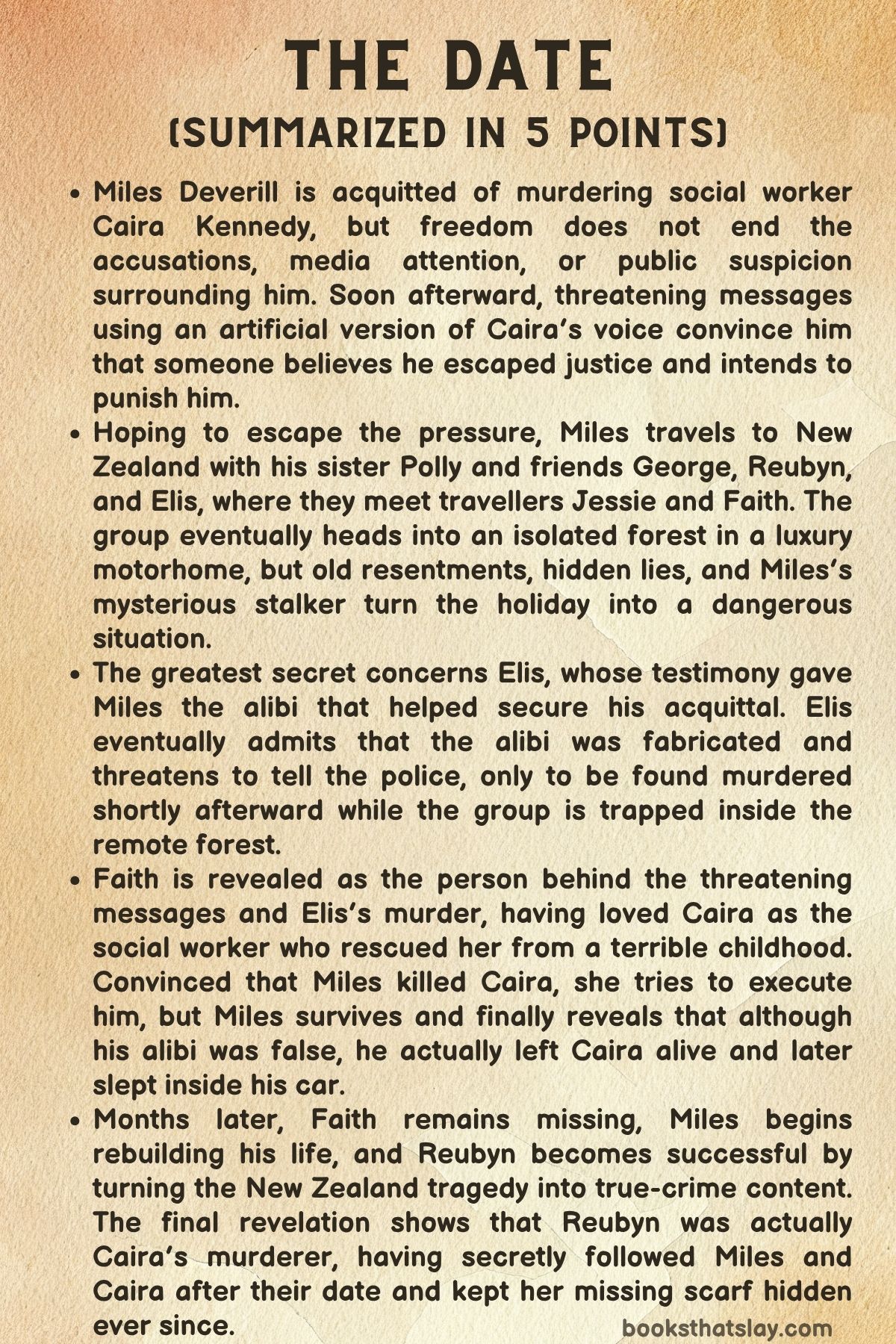
Summary
Caira Kennedy, a forty-year-old social worker, meets twenty-nine-year-old actor Miles Deverill through a dating app. Their first date goes surprisingly well, beginning with dinner and continuing with drinks before Miles walks Caira back to her basement flat and briefly enters after she invites him inside to warm up.
The following evening, police approach Miles because Caira has been murdered. What initially appears to be questioning quickly develops into a major criminal investigation, and because Miles was the last known person to see her alive, he becomes the obvious suspect.
Eleven months later, Miles waits for a jury to decide whether he murdered her. The prosecution argues that Caira rejected his sexual advances and that Miles, accustomed to getting what he wanted, strangled her with the leopard-print scarf she had worn during their date.
The case against him is circumstantial but troubling. Records establish that Miles and Caira reached her home shortly after midnight, his phone was dead, his later movements were difficult to verify, and the route he claimed to have taken appeared unnecessarily indirect. Prosecutors suggest he deliberately avoided CCTV after killing her.
Miles’s strongest protection is testimony from his friend Elis Pritchard-Jones. Elis claims Miles unexpectedly arrived at his flat before the television broadcast of Chinatown began at 12:30 a.m., leaving too little time for Miles to have remained inside Caira’s flat long enough to commit the murder and then travel to Elis’s home.
The defence also challenges the prosecution’s suggested motive by showing that Caira’s work exposed her to angry and sometimes violent people. Her former social-services manager explains how parents facing the removal of their children could become threatening, and documentary footage shows Caira being confronted by an aggressive father during her work.
The jury eventually finds Miles not guilty. His relief is immediately complicated by the grief of Caira’s family and by press photographs showing him smiling beside his friend George after leaving court, creating a public impression that he is celebrating rather than merely reacting to his freedom.
The media scrutiny worsens when journalist Anthony O’Neill discovers Miles drinking champagne with friends while songs including “Free Bird” play inside the family home. The resulting story presents the gathering as an insensitive celebration, and Miles discovers that acquittal has done little to persuade people who already decided he was guilty.
Then an apparently impossible message arrives. An email sent under Caira Kennedy’s name contains an audio recording in a voice indistinguishable from hers, warning Miles that the situation is not over. Police later determine that the voice was created artificially, but additional recordings continue arriving.
Miles becomes desperate to escape Britain and decides to take the long-postponed New Zealand trip that sustained him psychologically during the case. His sister Polly accompanies him, along with George, Reubyn Carmichael and Elis, although tensions already exist among the men because George regards Elis as an outsider to their old Holvine College friendship group.
In Queenstown, the group meets two travellers, Faith and Jessie. Miles becomes romantically interested in Jessie but lies about his surname, calling himself Miles Davis so she cannot search his real name and discover the murder case. Meanwhile, another threatening recording arrives.
A later message mentions the expensive Macallan whisky Miles drank the previous evening, a detail that should not have been publicly available. Miles and his friends learn that a stranger questioned a bartender about their drinks, apparently confirming that the person tormenting him has followed him to New Zealand.
George attempts to identify the stalker by secretly watching people in a bar. He and Miles pursue a suspicious stranger through Queenstown and obtain a photograph, but the man escapes. Soon afterward, a reporter also finds Miles, reinforcing his sense that neither journalists nor whoever is threatening him can be escaped simply by travelling abroad.
Reubyn then reveals a promotional arrangement that gives the group access to a huge luxury motorhome. They decide to leave Queenstown, with Faith and Jessie joining them, and Reubyn chooses isolated Hendrick’s Forest as their destination because he wants to film a rare kākāpō for his YouTube channel.
The forest proves much more dangerous than expected. Reubyn has ignored the fact that the reserve is officially closed, the weather deteriorates, and Miles fears a hooded figure seen outside a bird hide may be his stalker. At the same time, resentments within the group become increasingly severe.
George repeatedly belittles Elis, while Elis has grown tired of being treated as socially inferior. Their hostility eventually turns physical when George calls him a desperate outsider and Elis punches him. Polly begins wondering whether George’s long-standing distrust of Elis may have some basis, while everyone becomes eager to leave the forest.
The most dangerous secret emerges when Miles finds Elis alone in the bird hide after the fight. Their argument becomes personal, and Elis finally admits that the alibi he provided during the trial was false. Miles never arrived at his home before Chinatown began, and the two men never watched the film together that night.
Elis threatens to go to the police and admit that he committed perjury. Miles is horrified because the fabricated alibi was central to creating doubt about whether he had enough time to kill Caira, and its collapse could renew suspicion surrounding the unresolved murder.
The next morning, Elis disappears. His phone, passport, and other belongings remain inside the motorhome, making it unlikely that he simply walked away from the group. A search ends at the bird hide, where Elis is found dead with his throat cut.
With no mobile reception and the motorhome refusing to start, the surviving travellers are trapped. Reubyn eventually admits that the forest was closed and that he brought them inside anyway, while Jessie finally discovers that Miles has been lying about his identity and that he was recently tried for murder.
Suspicion initially falls heavily on George because he fought with Elis and threatened him. George responds by revealing that Miles has been stalked since his acquittal, raising the possibility that an outsider followed them into the forest, although nobody can explain why someone targeting Miles would murder Elis instead.
Miles has an additional reason for fear that he cannot reveal. Because Elis threatened to expose the false alibi shortly before dying, Miles himself appears to have a powerful motive for silencing him. He begins wondering whether his stalker intended to kill him but murdered Elis accidentally.
A clue finally connects the mysterious name Alex Burnfield to Caira. Polly remembers Burnfield Court, the troubled housing estate featured in the documentary Guardian Angels, where Caira worked with families affected by addiction, violence, and neglect.
Unable to contact anyone, Miles decides to walk out of the reserve until he gets a phone signal. Faith volunteers to accompany him because Polly is injured and George remains under suspicion, and the two leave while the others attempt to repair the motorhome.
Back at the vehicle, George, Reubyn and Jessie discover that the starter battery has been deliberately sabotaged. Someone has removed clamps and cut a cable, proving their isolation was intentional rather than accidental.
Polly then discovers a hidden note triggered by an alarm. The message identifies Faith as Elis’s killer, apologizes for his death, and states that the others are safe while making clear that Faith intends to do something to Miles.
By then, Miles has already discovered the truth. During their walk, Faith points a gun at him and drops the Australian accent she had been using. She admits that she is Alex Burnfield and has orchestrated the threatening recordings, surveillance, false clues, and journey toward the confrontation.
Faith grew up at Burnfield Court with a heroin-addicted mother. Caira intervened in her childhood, helped remove her from dangerous circumstances, and continued supporting her afterward, becoming the closest thing Faith had to a dependable parent.
Faith became convinced that Miles murdered Caira and that the legal system allowed him to escape punishment. She followed him to New Zealand to kill him and murdered Elis after forcing him to admit that his courtroom testimony had been false, interpreting his confession as final proof of Miles’s guilt.
Miles attacks before Faith can shoot him. He is wounded in the shoulder, but after a desperate struggle he gains possession of the gun and finally reveals the real reason for his false alibi.
Miles had indeed left Caira alive after only a few minutes. However, instead of visiting Elis, he returned to his own car, climbed into the back seat because he was too drunk to drive and had no working phone, and slept there for hours. He and Elis invented the Chinatown story because Miles feared that the true explanation sounded unbelievable and could not be independently proved.
Holding the gun, Miles has the opportunity to kill Faith but refuses. He fires the remaining bullets harmlessly into the air, convincing Faith that he is not the violent murderer she imagined. Faith finally accepts that he may be innocent and disappears into the forest rather than surrendering.
Months later, Miles attends Elis’s funeral. Faith remains missing, Caira’s murder remains officially unsolved, and Miles understands that his decision to fabricate evidence helped create consequences that eventually contributed to Elis’s death. He begins considering leaving acting and becoming a social worker, influenced by what he has learned about Caira’s life and work.
Reubyn, meanwhile, turns the New Zealand tragedy into a successful true-crime series that makes his channel enormously popular. He announces plans to return to New Zealand and search for Faith, appearing publicly as someone helping continue the investigation.
The final revelation changes the meaning of the entire story. Reubyn had secretly followed Miles and Caira on the night of their date because his fascination with Miles had become obsessive. After Miles left Caira alive, Reubyn approached her home himself, and a struggle followed.
Caira’s missing leopard-print scarf is still hidden in Reubyn’s wardrobe. He is her real killer, meaning Miles was factually innocent despite lying about his alibi, Faith killed Elis while pursuing the wrong person, and the man profiting from the tragedy has been responsible for the original crime from the beginning.
Characters
Miles Deverill
Miles is the central figure in The Date, and much of his characterization depends on the difference between innocence and honesty. He did not murder Caira, but he still makes choices that damage his credibility, particularly his decision to construct a false alibi with Elis rather than admit that he spent the night sleeping drunkenly inside his car.
That decision reveals one of Miles’s most important weaknesses: when frightened by how events might look, he tries to manage appearances rather than trusting the truth. The same instinct appears when he lies to Jessie about his surname and withholds the murder trial from her because he wants her to know him before she knows his public reputation.
Miles is also changed profoundly by prolonged suspicion. Before Caira’s death, he is an aspiring actor with travel plans and an ordinary social life, but the investigation leaves him watchful, anxious, defensive, and increasingly unable to separate real danger from paranoia.
His refusal to kill Faith after gaining control of the gun becomes a decisive moral moment. Miles cannot undo his lies or the damage surrounding them, but he proves through action that he is not the murderer Faith imagined, and his later interest in becoming a social worker suggests a desire to build a life with more direct meaning than the acting career he previously pursued.
Caira Kennedy
Caira is dead for almost the entire story, yet her presence shapes nearly every major decision. She is first presented as intelligent, socially committed, experienced enough to be cautious about dating, and deeply invested in protecting vulnerable children through her work.
Her professional life also complicates the investigation because social work brought her into contact with distressed and sometimes aggressive families. This creates credible alternative motives for her murder and prevents her from functioning merely as an anonymous victim attached to Miles’s story.
Caira’s strongest continuing influence is revealed through Faith. Her intervention in Faith’s childhood apparently extended beyond professional duty, and she continued offering support long after formal responsibility had ended.
That generosity has tragic consequences because Faith converts love and gratitude into an absolute conviction that Caira must be avenged. Caira therefore remains both the moral centre of several characters’ memories and the absent person whose unresolved murder allows everyone else’s assumptions to grow unchecked.
Faith
Faith is constructed around concealment. She enters the group as a friendly Australian traveller, becomes close enough to Reubyn and the others to appear harmless, and ultimately volunteers to accompany Miles out of the forest when doing so gives her exactly the private confrontation she has planned.
Her true identity as Alex Burnfield reveals considerable intelligence, patience, and technical planning. She schedules threatening messages, uses artificial reproduction of Caira’s voice, creates the illusion of a male stalker, manipulates strangers into producing false clues, obtains an illegal gun, and successfully follows Miles from Britain to New Zealand.
Faith is not motivated by money or ordinary personal resentment. Caira rescued her from a childhood defined by addiction and neglect, and Faith’s attachment to her becomes so absolute that she treats her own belief in Miles’s guilt as sufficient justification for punishment.
Her tragedy lies in confusing certainty with truth. Once Elis confirms that his alibi was false, she treats the lie as proof that Miles committed murder, never considering that a person can lie about one part of an event while still being innocent of the central crime.
Reubyn Carmichael
Reubyn initially appears insecure, socially awkward, ambitious, and desperate for his online career to succeed. He cares about Miles and enjoys being part of the trip, yet he also evaluates experiences according to their potential value as videos, partnerships, audience growth, and personal branding.
His relationship with George reveals how strongly he seeks acceptance. Reubyn remembers George protecting him from bullying at school and therefore interprets later cruelty as loyalty, even when George threatens him directly.
His romantic insecurity is similarly important. Faith’s friendliness causes him to imagine a relationship that does not exist, and her rejection quickly turns his disappointment into resentment toward Elis when he sees them together.
The closing revelation completely changes his role in The Date. Reubyn’s fascination with Miles had already become an unhealthy obsession before the main events, and after watching Miles leave Caira alive, he approached her himself and became responsible for her death.
His later success as a true-crime creator is therefore deeply disturbing. Reubyn gains fame by narrating and commercializing a chain of events created by his own crime while continuing to conceal the missing scarf that could expose him.
Elis Pritchard-Jones
Elis is defined by competing needs for loyalty, belonging, and recognition. He genuinely cares about Miles and initially takes pride in believing his courtroom testimony helped save his friend from prison, but his relationship with Miles is damaged by his awareness that he will never share the history Miles has with George and Reubyn.
His social insecurity becomes especially visible around George. Elis has consciously altered elements of his accent and presentation while pursuing acting, yet George repeatedly treats him as someone attempting to enter a social circle whose status and traditions he does not understand.
Elis’s most consequential act is giving Miles a false alibi. What may originally have seemed like loyalty becomes increasingly intolerable once he feels undervalued, and during his argument with Miles he threatens to confess the perjury despite the legal consequences for himself.
His death results from Faith’s determination to discover whether the alibi was genuine. Elis therefore becomes one of the clearest examples of how a lie created for protection can later become dangerous to everyone involved.
Polly Deverill
Polly is Miles’s most consistent source of practical and emotional support. She recognizes that Caira’s family still deserves justice even while feeling enormous relief over her brother’s acquittal, giving her a more balanced response than relatives who focus entirely on Miles’s suffering.
Her commitment to him has nevertheless required major sacrifices. She has stepped away from her public-relations company, endured invasive press attention, and repeatedly rearranged her life around Miles during the investigation, trial, and New Zealand journey.
Polly is observant and usually more realistic than Miles. She warns him about his lies to Jessie, questions the explanations surrounding the stalking, and understands that being found not guilty does not restore the person Miles was before the accusation.
Her final conversation with Miles confirms the central importance of their sibling relationship. While her business and other responsibilities can function without constant attention, she considers looking after her younger brother something fundamentally personal and enduring.
George
George is confident, domineering, loyal in selective ways, and deeply shaped by the status culture of Holvine College. He treats old friendships as forms of possession and repeatedly acts as though his history with Miles gives him a superior claim to influence within the group.
His treatment of Elis exposes the ugliest side of this attitude. George categorizes him as an outsider, mocks his attempts to belong, interprets his closeness with Miles suspiciously, and eventually provokes the physical confrontation that makes him appear capable of Elis’s murder.
Yet George is not simply disloyal or cowardly. He tries to identify Miles’s stalker, helps investigate suspicious events, and immediately runs after Miles once Faith’s note reveals that his friend is in danger.
His nightmares about Holvine suggest that his obsession with hierarchy may itself be rooted in fear and earlier experiences of institutional cruelty. The aggressive adult persona therefore appears partly learned as a way of surviving and controlling environments in which vulnerability once carried consequences.
Jessie
Jessie initially represents the possibility that Miles might be seen without the murder accusation attached to him. Because she meets him in New Zealand without knowing his surname, she responds to his personality rather than to headlines, online accusations, or courtroom reporting.
That temporary normality is precisely why Miles lies to her. Unfortunately, the deception ensures that when Jessie finally learns the truth, her response concerns not only the murder charge but the fact that Miles deliberately denied her the information necessary to decide whether she felt comfortable around him.
Jessie is therefore important to Miles’s moral development. His relationship with her demonstrates that hiding information in order to control another person’s perception is still a form of manipulation, even when his motive is understandable.
Her reaction also provides a believable outsider’s perspective on the group. Once the truth emerges, the strange loyalty, secrecy, conflict, and behaviour surrounding Miles suddenly appear far more alarming than they did when she believed he was simply another traveller.
Carl Deverill
Carl responds to Miles’s ordeal primarily as an angry and protective father. After the acquittal, he condemns the prosecution and appears eager to treat the verdict as confirmation that the authorities should never have charged his son in the first place.
His attitude contrasts with Polly’s greater awareness that acquittal does not answer the question of who murdered Caira. Carl’s instinct is to defend Miles against external institutions, journalists, and accusations rather than remain emotionally open to uncertainty.
He therefore represents the family’s understandable desire for finality. Once Miles is legally cleared, Carl wants the crisis to be finished, even though the unresolved murder and later threats demonstrate that legal closure cannot erase everything surrounding the case.
Zara Deverill
Zara’s response is quieter than Carl’s but reveals the emotional damage the prosecution has inflicted on Miles’s family. After the verdict she finally allows months of fear to surface through tears, suggesting that much of her energy during the case was devoted simply to surviving the uncertainty.
She receives less independent attention than Polly or Carl, but her presence contributes to the sense that a murder prosecution affects an entire family rather than only the accused person. Her relief also exists beside the grief of Caira’s relatives, making the courtroom aftermath emotionally complicated rather than purely celebratory.
Eleanor
Eleanor, Miles’s barrister, is disciplined, strategic, and highly conscious of how behaviour can influence perception. Even before the verdict, she warns Miles that a favourable decision must not lead to an uncontrolled celebration because Caira’s family will be present and the public will be watching.
Her defence focuses on weaknesses in the prosecution’s timeline and motive rather than attempting to prove exactly who killed Caira. She uses Elis’s evidence and Caira’s difficult professional encounters to establish alternative possibilities and create reasonable doubt.
Eleanor therefore represents the legal distinction between proving innocence and defeating a prosecution case. Her success saves Miles from conviction, yet the ending shows that even the correct verdict can be reached through evidence that was partly false.
David
David, Miles’s solicitor, provides steady legal guidance throughout a period in which Miles frequently reacts emotionally. He is present during the anxious wait for the verdict and later treats the artificial Caira recordings as harassment that should be preserved and reported rather than answered impulsively.
His approach contrasts with Miles’s increasingly personal interpretation of every threat. David tends to respond through procedure, documentation, and legal caution, showing how institutions attempt to manage danger through evidence even when the person experiencing it wants immediate certainty.
Detective Chris Lewin
Detective Lewin becomes Miles’s main connection to the investigation into the threatening messages. He confirms that Caira’s voice was reproduced artificially and explains that the first message was sent using fraudulent identification at Bristol Central Library, demonstrating that the harassment was planned carefully.
Lewin frustrates Miles because police procedures feel painfully slow compared with the immediacy of his fear. Nevertheless, later findings show that investigators successfully untangle several misleading clues, including the innocent man chased through Queenstown and the stranger paid by Faith to ask about the Macallan.
His role reinforces the difference between investigation and assumption. Police require evidence and verification, whereas Miles, Faith, George, and others repeatedly draw conclusions from appearances that later prove misleading.
Ben Knight
Ben is Caira’s former boyfriend and one of the people Miles initially suspects. His openly hostile stare during the trial makes Miles wonder whether the romantic picture Ben later presents to journalists accurately reflects their past relationship.
The suspicion demonstrates how easily Miles begins constructing theories around anyone who appears to hate him. Ben ultimately functions more as a reminder that grief, jealousy, anger, and suspicious behaviour do not automatically establish guilt.
Anthony O’Neill
Anthony represents the aggressive side of media attention following Miles’s acquittal. He approaches Miles immediately with an offer to tell his story and continues questioning him after being refused, eventually turning casual details about champagne and music into material for another sensational article.
He is effective because Miles underestimates how easily ordinary behaviour can be reframed once a person becomes publicly controversial. Anthony therefore helps establish one of Miles’s central problems: even after the court clears him, other people retain the power to construct competing versions of who he is.
Themes
Legal Truth, Actual Truth, and Personal Justice
The central conflict in The Date repeatedly separates what can be proved from what actually happened. The jury correctly acquits Miles, yet it does so partly because Elis supplies a false alibi, creating the disturbing possibility that a legally proper outcome can depend on dishonest evidence.
Miles therefore occupies a morally uncomfortable position. He is innocent of Caira’s murder, but he lies during the investigation because he fears that sleeping in his car without witnesses will not protect him, and this decision eventually gives Faith reason to believe the acquittal was fraudulent.
Faith represents the danger of replacing legal uncertainty with personal certainty. She decides that the justice system failed Caira and grants herself the authority to punish Miles, but because her conclusion is wrong, her campaign produces another innocent victim when she kills Elis.
The ending makes the theme even more severe because the real murderer is Reubyn, a man nobody seriously suspects. Miles is innocent, Faith is wrong, Elis dies because of a false inference, and Reubyn remains free, demonstrating that neither courts nor personal conviction automatically produce complete truth.
Deception, Performance, and Constructed Identity
Acting extends far beyond Miles’s profession and becomes a pattern through which characters attempt to control how others understand them. Miles performs normality for Jessie, inventing a different surname because he wants to separate his private identity from the public identity created by the murder trial.
Elis performs certainty in court when he claims Miles arrived before Chinatown began. His evidence sounds convincing because he supplies specific ordinary details, yet the apparent precision hides a deliberate fabrication designed to protect his friend.
Faith creates the most elaborate false identity. She adopts an Australian accent, presents herself as an ordinary traveller, schedules threatening messages, creates artificial recordings in Caira’s voice, and manipulates other people so Miles imagines a male stalker following him.
Reubyn ultimately provides the darkest version of performance. He publicly becomes a true-crime creator investigating the consequences of Caira’s murder while privately concealing the scarf that proves his own involvement.
The novel repeatedly demonstrates that convincing behaviour cannot be treated as reliable evidence of character. People can appear frightened, loyal, friendly, innocent, helpful, or objective while hiding motives and actions that completely contradict the role they present to everyone else.
Class, Status, and Social Belonging
Holvine College creates a social hierarchy that continues shaping George, Miles, Reubyn, and their relationships long after school. George especially treats shared history, wealth, education, and social position as markers that determine who naturally belongs inside the group and who must prove himself.
Elis experiences this hierarchy most directly. He has modified his accent and adapted himself while pursuing acting, yet George continues to regard him as someone entering a world whose unwritten rules he does not understand, eventually dismissing him as a desperate outsider.
Faith’s resentment also contains a class dimension. She believes Miles has received opportunities, protection, and career advantages that people from backgrounds like hers would rarely receive, and her stalking becomes partly connected to anger over what she sees as his lifelong privilege.
Reubyn occupies another unstable social position. Unlike several Holvine classmates, he did not come from major wealth, and his education depended on his mother’s employment at the school and later waived fees after her death.
Status therefore influences loyalty, resentment, insecurity, and even interpretations of guilt. Characters repeatedly judge one another not only by actions but by assumptions about where they belong socially and what advantages they have been given.
Obsession, Surveillance, and the Desire to Control Other People
Miles spends much of the story being watched. Journalists observe him, strangers photograph him, social-media users judge him, Faith follows his movements, and eventually the reader learns that Reubyn had already been secretly observing him before Caira died.
This constant surveillance changes Miles psychologically. He becomes increasingly conscious of cameras, online comments, public interpretation, and the possibility that harmless behaviour might become evidence for another damaging story.
Faith turns observation into a method of punishment. She studies Miles closely enough to follow him across countries, uses information about his movements to frighten him, and constructs false evidence intended to convince him that an unseen man is always nearby.
Reubyn’s obsession is quieter and ultimately more dangerous. His initial interest comes from advice encouraging him to study men who appear successful with women, but observation becomes fixation, leading him to follow Miles and Caira after their date and eventually approach Caira himself.
Even his later true-crime project continues that desire to control the narrative. He turns private suffering into content, converts tragedy into career success, and plans to continue the story by searching for Faith while ensuring that nobody knows the most important fact of all: he created the original crime that everyone else has been trying to understand.