The Death Row Club Summary, Characters and Themes
The Death Row Club by V.A. Vazquez is a psychological thriller about inherited guilt, secrecy, public judgment, and the complicated bonds between children and murderous parents.
At its center is Nicola Fischer, whose life collapses after her father is exposed as the Ellicott Creek Ripper, forcing her into a secret support group for relatives of serial killers. What begins as a secluded retreat becomes a murder investigation filled with concealed identities, betrayals, and competing versions of the past. The story also follows Greer Woods, whose own history challenges the distinction between victim, accomplice, survivor, and daughter.
Summary
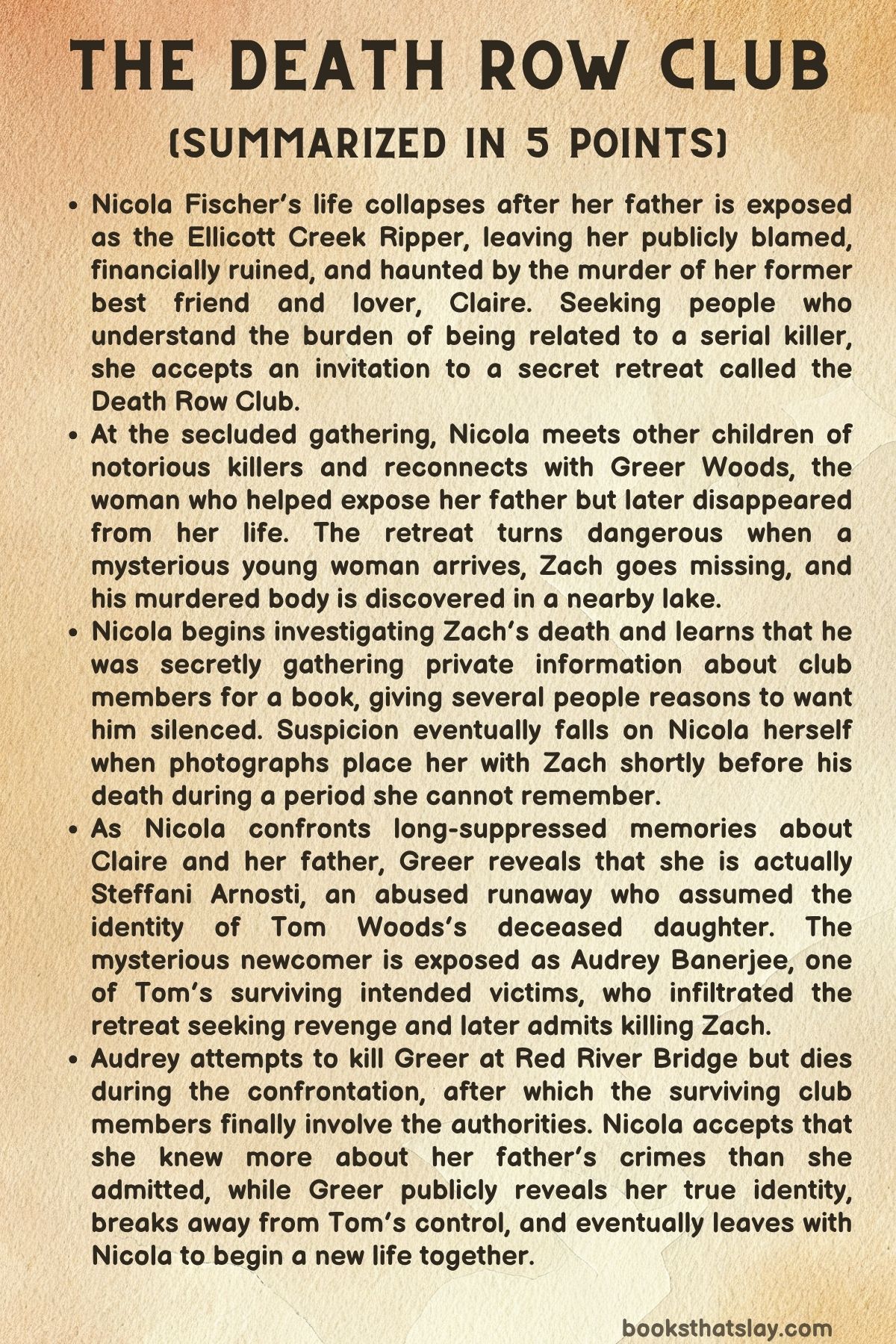
Nicola Fischer’s ordinary life ends when armed police officers storm her home and arrest her father. She cannot understand why the loving man who raised her is being treated like a dangerous criminal, but three months later the truth is public: he has been identified as the Ellicott Creek Ripper, responsible for murdering five women, including Nicola’s former best friend Claire Tenenbaum.
The consequences extend far beyond her father’s imprisonment. Nicola loses her teaching job after parents and coworkers begin treating her as though criminality must be hereditary, reporters surround her house, strangers abuse her online, and the debts secretly accumulated by her father leave her financially trapped in a home nobody wants to buy.
Nicola is especially tormented by Claire’s death. She remembers where she was when each victim was killed, but Claire is different because Nicola invited her to Oliante and therefore feels responsible for placing her within her father’s reach.
Her anger is also directed at Greer Woods, a defense attorney and television personality who helped expose Nicola’s father. Nicola once believed Greer had become a genuine friend, but Greer secretly searched Nicola’s house during the investigation, discovered victims’ jewelry behind a wall, and then disappeared from Nicola’s life after the arrest while a television series edited Nicola into a suspicious figure.
Greer eventually contacts Nicola indirectly through an invitation to the Death Row Club, a secret organization for children of serial killers. Desperate to meet people who may understand what her life has become and determined to confront Greer, Nicola accepts the invitation and travels to Washington for an isolated retreat.
Running alongside Nicola’s story is the journey of eighteen-year-old Steffani, a young woman who has spent years trying to escape her violent father. Restraining orders, foster homes, police reports, and repeated moves have never protected her because her father continually tracks her down, and Steffani suspects that he may also have murdered her missing mother.
On the flight to Seattle, Nicola meets Zach, another retreat member whose father was a serial killer. Zach’s dark humor and easy understanding of media harassment allow Nicola to laugh about experiences that nobody else in her life understands, and she quickly begins seeing him as a potential friend.
At the retreat, Nicola meets Connor Patchet, who manages the club’s secrecy and security, along with Kemy, Hannah, Ros, Imogen, and the other members. Connor confiscates electronic devices and reveals that Greer helped create the organization, while Nicola becomes increasingly nervous about the extensive background investigations he conducts on every prospective member.
Around a bonfire, members describe the crimes committed by their parents. Imogen’s mother killed hospice patients, Kemy’s father murdered more than a hundred women, Ros’s father was the Paper Bag Butcher, Connor grew up in a murderous cult, and Zach’s father imprisoned victims in a freezer, while Hannah refuses to discuss her family.
Greer finally arrives, giving Nicola the confrontation she has wanted for months. Nicola explains how the television series and Greer’s silence helped destroy her life, while Greer admits she handled everything badly, says she opposed the show’s treatment of Nicola, promises to correct the public record, and gives Nicola a $750,000 check because she recognizes the financial damage the production caused.
Their reconciliation is interrupted when another young woman appears in the woods. She identifies herself as Steffani, carries records documenting years of abuse, and claims that her father is a murderer whom authorities have repeatedly failed to stop; she has come because she wants Greer to expose him.
Greer allows the newcomer to stay for the night, but tension increases immediately. Nicola becomes jealous when Greer gives the stranger her attention, Zach warns Nicola that Greer has been lying to everyone, and Nicola becomes so intoxicated that she loses portions of her memory after apparently encountering someone in her bedroom.
The next morning, the newcomer is gone, Greer’s car has disappeared, and Zach is also missing. Members initially assume Zach left with her, but during a later swim with Greer, Nicola discovers Zach’s body at the bottom of a lake and becomes convinced that his injuries indicate murder.
The club initially resists contacting police because exposure could destroy the private lives its members have spent years constructing. Connor finds opioids in Zach’s pocket and offers an accidental-drowning explanation, but while preparing to bury him, Nicola removes a painted ceramic fragment from his head wound and realizes he was struck with an object before being placed in the water.
With the security system sabotaged and Steffani’s phone missing, the possibility arises that the killer is still among them. Nicola and Greer spend the night together, and Nicola finally reveals that Claire was not merely her closest friend but her lover, while Greer admits that she had already strongly suspected Nicola’s father before his arrest.
Nicola then investigates Zach’s room and discovers that his apparent friendship concealed another purpose. He had secretly collected detailed information about every club member and planned to publish a book about them, giving almost everyone at the retreat a reason to fear what he might reveal.
Connor becomes increasingly suspicious when Nicola searches his room and discovers intimate photographs from her college years. He explains that Greer once hired him to investigate everyone connected to Claire and that he bought the photographs from Nicola’s former classmate Justin Billings to prevent reporters from obtaining them.
Nicola then discovers Steffani’s burned identification and recognizes a necklace in Connor’s possession as the one the young woman had been wearing. Her suspicion shifts toward Connor, but newly developed photographs from a bloodstained disposable camera show Nicola confronting Zach on the night he died, during the exact period that her intoxication erased from her memory.
Connor publicly accuses Nicola of killing Zach and then reveals an older source of suspicion surrounding Claire. The photographs prove Claire had been romantically involved with Justin, and Connor proposes that Nicola discovered the betrayal, brought Claire home, and became involved in a murder her father later concealed.
The club votes to isolate Nicola, and Greer’s decision to join the vote feels like another devastating abandonment. Connor locks Nicola inside an old shack in the woods, leaving her alone with the possibility that everyone has decided she inherited her father’s violence.
Inside the shack, Nicola finally confronts the memory she has suppressed for years. She had discovered Claire’s relationship with Justin and learned that Claire had shown him intimate photographs of Nicola, then deliberately left Claire’s phone where her father would find it because she knew he would become angry and expected him to drive Claire away.
After Claire was murdered, Nicola strongly suspected what her father had done and even discovered physical evidence connected to his victims, yet she remained silent. Her guilt does not come from having committed the murder herself but from knowing she intentionally involved a possessive and dangerous father in her conflict with Claire and then spent years refusing to admit how much she understood.
Nicola also discovers Steffani’s phone and the blood-covered ceramic statue used to kill Zach. Messages reveal that the woman calling herself Steffani has also been using the name Audrey Banerjee and possesses information capable of damaging the clemency case of Greer’s imprisoned father, Tom Woods.
When Greer comes to rescue Nicola, an even greater secret emerges. Greer Woods is not actually Tom Woods’s biological daughter: she is the real Steffani Arnosti, the abused runaway whose journey has appeared throughout the story.
The original Greer Woods died while trying to escape Tom, and Steffani later assumed her identity because the two resembled each other and Tom lived so privately that the substitution could succeed. After Steffani’s biological father tracked her down, Tom helped kill him, offered Steffani a home, and became the parental figure she had always wanted.
Steffani eventually discovered that Tom was also a serial killer. Years after believing he had stopped, she encountered one of his terrified intended victims, investigated the old shack, found the names of numerous women, and anonymously contacted police, yet she preserved the Greer Woods identity rather than returning to the identity associated with her earlier life.
The woman who came to the retreat using Steffani’s name is actually Audrey Banerjee, Tom’s last intended victim and the young woman whose escape helped expose him. Audrey had spent years discovering Greer’s true identity and came to confront her because she could not understand why someone who knew what Tom was capable of would continue defending him from execution.
Audrey also killed Zach. He had traded the location of the retreat for information and secretly intended to publish a second book about Audrey, so during an argument she struck him with the ceramic statue and later tried to direct suspicion elsewhere.
Audrey summons Greer to Red River Bridge and attempts to kill her by driving Greer’s Challenger toward her. Greer jumps over the railing, knowing that a suicide-prevention net is installed beneath the bridge, while Nicola follows and confronts Audrey.
Audrey prepares to kill Nicola with an axe, but the driverless Challenger rolls through the fog after its defective hand brake releases and fatally strikes her. Connor then helps Nicola pull Greer back from the safety net, and Greer finally agrees that the entire story must be reported to police despite the consequences for the Death Row Club.
Greer later visits Tom and tells him she will publicly reveal her real identity, stop serving as his attorney, and make a victim impact statement. Tom responds by threatening to expose evidence connecting her to her biological father’s death, finally forcing Greer to recognize that even his version of parental love has always contained control and coercion.
Nicola returns home carrying a necklace belonging to one of her father’s victims and finally acknowledges that she discovered evidence of his crimes long before his arrest. She throws the necklace into the creek, an act that reflects both her continuing moral imperfection and her decision to stop pretending she understood nothing.
Greer publicly reveals that she was one of Tom’s victims, his sentence is commuted to life without parole, and she eventually arrives at Nicola’s home in a converted van containing a mobile art studio. Nicola chooses to leave with her, and as they drive past the road leading to the prison where Nicola’s father will remain, she does not even notice the turnoff, showing how far her attention has finally moved beyond him.
Characters
Nicola Fischer
Nicola is the central emotional perspective of The Death Row Club, and much of her conflict comes from the gap between the innocence she publicly claims and the more uncomfortable truth she privately knows. She genuinely did not participate in her father’s murders, yet her relationship with Claire left her carrying a specific kind of responsibility because she deliberately exposed Claire’s betrayal to a father whose possessiveness she already understood.
Her life after her father’s arrest is defined by social punishment, financial ruin, loneliness, and the assumption that a killer’s child must somehow share his nature. That treatment makes Nicola sympathetic, but the novel refuses to make her morally simple because she later admits that she found physical evidence connected to her father and remained silent rather than facing what it meant.
Nicola’s relationship with Greer also reveals how intensely she fears abandonment. Her anger over Greer’s disappearance after the investigation, her jealousy when Greer turns toward Audrey, and her devastation when Greer votes to isolate her all come from a recurring fear that anyone she loves will eventually choose someone or something else over her.
Her development comes through accepting responsibility without accepting the identity strangers impose on her. By the ending, she is neither the innocent daughter who understood nothing nor the secret accomplice imagined by the public; she is a flawed survivor who finally recognizes what she knew, what she feared, and what she chose not to confront.
Greer Woods / Steffani Arnosti
Greer is the other major character in The Death Row Club, and her identity makes the book’s questions about family, victimhood, and chosen identity especially complicated. Born Steffani Arnosti, she spends her youth escaping an abusive biological father before finding refuge with Tom Woods and eventually assuming the identity of Tom’s dead biological daughter.
For Steffani, becoming Greer is initially an act of survival. Tom provides the home, security, affection, and stability she has never possessed, which explains why she becomes emotionally attached to him even after recognizing that he is capable of extreme violence.
Her deepest contradiction is that she helps expose Tom yet continues loving him and opposing his execution. She constructs a professional life around justice while simultaneously defending the man who gave her a home, and this conflict makes her neither simply hypocritical nor innocent but someone whose gratitude and trauma have distorted her ability to recognize control.
Greer ultimately changes when Tom threatens her after she decides to reveal the truth. She realizes that his love has always depended partly on her obedience, resigns as his attorney, publicly identifies herself as his victim, and chooses a life that is no longer built around preserving the identity he gave her.
Zach
Zach initially appears to be Nicola’s easiest source of companionship because he instinctively understands the strange mixture of grief, shame, affection, and dark humor that comes with having a murderous parent. His friendliness allows Nicola to relax quickly, and she begins treating him almost like the brother she never had.
His history with addiction, homelessness, financial instability, and his father’s execution adds genuine vulnerability to his behavior. He spent money trying to prevent the execution even though the public expected him to celebrate his father’s death, revealing how completely he rejects the idea that loving a criminal means approving of the crime.
At the same time, Zach betrays the trust he claims to value. His secret notebooks reveal that he was gathering private information for a book, meaning his connection with Nicola and the others was mixed with professional exploitation.
His death therefore becomes morally complicated for the survivors. He was a vulnerable man who deserved neither murder nor public humiliation, but he was also preparing to expose people who had trusted a supposedly private community, giving several members legitimate reasons to feel betrayed by him.
Connor Patchet
Connor is defined by control, secrecy, and a belief that protecting the Death Row Club requires constant vigilance. He confiscates devices, investigates prospective members, manages security, and frequently treats privacy as something that can justify decisions other people would consider excessive.
His methods make him easy to suspect because he possesses private information about Nicola, keeps sensitive materials in his room, and uses physical force when she searches his belongings. His decision to hide the truth about Hannah retrieving Zach’s notebooks further demonstrates that his loyalty to club members can lead him to manipulate evidence and information.
Connor is not revealed as Zach’s killer, but his behavior shows how fear can transform protection into coercion. Locking Nicola inside the shack is especially significant because he acts without legal authority yet convinces himself that removing one person’s freedom is acceptable if it protects everyone else.
He remains capable of loyalty and practical courage, eventually helping rescue Greer from beneath the bridge. This prevents him from becoming merely an authoritarian obstacle and instead presents him as someone whose strongest virtues and worst tendencies come from the same desire to keep vulnerable people safe.
Audrey Banerjee
Audrey is initially introduced under the false identity of Steffani Arnosti, allowing her to enter the retreat and confront Greer about Tom Woods. In reality, she is Tom’s last intended victim, the young woman whose escape helped reveal his crimes.
Her anger toward Greer grows from years of believing that Greer knew more about Tom than she admitted. Once Audrey learns that Greer still loves him and genuinely opposes his execution, she sees that loyalty as an intolerable betrayal of Tom’s victims.
Audrey’s need to control her own story also explains her conflict with Zach. When she learns that he has secretly obtained another publishing deal centered on her, she reacts violently and kills him with the ceramic statue, turning a legitimate fear of exploitation into murder.
By the bridge confrontation, revenge has consumed her original demand for accountability. She attempts to kill Greer and then prepares to kill Nicola as a witness, demonstrating how thoroughly her desire to punish those connected to Tom has crossed into the same willingness to destroy other lives that she once condemned.
Kemy
Kemy approaches her father’s crimes through scholarship, justice, and a strong belief in capital punishment when guilt is unquestionable. Her father Marcus Jerome murdered 103 women, many from marginalized communities, and the neglect surrounding those victims helped shape Kemy’s academic career.
Her position creates professional consequences because colleagues resist supporting her tenure, showing how the public identities of these characters influence careers long after their parents are imprisoned. Kemy believes execution can prevent killers from continuing to dominate attention through books, interviews, and cultural fascination while victims remain secondary.
She is also relatively pragmatic during the crisis surrounding Nicola. Although she participates in the decision to isolate her, Kemy favors restraint rather than uncontrolled retaliation, fitting her broader preference for formal consequences over emotional chaos.
Hannah
Hannah is initially the quietest member of the retreat and refuses to discuss her family history during the bonfire. Her extreme fear after accidentally spilling paint suggests a background in which mistakes may have been punished severely, although the supplied material does not provide a complete explanation of her past.
Her silence does not mean she is passive. She immediately responds when Steffani’s scars become visible by asking who hurt her, revealing a sensitivity to abuse that breaks through her withdrawn behavior.
Hannah also knows where Zach’s notebooks are hidden and secretly retrieves them. Connor later appears to protect her involvement, suggesting that her quiet presence conceals greater awareness of events inside the club than Nicola initially assumes.
Ros
Ros has built an ordinary family life by concealing that her father is the Paper Bag Butcher. Her husband and daughters do not know the truth, making privacy not merely a matter of embarrassment but the foundation of the identity she has created as a wife and mother.
She challenges Greer’s tendency to search for redeeming value in Tom Woods and argues that the children of killers must resist romanticizing their parents. Her position makes her one of the clearest voices insisting that private affection should not obscure the suffering caused by violent offenders.
Yet Ros herself ultimately chooses secrecy over public accountability. When other members agree to speak with police following Audrey’s death, Ros refuses because she considers protecting her daughters more important than revealing the club’s existence, demonstrating that moral certainty becomes harder when disclosure threatens her own family.
Imogen
Imogen serves as one of the retreat facilitators and represents the therapeutic side of the Death Row Club. She guides activities intended to help members release guilt and discuss the difficult emotions attached to parents whose crimes cannot be separated cleanly from childhood memories.
Her mother killed hospice patients with morphine while believing she was ending suffering. That background presents a different kind of criminal parent from the sadistic killers associated with several other members and adds moral ambiguity to conversations about intention, responsibility, and punishment.
Zach’s notes reveal that Imogen also has professional misconduct allegations in her past. This gives her a personal reason to fear publication of his book and shows that even someone positioned as a therapeutic guide has private vulnerabilities she does not want exposed.
Tom Woods
Tom Woods occupies a complicated position because he is simultaneously a serial killer, Greer’s rescuer, her substitute father, and later one of the forces controlling her life. He helps kill Steffani’s abusive biological father and offers her the secure home she has always wanted, allowing her to build an adult identity around the belief that he chose and protected her.
That apparent transformation is false. Greer eventually discovers that Tom continued abducting and murdering women despite telling her otherwise, proving that the stability he offered never represented genuine moral change.
His most revealing moment occurs when Greer decides to stop representing him. Rather than accepting her independence, Tom threatens to use evidence from the death of her biological father against her, demonstrating that his affection has always contained the possibility of coercion.
Tom therefore represents the danger of confusing rescue with ownership. He gives Steffani a life she desperately needed, but the security he provides remains tied to secrecy, loyalty, and the expectation that she will continue defending him.
Nicola’s Father, the Ellicott Creek Ripper
Nicola’s father is first presented through the loving image she carries from childhood. Even while police drag him away, he reassures his daughter, and Nicola initially cannot reconcile that familiar man with the serial killer authorities claim to have arrested.
The later revelations make his love for Nicola disturbing because it appears possessive rather than selfless. Nicola concludes that Claire may have become a target partly because her father could not tolerate another person becoming more important in his daughter’s life.
His reassurance after Claire’s death also contains an implied threat that Nicola only fully acknowledges years later. By telling her the death was not her fault while knowing his own responsibility, he helps establish the silence in which Nicola spends years denying what she suspects.
The character therefore demonstrates how parental affection and violence can coexist without canceling each other. Nicola’s eventual growth depends not on pretending he never loved her, but on recognizing that love itself did not make him safe or morally redeemable.
Claire Tenenbaum
Claire is absent from the present-day action because she was murdered years earlier, yet she remains central to Nicola’s identity. Nicola repeatedly sees Claire’s face in her artwork and cannot escape the belief that inviting her home helped place her in danger.
Their relationship was romantic, not simply a friendship, which makes the later revelation of Claire’s involvement with Justin especially painful. Claire had shown Justin intimate photographs of Nicola and minimized her relationship with Nicola, leaving Nicola feeling humiliated and betrayed.
Claire is not responsible for what Nicola’s father did to her, and the book never turns her betrayal into justification for murder. Instead, her choices become the emotional trigger that Nicola uses to involve her father, making Claire’s death the point where ordinary relationship pain collides with a danger Nicola does not fully admit she understands.
Steffani’s Biological Father
Steffani’s biological father is the source of the fear that defines her early life. He repeatedly tracks her through foster placements and new homes, treating every attempt at independence as something he is entitled to destroy.
He calls his stalking and violence protection, demonstrating a distorted idea of parenthood in which possession is presented as love. His assaults, threats, and scars on Steffani’s body make clear that his claim to be protecting her is fundamentally about control.
Steffani’s decisive moment comes when he suggests that keeping him alive is the only way she may ever learn what happened to her mother. She chooses uncertainty instead, accepting that answers are not worth returning to captivity.
Justin Billings
Justin is a relatively minor character in the present narrative but has enormous importance in Nicola’s past. His relationship with Claire becomes the betrayal that alters Nicola’s understanding of their romance and indirectly contributes to the chain of choices preceding Claire’s death.
He also possesses intimate photographs of Nicola and later offers them for money, forcing Connor to purchase them before reporters can obtain them. His actions show another form of exploitation in a story where private information repeatedly becomes something other people can trade, publish, or use as leverage.
Ava
Ava is Nicola’s student and represents the ordinary teaching life Nicola loses after her father is exposed. Nicola’s painful goodbye with her and the later incident in which Nicola nearly hits Ava with her car become reminders of how quickly public scandal has transformed Nicola from a trusted teacher into someone parents fear.
Ava also matters because Nicola’s affection for her shows that Nicola possessed meaningful relationships and responsibilities independent of her father. Losing that connection contributes to Nicola’s sense that she is being punished not for anything she personally did but for the crimes associated with her family name.
Themes
Inherited Guilt and the Burden of Family Identity
Children in The Death Row Club are repeatedly judged according to crimes committed by their parents, creating a conflict between individual responsibility and inherited reputation. Nicola experiences this most directly when parents demand her removal from school, coworkers speculate that she helped her father, strangers threaten her online, and reporters treat every part of her behavior as possible evidence that violence runs in the family.
The retreat exists because its members understand that public judgment does not end when a criminal parent is arrested. Ros hides her father from her husband and daughters, Kemy’s career is shaped by her father’s crimes, Zach is expected to celebrate his father’s execution, and Greer constructs much of her adult identity around managing the consequences of Tom Woods.
At the same time, the story complicates the idea that children are entirely separate from their parents’ histories. Nicola genuinely bears no responsibility for her father’s murders, yet she did make choices surrounding Claire that contributed to her silence afterward, while Greer protected Tom long after discovering what he had done.
The distinction becomes crucial: responsibility can arise from a person’s own decisions, but guilt cannot simply be inherited through blood. The characters must learn to separate what belongs to their parents from what belongs to themselves.
Love, Possession, and Parental Control
Several parent-child relationships demonstrate that love and danger can exist in the same relationship. Nicola cannot simply hate her father because she remembers genuine affection from childhood, while Greer sincerely loves Tom because he gave her safety and belonging after years of abuse.
The danger appears when parental love becomes indistinguishable from ownership. Nicola comes to believe her father killed Claire partly because he could not tolerate another person occupying such an important place in Nicola’s life, while Steffani’s biological father repeatedly stalks and injures her while describing his behavior as protection.
Tom initially appears different because he rescues Steffani from abuse and provides a home. Yet when Greer finally rejects his influence, he threatens to expose evidence that could implicate her in her biological father’s death, revealing that his generosity also created leverage he expected to retain.
The story therefore refuses the comforting belief that love proves goodness. A violent person may genuinely feel affection while still using that affection to control another person, and recognizing this becomes essential to both Nicola’s and Greer’s growth.
Secrecy, Truth, and Self-Deception
Nearly every major conflict develops because someone controls, hides, edits, or manipulates information. Greer conceals her real identity, Nicola hides what she knew about Claire and her father, Zach secretly documents club members, Audrey enters under a false name, Connor withholds information, and the television series edits Nicola’s image into something more suspicious than reality.
Some secrets are initially presented as necessary forms of survival. Ros protects her daughters from public knowledge, Greer preserves the identity that allowed her to escape her earlier life, and the club itself depends on secrecy because its members have already experienced intense public scrutiny.
The greater danger, however, comes when secrecy turns into self-deception. Nicola spends years telling herself she did not know what her father was even though she found victims’ property, while Greer convinces herself that Tom’s role as her rescuer means he deserves continued protection.
Truth does not provide simple freedom because disclosure can cost careers, relationships, identities, and safety. Even so, the ending suggests that a life built entirely around protecting old secrets eventually becomes another form of confinement.
Accountability, Justice, and the Limits of Punishment
The characters disagree strongly about what justice should mean when guilt is certain. Kemy supports capital punishment because she believes notorious killers continue consuming public attention while their victims disappear from cultural memory, whereas Greer opposes execution even after acknowledging the full extent of Tom’s crimes.
Zach’s reaction to his father’s execution complicates the issue further. The state treats the execution as punishment for the killer, but Zach experiences it as the death of someone he still loves, demonstrating that legal punishment spreads emotional consequences beyond the person formally sentenced.
Audrey represents another extreme by turning justice into personal revenge. Her demand that Tom be executed grows into willingness to murder Zach, attempt to kill Greer, and threaten Nicola, showing how the desire to make another person suffer can eventually reproduce the same disregard for human life that supposedly justified punishment in the first place.
The ending favors accountability without presenting punishment as emotionally simple. Greer gives a victim statement but asks for life without parole rather than execution, Tom remains imprisoned, and both Nicola and Greer move forward only after acknowledging their own choices rather than defining justice solely through what happens to their fathers.