The Dragon Has Some Complaints Summary, Characters and Themes
The Dragon Has Some Complaints by John Wiswell is a fantasy novel built around Garrodigh, a damaged three-headed dragon whose heads possess separate personalities, competing beliefs, and an impressive talent for arguing with one another.
Centerhead considers himself a terrifying enemy of humanity, Upperhead believes he is secretly human, and Bottomhead mostly cares about food and comfort. Their attempt to exploit the floating human settlement of Winged City gradually becomes something very different as recovery, friendship, war, political conflict, and old secrets challenge nearly everything Garrodigh believes about dragons, humans, loyalty, identity, and home.
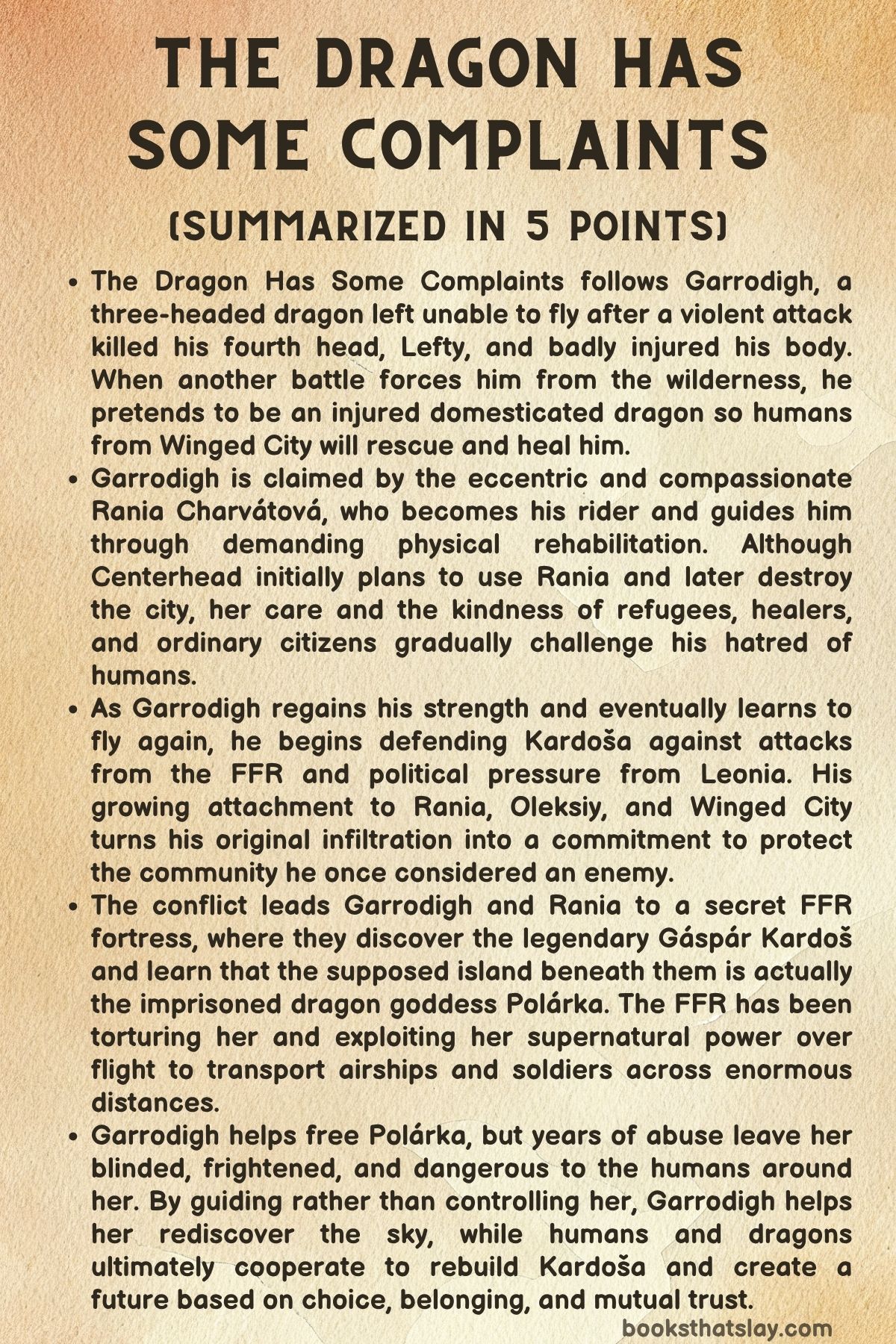
Summary
Garrodigh is a huge red dragon who once had four heads but now has only three. Centerhead is proud, angry, and convinced of his own greatness; Upperhead believes he is actually a human trapped in a dragon body; and Bottomhead is impulsive, practical, and primarily motivated by eating, sleeping, and whatever feels pleasant.
Years earlier, a cannonball killed their fourth head, Lefty, destroyed one foreleg, and badly damaged their wings. Garrodigh can no longer fly, and Centerhead has responded to his losses by presenting himself as an independent terror who needs neither humans nor other dragons.
When a new aerial battle breaks out above the wilderness, cannonballs rain around Garrodigh and force him to flee. He seeks safety among the wild dragons living at the Wall of Holes, but they reject him, reinforcing his belief that he belongs nowhere.
Garrodigh soon discovers a dead golden dragon and its human rider near Good Riddance Crater. Centerhead develops a plan: cover Garrodigh’s old injuries with the rider’s blood, pretend to be a wounded domesticated dragon, and allow humans from Winged City to rescue him.
The plan is supposed to be temporary. Centerhead intends to enter the city, obtain medical treatment and food, learn its weaknesses, recover his strength, and eventually destroy it.
The deception works. Garrodigh is taken aboard a rescue vessel and meets Oleksiy Vázsonyi, Kardoša’s charismatic First Knight, who shows dragons easy affection rather than fear.
Winged City astonishes all three heads. It is a vast floating settlement filled with farms, buildings, military facilities, livestock, civilians, and domesticated dragons, and Upperhead is fascinated by the human civilization he has always imagined himself belonging to.
Garrodigh is placed in a medical barn where clinicians treat injuries that have been neglected for years. His shattered foreleg is reset and braced, while his damaged wings are treated and later subjected to difficult rehabilitation.
The problem is that the clinicians know his wounds are too old to have come from the recent battle. Their attempts to identify him threaten Centerhead’s entire scheme.
An unexpected solution arrives in the form of Rania Charvátová. Enthusiastic, unconventional, affectionate, and convinced that she understands dragons through auras and spiritual connections, Rania immediately decides that the unidentified dragon needs her.
She becomes Garrodigh’s rider and gives him the ridiculous temporary name Mister Slithers. Centerhead accepts her attention only because he believes she can provide access to Winged City, but Bottomhead and Upperhead quickly begin enjoying her company.
Rania introduces Garrodigh to comforts Centerhead never expected to appreciate. Hot baths, brushes, food, flowers, treasure, physical affection, and careful medical attention gradually make his declared hatred of domestication more difficult to defend.
His relationship with Rania changes more significantly when they participate in refugee transport. Garrodigh meets frightened civilians displaced by the same wars that have hurt dragons, including a young girl named Delta who offers him a gold coin because she thinks dragons need treasure for comfortable sleep.
Rania explains that Kardoša is meant to offer refuge to people who have nowhere else to go. She herself came from Federation territory, and her belief that a person can choose Kardoša as a home challenges Centerhead’s assumption that humans can be divided neatly into enemies and oppressors.
Garrodigh’s physical recovery becomes increasingly demanding. Rania places him through painful wing rehabilitation, repeated walking exercises, fire training, running, and strength work until the damaged body begins performing movements Centerhead had accepted as permanently lost.
At the same time, Centerhead notices how harshly Cosmos Delamenti, Kardoša’s Second Knight, treats Rania. Cosmos questions Rania’s origins and worth, and Centerhead becomes unexpectedly angry on Rania’s behalf.
His affection becomes impossible to deny when he finds Rania emotionally distressed after one of her difficult interactions with Esme Parsons. Centerhead quietly comforts her and accidentally whispers good night, revealing that Garrodigh can speak.
Rania is thrilled rather than frightened. Centerhead initially pretends that speech is something Garrodigh has recently developed, but the heads gradually become comfortable talking with her.
Garrodigh also reveals his real name. Rania then helps Centerhead understand that his remaining inability to fly may no longer be purely physical: his body remembers the trauma of being shot down, losing Lefty, and falling from the sky.
During another enemy attack, Garrodigh finally overcomes that fear. He launches himself from Winged City, flies again, and destroys an FFR airship, turning what was once an infiltration into active defense of the city.
Centerhead continues insisting that his loyalties have not fundamentally changed, but his behavior says otherwise. He flies patrols, protects Rania, helps enforce Kardoša’s borders against Leonian forces, and increasingly views Winged City as something worth defending.
Rania meanwhile struggles with her long and unresolved history with Oleksiy. A forged romantic letter convinces her that Oleksiy has secretly loved her for years, but when she kisses him and confesses her feelings, she discovers that he never wrote it.
Humiliated, Rania withdraws. Garrodigh deliberately pretends to be seriously ill so that she will return to the barn, and the heads comfort her when she does.
Upperhead, who has spent much of his life afraid of actual humans because they threaten his imagined identity, finally speaks directly to Rania. His growing trust in her becomes part of a larger transformation in how the three heads relate to one another.
The political danger surrounding Kardoša intensifies. The FFR repeatedly manages to make airships appear near Winged City without crossing its defended airspace, and Garrodigh hears a strange supernatural roar before each unexplained arrival.
A major FFR offensive eventually approaches Kardoša. Garrodigh and Rania join the defense alongside Oleksiy, Cosmos, Esme, and other dragon riders.
Rania realizes too late that an enormous pale airship is not simply another military vessel. It is an explosive weapon intended to kill human riders while leaving many dragons alive for later capture.
Garrodigh warns much of the force, but Cosmos, Esme, and others are already too close. The airship explodes, killing many riders and leaving Cosmos as the only human Garrodigh manages to rescue from that formation.
Rania helps the devastated Cosmos despite their difficult history. Cosmos slowly confronts her fear of returning to the sky, while Garrodigh becomes part of her rehabilitation in much the same way Rania once supported his.
Centerhead also learns the truth about domesticated dragons when Emerald Shadow, Cosmos’s dragon, finally speaks. She reveals that all the dragons can talk but usually choose not to because humans already provide food, treasure, affection, shelter, and excitement without requiring much verbal explanation.
Another revelation follows when Cosmos admits that Esme wrote the forged letter to Rania. Esme had developed feelings for Rania and wanted to keep her apart from Oleksiy, while Cosmos had helped encourage the cruel idea.
Rania eventually confronts Oleksiy directly. He admits that he helped her escape the FFR years earlier and also arranged circumstances so that she would become Garrodigh’s rider after the dragon was rescued.
Their misunderstandings finally clear, and Rania asks him on a genuine date. Moments later, Oleksiy’s apartment building explodes.
Garrodigh rescues Oleksiy and a child from the burning structure and discovers evidence of deliberate sabotage. He tracks the culprit and finds Tomaz Mezzell, the Leonian diplomat who has repeatedly presented his country’s territorial ambitions as protective assistance.
Mezzell admits that he bombed the building so Kardošans would blame the FFR, panic, and accept Leonian control. Cosmos eventually orders Garrodigh to eat her uncle, and Bottomhead does so without hesitation.
With Oleksiy seriously injured, Minister Skakulecova sends Rania and Garrodigh on a secret reconnaissance mission. They must investigate a mysterious northern location from which the FFR’s unexplained attacks appear to originate.
Flying low over the ocean terrifies Garrodigh because deep water can extinguish a dragon’s internal fire. Nevertheless, he and Rania locate an enormous enemy fortress built on what appears to be a strange island.
Then Garrodigh’s flight is seized by an outside force. His body accelerates and rises without his control before suddenly losing flight completely, causing him to crash directly into the FFR fortress.
Garrodigh’s leg is badly reinjured, and Rania is shot during the ensuing battle. Their escape is unexpectedly aided by an older man who knows Garrodigh’s name and recognizes the scar left by Lefty’s death.
The stranger is Gáspár Kardoš, the legendary founder of Kardoša. He has been trapped at the enemy base for years after arriving there to investigate a mysterious event connected to the raising of Winged City.
Kardoš also remembers Garrodigh from the past. Centerhead is forced to accept that his cooperation with humans was never limited to Lefty; all four heads once helped Kardoš.
The greatest revelation concerns the apparent island beneath the fortress. It is actually the enormous sleeping body of Goddess Polárka, the legendary dragon deity whom dragons believed had died long ago.
The FFR captured Polárka and built its facility directly upon her. By poisoning old wounds and deliberately causing her pain, they discovered how to exploit her supernatural control over flight.
Each terrible roar Garrodigh has heard was Polárka screaming. Those screams were being used to move airships and people across enormous distances, explaining every impossible FFR attack.
Garrodigh, Rania, and Kardoš decide to free her. They attack the machinery surrounding Polárka’s head and use the explosion of another white airship to destroy much of her restraint system.
Polárka awakens and destroys the fortress, but freedom does not immediately restore her sanity. Metal remains fused around her eyes, leaving her nearly blind, and years of torture have taught her to associate humans with suffering.
When she senses Rania and Kardoš, Polárka attacks. Her roar instantly transports Garrodigh and his companions all the way back to Winged City.
The crisis also forces Garrodigh to reveal everything. Centerhead and Upperhead speak publicly, admitting that the dragon was never abandoned or newly capable of speech and that he originally entered Winged City under false pretenses.
Rania accepts the truth. Rather than treating the deception as the defining fact of their relationship, she recognizes that Garrodigh’s choices since arriving have made him part of her life and part of Kardoša.
Garrodigh races to the wild dragons and warns them that their goddess is alive, injured, and approaching. At first they refuse to help, but Upperhead and Centerhead challenge them to stop allowing generations of fear to determine what kind of dragons they will be.
Polárka reaches Kardoša and threatens Winged City. Rania and Garrodigh realize that the remaining metal prevents her from properly seeing the sky, while her memories of captivity cause her to respond violently to humans.
They try to draw her upward, but Garrodigh suddenly loses flight and begins falling toward Good Riddance Crater. Nightshade Darling catches him, carrying a badly burned but living Oleksiy.
The wild dragons then arrive as well, proving that Centerhead’s appeal succeeded. Together with the domesticated dragons, they distract Polárka and give Garrodigh one final chance to reach her.
Upperhead and Bottomhead grab the cables still attached to the restraints around the goddess’s eyes. Their first instinct is to pull hard and force her head upward.
Centerhead realizes that force is exactly what her captors used. Remembering Rania’s philosophy that reins should suggest rather than dominate, the heads loosen their grip and gently guide Polárka toward the open sky.
She responds.
Polárka rises, looks upward, and begins flying freely rather than attacking the city. Garrodigh rests on her head with his brothers as the goddess experiences the stars and sky that captivity had denied her.
When Polárka eventually returns, she peacefully coils herself around Winged City. Humans and dragons work together to remove the remaining metal from her eyes.
The FFR loses the secret power that allowed it to transport weapons instantly, and arriving ships increasingly carry refugees rather than attackers. Kardoš chooses not to reclaim political control from Skakulecova, recognizing that Kardoša survived and developed under her leadership.
Garrodigh’s injuries remain permanent. His foreleg has been broken again, and Zayd cannot promise that he will ever walk normally, but Centerhead no longer treats disability as the end of identity or usefulness.
The public discovery that dragons can speak also begins changing human-dragon relationships throughout Kardoša. Other dragons start talking when they feel motivated enough, especially when food is involved.
Rania finally goes on the long-delayed date with Oleksiy. Garrodigh even carries their restaurant table, allowing the couple to enjoy an ordinary evening after surviving war, betrayal, injury, and disaster.
Late that night, Rania and Oleksiy return to their familiar habit of behaving in ways the dragon heads find incomprehensible. Bottomhead decides that their behavior is simply boring true love, while Centerhead accepts that there may always be things about humans that dragons are not meant to understand.
Characters
Garrodigh
Garrodigh is the central character of The Dragon Has Some Complaints, but he functions less like one personality and more like a family forced to inhabit one body. His three surviving heads disagree about humanity, identity, courage, dignity, comfort, and almost everything else, yet their shared experiences gradually teach them that cooperation is not the same as surrendering individuality.
His physical condition is equally important to his characterization. Garrodigh begins the book permanently altered by war, unable to fly and forced to compensate for a badly damaged leg, but his development never depends on becoming physically perfect again.
Recovery gives him abilities he thought were lost, yet the story repeatedly acknowledges that damage remains. By the end, he accepts the possibility of braces, assistive devices, and recurring pain without allowing those realities to determine his worth.
Garrodigh also undergoes a profound change in belonging. He starts as an outsider rejected by wild dragons and committed to manipulating humans, but eventually understands Winged City, Rania, and the other heads themselves as parts of home.
Centerhead
Centerhead is the loudest and most defensive of Garrodigh’s personalities. He describes himself as rational, terrifying, independent, and superior, but much of this self-image exists to keep fear and grief under control.
His hatred of humans gives him an easy explanation for everything that happened to Garrodigh. If humanity is uniformly terrible, then he never has to admit that he once trusted people, that Lefty’s death traumatized him, or that he still wants connection.
Centerhead’s actions repeatedly expose the weakness in his claims. He insists that he does not care about Rania while comforting her, protecting her, searching for her, carrying her to safety, and becoming furious whenever someone harms her.
His greatest growth comes from accepting complexity rather than replacing hatred with blind admiration. He still distrusts individuals, enjoys intimidation, and remains aggressive, but learns to judge people by their choices rather than by species.
Upperhead
Upperhead spends much of his life convinced that he is actually a human trapped inside a dragon body. What first appears comic becomes a serious identity conflict as he encounters real humans and realizes that his certainty cannot protect him from doubt forever.
His fear of speaking around humans reflects this insecurity. If he communicates openly and forms relationships with them, he risks discovering that the boundary he has constructed between his imagined human self and his dragon existence may not hold.
Rania becomes essential to his development because she accepts him without demanding that he define himself first. When he finally speaks directly to her, the act represents trust rather than simply communication.
Later, he considers the possibility that he may actually be a dragon and discovers that the answer does not erase his personality. Centerhead’s surprisingly gentle support helps him understand that identity can be explored without turning uncertainty into shame.
Bottomhead
Bottomhead initially seems like the simplest of the three brothers. He likes eating humans, chewing metal, receiving head scratches, sleeping on treasure, and avoiding philosophical problems unless they interfere with food.
His simplicity, however, frequently produces the clearest observations in the story. Bottomhead notices Centerhead’s attachment to Rania before Centerhead will admit it, challenges Upperhead’s assumptions about perception, and often identifies emotional truths without dressing them in pride or ideology.
He is also the most adaptable head. While Centerhead resists comfort because he associates it with domestication and Upperhead overthinks what human contact means, Bottomhead simply evaluates experiences according to whether they are pleasant, useful, or kind.
His uncomplicated loyalty becomes a stabilizing force inside Garrodigh. Even his comic appetite often carries a serious point: Bottomhead accepts life as it exists rather than demanding that reality fit a preferred story.
Lefty
Lefty is dead before the central events begin, yet his absence influences almost everything Garrodigh does. His death during the earlier cannon attack becomes the emotional point around which Centerhead builds his hatred of humans and his belief that sympathy toward them belonged only to the missing head.
The later revelations about Garrodigh’s past challenge that interpretation. Kardoš remembers all four heads working with humans, proving that Centerhead has assigned inconvenient parts of his own history to Lefty in order to protect himself.
Lefty therefore represents more than grief. He becomes the missing piece Centerhead uses to separate the person he once was from the hardened identity he created after trauma.
Remembering Lefty more accurately allows Garrodigh to accept that care, trust, and cooperation did not die with him. Those qualities remained within the surviving heads even when Centerhead refused to recognize them.
Rania Charvátová
Rania is Garrodigh’s rider, caregiver, advocate, and eventually one of the central reasons he chooses to defend Kardoša. Her eccentricity is immediately visible through her belief in auras, flowers, spiritual connections, and an almost unstoppable desire to nurture dragons.
Beneath that confidence lies a powerful need to belong. Rania escaped an oppressive life in FFR territory and chose Kardoša, yet hostility from Cosmos and others repeatedly makes her wonder whether the country she loves truly regards her as one of its own.
Her approach to Garrodigh defines her character. She does not treat healing as making him obedient or returning him to some perfect previous condition; she works with the body and personality he actually has.
The same principle becomes crucial when Garrodigh remembers her philosophy of gentle reins while guiding Polárka. Rania’s ability to influence without controlling ultimately becomes a model for healing at a much larger scale.
Oleksiy Vázsonyi
Oleksiy is Kardoša’s First Knight and one of its most experienced dragon riders. His public personality is charming, flirtatious, theatrical, and apparently fearless, but much of that behavior is an adopted performance developed after his own departure from the FFR.
His relationship with Rania exposes the person beneath that performance. He helped her escape years earlier and later quietly arranged circumstances that would allow her to become Garrodigh’s rider, yet his inability to communicate clearly leaves both of them trapped in years of misunderstanding.
Oleksiy’s courage is consistently shown through action rather than reputation. He protects Garrodigh from cannon fire, helps organize Kardoša’s defense, shields a child during the bombing of his building, and returns to the final crisis despite severe burns.
His eventual romance with Rania works because both finally stop interpreting one another through old assumptions. Their date represents the possibility of ordinary happiness after years in which survival repeatedly took priority.
Cosmos Delamenti
Cosmos begins as one of the most difficult human characters because she directs much of her anger and prejudice toward Rania. She questions Rania’s origins, humiliates her, and reinforces the very insecurity that Rania has spent years trying to overcome.
The explosion of the white airship radically changes her circumstances. Cosmos survives while Esme and many fellow riders die, leaving her frightened of the sky and unable to face Emerald Shadow.
Her rehabilitation parallels Garrodigh’s earlier recovery. Both respond to catastrophic loss by hiding fear behind hostility, and Centerhead becomes increasingly uncomfortable when he recognizes his own behavior in hers.
Cosmos does not receive an easy moral reset. Her cruelty remains real, but grief, apology, vulnerability, and renewed courage reveal that she is capable of becoming more than the worst choices she made before the disaster.
Esme Parsons
Esme is closely connected with both Cosmos and Rania and becomes one of the more morally complicated figures in their interpersonal conflict. She shares intimacy with Rania but repeatedly fails to offer the emotional honesty and loyalty Rania needs.
Her role in the forged letter exposes the destructive side of that uncertainty. Because she has feelings for Rania and fears losing her to Oleksiy, Esme writes a false confession designed to manipulate Rania’s hopes.
The act is cruel precisely because Esme understands what Rania longs for. Instead of speaking openly, she uses private knowledge to influence Rania’s choices while hiding her own feelings.
Her death during the white-airship explosion prevents direct reconciliation. As a result, Cosmos must later communicate the truth and apologize, leaving Esme remembered through a combination of affection, anger, regret, and unfinished possibilities.
Emerald Shadow
Emerald Shadow is Cosmos’s enormous green dragon and initially seems to confirm Centerhead’s fear that domestication somehow robs dragons of speech. She watches, understands, reacts, and expresses emotion physically while refusing to answer his repeated attempts at conversation.
When she finally speaks, she overturns his entire assumption. She explains that domesticated dragons can speak perfectly well but often choose silence because humans already provide everything they want.
Her blunt philosophy also wounds Centerhead by suggesting that his constant concern with relationships and emotional questions makes him insufficiently dragonlike. This judgment forces him to confront another form of rejection after already being excluded by wild dragons.
Emerald Shadow later reveals her own attachment to Cosmos. Her supposed indifference is another performance, making her an effective mirror for characters who disguise vulnerability behind pride.
Zayd
Zayd is one of the main clinicians responsible for Garrodigh’s medical recovery. Unlike Rania, whose affection is immediate and openly emotional, Zayd represents disciplined care grounded in observation, rehabilitation, and practical treatment.
He is suspicious of Garrodigh from the beginning because the dragon’s old injuries do not match the explanation implied by his rescue. That suspicion is justified, even though Centerhead initially interprets it as hostility.
Zayd’s medical work becomes central to Garrodigh’s renewed mobility. Resetting bones, bracing the damaged leg, treating the wings, supervising rehabilitation, and later assessing the permanent consequences of new injuries all establish recovery as labor rather than magic.
He also understands emotional bonds more clearly than Centerhead expects. When Garrodigh pretends to be critically ill, Zayd quickly recognizes that the dragon may simply miss Rania.
Minister Skakulecova
Skakulecova represents the political principles that make Kardoša worth defending. She understands the country not as territory belonging to a fixed population but as a place repeatedly built by refugees, immigrants, workers, specialists, and people rejected elsewhere.
Her confrontation with Tomaz Mezzell demonstrates her refusal to trade sovereignty for supposed protection. She recognizes that Leonia’s offer of assistance is ultimately another attempt to possess Kardoša’s territory, dragons, and knowledge.
Skakulecova also grows through the lessons left by Gáspár Kardoš. She remembers once seeing refugees primarily as additional defenders, while Kardoš reminded her that the country’s purpose was to defend people who needed shelter.
Her leadership during the crisis proves that she has internalized that principle. Kardoš’s eventual decision not to replace her confirms that Kardoša has become something larger than its founder.
Gáspár Kardoš
Gáspár Kardoš exists for much of the novel as an absent legendary founder. Characters invoke his name as a model, political symbol, memory, or imagined standard without knowing whether he is alive.
His appearance inside the FFR fortress changes both the political story and Garrodigh’s understanding of his past. He recognizes Garrodigh immediately and remembers all four heads as compassionate allies rather than the purely anti-human creature Centerhead believes himself to have been.
Kardoš has spent years surviving in disguise after losing Ferocious Cloud and becoming trapped among the FFR. His experience makes him less interested in returning as a glorious savior than in helping the country he founded survive without depending on him.
His decision to remain an ordinary citizen after returning is one of his strongest choices. He recognizes that good leadership includes knowing when something no longer belongs exclusively to its creator.
Goddess Polárka
Polárka changes from religious legend into one of the most important living characters in The Dragon Has Some Complaints. Dragons believe she sacrificed herself long ago, only to discover that she survived beneath the ocean and was later captured by the FFR.
Her captivity transforms the unexplained military threat into an act of systematic abuse. The FFR poisons her, controls her through pain, restricts her sight, and exploits her power over flight to move people and machines across impossible distances.
Once freed, she does not immediately become a benevolent deity. Her violence toward humans reflects what captivity has taught her, making recovery more difficult than simply removing chains.
The final solution respects her agency. Garrodigh succeeds only after abandoning force and offering gentle guidance toward the sky, allowing Polárka to choose movement for herself.
Tomaz Mezzell
Tomaz Mezzell embodies domination disguised as protection. As a Leonian diplomat, he repeatedly presents territorial demands and political pressure as assistance that Kardoša should gratefully accept.
His relationship with Cosmos makes his behavior even more revealing. When she is wounded and grieving, he does not simply offer family support; he attempts to persuade her to abandon Kardoša, return to Leonian citizenship, surrender knowledge about dragon cooperation, and recruit others.
His bombing of Oleksiy’s building removes any remaining ambiguity about his values. He is willing to kill Kardošans and blame the FFR if manufactured fear will make Kardoša accept Leonian control.
Mezzell therefore demonstrates that conquest does not always announce itself through open invasion. It can also arrive through offers of safety designed to eliminate another community’s independence.
Sergei Antipov
Sergei Antipov is an FFR representative whose sudden arrival inside Kardoša confirms the scale of the enemy’s hidden advantage. His appearance proves that the same force transporting airships can move individual people across otherwise protected territory.
Antipov approaches conquest with complete confidence. He describes FFR expansion as liberation and behaves as though Kardoša’s surrender is merely an inevitable administrative step rather than the destruction of its independence.
His refusal to explain the mechanism of his arrival increases the fear surrounding him. More than a military opponent, he becomes evidence that conventional walls, patrols, and defenses may no longer matter.
His rhetoric also resembles Mezzell’s in an important way. Both men describe domination as something beneficial to the people being dominated, even though they represent competing powers.
Delta
Delta is a young refugee whose brief interaction with Garrodigh has lasting importance. Unlike many civilians frightened by dragons, she approaches him with curiosity and offers him a gold coin because she believes dragons need treasure to sleep well.
Centerhead initially dismisses the gesture, but the coin becomes emotionally significant. It provides comfort during his rehabilitation and later becomes something the three heads share while resting atop Polárka.
Delta later appears helping organize people during the final emergency. Her development from displaced child to active participant in Kardošan life quietly validates Rania’s explanation that refugees do not need generations of ancestry to belong.
Through Delta, hospitality becomes concrete rather than abstract. A child who arrived needing protection soon begins helping protect the community that welcomed her.
Gamma
Gamma is Delta’s brother and helps explain the human cost of the conflicts surrounding Kardoša. He tells Rania and Garrodigh that fighting between the FFR and Leonian forces transformed their home into a battlefield.
His presence emphasizes that imperial rivalry harms ordinary people regardless of which power claims to be right. Gamma and Delta are not strategists or political leaders; they are children forced to leave because larger states treated their home as contested ground.
Their acceptance into Kardoša gives Centerhead a different view of humanity. He begins understanding that many humans are not the people firing cannons but the people desperately trying to survive them.
Nightshade Darling
Nightshade Darling is Oleksiy’s dragon and one of the dependable aerial defenders of Kardoša. She repeatedly appears in moments when coordination between riders and dragons becomes essential to survival.
During Garrodigh’s failed attempt to fly, Oleksiy and Nightshade Darling intervene to save him from a cannonball. Later, Garrodigh fights alongside her during the major FFR assault.
Her most important intervention occurs near the end, when Garrodigh loses flight and falls toward Good Riddance Crater. Nightshade Darling catches him before impact, demonstrating the practical solidarity that has developed between dragons who once existed in very different worlds.
Ferocious Cloud
Ferocious Cloud is Gáspár Kardoš’s dragon and is already dead when Kardoš is discovered at the FFR base. His loss explains why Kardoš remained stranded for years after travelling north to investigate the strange reaction caused by Winged City’s creation.
Although he receives little direct characterization, Ferocious Cloud represents another example of the cost dragons have paid in human wars. His death separates Kardoš from both his country and the partner on whom his earlier life depended.
The loss also places Kardoš and Garrodigh in parallel positions. Both survive the violent loss of an essential part of their previous lives and must continue as changed people rather than restored versions of who they once were.
Loughcrub
Loughcrub is one of the wild dragons associated with the Wall of Holes. He challenges Centerhead’s version of his own history by remembering that Garrodigh once supported cooperation between humans and dragons.
That memory threatens Centerhead because it contradicts the story he has built around Lefty. Loughcrub therefore contributes to the gradual exposure of Centerhead’s selective memory long before Kardoš later confirms the truth.
He also represents the isolationist attitude of many wild dragons. Their refusal to become involved in human affairs is rooted partly in fear and accumulated experience, but it leaves them unwilling to act even when Polárka herself is threatened.
Lyneath
Lyneath is among the wild dragons who reject Garrodigh when he seeks shelter at the Wall of Holes. Her role is brief but important because the rejection establishes that Garrodigh’s alienation is not simply a result of human hostility.
The wild dragons have their own boundaries and ideas about who belongs among them. Garrodigh’s injuries, history with humans, and unconventional personalities make him uncomfortable company even for his own species.
That rejection helps explain why Centerhead clings so strongly to the identity of solitary Great Terror. Declaring that he needs nobody becomes easier than admitting how much exclusion hurts.
Themes
Trauma, Recovery, and Living With Lasting Change
Recovery in The Dragon Has Some Complaints is never presented as a return to an untouched earlier self. Garrodigh’s body has been permanently changed by the cannon attack that killed Lefty, damaged his leg, and destroyed his ability to fly, while his emotional response to that violence remains just as influential as the physical injuries.
Rania’s rehabilitation initially feels unbearable because Centerhead interprets pain as evidence of another attack. Only gradually does he understand that purposeful discomfort can differ from violence, especially when the person helping him respects his limits and wants him to regain choices rather than become obedient.
Even successful rehabilitation does not erase disability. Garrodigh experiences recurring pain, struggles after major flights, reinjures his leg, and ultimately faces the possibility that he may need permanent physical assistance.
The same pattern appears in Cosmos and Polárka. Cosmos survives catastrophic violence but becomes frightened of the sky, while Polárka is physically freed yet remains blinded, conditioned by torture, and initially unable to distinguish rescuers from captors.
Healing therefore means gaining enough safety and support to live forward while acknowledging what cannot simply be undone. Characters recover agency not by pretending the past disappeared, but by learning that injury does not remove the possibility of purpose, love, courage, or belonging.
Belonging, Refuge, and the Meaning of Home
Kardoša constantly asks whether belonging is determined by birthplace, ancestry, species, history, or choice. Rania was born under the FFR yet considers Kardoša home, while refugees such as Delta and Gamma are told that they can be Kardošan for as long as they choose to stay.
Garrodigh faces the same question from another direction. Wild dragons reject him, humans initially mistake him for a domesticated military dragon, and even the domesticated dragons later question whether Centerhead behaves like a proper dragon.
His eventual sense of home therefore comes from relationships rather than categories. Winged City becomes his home not because he was born there or officially belongs there, but because he chooses to protect its people and allows them to care for him.
Skakulecova gives this idea political meaning. Kardoša exists because generations of unwanted people arrived, contributed what they knew, and built a society that protected others who came after them.
The theme reaches its strongest expression when Garrodigh returns to his old wilderness and realizes that it no longer feels fully like home. Rania, his brothers, Winged City, and the people waiting for him have changed his understanding of the word.
Home becomes something created through mutual responsibility. To belong is not merely to receive shelter but eventually to participate in protecting the shelter others will need.
Identity and the Stories People Tell About Themselves
Nearly every major character constructs a story about who they are in order to make uncertainty easier to manage. Centerhead calls himself an independent human-hating terror, Upperhead insists he is human, Oleksiy performs the role of effortless flirt, Cosmos behaves as though fear is weakness, and Emerald Shadow pretends emotional detachment is simply proper dragon behavior.
These identities contain pieces of truth, but they also become defenses. Centerhead’s version of himself allows him to assign compassion to Lefty and avoid acknowledging that he personally once trusted humans.
Upperhead’s belief that he is human initially gives him a coherent explanation for why he feels different. When that certainty weakens, he fears that losing the label will mean losing himself.
The story repeatedly argues otherwise. Centerhead tells Upperhead that his habits, personality, memories, and relationships would remain real regardless of whether he eventually decides he is human or dragon.
Garrodigh reaches a similar conclusion when Emerald Shadow questions whether he is a proper dragon. Belonging to a category cannot require erasing the qualities that make him an individual.
Identity therefore becomes flexible without becoming meaningless. The characters are not asked to abandon labels altogether; they are asked to stop treating those labels as prisons that determine whom they may love, how they must behave, or what changes they are allowed to survive.
Control, Consent, and the Difference Between Guidance and Domination
Control appears at personal, political, and supernatural levels throughout the story. The FFR attempts to conquer Kardoša openly, Leonia tries to acquire it through conditional protection, humans have historically shaped relationships with dragons, and Polárka is physically transformed into a mechanism for transporting military forces.
The crucial distinction is whether influence preserves another being’s capacity to choose. Rania’s approach to riding Garrodigh becomes the clearest model because she describes reins as suggestions rather than instruments of domination.
That philosophy becomes decisive when Garrodigh tries to guide Polárka. Pulling the cables around her eyes only repeats the behavior of the people who tortured her, even though Garrodigh’s intention is completely different.
Centerhead realizes that good intentions do not automatically make force acceptable. He loosens the cables and offers direction without demanding obedience, allowing Polárka to respond voluntarily.
The same principle defines Kardoša’s conflict with larger nations. Both the FFR and Leonia claim that control would benefit Kardošans, but neither respects the country’s right to decide its own future.
Freedom is therefore not merely the absence of chains. It is the presence of meaningful choice, including the right to accept care, reject control, define one’s own identity, choose one’s community, and decide which direction to fly.