The Dungeon Book Summary, Characters and Themes
The Dungeon Book by Gareth Hanrahan is a fantasy novel about identity, belonging, power, and the uncertain boundary between humans and monsters. At its center is Bait, a kidnapped princess raised by the strange inhabitants of a vast magical Dungeon, whose understanding of home develops very differently from what the surface world expects of her.
Through Bait’s movement between underground and surface societies, the book examines how communities decide who belongs, how authority is constructed, and whether birth or experience has the greater claim on identity. The result is an adventure that treats goblins, gargoyles, dragons, changelings, knights, scholars, and rulers as participants in the same complicated struggle over freedom and place.
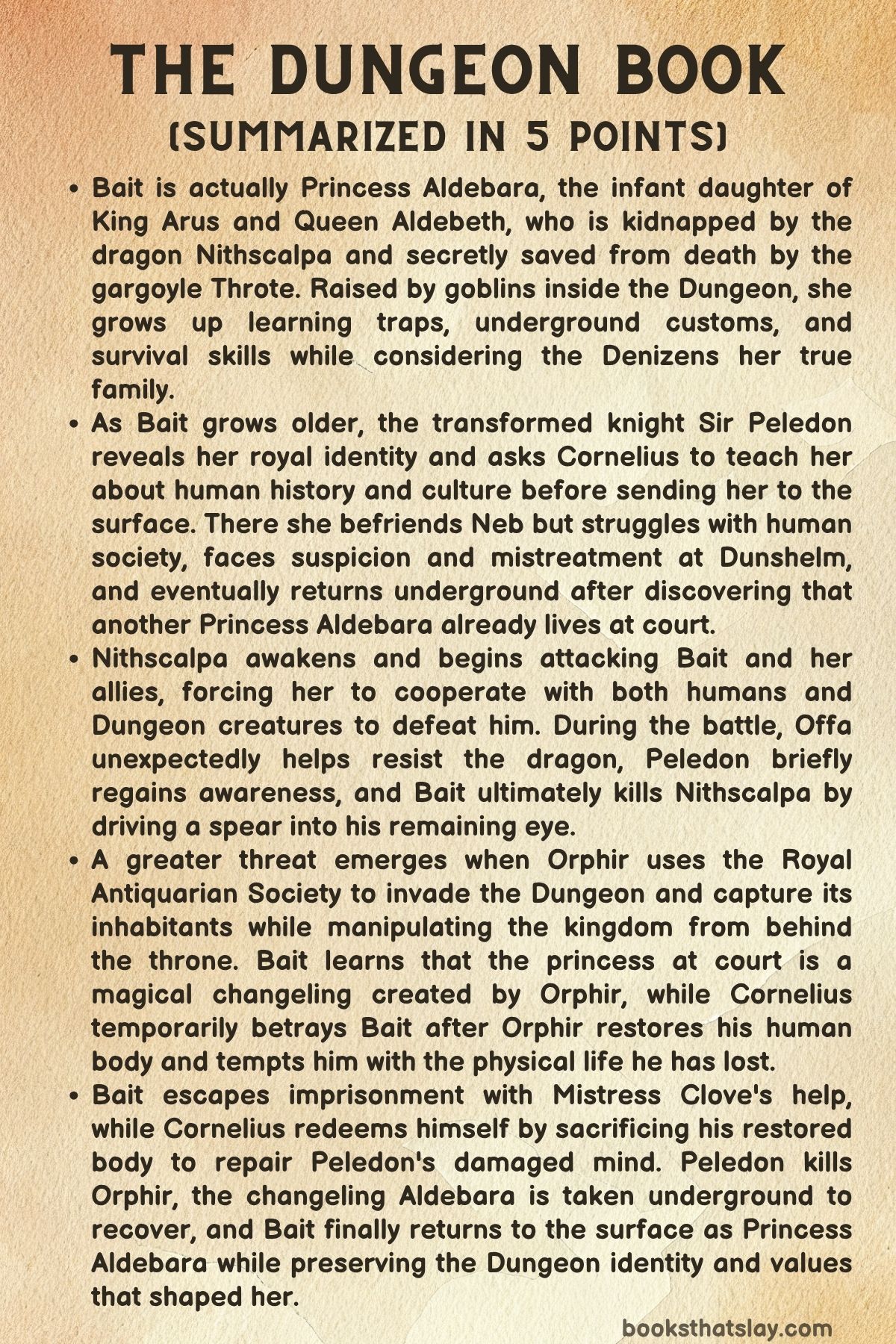
Summary
The story begins beneath the mountains in an ancient Dungeon filled with monsters, ruins, magic, and laws of its own. Cornelius, the talking skull of a former archmage, recounts how the dragon Nithscalpa attacks Castle Uthgard and abducts the infant daughter of King Arus and Queen Aldebeth, killing the queen after she destroys one of his eyes.
Nithscalpa takes the baby to Orphir, the Master of the Dungeon, who draws blood from her for an unknown magical purpose before ordering the gargoyle Throte to give her to the dragon. Throte cannot murder a defenseless child, so he secretly saves her and brings her to the goblins, who name the fierce little girl Bait and raise her as one of their own.
Bait learns the Dungeon Tongue, trap-making, navigation, and the survival customs of the underground inhabitants. Although some Denizens resent the presence of a human child, a formal Levelling eventually recognizes her right to live among them after a mysterious minotaur unexpectedly defends her.
Her early years are comparatively happy until the troll Crunchbone uses her as bait in a cattle-stealing scheme on the surface. The plan collapses, and Bait wanders through a hidden doorway into the Dungeon’s dangerous Fifth Level, where ancient wraiths nearly drain away her life before the minotaur rescues her.
Instead of learning to fear the wraiths permanently, Bait later returns to them voluntarily. By offering fragments of a blue necklace connected with the lost City of Wonders, she establishes a strange understanding with them and strengthens her conviction that creatures called monsters are not automatically evil.
As she grows older, Balor the Squinter remains determined to deliver her to Nithscalpa, believing the girl was always promised to the dragon. During one attempt to capture her, Bait encounters Cornelius again and eventually discovers that the minotaur who has repeatedly protected her is actually Sir Peledon, a famous human knight transformed by Orphir.
Peledon reveals that Bait is really Princess Aldebara, the missing daughter of Arus and Aldebeth. Because the transformation is steadily destroying his human mind, Peledon asks Cornelius to educate Bait about history, language, magic, and the customs of the human world she has never known.
Bait’s education does not erase her Dungeon instincts. Her encounters with manticores and other Denizens reinforce the idea that underground creatures possess rules, loyalties, and moral expectations of their own, while Peledon becomes increasingly convinced that she must eventually confront her human inheritance.
Peledon finally sends nine-year-old Bait to the surface to find his former squire Atten. The openness of the outside world terrifies her more than dark tunnels ever did, but she meets a village boy named Valourentius, known as Neb, whose patience and kindness create her first genuine friendship with an ordinary human.
Bait’s unfamiliarity with human customs soon causes trouble. Valuable coins from the Dungeon convince frightened villagers that Neb has encountered a supernatural creature, and Sir Rudyard organizes a hunt that ends with Bait being captured, renamed Ealdufrida, and assigned to work in the kitchens of Dunshelm Keep.
Life there is hostile, especially under Mistress Clove and her bullying son Offa. Bait responds to threats with traps and underground survival methods, while Neb tries to prevent the conflict from becoming lethal and eventually helps her meet the elderly Atten, who tells her about Peledon’s former life and the enormous sacrifices he made while searching for her.
The arrival of scholar Nala improves Bait’s circumstances. Nala treats her as a person worth studying rather than a dangerous creature, shares maps and books with her, and inadvertently reveals a devastating fact: the royal court already has a living Princess Aldebara who was supposedly rescued years earlier.
Bait concludes that Peledon must have been mistaken about her identity. Rather than trying to prove herself on the surface, she decides that the Dungeon is the only home she truly wants, escapes with Neb’s assistance, claims the ruined Entrance Hall as her lair, and begins creating her own Dungeon Book from Nala’s notebook.
Her return coincides with Nithscalpa’s awakening. The dragon remembers the infant Throte denied him, rejects Bait’s claim that her lair protects her under Dungeon law, declares himself Master, and begins attacking her allies, forcing the Denizens to choose sides in an internal war.
When Nithscalpa captures Peledon, Bait accepts that she cannot save him by herself. She returns to the surface and secretly helps guide Rudyard, Offa, Neb, and their companions through the Dungeon, negotiating with creatures that would normally kill intruders and trying to direct the expedition toward the dragon.
The plan nearly fails when Offa discovers Bait and assumes she has betrayed the humans. Balor captures them both and delivers them to Nithscalpa, where Offa unexpectedly rejects the dragon’s offer of treasure and freedom, attacks Balor, and triggers the magical chaos that gives the Dungeon’s defenders their opportunity.
A vast battle follows. Bait reaches the fading human consciousness inside Peledon by naming herself Princess Aldebara and calling him her champion, while the ghast weakens Nithscalpa and Bait ultimately drives a spear into the dragon’s remaining eye.
Neb receives public credit for killing the dragon, while Bait remains underground to care for Peledon. When Mistress Clove enters the Dungeon searching for her dead son Offa, Bait chooses not to take revenge and instead offers to teach the woman how to survive.
The victory does not bring lasting peace. The kingdom above falls deeper into rebellion and political disorder, while the Royal Antiquarian Tunnel Surveyors invade the Dungeon with specialized weapons, maps, and detailed knowledge of the Denizens, capturing many of Bait’s friends and even taking Cornelius.
Seeking the power to defend her home, Bait tries to claim the Master’s Tower. Orphir anticipates her attempt, captures her, and reveals himself as a far more powerful figure than she understood, having become both Chancellor and the dominant political force behind the weakening King Arus.
Cornelius, meanwhile, has made a disastrous compromise. Orphir uses Dungeon magic to restore his human body and promises him the physical life he has missed for years, eventually persuading Cornelius to reveal where Bait will go in exchange for completing his restoration.
Orphir also reveals the central secret: the Aldebara living at court is a magical changeling he created after stealing the real princess. The changeling is dying, and Orphir believes Bait’s body and magic can preserve her, allowing him to continue controlling the throne through the false princess.
At Dunshelm, Bait finally meets the other Aldebara. The two girls look identical, but the court-raised princess is refined, controlled, and physically frail, while Bait has been shaped by underground life; importantly, Aldebara already knows that she is the changeling and recognizes Bait as the true biological daughter of the king and queen.
Orphir forces Bait to submit to repeated magical procedures by threatening the imprisoned Denizens. Cornelius tries to persuade her to cooperate, and his betrayal hurts Bait deeply because he had become far more than a tutor to her.
Outside the castle, Neb has become a celebrated dragon-slayer and later a soldier, only to discover that Orphir intends to have him killed. He joins the rebellion against the Chancellor and eventually returns toward Dunshelm, while Cornelius begins to realize how completely his desire for a restored body has compromised him.
Bait escapes through the unexpected help of Mistress Clove, who hides her beneath her skirts and carries her past the guards. Rather than immediately fleeing, Bait gathers trap-making supplies and climbs into the castle, where she encounters her dying biological father for the first time.
King Arus has been told that Bait is the changeling, yet Bait sees clearly that his love for the court-raised Aldebara is genuine. She does not experience an instant emotional bond with him simply because they share blood, but she remains beside Aldebara as the king dies and recognizes that the relationship between parent and child cannot be reduced to biology.
After Arus’s death, Bait impersonates Aldebara and prepares a trap for Orphir, but the attempt fails when Nala enters first and Bait abandons the attack to save her. Orphir, increasingly desperate as Aldebara’s body deteriorates, decides to slaughter captured Denizens and use their magical essence together with Bait’s to construct another controllable princess.
Cornelius finally chooses differently. Understanding that belonging should refer to home rather than a predetermined social position, he sacrifices his restored body and transfers its magic into Peledon, partly restoring the knight’s mind and returning himself to the form of a skull.
Peledon awakens, frees the imprisoned Denizens, and attacks Dunshelm. Goblins, kobolds, trolls, Balor, Gloop, Only-Sister, and the other prisoners revolt, while Peledon reaches the tower, rescues Bait, and kills Orphir, bringing the wizard’s long attempt to control both Dungeon and kingdom to an end.
The surviving Denizens carry the unconscious changeling Aldebara underground and finally understand why she has been dying. She is not being weakened by Bait’s existence; because she was made from wild Dungeon magic, she is herself a Denizen whose long residence on the surface has slowly destroyed her health.
Peledon apologizes for trying to force Bait into the life he thought she should have. Bait forgives him, asks him to protect the recovering Aldebara, leaves her Dungeon Book with Cornelius so that he can educate the changeling, and prepares for one final transformation in her own life.
Bait leaves her underground family and returns to the surface as Princess Aldebara, but she does not reject the identity created by her years below. Faced with a divided kingdom, she carries the Dungeon’s customs with her and responds to political conflict in the way that feels most natural: she calls a Levelling, symbolically joining her royal inheritance with the culture that truly raised her.
Characters
Bait / Princess Aldebara
Bait is the central character of The Dungeon Book, and nearly every major conflict in the novel grows from the question of who has the right to define her. Biologically she is Princess Aldebara, daughter of Arus and Aldebeth, but emotionally, culturally, and practically she is a child of the Dungeon, raised by goblins and protected by creatures humans would ordinarily classify as monsters.
Her development is marked by an unusual reversal of conventional fantasy expectations. Darkness, tunnels, traps, goblins, trolls, gargoyles, and dangerous creatures feel familiar to her, while sunlight, villages, castles, crowds, and ordinary human behavior initially seem strange and threatening.
Bait is also highly adaptive. Clickglee teaches her trap-making, Cornelius gives her intellectual education, Peledon introduces her to her biological heritage, Neb teaches her about friendship with surface humans, and Nala exposes her to scholarly ways of understanding the Dungeon.
None of these influences completely replaces the others. By the conclusion, she is capable of functioning as a princess precisely because she refuses to erase the Dungeon-raised girl she has always been.
Her morality develops independently of conventional human standards. She can respond to bullying with potentially lethal traps, yet she repeatedly shows mercy when revenge would be easy, including toward Mistress Clove, and she risks herself to save Nala even when doing so ruins her attempt to kill Orphir.
Bait’s final choice to return to the surface is therefore not a surrender to bloodline or royal expectation. She accepts political responsibility while carrying underground values with her, transforming the role of princess rather than allowing the title to transform her completely.
Cornelius
Cornelius is one of the most morally complicated characters in The Dungeon Book because his role changes from observer and teacher to betrayer and finally to self-sacrificing ally. Existing for years as a disembodied talking skull leaves him intelligent and articulate but deeply deprived of ordinary physical experience.
His relationship with Bait gives him renewed purpose. He becomes her teacher, introducing her to human language, history, magical knowledge, and culture, while gradually forming an attachment that extends far beyond scholarly responsibility.
Orphir exploits Cornelius’s greatest vulnerability by offering him a restored human body. After years without food, touch, physical movement, or bodily sensation, Cornelius becomes so overwhelmed by their return that he eventually exchanges information about Bait for the completion of his restoration.
The betrayal is particularly painful because Cornelius understands what he is doing. He rationalizes the decision and insists that Bait must remain unharmed, but those conditions cannot disguise the fact that he has placed his own desires above the safety of someone who trusted him.
His redemption comes when he stops defining life through physical possession. By giving up his restored body to repair Peledon’s damaged mind, Cornelius voluntarily returns to the condition he had once considered unbearable.
That sacrifice does not erase his betrayal, but it demonstrates genuine change. He finally chooses relationship, loyalty, and home over bodily comfort, and Bait entrusts him with both the changeling Aldebara’s education and the Dungeon Book itself.
Sir Peledon
Peledon provides The Dungeon Book with one of its clearest examples of loyalty becoming both noble and dangerously controlling. He enters the Dungeon as a celebrated knight determined to rescue the stolen princess, sacrificing his ordinary life, family connections, and eventually his human body in pursuit of that promise.
Orphir’s transformation turns him into a minotaur and slowly destroys his mind. Even as his memories fade, however, some instinctive devotion to Bait survives, leading him to protect her from childhood and defend her when other Denizens question whether she belongs underground.
Peledon sees Bait first through the identity she has lost. Once he realizes that she is Aldebara, he believes restoring her to human society is the fulfillment of his mission, and his decision to send her alone to the surface reflects both love and an inability to understand how completely the Dungeon has become her home.
This produces one of his central flaws. Peledon assumes that birth determines the life Bait ought to want, even though years of experience have created a person very different from the infant princess he originally set out to rescue.
His eventual apology is therefore important. After Cornelius partly restores his mind, Peledon recognizes that protecting Bait should never have meant forcing her into his own vision of her proper future.
Bait’s decision to forgive him and entrust Aldebara to his protection completes his transformation. He remains a guardian, but his task is now based on respecting another person’s needs rather than imposing a predetermined destiny.
Princess Aldebara
The changeling Aldebara is one of the most conceptually important characters in The Dungeon Book because her existence destroys any simple division between authentic and false identity. She was created by Orphir as a replacement for the kidnapped princess, yet years of lived experience have made her a genuine daughter to King Arus and a person with her own consciousness, fears, knowledge, and relationships.
Her refinement initially makes her seem like Bait’s opposite. Aldebara has been shaped by court etiquette and royal expectations, whereas Bait moves instinctively according to Dungeon rules.
The revelation that Aldebara already knows she is a changeling gives her considerable emotional depth. She understands both the artificial origin of her body and Orphir’s political plan, yet she cannot simply discard the life she has lived or the relationship she shares with the king.
Her illness reinforces this complexity. Everyone initially assumes that Bait’s survival somehow threatens her, but the eventual discovery that Aldebara is herself a Dungeon Denizen shows that her suffering comes from being separated from the magical environment to which she truly belongs.
The relationship between the two Aldebaras therefore avoids reducing them to rivals. Bait does not need the changeling to disappear in order to become legitimate, and Aldebara does not need to deny Bait’s biological identity in order to preserve her own value.
Their coexistence demonstrates that identity can be genuine even when its origin is artificial. By the end, both girls possess valid claims to personhood and belonging, but those claims lead them toward different homes.
Orphir
Orphir is the principal human antagonist of The Dungeon Book, and his defining characteristic is his desire to control identities, institutions, magic, and political outcomes. He does not merely seek personal power; he repeatedly turns living beings into instruments that can be positioned, altered, sacrificed, or replaced according to his plans.
His treatment of the infant Aldebara establishes this pattern immediately. He uses her blood for magic, creates a changeling substitute, later transforms Peledon into a minotaur, manipulates the royal court, takes control of the Royal Antiquarian Society, and eventually treats captured Denizens as stores of magical material.
Orphir’s relationship with Cornelius shows that his strongest weapon is often temptation rather than direct force. He identifies Cornelius’s longing for physical life and patiently constructs circumstances in which betrayal becomes easier to rationalize.
His treatment of the changeling Aldebara reveals another form of possession. Although he is trying to keep her alive, his motive is tied to preserving political control, and when her body begins to fail he immediately considers replacing her with another constructed princess.
The same logic shapes his view of Bait. Her wishes, loyalties, and experiences mean nothing to him because he sees her primarily as biological and magical material that can solve a problem.
His death at Peledon’s hands is therefore symbolically appropriate. One of the people he transformed into an object of magical control ultimately regains enough selfhood to destroy the man responsible.
Neb / Valourentius
Neb is Bait’s most important human friendship and one of the few surface characters who approaches her without immediately trying to classify her. When he first encounters the strange girl emerging from the Dungeon, he responds with curiosity and kindness rather than fear.
His role becomes especially important because he acts as an intermediary between Bait and ordinary human life. He helps her communicate, prevents conflicts from escalating, assists her in finding Atten, and later helps her escape Dunshelm.
Neb’s accidental public transformation into Valourentius the Dragon-slayer creates an identity problem of his own. Society turns him into a heroic figure for deeds that do not accurately represent what happened, while Bait, who actually killed Nithscalpa, remains hidden.
Instead of becoming corrupted by celebrity, Neb is eventually drawn into the kingdom’s political crisis. Orphir attempts to remove him by sending him into a deadly military situation, but Neb survives, joins the rebels, and grows into a capable scout and soldier.
His continued loyalty to Bait demonstrates that their friendship survives radical changes in status. Whether she is considered a monster, servant, changeling, Dungeon Denizen, or princess, Neb responds to the individual he already knows.
Throte
Throte is the character whose single act of disobedience makes Bait’s entire life possible. Ordered to deliver the kidnapped infant to Nithscalpa, he refuses to participate in the killing of a helpless child and secretly rescues her.
His decision is important because Throte is a creature bound by roles and commands. Saving Bait therefore represents a moral judgment in which personal conscience becomes more important than obedience.
Throte continues to exist within systems that limit his freedom. When Bait later attempts to claim the Master’s Tower, he is required to oppose her, yet he still finds indirect ways to help by hinting at an alternative route.
His character demonstrates that loyalty does not always require open rebellion. Sometimes resistance appears through small choices made inside restrictive structures, and Bait survives repeatedly because individuals like Throte interpret duty according to conscience rather than simply following orders.
Clickglee
Clickglee is central to Bait’s childhood because the goblin gives her not only shelter but a practical education. Bait learns traps, tunnels, Dungeon customs, and the habits of survival from Clickglee and the goblin community.
This upbringing shapes almost every later stage of her life. When confronted by human pursuers, dragon attacks, military occupation, or Orphir’s guards, Bait repeatedly relies on skills that originated in the apparently humble work of a goblin trapsmith.
Clickglee also helps establish the Dungeon as a genuine society rather than merely a collection of hostile creatures. The goblins possess trades, relationships, traditions, humor, and communal loyalties, and Bait’s bond with them becomes one of the strongest reasons she considers the Dungeon her home.
Nithscalpa
Nithscalpa represents a more traditional form of monstrous power. He is physically overwhelming, possessive, violent, and convinced that Bait belongs to him because she was promised as prey when she was an infant.
Unlike many of the Dungeon’s creatures, Nithscalpa shows little willingness to recognize reciprocal obligation. He invokes authority when it benefits him, declares himself Master, and treats both people and other Denizens as things to dominate.
His conflict with Bait therefore becomes more than a battle between human and dragon. Bait challenges the assumption that superior force automatically produces legitimate authority.
His death requires cooperation among individuals who would normally be enemies. Humans, goblins, monsters, Bait, Offa, the ghast, and other Denizens all contribute, reinforcing the idea that shared danger can create alliances across deeply established boundaries.
Balor the Squinter
Balor is one of Bait’s persistent underground enemies. He never forgets that she was originally intended for Nithscalpa and repeatedly treats that old arrangement as more important than the life she has built within the Dungeon.
His many magical eyes make him dangerous, but his importance is also social and political. Balor represents the Denizens who believe established claims and hierarchies must be honored even when circumstances have changed.
Yet Balor later participates in the revolt against Orphir’s forces. His character therefore illustrates how alliances within the Dungeon are fluid and often depend upon immediate questions of territory, survival, and common threat rather than permanent categories of friend and enemy.
Nala
Nala offers Bait one of her first experiences of sustained intellectual companionship with a surface human. Unlike Mistress Clove or Rudyard’s frightened followers, she does not respond to Bait primarily through superstition.
Her scholarly interest is imperfect because she initially views the girl partly as an object of investigation. Even so, Nala gives Bait access to books, maps, historical information, and the strange experience of seeing her underground home converted into formal human knowledge.
Nala also represents a more complicated side of the Royal Antiquarian project. Scholarship can preserve and explain knowledge, but the organization connected to that scholarship eventually becomes a military force that captures, studies, and exploits living Denizens.
Bait’s willingness to save Nala from her own failed assassination trap is especially revealing. Personal affection remains stronger than strategic advantage, even when saving Nala means losing the opportunity to kill Orphir.
Mistress Clove
Mistress Clove initially embodies the fear and superstition Bait encounters among surface humans. Convinced that the strange girl may be a changeling, she subjects Bait to tests and tolerates Offa’s hostility toward her.
Her attitude makes Bait’s time at Dunshelm especially painful. Yet Clove later enters the Dungeon looking for her dead son, and Bait chooses to help rather than punish her.
That experience changes Clove enough that she later becomes the person who enables Bait to escape imprisonment. By hiding Bait beneath her skirts and carrying her past the guards, she repays the mercy she once received underground.
Clove’s development is therefore based on uncomfortable experience rather than abstract enlightenment. She learns that the supposed monster she feared can show compassion and that official human institutions are capable of far greater cruelty than many Dungeon creatures.
Offa
Offa spends much of the story as one of Bait’s most unpleasant human enemies. He bullies her in the kitchens, participates in hostility toward her, and later immediately assumes that she is betraying the human expedition when he discovers her with Neb.
His final actions, however, complicate any simple judgment of him. Captured by Nithscalpa and offered treasure in exchange for abandoning Bait, Offa recognizes that the dragon cannot be trusted.
He attacks Balor even though he has little reason to expect survival. The resulting eruption of Balor’s uncontrolled magic damages Nithscalpa and gives the attackers an opportunity that helps make victory possible.
Offa dies without becoming a completely different person. His last decision instead demonstrates that even a deeply flawed character can recognize a moral boundary when confronted with unmistakable evil.
King Arus
King Arus remains distant from Bait for most of the story, making their eventual meeting especially significant. By the time she sees him, he is dying and believes that the girl before him is the false princess rather than his biological daughter.
Bait notices their physical resemblance but experiences no miraculous sense of family connection. This reaction challenges the expectation that blood alone should create emotional intimacy.
Arus’s devotion to the changeling Aldebara further complicates the question of parenthood. Although she was created as a substitute, she is the daughter he actually raised and loved, and his willingness to surrender his kingdom to save her confirms the reality of that relationship.
His final moments allow Bait to understand that biological truth and emotional truth can coexist without being identical. She can be his daughter by birth while Aldebara remains his daughter through years of shared life.
Queen Aldebeth
Queen Aldebeth appears only briefly, but her actions shape everything that follows. During Nithscalpa’s attack, she fights the dragon fiercely enough to destroy one of his eyes before being killed.
Her death leaves Bait without any direct memory of her biological mother. Unlike Peledon, Arus, or the changeling Aldebara, Aldebeth exists for Bait primarily as part of a history she has been told rather than a relationship she has personally experienced.
Her resistance nevertheless has long-term consequences. The loss of Nithscalpa’s first eye makes the remaining eye vulnerable in the final battle, allowing Bait to complete a struggle that began with her mother.
Gloop
Gloop, the living slime, reinforces the story’s refusal to measure moral value by physical appearance. The creature may seem alien or grotesque by surface standards, but its actions toward Bait are defined by loyalty.
When Nithscalpa attacks, Gloop sacrifices much of its own body to protect her. That act places the slime among Bait’s genuine friends and exposes the weakness of human assumptions that outwardly monstrous creatures must possess monstrous intentions.
Gloop later participates in the uprising at Dunshelm. Its continued loyalty confirms that Bait’s underground family is built through repeated acts of protection rather than shared species.
Themes
Identity, Belonging, and the Meaning of Home
Bait’s entire life challenges the assumption that identity can be settled by ancestry alone. She is biologically the daughter of King Arus and Queen Aldebeth, yet nearly everything that makes her recognizable as an individual comes from her years among goblins, monsters, tunnels, traps, Dungeon laws, and underground friendships.
This tension gives The Dungeon Book its central question: whether a person belongs where birth assigns them or where experience has allowed them to become themselves. Bait’s discomfort on the surface makes clear that recovering her biological identity does not automatically restore a lost human self, because the infant princess she once was cannot simply replace the Dungeon-raised child she became.
The changeling Aldebara expands this idea further. She has no biological claim to the royal family, yet Arus genuinely loves her as his daughter because parenthood has been created through years of relationship rather than blood.
At the same time, Aldebara’s physical decline on the surface reveals that she belongs biologically and magically to the Dungeon even though her emotional life has been formed at court. The two girls therefore mirror one another: the human child grows into a Dungeon Denizen, while the magically created Denizen grows into a human princess.
The ending refuses to force either girl into a single category. Bait returns to the surface but carries Dungeon culture with her, while Aldebara goes underground to recover, demonstrating that belonging can contain multiple histories rather than demanding the destruction of one identity in favor of another.
Monsters, Humanity, and Moral Judgment
The distinction between human and monster repeatedly fails as a reliable moral category. Bait grows up among creatures that surface society fears, yet many of those beings show loyalty, fairness, compassion, and respect for communal rules.
Throte saves an infant he was ordered to surrender to death. Goblins raise Bait as one of their own, Gloop sacrifices its body to protect her, manticores accept apology and reciprocity, wraiths can be approached through understanding, and even dangerous Denizens participate in alliances governed by recognizable obligations.
By contrast, humans frequently behave with cruelty while insisting on their own civilization. Villagers hunt Bait because they do not understand her, Mistress Clove subjects her to superstitious tests, soldiers capture Dungeon inhabitants for experimentation, and Orphir reduces living beings to magical material.
The novel does not simply reverse the categories by declaring monsters good and humans evil. Nithscalpa is brutal, Balor persecutes Bait for much of her life, Offa is cruel before making a courageous final choice, and Clove moves from hostility to rescue.
Moral identity is therefore shown through behavior rather than species. Characters become trustworthy or dangerous according to what they choose when confronted with fear, temptation, power, or vulnerability.
Bait understands this before most surface characters because she has never been taught to equate physical strangeness with wickedness. Her perspective allows the story to question the cultural labels through which entire groups are declared civilized, monstrous, legitimate, or disposable.
Power, Authority, and the Right to Rule
Authority appears throughout The Dungeon Book as something that must be justified rather than merely claimed. Dragons, kings, Dungeon Masters, military commanders, scholars, and political officials all possess different forms of power, yet the story repeatedly distinguishes power from legitimacy.
Nithscalpa believes strength entitles him to become Master of the Dungeon. Orphir uses magic, scholarship, political office, imprisonment, substitution, and secrecy to control both the royal court and the underground world.
Bait’s understanding of authority develops through the Dungeon’s tradition of Levellings. These gatherings may be rough and dangerous, but they are built around collective recognition, argument, rights, customs, and the idea that even powerful creatures can be challenged publicly.
That tradition becomes especially important at the end. Bait does not return to the surface merely to occupy the throne through biological inheritance; her instinct is to call a Levelling, importing a participatory Dungeon practice into a kingdom damaged by manipulation and civil conflict.
Orphir represents the opposite approach. He believes society can be managed by controlling the correct body, the correct title, and the correct magical resources, which is why he treats both versions of Aldebara as pieces within a political structure rather than independent people.
The conflict ultimately suggests that authority becomes legitimate only when those affected by it are recognized as participants rather than property. Bait’s emerging leadership rests on this lesson, because she has spent her life seeing how systems behave from the perspective of someone repeatedly classified, claimed, renamed, and controlled.
Choice, Loyalty, and the Possibility of Change
Many of the story’s most important moments occur when characters act against the roles that history, society, or previous behavior seem to have assigned them. Throte is ordered to deliver a baby to a dragon but saves her, creating Bait’s future through one act of disobedience.
Offa spends years bullying Bait but eventually refuses Nithscalpa’s bargain and attacks Balor. Mistress Clove persecutes Bait as a suspected changeling but later risks herself to smuggle her out of captivity.
Cornelius provides the most painful example because his choices move in both directions. His longing for a restored human body leads him to betray Bait, proving that affection does not automatically prevent selfishness when a person’s deepest desire is offered at the right moment.
His later decision to abandon that restored body shows that failure does not make future loyalty meaningless. Redemption requires sacrifice precisely because words alone cannot repair what his betrayal has damaged.
Peledon undergoes a related change. His lifelong loyalty to the princess initially causes him to impose a human destiny on Bait, but he eventually recognizes that devotion without respect can become another form of control.
Bait herself repeatedly chooses relationships over fixed categories. She protects humans and monsters, forgives enemies without pretending their earlier actions were harmless, and finally assumes royal responsibility without surrendering the underground identity that shaped her.
The novel therefore treats character as something revealed through repeated choices rather than permanent labels. Human, monster, princess, changeling, knight, servant, scholar, or Master may describe a social position, but loyalty and moral responsibility are determined by what each person decides to do when obedience and conscience come into conflict.