The Dog Stars Summary, Characters and Themes
The Dog Stars by Peter Heller is a post-apocalyptic novel centered on Hig, a survivor of a devastating flu that has erased most of humanity and left society ruled by isolation, scarcity, and violence.
Living at an abandoned Colorado airfield with his dog Jasper and the heavily armed Bangley, Hig survives physically while struggling to preserve tenderness, memory, curiosity, and hope. His flights, encounters with other survivors, grief for his dead wife, and eventual journey west gradually force him to decide whether continued existence means merely staying alive or remaining emotionally human in a world where trusting another person can be fatal.
Summary
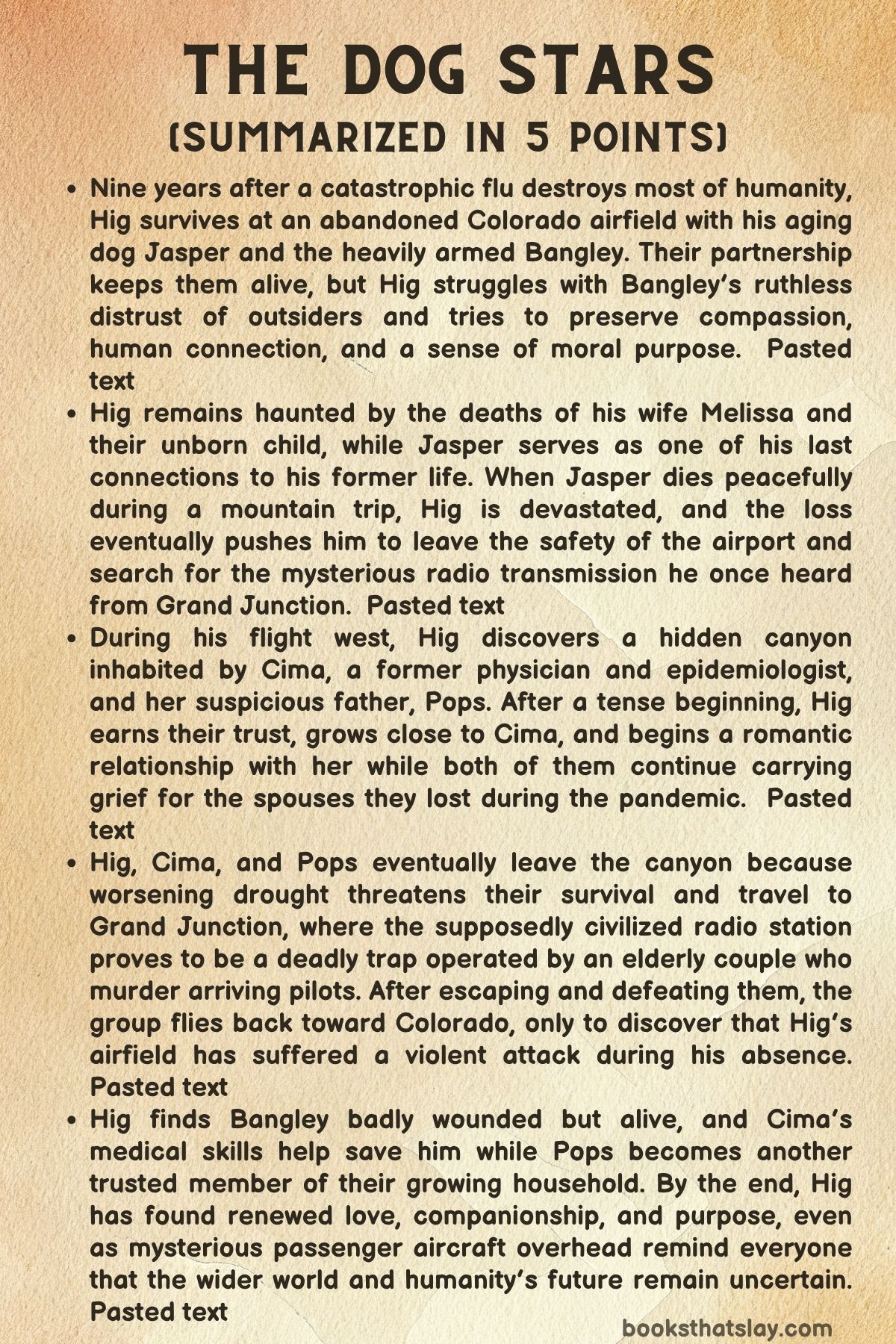
Nine years after a catastrophic flu destroys most of civilization, Hig lives at an abandoned airport in Colorado with his aging dog Jasper and a survivalist named Bangley. Their arrangement is based on practical necessity: Hig uses his 1956 Cessna 182, which he calls the Beast, to patrol the surrounding territory and locate resources, while Bangley guards the airfield with weapons, surveillance equipment, and a willingness to kill anyone who approaches without permission.
The two men survive together but possess very different ideas about what survival should mean. Bangley believes that outsiders are dangers until proven otherwise, while Hig remains disturbed by indiscriminate violence and continues wanting companionship, compassion, beauty, and some connection to the moral world that existed before the pandemic.
Hig is haunted by the family he lost. His wife Melissa died during the flu while pregnant with their child, and his memories of her ordinary presence remain among the strongest links to the world that disappeared.
Melissa’s death carries an additional burden because, during her final suffering, she asked Hig to end her life. Unable to watch the disease destroy her any longer, he smothered her with a pillow, an act of mercy that continues to trouble him long afterward.
Hig also mourns the damaged natural environment. Climate change, dying forests, warmer streams, and disappearing trout make the ruined world feel larger than a human catastrophe, because the natural places that once gave him peace have also been altered.
Fishing had always helped him endure grief, from his father’s death to later personal disappointments. After civilization collapses, however, even this source of comfort gradually disappears from his routine.
Against Bangley’s advice, Hig maintains contact with nearby Mennonite families suffering from a blood-borne illness. He brings them food and accepts the risk because withdrawing completely from other people would mean surrendering another part of himself.
His instinct for mercy repeatedly places him in danger. During a supply trip, Jasper detects three men hiding near an abandoned Coca-Cola truck, and one of them attacks Hig with a bow.
Hig kills his attacker but initially spares the remaining men and gives them supplies. His compassion turns to rage when he discovers that one survivor wears a necklace made from mutilated pieces of women’s bodies, and Hig kills the man while allowing the third stranger to escape.
Bangley angrily explains everything Hig did wrong during the encounter. From Bangley’s perspective, Hig approached carelessly, allowed an attacker too close, failed to control the survivors, and killed a potentially useful source of information before questioning him about reports of dangerous armed groups in the region.
Hig understands the logic but resists the worldview behind it. He fears that a life based entirely on suspicion and killing may preserve the body while destroying the qualities that make survival worth having.
Seeking relief, Hig takes Jasper into the mountains. Away from the airport, he notices trees, water, animal tracks, smells, and the remembered pleasure of fishing, temporarily recovering an awareness of life beyond defense and violence.
Yet Jasper has grown old. After Hig catches fish and spends a peaceful night beside the creek with his companion, he awakens to discover that Jasper has died quietly during the night.
The loss devastates Hig because Jasper represented far more than companionship. The dog had remained beside him through both his former life and the years after civilization collapsed, making Jasper one of Hig’s last living connections to the person he once was.
Hig buries him beneath stones and spends days wandering through the mountains almost indifferent to his own survival. Hunger and harsh weather finally force him to return to practical awareness, and he begins traveling back toward the airport carrying deer meat.
On his return, nine armed men follow him toward the settlement. Bangley guides Hig by radio, directing him into defensive positions, and the two kill or scatter the attackers, with Bangley ultimately using mortar fire when the situation becomes desperate.
Hig feels sickened rather than victorious afterward. When he later visits the sick families and a young girl named Matilda offers him flowers, he crosses their quarantine boundary and takes her hand, choosing direct human contact despite the danger.
Jasper’s death and Hig’s growing dissatisfaction with his limited existence finally push him toward a decision he has postponed for years. Long ago, he heard a mysterious radio transmission from Grand Junction, and he now decides to fly west and discover whether another organized community exists there.
Bangley opposes the journey because it may be impossible for Hig to return. Nevertheless, he accepts Hig’s choice, gives him grenades for protection, and unexpectedly admits that he considers Hig both a good partner and family.
Hig flies west until he crosses the point at which his available fuel makes an easy return impossible. During the journey, he notices a hidden canyon containing cattle, cultivated land, a stone house, and most importantly, other people.
An older man sees the aircraft and fires at it, damaging the Beast and injuring Hig with fragments. Instead of responding with anger, Hig realizes the stranger is behaving much as Bangley would toward an unknown aircraft approaching his home.
The attack has an unexpected effect on Hig. As death becomes possible, he recognizes that he strongly wants to live, revealing that his western journey is not simply an act of despair but part of a search for reasons to care about life again.
After landing nearby, Hig approaches the canyon on foot. The old man and a woman remain armed and suspicious, so Hig attempts communication rather than violence, using Jasper’s old quilt as a flag and written signs to demonstrate peaceful intentions.
Hig even detonates one of Bangley’s grenades at a safe distance to prove that he possesses powerful weapons but is deliberately refusing to use them against the canyon residents. His strategy works well enough for him to approach, although the old man soon ambushes, binds, disarms, and interrogates him.
The situation changes when Hig’s accumulated frustration erupts. He explains Jasper’s death and his exhaustion with constant killing, and the woman, Cima, persuades her father to release him.
The hostility gives way to an almost surreal return to ordinary social life. Hig is invited to lunch, where shepherd’s pie, butter, and fresh milk affect him powerfully because sharing a meal with other people restores habits of hospitality he had nearly forgotten.
Cima explains that she was a physician and epidemiologist before the pandemic. She possesses inherited resistance to the flu, although survival left lasting physical damage, while her husband Tomas died.
Hig stays in the canyon, helps with daily labor, and grows increasingly close to Cima. Her father, whom Hig begins calling Pops, gradually accepts him as well, creating a temporary domestic life that feels remarkably different from the militarized isolation of the airport.
The canyon cannot remain secure forever because worsening drought threatens its resources. Pops decides they must leave, and Hig develops a plan to use the Beast to transport Cima first and then collect Pops from a longer section of highway suitable for another takeoff.
As preparations continue, Hig and Cima reveal their most painful memories. Hig tells her that Melissa begged him to end her suffering and that he obeyed, while Cima speaks about Tomas and understands why love could lead someone to make such a terrible choice.
Their emotional openness develops into a sexual and romantic relationship. Yet Cima continues dreaming about Tomas and sometimes withdraws from Hig, forcing both of them to recognize that loving someone new does not erase attachment to someone who died.
Eventually Hig and Cima leave the canyon in the heavily loaded Beast, even taking a ram and ewe lamb with them. They barely clear the trees, reach the highway, pick up Pops, and continue toward Grand Junction in hopes of finding the mysterious radio operator.
At Grand Junction they hear a calm female voice giving landing instructions, and the organized communication initially seems like evidence of a functioning community. Hig notices suspicious wreckage at the last moment, however, and realizes the runway is a trap.
A hidden cable is raised across the runway to destroy incoming aircraft. Hig escapes the trap and lands beyond it with almost no fuel remaining, after which he and Pops attack the tower.
They discover that an elderly couple has been deliberately attracting pilots, causing crashes, murdering survivors, and collecting trophies from the victims. Hig and Pops kill them, refuel the aircraft, and begin the flight east.
During a stop near Winter Park, Cima sees the devastation of the wider world more directly and breaks down inside an abandoned restaurant. Her reaction shows that surviving in an isolated canyon protected her from fully confronting the scale of civilization’s destruction.
The group continues across the Continental Divide and finally reaches Erie. Hig expects to return to Bangley and the familiar routines of the airport, only to discover extensive damage showing that the settlement was attacked while he was away.
Inside Bangley’s ruined living space, Hig discovers how carefully his partner had positioned himself to protect nearly every part of their settlement. He finally understands the extent to which Bangley’s harshness concealed loyalty and affection.
Hig soon finds Bangley badly wounded but still alive. Cima uses her medical knowledge to treat his shattered leg, blood loss, and other injuries, while Pops and Bangley quickly develop mutual respect based partly on their shared military backgrounds.
Cima also begins helping the nearby sick families. She explains that their illness spreads through bodily fluids rather than ordinary casual contact and considers whether vitamin D may help reduce its effects.
Gradually the survivors create a new household. Hig and Cima build a life together, Pops and Bangley form their own companionship, and the natural environment shows scattered signs of renewal.
Their future remains uncertain. Large passenger aircraft begin crossing the sky carrying Arabic-speaking travelers who do not answer Hig’s radio calls, suggesting that organized human societies may exist elsewhere even though their intentions and circumstances remain unknown.
Hig still dreams of Jasper and still carries the losses of Melissa and the former world, but he is no longer defined solely by bereavement. Beside Cima and the strange family that has formed around him, he reaches a life in which love, uncertainty, danger, and hope can exist together.
Characters
Hig
Hig is the emotional center of The Dog Stars, defined by the conflict between the practical demands of survival and his refusal to become completely hardened by them. He knows that violence is sometimes unavoidable, yet he repeatedly questions whether remaining alive has value if fear eliminates compassion, beauty, curiosity, and attachment.
His grief shapes nearly every major decision he makes. Melissa’s death, the loss of their unborn child, the destruction of his former community, environmental decline, and eventually Jasper’s death leave Hig carrying an enormous emotional burden, but his grief never completely destroys his capacity to care.
His relationship with flying expresses his desire for freedom and perspective. In the air he can temporarily rise above the defensive mentality of the airport, while his later flight west becomes a literal search for another way of living.
Hig changes most clearly after Jasper dies. Instead of remaining protected by the limited safety of Erie, he chooses uncertainty and contact, eventually discovering Cima, Pops, renewed love, and a wider community that gives his continued existence greater meaning.
Bangley
Bangley represents the survival ethic that Hig both depends upon and resists throughout The Dog Stars. He is armed, disciplined, suspicious, tactically intelligent, and prepared to kill before a possible enemy has the opportunity to become a definite threat.
His worldview is not presented as simple cruelty because experience repeatedly confirms that his fears have practical justification. Strangers attack the airport, opportunistic killers roam the country, and even the apparently organized radio station at Grand Junction is actually a trap designed to murder travelers.
Bangley’s harsh personality also conceals substantial loyalty. He monitors the settlement constantly, protects Hig during attacks, worries when Hig travels alone, and finally calls him both partner and family before the western flight.
His later vulnerability changes how Hig sees him. Discovering Bangley seriously wounded and recognizing how carefully he had defended their home allows Hig to understand that Bangley’s love is expressed through protection rather than tenderness.
Jasper
Jasper is much more than Hig’s dog in The Dog Stars because he functions as a living connection between Hig’s vanished domestic life and his post-pandemic existence. While nearly every human institution has disappeared, Jasper continues offering uncomplicated companionship that does not require suspicion, negotiation, or defensive planning.
His aging body quietly introduces the certainty of another approaching loss. Hig notices Jasper becoming slower and stiffer, but knowing that death will eventually come does little to prepare him for waking beside the creek and discovering that his companion has died during the night.
Jasper’s death produces one of Hig’s lowest emotional periods. Hig wanders carelessly, barely eats, and temporarily loses the instinct for self-preservation that normally keeps him alive.
At the same time, the loss ultimately forces movement. Without Jasper beside him, the airport becomes emotionally insufficient, and Hig’s journey west begins soon afterward, making Jasper’s death both an ending and a catalyst for Hig’s search for renewed human connection.
Melissa
Melissa remains one of the novel’s strongest presences despite being dead before much of the central action occurs. Hig remembers their marriage, ordinary celebrations, shared domestic life, and the future they expected to have before the pandemic destroyed all of it.
Her final illness leaves Hig with a memory that combines love, mercy, horror, and guilt. When Melissa asks him to end her suffering, Hig eventually suffocates her with a pillow, making her death an experience he cannot reduce to either simple compassion or simple wrongdoing.
The memory affects how Hig understands violence throughout the story. He knows from personal experience that an act causing death can arise from love rather than hatred, which complicates any easy moral division between killing and mercy.
His eventual confession to Cima is therefore crucial. By telling another person the truth about Melissa, he allows an experience he has carried privately for years to become part of a relationship rather than a solitary burden.
Cima
Cima becomes the most important new relationship Hig forms in The Dog Stars, representing both renewed intimacy and the possibility of rebuilding a life without denying the past. Her background as a physician and epidemiologist also gives her practical importance in a world where medical knowledge has become extremely rare.
She survives the flu because of inherited resistance, but survival does not leave her untouched. Tomas’s death continues to shape her emotional life, and her dreams about him reveal that beginning a relationship with Hig cannot simply replace the marriage she lost.
Cima’s response to Hig’s confession about Melissa demonstrates her capacity for empathy. Her own experience with Tomas allows her to understand why Hig might have considered ending suffering an act of compassion, even though the memory remains painful.
Her later arrival at Erie expands her role beyond Hig’s partner. She treats Bangley, investigates the Mennonite community’s illness, and brings professional knowledge into a household that had previously depended mostly on weapons, improvisation, and luck.
Pops
Pops initially appears as an armed and deeply suspicious defender in The Dog Stars, making his first interactions with Hig resemble the hostility that dominates the wider post-pandemic world. He shoots at Hig’s aircraft, watches him carefully, and eventually captures and interrogates him after Hig approaches the canyon.
His suspicion comes from the same reality that shaped Bangley. In a world where strangers may steal supplies, murder survivors, or lure travelers into traps, trusting an unfamiliar person can place an entire household at risk.
Once Hig proves his intentions, however, Pops becomes capable of strong loyalty and practical cooperation. His decision to welcome Hig, share food, prepare for relocation, and trust him with Cima demonstrates that suspicion has not completely destroyed his capacity to form bonds.
His military background as a former Navy SEAL also gives him an immediate point of connection with Bangley. By the end of the novel, the two older men can relate through shared habits of strategy and defense, helping transform the airport into a more balanced community.
Tomas
Tomas, Cima’s dead husband, serves a role similar to Melissa because his absence continues influencing the living. He represents the life Cima had before the pandemic and the attachment she cannot simply abandon because a new relationship has become possible.
Cima’s dreams about his death reveal unresolved grief and guilt. Her occasional withdrawal from Hig is not evidence that her feelings for Hig are false; instead, it shows that emotional recovery cannot require erasing someone who once mattered deeply.
Tomas also becomes indirectly important to Hig and Cima’s relationship. Their willingness to speak honestly about Tomas and Melissa allows their intimacy to develop through recognition of loss rather than through pretending that the past no longer matters.
Through Tomas, the novel suggests that new love after catastrophe must make room for memory. Cima’s future with Hig becomes possible only when both accept that their previous partners remain part of who they are.
Matilda
Matilda appears briefly, but her interaction with Hig carries strong emotional significance. She belongs to the sick Mennonite community that Hig continues helping despite Bangley’s concern about infection.
After Jasper dies, Matilda offers Hig flowers and asks about the dog. Her simple gesture breaks through the emotional defenses Hig has built around himself and gives him an opportunity to respond to another person’s kindness.
Hig’s decision to cross the quarantine boundary and take Matilda’s hand becomes more important than the physical action itself. It signals that fear of disease will not completely determine the terms of his relationships with other human beings.
Matilda therefore represents ordinary human contact in a world where touch has become associated with danger. Through her, compassion becomes something enacted physically rather than merely remembered.
The Mennonite Community
The Mennonite families function collectively as an important moral presence in the story. Their illness makes contact with them dangerous enough that Bangley considers Hig’s continued visits unnecessary, yet Hig refuses to treat them as people who should simply be abandoned.
His willingness to bring them food demonstrates one of the basic differences between him and Bangley. Hig understands the survival argument for isolation but believes that refusing every human obligation would destroy part of his identity.
Their later relationship with Cima also changes their situation. Her medical knowledge allows the community’s illness to be understood more accurately, particularly when she identifies bodily fluids rather than casual contact as the main route of transmission.
They therefore become part of the story’s gradual movement from fear toward cooperation. Their presence shows how knowledge, care, and shared resources can replace at least some of the isolation that initially governs the survivors.
The Grand Junction Couple
The elderly couple operating the radio trap represent one of the darkest forms of post-collapse adaptation. Unlike people who kill primarily for immediate defense, they deliberately create the appearance of civilization in order to attract vulnerable travelers.
Their calm radio procedures make the deception especially disturbing. They exploit survivors’ desire for communication and organized society, transforming hope itself into a weapon.
The wrecked aircraft and trophies from previous victims demonstrate that their actions are systematic rather than spontaneous. They have turned predation into a routine and apparently see arriving pilots as resources or targets.
Their presence also validates some of Bangley’s warnings without proving that his worldview should govern every relationship. Hig encounters both murderous strangers and people such as Cima and Pops, meaning survival requires judgment rather than either total trust or total isolation.
Themes
Survival Versus Humanity
Survival in The Dog Stars is never presented as a purely physical achievement. Hig and Bangley remain alive because they possess complementary abilities, yet the novel repeatedly asks whether continued existence is sufficient when every stranger must be treated as an enemy and every relationship becomes secondary to security.
Bangley represents the strongest case for defensive brutality. His methods frequently work, his warnings are often correct, and several encounters prove that hesitation can easily result in death.
Hig nevertheless fears the psychological cost of adopting Bangley’s philosophy completely. He continues visiting the sick families, refuses to automatically kill everyone he encounters, seeks contact with the canyon survivors, and eventually builds relationships that would have been impossible if he had treated every unfamiliar person as a target.
The contrast does not produce an easy answer because Hig’s compassion can be dangerous. His encounter near the abandoned truck shows that mercy without caution can expose him to people capable of horrifying violence, while Grand Junction proves that signs of civilization can conceal deliberate murder.
The story instead presents humanity as something that must be repeatedly chosen under pressure. Hig survives not by abandoning caution but by refusing to allow caution to become his entire moral identity, creating a balance in which vigilance protects life while compassion gives that life purpose.
Grief, Memory, and Continuing Life
Grief shapes nearly every important relationship and decision in the novel. Hig does not simply remember Melissa; he continues living in conversation with the life they lost, recalling birthdays, marriage, pregnancy, illness, and the terrible responsibility of ending her suffering when she asks him to help her die.
Jasper provides another connection to the past because the dog belongs to both Hig’s old life and his post-pandemic existence. When Jasper dies, Hig loses one of the final living beings who shared his memories of the world before catastrophe, and the resulting emptiness nearly destroys his desire for self-preservation.
Cima carries a parallel relationship with Tomas. Her love for Hig does not remove her grief for her husband, and her dreams demonstrate that emotional attachment does not obey the simple logic of replacement.
The novel therefore treats recovery as coexistence rather than forgetting. Hig can love Cima while remembering Melissa, and Cima can build a future with Hig while still mourning Tomas.
Even Jasper remains present through Hig’s dreams after a new household has formed at Erie. Memory is not an obstacle that must disappear before life can continue; instead, the survivors gradually learn that loss becomes part of the emotional structure of whatever future they manage to create.
Isolation and Human Connection
Isolation initially appears to be one of the safest responses to the ruined world in The Dog Stars. The airport survives because Hig and Bangley control its perimeter, watch approaching strangers, limit contact, and assume that outsiders may be violent.
Yet emotional isolation slowly becomes another kind of threat. Hig’s visits to the sick families, his relationship with Jasper, his flight west, and his willingness to approach Cima and Pops all reveal his need for connection even when connection introduces danger.
Several important moments involve deliberately crossing boundaries. Hig takes Matilda’s hand despite the quarantine line, approaches the canyon despite being shot at, tells Cima the truth about Melissa, and later brings Cima and Pops back into the life he once shared almost exclusively with Bangley.
These actions gradually transform the structure of his existence. The airport changes from a defensive partnership between two lonely men into a household containing companionship, medical knowledge, military experience, romantic love, friendship, and contact with a wider local community.
The risks of connection never disappear. Grand Junction demonstrates that people can exploit another survivor’s desire for companionship, while the later appearance of unexplained aircraft preserves uncertainty about the wider human world.
Even so, the story shows that absolute isolation cannot provide the life Hig wants. Security may prevent death, but relationships restore reasons to remain alive.
Nature, Renewal, and Hope
The natural world reflects both devastation and continuity throughout the story. Hig notices warming streams, dying forests, disappearing trout, drought, and other ecological changes that make the catastrophe feel broader than the loss of human civilization.
Nature also remains one of his strongest sources of emotional stability. Flying, fishing, walking through forests, following animal signs, planting vegetables, and sleeping beside water allow Hig to experience forms of attention that are not governed solely by fear.
The mountain journey with Jasper demonstrates this restorative quality most clearly. For a short period beside the creek, Hig experiences something close to his former life, even though the same peaceful setting becomes the place where Jasper dies.
Nature therefore contains loss and consolation simultaneously. The environment has been damaged, but it has not disappeared, and the survivors continue depending on animals, crops, water, weather, and seasonal cycles.
Scattered signs of ecological recovery near the end accompany the creation of Hig’s new household. These developments do not promise a return to the old world, just as Hig’s relationship with Cima does not restore Melissa or erase everything that has happened.
Hope instead appears as the capacity for new life to exist beside permanent damage. The uncertain aircraft overhead reinforce that the future remains unresolved, but Hig’s final circumstances show that uncertainty no longer prevents him from loving, noticing the world, and imagining that something may continue.