The Dog Park Murders Summary, Characters and Themes
The Dog Park Murders by Angela Barker is a cozy murder mystery that combines small-town intrigue, romance, and the complicated relationships between people and their pets.
Set in the fictional community of Labrador Falls, the novel follows a dog groomer who becomes the principal suspect in a murder investigation after discovering a body at the local dog park. As she searches for the actual killer, she develops an unexpected relationship with a guarded café owner whose past remains a source of considerable pain. Through its combination of suspicious deaths, family secrets, romantic misunderstandings, and canine companionship, the story explores prejudice, grief, personal growth, and the importance of finding a place to belong. It’s the 1st book in the Dog Park Murders series.
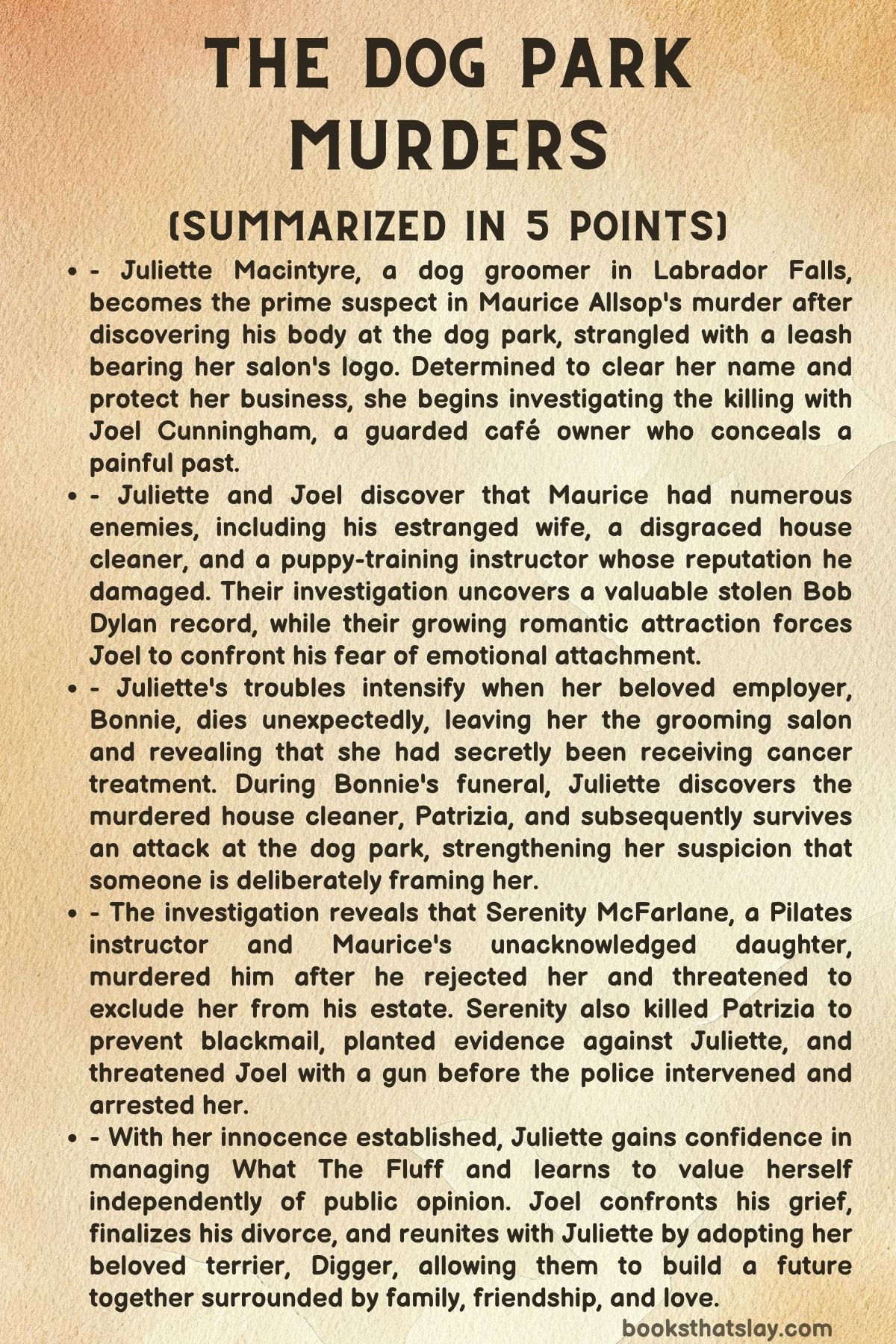
Summary
Juliette Macintyre works at What The Fluff, a successful pet-grooming salon in the small town of Labrador Falls. When the owner, Bonnie, leaves for what is supposedly a Caribbean cruise, Juliette assumes responsibility for the business, determined to demonstrate that she deserves the partnership Bonnie has offered her.
Although Juliette is an experienced groomer, she constantly doubts herself and worries about disappointing others. Her insecurities are intensified by the reputation of her family, which has remained damaged since her father was dismissed from the police force for destroying evidence to protect his brother.
Juliette regularly visits Brewed Awakening, the café next door, where she enjoys teasing its handsome but unfriendly owner, Joel Cunningham. Joel insists that he dislikes dogs and prefers solitude, despite having created an elaborate pet-friendly courtyard for his customers.
Unknown to Juliette, Joel is attracted to her but refuses to pursue a relationship because of painful experiences in California. An unopened letter from a Los Angeles law firm reminds him that the life he abandoned remains unresolved.
Meanwhile, Juliette is fostering Digger, an energetic Jack Russell terrier, while her twin sister, Norah, looks after Bonnie’s difficult Pomeranian, Marshmallow. During an outing at the local dog park, the sisters witness a confrontation between Corinne Allsop and her estranged husband, Maurice.
The couple are involved in a bitter divorce, with custody of their Afghan hound, Brigitte, becoming another source of conflict. When Maurice roughly takes possession of the dog, Juliette intervenes, provoking an argument that attracts the attention of Police Chief Dooley.
The chief treats Juliette dismissively, reflecting the prejudice she has experienced since her father’s disgrace. Corinne minimizes the confrontation, leaving Juliette frustrated by the unfairness of the situation.
The following morning, Juliette visits the dog park with Digger and discovers Maurice’s body inside the large-dog enclosure. He has been strangled with a pink-and-blue leash bearing the distinctive logo of What The Fluff.
Detective Shane Dooley, the police chief’s son, immediately considers Juliette a suspect. He emphasizes her confrontation with Maurice, her connection to the murder weapon, and her inability to provide an alibi for the previous evening.
Juliette explains that the salon ordered two promotional leashes, one of which she took home while the other remained at the business. Nevertheless, Shane’s accusatory questioning convinces her that he intends to exploit her family’s reputation to secure an easy conviction.
News of Maurice’s murder spreads rapidly, and Juliette begins losing grooming appointments as customers question whether they can trust her. Concerned about protecting Bonnie’s business, she decides to investigate the killing herself.
Joel initially recommends hiring a lawyer, but he eventually agrees to accompany her because he fears she might encounter the murderer. Their investigation begins at the dog park, where they discover that Maurice had antagonized numerous residents.
Ruth Goldstein, a strict enforcer of park regulations, admits that Maurice regularly irritated her. Serenity McFarlane, a friendly Pilates instructor, reveals that he had also publicly criticized Kacey Greenwood, the owner of a puppy-training academy, and dismissed his house cleaner.
Further inquiries establish that Maurice accused the cleaner, Patrizia Pisano, of stealing a valuable vinyl record. The allegation damaged her professional reputation and reduced her income, providing another possible motive for revenge.
Juliette and Joel question Kacey, who admits threatening Maurice after he attempted to turn her training business into a franchise. When she rejected his proposal, he retaliated by attacking her reputation, although she denies involvement in his death.
Meanwhile, Joel’s growing attachment to Juliette begins threatening the emotional barriers he has constructed around himself. During an evening visit to his home, Juliette notices a photograph of him with fellow firefighters and a chocolate Labrador.
Their conversation unexpectedly triggers painful memories, and Joel abruptly orders her to leave. Hurt and confused, Juliette cannot understand why someone who has shown her such kindness suddenly treats her as an unwelcome visitor.
Elsewhere, Juliette and Norah discover inconsistencies in Bonnie’s supposed travel arrangements. A cruise brochure, flight information for Denver, and a mysterious restaurant reservation suggest that Bonnie has concealed the real purpose of her journey.
Despite their concern, the sisters cannot establish where she is or why she has stopped communicating.
Their murder investigation produces a breakthrough when Corinne reveals that she wants a particular Bob Dylan record from Maurice’s estate. She associates the recording with happier memories of their relationship.
Joel and Juliette visit a local record shop, where owner Beau Gerrard explains that the album is an exceptionally rare early pressing of The Freewheelin’ Bob Dylan, containing songs removed from the commercial release. A surviving copy could command tens of thousands of dollars.
Beau also reveals that someone anonymously contacted him, offering to sell precisely this valuable edition for $25,000. The discovery suggests that the missing record might connect Maurice’s death to an attempted financial crime.
As Juliette and Joel reconsider their suspects, their relationship becomes increasingly intimate. Joel acknowledges his fear of emotional attachment, while Juliette argues that avoiding relationships merely to prevent disappointment means sacrificing the possibility of happiness.
They finally kiss, but their romantic breakthrough is interrupted when Norah telephones with devastating news: Bonnie has died.
Juliette subsequently learns that Bonnie never intended to take a cruise. Instead, she traveled to Colorado for experimental cancer treatment, concealing her illness because she did not want her loved ones to worry.
At Bonnie’s unconventional funeral, Juliette discovers that she has inherited What The Fluff. Bonnie also leaves her apartment to Norah and a collection of personal possessions to their friend Alexa, demonstrating how much she valued the three women.
Juliette struggles with the responsibility of inheriting the salon, particularly when her professional reputation remains endangered by the murder investigation.
The funeral takes an even darker turn when she discovers Patrizia’s body in the bathroom. The cleaner has been strangled with a pink feather boa, making Juliette the unfortunate discoverer of a second murder victim.
Detective Dooley becomes increasingly suspicious of her. Joel suggests that Patrizia may have discovered something about Maurice’s killer and subsequently been murdered to prevent her from revealing it.
Shortly afterward, someone throws a brick through the salon window, accompanied by a threatening message. Although the incident suggests that Juliette herself is in danger, Shane considers the possibility that she staged the attack.
During the confrontation, he reveals that Joel remains legally married to a woman named Marissa and was involved in a fatal fire in California. Juliette is devastated that Joel concealed such important information, especially after their growing romantic closeness.
Later, while walking Digger at the dog park, Juliette is attacked by an unidentified person who attempts to render her unconscious with a chemical-soaked cloth. The attacker suggests that Juliette’s imprisonment would allow them to obtain something they desperately want.
Digger attacks the assailant, forcing the stranger to flee. Juliette recovers a torn piece of fabric bearing small brown hairs and contacts Joel for help.
That evening, Joel finally explains his history. He was a firefighter whose closest friend and brother-in-law, Chase, died during a rescue operation after a collapsing beam trapped him inside a burning building.
Joel had been carrying a young girl to safety and faced a terrible decision between returning for Chase and completing the child’s rescue. He saved the girl, but his inability to save Chase destroyed his peace of mind.
Marissa struggled with her brother’s death, and their marriage gradually collapsed. Joel subsequently abandoned his former life, believing that emotional isolation would protect him from experiencing another devastating loss.
Juliette assures him that the tragedy was not his fault, and they spend the night together. However, Joel panics the following morning and rejects their relationship, leaving Juliette heartbroken.
Returning to the salon, Juliette discovers that the original promotional leash has disappeared from its drawer. In its place lies a damaged leash bearing an N charm, accompanied by a note indicating that Bonnie loaned the promotional leash to someone.
Consulting the salon’s appointment records, Juliette discovers that Serenity visited on the relevant date. The connection between Serenity, her dog Nibs, the damaged leash, and Juliette’s attacker suddenly becomes apparent.
Before she can warn Joel, Shane arrives and arrests her for both murders.
Meanwhile, Serenity visits Joel, claiming to possess important information. Her behavior becomes increasingly disturbing as she speaks possessively about him and treats Juliette as an obstacle to their supposed romantic future.
Joel gradually realizes that Serenity is Maurice’s illegitimate daughter. Following her mother’s death, she moved to Labrador Falls hoping to establish a relationship with him, only to be rejected and threatened with exclusion from his estate.
Serenity admits that she stole Maurice’s valuable possessions, including the rare Bob Dylan record. She subsequently lured him to the dog park with a fabricated photograph suggesting Corinne was having an affair and strangled him using the salon’s promotional leash.
Patrizia discovered Serenity’s connection to Maurice and attempted to blackmail her. To protect herself, Serenity murdered the cleaner as well.
Serenity also planted an ordinary pressing of the stolen record in Juliette’s apartment and anonymously alerted the police. Her intention was to frame Juliette, remove a romantic rival, and divert suspicion while she pursued Maurice’s valuable estate.
When Joel understands the danger, Serenity produces a handgun. Police officers arrive outside, and as Joel attempts to resist, the gun fires.
Juliette subsequently watches Serenity being taken into custody while paramedics carry Joel away with a gunshot wound to his shoulder.
The police intervened because Juliette identified the recovered album as an ordinary pressing rather than the valuable original. She also explained Bonnie’s note and the significance of Serenity’s borrowed leash, persuading investigators to examine the new evidence.
Her insistence that Joel might be in danger led officers to his home, where they arrived in time to apprehend Serenity.
Two weeks later, Joel is recovering, and Juliette has been cleared of both murders. Nevertheless, their relationship remains unresolved because Joel has not contacted her.
Juliette also faces the prospect of losing Digger after returning him to the animal shelter. Realizing that her reluctance to adopt him reflects her own fear of permanent commitment, she rushes back, only to discover that another person has already adopted him.
On Halloween, Norah and Alexa arrange for Juliette to visit Joel’s house, where she discovers him waiting with Digger. Joel reveals that he adopted the terrier specifically to reunite them.
He has also signed his divorce papers and reconciled himself to the end of his marriage. Having confronted his grief, he no longer wants fear to determine the course of his life.
Joel declares his love for Juliette, and she accepts his apology. They agree to communicate openly and face future difficulties together.
Four months later, What The Fluff is flourishing under Juliette’s ownership, and she has become more confident about setting professional boundaries. Her relationship with Joel has also strengthened, while Digger has become an essential part of their shared life.
At a surprise birthday celebration, Joel is reunited with his sisters and surrounded by the friends he has made in Labrador Falls. The man who once avoided relationships now recognizes that companionship, community, and love have restored the sense of belonging he believed he had permanently lost.
Characters
Juliette Macintyre
Juliette Macintyre is the central protagonist of The Dog Park Murders, a compassionate and determined dog groomer whose involvement in a murder investigation forces her to confront her insecurities. Her natural optimism, affection for animals, and tendency to see the good in others distinguish her from the more suspicious residents of Labrador Falls.
Much of Juliette’s behavior is shaped by the disgrace surrounding her father’s dismissal from the police force. Having experienced social rejection because of circumstances beyond her control, she develops an overwhelming desire to please others and establish an unquestionable reputation.
This desire affects her professional confidence, particularly when she assumes responsibility for Bonnie’s salon. Although she possesses the skills to manage the business, she repeatedly questions whether she deserves the opportunity.
Maurice’s murder transforms Juliette’s ordinary life into a struggle for personal and professional survival. Rather than accepting the police investigation as impartial, she recognizes that longstanding prejudice could make her an attractive suspect.
Her decision to investigate the murder demonstrates courage, but it also reveals her impulsiveness. She sometimes places herself in dangerous situations because her determination to establish the truth outweighs her instinct for self-preservation.
Juliette’s relationship with Joel introduces another dimension to her development. Although she initially appears more emotionally confident than he is, she also struggles with vulnerability and commitment, as demonstrated by her hesitation to adopt Digger permanently.
By the conclusion, Juliette has developed a stronger understanding of her own worth. She no longer allows public opinion to determine her decisions, accepts responsibility for the salon, and recognizes that meaningful relationships require both independence and openness.
Joel Cunningham
Joel Cunningham provides the principal romantic counterpart to Juliette in The Dog Park Murders. As the owner of Brewed Awakening, he presents himself as an unfriendly loner who dislikes dogs, romantic attachments, and unnecessary social interaction.
His behavior conceals a considerably more compassionate personality. He creates a welcoming space for customers with pets, quietly helps people in need, and repeatedly places Juliette’s safety above his preference for solitude.
Joel’s emotional isolation originates in his former career as a firefighter. During a rescue operation, he saved a child but lost his closest friend and brother-in-law, Chase, leaving him burdened by guilt over a decision made under impossible circumstances.
The tragedy also contributed to the destruction of his marriage to Marissa. Unable to separate himself from the loss, Joel abandoned California and attempted to establish a new existence in Labrador Falls.
His relationship with Juliette threatens this carefully maintained isolation. Although he enjoys her company and increasingly admires her courage, he repeatedly withdraws whenever emotional intimacy makes another loss seem possible.
Joel’s affection for animals reveals the tenderness he attempts to suppress. His growing attachment to Digger and his memories of Myla demonstrate that his apparent dislike of dogs is actually a defense against painful reminders of his previous life.
His willingness to protect Juliette during the investigation establishes his moral courage, while his initial rejection of her exposes the limits of his emotional resilience. Physical danger is easier for him to confront than the possibility of loving someone again.
By eventually signing his divorce papers, adopting Digger, and declaring his love for Juliette, Joel accepts that grief need not determine his future. His development illustrates the difficult process of moving beyond guilt without denying the significance of what has been lost.
Serenity McFarlane
Serenity McFarlane is the principal antagonist of The Dog Park Murders, although she initially appears to be a friendly Pilates instructor and an ordinary member of the dog park community. Her cheerful manner, attractive appearance, and apparent helpfulness conceal resentment, possessiveness, and a willingness to use violence.
Her actions originate partly in the rejection she experiences from Maurice, her biological father. Following her mother’s death, she approaches him hoping to establish a relationship, only to encounter his refusal to acknowledge her.
This rejection becomes particularly significant because Maurice also threatens to exclude her from his estate. Serenity interprets his behavior as another denial of the recognition and security she believes she deserves.
Rather than confronting her disappointment constructively, she develops a scheme involving theft, murder, and the manipulation of others. She steals valuable possessions, uses a fabricated accusation of infidelity to lure Maurice to the dog park, and kills him.
Her murder of Patrizia further exposes her willingness to eliminate anyone who threatens her interests. Patrizia’s knowledge of her connection to Maurice makes the cleaner dangerous, and Serenity responds by killing her rather than risking exposure.
Serenity’s attraction to Joel provides an additional motive for targeting Juliette. She imagines a romantic connection that Joel does not reciprocate and treats Juliette as a rival whose imprisonment would remove an obstacle.
Her use of the salon’s promotional leash demonstrates calculated planning. By obtaining an object associated with Juliette’s workplace, she creates evidence that directs police suspicion toward someone else.
Serenity represents the destructive consequences of allowing rejection and entitlement to become justifications for harming others. Although her experiences help explain her resentment, they do not excuse her decision to murder, deceive, and manipulate innocent people.
Norah Macintyre
Norah is Juliette’s twin sister and one of her most reliable sources of emotional support. She shares Juliette’s history of suffering because of their father’s disgrace, giving her a particularly strong understanding of her sister’s insecurities.
Her responsibility for Bonnie’s Pomeranian, Marshmallow, introduces considerable humor into the novel. The dog’s stubborn personality repeatedly disrupts her routines and contrasts with Juliette’s more enthusiastic relationship with Digger.
Norah also makes important contributions to the investigation. Her connection to the cleaning company provides access to information about Patrizia, while her discovery of Bonnie’s suspicious travel documents establishes that the supposed cruise was a fabrication.
Following Bonnie’s death, Norah inherits the apartment and responsibility for Marshmallow. The inheritance reflects Bonnie’s affection for her and reinforces her importance within their chosen family.
Norah’s encouragement helps Juliette recognize that she deserves ownership of the salon. Her role demonstrates the stabilizing influence of sibling loyalty during periods of uncertainty and emotional distress.
Alexa
Alexa is Juliette’s close friend and the owner of Glow Up, a local candle shop. Her friendship provides Juliette with a supportive environment outside the increasingly hostile atmosphere surrounding the grooming salon.
Although Alexa initially knows little about Maurice’s murder, she quickly becomes interested in Juliette’s predicament. Her suggestion that the investigation should consider people personally connected to Maurice demonstrates her practical approach to the mystery.
Alexa also helps Juliette process Bonnie’s death and the responsibilities associated with her inheritance. Receiving Bonnie’s vintage clothing, jewelry, and other possessions confirms that she was regarded as a member of Bonnie’s extended family.
Her later assistance in arranging Joel’s Halloween surprise demonstrates her investment in Juliette’s happiness. She represents friendship based on mutual encouragement rather than social convenience.
Bonnie
Bonnie is the owner of What The Fluff and an important maternal figure in The Dog Park Murders. Although she is absent during much of the action, her decisions influence Juliette’s professional development and several important discoveries.
Her decision to conceal her cancer diagnosis originates in her wish to protect the people she loves from worry. Unfortunately, the secrecy also creates anxiety and confusion when Juliette and Norah discover inconsistencies in her supposed travel arrangements.
Bonnie’s insistence on making Juliette a business partner becomes more meaningful after her death. She recognizes Juliette’s abilities and attempts to ensure that the salon will remain in capable hands.
Her carefully arranged inheritance demonstrates the depth of her affection for Juliette, Norah, and Alexa. She regards the three women as daughters and provides each with something suited to her circumstances.
Even the promotional leash becomes significant because Bonnie records that she loaned it to someone. Her ordinary business note eventually provides a crucial connection between Serenity and the murder weapon.
Bonnie’s influence continues after her death through the confidence she placed in Juliette. Her character illustrates how generosity, trust, and mentorship can shape another person’s future.
Detective Shane Dooley
Shane Dooley is the detective responsible for investigating Maurice’s murder. His position gives him considerable authority, but his longstanding history with Juliette and her family compromises her confidence in his impartiality.
Shane has known Juliette since childhood, when she regarded him as a bully who benefited from his father’s position. His treatment of her during the investigation reinforces her belief that he has never viewed her fairly.
He repeatedly emphasizes circumstantial evidence pointing toward Juliette, including the branded leash, her confrontation with Maurice, and her discovery of both bodies. His determination to solve the case and establish his professional reputation contributes to his narrow investigative focus.
Shane’s treatment of Joel is similarly confrontational. By revealing sensitive information about Joel’s marriage and firefighting past, he demonstrates a willingness to exploit personal vulnerabilities during questioning.
Nevertheless, Shane eventually responds to evidence that contradicts the case against Juliette. The distinction between his earlier conduct and his eventual intervention shows how a flawed investigation can still change direction when compelling information emerges.
Police Chief Dooley
Chief Dooley is Shane’s father and a representative of the local authority structure that Juliette distrusts. His dismissive response to her confrontation with Maurice demonstrates how her family’s history continues to influence the treatment she receives.
Rather than examining the dispute with complete neutrality, he criticizes Juliette and Norah for interfering in another couple’s affairs. His conduct reinforces the sisters’ perception that their community holds them responsible for their father’s actions.
Although he remains a secondary character, the chief helps establish the social environment in which the murders occur. His position gives institutional significance to the prejudice that Juliette encounters in everyday life.
Maurice Allsop
Maurice Allsop is the first murder victim, and his complicated relationships provide the foundation for the central mystery. His abrasive personality and tendency to antagonize others create numerous possible motives for his death.
His bitter separation from Corinne becomes especially visible through their disagreement over Brigitte. His rough treatment of the dog provokes Juliette’s intervention and places her among the people who publicly confronted him shortly before his death.
Maurice also uses his financial position and influence in ways that damage other people. He retaliates against Kacey for refusing his business proposal and accuses Patrizia of theft, causing serious harm to her reputation.
His rejection of Serenity proves especially consequential. By refusing to acknowledge his daughter and threatening to exclude her from his estate, he intensifies an existing emotional conflict that ultimately contributes to his murder.
Maurice is presented as an unpleasant and often insensitive man, but his behavior does not justify his killing. The novel uses his numerous conflicts to create uncertainty about which grievance might have led to violence.
Corinne Allsop
Corinne is Maurice’s estranged wife and one of the earliest possible suspects. Their divorce and dispute over Brigitte establish an obvious personal connection to the victim.
Despite the bitterness of their separation, Corinne reveals that she still loved Maurice. Her feelings complicate the initial impression that their relationship consisted entirely of hostility.
Her attachment to the rare Bob Dylan record is particularly significant because it represents memories of happier times. Although the record possesses considerable financial value, her stated interest in it is sentimental.
Corinne’s willingness to discuss the album openly helps Joel and Juliette reconsider whether she could be responsible for its disappearance. Her character demonstrates how marital conflict can coexist with lingering affection and grief.
Patrizia Pisano
Patrizia is the cleaner whom Maurice accused of stealing a valuable record. The accusation damages her standing at work, reduces her income, and threatens her ability to support her family.
Her situation creates a plausible motive for revenge, making her an important suspect during the early investigation. Her involvement in a secondhand-goods business also raises questions about whether she might have attempted to sell the missing record.
However, Patrizia’s significance changes when she discovers information about Serenity’s relationship with Maurice. Rather than immediately exposing the truth, she attempts to use that knowledge for financial advantage.
Her decision to blackmail Serenity places her in fatal danger. Patrizia becomes the second murder victim, demonstrating that the killer is prepared to commit further violence to prevent exposure.
Her character occupies a morally complicated position because her attempt at blackmail is wrong, yet she has already experienced serious injustice through Maurice’s accusation. Her death shows how a relatively ordinary financial dispute can become entangled with far more dangerous circumstances.
Kacey Greenwood
Kacey Greenwood owns a puppy-training academy and becomes a suspect because of her dispute with Maurice. When he proposes franchising her business, she rejects the arrangement because she wants to concentrate on serving local dog owners.
Maurice responds by attacking her professional reputation, provoking a confrontation in which Kacey threatens him. Her admitted threat makes her appear suspicious, particularly because she possesses the physical strength to overpower another person.
Nevertheless, the disagreement also reveals her commitment to maintaining control over her business. She refuses to sacrifice her original purpose simply because someone else identifies an opportunity for commercial expansion.
Kacey functions as a plausible alternative suspect whose personal grievance broadens the investigation. Her experiences also reinforce the recurring problem of powerful individuals attempting to control other people’s livelihoods.
Marissa
Marissa is Joel’s estranged wife and Chase’s sister. Her relationship with Joel deteriorates following Chase’s death, a tragedy that profoundly affects them both.
Although Marissa remains largely outside the main setting, her conversations with Joel establish that their marriage has not been emotionally or legally resolved. Their continued connection keeps Joel attached to a period of his life that he cannot comfortably remember.
Her request that Joel accept the end of their marriage reflects a recognition that neither can recover their previous relationship simply by refusing to move forward. Her eventual agreement to the divorce allows both characters to establish separate futures.
Marissa’s significance lies in the way her grief parallels Joel’s while producing different consequences. Their shared loss does not create lasting unity because they cannot find a way to process it together.
Chase
Chase is Joel’s closest friend, fellow firefighter, and brother-in-law. His death during a rescue operation is the central tragedy shaping Joel’s emotional life.
When a collapsing beam traps Chase inside a burning building, Joel must decide whether to return for him or continue carrying a child to safety. Joel saves the child, but Chase dies.
Although Chase appears primarily through Joel’s memories, his absence influences the protagonist’s marriage, career, and subsequent isolation. He represents the enduring emotional consequences of a traumatic loss.
April
April works at Brewed Awakening and understands Joel’s personality better than many other residents of Labrador Falls. Her teasing frequently exposes the romantic interest in Juliette that Joel attempts to deny.
She also serves as an observer of the town’s gossip and social tensions. Her knowledge helps Joel understand how Maurice’s murder affects Juliette’s reputation.
When Joel asks her to listen discreetly to Shane’s conversation with Kacey, April demonstrates both loyalty and caution. She recognizes that interfering with the investigation could create serious problems.
Her presence provides humor and companionship within the café. She also illustrates that Joel has meaningful relationships in Labrador Falls even before he becomes willing to acknowledge them.
Digger
Digger, the energetic Jack Russell terrier, is one of the most consequential animal characters in The Dog Park Murders. Initially abandoned by his previous owners, he enters Juliette’s life as a foster dog and quickly becomes her constant companion.
His enthusiastic and mischievous behavior creates humorous situations, but his importance extends beyond comic relief. He provides Juliette with comfort during police questioning and becomes a source of companionship when her reputation deteriorates.
Digger also saves Juliette during the attack at the dog park by biting her assailant. The fabric he tears from the attacker subsequently provides an important investigative clue.
His growing relationship with Joel exposes the café owner’s concealed affection for animals. Through their playful interactions, Joel begins recovering memories of happiness that he has long associated with unbearable loss.
Juliette’s eventual decision to adopt Digger reflects her growing willingness to make lasting commitments. When Joel adopts the dog and reunites them, Digger becomes a symbol of the family they are finally prepared to build.
Marshmallow
Marshmallow is Bonnie’s stubborn Pomeranian, temporarily placed in Norah’s care. His difficult temperament creates frequent comic relief, especially when Norah struggles to manage his behavior.
His unexpected affection for Joel challenges the café owner’s insistence that he dislikes dogs. Marshmallow’s acceptance suggests that Joel possesses a gentler personality than his outward behavior indicates.
Following Bonnie’s death, Norah inherits responsibility for the dog. Marshmallow therefore also represents the continuation of Bonnie’s presence in the lives of the people she loved.
Brigitte
Brigitte is the Afghan hound at the center of Maurice and Corinne’s custody dispute. Her ownership becomes another source of conflict during their already bitter separation.
Her presence at the dog park brings Juliette into direct confrontation with Maurice. Later, when she wanders into Joel’s café courtyard, his willingness to care for her contradicts his professed dislike of animals.
Brigitte serves as both a catalyst for important events and a reminder that animals can become entangled in human disagreements.
Ruth Goldstein
Ruth Goldstein is an elderly dog park regular who takes the park’s regulations extremely seriously. Her strict attitude and frustration with Maurice establish her as one of the people who openly disliked him.
Although she acknowledges his irritating behavior, she resists Juliette’s attempts to gather information. Her reluctance demonstrates the difficulty of conducting an informal investigation in a close-knit community.
Ruth also contributes to the novel’s humor through her assumption that Juliette and Joel are romantically involved. Her observations suggest that their developing attachment is more apparent to outsiders than they realize.
Beau Gerrard
Beau Gerrard is a former musician who owns Vinyl Destination, the local record shop. His specialized knowledge becomes crucial when Juliette and Joel investigate Maurice’s missing Bob Dylan album.
He explains the rarity of the early pressing and reveals that an anonymous seller recently offered him a copy. The information transforms the stolen record from a minor detail into a potentially important clue.
Beau’s friendship with Maurice adds a personal dimension to his involvement. His willingness to share the anonymous correspondence helps the investigation progress toward identifying the killer.
Mrs. Carver
Mrs. Carver is a grooming customer whose suspicious behavior reflects the damage caused by rumors about Juliette. Although she initially brings her poodles to the salon, she appears reluctant to leave them with someone accused of murder.
Her attitude illustrates how quickly public suspicion can affect an innocent person’s livelihood. Juliette’s confrontation with her demonstrates the emotional cost of repeatedly defending herself against accusations.
Mrs. Carver returns in the epilogue, when Juliette politely refuses to rearrange her schedule for an immediate appointment. The interaction reveals how much Juliette has developed in her ability to establish boundaries without fearing disapproval.
Juliette and Norah’s Father
The sisters’ father is a former police officer whose decision to destroy fingerprint evidence causes lasting damage to his family. He acts to protect his brother Pete, who committed burglaries while attempting to repay gambling debts.
Although his intentions arise from family loyalty, his actions constitute an abuse of professional responsibility. His dismissal leaves Juliette and Norah carrying the social consequences of wrongdoing they did not commit.
His presence in the family history explains Juliette’s desire for respectability and her distrust of the Dooley family. He also provides an important contrast to the sisters, who must establish identities independent of his decisions.
Pete
Pete is Juliette and Norah’s uncle, whose burglaries initiate the scandal surrounding their father. His gambling debts lead him into criminal behavior, prompting his brother to interfere with evidence.
Although Pete does not actively participate in the central mystery, his actions have lasting consequences for the sisters. He demonstrates how one person’s wrongdoing can affect an entire family long after the original incident.
Dragomir Bibic
Dragomir Bibic is associated with Clean Sweep Cleaning Co., where Norah works. His position provides the professional context for Patrizia’s employment and the damage caused by Maurice’s accusation.
Although he plays a limited role in the plot, his business connects the sisters to an important potential suspect. The cleaning company also illustrates how the town’s ordinary professional relationships become relevant to the murder investigation.
Arthur Harrington
Arthur Harrington is the attorney responsible for explaining Bonnie’s estate arrangements. His appearance at the funeral reveals the depth of Bonnie’s affection for Juliette, Norah, and Alexa.
By presenting Bonnie’s letter and explaining her bequests, he provides the surviving women with a clearer understanding of her intentions. His role establishes the legal foundation for Juliette’s eventual ownership of What The Fluff.
Myla
Myla is the chocolate Labrador Joel rescued from a burning building during his firefighting career. She subsequently becomes a beloved companion at the fire station and within his household.
His memories of Myla are associated with a period of happiness that ended after Chase’s death and the deterioration of his marriage. Consequently, thinking about her initially intensifies his grief.
As Joel develops his relationship with Digger, his memories of Myla become less exclusively painful. Learning that she remains happy and well cared for helps him accept that loving another dog does not diminish the significance of his former companion.
Alyssa Cunningham
Alyssa is one of Joel’s sisters, whose appearance at his birthday celebration reflects his renewed connection with family. Her visit demonstrates that he is no longer determined to keep his former life completely separate from his present circumstances.
Although her role is brief, she contributes to the closing atmosphere of reconciliation and belonging. Her presence confirms that Joel has begun restoring relationships beyond his romance with Juliette.
Faith Cunningham
Faith is Joel’s other sister and joins Alyssa in surprising him at his birthday celebration. Her appearance reinforces the importance of the family connections that Joel previously struggled to maintain.
Together, the sisters help demonstrate how significantly his life has changed. He can now enjoy the affection of others without allowing his memories of loss to overwhelm the experience.
Rita
Rita is April’s girlfriend and appears among the friends attending Joel’s birthday celebration. Although she has a minor role, her presence contributes to the community that develops around Joel and Juliette.
Through Rita and the other guests, the ending emphasizes the ordinary social relationships that Joel once attempted to avoid. His enjoyment of their company confirms his increasing comfort with companionship and emotional closeness.
Themes
Prejudice, Reputation, and the Search for Justice
Juliette’s experience demonstrates how a person’s reputation can be shaped by events entirely outside their control. Her father’s dismissal from the police force creates a lasting social stigma that follows both daughters into adulthood.
Although Juliette has committed no wrongdoing, residents continue judging her through the actions of her family. This prejudice becomes particularly dangerous when she discovers Maurice’s body and attracts the attention of Detective Dooley.
The murder investigation reveals how existing assumptions can influence the interpretation of evidence. Juliette’s argument with Maurice and her connection to the promotional leash are legitimate matters for police consideration, but Shane’s personal history with her makes his approach appear especially hostile.
Instead of feeling protected by the authorities, Juliette fears that they are searching for evidence to confirm an accusation already formed. The distinction between investigating suspicious circumstances and assuming guilt becomes central to her experience.
Public opinion compounds the problem because customers begin canceling appointments before any wrongdoing has been established. The accusations therefore threaten not only Juliette’s freedom but also her financial security and Bonnie’s business.
The Dog Park Murders demonstrates that reputational damage can occur independently of factual guilt. Even when allegations remain unproven, their practical consequences can be immediate and severe.
Joel’s history provides a parallel example through his recollection of an earlier investigation in which prejudice contributed to a wrongful conviction. His distrust of the justice system makes him particularly sensitive to the danger facing Juliette.
The eventual exposure of Serenity challenges the assumptions that guided the initial investigation. The actual killer exploits the police’s suspicions, using Juliette’s existing vulnerability to construct a convincing false accusation.
Juliette’s ultimate freedom depends on examining evidence beyond its most convenient interpretation. The rare record, Bonnie’s note, and Serenity’s connection to the leash demonstrate why apparently persuasive circumstances must be tested against alternative explanations.
The resolution also separates legal vindication from personal recovery. Although Juliette is officially cleared, her deeper growth involves understanding that she cannot control every opinion held about her.
By the conclusion, she no longer feels compelled to sacrifice her own needs to secure universal approval. Her development suggests that genuine self-respect requires an identity grounded in personal values rather than the fluctuating judgments of a community.
Grief, Guilt, and Emotional Recovery
Joel’s life is dominated by the emotional consequences of Chase’s death. Although he successfully rescues a child from a burning building, he interprets his inability to save his closest friend as a permanent personal failure.
The circumstances of the rescue reveal the difference between responsibility and guilt. Joel faces an impossible decision under extreme pressure, yet he continues judging himself as though a perfect outcome had been available.
His grief affects nearly every aspect of his subsequent existence. He leaves California, separates from his former profession, withdraws from relationships, and attempts to establish a life in which emotional attachments cannot expose him to further pain.
This self-imposed isolation provides an illusion of safety, but it also prevents him from experiencing happiness. His attraction to Juliette becomes frightening precisely because she offers companionship that he has convinced himself he cannot afford to accept.
His relationship with Digger provides another route toward emotional recovery. The terrier reminds him of Myla, initially producing painful memories but gradually allowing him to reconnect with the affection he once expressed freely.
Juliette experiences grief differently following Bonnie’s death. Her sorrow is complicated by the discovery that Bonnie concealed her illness and by the responsibility of inheriting the business.
Bonnie’s secrecy reflects an understandable desire to protect loved ones, but it also deprives them of the opportunity to support her. The resulting confusion demonstrates that attempts to shield others from suffering can sometimes produce additional distress.
Both Juliette and Joel must learn to accept changes they cannot reverse. Joel cannot save Chase or restore his marriage, while Juliette cannot recover the time she might have spent supporting Bonnie through her illness.
The novel does not suggest that recovery requires forgetting the dead. Instead, it presents healing as the gradual ability to remember loss without allowing that loss to determine every future decision.
Joel’s eventual contact with Marissa and Myla demonstrates this change. He can acknowledge the importance of his former life while accepting that it no longer needs to prevent him from building another.
His relationship with Juliette becomes possible only when he understands that loving someone again is not a betrayal of those he has lost. Similarly, Juliette honors Bonnie not by fearing the responsibilities she inherited, but by developing the confidence to fulfill them.
Their experiences suggest that grief becomes more manageable when people allow themselves to accept support, acknowledge uncertainty, and remain open to new experiences.
Love, Vulnerability, and the Courage to Commit
Juliette and Joel approach romantic relationships from seemingly opposite positions. Juliette openly believes in the possibility of lasting happiness, while Joel insists that emotional attachment leads inevitably to disappointment.
Nevertheless, both characters struggle with commitment. Joel fears losing someone he loves, whereas Juliette worries about making permanent decisions that might expose her inadequacies or limit her ability to please others.
Their differences become apparent during the murder investigation. Juliette welcomes Joel’s companionship and gradually invites him into her personal life, while he repeatedly attempts to define their growing intimacy as a practical partnership.
His actions contradict these declarations. He brings her food, protects her during dangerous situations, cares for Digger, and makes thoughtful gestures that reveal affection he refuses to acknowledge.
Juliette recognizes the discrepancy between Joel’s words and behavior. Rather than accepting his unfriendly exterior as his complete identity, she challenges his belief that he is incapable of meaningful attachment.
However, her willingness to understand his pain does not eliminate the harm caused by his repeated withdrawals. When he rejects their relationship after spending the night together, she confronts him rather than pretending that his behavior has no emotional consequences.
This conflict establishes an important distinction between compassion and unlimited tolerance. Juliette can recognize Joel’s trauma without accepting that his suffering gives him permission to disregard her feelings.
The Dog Park Murders presents emotional vulnerability as an essential condition of love rather than a weakness to be eliminated. Joel’s eventual happiness depends on his willingness to accept that relationships cannot guarantee protection against future pain.
Digger provides a parallel illustration through Juliette’s reluctance to adopt him. She loves the terrier but hesitates because permanent responsibility makes the possibility of loss more frightening.
Her decision to adopt Digger reveals that she has begun accepting the uncertainty accompanying attachment. Joel’s decision to adopt him independently demonstrates a similar transformation.
Their reunion becomes meaningful because both characters make deliberate choices rather than simply surrendering to romantic attraction. They acknowledge their earlier mistakes and agree that future difficulties must be addressed through communication.
The relationship therefore develops beyond the initial excitement of their attraction. Its resolution emphasizes mutual accountability, emotional honesty, and the willingness to remain present when love becomes complicated.
Through their experiences, the novel suggests that lasting companionship requires courage from both partners. Love becomes sustainable not because the possibility of suffering disappears, but because the individuals involved choose to face uncertainty together.
Family, Community, and the Meaning of Belonging
Family relationships influence the characters’ lives in ways that extend far beyond their immediate households. Juliette’s father’s misconduct shapes her standing in Labrador Falls, while Joel’s connection to Chase transforms a professional tragedy into a personal catastrophe.
These experiences demonstrate that family bonds can create obligations and consequences that individuals never consciously choose. Juliette inherits social disgrace, and Joel assumes an overwhelming sense of responsibility for the death of someone who was both his friend and relative.
Yet the novel also presents family as something that can be created through affection, loyalty, and shared experience. Bonnie’s relationship with Juliette, Norah, and Alexa provides the clearest example.
Although she has no daughters of her own, Bonnie regards the three women as family. Her estate arrangements recognize these emotional bonds by leaving each woman something personally meaningful.
The inheritance emphasizes that belonging is not determined exclusively by biological relationships. Bonnie’s generosity reflects years of companionship and mutual trust rather than conventional family obligations.
The dog park provides another form of community, bringing together residents whose ordinary lives might otherwise remain separate. Its social environment contains disagreements, friendships, petty rivalries, and complicated loyalties.
These relationships create opportunities for both support and hostility. The same community that provides Juliette with friendships also spreads accusations that threaten her livelihood.
Labrador Falls therefore becomes a setting in which belonging must be negotiated rather than automatically granted. Juliette’s development requires her to distinguish between the people who genuinely value her and those whose approval depends on rumor or social status.
Joel experiences a different form of alienation because he deliberately distances himself from others. His café, however, gradually establishes connections that undermine his preference for isolation.
April’s friendship, Juliette’s affection, and Digger’s companionship demonstrate that he has already begun constructing a new community before he consciously accepts it. His eventual reunion with his sisters confirms that establishing new relationships does not require abandoning existing family bonds.
The animals reinforce this understanding by creating connections across different households. Digger moves from abandonment to foster care and finally to a permanent home, mirroring the human characters’ search for security and acceptance.
By the conclusion, Juliette and Joel have developed a shared life supported by friends, relatives, and the town’s renewed goodwill. Their happiness depends not on universal acceptance but on the relationships they have chosen to nurture.
The closing birthday celebration brings these ideas together through an ordinary gathering of people who care about one another. For Joel, the presence of family and friends confirms that the home he has found is defined less by geography than by the companionship he is finally prepared to embrace.