The Ending Writes Itself Summary, Characters and Themes
The Ending Writes Itself by Evelyn Clarke is a closed-island literary mystery about ambition, authorship, fraud, and the deadly hunger for recognition. Set on a private Scottish island owned by the legendary crime writer Arthur Fletch, the novel gathers a group of struggling or unstable writers under the promise of a career-changing prize: the chance to complete Fletch’s final unfinished manuscript.
What begins as a strange professional contest soon becomes a dangerous test of desperation, jealousy, and survival. The story uses the publishing world as both setting and target, exposing how easily art, ego, money, and imitation can become weapons.
Summary
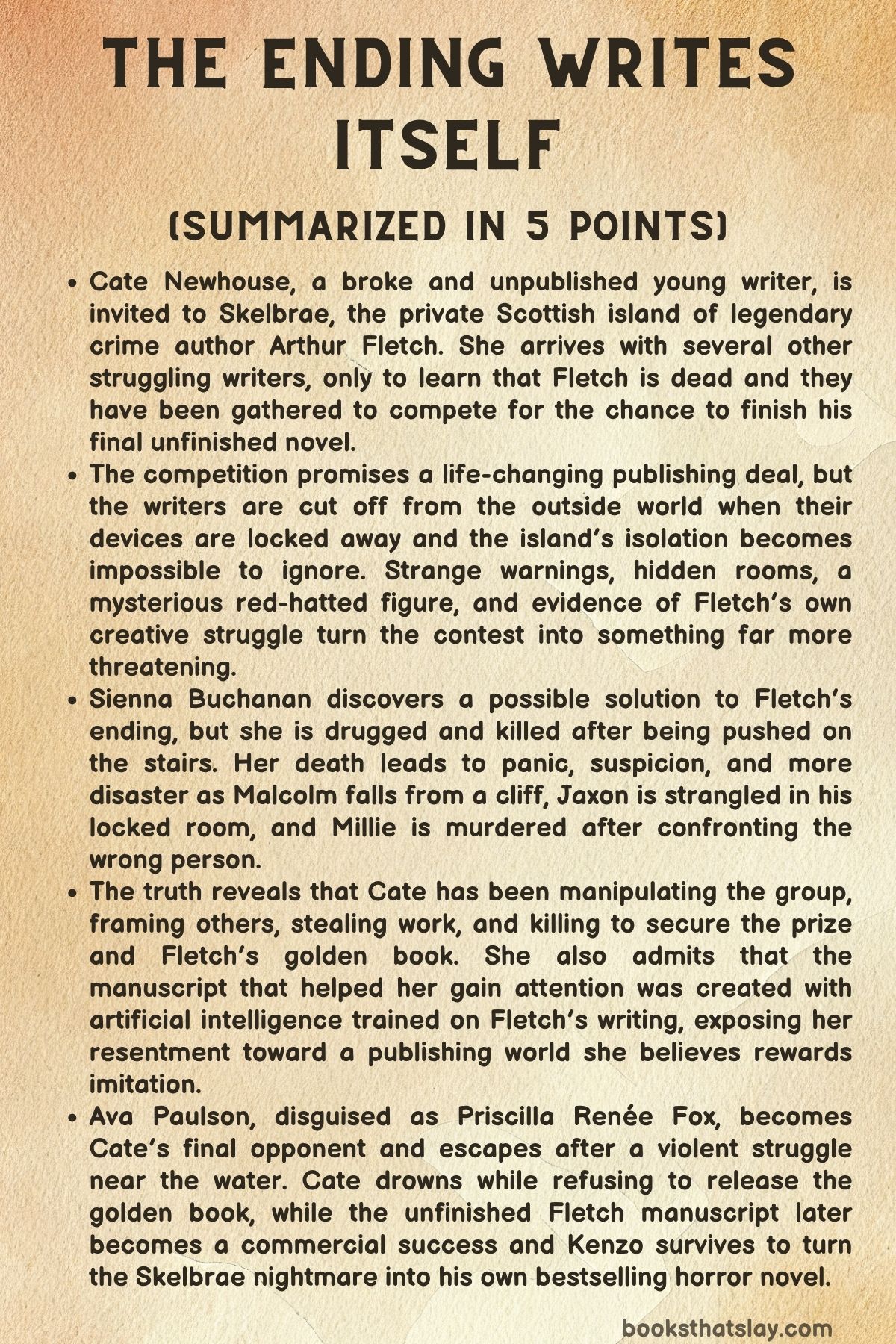
Cate Newhouse is twenty-two, broke, unpublished, and emotionally bruised after being dumped by her girlfriend. She is living in a miserable shared flat and clinging to the faint hope that her writing career might still become something real.
Her agent, Eleanor Vandenberg, suddenly forwards her a message that feels almost impossible: Arthur Fletch, the world-famous creator of the Petrarch crime novels, has invited her to one of his exclusive literary salons on Skelbrae, his private island in Scotland. Fletch’s salons are legendary, and Cate knows she does not belong among the type of established writers usually chosen for them.
Still, she accepts because she has little to lose and everything to gain.
Skelbrae immediately feels like a place designed for secrets. The island is bleak, isolated, and dramatic, dominated by Fletch’s enormous gothic house.
The mansion is filled with trophies, relics linked to his books, hidden spaces, old-fashioned details, and a detailed model of the house itself. The other invited writers arrive by boat with their own ambitions and anxieties.
Sienna and Malcolm Buchanan are a married thriller-writing team who publish together under the name Penn Stonely. Millie Mitchell is a lively young adult author who wants to escape the limits of her current career.
Priscilla Renée Fox presents herself as a romance writer. Jaxon Knight is a science fiction writer whose career has stalled after his series was cancelled.
Kenzo Gray is a horror writer who observes the group with unusual care. As Sienna and Malcolm approach the house, they see a figure wearing Fletch’s famous red hat standing on the cliff, but the figure disappears before they can understand what they have seen.
Inside the mansion, the guests are left to wait together. They sign nondisclosure agreements, try to judge one another, and slowly realize that none of them fits the usual profile for one of Fletch’s glamorous salons.
The atmosphere is awkward before it becomes alarming. Eleanor Vandenberg arrives with a man introduced as Rufus Beaumont, Fletch’s editor, and reveals the real reason they have been summoned.
Arthur Fletch is dead. He drowned a month earlier while swimming, but his death has been kept secret.
His final Petrarch novel, The Last Gasp, was unfinished when he died. The night before his death, Fletch sent Eleanor a ninety-thousand-word draft, leaving about ten thousand words still needed for the ending.
The writers have not been invited for conversation or mentorship. They have been brought to Skelbrae to compete for the right to finish the manuscript.
The prize is enormous: the remaining portion of Fletch’s advance and a three-book deal, together worth two million dollars. The competition will last seventy-two hours.
To preserve secrecy and force the writers into the same old-world conditions associated with Fletch, all phones, laptops, tablets, and smartwatches are locked inside his timed safe. Each writer is assigned a bedroom with an old typewriter and colored paper so their endings can be judged blindly.
The rules turn the mansion into both a retreat and a trap. Everyone is cut off from the outside world, and the opportunity exposes their private desperation almost immediately.
Millie sees the contest as a way out of the expectations surrounding young adult publishing. Jaxon wants to revive a career that has gone quiet.
Sienna wants the prize but no longer wants to be tied to Malcolm or to their shared pen name. Malcolm, however, wants to keep the partnership alive, partly because Sienna’s talent benefits him.
Cate feels intimidated and out of place, but she is also quietly driven by need. Kenzo remains alert and watchful, while Priscilla seems calmer than the others and more observant than she lets on.
The strange events begin quickly. Late at night, Cate sees a flash of red outside, suggesting either a prank, a ghostly return of Fletch, or the same mysterious figure seen near the cliff.
Then Millie screams after finding a typed message in her room telling her to “GET OUT.” The note could not have been produced on her own typewriter, and when the group compares samples from the other bedrooms, none of the machines match. The threat seems to come from somewhere outside the official rules of the contest.
Sienna starts investigating and uses the model house to identify hidden passages. Her search leads her to a secret attic writing room above the bedrooms.
There she finds Fletch’s hidden typewriter, whose crooked letter matches the note found in Millie’s room. She also discovers evidence that Fletch himself had been unable to solve the ending of his final novel.
The pressure inside the house sharpens the conflict between Sienna and Malcolm. Their marriage is already collapsing, and the contest makes the break unavoidable.
Sienna wants to submit her own ending separately, while Malcolm wants to preserve Penn Stonely and profit from her work as he has before. During a tense evening, Sienna suddenly has a brilliant idea for the ending of The Last Gasp and begins writing notes in her notebook with Priscilla’s red pen.
Unknown to the others, Cate has drugged the tea with Sienna’s sleeping pills while searching the house for Fletch’s rumored golden book, a valuable object connected to his legacy. Sienna drinks too much of the tea, becomes dizzy, and later tries to carry her typewriter downstairs so she can work without waking Malcolm.
While she is unsteady on the stairs, someone gives her a small push. She falls, and the heavy typewriter crashes down after her, killing her.
Sienna’s death destroys any remaining illusion that the weekend is merely a contest. Kenzo reveals that he works as a forensic technician and examines the scene.
At first he thinks the fall may have been accidental, especially given Sienna’s dizziness and the difficult staircase. Malcolm insists she was murdered.
The group soon learns that their isolation has become worse: Rufus has vanished, the yacht is gone, the landline is dead, and the timed safe containing their devices still cannot be opened. The truth is that “Rufus Beaumont” is not Fletch’s editor.
He is Holden Merriweather, assistant to the real editor, Ava Paulson. Priscilla is actually Ava in disguise, planted among the writers to observe them from within the group.
Holden, terrified after seeing the red-hatted figure outside and realizing the situation is falling apart, steals Fletch’s yacht and escapes the island, abandoning the others.
Malcolm, grieving and furious but still driven by professional hunger, finds Sienna’s notebook and tries to steal her idea for the ending. He cannot understand her shorthand until he finds her key.
Loose pages blow near the cliff, and as Malcolm tries to recover them, Jaxon sees him from a distance and thinks he may be about to jump. Jaxon shouts for him to stop.
Malcolm is startled, loses his footing, and falls to his death on the rocks below. Millie sees enough of the moment to believe that Jaxon pushed him.
Fear hardens into accusation, and the surviving writers lock Jaxon in his room for safety. While confined, Jaxon finally begins writing and produces pages of his own.
Then someone enters through a secret passage and strangles him with his resistance band. His completed pages are stolen.
Millie and Kenzo find Jaxon dead, and the secret passage connecting Jaxon’s room to Millie’s makes her look suspicious. Millie tries to protect herself by searching Ava’s room, where she finds stolen pages that make Ava appear guilty.
Millie confronts Ava with a decorative weapon, but the real danger arrives from elsewhere. Cate appears with Fletch’s actual golden book and strikes Millie in the head, killing her.
Ava finally understands that Cate has been behind the deaths and manipulations. Cate admits the truth about her supposed talent and her path to Skelbrae.
She never truly wrote the manuscript that impressed Eleanor. Instead, she used artificial intelligence trained on Arthur Fletch’s books to create work that sounded familiar enough to catch attention.
She came to the island for money, for the golden book, and to prove that the publishing industry rewards imitation as readily as originality.
Cate’s confession reveals the full shape of the nightmare. She wrote the “GET OUT” note as a prank, drugged the tea, nudged Sienna on the stairs, killed Jaxon, stole his pages, and framed others when it suited her.
She has also attacked Kenzo, leaving him impaled on the antler display. Her violence is not only practical but ideological.
She believes the system is already corrupt, already built on copies, market expectations, and reputations rather than true art. If the literary world values a fake Fletch ending, then Cate sees herself as the person honest enough to exploit that truth.
Ava, who has spent her career inside publishing, becomes the one person left to resist both Cate’s violence and the lie behind it.
A storm rises as Cate chases Ava through the house and toward the water with a crossbow and the golden book in a satchel. Ava survives by using Priscilla’s red pen to stab Cate’s hand, turning one of her disguise props into a weapon.
Ava reaches a rowboat and tries to escape. Cate jumps in after her, still refusing to release the golden book.
Ava strikes her with an oar, and Cate falls into the sea. The weight of the golden book drags her downward.
Rather than let go of the prize she has killed for, Cate drowns.
When the safe finally opens, it is far too late. Almost everyone is dead, missing, or changed beyond repair.
Eleanor later arrives and quietly manages the aftermath, protecting what can still be protected and shaping the public version of events. Ava survives but quits publishing, refusing Eleanor’s offer to finish Fletch’s final book herself.
Merriweather Press eventually publishes The Last Gasp unfinished, ending exactly where Fletch left it. The missing ending becomes its own marketing miracle, turning absence into profit and making the incomplete novel a massive commercial success.
The truth of Skelbrae does not vanish entirely. Kenzo survives after being rescued by Angus, the island’s former groundskeeper.
Angus had been the red-hatted figure haunting the island, not as a supernatural presence but as a man searching for the golden book. Kenzo signs with Eleanor and writes a horror novel based on the Skelbrae events.
In the end, the island’s real deaths become material for fiction, and Kenzo gains the career he had been chasing. The Ending Writes Itself closes with a bitter irony: the publishing world absorbs scandal, death, fraud, and unfinished art, then sells the story anyway.
Characters
Cate Newhouse
Cate Newhouse is the central figure whose vulnerability gradually reveals itself as something far more dangerous. At the beginning of the book, she appears to be an anxious and insecure young writer who has been discarded by both love and the literary world.
She is broke, unpublished, emotionally bruised, and painfully aware of her outsider status among more established writers. This makes her seem sympathetic at first, especially because the invitation to Skelbrae appears to offer her one rare chance at recognition.
Yet Cate’s insecurity is not passive. It has curdled into resentment, entitlement, and a willingness to cheat the system she believes has already cheated her.
Her use of artificial intelligence to imitate Arthur Fletch exposes her deepest conflict: she wants to be seen as a writer, but she does not truly trust originality, effort, or artistic integrity to save her. In The Ending Writes Itself, Cate becomes a harsh portrait of ambition detached from conscience.
Her crimes are not random bursts of panic but steps in a larger attempt to take control of a world where she feels powerless. The golden book becomes a physical symbol of everything she wants: legitimacy, wealth, literary inheritance, and proof that she can seize what was denied to her.
Her refusal to let it go even while drowning shows that her hunger for validation has become stronger than survival itself.
Ava Paulson / Priscilla Renée Fox
Ava Paulson is one of the book’s most layered characters because she enters the story under false identity while still becoming one of its moral anchors. Disguised as Priscilla Renée Fox, she presents herself as a romance writer, quiet enough not to dominate the group but observant enough to study everyone closely.
Her hidden role as Fletch’s real editor places her at the center of the publishing scheme that brings the writers to Skelbrae. She is not innocent of manipulation; she helps create the conditions that trap desperate writers in a contest built on secrecy, pressure, and professional temptation.
However, as the violence increases, Ava’s position changes. She is forced to confront the human cost of the industry games she has helped manage.
Her survival depends not on power but on quick thinking, endurance, and her growing ability to see Cate clearly. The red pen she carries as part of her false persona becomes crucial in her fight for life, which is fitting because Ava’s professional world has always been built around editing, correction, and judgment.
By the end, her refusal to finish Fletch’s book marks a meaningful break from the system that shaped her. She understands that some stories should not be completed for profit, especially when the cost has been so high.
Arthur Fletch
Arthur Fletch is dead before the main contest begins, but his presence controls the entire book. He is less an active character than a powerful absence around which everyone else moves.
As the celebrated author of the Petrarch novels, he represents literary fame at its most mythic: the private island, the gothic house, the relics, the salons, the devoted publishing machine, and the aura of genius. Yet the discovery that he could not finish The Last Gasp complicates that legend.
Fletch’s hidden writing room and unfinished work reveal a man trapped by his own reputation. His fame demands a perfect ending, but his creative power has failed him at the final moment.
This makes him both larger than life and strangely human. The competition to complete his book turns his legacy into a marketplace, where other writers are invited to imitate him for money and status.
Even after death, Fletch shapes everyone’s behavior because they are not only competing to finish his manuscript; they are competing to possess part of his authority. His red hat, golden book, house, and unfinished ending all become symbols of an author whose image has outgrown the person behind it.
The book uses him to question whether literary greatness belongs to the writer, the brand, the publisher, or whoever can reproduce the style convincingly enough.
Eleanor Vandenberg
Eleanor Vandenberg is a polished and pragmatic agent whose calm handling of crisis makes her both impressive and unsettling. She brings Cate into the orbit of Skelbrae by forwarding Fletch’s invitation, and she later helps reveal the true purpose of the gathering.
Eleanor understands the publishing world as a place of deals, leverage, timing, and reputation. Her decisions are rarely sentimental.
She knows the value of Fletch’s final manuscript, and she knows that an ending attached to his name could generate enormous money. What makes Eleanor compelling is that she is not portrayed simply as a villain.
She is a professional who has learned to survive by managing narratives, and that skill becomes especially visible after the deaths. When she arrives later and quietly handles the cover-up, she shows how institutions absorb disaster by controlling what becomes public.
Eleanor’s offer to Ava to finish the manuscript shows her instinct to convert even trauma into a publishable solution. Her later signing of Kenzo also reveals her ability to recognize opportunity inside horror.
She is one of the sharpest representations of the business side of literature in the novel: controlled, strategic, and willing to accept moral discomfort if the result can be shaped into success.
Sienna Buchanan
Sienna Buchanan is talented, frustrated, and trapped inside both a marriage and a writing partnership that no longer serve her. As one half of the Penn Stonely brand, she has spent years sharing a professional identity with Malcolm, but the book makes clear that this arrangement has become a form of confinement.
Sienna wants the prize, yet she also wants independence. Her decision to submit separately is not merely a career move; it is an act of self-reclamation.
She wants to prove that her ideas and voice can exist without being absorbed into a shared name. Her sudden breakthrough for the ending of The Last Gasp shows her creative strength, and that strength is exactly what makes her vulnerable.
Others want access to what she has imagined, especially Malcolm, who sees her work as something that can keep their partnership alive. Sienna’s death is tragic because it comes at the moment when she is closest to breaking free.
The sleeping pills, the typewriter, and the staircase turn her ambition into a scene of fatal vulnerability. Her notebook continues to matter after her death, showing that her ideas outlive her body and become another object for others to fight over.
Sienna’s role exposes how creative labor can be stolen, minimized, or claimed by those closest to the artist.
Malcolm Buchanan
Malcolm Buchanan is defined by dependence disguised as partnership. As Sienna’s husband and co-author under the Penn Stonely name, he wants to preserve the writing team not only because of love or habit, but because the arrangement benefits him.
His fear of losing Sienna is tied to his fear of losing professional identity. When she wants to submit separately and leave both the marriage and the brand, Malcolm reacts as someone whose personal and artistic security is collapsing at once.
After Sienna dies, his grief is mixed with possessiveness and opportunism. His attempt to take her notebook and use her ending idea shows that he still sees her creativity as something he can claim.
This makes him morally compromised without making him the true murderer. His death near the cliff is shaped by misunderstanding, panic, and the unstable atmosphere of the island.
Jaxon thinks he is about to jump, Malcolm is startled, and he falls. The moment captures how suspicion turns accidents into apparent crimes.
Malcolm’s character adds a sharp study of collaboration gone wrong. He is not simply a bad husband or weak writer; he is a man who has built his life around shared authorship and cannot accept that the more gifted half of that partnership wants to walk away.
Millie Mitchell
Millie Mitchell brings energy and apparent openness to the group, but beneath her lively surface is a writer under pressure. As a young adult author, she sees the competition as a chance to escape the expectations that have boxed in her career.
She wants to be taken seriously beyond the category assigned to her, and the Fletch contest offers a path into a different level of prestige and money. Millie is also one of the first targets of the island’s psychological games when she finds the “GET OUT” note in her room.
Her fear helps shift the mood from awkward competition to genuine danger. As deaths pile up, Millie becomes increasingly reactive and suspicious, especially after she believes Jaxon pushed Malcolm.
Her actions are often shaped by incomplete information, which is one of the book’s key methods of creating danger among the characters. When she searches Ava’s room and finds stolen pages, she thinks she has uncovered guilt, but she is actually being moved through a false trail.
Millie’s confrontation with Ava shows courage, but also how easily fear can be redirected toward the wrong person. Her death at Cate’s hands is brutal because Millie is killed just as she thinks she is acting to expose the truth.
Her character shows the vulnerability of someone trying to outthink a situation built on lies.
Jaxon Knight
Jaxon Knight is a stalled science fiction writer whose career disappointment makes him one of the many guests vulnerable to the contest’s promise. His cancelled series has left him needing professional rescue, and the chance to finish Fletch’s final book offers a way back into relevance.
Jaxon is not presented as especially powerful or sinister, but he becomes a convenient object of suspicion after Malcolm’s fall. His shout near the cliff is meant to prevent what he thinks may be a suicide, yet it triggers the accident that kills Malcolm.
Because Millie misreads the scene, Jaxon is treated as a potential murderer and locked in his room. His confinement becomes one of the book’s cruel ironies.
Isolated from the others, he finally begins to write productively, suggesting that fear and pressure have unlocked something in him. But the same isolation makes him easy to kill through the secret passage.
His completed pages are stolen, reducing him to another exploited source of usable material. Jaxon’s arc reflects the book’s concern with how writers are valued for output even when they are personally disposable.
His death also deepens the atmosphere of mistrust because it proves that locked doors and group judgment cannot protect anyone when the house itself is full of hidden routes.
Kenzo Gray
Kenzo Gray is one of the most observant and quietly capable figures in the book. Introduced as a horror writer, he later reveals that he works as a forensic technician, which explains his careful attention to evidence and behavior.
This practical knowledge makes him valuable after Sienna’s death, when the others are overwhelmed by panic. Kenzo’s first reading of the scene as a possible accident shows that he is not eager to sensationalize events.
He looks for what the evidence supports, which separates him from characters who leap toward accusation because fear demands an answer. Yet Kenzo is not only a rational observer.
He is also a writer chasing success, and the horror of Skelbrae eventually becomes the material that launches his career. His survival after being impaled on the antler display is one of the book’s final reversals, especially because he is rescued by Angus, the figure others had mistaken for something ghostly.
Kenzo’s later novel based on the island events raises uncomfortable questions about turning trauma into art. In The Ending Writes Itself, he becomes the character who most clearly transforms real violence into fiction, suggesting that storytelling can preserve truth but can also profit from suffering.
Holden Merriweather / Rufus Beaumont
Holden Merriweather is a nervous impostor whose false role helps set the entire disaster in motion. Presented to the writers as Rufus Beaumont, Fletch’s editor, he appears to carry authority he does not truly possess.
In reality, he is assistant to Ava Paulson, the actual editor. His disguise is part of the carefully staged secrecy around the contest, but Holden is not strong enough to manage the consequences once fear takes hold.
When he sees the red-hatted figure outside and realizes the weekend is becoming dangerous, he panics. His decision to steal the yacht and escape the island is cowardly, but it is also understandable in a setting where deception has created conditions no one can control.
By leaving, he cuts the others off from a possible escape and intensifies their isolation. Holden represents the lower ranks of a publishing machine that asks people to perform power without truly giving it to them.
He is part of the manipulation, yet he is also out of his depth. His flight shows how quickly professional theater collapses when real danger enters the room.
Angus
Angus, the former groundskeeper, is the human explanation behind the red-hatted figure haunting Skelbrae. Throughout much of the book, the sight of a figure in Arthur Fletch’s famous hat creates an atmosphere of ghostly uncertainty.
The guests interpret the figure through fear, rumor, and the mythology surrounding Fletch. Angus’s eventual role changes that meaning.
He is not a supernatural presence but a man searching for the golden book, moving around the island in a way that others misunderstand. His presence helps show how the house and island encourage false readings.
People see what they are prepared to fear: Fletch’s ghost, a threat, a sign of doom. Angus also becomes important because he rescues Kenzo, allowing part of the truth to survive.
He belongs to the older, hidden life of Skelbrae, separate from the glamorous literary spectacle built around Fletch. Through Angus, the book grounds one of its eerie elements in human motive and history rather than pure mystery.
Themes
Authorship, Imitation, and the Value of Originality
The question of who has the right to finish another writer’s work sits at the center of the story. Arthur Fletch’s unfinished manuscript is not treated as a private artistic failure but as a valuable commercial object that must somehow be completed.
The invited writers are asked to imitate him well enough to protect the brand, which immediately blurs the line between homage, continuation, theft, and fraud. Cate takes that logic to its most extreme form.
Her use of artificial intelligence trained on Fletch’s books exposes a world in which style can be copied, reputation can be simulated, and industry approval can be won by producing something familiar rather than something true. The novel does not present imitation as a simple technical trick; it treats it as a moral problem.
If a machine-assisted manuscript can impress an agent because it resembles a famous author’s voice, then the publishing system itself becomes part of the deception. The Ending Writes Itself uses Fletch’s missing ending to ask whether authorship comes from language, intention, labor, name recognition, or market acceptance.
Cate’s downfall suggests that copying a voice is not the same as earning one.
Ambition and the Violence of Desperation
Every writer invited to Skelbrae arrives with something missing: money, status, freedom, relevance, respect, or proof of talent. The two-million-dollar prize does not create their desperation from nothing; it gives that desperation a stage and a deadline.
The contest is cruel because it gathers people who are already professionally vulnerable and asks them to compete under isolation, secrecy, and pressure. Sienna wants escape from a suffocating partnership.
Jaxon wants a career revived. Millie wants to break out of a category that limits her.
Cate wants legitimacy and wealth so badly that she treats other people as obstacles. The island setting removes normal social restraints and turns ambition into survival logic.
At first, the writers compete through ideas and suspicion, but the competition soon becomes physical, with notes, stolen pages, framing, and murder. The story shows how easily artistic ambition can become destructive when success is presented as scarce, life-changing, and available only to one winner.
It also criticizes the systems that make desperate people feel replaceable until they produce something profitable. The deaths on Skelbrae are extreme, but the emotional engine behind them is recognizable: fear of being ignored.
Publishing as Performance and Control
The publishing world in the book is not just an industry; it is a theater of managed appearances. Arthur Fletch’s death is hidden.
A false editor is presented to the guests. Ava disguises herself as a writer.
The contest is framed as a prestigious opportunity, but it is also a controlled experiment designed to solve a commercial problem. Nearly everyone is performing a role, whether for professional survival or strategic advantage.
Eleanor understands this better than anyone. Her power lies in shaping what people know, when they know it, and what story can be sold afterward.
Even after the violence, the machinery of publishing does not stop. The unfinished The Last Gasp is released exactly where Fletch left it, and the absence of an ending becomes a sales advantage.
This theme gives the novel its sharpest satirical edge. Books are treated as art, but also as products attached to timing, secrecy, reputation, and public curiosity.
The industry can turn mystery into marketing and tragedy into myth. Through Ava’s eventual refusal to finish the manuscript, the story offers a rare act of resistance against that machine, though it also shows how easily the machine keeps moving without her.
Isolation, Mistrust, and Misread Evidence
Skelbrae’s isolation transforms uncertainty into danger. Once the phones and devices are locked away, the yacht disappears, and the landline goes dead, the characters are forced to interpret every event with limited information.
The house itself increases confusion through hidden passages, secret rooms, old objects, and misleading symbols. A red hat becomes a possible ghost.
A fall becomes a suspected murder. A shout near a cliff becomes proof of violence in the eyes of a frightened witness.
Stolen pages in the wrong room make the wrong person look guilty. The characters are not foolish; they are trapped inside a setting designed to make partial evidence feel complete.
This theme is especially important because the book repeatedly shows how fear narrows judgment. People under pressure prefer a clear suspect to an unresolved question, even when the facts are incomplete.
The result is a chain of false conclusions that helps Cate keep killing and framing others. The mystery depends not only on hidden truth but on the human urge to create a story from fragments.
Skelbrae becomes a place where every clue can be real and misleading at the same time.