The Fake Out Summary, Characters and Themes
The Fake Out by Stephanie Archer is a contemporary hockey romance that balances rivalry, redemption, and unexpected love. At its heart, the story follows Rory Miller, a rising star for the Vancouver Storm, and Hazel Hartley, the team’s physiotherapist with her own difficult past.
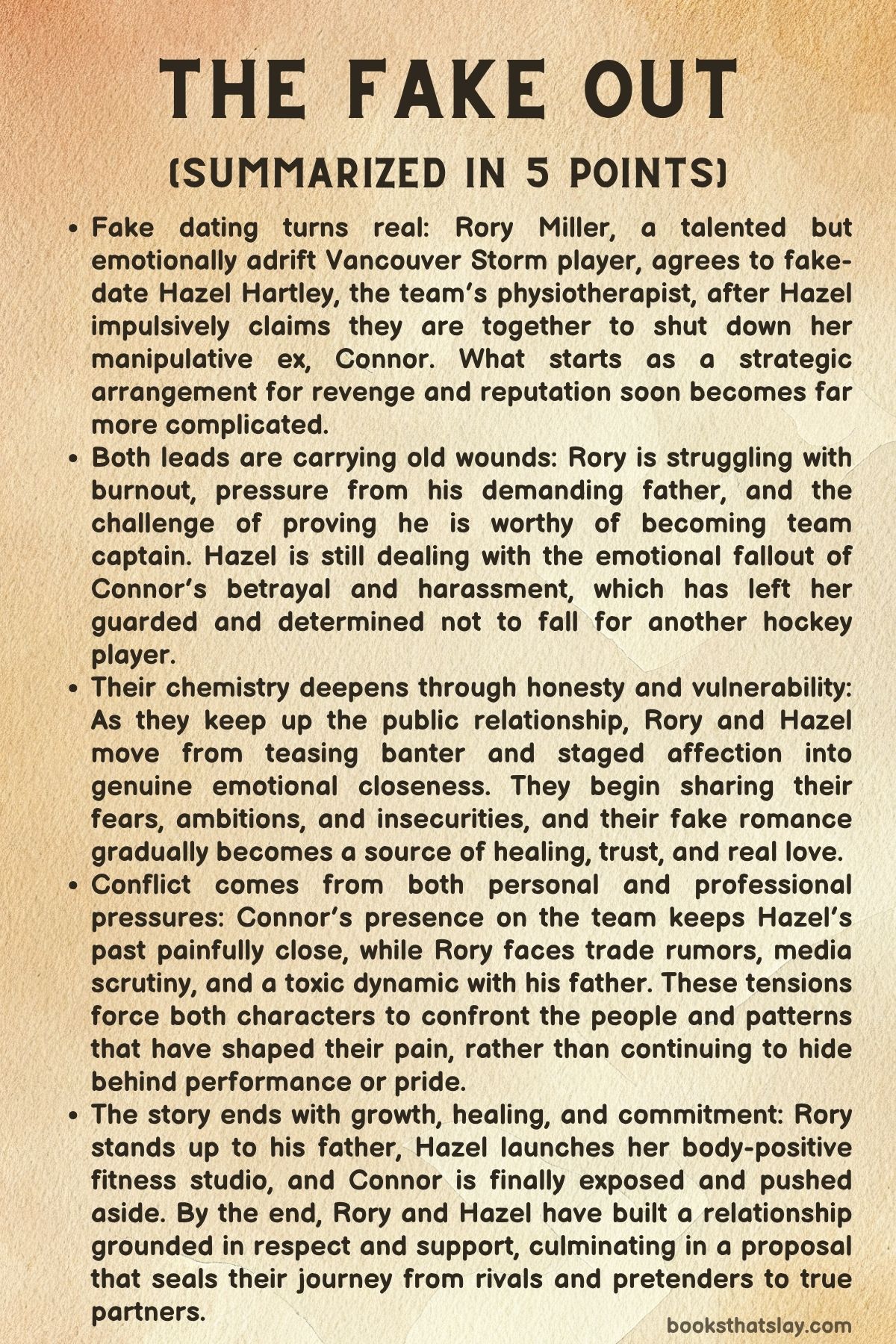
What begins as a fake dating arrangement to outwit an ex and polish Rory’s reputation soon spirals into a complex relationship that challenges both characters to confront old wounds, insecurities, and the weight of expectations. With sharp banter, emotional growth, and the high stakes of professional sports, this novel explores how love can become the game-changer neither expected.
Summary
Rory Miller begins the season with the Vancouver Storm by scoring an overtime-winning goal, yet he feels a strange emptiness instead of triumph. Hockey, once his passion, no longer brings him joy.
His sarcastic banter with Hazel Hartley, the team’s physiotherapist and his former high school tutor, stirs something he cannot ignore. Coach Ward, his mentor, offers him the chance to become team captain—if Rory proves he can lead with discipline and maturity.
The news of a trade complicates things when Connor McKinnon, Hazel’s manipulative ex and Rory’s bitter rival, joins the roster.
At Jamie Streicher and Pippa Hartley’s engagement party, Hazel struggles to hide her discomfort about working with Connor. He once betrayed her trust and left her with scars that still affect her.
Rory teases her in familiar fashion, their rivalry charged with a spark neither admits. When Connor insinuates Hazel still wants him, Hazel impulsively declares she’s dating Rory.
To her surprise, Rory jumps in to play along, delighted by the idea. Their arrangement becomes official: they’ll fake-date for half the season, with clear rules and boundaries.
For Hazel, it’s revenge and survival. For Rory, it’s also a chance to soften his image for the captaincy.
Their charade quickly gains momentum. At games, Rory openly gestures to Hazel, and when a bloody injury sends him to the glass, he goads her into kissing it better in front of thousands of fans.
The crowd erupts, and their fake romance goes public. Meanwhile, Hazel battles resurfacing trauma from Connor while trying to maintain professionalism.
Rory, however, finds meaning in their ruse, enjoying the feeling of being alive in ways hockey no longer provides.
Their dynamic deepens during nights out with friends and teammates. Hazel’s circle teases her relentlessly, while Rory plays his part with ease, sliding into booths beside her, calling her pet names, and making the act look convincing—even to Connor, who fumes from the sidelines.
A betting pool among teammates about when Rory and Hazel would get together only makes their “relationship” more entertaining for those around them. Connor, however, remains a looming threat, and Hazel braces herself for his constant intrusions.
As the fake dating continues, Rory begins to show Hazel a more serious side. He reveals discipline in his lifestyle, a deep resentment toward his overbearing father, Rick Miller, and vulnerabilities hidden beneath his confident exterior.
Hazel, in turn, shares her ambitions of opening a body-positive fitness studio, her fear of skating, and the insecurities she carries from past relationships. At times, their playful banter gives way to raw honesty, and both feel the pull of something real.
Their connection intensifies when Rory disrupts Connor by joining Hazel’s yoga class online, flaunting his supposed relationship in front of him while unexpectedly engaging with Hazel’s teaching in a meaningful way. He later surprises her with gifts, such as a crystal dragon he nicknames after her fiery personality.
These gestures blur the line between pretense and authenticity. Yet, conflict arises when Hazel confronts Rory about past behavior in high school, accusing him of treating women carelessly.
Rory’s defensive reaction nearly ends their arrangement, but his heartfelt apology and acknowledgment of guilt begin to rebuild trust.
As chemistry grows, physical intimacy follows. Playful texts escalate into increasingly vulnerable photo exchanges, revealing the desire simmering between them.
Hazel struggles against her vow never to fall for a hockey player again, but her attraction to Rory is undeniable. Their relationship crosses into real intimacy during a night fueled by jealousy after Connor’s unwanted intrusion.
For the first time, they admit their bond is different from anything they have known before.
Amid these personal shifts, Rory’s career remains in flux. His father pressures him about performance and even stirs trade rumors.
During a live interview, Rory shocks the media by declaring he will not leave Vancouver because of his love for the team, his coach, and his girlfriend. Hazel, upon hearing this, rushes to the arena to reassure him, and their public kiss cements their love story.
Tensions with Rory’s father come to a head when Rory ends their professional relationship, demanding emotional support instead of constant criticism. Rick, shaken, admits his own flaws, and with Rory’s encouragement, begins the process of reconciliation with Rory’s mother.
Meanwhile, Connor’s scheming comes to light when it’s revealed he spread the trade rumors. Coach Ward demotes him, protecting Hazel from further harassment.
Hazel and Rory continue to merge their lives. He asks her to move in, and she agrees.
Together, they prepare for the launch of Hazel’s dream project: Ember Studios, a fitness space rooted in body positivity. The event is a success, drawing support from family, teammates, and even Rory’s slowly reconciling parents.
Ward offers Hazel a part-time role with the team, allowing her to balance her studio with her profession.
Finally, Rory plans a romantic surprise at an outdoor rink under twinkle lights. With Hazel already having discovered his engagement ring, the moment is perfectly timed.
Rory proposes, and Hazel says yes. Their journey from rivals to fake lovers to partners becomes complete, marked by personal healing, renewed family bonds, and the promise of a future built together.
Through Hazel’s resilience and Rory’s transformation, The Fake Out delivers a story about finding love where it’s least expected, overcoming old wounds, and redefining what it means to win—both on and off the ice.
Characters
Rory Miller
Rory Miller emerges as both the hero of The Fake Out and a man at a personal crossroads. At first, he appears to embody the archetype of a cocky hockey star, living under the shadow of his father’s relentless expectations and wrestling with the void left by his waning passion for the sport.
His journey is defined by an inner conflict: the pressure to be the captain his coach believes in, the fear of becoming his father, and the desire to find something meaningful beyond the rink. Through his banter and flirtations with Hazel Hartley, Rory reveals a playful charm, but beneath that surface lies a vulnerability rooted in his fractured family relationships and his desperate need for validation.
Over time, Hazel becomes not just a partner in his public charade but the spark that reignites his sense of self, showing him he is capable of love, loyalty, and a future not dictated by hockey alone. Rory’s growth from a selfish, arrogant player to a man who embraces emotional intimacy and selfless leadership underscores his evolution into a layered and relatable protagonist.
Hazel Hartley
Hazel Hartley provides the emotional backbone of The Fake Out, grounding the novel with her resilience and depth. A skilled physiotherapist and a woman carrying scars from her toxic relationship with Connor McKinnon, Hazel has vowed never to entangle her heart with another hockey player.
Yet her forced proximity to Rory reawakens both her guarded instincts and her suppressed desire to trust again. Her arc is one of reclaiming her agency—professionally, emotionally, and personally—by refusing to let her past define her present.
Hazel’s banter with Rory is both her shield and her release, allowing her to test the limits of vulnerability while keeping her defenses intact. Beyond the romance, she is also a woman with dreams, as seen in her passion for opening Ember Studios, a fitness space celebrating body positivity.
Hazel’s journey is about overcoming shame, embracing her worth, and realizing that love does not diminish her independence but strengthens it.
Connor McKinnon
Connor McKinnon functions as the antagonist of The Fake Out, embodying the manipulative ex whose presence reignites old wounds. His arrogance, entitlement, and calculated attempts to undermine Hazel highlight the emotional abuse that shaped her hesitance to trust.
Connor is more than a simple rival—he symbolizes both the professional and personal threats that Hazel and Rory must navigate together. His attempts to belittle Hazel in professional settings and to provoke Rory on the ice serve as catalysts for the deepening bond between the protagonists.
Ultimately, Connor’s downfall, both professionally and socially, reinforces the triumph of respect, integrity, and self-worth over manipulation and cruelty.
Jamie Streicher
Jamie Streicher, Rory’s best friend and Hazel’s soon-to-be brother-in-law, serves as the story’s moral compass. As a steady and supportive figure, Jamie embodies loyalty, caution, and protective instincts.
He balances Rory’s impulsiveness with grounded advice, reminding him of the values of honesty and discipline. At the same time, his care for Hazel—warning her against Connor and supporting her independence—cements his role as a bridge between the main couple.
Jamie’s stability contrasts with Rory’s turbulence, highlighting how true friendship can anchor someone during their most chaotic moments.
Pippa Hartley
Pippa Hartley, Hazel’s sister and Jamie’s fiancée, infuses the narrative with warmth, humor, and occasional mischief. As both a confidante and playful instigator, she constantly nudges Hazel toward confronting her true feelings for Rory.
Her teasing at pivotal moments, like the public chanting for Hazel and Rory to kiss, adds levity to the otherwise tense emotional dynamics. Beyond her humor, Pippa embodies familial love and support, reminding Hazel that she deserves happiness despite past heartbreak.
She plays a subtle but vital role in encouraging Hazel to embrace vulnerability and possibility.
Rick Miller
Rick Miller, Rory’s father, represents the oppressive weight of legacy. A former hockey legend turned agent, he embodies the relentless pursuit of perfection that shaped Rory’s insecurities and fear of failure.
Rick equates love with performance, making him both an antagonist and a tragic figure. His strained relationship with Rory underscores the generational cycle of emotional neglect and pressure.
Yet his eventual vulnerability—admitting his regrets and beginning reconciliation with both Rory and Nicole—offers one of the book’s most poignant arcs. Rick’s journey illustrates how even the most hardened characters can confront their shortcomings and strive to rebuild broken bonds.
Coach Ward
Coach Ward functions as both a mentor and a father figure to Rory, offering him the captaincy as both a challenge and a lifeline. Unlike Rick, Ward represents a vision of leadership grounded in growth, humility, and teamwork.
His faith in Rory, tempered with clear expectations, pushes the young player to reevaluate not just his approach to the game but also his relationships. Ward’s steady guidance and ultimate defense of Rory against trade rumors solidify his role as the mentor Rory desperately needed.
Themes
Identity and Self-Worth
In The Fake Out, one of the most compelling themes is the struggle with identity and the search for genuine self-worth. Rory Miller’s journey is defined by the emptiness he feels despite professional success, highlighting the dissonance between external achievement and internal fulfillment.
Scoring the game-winning goal in his debut should be triumphant, yet it only magnifies the hollowness he carries. His hockey career, long dictated by the expectations of his father and the weight of his own ambition, no longer delivers joy.
Instead, Rory begins to question whether his identity has been constructed entirely around a sport that cannot fill the void he feels inside. This exploration deepens as his fake relationship with Hazel unexpectedly grants him a sense of meaning, reminding him that connection and emotional intimacy provide something hockey never could.
Hazel, too, confronts issues of self-worth tied to her past with Connor McKinnon. His betrayal left her carrying undeserved shame, influencing her vow to never again get entangled with hockey players.
Through Rory’s support and their gradual emotional bond, Hazel reclaims her self-confidence and learns that her worth is not determined by someone else’s treatment of her. Both characters mirror each other in this theme, as they gradually redefine their identities outside of the roles imposed on them—Rory as more than his father’s protégé and Hazel as more than the girl hurt by a manipulative ex.
Their stories converge in a message about the courage it takes to step away from externally imposed measures of success and embrace an authentic sense of self.
Love as Healing and Transformation
The novel portrays love not simply as a romantic plotline but as a force of profound healing and transformation. Rory begins the story emotionally detached, exhausted by a career that feels more like an obligation than a passion.
Yet, his fake relationship with Hazel awakens something dormant within him. What begins as a calculated charade slowly reveals itself to be a lifeline, restoring joy, playfulness, and purpose.
Hazel, initially resistant due to her distrust of hockey players, finds herself disarmed by Rory’s sincerity and vulnerability. Their growing intimacy allows her to face long-buried pain from her relationship with Connor and finally release the shame she has carried.
Love, in their case, does not erase wounds but creates space to confront them, offering the possibility of renewal. Their emotional and physical closeness also reframes their understanding of trust: Rory, who has grown up under the harsh demands of an unyielding father, learns to embrace softness without fear of weakness, while Hazel rediscovers the courage to be vulnerable after betrayal.
Their union culminates in moments of honesty and mutual support, such as Hazel encouraging Rory to repair his bond with his mother and Rory defending Hazel against Connor’s harassment. The progression from fake to real is symbolic of how love itself often surprises, emerging in unexpected ways and transforming both individuals by allowing them to face their deepest insecurities together.
Family, Legacy, and Breaking Cycles
Family dynamics, especially the legacy of parental influence, are central to the conflicts and growth in The Fake Out. Rory’s relationship with his father, Rick, is fraught with pressure, resentment, and unmet emotional needs.
Rick’s identity as both a hockey legend and Rory’s agent casts a shadow that blurs personal and professional boundaries, leaving Rory suffocated by expectations and fearful of becoming his father’s mirror image. Much of Rory’s arc is about resisting this cycle and forging a new path, one defined not by relentless pursuit of perfection but by balance, empathy, and genuine happiness.
His reconciliation with his mother further underscores the theme of breaking cycles, as he acknowledges the pain caused by neglect and seeks to rebuild bonds fractured by hockey’s dominance in their lives. Hazel’s family dynamics, particularly the criticism from her mother about body image, reveal a quieter but equally powerful cycle of inherited pain.
Her decision to open Ember Studios, a body-positive fitness space, represents her rejection of these harmful patterns and her choice to create an environment rooted in acceptance and empowerment. Both characters, by confronting the legacies of their families, refuse to let the past dictate their futures.
This theme resonates strongly in the novel’s conclusion, where Rory and Hazel step into their shared future determined to live differently—choosing love, balance, and authenticity over repetition of old wounds.
Rivalry, Reputation, and Redemption
The tension between rivalry and redemption is woven through the personal and professional arcs of the characters. Rory’s rivalry with Connor McKinnon is not just about hockey but about deeper emotional stakes tied to Hazel’s past.
The arrival of Connor threatens both Rory’s career trajectory and Hazel’s fragile sense of peace, making their alliance in the form of fake dating as much about protection and defiance as it is about personal growth. Public reputation plays a significant role in shaping their choices: Rory agrees to the fake relationship partly to polish his image for the captaincy, while Hazel uses it to push back against Connor’s manipulations.
What begins as a performance, however, evolves into a redemptive journey for both. For Rory, redemption comes in proving to himself and others that he is not defined by arrogance or impulsiveness but by his capacity for leadership, loyalty, and care.
For Hazel, redemption lies in reclaiming her narrative after years of allowing Connor’s betrayal to shape how she sees herself. The rivalry that once threatened to undo them becomes the backdrop against which they discover resilience and forge a stronger partnership.
Redemption here is not about erasing the past but transforming its power—choosing to rise above rivalry by creating a future rooted in strength, honesty, and love.