The Fires of December Summary, Characters and Themes
The Fires of December by Brandon Sanderson is a fantasy story about age, memory, choice, power, and the strange burden of being given another chance at life.
At its center is December, a woman who dies after eighty difficult years only to awaken again in her twenty-one-year-old body with every memory intact. Her attempt to prevent the destruction she once witnessed leads her from a small riverside town into royal politics, demon magic, espionage, romance, and questions about whether fate can truly be changed. The novel turns time travel into an emotional experience rather than merely a plot device, asking what a person becomes after living several complete lives. It’s the 3rd book of the Hoid’s Travails series.
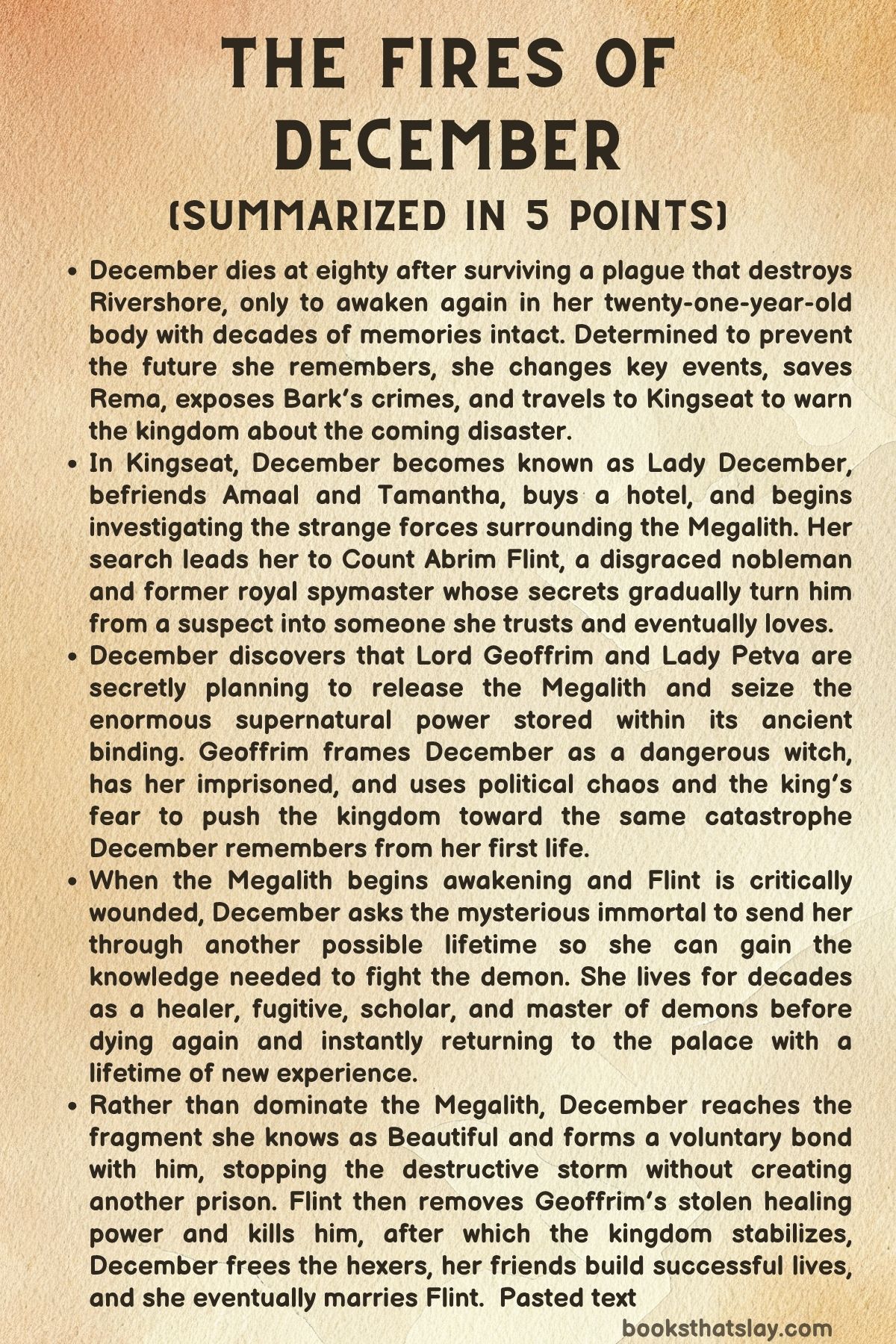
Summary
December is born in Rivershore at the end of a harsh winter. Her mother dies shortly after giving birth, her sailor father is absent, and December is eventually raised by an innkeeper’s family, growing into a reserved and observant young woman who never quite feels as though she belongs anywhere.
At twenty-one, pressure from the expectations of her community leads her to marry Bark, a miner she does not love. Their marriage becomes miserable when December proves unable to have children, and Bark eventually becomes violent toward her.
December leaves him and spends years in poverty while Bark discovers silver, becomes wealthy, and uses his growing influence to make her circumstances even harder. Eventually she approaches Matin, the widowed reeve of Rivershore, and proposes a practical marriage that offers both of them companionship and stability.
Life with Matin becomes the best period of December’s first existence. She grows deeply attached to his sons, finds intellectual purpose, becomes respected within the community, and experiences the closest thing to a loving family she has ever known.
That happiness ends when the demon-blood river becomes poisonous. A devastating plague follows, killing Matin, his family, and nearly everyone December knows, while she inexplicably survives.
December spends the remainder of her life helping the dwindling population of Rivershore. She finally dies at eighty, alone after decades of loss, only to awaken the next morning in her twenty-one-year-old body fifty-nine years earlier.
Her first decision changes history immediately. Remembering that Matin’s wife Rema died by choking on that particular day, December rushes to save her using medical knowledge learned much later in her original lifetime.
By saving Rema, December knowingly erases the future in which she married Matin and helped raise his children. She accepts the personal cost because she cannot justify allowing an innocent woman to die merely to restore the family she remembers.
December also refuses Bark’s marriage proposal and exposes him as the murderer of his former partner, Tap. She leads Matin to the hidden body and silver deposit, Bark accidentally reveals knowledge that proves his guilt, and he is executed.
The discovery gives December money and independence. More importantly, she realizes that changing history is possible, so she decides to prevent the war, poisoning, and plague that destroyed her first life.
She warns Matin about the disasters she remembers and asks for an introduction to the king. Soon afterward, she leaves Rivershore and travels upriver toward Kingseat.
During the journey, December meets Sister Amaal, a young priestess who becomes fascinated by December’s questions concerning the Megalith, the enormous demon whose blood forms the kingdom’s rivers. Amaal begins researching the Prophet, the ancient figure credited with defeating and binding the creature.
December also learns that the kingdom’s religious traditions have simplified the Prophet’s original teachings over centuries. Demons are not merely monsters in the traditional sense but fragments of larger supernatural entities whose relationships with humans are far more complicated than popular belief suggests.
A smaller catlike demon begins following December after she casually calls it beautiful. She does not initially understand that attention and description can strengthen demons, creating the beginnings of a supernatural bond.
At Duck Seat, December encounters Tamantha, a talented designer being abused and controlled by her brother. Recognizing patterns similar to those she witnessed in her own life, December uses the mistaken belief that she is a wealthy noblewoman to publicly patronize Tamantha’s designs.
The maneuver gives Tamantha enough status to escape her brother. She joins December as her lady’s maid and fashion adviser, while December gradually becomes known as “Lady December” despite having no noble birth.
December’s growing reputation becomes impossible to control. Her calm response to an attempted robbery aboard the Northern Eclipse only makes the stories about her more dramatic.
The robber escapes, but when December reaches Kingseat, rumors about the mysterious noblewoman have already preceded her. More seriously, the king has heard that she has been implying a royal connection and orders her to appear before him.
Kingseat is unlike anything December has experienced. The immense remains of the Megalith dominate the capital, and the creature’s blood is incorporated into transportation, commerce, entertainment, clothing, and everyday life.
People even bathe in the demon blood and emerge wearing temporary garments formed from designs held in their minds. December begins to understand that the Megalith is not merely a religious object but the foundation of the city’s culture and economy.
At court she meets King Beaudilog, General Drakes, finance minister Lord Geoffrim, and the king’s niece, Lady Petva. December initially invents a story about receiving prophetic knowledge because she fears the truth about her lost lifetime will sound impossible.
Geoffrim quickly uncovers her real background. When December finally tells him and Petva the truth, however, they become interested after she describes the mysterious white-haired stranger who visited Rivershore before her transformation.
Government officials have been tracking the same immortal traveler. Their interest intensifies when December learns that he recently arrived in Kingseat and was apparently murdered.
Geoffrim and Petva officially grant December the noble status that public rumor has already assigned her. They also tell her that Count Abrim Flint, a notorious nobleman associated with gambling, scandal, Duke Kird, and political unrest, is suspected of knowing something about the immortal.
December decides to investigate Flint herself. Her interest becomes much more personal when she sees him at a casino and recognizes him as the man who previously attacked her aboard the Northern Eclipse.
Rather than flee, she studies him. She discovers that Flint is intelligent, financially desperate, socially dangerous, and much more perceptive than his scandalous reputation suggests.
December attempts to seduce him into revealing information, but her inexperience makes the effort almost comically obvious. Flint recognizes the attempt immediately and begins teaching her how manipulation actually works.
Their exchanges gradually become genuine conversations. December discovers that she enjoys his intelligence and irreverence, while Flint becomes fascinated by the strange maturity of a woman who appears twenty-one but speaks and reacts as though she has already experienced a long life.
December follows Flint through Kingseat and discovers his connections to gambling schemes, hexers, and the supposedly murdered immortal. At the same time, she becomes increasingly attracted to him and increasingly doubtful that the public stories about him are accurate.
Her life in Kingseat also expands beyond her investigation. After discovering that her hotel manager mistreats Dmitrovik, a young worker from the streets, December buys the entire hotel and begins reforming its policies.
The purchase reflects a growing change in December. She is no longer merely trying to stop the destruction she remembers; she is beginning to create institutions and relationships worth preserving.
She eventually follows Flint into the interior of the Megalith, where he meets secretly with hexers. There she discovers that the supposedly dead immortal survived the destruction of his body as a living flame.
Flint has brought the immortal to the hexers in hope of helping him recover. December also learns that Flint is considering supplying demonstone to Duke Kird, an action that could contribute to the civil war she remembers from her first life.
When Flint discovers her spying, the two finally exchange secrets. Flint reveals that he secretly served as the kingdom’s Royal Minister of Espionage and that the king ordered him to assassinate the immortal.
Flint refused the order after understanding what his target was, although someone else apparently destroyed the immortal’s body. December, in return, tells Flint everything about her first lifetime.
Unlike almost everyone else, he believes her quickly. Their trust grows, and Flint agrees not to give demonstone to Duke Kird after understanding the disastrous future December witnessed.
Before they can act together, General Drakes arrests Flint. Soon afterward December learns that Geoffrim has concealed her warnings from other government officials.
Using a key Flint secretly gives her, December enters Geoffrim’s office and discovers the truth. Geoffrim has spent years studying how to release the Megalith, and December’s memories have convinced him that such a release is possible rather than frightening him away from the idea.
Geoffrim knows the Prophet’s binding will eventually weaken, but he has transformed a long-term danger into an excuse for immediate action. He believes that if he controls the release himself, he can control the consequences.
Lady Petva is his secret accomplice and a practicing witch. When she finds December searching the office, December is captured, framed as a dangerous witch, stripped of her title and property, and thrown into the palace dungeon.
Geoffrim reveals another layer of his plan while interrogating her. He wants the immense reservoir of power associated with the binding because it can heal its recipient, and Geoffrim himself is dying.
He tortures Flint to force December to reveal details about her future. She eventually gives him approximate dates, but once he leaves, December refuses to accept defeat.
The catlike demon she has named Beautiful answers her call. December learns that she has carried a fragment of demonic power since birth, apparently given to her by her mother, which explains her strange eyes and unusual resistance to supernatural forces.
With Beautiful’s help, she escapes and frees Flint. Their emotional honesty during the escape finally brings them together, and they acknowledge that their connection has developed into love.
December later separates from Flint so he can rescue Amaal, Tamantha, and Dmitrovik. She deliberately surrenders herself to the king under an old arrangement that allows witches to serve the crown rather than face execution.
She is sent to live with the hexers inside the Megalith. Their leader, Weonim, explains that the hexers control their bonded demons by compressing them into silent crystalline forms.
December is offered the same method for controlling Beautiful. Instead, she realizes that having absolute authority over another conscious being merely repeats the logic of imprisonment that has caused so much suffering.
She releases Beautiful entirely. The demon is astonished by an act of mercy it has never experienced.
December finally speaks directly with the recovering immortal, who confirms that her original lifetime was real even if it represented only one possible future. He also explains that the Prophet’s magical binding contains an enormous store of power governed by several passphrases.
Geoffrim wants that power partly because it can heal him. Although the Megalith’s binding is weakening, the immortal explains that the danger is not immediate enough to justify the reckless release Geoffrim has planned.
Events accelerate before December can stop him. Civil conflict erupts, the king is killed, and Geoffrim manipulates the crisis so that he appears to be the responsible official attempting to contain the disaster.
The Megalith begins awakening. Its scattered demonic fragments move toward its central consciousness, creating a destructive storm of heat and power.
Petva attempts to control the creature through witchcraft but is destroyed when her command fails. Flint attacks Geoffrim, whose stolen supernatural power instantly heals his injuries, and Geoffrim badly wounds Flint.
December realizes that she lacks enough knowledge to master the Megalith. Remembering that her previous lifetime gave her decades of experience in moments, she asks the immortal to send her through another possible life.
December then lives another full existence while almost no time passes in the palace. Flint dies, her friends are killed, civil war destroys the kingdom, and December spends decades studying demons while working as a healer and surviving as a hunted witch.
She eventually reaches cultures on the southern plains possessing sophisticated traditions concerning supernatural beings. Over many years she becomes a master Inspirer and learns how human will can influence demons without relying solely on brute force.
She also learns that the Prophet created three passphrases for transferring, removing, and dispersing the power stored in the Megalith’s binding. Eventually the fully restored Megalith finds her, removes the demon fragment she has carried since birth, and kills her at eighty-eight.
December instantly returns to the palace beside the still-living Flint, carrying decades of additional knowledge and grief. She enters the Megalith’s supernatural storm and discovers that she now has enough skill to dominate the creature.
Yet domination would merely replace one prison with another. Instead, she searches inside the immense entity for Beautiful, the individual fragment with whom she formed a relationship.
December offers the Megalith something entirely different from control. She asks it to bond with her voluntarily so that they can learn restraint, freedom, and mercy together.
Beautiful agrees, and the storm ends. Rather than destroying or enslaving the Megalith, December creates a mutual relationship in which neither side completely possesses the other.
Geoffrim still possesses the stolen healing power, however. December remembers the three passphrases and secretly tells Flint how to remove it.
Flint attacks Geoffrim once more and speaks the second phrase. The stored power transfers away from Geoffrim, leaving him mortal.
Flint kills him, ending the conspiracy. The kingdom survives, though December must now live with memories from several lifetimes that no one else experienced.
Beautiful remains bonded to her and begins learning how to live without surrendering either freedom or responsibility. Flint keeps the transferred restorative power, which slows his aging and gives him more time with December.
Duke Kird eventually becomes king, Matin becomes Minister of Finance, Amaal rises in the priesthood, Tamantha becomes a successful designer, and Dmitrovik helps manage December’s expanding hotel business. The hexers are freed from the restrictive system that previously controlled them.
The mystery of the immortal’s supposed murder receives an ironic solution: nobody successfully assassinated him. He accidentally entered a temple protected against beings like himself and destroyed his own body.
Two years later, December and Flint marry. Having lived through suffering, widowhood, motherhood, magical study, political upheaval, and several deaths, December finally reaches a moment she believes may be the happiest of all her lives, while also accepting that the future can still surprise her.
Characters
December
December is the emotional, philosophical, and narrative center of The Fires of December. Although physically returned to the age of twenty-one, she carries the memories, habits, grief, practical judgment, and emotional fatigue of a woman who has already lived to eighty, creating a constant tension between how the world sees her and who she knows herself to be.
Her defining quality is not supernatural power but accumulated perspective. December has experienced poverty, domestic violence, widowhood, motherhood, disease, civic responsibility, and loneliness, so she approaches danger with a patience that other characters repeatedly mistake for aristocratic confidence.
December’s decision to save Rema reveals her moral character more clearly than any later display of magic. Saving Rema destroys the possibility of recovering December’s own beloved family with Matin, yet she refuses to purchase personal happiness with another woman’s death.
That choice establishes her understanding of second chances. She does not see the altered timeline as permission to recreate the life she wanted; she sees it as a responsibility to prevent suffering where she can.
Her relationship with power develops throughout the book. At first she relies on money, reputation, social manipulation, and knowledge of the future, but each of those tools proves limited.
Her eventual mastery of demons therefore matters because she consciously rejects mastery as the final answer. After spending another lifetime learning how to dominate supernatural beings, she decides that forcing Beautiful into obedience would reproduce the same logic that trapped the Megalith for centuries.
December’s romantic development is equally significant. Bark represented possession without respect, while Matin offered security and companionship but remained emotionally connected to the wife he had lost.
With Flint, December finally enters a relationship built on attraction, intellectual equality, deliberate choice, shared vulnerability, and the ability to see each other without idealization. The Fires of December therefore presents her final romance not as a reward for suffering but as evidence that experience has taught her to recognize the difference between dependence, companionship, and mutual love.
December is also forced to confront the psychological cost of living several lives. By the final stages of the story, she has accumulated decades of relationships, deaths, studies, migrations, and identities that nobody around her remembers.
Her victory is therefore incomplete in an important way. She saves the kingdom, but she must still integrate the fosterling, abused wife, stepmother, widow, healer, hotel owner, witch, Inspirer, lover, and elderly survivor into one continuing sense of self.
Count Abrim Flint
Flint initially appears to represent almost everything December should distrust. He is a notorious gambler, seducer, disgraced nobleman, political troublemaker, suspected murderer, confidence artist, and the very man who once held a knife to her throat.
The novel gradually reveals that nearly every public description of him is incomplete. Flint genuinely lies, gambles, steals, manipulates, and makes dangerous choices, but many of his worst apparent crimes exist within the hidden work he performed as Royal Minister of Espionage.
His intelligence makes him particularly compatible with December. Unlike characters who dismiss her as either inexperienced or unstable, Flint immediately notices the contradictions within her personality and eventually accepts her impossible history with surprisingly little resistance.
Flint’s cynicism also conceals substantial moral boundaries. Ordered to assassinate the immortal, he refuses once he understands the nature of his target, and when December explains the future consequences of giving demonstone to Duke Kird, he changes his plans rather than defending them out of pride.
His relationship with Melsi shows both his failures and his capacity for self-judgment. He allows a relationship with a much younger woman to become intimate before recognizing that she partly sees him as a mentor and protector, and ending the relationship does not erase his responsibility for allowing it to develop.
Flint’s fear about loving December is similarly revealing. He worries about age, declining health, and eventually becoming dependent upon her, demonstrating that beneath his confidence lies a man deeply afraid of becoming a burden.
Within The Fires of December, Flint functions as a challenge to easy judgments about reputation. He is neither secretly innocent of everything nor secretly as corrupt as gossip claims; he is a compromised man whose better qualities become visible only when someone looks beyond the performance.
Sister Amaal
Amaal begins as an enthusiastic young priestess whose religious certainty often exceeds her worldly experience. Her fascination with the Prophet and the teachings of her monastery makes her invaluable to December, but her greatest development comes when reality refuses to fit the simple categories she has inherited.
She is talkative, energetic, scholarly, sincere, and frequently amusing because of the contrast between her religious position and the morally complicated situations surrounding December. Yet her enthusiasm is never presented merely as comic innocence, because she possesses genuine intellectual curiosity.
Amaal gradually discovers that institutional religion has altered, simplified, and sanitized aspects of the Prophet’s original teachings. Her response is not to abandon faith but to seek a more mature version of it.
Her friendship with December is also significant because she accepts revelations that challenge everything she understands about time, demons, prophecy, and divine authority. She becomes one of December’s most dependable companions precisely because her beliefs remain capable of growth.
By the ending, Amaal’s rise within the priesthood suggests that reform does not always require rejecting an institution from outside. Her experiences equip her to bring greater honesty and intellectual openness into the religious system itself.
Tamantha
Tamantha first appears as a gifted young designer trapped beneath the authority of an abusive brother. Her circumstances immediately resonate with December because both women understand how dependence can make exploitation seem unavoidable.
December helps Tamantha gain social recognition, but Tamantha is never reduced to a helpless victim. Once an opportunity appears, she chooses to leave, develops her own professional identity, and becomes one of the most practical members of December’s household.
Her expertise in fashion gives her genuine authority in a world December barely understands. Tamantha teaches December how clothing communicates status in Kingseat and later uses demon-blood fashion to establish herself publicly as a designer.
Tamantha also contributes to December’s rediscovery of youth. She encourages her to see her twenty-one-year-old body as something she is allowed to inhabit rather than merely a temporary shell carrying an elderly consciousness.
Their friendship therefore develops through mutual assistance rather than simple patronage. December helps Tamantha escape economic and emotional control, while Tamantha helps December participate more fully in the life she has unexpectedly regained.
Her eventual professional success is one of the clearest examples of the constructive side of December’s second chance. Preventing disaster matters, but enabling another person to build an independent future is equally important.
Beautiful
Beautiful begins as a catlike fragment of the Megalith and initially seems almost playful. December unknowingly strengthens him by repeatedly calling him beautiful, demonstrating that language and attention have concrete supernatural consequences in the magical system.
His morality initially differs profoundly from human morality. Beautiful is willing to accept enormous human casualties if destruction would produce freedom for the Megalith, and he struggles to understand why December considers other lives morally important.
Yet he is capable of desire beyond destruction. When December asks what he personally wants, Beautiful admits that he wants to become what she named him.
The defining moment in their relationship occurs when December discovers that she has the power to impose absolute control over him. Rather than using that authority, she releases him.
That act introduces Beautiful to mercy as something more than weakness. Later, after December acquires enough knowledge to dominate the entire Megalith, she again chooses cooperation rather than coercion.
In The Fires of December, Beautiful represents the possibility that nature does not have to function as destiny. His destructive instincts remain real, but December believes moral development can begin when a being is given both freedom and responsibility.
Their voluntary bond becomes the novel’s strongest alternative to systems based on domination. Neither participant becomes harmless or powerless; instead, they agree to influence one another without erasing identity.
Lord Geoffrim
Geoffrim is effective as an antagonist because his reasoning begins from a partially legitimate problem. The Megalith’s binding really is weakening, and eventually the kingdom will need a new solution.
His corruption begins when he converts that distant problem into justification for immediate personal control. Because he is dying, the healing power within the binding becomes inseparable from his political theories about necessity.
December initially responds positively to Geoffrim because his calm intelligence reminds her of Matin. That similarity makes his eventual betrayal especially disturbing.
Where Matin’s practicality existed alongside concern for others, Geoffrim allows rational calculation to consume empathy. Human beings become variables within plans whose success he believes will justify their suffering.
He is also skilled at narrative control. When the king dies and the Megalith begins awakening, Geoffrim immediately rearranges public perception so that responsibility appears to belong elsewhere while he presents himself as the person restoring order.
His greatest weakness is his conviction that intelligence grants moral authority. Geoffrim repeatedly assumes that because he sees risks more clearly than other people, he has earned the right to decide what everyone else must endure.
Ironically, his terror of dying causes him to die earlier than his illness would have killed him. The power he steals protects him only until December and Flint understand the mechanism well enough to remove it.
Lady Petva
Petva initially appears to be one of the more reasonable figures at court. She listens to December, participates in questioning her claims, and warns her about Flint, creating the impression that she is an intelligent political ally.
Her later revelation as Geoffrim’s secret collaborator changes the meaning of those interactions. Petva has spent years studying witchcraft and believes supernatural power can be controlled through sufficient knowledge and discipline.
Unlike Geoffrim, whose motivations include fear of illness and death, Petva appears more attracted to control itself. She believes preparation can overcome the dangers associated with commanding beings far beyond ordinary human strength.
Her death demonstrates the limits of that assumption. She succeeds briefly in influencing the emerging Megalith, but the scale of the being exceeds her abilities and destroys her.
Petva therefore serves as a dark parallel to December. Both women acquire relationships with demons, but Petva seeks command while December eventually chooses cooperation.
General Drakes
General Drakes initially appears as an intimidating military figure whose physical presence reinforces the power of the royal government. December later discovers that he possesses greater fairness and perceptiveness than she first assumes.
His willingness to defend aspects of Flint’s character is especially important. Drakes knows enough about Flint’s hidden service to recognize that public scandal cannot provide a complete account of the man.
He also reacts immediately when December reveals that Geoffrim has hidden critical information from the king. His response demonstrates loyalty not simply to an individual ruler but to the proper functioning of the government.
Drakes’s death becomes one of the turning points in Geoffrim’s rise. Once he is removed, the palace loses a powerful figure capable of organizing resistance.
Even after his death, however, his influence continues through soldiers who remain loyal to him. Those troops later assist Flint, showing that Drakes earned allegiance strong enough to survive him.
King Beaudilog
King Beaudilog is not portrayed as a monstrous ruler so much as a weak one. He occupies enormous institutional power without possessing the judgment, confidence, or emotional stability required to use it responsibly.
His initial dismissal of December’s warning reflects this weakness. Rather than seriously investigating an extraordinary claim, he allows court habits and existing assumptions to determine his response.
As political pressure increases, his fear becomes increasingly useful to Geoffrim. The finance minister manipulates concerns about Duke Kird, Drakes, Flint, and threats to the throne until the king begins making destructive decisions himself.
His willingness to consider the Megalith’s power arises from insecurity. Geoffrim does not need to command him directly because he understands how to make the king believe dangerous choices are his own ideas.
The king’s death becomes another demonstration of the dangers of authority without judgment. His position gives him access to forces he cannot understand, and that access allows Geoffrim to advance the release.
Matin
Matin represents one of December’s deepest emotional attachments across her different lives. In the original timeline, their practical marriage gradually becomes a stable partnership, and December becomes a devoted mother to his sons.
Their relationship is loving but imperfect. Matin offers respect, intellectual companionship, and family, yet part of him remains emotionally connected to Rema after her death.
December nevertheless values their years together profoundly. The fact that she willingly saves Rema and erases her own marriage to Matin demonstrates how much she has grown beyond treating personal happiness as something history owes her.
Later, when December encounters him in another possible lifetime, the emotional complexity becomes even stronger. He is simultaneously someone she knows intimately and someone who has never shared those memories with her.
His eventual rise to Minister of Finance provides a quiet confirmation that December did not need to recreate their marriage in order for his life to have meaning. Loving him ultimately means allowing him to belong to the life he actually lives.
Rema
Rema has comparatively little direct presence, but she is essential to the moral structure of December’s second life. Her survival is the first major consequence of December choosing to change history.
December could have allowed Rema to die and eventually attempted to reproduce her marriage with Matin. Instead she saves her immediately.
Rema therefore becomes a living symbol of the cost of doing the right thing. Every happy moment she later shares with Matin and their sons confirms that December’s sacrifice created something valuable even though December herself no longer belongs inside that family.
Bark
Bark represents the form of power December first learns to fear. He marries her when social pressure leaves her feeling unable to imagine a different future, then turns infertility into an excuse for resentment and physical abuse.
After December leaves him, wealth amplifies his cruelty. His silver discovery allows him to obtain political and social influence, which he uses to make her life harder.
The second timeline strips away that power before it can fully develop. December refuses his proposal, exposes his murder of Tap, and prevents his later wealth from becoming a weapon against her.
His removal early in December’s second life is significant because she no longer responds to him as the powerless young woman he once knew. Decades of memory allow her to recognize patterns she previously endured without understanding how to escape them.
The Immortal Narrator
The white-haired immortal occupies an unusual position because he is simultaneously a mysterious participant and eventually part of the narrative structure itself. His presence near December shortly before her transformation suggests that her second life is connected to forces far beyond Mountaincrest’s ordinary magical understanding.
His apparent murder becomes one of the central mysteries of the middle portion of the novel. The revelation that his body can be destroyed without permanently killing him expands the scale of the supernatural world.
Most importantly, he gives December validation that nobody else can provide. He confirms that her alternate lifetimes are not meaningless fantasies but genuine experiences within possible realities.
He also provides technical knowledge about the Prophet’s binding and eventually gives December another lifetime when she desperately needs decades of experience in moments. His abilities therefore make extraordinary intervention possible, but he never solves the central conflict for her.
Dmitrovik
Dmitrovik begins as a hotel worker whose social background causes others to underestimate him. December deliberately chooses him as her temporary footman because she recognizes useful intelligence beneath the assumptions attached to class.
He quickly proves skilled at gathering information and locating people in Kingseat. His knowledge of streets, servants, social networks, and informal communication makes him useful in ways polished aristocratic employees could not easily replicate.
December’s treatment of Dmitrovik also reveals her increasing awareness of her own unconscious prejudices. Having suffered from class judgment herself does not automatically make her immune to absorbing some of society’s assumptions.
His eventual role in managing December’s hotel enterprises completes an arc based on opportunity rather than rescue. Once given responsibility matching his actual abilities, Dmitrovik demonstrates that status had been hiding competence rather than measuring it.
Weonim
Weonim is the elderly leader of the hexers and represents a morally complicated response to danger. She treats December with genuine kindness and explains the system of demonic bonding without the cruelty December expects from her captors.
Her philosophy is based on survival. Because unrestricted relationships with demons have historically killed practitioners, Weonim believes suppressing demons into controlled crystalline forms is the responsible choice.
December understands the logic even while rejecting its consequences. Weonim therefore cannot be dismissed as simply oppressive, because she maintains the system partly from sincere concern for human life.
Her character exposes one of the story’s central difficulties: systems of control often survive because they offer real protection from real dangers. Replacing them requires something better than moral outrage.
Duke Kird
Duke Kird remains largely outside the immediate action but exerts considerable pressure on the political story. His forces and conflict with the crown create the possibility of civil war long before the Megalith is actually released.
Flint seriously considers supporting Kird because he believes the duke might govern more effectively than Beaudilog. December’s memories of the earlier timeline make her understand how quickly such political calculations can produce catastrophe.
Kird ultimately becomes king after the crisis. His accession suggests that political change itself was not necessarily the disaster December needed to prevent; the true danger was the combination of civil conflict, supernatural manipulation, and reckless ambition.
Melsi
Melsi, Duke Kird’s daughter, is most important through her relationship with Flint. Their affair becomes one of the scandals used to define Flint publicly and contributes to tensions between him and the duke.
The relationship also exposes Flint’s capacity for moral failure. As her espionage instructor, he occupies a position of experience and authority that complicates genuine consent and equality even after attraction develops between them.
Flint eventually recognizes the imbalance and ends the relationship. His regret does not erase what happened, but his willingness to acknowledge responsibility differentiates him from characters who turn wrongdoing into justification for further harm.
Brother Grund
Brother Grund appears during December’s second extended possible lifetime, when she spends decades attempting to understand demons. He shelters her at Amaal’s monastery despite her status as a hunted witch.
He also gives her access to forbidden writings that complicate the official interpretation of the Prophet’s teachings. Through these materials, December discovers that warnings against witchcraft were never meant as an absolute rejection of all supernatural practice.
Brother Grund therefore represents intellectual courage within religious tradition. His support helps December move from desperate experimentation toward disciplined understanding.
Although he belongs to a future that is later prevented, December remembers him fully. Like many people from her possible lifetimes, he remains emotionally real to her even when history erases the circumstances in which they met.
The Prophet
The Prophet exists throughout the story as both historical figure and misunderstood religious authority. Centuries of institutional interpretation have transformed his original teachings into cleaner, simpler doctrines that do not always reflect what he actually believed.
The later revelation that he was an offworld visitor rather than the divine figure imagined by popular religion does not make his moral influence meaningless. Instead, it separates wisdom from mythology.
His design of the Megalith’s binding also proves more sophisticated than later generations realize. The three passphrases demonstrate that he anticipated the need to place, remove, and disperse power rather than merely imprison it permanently.
Within The Fires of December, the Prophet represents the difference between inheriting rules and understanding why those rules were created. December succeeds partly because she eventually learns enough to move beyond simplified tradition without dismissing the experience that produced it.
Miss Greenwares
Miss Greenwares manages the hotel before December purchases it and embodies ordinary class prejudice rather than dramatic villainy. She assumes Dmitrovik’s poverty proves moral inferiority and believes respectable establishments should exclude people who do not fit accepted social categories.
December is particularly angered by this attitude because her own history includes illegitimacy, foster care, poverty, and social exclusion. Greenwares therefore forces December to recognize how easily institutions convert prejudice into routine policy.
Her departure allows the hotel to become one of December’s experiments in building a more humane society. Unlike the struggle against Geoffrim, this conflict is resolved through ownership, management, and changed rules rather than violence.
Themes
The Burden and Opportunity of Second Chances
Second chances in The Fires of December are never simple opportunities to correct mistakes. December’s return to youth gives her knowledge and power, but every alteration also destroys futures that were emotionally real to her.
Saving Rema illustrates this tension immediately. December prevents an unnecessary death but simultaneously erases the marriage, motherhood, and family that became the happiest part of her first existence.
Her later journeys through possible futures deepen the same problem. December gains decades of experience in moments, yet every new lifetime brings relationships, grief, communities, and identities that remain vivid after the timeline disappears.
The story therefore refuses the fantasy that perfect knowledge would make life easy. Knowing what happened once does not reveal exactly what will happen after circumstances change, because every intervention produces new people, motivations, accidents, and consequences.
December eventually learns that another life cannot be used merely to recreate an old one. Her responsibility is to make choices based on the people who exist now rather than treating the present as raw material for rebuilding what she lost.
By the ending, second chances become less about correction than expansion. December cannot undo suffering or recover every lost relationship, but she can use experience to respond with greater courage, mercy, and understanding when new choices appear.
Freedom, Control, and the Ethics of Power
Nearly every major conflict concerns the difference between possessing power and having the moral right to exercise it. Geoffrim believes knowledge and preparation justify releasing the Megalith, while Petva believes magical discipline gives her the right to control forces capable of destroying thousands.
The hexers present a more sympathetic version of the same issue. Their demons are genuinely dangerous, so compressing them into obedient crystalline forms offers safety, yet that safety depends on destroying another conscious being’s freedom.
December encounters the same choice personally with Beautiful. Once she learns that their bond allows her to impose absolute obedience, she possesses a form of control that could protect her completely.
Her decision to release him transforms their relationship. Later, when decades of training give her enough strength to dominate the entire Megalith, she again refuses to make coercion her permanent solution.
This does not mean the story presents freedom as the absence of restraint. Beautiful must still learn not to injure others merely because he has the ability or desire to do so.
The alternative is reciprocal responsibility. December allows Beautiful freedom while asking him to accept limits based on the existence and dignity of other beings.
Power therefore becomes ethical only when the powerful person acknowledges that ability does not create entitlement. December succeeds where Geoffrim and Petva fail because she ultimately seeks cooperation rather than ownership.
Identity, Age, and the Accumulation of Experience
December’s physical age and psychological age remain in conflict throughout the novel. She appears twenty-one but initially experiences herself primarily as an eighty-year-old woman temporarily placed inside a younger body.
This difference affects everything from clothing to romance. She finds fashionable outfits embarrassing, reacts to young adults with the instincts of someone decades older, and initially struggles to believe that enjoying her restored youth is morally or emotionally appropriate.
Tamantha helps her understand that the body she inhabits is still genuinely hers. Flint later complicates the problem because his older age makes their outward age difference socially unusual even though December internally possesses more lived experience than he does.
The theme becomes even more complex after December experiences another possible lifetime. She returns to the palace having accumulated many additional decades, forcing her to ask which version of herself should count as the real one.
The answer is never a single identity. December is simultaneously the abandoned child, abused wife, stepmother, widow, healer, business owner, lover, witch, elderly scholar, and young woman standing in the present.
Her challenge is not to select one self and discard the others. She must allow memory to enlarge her identity without letting previous lives make present happiness impossible.
Mercy as an Alternative to Domination
Mercy becomes the decisive moral principle of The Fires of December because it offers a response to conflict that neither denies danger nor assumes destruction is the only answer. December learns this principle through experiences in which she herself repeatedly suffers from people who believe control is justified.
Bark tries to control her through marriage and violence. Social hierarchy controls people such as Tamantha and Dmitrovik by restricting what futures they are permitted to imagine, while the kingdom controls hexers and demons by turning fear into institutional confinement.
December could easily reproduce these patterns once she becomes powerful enough to command Beautiful. Instead, she gives him freedom precisely when domination would be easiest.
That decision changes Beautiful because mercy introduces an experience he has no framework for understanding. He has known imprisonment, hunger, violence, desire, and destruction, but voluntary surrender of power creates the possibility of trust.
The final confrontation with the Megalith extends the same principle to an enormous scale. December possesses the knowledge necessary to force the creature into obedience, yet she understands that another prison would only continue the cycle.
Her mutual bond with Beautiful does not erase danger or guarantee permanent harmony. It establishes something more difficult: a relationship in which freedom survives alongside accountability, and compassion becomes a form of strength rather than surrender.