The Geomagician Summary, Characters and Themes
The Geomagician by Jennifer Mandula is a historical fantasy centered on Mary Anning, the famous fossil hunter of Lyme Regis, reimagined in a world where fossils can hold and shape magic. The novel blends scientific discovery, social reform, romance, and magical danger while keeping Mary’s struggle for recognition at its center.
She is brilliant, poor, stubborn, and blocked by institutions that refuse to take women seriously. When she discovers a living pterodactyl hatched from an ancient fossil egg, her life becomes tied to questions of power, faith, science, exploitation, and who gets to control knowledge.
Summary
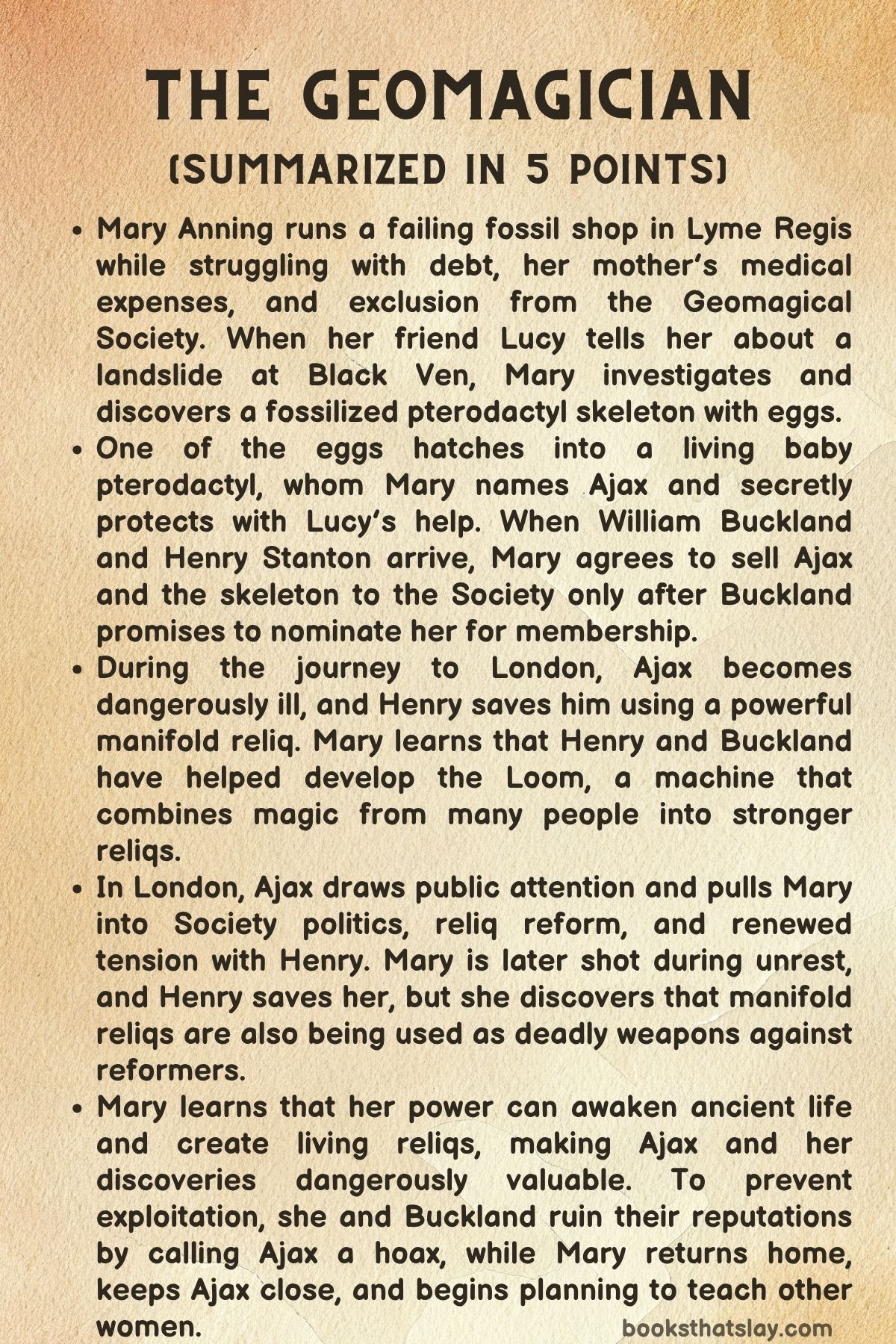
Mary Anning runs a fossil shop in Lyme Regis, but the business is barely keeping her afloat. Her fossils are not only scientific curiosities; in this world, they can be turned into reliqs, objects that store magic and power much of society.
Mary’s skill and knowledge are widely used, yet she remains excluded from the Geomagical Society because she is a woman. Her mentor, William Buckland, respects her work but still refuses to nominate her, hiding behind custom and the Society’s long history of keeping women out.
Mary’s personal pressures are severe. She is behind on rent, her mother’s medical care is costly, and she is angry that men with less practical knowledge receive opportunities denied to her.
In desperation, she nearly sells her own ammonite reliq, which contains precious magic, to a slicker. Slickers are part of the magical economy, buying and selling reliq power in ways that often exploit the poor.
Before Mary can make the sale, her friend Lucy Murray arrives with urgent news: a landslide has opened part of Black Ven.
Lucy is a witch and a Promethean reformer, committed to changing the unfair reliq system. She and Mary hurry to the cliffs during a storm, knowing that the landslide may have exposed important fossils.
The cliff face is dangerous, but Mary climbs anyway. Inside the unstable rock, she discovers hollow fossilized bones and a clutch of eggs.
Lucy uses magic to carve a tunnel, but the cliff partly collapses, trapping Mary for a short time.
In the tunnel, Mary realizes she has found the fossilized skeleton of a pterodactyl. More astonishingly, one of the eggs softens, cracks, and hatches into a living baby pterodactyl.
Mary uses the last of her ammonite reliq’s magic to extract the mother’s bones, then wraps the hatchling in cloth and escapes. She names the creature Ajax and hides him at Lucy’s cottage.
There, Mary and Lucy feed him, study him, and try to understand how something ancient and fossilized has returned to life.
Mary writes to Buckland, who arrives with Henry Stanton. Henry is now a wealthy and respected geomagician, but he is also Mary’s former childhood sweetheart.
Their reunion is strained. They once loved each other, but Mary believes Henry abandoned her years ago.
His return brings back hurt, suspicion, and feelings she has tried to bury.
Buckland and Henry examine Ajax and question Mary closely about the hatching. They test whether she has used sorcery, but she passes.
Buckland proposes an explanation that keeps the event within acceptable religious and scientific boundaries: Ajax was not raised from the dead by Mary but awakened from an ancient sleep ordained by God. Mary agrees to sell Ajax and the mother’s skeleton to the Society for a large sum, enough to change her circumstances.
In exchange, Buckland must nominate her for Society membership. Mary also insists on traveling to London with Ajax, Buckland, Henry, and Lucy rather than handing over her discovery and staying behind.
On the journey to London, Ajax becomes seriously ill. Henry saves him using a manifold reliq, an object far more powerful than ordinary reliqs.
Mary learns that Henry and Buckland have helped create a machine called the Loom. The Loom combines magic from multiple people into stronger reliqs.
Henry believes it could end dependence on slickers and create a fairer system where workers are paid properly. Lucy is far less convinced.
She fears the invention will strengthen the very structures that oppress poor magic workers and give the powerful even greater control.
In London, Ajax becomes a sensation. Mary is introduced to the Geomagical Society and drawn into its rivalries, ambitions, and political pressures.
Her discovery could secure her recognition at last, but it also makes her useful to people who want power more than truth. Henry’s research, Buckland’s hopes for the Society, and Lucy’s Promethean activism all pull Mary in different directions.
The political situation grows more dangerous as unrest builds around reliq reform. Prometheans protest the cruelty of the existing system, while authorities look for ways to control them.
During this turmoil, Mary is shot. Henry saves her life with a manifold reliq, proving again how powerful the new technology can be.
But Mary later learns something horrifying: Henry has also used a manifold reliq to kill attackers by stopping their hearts. Even worse, the government has already received manifold reliqs for use against Promethean demonstrations.
Mary’s trust in Henry becomes more fragile. He has defended the Loom as a tool for progress, but its power is already being turned toward violence and state control.
Lucy’s warnings begin to look justified. The question is no longer only whether the Loom works, but who will command it and who will suffer because of it.
As Mary uncovers more, she learns that her own abilities are central to the danger. She has a rare power connected to fossils and living creatures.
Ajax is not simply a miracle or an accident. The things Mary awakens can act as living reliqs, generating extraordinary amounts of magic.
This makes her discoveries far more valuable and far more dangerous than she understood.
Henry and Edgar Murray, Lucy’s brother and Henry’s collaborator, have known more than they admitted. They have hidden parts of the truth from Mary and used her discoveries in their research.
Their work has opened the door to terrible possibilities, including a huge resurrected creature and magical weapons with destructive force. Mary realizes that if the Society, the government, or ambitious geomagicians fully understand what she can do, they may use her and her creatures as sources of power.
Another truth also comes to light. Mary and Henry’s separation was not caused by simple abandonment.
Edgar intercepted their letters years earlier, making each believe the other had stopped writing. Their old heartbreak was manipulated by someone close to Henry and Lucy.
This revelation does not erase the harm Henry has done, but it changes Mary’s understanding of their past. The love they lost was not as false as she believed.
Faced with the risk of exposure, Mary and Buckland make a painful choice. To prevent Ajax and Mary’s power from being exploited, they agree to destroy their own credibility.
They present Ajax as a hoax and resign from the Geomagical Society. For Mary, this means giving up the recognition she has fought for all her life.
For Buckland, it means sacrificing professional standing. Yet both understand that protecting the truth may matter more than being honored by an institution willing to misuse it.
Mary also asks the archbishop to meet with Promethean leaders and confront the cruelty of the reliq system. She cannot solve every injustice herself, but she uses what influence she has to push those in power toward reform.
Her actions show that knowledge and magic cannot be separated from responsibility.
Mary returns to Lyme Regis changed. She closes her shop and tries to release Ajax back into the cave where she found him, believing he may belong to the ancient world he came from.
But she cannot abandon him, and he remains part of her life. Her bond with Ajax is not ownership; it is care, wonder, and responsibility.
Henry later comes to Mary’s doorstep with the stolen letters, proof that he had written to her all along. He also brings her a pterodactyl skull cast from Charles Lyell.
The gesture does not instantly repair their relationship, but it opens a small possibility. Mary allows him to return the next day, though only as far as the stoop.
She is not ready to forgive everything, and she will not surrender her independence.
By the end of The Geomagician, Mary turns away from the approval of institutions that have failed her. Instead, she begins writing to women who had asked her to teach them.
Rather than setting herself above them, she proposes that they learn together. Her future will not depend on permission from the Society.
It will be built through shared study, courage, and a new understanding of power.
Characters
Mary Anning
Mary Anning is the central character of the book, and her journey is built around ambition, injustice, scientific curiosity, and moral courage. At the beginning of The Geomagician, she is struggling financially, emotionally burdened by her mother’s medical needs, and professionally blocked by a male-dominated institution that refuses to recognize her talent.
Mary’s fossil shop is not just a business; it represents her knowledge, independence, and connection to the ancient world. Her anger toward William Buckland and the Geomagical Society comes from years of being useful to powerful men while still being denied equal status.
This makes her discovery of Ajax especially meaningful because it gives her the kind of undeniable evidence that should force the world to acknowledge her abilities.
Mary is also defined by her deep relationship with fossils and living creatures. She does not treat fossils merely as objects of profit or study; she senses their history and power in a way other characters cannot.
Her ability to awaken Ajax reveals that her gift is far greater than ordinary geomagic. However, this power also places her in danger because others want to interpret, control, or exploit what she can do.
Mary’s character becomes increasingly complex as she realizes that recognition from the Society may come at the cost of helping an unjust magical system grow stronger. Her decision to destroy her own reputation by presenting Ajax as a hoax shows her moral strength.
She chooses truth, safety, and reform over fame, money, and acceptance.
Mary’s emotional arc is equally important. Her relationship with Henry Stanton is shaped by old love, betrayal, misunderstanding, and lingering tenderness.
She believes he abandoned her, which makes his return painful rather than comforting. When she learns that their letters were intercepted, her anger does not vanish immediately, because the damage done to her life cannot be erased by a single explanation.
By the end of the book, Mary is not fully reconciled with Henry, but she allows the possibility of renewed trust. Her choice to begin writing to women who want to learn from her shows that she has moved beyond seeking approval from men and institutions.
She begins creating a new kind of community, one based on shared learning rather than exclusion.
Lucy Murray
Lucy Murray is Mary’s loyal friend, a witch, and a Promethean reformer whose political beliefs make her one of the book’s clearest voices of social conscience. Lucy is brave, practical, and deeply committed to challenging the cruelty of the reliq system.
She is not simply a companion to Mary; she actively shapes the story by warning Mary about the landslide, helping her reach the fossil cave, and using magic to protect and assist her. Her courage during the Black Ven discovery shows that she is willing to take real risks for both friendship and knowledge.
Lucy’s role is also important because she questions the moral consequences of magical invention. While Henry sees the Loom as progress, Lucy immediately understands how powerful technology can strengthen oppression when placed in the hands of governments and elites.
Her Promethean ideals make her suspicious of systems that profit from exploited workers, slicks, and unequal access to magic. Through Lucy, the book examines reform, labor injustice, and the dangers of allowing powerful people to decide what counts as progress.
Lucy is also emotionally significant because she offers Mary a space outside the Society’s judgment. Her cottage becomes a refuge where Ajax can be hidden, fed, and studied.
Unlike Buckland or Henry, Lucy does not view Ajax primarily as evidence, property, or a breakthrough. She sees the danger, wonder, and ethical responsibility involved.
Her connection to Edgar also makes her position painful, because her own brother becomes involved in secrets and experiments that betray both Mary and the ideals Lucy supports. This gives Lucy a personal stake in the conflict between reform and exploitation.
Ajax
Ajax, the baby pterodactyl, is one of the most symbolic figures in the story. Though he is not human, he functions as a living embodiment of wonder, danger, innocence, and power.
His hatching changes Mary’s life because he proves that fossils may contain more than ancient remains; they may hold sleeping life and magical possibility. Ajax’s existence challenges scientific, religious, and magical assumptions at once.
To Buckland, he becomes evidence of divine design. To Henry and Edgar, he becomes a clue to new sources of magical power.
To Mary, however, he becomes a living creature she feels responsible for.
Ajax’s vulnerability is central to his role in the book. He becomes ill on the journey to London, needs care, and depends on Mary’s protection.
This makes it impossible to see him merely as a discovery or specimen. His helplessness exposes the moral failures of those who want to use him for prestige, research, or power.
When Mary realizes that Ajax and other awakened beings could function as living reliqs, his importance becomes terrifying. He is not only a miracle; he is also something the powerful could turn into a weapon or resource.
Mary’s inability to abandon Ajax at the end reveals how deeply he has changed her. Releasing him would seem like the practical or ethical solution, but she cannot reduce him to a problem to be solved.
Ajax represents Mary’s bond with the ancient world and her refusal to treat living beings as tools. His presence forces the book’s characters to confront the difference between discovery and exploitation.
William Buckland
William Buckland is Mary’s mentor, ally, obstacle, and representative of institutional power. He recognizes Mary’s intelligence and relies on her abilities, but he also participates in a system that excludes her.
His refusal to nominate her to the Geomagical Society at the beginning shows his weakness and caution. He may respect Mary privately, but he initially lacks the courage to challenge public rules and traditions on her behalf.
This makes him frustrating because he understands her worth while still benefiting from the structures that deny it.
Buckland’s interpretation of Ajax as a creature awakened from a divinely ordained sleep reveals his religious and intellectual worldview. He tries to make the impossible acceptable by placing it within a framework of divine order.
This helps protect Mary from accusations of sorcery, but it also shows his instinct to control meaning through authority. He wants discoveries to fit into respectable institutions, approved theories, and public narratives.
His ambition is not purely selfish, but it is tied to reputation and status.
As the story progresses, Buckland becomes more morally complex. He eventually agrees to ruin his own reputation alongside Mary by presenting Ajax as a hoax.
This decision marks a major change in him. He finally chooses responsibility over prestige and protects the world from knowledge that could be misused.
His resignation from the Society shows that he is capable of sacrifice, even if he reaches that point later than Mary. Buckland’s character demonstrates how difficult it can be for people inside powerful institutions to act justly, even when they know the system is wrong.
Henry Stanton
Henry Stanton is one of the book’s most emotionally and morally complicated characters. He is Mary’s former love, a wealthy geomagician, and a man whose intelligence and ambition have drawn him into dangerous work.
His return brings back Mary’s old wounds because she believes he abandoned her. Henry’s presence is therefore charged with both affection and resentment.
He still cares for Mary, but his secrecy and involvement in the Loom make it hard for her to trust him.
Henry’s use of manifold reliqs reveals the contradiction at the heart of his character. He can be tender and protective, as seen when he saves Ajax and later saves Mary’s life, but he is also capable of terrifying violence.
His ability to stop attackers’ hearts with a reliq shows how easily protective power can become lethal force. Henry believes the Loom can improve society by replacing exploitative slicks and paying workers fairly, but his optimism blinds him to how governments and institutions will use such power.
He wants to be a reformer through invention, yet his inventions become tools of suppression.
His relationship with Mary is shaped by manipulation from others, especially Edgar’s interception of their letters. This revelation makes Henry more sympathetic because he did not simply abandon Mary.
However, the truth does not erase his later choices. He still hid important information about Mary’s abilities and participated in experiments that put others at risk.
By bringing Mary the stolen letters and the pterodactyl skull cast at the end, Henry shows remorse and a desire to repair what was broken. Mary allowing him only as far as the stoop is fitting because their relationship has hope, but not easy forgiveness.
Edgar Murray
Edgar Murray is one of the most damaging figures in the story because his betrayals are both personal and scientific. As Lucy’s brother and Henry’s collaborator, he is connected to characters who care deeply about reform and discovery, but he uses knowledge in secretive and manipulative ways.
His decision to intercept Mary and Henry’s letters changes the course of both their lives. By making each believe the other had abandoned them, he causes years of pain, mistrust, and separation.
Edgar’s role in the experiments also makes him morally dangerous. He helps conceal the truth about Mary’s unusual power and contributes to research that turns living magic into a possible weapon.
Unlike characters who hesitate or struggle openly with the ethics of their choices, Edgar seems willing to hide information when it serves his goals. His actions show how intellectual ambition can become cruel when separated from consent and accountability.
Edgar is especially significant because he betrays not only Mary and Henry but also Lucy’s values. Lucy’s Promethean reform work is based on justice and resistance to exploitation, while Edgar participates in systems that could create even greater oppression.
His character exposes the danger of people who claim to be building the future while ignoring the human cost of their methods.
Mary’s Mother
Mary’s mother represents the domestic and financial pressures that shape Mary’s choices. Her medical costs are one of the reasons Mary feels desperate enough to consider selling her own magic-filled ammonite reliq.
Although she is not at the center of the public conflicts involving the Society, her presence matters because she reminds the reader that Mary’s decisions are not abstract. Mary is not simply chasing recognition; she is trying to survive, care for her family, and keep her household from collapsing.
Through Mary’s mother, the book shows the burden placed on working women who must balance ambition with caretaking responsibilities. Mary’s financial anxiety is tied to love, duty, and fear.
Her mother’s illness makes Mary more vulnerable to exploitation because money becomes urgent. This helps explain why the offer for Ajax and the mother pterodactyl’s skeleton is so tempting.
Mary’s mother therefore deepens the emotional stakes of Mary’s struggle for independence.
The Slicker
The slicker who nearly buys Mary’s ammonite reliq represents the exploitative side of the magical economy. He appears at a moment when Mary is desperate, and his presence shows how easily people with money or connections can take advantage of those in need.
The reliq system depends on unequal exchanges, and the slicker embodies that imbalance. He does not need to be a deeply developed individual to matter; his function in the story is to reveal the pressure Mary is under and the predatory nature of the market around her.
His interruption by Lucy is important because it prevents Mary from giving up something deeply personal and powerful. The moment also shows the contrast between transactional relationships and genuine friendship.
The slicker sees Mary’s reliq as an opportunity, while Lucy sees Mary herself and pulls her toward action, discovery, and possibility.
Charles Lyell
Charles Lyell is a minor but meaningful figure in the book because his connection to the pterodactyl skull cast reinforces the scientific world surrounding Mary. The cast Henry brings from Lyell at the end serves as more than a gift.
It is a gesture of respect, memory, and attempted reconciliation. For Mary, fossils and casts are not decorative objects; they are tied to knowledge, recognition, and emotional history.
Lyell’s presence also suggests the wider network of scientific men whose names and resources carry authority. Mary’s work exists within this world, but she is not granted the same status within it.
The skull cast therefore reflects both connection and exclusion. It is valuable, but it also reminds the reader that Mary has often had to receive recognition indirectly rather than being fully welcomed as an equal.
Themes
Ambition, Exclusion, and the Cost of Recognition
Mary’s desire to join the Geomagical Society is not simple vanity; it comes from years of labor, discovery, and intellectual ability being dismissed because she is a woman. She knows fossils better than many recognized men, yet her knowledge remains unofficial because the institution protects its own traditions.
Buckland’s refusal to nominate her shows how exclusion can be disguised as caution, custom, or respectability. Mary’s struggle is made sharper by money: she is not only seeking honor, but survival, rent, medical care for her mother, and fair payment for work others profit from.
Her agreement to sell Ajax and the skeleton becomes a bargain for legitimacy, but London reveals that recognition from a corrupt institution may demand moral compromise. By the end of The Geomagician, Mary chooses truth and responsibility over public status.
Her resignation and ruined reputation become acts of resistance, showing that real authority may come from integrity rather than membership in powerful societies.
Magic, Industry, and Exploitation
The reliq system turns magic into a resource that can be bought, sold, stored, and controlled, which makes it closely tied to class power. Slicks exploit desperate people, while institutions and government officials benefit from magical labor without fully facing its human cost.
Henry presents the Loom as a solution because it could replace abusive slicks and pay workers fairly, but Lucy sees the danger more clearly: a more efficient system can still be oppressive if it remains controlled by the same powerful people. The manifold reliqs prove this risk.
They can heal Ajax and save Mary’s life, but they can also kill attackers and suppress demonstrations. The novel treats invention as morally unstable; technology itself is not evil, but it becomes dangerous when ambition, secrecy, and state power guide its use.
Mary’s discoveries are especially vulnerable because her living reliqs create immense power. The question becomes not whether magic can advance society, but who controls it and whom it harms.
Trust, Betrayal, and Hidden Truths
Mary’s personal relationships are shaped by missing information, half-truths, and deliberate manipulation. Her pain over Henry begins with the belief that he abandoned her, while Henry believes the same of her.
Edgar’s interception of their letters turns private love into years of resentment, showing how betrayal can damage lives without the victims even knowing its source. This pattern repeats on a larger scale.
Henry and Edgar conceal Mary’s unusual power from her, using discoveries connected to her without full consent. Buckland also frames Ajax’s hatching in a way that protects religious and institutional authority.
Trust becomes difficult because even people who care for Mary often decide what she should know. The emotional force of the story comes from Mary learning that affection does not excuse control.
Henry’s return with the stolen letters matters because it restores evidence, not just romance. Repair begins only when hidden truths are brought into the open and Mary is allowed to judge them herself.
Responsibility Toward Living Wonders
Ajax begins as a scientific miracle, a possible path to money, fame, and acceptance, but Mary’s bond with him changes the meaning of discovery. He is not merely a specimen, a reliq, or proof of a theory; he is alive, vulnerable, and dependent on her care.
This creates a moral conflict that runs through the story. The Society sees Ajax as evidence, Henry and Edgar see the magical potential in awakened life, and the government sees power that might be weaponized.
Mary gradually understands that naming, feeding, hiding, and protecting Ajax make her responsible for him in a way no institution can replace. Her attempt to release him back into the cave shows her desire to undo the danger surrounding him, but she cannot treat him as a problem to discard.
The theme also expands beyond Ajax: awakened creatures and fossils carry consequences that science alone cannot manage. Mary’s final turn toward teaching other women suggests a different kind of responsibility, based on shared learning rather than possession.