The Fox and the Devil Summary, Characters and Themes
The Fox and the Devil by Kiersten White is a dark supernatural mystery about Anneke Van Helsing, a forensic investigator haunted by her father’s death and the strange woman she believes caused it. Set across Europe in the years leading up to the 1900 Paris Exposition, the book follows Anneke as she confronts impossible crimes, hidden monsters, old family secrets, and the painful cost of truth.
What begins as a hunt for a suspected murderer grows into a larger battle against a creature that feeds on pain and uses human grief as its weapon.
Summary
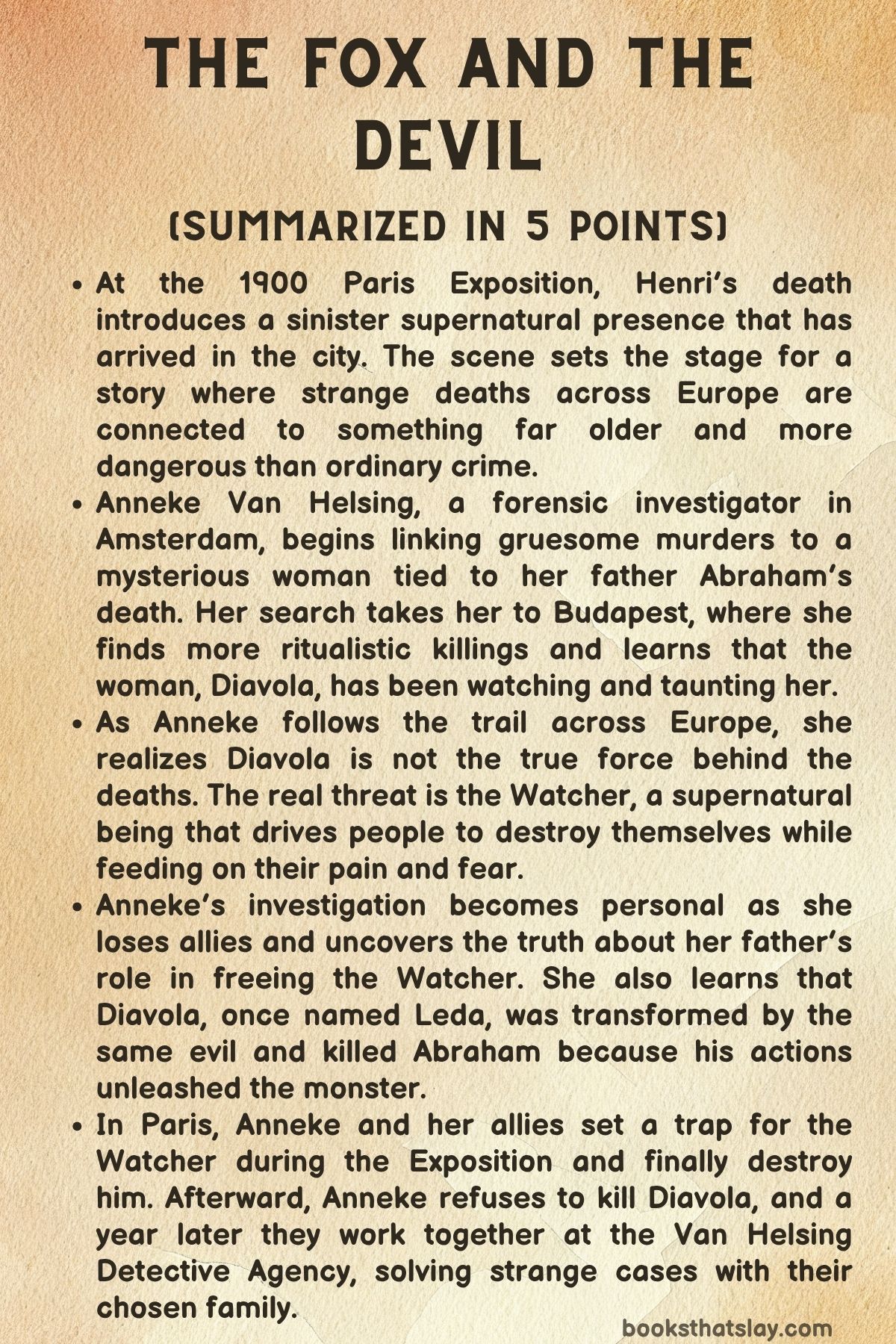
The Fox and the Devil opens at the 1900 Paris Exposition, where a schoolboy named Henri chooses excitement over routine and slips away to enjoy the fair. The great exhibition is full of marvels, crowds, and modern wonders, but the day turns deadly when a concrete ramp near the giant globe collapses.
Henri is trapped and crushed beneath the wreckage. As he dies, he sees something that does not belong among the smoke, dust, and panic: a smiling, inhuman presence that seems delighted not by the tragedy alone, but by its own arrival in Paris.
This brief moment sets the tone for a story in which public spectacle hides private horror, and the ordinary world is never as safe as it seems.
The story then moves back to Amsterdam in 1895 and introduces Anneke Van Helsing, a young forensic investigator with sharp instincts and a difficult family legacy. Anneke is called to examine a death so grotesque that it challenges any simple explanation.
A shipping clerk appears to have nailed himself to the floor, cut himself open, and tried to remove his own heart. The room has been arranged in a strange, deliberate way, as though someone wanted the scene preserved for photographs or moving pictures.
The violence is disturbing enough on its own, but what truly unsettles Anneke is the sense of performance around it. This is not merely death.
It is death staged for attention.
The scene awakens an older fear in Anneke. Five years earlier, her father, Abraham Van Helsing, died under circumstances everyone else accepted as suicide.
Anneke never believed that. She remembers seeing a mysterious woman standing over him as he died, and she has carried the certainty that this woman murdered him.
The new death in Amsterdam seems connected to that memory, especially because the signs around it feel too controlled, too theatrical, and too cruel to be random.
Anneke’s search draws her beyond Amsterdam when photographs sent by her former lover and fellow investigator Dávid lead her to Budapest. There, she finds another awful scene: a family murdered in what looks like an Egyptian-style ritual.
The details suggest obsession, symbolism, and a mind that enjoys turning death into a message. In one of the photographs, Anneke spots the same woman she saw at her father’s death.
That discovery confirms what she has feared for years. The woman is real, and she is still close to the violence spreading across Europe.
Anneke also meets Maher Idrissi, a photographer who has taken portraits of the same mysterious woman. Through these clues, Anneke learns that the woman calls herself Diavola.
Diavola begins leaving letters for Anneke, addressing her as “Little Fox.” The name feels mocking, but also oddly personal, as though Diavola sees Anneke not only as an enemy but as someone worth studying. Anneke tries to trap Diavola in a hotel, hoping to finally confront the woman she believes destroyed her family.
The plan fails. Diavola escapes, searches Anneke’s room, discovers what Anneke knows, and makes it clear that she can threaten the people around Anneke whenever she chooses.
Back in Amsterdam, Anneke works with her mentor Joren Van Engelenhoven, Joren’s daughter Inge, Dávid, Maher, and others to follow the pattern of horrifying deaths spreading across Europe. Each crime seems impossible in its own way.
Victims appear driven to commit unbearable acts against themselves or their families. Diavola’s letters keep appearing, sometimes cruel, sometimes admiring, sometimes almost protective.
Anneke begins to understand that the truth is more complicated than revenge against a single woman. Diavola may be present near the crimes, and she may be dangerous, but she is not necessarily the force causing them.
The real source of the deaths is another supernatural being, later known as the Watcher. This creature does not simply kill its victims.
It manipulates them through fear, pain, longing, and weakness until they destroy themselves or those they love. It feeds on suffering and turns human despair into a weapon.
Once Anneke accepts this possibility, the investigation shifts from criminal detection into a fight against something ancient and inhuman. For Anneke, this is especially difficult because she has built her life around facts, evidence, and the discipline of forensic science.
The Watcher forces her to accept that some truths cannot be explained by ordinary rules.
In Munich, Anneke investigates another family tragedy with Officer Berend. The case seems to involve death, grief, and madness, but it becomes far worse when Anneke discovers that the dead father is not truly dead.
The encounter turns disastrous. Berend is killed, and soon afterward Anneke learns that Dávid has also died.
These losses break through her professional control and leave her shaken. Dávid had been more than a colleague.
Their past relationship, their shared work, and the unresolved feelings between them make his death a wound Anneke cannot easily seal.
In her grief, Anneke turns to Abraham Van Helsing’s journals. Through them, she finally begins to accept the supernatural reality her father had known and tried to fight.
The journals lead her to Lesvos, where she uncovers the origins of Diavola. Diavola’s real name is Leda, and she was once human before an encounter with the Watcher transformed her.
Anneke also learns the painful truth about her father. Abraham was not only a victim.
In his desperation to restore his dead son Pieter, he freed the Watcher from imprisonment. Diavola killed Abraham because his actions had released a monster that would go on to cause many deaths.
This revelation changes Anneke’s understanding of nearly everything. The woman she has hated for years is not innocent, but she is not the simple villain Anneke imagined.
Diavola is both dangerous and damaged, shaped by the Watcher and by her own long history of survival. Abraham, whom Anneke mourned and defended, made a terrible choice out of grief.
The truth does not erase Anneke’s love for her father, but it forces her to see him clearly. It also makes her recognize that the fight ahead is larger than personal revenge.
Anneke returns home and reunites with her allies. Together, they form a group devoted to hunting the Watcher.
Their investigation eventually brings them to Paris in 1900, where the Exposition has become a perfect hunting ground for the creature. The fair gathers thousands of visitors, all eager for wonder, distraction, and spectacle.
Among its attractions is the House of Curiosity, where the Watcher has begun preying on people. In such a crowded place, fear and suffering can hide behind entertainment.
Anneke, Maher, Inge, and eventually Diavola prepare a trap using electricity and a steel cage. The plan depends on courage, timing, and trust among people who have all been wounded in different ways.
Diavola agrees to help, but she asks Anneke to kill her afterward. She believes she is too dangerous to be allowed to continue living.
Anneke cannot fully trust her, but she also cannot ignore the person beneath the monster.
The Watcher raises the stakes by capturing Inge, who is revealed to have her own supernatural nature: she can transform into a wolf. Anneke, Maher, and Diavola rush to save her.
In the final confrontation, the Watcher appears to Anneke as her father, using Abraham’s face and Anneke’s grief to try to control her. This is the creature’s greatest strength: it does not only attack the body; it reaches for the memories and losses people cannot bear.
Anneke resists. She refuses to let the Watcher use her love for her father as a chain.
The electrical trap weakens the Watcher, giving Anneke the chance she needs. She stakes him through the heart and destroys him.
The victory is not clean or easy, but it ends the creature’s reign of manipulation and suffering. Afterward, Diavola expects Anneke to keep her promise and kill her too.
Anneke refuses. She will not reduce Diavola to a monster, just as she has learned not to reduce anyone to a single act, a single wound, or a single role in her grief.
Instead, she persuades Diavola to keep living.
A year later, Anneke has built a new life in Amsterdam. She, Maher, Inge, Camille, and Diavola operate the Van Helsing Detective Agency, taking on strange cases and facing mysteries that ordinary investigators cannot solve.
Anneke still mourns Dávid, and the losses behind her remain real. Yet she is no longer alone in her work or in her understanding of the world.
She has found a chosen circle of allies, a new purpose, and an uneasy but meaningful partnership with Diavola. The Fox and the Devil ends with Anneke continuing forward, shaped by grief but not ruled by it, ready to face whatever darkness comes next.
Characters
Anneke Van Helsing
Anneke Van Helsing is the central figure of The Fox and the Devil, and her character is shaped by grief, intelligence, suspicion, and a fierce need for truth. As a young forensic investigator, she begins the story grounded in evidence, observation, and rational explanation, but the strange deaths she investigates gradually force her to accept that the world contains forces beyond ordinary human understanding.
Her father’s death is the emotional wound that drives much of her journey. She does not simply want justice for Abraham Van Helsing; she wants confirmation that her instincts were right and that the mysterious woman she saw was not a product of fear or trauma.
This makes Anneke both determined and vulnerable, because her search for answers is also a search for emotional closure.
Anneke’s greatest strength is her ability to look closely when others look away. She studies bodies, rooms, photographs, letters, and patterns with the patience of someone trained to notice hidden meaning.
Yet her intelligence is not cold or detached. She is deeply affected by the deaths around her, especially when people she knows and cares about are drawn into danger.
The losses of Berend and Dávid break through her professional control and reveal how much she has been carrying beneath the surface. Her grief does not weaken her permanently; instead, it changes her.
She becomes less dependent on denial and more willing to face frightening truths directly.
Her relationship with Diavola is one of the most important parts of her development in the story. At first, Anneke sees Diavola almost entirely through the lens of her father’s death and the horrifying crimes surrounding her.
Over time, however, Anneke learns that evil is not always as simple as it first appears. Her ability to reconsider Diavola shows emotional maturity and moral courage.
By the end of the book, Anneke is no longer only a daughter trying to solve her father’s murder. She becomes a hunter of mysteries, a protector of others, and a person capable of choosing mercy without becoming naïve.
Diavola / Leda
Diavola, whose true name is Leda, is one of the most tragic and morally complex figures in the book. She is introduced as frightening, elegant, manipulative, and possibly monstrous, especially because of her connection to Abraham Van Helsing’s death and the strange murders across Europe.
Her letters to Anneke, in which she calls her “Little Fox,” make her seem both threatening and intimate. She enjoys unsettling Anneke, but she also seems fascinated by her intelligence and resolve.
This mixture of danger, admiration, mockery, and warning makes Diavola difficult to understand at first, which is exactly what gives her character so much power.
As the story unfolds, Diavola becomes more than a villainous presence. Her past as Leda reveals that she was once a victim of the Watcher, transformed by an encounter with something inhuman and cruel.
This history does not erase the harm she has caused, but it complicates the way she should be judged. She is dangerous, but she is also someone who has suffered deeply and has been shaped by forces beyond ordinary human control.
Her killing of Abraham is not presented as a random act of evil, but as an act tied to his role in freeing the Watcher. This makes Diavola a character who exists in the gray space between monster, survivor, avenger, and reluctant ally.
Diavola’s desire for Anneke to kill her after the Watcher is defeated shows how much self-loathing she carries. She believes herself to be too dangerous to continue living, as if her monstrousness has completely consumed her identity.
Anneke’s refusal to kill her is therefore a major turning point. It allows Diavola to be seen not only as a threat, but as a person who can still choose what to do with her existence.
By the end of the story, her place beside Anneke suggests the possibility of redemption, companionship, and continued struggle rather than simple forgiveness.
The Watcher
The Watcher is the true supernatural threat at the center of the story, and its evil lies in manipulation rather than simple violence. Unlike a human murderer who acts through physical force alone, the Watcher feeds on suffering and turns people against themselves.
The victims do not merely die; they are driven into grotesque acts of self-destruction, making the Watcher’s cruelty psychological, spiritual, and bodily all at once. This makes it a terrifying antagonist because it attacks the mind before the body, using desire, grief, fear, and weakness as weapons.
The Watcher’s ability to appear in forms that manipulate its victims makes it especially dangerous to Anneke. When it appears to her as her father, it does not simply try to frighten her; it tries to exploit her deepest wound.
It understands that Abraham’s death has shaped her life and tries to use that grief to control her. This moment reveals the Watcher’s essential nature.
It does not create pain from nothing; it finds pain that already exists and twists it until the victim becomes trapped inside it.
As a symbol, the Watcher represents the danger of obsession, denial, and the refusal to let the dead remain dead. Abraham’s decision to free it comes from his desperate hope of restoring Pieter, and that choice unleashes terrible consequences.
The Watcher therefore stands not only as a monster but as a punishment for trying to bargain with grief. Its destruction by Anneke is significant because she defeats it by refusing illusion.
She does not accept the false image of her father, and by rejecting that manipulation, she breaks the emotional power it tries to hold over her.
Maher Idrissi
Maher Idrissi is an important ally whose role combines observation, artistry, courage, and emotional steadiness. As a photographer, he is connected to the visual evidence that helps Anneke follow Diavola’s trail.
His profession matters because the story repeatedly deals with images, staged scenes, appearances, and the difference between what is seen and what is true. Maher’s camera captures clues, but his character also shows that seeing clearly requires more than technical skill.
He is observant, thoughtful, and willing to stand beside Anneke as the investigation becomes more dangerous.
Maher brings a grounded warmth to the book. While Anneke is often driven by grief and urgency, Maher offers patience and loyalty.
He does not dismiss the strangeness around them, nor does he collapse under it. Instead, he adapts, helps, and remains present.
This makes him a stabilizing figure in Anneke’s life, especially after the deaths and revelations that shake her sense of reality. His courage is not reckless; it comes from commitment to the people around him and to the truth they are trying to uncover.
His connection with Anneke also suggests the possibility of healing after loss. He does not replace Dávid, and the story does not treat grief as something that can simply be erased.
Instead, Maher becomes part of the new life Anneke builds after tragedy. His presence at the Van Helsing Detective Agency shows that he is not merely a temporary helper in the investigation but a lasting companion in Anneke’s strange and dangerous work.
Inge Van Engelenhoven
Inge Van Engelenhoven is one of the most surprising characters in the story because she begins as someone connected to Anneke’s circle through family and friendship, but later proves to have a hidden supernatural nature. Her ability to transform into a wolf changes the reader’s understanding of her, but it does not reduce her to that ability.
Instead, it reveals that she too has been living with secrets, danger, and a divided identity. Like Diavola, she complicates the boundary between human and monster.
Inge’s capture by the Watcher raises the emotional stakes of the final confrontation. She is not just another victim in a pattern of supernatural violence; she is someone Anneke and the others know and love.
Her danger forces the group to act quickly and personally. Through Inge, the story shows that the supernatural is not always purely evil.
Her wolf nature may be frightening, but she is not defined by cruelty. This supports one of the book’s central moral ideas: monstrosity is not determined only by what someone is, but by what they choose to do.
Inge also represents belonging. By the end, she becomes part of the Van Helsing Detective Agency, suggesting that unusual or frightening identities can still have a place within a chosen family.
Her character helps expand Anneke’s world from one of suspicion and isolation into one where strange people can work together for good.
Joren Van Engelenhoven
Joren Van Engelenhoven serves as Anneke’s mentor and one of the important figures connecting her professional life to her emotional support system. He represents experience, guidance, and intellectual companionship.
His presence gives Anneke a foundation as she investigates deaths that become increasingly difficult to explain through ordinary forensic methods. In a story filled with uncertainty, Joren provides a sense of stability and continuity.
Joren is significant because he is not simply a background authority figure. He is tied to the network of people who help Anneke face the Watcher, and his daughter Inge’s hidden nature also connects him to the story’s larger supernatural world.
His role as a mentor suggests that knowledge is passed down not only through formal training but through trust, collaboration, and shared danger. Anneke’s work is her own, but Joren helps create the environment in which her skills can grow.
He also reflects the importance of chosen support after family loss. Anneke’s biological father is dead, and her relationship with Abraham is complicated by grief, mystery, and later revelations.
Joren cannot replace him, but he helps fill the space of guidance and care in Anneke’s life. His character gives the book a quieter emotional strength, showing that the fight against darkness depends not only on heroes, but also on those who teach, support, and remain steady.
Dávid
Dávid is a deeply important figure in Anneke’s emotional life, even though his role is marked by distance, history, and loss. As her former lover and fellow investigator, he represents a part of Anneke’s past that remains unresolved.
His photographs draw her to Budapest, making him essential to the movement of the investigation. Through him, Anneke is pulled more directly into the wider pattern of deaths and into Diavola’s orbit.
Dávid’s importance comes not only from what he does but from what he means to Anneke. Their past relationship suggests intimacy, trust, and perhaps pain that has never fully settled.
His involvement in the investigation reopens emotional territory for Anneke at the same time that the supernatural mystery deepens. When he dies, his loss becomes one of the major emotional blows that pushes Anneke toward transformation.
She can no longer treat the case as something separate from her heart.
His death also reinforces the cost of the hunt. The Watcher’s destruction is not an abstract victory; it comes after real people have been lost.
Anneke continues to mourn him even after building a new life, which makes her grief feel honest and lasting. Dávid remains part of her inner world, shaping her even after he is gone.
Abraham Van Helsing
Abraham Van Helsing is central to the emotional and moral structure of the story, even though he is dead for most of it. At first, he exists in Anneke’s memory as a murdered father whose death was misunderstood by others.
Her belief that he did not kill himself becomes one of the driving forces behind her search for truth. For Anneke, Abraham is not only a parent but a mystery, and solving that mystery becomes tied to her identity.
The revelations about Abraham complicate him significantly. He is not simply a victim.
His grief over Pieter leads him to free the Watcher, hoping the creature can restore his dead son. This choice makes him a tragic figure because his love and desperation produce terrible consequences.
He is not evil in the same way the Watcher is evil, but his refusal to accept loss allows evil to enter the world more freely. His actions show how grief can become dangerous when it seeks impossible solutions at any cost.
Abraham’s character also forces Anneke to grow beyond idealized memory. She must accept that her father was both loved and flawed, both victim and cause.
This is painful, but it gives her a fuller understanding of truth. By rejecting the Watcher when it appears as Abraham, Anneke symbolically refuses to be ruled by the past.
She honors her father not by believing an illusion, but by facing what he actually did.
Berend
Officer Berend plays a smaller but meaningful role in the story, especially during the Munich investigation. He represents the ordinary human world of law, procedure, and official duty entering a situation far beyond normal understanding.
His presence alongside Anneke shows how difficult it is for ordinary systems of investigation to survive contact with supernatural horror. He approaches the case as an officer, but the danger he encounters is not something conventional authority can control.
Berend’s death is important because it marks a turning point in the emotional weight of the story. His loss shows that the investigation is not simply strange or disturbing; it is deadly for those who come too close.
Anneke is forced to witness the consequences of the forces she is pursuing, and his death adds to the burden she carries. He becomes one of the people whose fate proves that the Watcher must be stopped.
Though Berend is not as central as Anneke, Diavola, or Maher, he helps demonstrate the widening impact of the supernatural threat. The Watcher’s violence does not remain confined to mysterious victims in distant cities.
It reaches into the lives of those trying to help, making courage costly and danger immediate.
Camille
Camille appears as part of the new life and team that forms after the Watcher’s defeat. While she is not as heavily developed as some of the central characters, her presence at the Van Helsing Detective Agency matters because it shows that Anneke’s work has become larger than one woman’s private quest.
The agency is a sign of continuation, collaboration, and purpose. Camille’s inclusion suggests that the fight against strange and dangerous mysteries will require a community rather than a lone investigator.
Camille also helps establish the story’s ending as one of renewal rather than simple closure. The Watcher may be destroyed, but the world remains full of unknown threats and unresolved mysteries.
By standing with Anneke, Maher, Inge, and Diavola, Camille becomes part of a chosen circle built around investigation and protection. Her role points toward a future in which the characters use what they have suffered to help others.
Pieter Van Helsing
Pieter Van Helsing is important despite his absence because his death is the grief that leads Abraham toward disaster. He functions as the lost child whose memory haunts the Van Helsing family and indirectly shapes the events of the story.
Abraham’s desire to restore Pieter is what leads him to free the Watcher, making Pieter’s death one of the hidden causes behind the suffering that follows.
Pieter represents the danger of grief that cannot accept finality. He is not responsible for Abraham’s choices, but his absence creates the emotional wound Abraham tries to heal through unnatural means.
In this way, Pieter’s role is symbolic as well as personal. He shows how love can become destructive when it turns into obsession and when the desire to undo death becomes stronger than moral judgment.
For Anneke, Pieter’s place in the family history also changes her understanding of her father. She must confront not only the mystery of Abraham’s death but also the grief that drove him before he died.
Pieter’s memory therefore deepens the tragedy of the Van Helsing family and connects personal loss to the larger supernatural conflict.
Henri
Henri appears at the beginning of The Fox and the Devil, and his death immediately establishes the danger and horror that will later be connected to the Watcher. He is an ordinary boy who skips school to enjoy the Paris Exposition, which makes his fate especially cruel.
His innocence and excitement contrast sharply with the violence of the collapsing ramp and the inhuman presence he sees as he dies.
Henri’s role is brief, but it is structurally important. Through him, the story begins with wonder turning into terror.
The Paris Exposition should represent progress, spectacle, and human achievement, but Henri’s death reveals that something monstrous has entered that world of modern marvels. His final vision of the smiling presence creates an atmosphere of dread before the story moves into the past to explain how that evil came to Paris.
As a character, Henri also reminds the reader that the Watcher’s victims are not only investigators, adults, or people connected to old supernatural histories. The danger reaches innocent bystanders as well.
His death gives the story an immediate moral urgency because it shows that the monster’s presence threatens anyone who crosses its path.
Themes
Grief, Memory, and the Need for Truth
Anneke’s life is shaped by a death she has never been allowed to understand. Her father’s supposed suicide becomes a wound that refuses to close because the official story contradicts what she saw with her own eyes.
This grief does not make her passive; it turns into a fierce need for evidence, pattern, and explanation. In The Fox and the Devil, memory becomes both a burden and a guide, because Anneke’s recollection of the mysterious woman keeps her from accepting easy answers.
Her investigation is not only about solving murders, but also about reclaiming the truth of her own past. The supernatural horror grows out of this emotional uncertainty: the dead do not simply disappear, and the past keeps forcing itself into the present.
By accepting the reality of what happened to Abraham, Anneke also accepts that grief cannot be cured by denial. Truth hurts her, but it also frees her from confusion and gives her the strength to face the Watcher.
The Danger of Obsession
Obsession drives many characters toward ruin, especially when love, guilt, or ambition becomes stronger than moral judgment. Abraham’s desire to restore his dead son leads him to make a terrible choice, freeing a force that spreads death across Europe.
His action shows how grief can become dangerous when it rejects limits and treats other lives as secondary. Anneke also risks being consumed by obsession, because her pursuit of Diavola begins as a personal mission tied to anger and loss.
Yet her obsession changes as she learns more. She moves from revenge toward responsibility, from wanting one figure punished to understanding the larger evil at work.
The Watcher feeds on weakness, pain, and desperation, which makes obsession one of his most useful weapons. People who cannot release what they crave become vulnerable to manipulation.
The story suggests that devotion without restraint can become destructive, but disciplined commitment can become courage. Anneke survives because she learns the difference.
Monstrosity and Moral Choice
The story questions whether a person or creature should be judged only by what they are, or by what they choose to do. Diavola appears at first as a terrifying figure connected to death, manipulation, and supernatural power.
Anneke’s early view of her is shaped by fear and the belief that she murdered Abraham without reason. As the truth emerges, Diavola becomes harder to define.
She has done frightening things, but she is also a victim of transformation, trauma, and survival. The Watcher, by contrast, represents a more complete form of evil because he uses suffering as food and treats human lives as tools.
Anneke’s final refusal to kill Diavola is important because it rejects a simple division between human and monster. She understands that danger is real, but she also sees pain, choice, and the possibility of change.
The theme argues that monstrosity is not only about appearance or power. It is revealed through cruelty, manipulation, and the refusal to value life.
Found Family and Shared Purpose
Anneke begins as someone marked by isolation, mistrust, and private grief, but her journey gradually builds a circle of people who choose to stand with her. Joren, Inge, Dávid, Maher, Camille, and even Diavola become part of a wider emotional and practical support system.
This matters because the evil they face cannot be defeated by one person acting alone. The Watcher thrives by separating people from reason, safety, and trust, so the group’s loyalty becomes a direct answer to his power.
Their bond is not simple or painless. They suffer losses, face fear, and carry secrets, but their shared purpose gives them strength beyond individual bravery.
Anneke’s new life at the detective agency shows that healing does not mean forgetting the dead or escaping danger. It means building something meaningful after loss.
The final image of the group working together turns survival into continuation. They are not untouched by horror, but they are no longer alone inside it.