The Fourth Wife Summary, Characters and Themes
The Fourth Wife by Linda Hamilton is a historical Gothic novel set in 1882 Salt Lake City, where faith, fear, marriage, and control shape a young woman’s life. Hazel Russon is twenty years old, sensitive, musical, and desperate for love and approval in a world that gives women few choices.
When she is pushed into becoming the fourth wife of the wealthy Jacob Manwaring, she enters a grand, decaying house filled with secrets. The story follows Hazel as she uncovers the truth behind her marriage, the haunted manor, and the women trapped inside it.
Summary
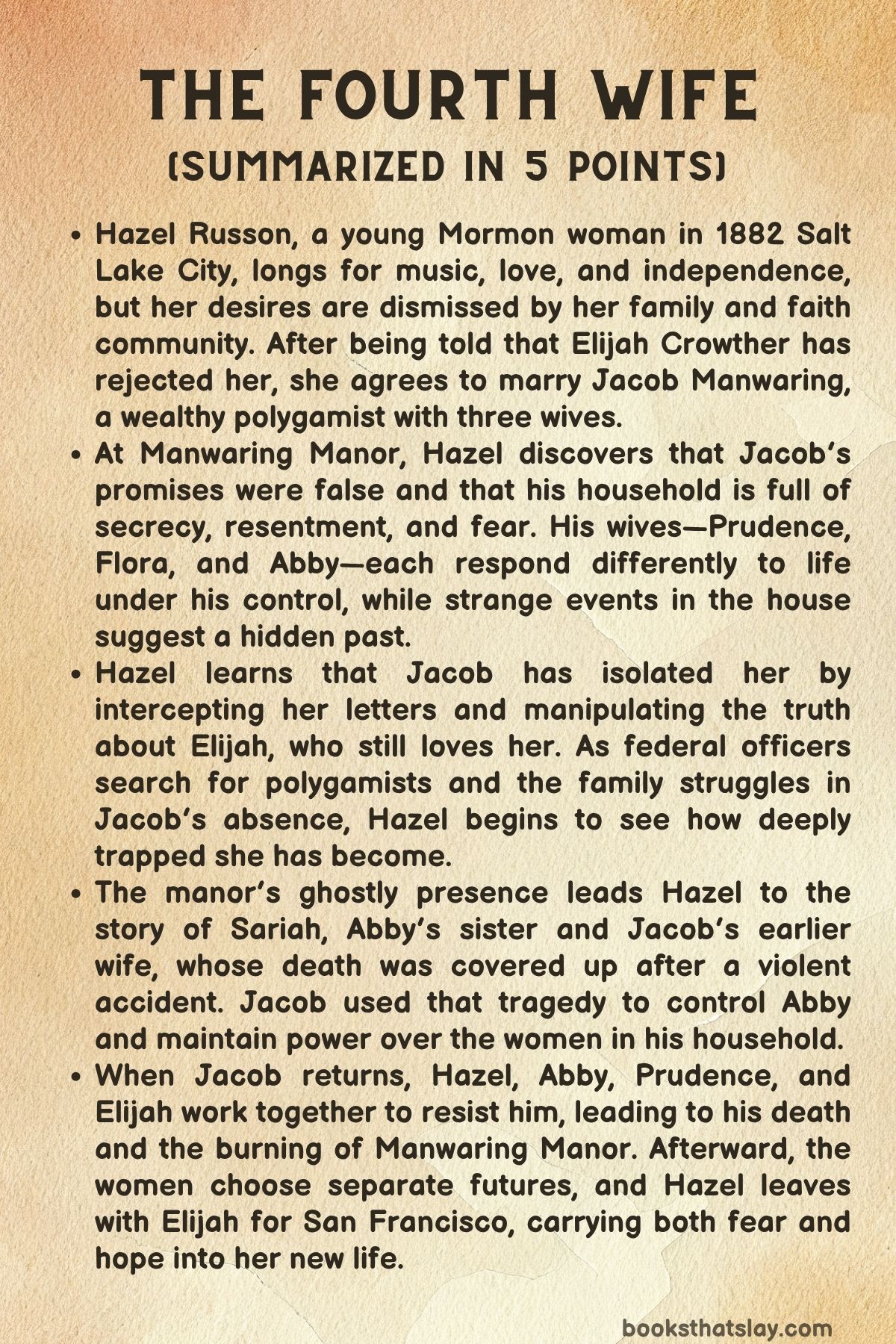
Hazel Russon lives in Salt Lake City in 1882, in a Mormon community where obedience is treated as a measure of faith. She is twenty years old and already feels out of place in her family and church.
Her household is tense, shaped by the pressures of plural marriage and strict expectations. Hazel is expected to be humble, useful, and willing to accept whatever duty is assigned to her.
But she longs for something more personal and private. She loves music, especially the piano, and imagines a life where that love matters.
To those around her, however, her dreams seem selfish and impractical.
Hazel also suffers from panic attacks, though her family does not understand them as illness or fear. They see her distress as a failure of spirit, a weakness she should overcome through prayer and obedience.
This leaves Hazel ashamed of herself and eager to prove that she can be good. Her one hope is Elijah Crowther, the young man she loves.
Elijah is away serving a mission in England, but Hazel believes they have promised themselves to each other. She holds on to that belief as proof that her future may still contain love.
That hope is destroyed when Elder Crowther, Elijah’s father, summons Hazel to speak with him. He tells her Elijah no longer intends to marry her.
According to him, Elijah has chosen the path of obedience and accepted plural marriage instead. Hazel is shocked and humiliated.
Before she can recover, Elder Crowther tells her that God has another plan for her. She is to marry Jacob Manwaring, a wealthy and respected Mormon man who already has three wives.
Hazel is devastated, but she has been taught to distrust her own desires. Hurt by the idea that Elijah has rejected her and desperate to be accepted as righteous, she agrees.
Two weeks later, Hazel marries Jacob. At first, he appears kind, charming, and attentive.
He speaks as though he values her and promises a better life. Hazel travels with him to Manwaring Manor, an enormous house on the edge of the valley.
The manor looks impressive from a distance, but close up it is worn, gloomy, and neglected. Hazel soon realizes that much of what she expected is false.
She will not have her own house. There is no piano waiting for her, though music means everything to her.
Most painfully, Jacob’s other wives did not know he was bringing home another bride.
Hazel meets the women who already belong to Jacob’s household. Prudence is pregnant, gentle, and kind.
She dreams of becoming a midwife and seems to understand more than she says. Flora is strict, severe, and devoted to order.
She believes survival comes through obedience and careful control. Abby, the third wife, is magnetic, unpredictable, and openly disrespectful toward Jacob’s rules.
She unsettles Hazel because she seems both dangerous and wounded. The household is not a peaceful family but a place full of resentment, grief, secrets, and fear.
As Hazel tries to find her place, the manor begins to disturb her. Lights appear where they should not be.
Furniture seems to shift. Hidden rooms reveal themselves.
Hazel hears a hymn being played on a piano, though Jacob insists no such piano exists. She also sees a ghostly woman who looks almost exactly like Abby.
The figure appears near the attic, Jacob’s study, and other forbidden places in the house. Hazel cannot decide whether she is losing her mind, being punished, or seeing something real.
The longer Hazel stays, the more she understands that Jacob is not the loving husband he pretends to be. He expects obedience and uses religion, affection, and fear to control the women around him.
When Prudence goes into labor, Jacob prepares to flee because federal officers are pursuing men involved in polygamy. Hazel is horrified that he would abandon Prudence during childbirth.
She challenges him, and his charm drops away. He threatens her with a letter she once wrote to Elijah, making it clear he can shame and control her if she resists.
Jacob leaves anyway, and Prudence’s baby is stillborn.
After Jacob’s departure, the women are left to survive in the decaying manor with little money, little food, and no clear protection. Grief hangs over the house, especially for Prudence, who must mourn her child while continuing to live under Jacob’s shadow.
Federal danger remains close. An officer visits the manor and threatens to return, reminding the women that the outside world is also unsafe.
Hazel begins to understand that marriage has not protected her. It has trapped her inside a system where men decide truth, duty, and punishment.
Then Elijah arrives at the manor under the name Brother Smith. He has come looking for Hazel.
His appearance changes everything she believed about her past. Elijah tells her he never rejected her and never chose to abandon their promise.
His father lied. Hazel learns that Jacob has been intercepting her letters, cutting her off from Elijah and from her own family.
The discovery is devastating. Her marriage was built not only on pressure and fear, but also on deliberate deception.
Hazel’s love for Elijah returns, but she remains sealed to Jacob and terrified of the spiritual and social consequences of leaving.
The hauntings grow stronger. Hazel and Abby begin to investigate Jacob’s study and the hidden parts of the house.
They find references to blood atonement and a mysterious black scripture book, suggesting that Jacob’s beliefs are darker and more dangerous than he admits. The ghostly woman continues to guide Hazel toward the truth.
Hazel first thinks the spirit is some strange reflection of Abby, but she eventually learns the woman’s name: Sariah.
Sariah was Abby’s sister and one of Jacob’s earlier wives. Through a vision, Hazel sees what happened years before.
Abby and Sariah were both married to Jacob, and their relationship was damaged by jealousy, rivalry, and Jacob’s manipulation. He set women against one another while keeping himself in control.
During a fight, Abby shoved Sariah. Sariah fell down the stairs and died.
Jacob covered up the death and used the secret to dominate Abby afterward. He made Abby feel that her guilt belonged to him, and that he could expose or punish her whenever he wished.
This truth changes Hazel’s understanding of the manor. The house is not simply haunted by a dead woman.
It is haunted by what Jacob has done to every woman inside it. Sariah’s spirit has remained because her death was hidden and because Jacob’s power continued after it.
Hazel also sees Abby differently. Abby is not only wild or cruel; she is a woman broken by guilt, fear, and years of being controlled.
When Jacob returns, the danger becomes immediate. He locks Hazel in his study, trying once again to isolate and silence her.
But Sariah’s spirit helps Abby free her. Hazel, Abby, Prudence, and Elijah understand that Jacob will not release them willingly.
Together, they form a plan to overpower him and end his control. Flora, though still attached to obedience and order, is also part of the household that must survive the consequences of Jacob’s actions.
The final confrontation is violent and chaotic. Jacob is killed, and Manwaring Manor catches fire.
As the flames spread, the house that has held so much fear and secrecy begins to collapse. Sariah’s spirit helps the women and children escape.
The burning of the manor becomes a release, not only from Jacob’s physical presence but from the hidden crimes and spiritual terror rooted in the house. Sariah is finally freed.
After the fire, Abby chooses disappearance. She leaves with her children and allows the world to believe she died in the flames.
This gives her a chance at a life beyond Jacob’s name and the guilt he used against her. Four weeks later, Hazel, Prudence, and Flora meet one last time.
Their lives are moving in different directions. Flora remains in Utah with her children, still tied to the world she knows.
Prudence leaves for the East to train as a midwife, claiming the future she once only imagined. Abby is secretly alive in Oregon.
Hazel prepares to leave with Elijah for San Francisco. Her future is uncertain, and she is still afraid, but her fear no longer rules her in the same way.
She has learned that obedience without truth can become a prison. She has also learned that love cannot be built on control, silence, or deception.
At the end of The Fourth Wife, Hazel steps away from Manwaring Manor, Jacob’s power, and the life chosen for her. She moves toward freedom with hope, pain, and the knowledge that she can finally choose for herself.
Characters
Hazel Russon
Hazel Russon is the emotional center of The Fourth Wife, and her journey gives the book its strongest sense of fear, longing, and gradual awakening. At twenty years old, she begins as a young woman shaped by obedience, religious pressure, family expectations, and the belief that suffering quietly is part of being righteous.
Her love of music shows that she has a private inner life that is richer than the role others assign to her. The piano represents beauty, independence, and self-expression, but those desires are treated as selfish by the people around her.
Hazel’s panic attacks also reveal how deeply trapped she feels, although the people in her life misread her distress as weakness rather than pain.
Hazel’s marriage to Jacob forces her into a world where nearly every promise made to her is broken. She believes she is entering a respectable household and fulfilling divine duty, but she quickly discovers that she has been manipulated, isolated, and used.
Her early need to be accepted makes her vulnerable, yet she is never simply passive. Even when frightened, she notices contradictions, questions Jacob’s authority, and slowly learns to trust her instincts.
Her relationship with the hauntings is especially important because it mirrors her own buried fear. As Hazel uncovers Sariah’s truth, she also uncovers the truth about her own life: that obedience without freedom can become a prison.
By the end of the story, Hazel becomes far stronger than the young woman who first arrived at Manwaring Manor. Her courage does not mean she loses fear; instead, she learns to act despite fear.
Her final decision to leave with Elijah for San Francisco suggests not just romance, but self-possession. Hazel’s freedom comes from rejecting the lies that controlled her, accepting the reality of what happened, and choosing a future that belongs to her.
Jacob Manwaring
Jacob Manwaring is one of the most dangerous figures in the book because his cruelty is hidden beneath charm, wealth, and religious respectability. At first, he appears affectionate and protective, especially to Hazel, but this surface kindness is part of his control.
He understands how to make women feel chosen, guilty, dependent, and afraid. His power does not come only from his position as a husband, but from the way he uses faith, secrecy, and social reputation to silence the women around him.
Jacob’s treatment of Hazel reveals his manipulative nature. He lies about Elijah, intercepts letters, hides important truths, and uses Hazel’s emotional vulnerability against her.
His household is not a family built on love, but a system built around his authority. Each wife is controlled differently: Prudence through gentleness and dependence, Flora through obedience and order, Abby through guilt and fear, and Hazel through isolation and spiritual pressure.
Jacob’s connection to the black scripture book and blood atonement deepens his role as a man who twists religion into a weapon.
His downfall is significant because it represents the collapse of the world he created. Jacob is not defeated by one person alone, but by the women whose lives he tried to control.
His death and the burning of Manwaring Manor symbolize the destruction of his authority, his secrets, and the fear that allowed him to dominate others.
Elijah Crowther
Elijah Crowther represents both Hazel’s lost hope and the possibility of a different future. For much of the story, he exists in Hazel’s mind as the man she believes abandoned her, which makes his return deeply important.
When he arrives under the name Brother Smith, he brings with him the truth that Hazel has been denied: he never rejected her, and the story used to push her into marriage with Jacob was a lie. His presence exposes the depth of the manipulation surrounding Hazel’s life.
Elijah is important not only as a romantic figure but also as a contrast to Jacob. Where Jacob controls through secrecy, Elijah seeks honesty.
Where Jacob treats Hazel as someone to possess, Elijah recognizes her feelings and choices. However, Elijah’s role is complicated by the world around him.
He has also been shaped by religious expectations and family authority, especially through his father. His love for Hazel matters because it gives her emotional support, but the story does not make him the sole source of her rescue.
Hazel’s growth remains her own.
By the ending, Elijah’s relationship with Hazel points toward renewal rather than simple escape. Their future in San Francisco suggests a movement away from the suffocating control of the manor and toward a life where Hazel may finally choose who she wants to become.
Elder Crowther
Elder Crowther is a major force behind Hazel’s suffering, even though he is not present throughout the entire story. His importance comes from the way he uses spiritual authority to redirect Hazel’s life.
By telling her that Elijah no longer wants to marry her and that God has directed her toward Jacob, he crushes her emotionally and pressures her into accepting a marriage she would not have chosen freely.
His character shows how authority can become dangerous when it is treated as unquestionable. Elder Crowther does not need physical force to control Hazel; he uses shame, obedience, and divine language.
Because Hazel wants to be righteous and accepted, his words carry enormous weight. His lie about Elijah is one of the central betrayals in the book because it separates Hazel from the person she loves and places her in Jacob’s power.
Elder Crowther also helps reveal that Hazel’s world is controlled not only by one cruel husband, but by a wider system of men who decide women’s futures while presenting those decisions as religious duty. His character is therefore essential to understanding how Hazel becomes trapped before she even reaches Manwaring Manor.
Prudence Manwaring
Prudence is one of the gentlest and most sympathetic characters in the story. As Jacob’s pregnant wife, she initially appears to be a figure of domestic patience and kindness.
She treats Hazel with more warmth than the others and gives the household a softer emotional presence. Her dream of becoming a midwife shows that she has ambitions of her own, even if they are quieter than Hazel’s desire for music.
Prudence wants to care for others, but she also wants a life with purpose beyond simply being one of Jacob’s wives.
Her stillbirth is one of the most painful events in the book because it exposes the emotional and physical cost of the household’s instability. Jacob’s decision to flee while Prudence is in labor reveals his selfishness and cowardice.
Prudence’s suffering also strengthens the bond among the women, because it becomes clearer that they cannot depend on Jacob for protection, compassion, or honesty.
By the end, Prudence’s decision to leave for the East and train as a midwife is deeply meaningful. She transforms grief into purpose.
Her ending suggests healing, independence, and the possibility of using her pain to help others. Prudence may be gentle, but she is not weak; her strength lies in endurance, compassion, and the courage to begin again.
Flora Manwaring
Flora is a stern and disciplined character who clings to obedience because it gives her a sense of safety. She is severe with Hazel and often seems more loyal to household order than to emotional truth.
However, Flora is not simply cruel. Her strictness comes from fear, training, and survival.
In a household ruled by Jacob, order becomes her way of coping with uncertainty. She has learned to live by rules because questioning them might mean facing the full horror of her situation.
Flora’s character shows how oppression can make people defend the very system that harms them. She believes in duty, hierarchy, and religious submission, partly because those beliefs give structure to her life.
Unlike Abby, who openly mocks and resists Jacob, Flora survives by obeying. This makes her frustrating at times, but also realistic.
Not every trapped person rebels in the same way, and Flora represents the kind of person who has buried her fear under discipline.
Her ending, where she remains in Utah with her children, fits her character. She does not pursue the same kind of freedom as Hazel, Prudence, or Abby, but she still survives the destruction of Manwaring Manor.
Flora’s future is quieter and more conservative, yet the burning of the manor still frees her from Jacob’s direct control.
Abigail “Abby” Manwaring
Abby is one of the most magnetic, unsettling, and tragic figures in The Fourth Wife. From Hazel’s first encounters with her, Abby seems unpredictable and dangerous, but her strange behavior is gradually revealed to be rooted in trauma.
She mocks Jacob and resists the household’s rules, yet she is also deeply wounded by guilt and fear. Her wildness is not madness in a simple sense; it is the result of living with a terrible secret that Jacob has used to control her for years.
Abby’s connection to Sariah is central to her character. The discovery that Sariah was her sister and Jacob’s earlier wife transforms the reader’s understanding of Abby.
Her guilt over shoving Sariah during their fight has trapped her emotionally, while Jacob’s cover-up has trapped her socially and spiritually. He turns her worst moment into a chain around her life.
Abby’s anger, sharpness, and instability are therefore signs of a person who has been punished endlessly for a tragedy that Jacob manipulated for his own power.
Her choice to disappear with her children is one of the boldest acts of self-preservation in the story. By letting the world believe she died in the fire, Abby escapes not only Jacob’s household but also the identity he forced upon her.
Her ending in Oregon suggests reinvention. Abby does not receive a perfectly clean redemption, but she receives something more complex: the chance to live beyond guilt.
Sariah
Sariah is the hidden wound at the heart of the story. Though she is dead for the main events, her presence shapes the atmosphere of Manwaring Manor and drives the mystery forward.
At first, she appears through ghostly signs: music, visions, hidden rooms, and strange movements within the house. These hauntings are frightening, but they are not evil.
Sariah is trying to reveal the truth that was buried with her.
Her life and death expose the darkest part of Jacob’s household. Sariah was not merely a ghostly figure or a secret from the past; she was a woman whose life was erased to protect Jacob’s reputation.
Her death came from conflict, jealousy, and manipulation, but Jacob’s response made the tragedy even worse. Instead of seeking truth or justice, he covered it up and used it to control Abby.
Sariah’s spirit therefore represents both the past demanding recognition and the silenced woman demanding to be seen.
When Sariah helps Hazel and the others escape, her role changes from haunting presence to liberating force. The burning of Manwaring Manor frees her spirit because the lies that trapped her are finally destroyed.
Sariah’s character shows that buried truth does not disappear; it waits until someone is brave enough to uncover it.
Themes
Control Disguised as Faith
In The Fourth Wife, religious obedience is often used as a tool for control rather than comfort. Hazel enters marriage with Jacob not because she freely chooses him, but because powerful men present the decision as God’s will.
Elder Crowther’s lie about Elijah and Jacob’s later manipulation of Hazel’s letters show how spiritual authority can be twisted to silence women and remove their choices. Jacob’s household depends on fear, secrecy, and the expectation that wives must submit even when they are unhappy or unsafe.
Flora’s strict devotion to order also reflects how deeply this control has shaped the women themselves; she has learned to survive by defending the very system that limits her. Hazel’s panic attacks are treated as moral failure, which further shows how emotional suffering is misunderstood when obedience matters more than truth.
The theme becomes powerful because faith itself is not presented as the enemy. Instead, the danger lies in people who use sacred language to justify selfishness, domination, and cruelty.
Women’s Search for Freedom
Hazel’s journey is shaped by her growing desire to own her life. At first, she wants acceptance so badly that she agrees to a marriage that hurts her, believing obedience may bring safety and belonging.
Yet the manor gradually teaches her that survival requires more than patience. Her love of music, her longing for Elijah, and her refusal to remain silent during Prudence’s labor all reveal a self that has never fully disappeared.
Prudence’s wish to become a midwife adds another form of freedom, one based on skill, purpose, and service beyond marriage. Abby’s rebellion is sharper and more dangerous, but it also comes from the same need to escape Jacob’s power.
Even Flora, though she chooses to remain in Utah, represents a different kind of endurance. The ending does not make freedom simple or painless.
Each woman chooses a separate future, and those choices matter because they come after years of being told that choice itself was sinful.
Secrets, Guilt, and the Past
The hauntings are not only frightening events; they are signs that buried truth cannot stay hidden forever. Manwaring Manor is filled with locked rooms, unexplained music, hidden objects, and half-spoken memories because Jacob’s household has been built on lies.
Sariah’s death is the central secret, but it is not the only one. Elijah’s supposed rejection, Hazel’s intercepted letters, Abby’s guilt, and Jacob’s false image as a respectable husband all create a world where appearances hide harm.
The ghostly presence forces Hazel to look beyond what she has been told and trust what she sees and feels. Abby’s guilt is especially important because Jacob uses it to keep her trapped, reminding her of the worst moment of her life so she will remain under his power.
When the truth finally becomes clear, it does not erase suffering, but it breaks Jacob’s control. The past must be faced before the women can leave it behind.
Sisterhood and Female Solidarity
The women begin as strangers placed in competition with one another, but their survival depends on learning to stand together. Plural marriage creates jealousy, suspicion, and unequal power, especially because Jacob controls information and affection.
Hazel enters the household as an unwanted fourth wife, and the others react with pain, anger, or guarded kindness. Over time, however, the women’s shared suffering becomes stronger than the divisions Jacob encourages.
Prudence offers gentleness and emotional warmth, Abby brings courage and knowledge of the house’s secrets, and Hazel grows into someone willing to act rather than simply endure. Even Sariah, though dead, becomes part of this female bond by guiding Hazel and helping the others escape.
Their unity is not perfect or sentimental; it is formed through grief, fear, conflict, and necessity. By the end, the women do not all choose the same path, but they help make one another’s futures possible.
Solidarity becomes the force that finally defeats isolation.