The Gilded Heiress Summary, Characters and Themes
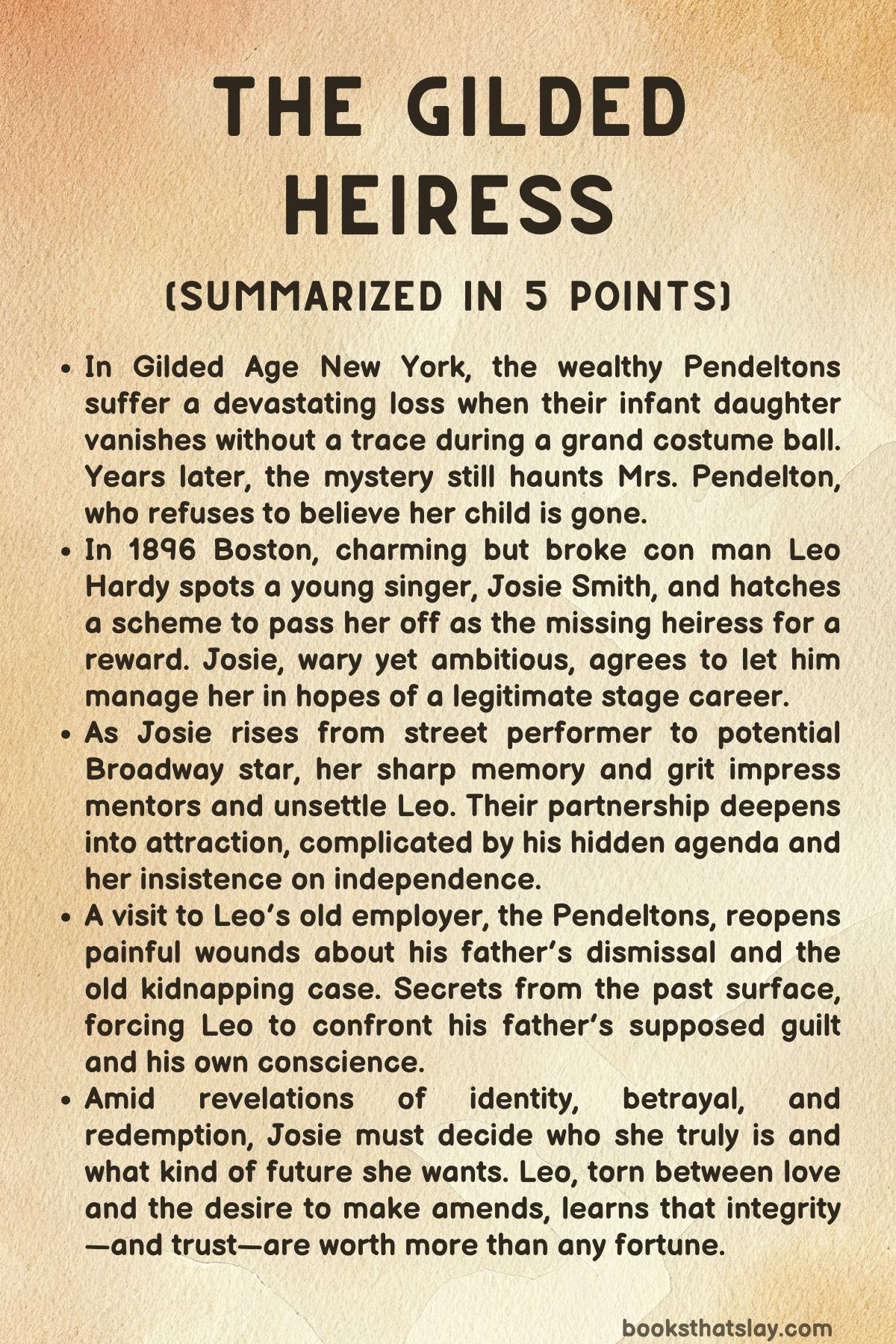
The Gilded Heiress by Joanna Shupe is a historical romance set against the opulent backdrop of Gilded Age New York and Boston. The novel follows Leo Hardy, a charming con man burdened by poverty and family duty, and Josie “Smith,” a talented young singer with a mysterious past.
When Leo realizes Josie might be the long-lost Pendelton heiress, he sees an opportunity for fortune—but his plans soon collide with conscience and love. Through deception, ambition, and rediscovered identity, Shupe paints a vivid portrait of two outsiders struggling for redemption and belonging in a world ruled by class and appearances.
Summary
The story begins in October 1878 at the lavish Fifth Avenue mansion of the Pendelton family. Their grand costume ball ends in tragedy when Mrs. Pendelton discovers her twenty-two-month-old daughter, Joséphine, missing from the nursery. A ladder by the window and clueless nursemaids suggest kidnapping, but despite police and media frenzy, no ransom arrives.
Months turn into years, and though Mr. Pendelton eventually gives up hope, Mrs.
Pendelton never stops believing her daughter is alive.
Eighteen years later, in Boston, Leo Hardy—a charming yet struggling con man—scrapes by with street scams to support his widowed mother and five sisters. His resentment toward the Pendeltons runs deep; his father, their former gardener, was unjustly fired after the kidnapping, sending the family into hardship.
When Leo spots a young blonde street singer, Josie “Smith,” he notices her refined features and begins to suspect she could be the missing Pendelton daughter. Seeing a chance for revenge and reward, he plans to train her as a lady, present her as the lost heiress, and claim the prize money.
Josie, an orphan raised in the Boston Children’s Asylum, survives by singing in streets and taverns. When Leo approaches her with promises of fame and fortune, she is skeptical but intrigued.
She negotiates a business partnership, demanding proof of his sincerity before trusting him. Through persistence and audacity, Leo secures an audition for her with famous actress Lotta Crabtree.
Josie’s raw talent impresses Lotta, who offers her guidance and a letter of introduction to a powerful Broadway producer, Melvin Birdman.
Lotta also warns Leo to keep his relationship with Josie professional. However, as Leo and Josie travel together, their growing attraction complicates matters.
Josie’s intelligence, quick wit, and perfect memory—she can recall conversations word for word—fascinate him. Their journey includes etiquette lessons from Leo’s friend Martha Stockwell, a madam who helps refine Josie’s manners and wardrobe.
Amid lessons, flirtation, and quarrels, Josie begins to see Leo’s hidden decency, while he struggles with guilt over his deceptive plan.
When a violent incident at Martha’s brothel reveals Leo’s fiercely protective side, Josie realizes he is more than a charming schemer. They continue to New York, where Leo hides his discomfort with returning to the city that holds painful memories.
Josie quickly attracts attention by singing on the streets, drawing crowds, and angering Leo, who fears exposure. Their arguments turn personal and emotional, fueled by jealousy and unspoken desire.
Leo’s resentment toward the Pendeltons drives him to visit their decaying estate, once tended by his father. He learns that Mrs. Pendelton still grieves the lost child, reinforcing his determination to use Josie to reclaim what he feels his family was denied. When Josie insists on equal partnership, he reluctantly agrees.
Her audition for Melvin Birdman proves her natural brilliance—Melvin renames her “Joséphine” and offers her a contract.
As Josie’s career begins, her bond with Leo deepens. They share confessions about their pasts—her abandonment, his family’s disgrace—and their differences seem to fade.
During a day in Central Park, they fend off a thief, and their mutual admiration ignites into passion. Though Leo pulls away afterward, their connection grows undeniable.
Their visit to the Pendelton estate reopens old wounds. Leo introduces Josie as a potential performer for charity, but when they are recognized by an old groom, Freddie, the past resurfaces.
Freddie reveals that years earlier, evidence surfaced implicating Leo’s father in the kidnapping. Devastated, Leo realizes the false accusations led to his father’s ruin and death.
Seeking solace, he and Josie hide in an abandoned carriage house, where grief turns into intimacy. They share a night of passion, each overwhelmed by emotion and love they can’t fully admit.
Leo’s guilt intensifies—he started this scheme for revenge but now loves Josie sincerely. When they return to New York, Josie meets Leo’s old partner Ambrose, who hints at Leo’s past cons.
Suspicious, Josie questions Leo, who admits his criminal history but claims he’s changed. Determined to prove it, Leo investigates his father’s case, stealing an old letter from a retired detective that framed his father as the nursemaid’s lover and accomplice.
He vows to clear his father’s name and expose the truth.
Eventually, Leo and Josie are summoned to the Pendelton mansion. There, Josie learns that Mrs.
Pendelton recognizes her childhood toy—a stuffed rabbit—as her daughter’s. Investigations confirm that Josie is indeed the long-lost heiress.
Stunned, Josie reunites with her parents, who are overjoyed but cautious about her performing career. While her father is gentle, her mother pushes her toward refinement and away from the stage.
Amid this reunion, Ambrose resurfaces and deceitfully claims credit for reuniting Josie with her parents, collecting the $100,000 reward. Furious, Josie exposes him as a liar.
Meanwhile, Leo confronts Ambrose and orchestrates an elaborate ruse involving fake diamonds to recover the stolen money. He then returns the entire reward to the Pendeltons, confessing his involvement and proving his integrity.
Josie confronts Leo about his decision to give up the fortune. He insists it’s the right thing to do—that neither he nor Ambrose deserve the money—and prepares to leave her life to protect her reputation.
His honesty, however, only deepens Josie’s love. When she visits him in Boston with her father, she confesses her feelings and insists she still belongs with him, not just as the Pendelton heiress but as the woman he helped her become.
Moved, Leo proposes marriage, and she accepts, demanding that his family and her friend Pippa join them in New York.
Six months later, Josie—now Mrs. Leo Hardy—is performing in a hit Broadway show, The Girl from Paris.
Her marriage thrives alongside her growing fame. Leo, now a respected theatrical manager, surprises her with a birthday party attended by both families.
Surrounded by love and success, Josie reflects on how far they’ve come—from an orphan and a con man to partners in life and ambition. Their story closes on a note of triumph and affection, proving that even in a world obsessed with wealth and status, love and integrity can outshine gold.
Characters
Joséphine “Josie” Smith (Pendleton)
Josie is the emotional and moral center of The Gilded Heiress, a woman who begins her life as an orphan with no memory of her past and rises to become a celebrated performer—and, ultimately, the rediscovered daughter of a wealthy family. Her character journey is one of self-discovery, integrity, and resilience.
From her early days singing on Boston’s streets, Josie demonstrates fierce independence and intelligence. Her eidetic memory, allowing her to recall conversations word for word, symbolizes her control in a world that has often denied her agency.
Despite her humble origins, she possesses innate poise and determination, which draw others to her and mark her as extraordinary long before her true identity as the missing Pendelton heiress is revealed.
Throughout the story, Josie’s relationship with Leo Hardy serves as both a catalyst and mirror for her growth. Initially cautious and distrustful, she learns to balance self-protection with vulnerability.
Her interactions with Leo—marked by wit, emotional honesty, and eventual passion—show her evolution from a guarded orphan to a woman who claims both her voice and her destiny. When Josie learns of her true parentage, she faces the ultimate test of identity: reconciling the gritty realism of her upbringing with the expectations of high society.
Rather than surrendering to wealth or propriety, Josie retains her core self—a symbol of authenticity in an age obsessed with appearances. Her final triumph, as both performer and woman in control of her future, solidifies her as one of Joanna Shupe’s most dynamic heroines.
Leo Hardy
Leo Hardy is a compelling study in contradiction: charming yet wounded, cynical yet deeply moral beneath his deceptions. A born survivor from Boston’s impoverished streets, Leo’s early life shaped him into a con artist, driven not by greed but by necessity.
Supporting his widowed mother and sisters, he learned to manipulate others through wit and confidence. Yet beneath this veneer lies a man tormented by his father’s unjust fall from grace after the Pendelton kidnapping.
His resentment toward the wealthy Pendeltons fuels his initial scheme to use Josie for revenge and financial gain, but as he grows closer to her, the grifter’s mask begins to crack.
Leo’s development is one of redemption through love. His attraction to Josie evolves into genuine respect and devotion, challenging his self-image as a man beyond salvation.
Each encounter with her exposes the depth of his conscience and his yearning for dignity. His moral turning point arrives when he refuses the Pendeltons’ money and later exposes Ambrose’s deceit, proving he values honor over profit.
By the novel’s end, Leo transforms from a man defined by circumstance into one defined by choice—a partner worthy of Josie’s affection and trust. His journey reaffirms the idea that integrity, not birthright, determines true nobility.
Mrs. Pendelton
Mrs. Pendelton represents the enduring ache of maternal loss and the class divide that drives much of The Gilded Heiress.
Her unwavering belief that her kidnapped daughter is alive shapes her entire existence. In contrast to her husband’s resignation, Mrs.
Pendelton’s faith borders on obsession, manifesting in both dignity and quiet despair. When Josie reenters her life as the grown version of her missing child, Mrs.
Pendelton’s initial composure gives way to joy tempered by guilt—for misjudging the Hardy family and for years lost.
Her interactions with Josie also expose the rigid expectations of upper-class womanhood in Gilded Age New York. Mrs. Pendelton pressures her daughter toward refinement and conformity, struggling to accept Josie’s independent spirit and devotion to the stage. Yet beneath her social poise, she is deeply compassionate and perceptive, recognizing the courage that sustained Josie through hardship.
Her gradual acceptance of Josie’s identity as both heiress and performer marks her transformation from a grieving mother into a woman who finally understands that love transcends class and decorum.
Mr. Pendelton
Mr. Pendelton embodies the restrained, pragmatic patriarch of the Gilded Age—powerful in public yet emotionally reserved at home.
His reaction to his daughter’s disappearance contrasts sharply with his wife’s perseverance: where she clings to hope, he succumbs to cynicism, channeling his pain into work and wealth. His decision to falsely implicate his gardener, Steven Hardy, becomes the moral failing that ripples across generations, shaping Leo’s bitterness and setting the stage for the novel’s central conflicts.
When confronted with the truth, Mr. Pendelton redeems himself through humility.
His apology to Leo and restitution offer, though rejected, symbolize a man struggling to reconcile justice with guilt. His relationship with Josie after her rediscovery is tender yet cautious—marked by fear of losing her again.
Ultimately, he becomes a quieter moral compass, illustrating that atonement, not authority, defines a man’s legacy.
Ambrose Lee
Ambrose Lee is Leo Hardy’s shadow—a reflection of what Leo might have become had he never found redemption. A fellow grifter and former partner in crime, Ambrose represents the temptations of greed, cynicism, and moral decay that constantly threaten to pull Leo backward.
Charming, manipulative, and ruthlessly pragmatic, Ambrose views relationships as transactions. His betrayal—stealing the Pendelton reward money—serves as both a narrative climax and a moral test for Leo.
Ambrose’s presence underscores the theme of moral duality that runs through the novel. Where Leo seeks truth and self-forgiveness, Ambrose embodies denial and selfishness.
His opportunism contrasts sharply with Josie’s integrity, highlighting how environment and choice shape destiny. Though his final downfall is fitting, it is less a punishment than an inevitability—a man devoid of conscience cannot survive in a story where redemption and authenticity triumph.
Pippa
Pippa provides emotional balance and warmth throughout The Gilded Heiress, serving as Josie’s confidante and moral anchor. As a working-class woman navigating a harsh world, she offers a grounded counterpoint to Josie’s idealism.
Her friendship with Josie is one of the most stable relationships in the novel—a sisterhood forged by shared struggle and mutual respect. Pippa’s sharp wit and practical advice often steer Josie toward caution, yet she also celebrates her friend’s ambitions with unselfish loyalty.
Her reunion with Josie after the latter’s rediscovery as an heiress reinforces one of the novel’s core messages: that true affection transcends social class. Pippa’s inclusion in Josie’s new life is both symbolic and emotional—proof that Josie never abandons her roots or her chosen family.
In a world obsessed with wealth and appearances, Pippa stands for constancy, empathy, and the kind of love that asks for nothing in return.
Martha Stockwell
Martha Stockwell, the madam who assists in Josie’s transformation, embodies the novel’s theme of feminine resilience within a patriarchal society. Despite her profession, Martha wields power through intelligence, grace, and social insight.
She teaches Josie the refinements of behavior, diction, and self-presentation—skills necessary to navigate the elite world Josie will soon enter. Yet Martha’s wisdom extends beyond etiquette; she understands men and society’s hypocrisy better than most.
Her warnings to both Leo and Josie about deceit and heartbreak reveal her depth of experience and moral clarity. To Josie, she becomes a mentor figure, offering lessons not only in sophistication but in self-respect.
To Leo, she acts as a mirror, exposing his conflicting desires and moral weakness. Through Martha, the novel blurs the line between respectability and virtue, illustrating how women often create their own codes of honor in a world that denies them power.
Themes
Identity and Self-Discovery
In The Gilded Heiress, the exploration of identity stands at the center of every personal transformation and emotional conflict. Josie’s journey from an orphaned street singer to the rediscovered Pendelton heiress is not merely one of social elevation but of self-realization.
For most of her life, Josie constructs her identity through resilience, talent, and independence rather than family lineage. Her sense of self comes from survival and her unrelenting will to define her own worth in a world that often assigns value through birth or wealth.
When she learns that she may be the missing Pendelton child, the revelation destabilizes her understanding of who she is. The past that once defined her as abandoned and forgotten is suddenly rewritten, yet the emotional scars of neglect remain.
This duality—of belonging and alienation—shapes Josie’s internal struggle as she grapples with what it means to reclaim a name that once belonged to a stranger. For Leo, identity takes a different but equally painful form.
The son of a disgraced gardener accused of complicity in a crime, Leo grows up marked by the sins of others. His con artistry becomes both rebellion and armor, allowing him to manipulate perceptions while hiding his wounded pride.
Through Josie, he learns that reinvention must stem from integrity rather than deception. Their intertwined stories ultimately suggest that identity cannot be bestowed by wealth, bloodline, or reputation; it must be earned through honesty, love, and the courage to reconcile the person one was with the person one chooses to become.
Class and Social Mobility
The novel portrays the rigid social hierarchies of Gilded Age America with striking emotional clarity, showing how class defines opportunity, morality, and even love. The chasm between the glittering Fifth Avenue world of the Pendeltons and the grimy tenements of Boston is not only economic but moralized—society equates wealth with virtue and poverty with vice.
Leo’s lifelong resentment of the rich stems from watching his father’s integrity destroyed by their callousness, while Josie, though born to privilege, experiences life entirely from the margins. Her artistry exposes her to the streets and stages that polite society scorns, and yet it is there that she finds authenticity and freedom.
The novel also explores the performative nature of class—how manners, diction, and dress can manufacture belonging. Under Martha Stockwell’s tutelage, Josie learns that refinement is as much a costume as the ones worn onstage.
For Leo, class is both aspiration and curse; he seeks entry into the upper echelons not for comfort but to prove his worth. Yet, every step closer to that world reminds him of its corruption and hypocrisy.
The ultimate reconciliation between Josie and Leo—an heiress and a former con man—undermines the very idea that social boundaries are natural or immutable. By rewarding integrity and love over birthright, the novel dismantles the illusion that class determines character, showing that dignity exists far more often among the poor than within the marble halls of the elite.
Deception and Truth
Deception is the lifeblood of The Gilded Heiress, shaping every major relationship and revelation. Leo’s manipulation of Josie begins as a calculated scheme, one born of desperation and the illusion that lies can lead to justice.
His con artistry reflects a broader theme of moral ambiguity—he deceives not for greed but for survival and, eventually, for the hope of redemption. Josie, in turn, learns to navigate a world where truth is a luxury few can afford.
Her sharp intuition and capacity for recall become defenses against manipulation, yet she too engages in a kind of performance, masking vulnerability behind wit and bravado. The narrative constantly questions where deceit ends and self-preservation begins.
Even the Pendeltons, the supposed moral center of society, are complicit in falsehoods—burying uncomfortable truths about their own actions and the class biases that condemned an innocent man. When the ultimate truth surfaces—that Josie is the lost child and Leo’s father was wrongfully accused—it exposes how deceit can infect not only individuals but entire systems of power.
The revelation brings catharsis but also underscores the cost of living in a world governed by appearances. By the novel’s end, truth emerges not as an absolute state but as an act of courage—the willingness to confront the past without disguise and to build love and trust upon the ruins of deceit.
Love, Redemption, and Moral Renewal
Love in The Gilded Heiress operates as a force of redemption that transcends shame, deception, and class barriers. Leo’s relationship with Josie begins in manipulation but evolves into an emotional awakening that restores his faith in himself.
His love for her is not the impulsive desire of a con man but the slow transformation of a man who rediscovers morality through connection. Josie’s love is equally transformative; it teaches her to trust in partnership after years of abandonment and exploitation.
Yet, their love is never portrayed as a fairy tale—it is fraught with conflict, pride, and the haunting awareness of betrayal. This complexity allows the theme of redemption to unfold organically.
Both characters seek forgiveness, but not from others alone; they must forgive themselves. Leo’s decision to reject wealth gained through deceit and Josie’s insistence on preserving her independence signify that redemption is inseparable from integrity.
Their union at the end does not erase their past sins or hardships; instead, it acknowledges that moral renewal requires acknowledgment, not denial, of one’s flaws. Through love, the novel suggests, individuals can reclaim not only each other but the better versions of themselves.
In a society obsessed with appearances, their bond becomes a quiet rebellion—a testament that true worth lies not in perfection or pedigree but in the human capacity to change, forgive, and begin anew.