The Half-Hearted Queen Summary, Characters and Themes
The Half-Hearted Queen (The Shattered King #2) by Charlie N. Holmberg is a fantasy novel about power, sacrifice, and the cost of love in a world where magic can bind souls, read minds, and alter lives. The story follows Nym Tallowax after an extraordinary act of healing ties her heart to Renn Noblewight and makes her a target for a ruthless king.
As Nym is taken into enemy territory, she must protect the secret of her magic while uncovering truths about Renn’s bloodline, Sesta’s ruler, and a prophecy that could change two kingdoms. The book blends romance, political danger, war, and personal courage.
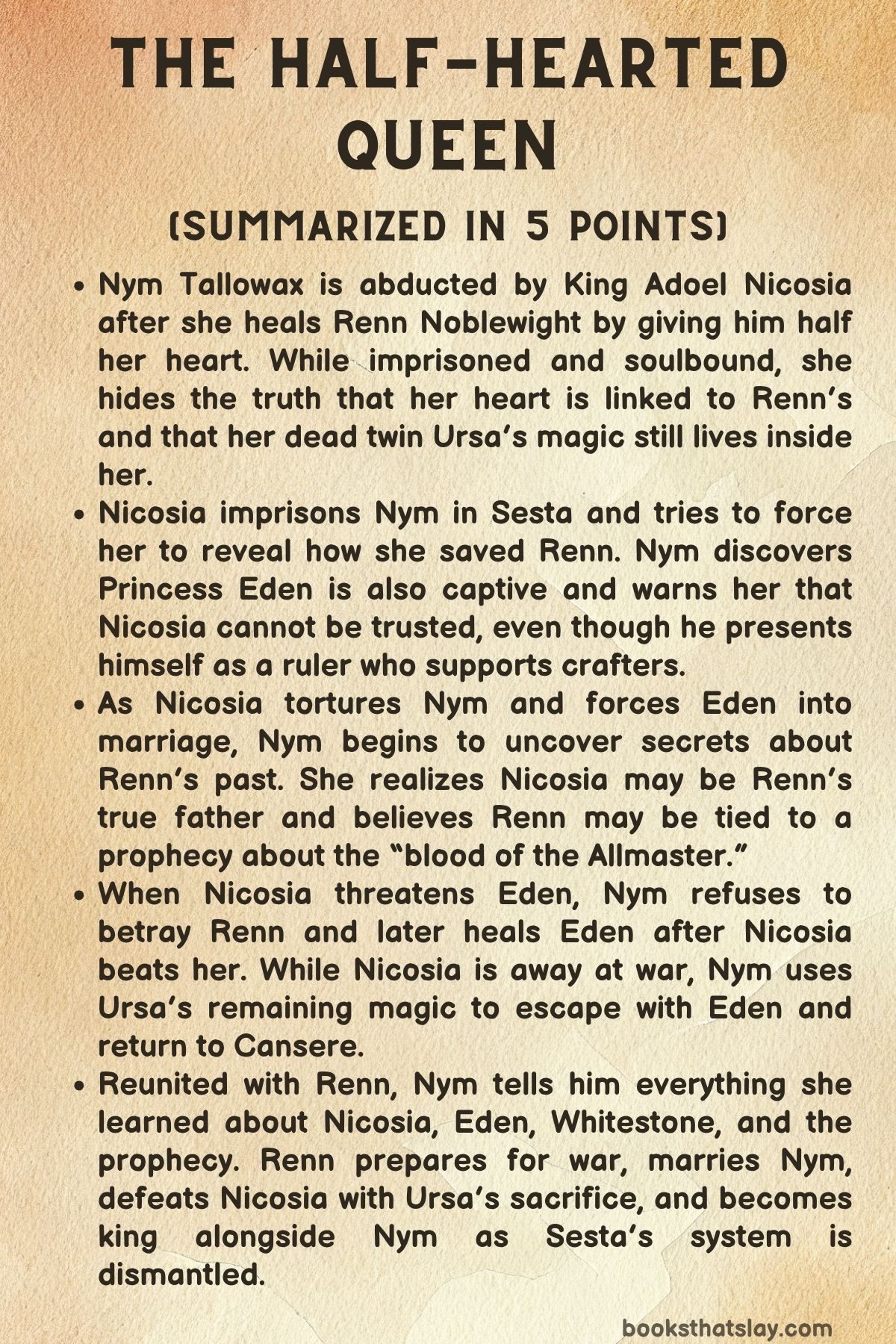
Summary
Nym Tallowax’s life changes after she heals Renn Noblewight from terrible injuries by giving him half of her own heart. The act restores him, but it also creates a deep bond between them.
Nym can feel Renn’s pain, hunger, fear, and emotions even when they are far apart. This bond becomes both a comfort and a source of suffering after King Adoel Nicosia of Sesta abducts her.
Nicosia wants to know how she saved Renn, and he is determined to break the answer out of her.
Nym is taken aboard a ship and kept under tight control through soulbinding. At first, she is bound directly to Nicosia, allowing him access to her mind and body in a way that leaves her vulnerable.
Later, he chains her to a mastiff to keep her restrained. Nym quickly understands that her greatest defense is secrecy.
She builds a wall inside her lumis, the inner structure of her magic and self, to keep Nicosia from reading her thoughts. Behind that wall, she hides the truth about Renn and also hides Ursa, her dead twin sister, whose remaining magic still lives within her.
Nicosia uses hunger, drugs, threats, and fear to wear Nym down. He wants the secret of her healing power, but Nym refuses to surrender it.
Her silence is not only for herself; it is for Renn, whose life may depend on Nicosia not understanding what has happened between them. While on the ship, Nym briefly sees Princess Eden, who is alive but also captive.
Eden’s presence confirms that Nicosia’s plans reach far beyond Nym. He is gathering pieces of power for a larger purpose.
When they reach Rodsfell, the capital of Sesta, Nym is imprisoned in a glass conservatory built around the Egroran, an ancient sacred tree. Nicosia soulbinds her to the tree, trapping her in a beautiful prison.
Through openings near the tree, Nym discovers that Eden is being held below. The two women speak when they can.
Eden hopes she might be able to influence Nicosia, but Nym warns her against trusting him. Nym has already seen that Nicosia can use politeness, religion, and royal duty to hide cruelty.
Nicosia tries another method to control Nym. He shows her parts of Sestan society and presents his kingdom as a place where crafters are valued.
In Cansere, craftlock has been banned and feared, but in Sesta, crafters are openly trained and used by the crown. Nicosia wants Nym to see this as freedom.
Instead, she notices that the crafters are still managed, watched, and directed according to the king’s needs. They may not be hidden, but they are not truly free.
Nym also begins to understand Nicosia’s religious certainty. He is devoted to the goddess Zia and believes his rule has divine meaning.
His faith is not humble; it feeds his sense that he is chosen. This belief makes him more dangerous because he does not see his actions as simple ambition.
He sees them as destiny.
Nicosia then forces Eden into marriage. By marrying her, he strengthens his claim to Cansere and deepens the threat against Renn’s homeland.
During the ceremony, Nym sees Wald Whitestone, Renn’s former physician. Whitestone should have been dead, executed for his part in arranging Nym’s assassination.
His survival raises more questions about Nicosia’s plans and about what really happened in Renn’s past.
As Nicosia loses patience, he tortures Nym repeatedly. He wants the secret of the healing, but each attempt only strengthens her resolve.
During one magical fight, Nym enters his lumis and is shocked by what she finds. His inner structure feels familiar, but not because of her family.
It reminds her of Renn. The discovery unsettles her, and she starts putting together clues that point to a hidden truth: Nicosia may be Renn’s true father.
More pieces begin to fit. Queen Winvrin may have been Sestan and may once have been known as Alarna.
Nicosia knew her. Renn’s lumis resembles Nicosia’s.
Scripture speaks of the “blood of the Allmaster,” and Nicosia seems to believe bloodlines carry divine purpose. Nym concludes that Nicosia sees himself as connected to Zia, but the prophecy may not point to him.
It may point to Renn, his blood, as the one destined to rise against him.
Nicosia’s cruelty reaches Eden as well. He brings her to Nym and threatens to torture Eden instead if Nym will not answer him.
Nym still refuses to betray Renn. Nicosia beats Eden until he is interrupted by a summons to war.
After he leaves, Nym uses her power to heal Eden. The two women exchange what they know.
Eden reveals that Nicosia told her to tell Renn what he had done to her, making it clear that his hatred of Renn is deeply personal. Nym tells Eden to prepare for escape.
While Nicosia is away, Nym suffers through the bond she shares with Renn. She senses him being badly wounded and feels his agony from a distance.
For days, she carries his pain and fear while not knowing whether he will live. The experience nearly breaks her, but Renn survives.
His survival gives Nym hope and reminds her why she must keep fighting.
Whitestone later visits Nym and reveals more about Renn’s history, including Nicosia’s part in damaging him. Nym realizes that escape will require more than strength.
She must use the hidden parts of herself that Nicosia has failed to understand. She forms a plan involving Ursa’s remaining presence.
By reshaping her lumis to resemble Nicosia’s, Nym creates a way for Ursa to pass into him and attack him from within.
Nym and Eden escape Rodsfell and begin the dangerous journey across Sesta. They must cross enemy land while avoiding capture and carrying the weight of what has happened to them.
Their return to Cansere is not only a physical escape but also a return with knowledge that can change the war. Nym brings back the truth about Nicosia’s cruelty, Eden’s suffering, Whitestone’s survival, Renn’s possible parentage, and the prophecy that may place Renn at the center of the conflict.
When Nym reunites with Renn, she tells him everything. Their bond has already connected them through pain, but now they must face the political and personal consequences together.
Renn responds by preparing Cansere for war. He raises forces and makes a major change within his own kingdom by lifting the ban on craftlock.
This allows healers, mindreaders, and soulbinders to organize openly in defense of Cansere. The very magic once feared by the kingdom becomes part of its survival.
Nym and Renn marry during the campaign, choosing love and commitment even in the middle of danger. Their marriage is not an escape from the war but a promise made inside it.
Together, they move toward the fight to reclaim Rove and stop Nicosia’s control from spreading further.
The final confrontation brings Nym, Renn, and Nicosia face-to-face. Nicosia nearly kills them, proving how powerful and ruthless he remains.
Yet the secret he never fully understood becomes his undoing. Ursa sacrifices the last of her remaining presence to save Nym and Renn.
Her final act protects her sister and helps end Nicosia’s reign.
Nicosia dies, and with him falls the system he built on control, fear, and false holiness. Sesta’s structure of magical obedience is dismantled.
Eden survives and helps restore Rove after everything she endured. Nym’s family is safe beside her, and the wounds left by war begin to move toward repair.
In the end, Renn and Nym are crowned king and queen. Their rule begins after loss, sacrifice, and hard-won truth.
Nym is no longer only a captive, healer, or half-bound woman carrying another person’s pain. She becomes a queen who understands the cost of power and the importance of choosing mercy without surrendering strength.
Renn, too, steps into leadership with a fuller knowledge of his past and his purpose. Together, they inherit kingdoms damaged by fear, but they also carry the hope of building something freer.
Characters
The Half-Hearted Queen presents its characters through captivity, loyalty, hidden power, inheritance, and moral choice, making each major figure important to the emotional and political movement of the story.
Nym Tallowax
Nym Tallowax is the emotional and moral center of the book. Her power as a healer is not shown as simple magic, but as something deeply tied to sacrifice, love, pain, and identity.
By giving Renn half her heart and restoring his broken body, she creates a bond that changes the direction of her life completely. Her abduction by King Adoel Nicosia places her in a position of extreme vulnerability, but her character is defined by the way she resists being reduced to a prisoner, a tool, or a secret to be extracted.
Even when she is starved, drugged, chained, threatened, and tortured, she refuses to surrender the truth about Renn or the nature of their connection. This makes her courage quiet but powerful, because much of her strength comes not from open battle at first, but from endurance, self-control, and the ability to protect what matters while suffering greatly.
Nym is also a character shaped by inner conflict and hidden depths. Her lumis becomes a private battlefield where she must defend her thoughts from Nicosia’s intrusion.
The protective wall she builds inside herself shows her growing mastery over her own mind and magic, but it also symbolizes her emotional boundaries. She has been violated, watched, and controlled, so creating a guarded inner space becomes an act of survival.
Her connection to Renn intensifies this conflict because she cannot fully escape suffering even when Nicosia is not directly hurting her. Through their shared heart, she feels Renn’s pain, hunger, fear, and emotions across distance, which makes her love for him both beautiful and agonizing.
She is never isolated in a simple way; even when trapped, she is emotionally tied to someone else’s struggle.
Nym’s relationship with Ursa adds another layer to her character. Ursa’s remaining magic inside her means Nym carries not only grief, but also a living remnant of her dead twin.
This makes Nym’s identity unusually complex, because she is not only fighting as herself but also protecting a hidden presence that Nicosia must not discover. Her bond with Ursa gives her strength, comfort, and eventually a weapon against Nicosia, yet it also keeps her connected to loss.
Nym’s power is therefore never separate from love and mourning. She survives because she knows how to hold pain without letting it destroy her sense of purpose.
By the end of the story, Nym grows from a captive healer into a queen who understands the cost of power. Her escape with Eden, her reunion with Renn, her role in revealing the truth about Nicosia, and her participation in the final conflict all show her transformation from someone hunted for her gift into someone who helps reshape a kingdom.
She does not become powerful by becoming cruel or detached. Instead, her strength remains rooted in compassion, loyalty, and the refusal to let tyrants define the meaning of magic.
Her crowning beside Renn represents not only a political victory, but also the recognition that someone who has been wounded, used, and underestimated can still become a ruler capable of healing more than bodies.
King Adoel Nicosia
King Adoel Nicosia is the central antagonist of the book and one of its most dangerous figures because his cruelty is supported by intelligence, religious certainty, and political ambition. He is not merely violent; he is calculating.
His abduction of Nym reveals that he sees people primarily as instruments. He wants to understand how she healed Renn not because he respects the miracle of it, but because he wants to possess and control that power.
His use of soulbinding, starvation, drugs, chains, threats, and torture shows a ruler who believes domination is a legitimate path to knowledge. He treats Nym’s body, mind, and magic as things he has the right to invade.
Nicosia’s character is especially disturbing because he presents control as order and oppression as purpose. When he shows Nym Sestan society, he tries to frame the open training of crafters as freedom.
Yet Nym sees the deeper truth: the crafters are still controlled by the crown. This contrast reveals one of Nicosia’s defining traits.
He is skilled at turning systems of exploitation into arguments for progress. He understands appearances and knows how to make his kingdom look more enlightened than Cansere’s ban on craftlock, but his version of acceptance is still built on ownership.
For him, magic is valuable only when it serves his authority.
His devotion to Zia and his belief in divine connection make him even more dangerous. Nicosia does not seem to view his rule as merely political; he sees it as sacred or destined.
This gives his ambition a fanatical quality. His interest in prophecy and the “blood of the Allmaster” suggests that he interprets bloodline, power, and divinity in ways that justify his actions.
If he believes himself chosen, then resistance to him becomes, in his mind, resistance to a divine plan. This kind of thinking allows him to commit brutality without guilt because he can imagine himself as the necessary center of history.
Nicosia’s relationship to Renn gives his villainy a personal dimension. The clues that he may be Renn’s true father transform him from a distant tyrant into a figure of intimate betrayal.
His hatred of Renn is not abstract; it is personal, bitter, and tied to the past. His role in breaking Renn, his connection to Queen Winvrin, and his reaction to the prophecy all suggest a man terrified of being displaced by his own blood.
This makes him both powerful and insecure. He rules kingdoms and commands armies, but he is still haunted by the possibility that Renn represents the divine destiny he wanted for himself.
His death is therefore not only the fall of a king, but the collapse of a false vision of power.
Renn Noblewight
Renn Noblewight is a character defined by suffering, endurance, and the burden of hidden inheritance. At the beginning of the central conflict, he has already been physically broken, and Nym’s healing of him becomes one of the most important acts in the story.
His restored body is not just a sign of survival; it becomes the foundation of a bond that connects him to Nym in a profound and painful way. Because she gives him half her heart, Renn’s life is inseparable from hers.
Their relationship is therefore not simply romantic. It is spiritual, magical, physical, and emotional, making him a character whose existence continually affects Nym even when he is absent from the scene.
Renn’s importance grows as the truth about his origins begins to emerge. The possibility that Nicosia is his true father changes the meaning of Renn’s past and future.
He is not only the damaged man Nym loves; he may also be the blood-linked figure connected to prophecy and divine expectation. This revelation complicates his identity because it ties him to the very man who has caused so much suffering.
Renn becomes a living contradiction to Nicosia’s worldview. If Nicosia believes himself chosen by Zia, Renn’s existence threatens that belief.
If Renn is the prophesied figure meant to rise against him, then Renn’s survival becomes an act of destiny as well as defiance.
Renn’s character is also important because he must move from being a victim of hidden violence into a ruler prepared for open war. When Nym returns and tells him what she has learned, he does not remain trapped in shock or pain.
He acts. He raises forces, lifts Cansere’s ban on craftlock, and begins organizing healers, mindreaders, and soulbinders.
These choices show that Renn’s leadership is different from Nicosia’s. While Nicosia uses crafters as controlled assets of the crown, Renn begins to recognize them as necessary participants in a larger struggle.
His leadership is shaped by adaptation, trust, and the willingness to change unjust systems when survival and justice require it.
Renn’s marriage to Nym during the campaign strengthens his character’s emotional arc. He is not only fighting for a kingdom, but also for the person whose heart is bound to his.
Their love carries the weight of shared pain, and their final confrontation with Nicosia proves how closely their fates are linked. Renn’s survival and rise to kingship do not erase what was done to him, but they show that brokenness does not disqualify someone from power, love, or destiny.
As king beside Nym, he represents a future that rejects secrecy, inherited cruelty, and fear-based rule.
Princess Eden
Princess Eden is one of the most important captive figures in the story, and her arc highlights the political and emotional consequences of Nicosia’s cruelty. When Nym first sees her aboard the ship, Eden is alive but trapped, which immediately changes the stakes of Nym’s imprisonment.
Eden is not merely a symbol of political leverage; she is a person caught between fear, hope, and survival. Her captivity beneath the Egroran later deepens this sense of injustice, placing her literally below the surface of Nicosia’s sacred and political world.
She is hidden away while Nicosia performs power above her.
Eden’s initial belief that she might influence Nicosia shows her complexity. She is not foolish, but she is placed in a situation where hope may feel like the only form of agency available.
Her desire to believe she can affect him suggests both courage and vulnerability. Nym’s warning not to trust him reveals the contrast between their positions.
Nym has experienced Nicosia’s methods directly and understands that his charm, religious language, and political gestures are all secondary to his need for control. Eden’s arc therefore becomes partly about recognizing the full danger of a man who uses marriage, captivity, and violence as tools of conquest.
Nicosia’s forced marriage to Eden is one of the clearest examples of his political abuse. Through it, Eden’s body and title are turned into instruments for strengthening his claim to Cansere.
This makes her suffering both personal and national. She is harmed as an individual, but she is also used as a bridge for conquest.
When Nicosia later beats her in front of Nym to pressure Nym into betraying Renn, Eden becomes the target of violence meant for someone else’s emotional destruction. Her pain is used as a weapon, which shows how tyrants often attack bonds between people rather than only attacking individuals.
Despite this, Eden remains resilient. After Nym heals her, the two women exchange vital information, and Eden becomes part of the escape plan.
Her survival matters because she carries truth: she reveals that Nicosia told her to tell Renn what he had done to her, proving that his hatred of Renn is deeply personal. Eden’s role after the final conflict, helping restore Rove, shows that she is not defined only by victimhood.
She emerges as someone who has suffered political violence and still participates in rebuilding. Her character represents endurance after humiliation, and her restoration work suggests that healing a country requires the strength of those who survived its worst abuses.
Ursa Tallowax
Ursa Tallowax is physically dead for the events described, but her presence remains one of the most emotionally and magically significant forces in the story. As Nym’s twin sister, Ursa represents family, grief, memory, and unfinished power.
Her remaining magic living inside Nym makes her more than a memory. She is a hidden presence, a secret Nym must protect from Nicosia, and a reminder that love can continue to act even after death.
This gives Ursa an unusual role because she is absent from the ordinary world but active within the inner and magical life of the heroine.
Ursa’s presence deepens Nym’s character by showing that Nym is never truly alone, even in captivity. However, that companionship is complicated by danger.
If Nicosia discovered Ursa within Nym, he might exploit or destroy what remains of her. Nym’s need to hide Ursa therefore adds another layer to her resistance.
She is protecting Renn’s secret, guarding her own mind, and preserving the last trace of her sister all at once. This makes Ursa a symbol of the emotional weight Nym carries.
Nym’s strength is not clean or uncomplicated; it is built from grief, attachment, and the need to defend the dead as well as the living.
Ursa also becomes crucial to the final defeat of Nicosia. Nym’s plan to reshape her lumis so Ursa can pass into Nicosia and attack from within is one of the most meaningful uses of inner magic in the story.
It turns the private, hidden space of the lumis into a battlefield where the dead can still resist tyranny. Ursa’s sacrifice of her remaining presence to save Nym and Renn completes her arc as a figure of love transformed into protection.
She gives what is left of herself so that her sister and Renn can live.
Her sacrifice is deeply moving because it forces Nym to lose Ursa again, this time more completely. Yet it also gives Ursa agency and purpose.
She is not simply a tragic memory haunting the heroine; she becomes an active participant in liberation. Through Ursa, the story suggests that the bonds of family can survive beyond death, but that love sometimes reaches its highest expression through release.
Her final act helps make the future possible, even though she cannot live in it herself.
Princess Eden and Nym’s Partnership
The partnership between Eden and Nym deserves attention because it becomes one of the strongest examples of female solidarity in the book. Both women are captives of Nicosia, but they experience his control in different ways.
Nym is valuable to him because of her healing power and her connection to Renn, while Eden is valuable because of her royal identity and political usefulness. Their situations are separate, but the structure of their suffering is similar: Nicosia wants to use both of them to strengthen his own power.
Their bond grows through truth-telling and mutual protection. Nym warns Eden not to trust Nicosia, heals her after she is beaten, and prepares her for escape.
Eden, in turn, provides information that helps Nym understand the personal nature of Nicosia’s hatred for Renn. This exchange makes their relationship practical as well as emotional.
They do not simply comfort each other; they help each other survive and act. Their escape from Rodsfell is important because it shows that Nicosia’s control can be broken not only by armies, but by trust between people he tried to isolate.
This partnership also contrasts sharply with Nicosia’s idea of power. He builds authority through binding, imprisonment, forced marriage, and fear.
Nym and Eden build strength through care, warning, healing, and shared knowledge. Their connection is therefore quietly revolutionary.
It shows that the ability to protect and believe another person can become a form of resistance. In a story filled with magical bonds and political claims, their human bond becomes one of the clearest signs of hope.
Wald Whitestone
Wald Whitestone is a morally troubling and secretive figure whose presence complicates the story’s understanding of loyalty, survival, and betrayal. As Renn’s former physician, he is connected to Renn’s past and to the physical damage that shaped him.
The fact that he was supposed to have been executed for arranging Nym’s assassination makes his reappearance shocking. His survival suggests deception, hidden alliances, and unfinished consequences.
When Nym sees him during Nicosia’s forced marriage to Eden, his presence immediately raises questions about how much of the past has been manipulated.
Whitestone’s role is important because he carries knowledge that other characters need. When he later visits Nym and reveals more about Renn’s past, including Nicosia’s role in breaking him, he becomes a source of painful truth.
He helps connect the personal suffering of Renn to the larger political and dynastic conflict involving Nicosia. This makes him more than a minor conspirator.
He is part of the network of secrets that kept Renn’s identity, injuries, and origins obscured.
At the same time, Whitestone remains morally uneasy because of his connection to the attempt on Nym’s life. The story does not present him as purely noble simply because he reveals information.
His usefulness does not erase the harm associated with him. This makes him a character who occupies a gray space between guilt and assistance.
He is valuable because he knows the truth, but that truth comes from proximity to corruption and betrayal.
Whitestone’s character shows how court politics can turn physicians, advisors, and servants of the body into instruments of power. As a physician, he should be associated with healing, but his history links him to harm, secrecy, and manipulation.
This contrast makes him an unsettling figure. He helps expose Nicosia’s past crimes, yet he also reminds the reader that oppressive systems survive because many people around the tyrant participate, compromise, hide facts, or act too late.
Queen Winvrin, Also Known as Alarna
Queen Winvrin, possibly born Alarna, is a character whose importance lies largely in the secrets surrounding her identity and past. Though she is not as directly active in the described events as Nym, Renn, Eden, or Nicosia, she is central to the mystery of Renn’s bloodline.
The suggestion that she may have been Sestan and that Nicosia knew her adds emotional and political weight to Renn’s origins. Her hidden identity becomes a bridge between Cansere and Sesta, between public royalty and private truth, and between Renn’s known life and the buried history that shaped him.
Winvrin’s possible Sestan origin complicates the idea of national identity in the story. If she was born Alarna, then the boundaries between enemy kingdoms are less clear than they appear.
Her past suggests that royal bloodlines, political loyalties, and personal relationships may have been entangled long before the open conflict of the present. This matters because Nicosia’s claim, Renn’s inheritance, and the prophecy all seem connected to truths that were hidden or suppressed.
Winvrin becomes part of the story’s larger argument that concealed history can shape the fate of nations.
Her connection to Nicosia is especially significant because it helps explain why Renn’s existence threatens him so deeply. If Nicosia is Renn’s true father and Winvrin is part of that secret, then her life becomes the origin point of a dangerous legacy.
The mystery around her suggests that Renn was born into a conflict he did not choose, one involving desire, power, blood, divinity, and political fear. Winvrin’s role therefore makes Renn’s suffering feel less accidental and more like the result of a hidden dynastic struggle.
Even in absence, Winvrin influences the present. Her concealed identity, her relationship to Nicosia, and her place in Renn’s history all shape the choices of the living characters.
She represents the kind of truth that cannot stay buried forever. Once Nym begins to understand the connections between Nicosia, Renn, Sestan scripture, and the “blood of the Allmaster,” Winvrin becomes a key figure in the unraveling of the past.
Her character shows that sometimes the most powerful people in a story are not those currently acting, but those whose hidden lives created the conflicts others must resolve.
Zia
Zia functions less as an ordinary character and more as a divine presence whose meaning is shaped by belief, prophecy, and interpretation. Nicosia’s devotion to her is one of the most important parts of his identity.
He sees himself as connected to divinity, and his belief in Zia appears to support his sense of destiny. This makes Zia important because the idea of her becomes a source of authority that Nicosia uses to understand and justify himself.
However, the story also shows the danger of a ruler interpreting divinity through ambition. Nicosia’s belief that he may be chosen does not make him compassionate, humble, or just.
Instead, it seems to intensify his entitlement. His devotion becomes tied to control, prophecy, bloodline, and conquest.
In this way, Zia’s presence exposes the difference between faith and self-glorification. The problem may not be belief itself, but Nicosia’s use of belief to elevate himself above moral accountability.
The prophecy involving the “blood of the Allmaster” further complicates Zia’s role. If Renn, rather than Nicosia, is the figure destined to rise, then Nicosia’s entire understanding of divine favor is threatened.
This creates a powerful irony. The man who thinks he stands closest to sacred destiny may actually be opposed by the very bloodline he fears.
Zia’s significance therefore lies in the tension between true destiny and corrupted interpretation.
Zia also helps deepen the story’s political conflict by giving it a spiritual dimension. The struggle is not only about kingdoms, captivity, or revenge.
It is also about who has the right to claim divine purpose and what kind of person is worthy of power. Through Nicosia’s obsession with her, Zia becomes a mirror reflecting the danger of religious certainty without mercy.
Through Renn’s possible connection to prophecy, she also becomes part of the hope that tyranny can be challenged by a different kind of chosen figure.
Themes
Power, Control, and False Freedom
In The Half-Hearted Queen, power is shown not only through armies and crowns, but through the ability to limit another person’s choices. Nicosia presents Sesta as a place where crafters are accepted, trained, and respected, yet the freedom he offers is carefully controlled by the crown.
His society looks more open than Cansere’s because magic is not banned, but that openness becomes another form of ownership when crafters are treated as tools of the state. Nym quickly understands that permission is not the same as freedom.
Her captivity makes this theme even stronger because Nicosia controls her body through chains, soulbinding, drugs, hunger, and threats, yet he cannot fully control her will. The contrast between outward freedom and hidden control exposes the danger of rulers who justify cruelty as order.
True freedom in the story is not simply the right to use magic; it is the right to choose how one’s power, body, loyalty, and identity are used.
Sacrifice and the Cost of Love
Love in the story is not passive or easy; it repeatedly demands pain, endurance, and loss. Nym’s bond with Renn begins with the sacrifice of half her heart, and that act shapes everything that follows.
Because she can feel his suffering across distance, love becomes physical, emotional, and constant. Her refusal to betray him is not based on romantic devotion alone, but on a deep moral commitment to protect the life she helped save.
This theme also appears through Ursa, whose remaining magic stays with Nym until the final sacrifice. Ursa’s presence shows that love can survive death, but it also asks for release when protection requires a final cost.
Eden’s suffering adds another layer, because Nym must face the pain of choosing between saving one innocent person and protecting a larger future. Sacrifice is never treated as simple heroism.
It is painful, unfair, and often forced by cruelty, yet it becomes meaningful when characters choose loyalty, protection, and hope over fear.
Identity, Inheritance, and Chosen Purpose
Questions of identity shape the conflict around Renn, Nym, and Nicosia. Renn’s possible connection to Nicosia changes the meaning of his past because his brokenness may not be random cruelty, but the result of a father’s fear, hatred, and obsession with prophecy.
Inheritance becomes both biological and spiritual: blood may link Renn to Nicosia, but it does not define who he becomes. Nicosia believes bloodline and divine favor give him the right to rule and destroy, while Renn’s choices prove that identity is built through compassion, responsibility, and self-command.
Nym’s identity is also divided between her own heart, Renn’s pain, and Ursa’s lingering magic. She must protect the hidden parts of herself from a man who wants to read, use, and own them.
The story argues that origin matters, but it is not destiny. A person may inherit trauma, power, or prophecy, yet their true identity is revealed through the choices they make under pressure.
Healing, Restoration, and the Rebuilding of a Kingdom
Healing in the story reaches far beyond the repair of wounded bodies. Nym’s power begins with physical restoration, but the larger journey is about healing damaged people, broken systems, and divided nations.
Renn’s body is restored early, yet his emotional wounds, political burdens, and fear of his past take much longer to face. Eden also needs healing after being used as a political prisoner and forced into a marriage meant to strengthen Nicosia’s claim.
On a wider level, Cansere must heal from its fear of craftlock, while Sesta must be freed from a system that trains magical people only to serve royal power. The ending suggests that restoration requires more than defeating one tyrant.
It demands new laws, trust in formerly feared abilities, and leaders willing to protect rather than possess. Nym and Renn’s rise to the throne matters because they understand suffering personally.
Their rule carries the hope that healing can become a principle of governance, not just a private act of magic.