The Hope Keeper Summary, Characters and Themes
The Hope Keeper by Heather Webb is a historical novel set in Washington, DC, during the years following the First World War.
It follows Elisabeth Beaumont, a gifted jeweler whose search for answers about her twin brother’s death draws her into the glamorous and dangerous circle of Evalyn Walsh McLean, owner of the legendary Hope Diamond. Mixing family grief, romance, social intrigue, historical figures, and questions about fate, the novel examines how easily wealth and beauty can conceal manipulation, loneliness, and corruption. Elisabeth’s investigation eventually becomes a larger search for personal freedom, emotional healing, and a life chosen according to her own ambitions.
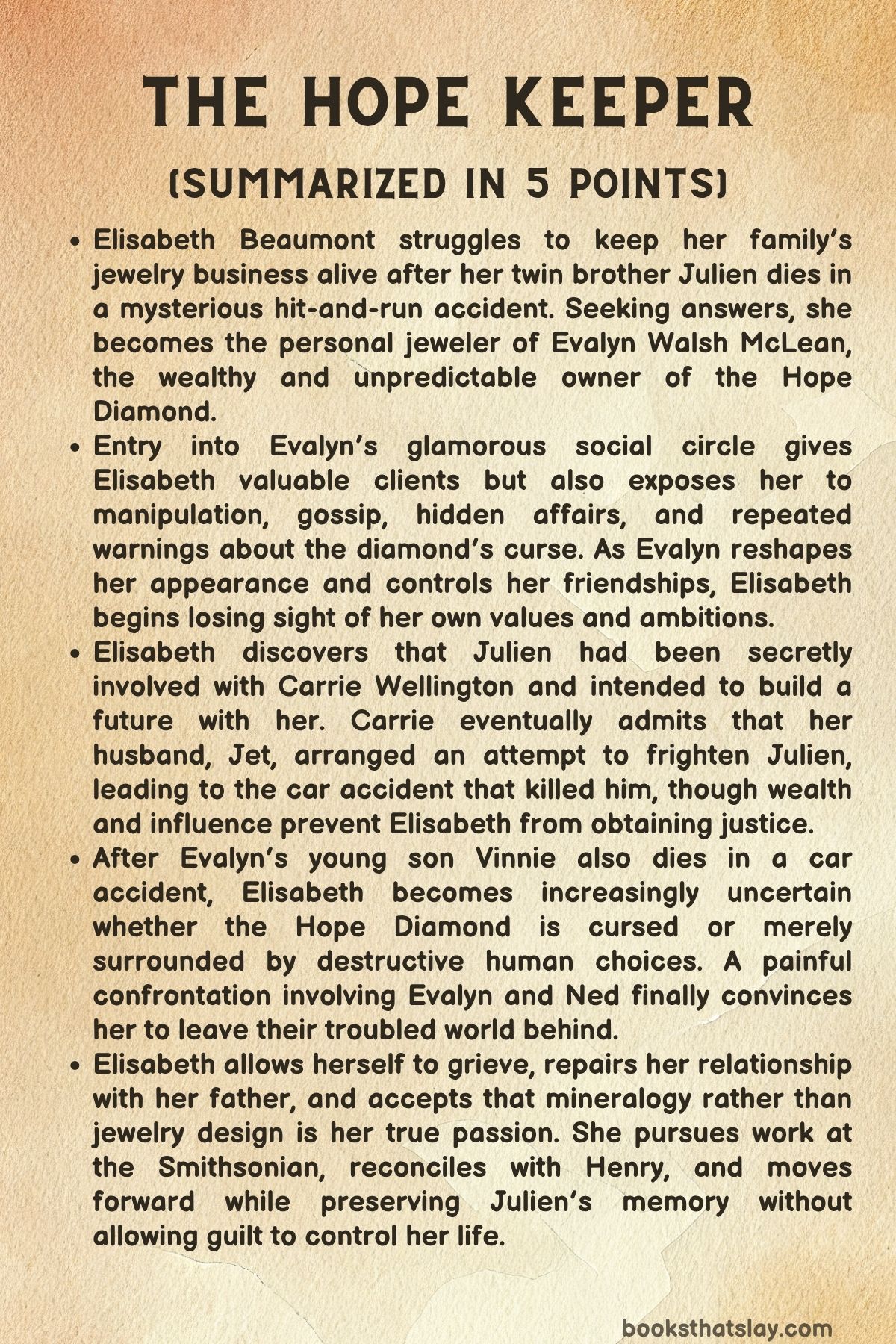
Summary
Elisabeth “Lizzie” Beaumont is a talented jeweler working in her family’s struggling Washington boutique. Since the death of her twin brother Julien in a hit-and-run accident, both the business and the Beaumont family have been falling apart.
Her father, Gérard, has withdrawn into his bedroom and refuses to work. Elisabeth must complete commissions, manage debts, care for him, and suppress her own grief while trying to understand why Julien had become so secretive before his death.
Julien had recently established a professional relationship with Evalyn Walsh McLean, the wealthy socialite who owns the Hope Diamond. Gérard believes the stone carries a curse and had forbidden Julien from working with the McLeans, forcing Julien to hide the arrangement from his family.
Desperate to save Beaumont Jewelers, Elisabeth visits Evalyn and asks to service her jewelry collection. Evalyn initially dismisses her, but Elisabeth enters one of her extravagant parties without an invitation and persuades the amused hostess to consider her proposal.
Elisabeth is immediately drawn to the Hope Diamond around Evalyn’s neck. Although she does not fully believe in curses, she wonders whether the gem’s dark history might somehow be connected to Julien’s death.
Evalyn eventually invites Elisabeth to Friendship, her Georgetown estate. There, Elisabeth meets several members of Evalyn’s social circle, including Beatrice Cauldwell, Gwen Chaney, Sharon, and the striking red-haired Carrie Wellington.
When Evalyn criticizes Julien for missing appointments, Elisabeth reveals that he was her twin and has died. Speaking about his death causes her emotional restraint to break, but the moment also strengthens her determination to discover what he had been doing among the McLeans.
Elisabeth begins recording everything she learns about Evalyn’s household and acquaintances. She studies the Hope Diamond’s history and remembers Gérard teaching her that gemstones gain much of their value from the stories attached to them.
Financial pressure continues to increase. Bradford Jones from the bank warns Elisabeth that the Beaumont mortgage is seriously overdue and that the family could lose both the boutique and their home.
Elisabeth creates aquamarine hair combs as a gift for Evalyn and uses them to gain another invitation. Evalyn admires the work, takes Elisabeth driving through Washington, and introduces her more fully to a social world shaped by luxury, competition, alcohol, gossip, and concealed resentment.
Evalyn’s friends mock Elisabeth’s clothing and working position, but she defends her family’s reputation. She learns that acceptance among these women requires confidence, sharp responses, and an ability to survive public humiliation.
Carrie privately tells Elisabeth that she encouraged Evalyn to employ her. Because Carrie seems to have known Julien personally, Elisabeth begins to suspect that she understands more about his final months than she admits.
Evalyn formally hires Elisabeth to inspect and clean her vast jewelry collection every two weeks. When she places the Hope Diamond in Elisabeth’s hand, Elisabeth feels both fear and fascination, but she accepts responsibility for it because access to the collection may lead her to the truth.
While examining the diamond, Elisabeth questions Evalyn about Julien. Evalyn reveals that he spent considerable time not only with the women but also with Ned McLean and a group of powerful men that included Jet Wellington, John Whitehall, and Peter Willoughby.
Elisabeth notices that Evalyn already knew about Julien’s accident despite previously behaving as though the news surprised her. This small deception makes Elisabeth more cautious about trusting anything Evalyn says.
At home, Elisabeth struggles to keep Beaumont Jewelers open. She completes earrings for Rosalee Smith and successfully convinces her to purchase a matching necklace, proving that she can attract clients through her own craftsmanship and determination.
During another gathering, Elisabeth sees how the curse surrounding the Hope Diamond affects Evalyn’s household. Threatening letters arrive regularly, servants speak of accidents and misfortunes, and Evalyn’s friends list the tragedies that have occurred around her.
Ned drives Elisabeth home and explains that Julien became part of an exclusive male circle. His revelation confirms that Julien’s connection to the McLeans extended far beyond ordinary jewelry work.
Elisabeth also begins experiencing disturbing dreams involving the diamond, Julien, and unseen pursuers. She visits her scientist friend Ken Davis, who encourages her to remain open-minded about unexplained possibilities while still seeking evidence.
Ken’s mineral collection revives Elisabeth’s old interest in geology and scientific exploration. She begins to recognize that her deepest fascination lies in the natural origins of stones rather than in transforming them into ornaments for wealthy customers.
At Friendship, Elisabeth befriends Evalyn’s young son Vinnie, who is fascinated by her tools. Jerry, a servant in the McLean household, quietly tells her that many staff members believe the Hope Diamond is responsible for injuries, deaths, fires, and other disasters.
Jerry also reveals that Julien stopped visiting Friendship regularly shortly before his death, even though he continued telling his family that he was working there. Elisabeth realizes that Julien had been lying about his whereabouts.
A memory from an earlier jewelry bazaar provides another clue. Carrie had met Julien there, flirted with him, purchased one of his designs, and invited him to a party at the McLean estate.
Carrie therefore opened the door that brought Julien into Evalyn’s circle. Elisabeth suspects that the attraction between them continued long after their first meeting.
Meanwhile, Evalyn takes Elisabeth shopping and gives her fashionable clothing, a new hairstyle, and professional makeup. Elisabeth feels uncomfortable being treated as one of Evalyn’s personal projects, yet she also enjoys the attention and escape from grief.
Ned begins flirting openly with Elisabeth. Although she understands that responding to him would be dangerous, she is affected by his admiration and by the sense of confidence she experiences in Evalyn’s world.
The transformation also forces Elisabeth to reconsider her career. Looking at her unfinished jewelry collection, she admits that the pieces are technically accomplished but do not express a passion she genuinely feels.
Gérard’s recovery slowly begins as he returns to sketching and discussing the business. He encourages Elisabeth to reconcile with Henry Cooper, Julien’s closest friend and the man Elisabeth loved before Julien’s death separated them emotionally.
Henry works at the Smithsonian and shares Elisabeth’s interest in science and minerals. Their meetings remind her of the future they once imagined, but both remain burdened by guilt because they were late to meet Julien on the night he died.
Elisabeth learns more about Evalyn’s methods of controlling people. Evalyn gives expensive gifts and offers social opportunities, but she also collects damaging secrets that allow her to frighten, punish, or humiliate her friends.
A threatening letter arrives at the Beaumont boutique, warning Elisabeth to stop caring for the Hope Diamond. Before she can investigate it, Evalyn’s friends visit the shop and purchase enough jewelry to rescue the business from immediate financial ruin.
Gérard sees Evalyn and realizes that Elisabeth has been working with the McLeans. He accuses her of placing herself in the same danger that surrounded Julien, but Elisabeth angrily reminds him that she saved the family while he remained consumed by grief.
Their confrontation marks a change in Elisabeth. She no longer accepts the belief that she must quietly obey her father while carrying every practical responsibility alone.
At the Smithsonian, Henry introduces Elisabeth to curator Julia Wane and other women working in scientific fields. Julia asks whether Elisabeth has considered museum work, giving her the first serious opportunity to imagine a life outside Beaumont Jewelers.
Elisabeth admits that mineralogy is her true passion. The admission gives language to a desire she has suppressed for years in order to support Gérard and compete with Julien’s natural success in the family profession.
Carrie later visits the boutique wearing a pendant designed by Julien. Under questioning, she dismisses their connection as harmless flirtation but warns Elisabeth that Evalyn collects people, reshapes them, and abandons them once they are no longer entertaining.
She also warns Elisabeth about Ned’s interest. Elisabeth dislikes hearing the truth from Carrie but begins to understand how deeply Evalyn’s influence is affecting her choices.
Elisabeth searches Evalyn’s study for threatening letters, hoping to compare them with her own. She finds no clear connection, but the search confirms that Evalyn’s glamorous existence is surrounded by blackmail, fear, resentment, and danger.
When Elisabeth misses a planned dinner with Rosalee because Evalyn persuades her to stay at Friendship, she discovers how thoroughly her loyalties have shifted. Evalyn had promised to notify Rosalee but failed to do so, damaging one of Elisabeth’s few sincere friendships.
Another warning letter explicitly mentions Julien’s death. Elisabeth searches his room and finds identical letters among his possessions, proving that the same person had tried to frighten both twins away from the Hope Diamond.
At another gathering, Evalyn’s friends deliberately wear jewelry connected to Julien. Their explanation appears rehearsed, and a drunken comment from Bea confirms that the group is hiding something involving Carrie.
Jerry’s guarded behavior makes it clear that he also knows the secret. He cannot reveal everything, but he quietly offers to help Elisabeth.
A visit to New York with Gérard renews his professional energy. He becomes inspired by modern geometric designs, while Elisabeth becomes even more certain that she wants to work in a museum rather than remain a jeweler’s assistant.
Henry informs her of a part-time position with a Smithsonian mineralogist. The opportunity excites her, yet she hesitates because leaving the boutique feels like abandoning her father and Julien’s memory.
Her relationship with Evalyn soon deteriorates. Evalyn becomes jealous of Ned’s attention toward Elisabeth, excludes her from gatherings, and deliberately damages the jeweled headband Elisabeth created for her.
Elisabeth receives another warning letter and decides Carrie must be responsible. She goes to Carrie’s home and confronts her directly.
Carrie denies writing the letters but finally admits that she and Julien were lovers. She had planned to leave Jet and build a new life with Julien, while Evalyn knew about the affair and used the secret to control her.
The confession restores Elisabeth’s blocked memory of the night Julien died. She remembers that a red-haired woman had been waiting near him and fled after the accident.
The complete memory returns. Earlier that evening, Henry had declared his love for Elisabeth beneath an old oak tree, and they lost track of time after sharing their first kiss.
They arrived late to meet Julien, who intended to introduce them to Carrie. As Carrie approached, a speeding car turned the corner, and Julien stepped into its path after hearing Elisabeth call his name.
The car struck him and drove away. Carrie briefly bent over Julien but fled because discovery would expose her affair and destroy her social position.
Elisabeth accuses Jet of arranging the killing. Carrie insists that Jet intended only to frighten Julien and that either Jet or his chauffeur lost control of the vehicle while intoxicated.
Because Jet is wealthy and protected by influential friends, Elisabeth knows proving the truth will be almost impossible. She also turns her anger on Carrie for wanting both the security of her marriage and the love Julien offered.
Soon afterward, Evalyn’s young son Vinnie is killed by a car. The similarity to Julien’s death intensifies Elisabeth’s fear that the Hope Diamond may carry some form of destructive power.
Despite their estrangement, Elisabeth goes to Friendship to comfort Evalyn. There, Jerry admits that he wrote the warning letters because he feared for Julien and later wanted to protect Elisabeth.
That night, grief, alcohol, and exhaustion weaken Elisabeth’s judgment. She puts on the discarded Hope Diamond, and when Ned kisses her, she does not immediately stop him.
Evalyn discovers them and accuses Elisabeth of pursuing her husband. She also reveals that Carrie’s guilt was the main reason she originally hired Elisabeth.
Ashamed of what she has become in Evalyn’s world, Elisabeth removes the diamond and leaves. She reports her suspicions about Jet and the chauffeur to the police, but the investigation produces no result.
For several weeks, Elisabeth finally allows herself to mourn without hiding behind work, parties, or investigation. Gérard cares for her, and their relationship heals as they begin sharing their grief rather than suffering separately.
Six months later, Elisabeth rejects the identity Evalyn created for her and donates the expensive clothes she received. She tells Gérard that she will not complete her jewelry collection or spend her life maintaining a career chosen by her family.
Gérard admits that he always understood her true interests. He supports her application to the museum and agrees to hire someone else for the boutique.
Elisabeth performs impressively during her interview with the mineralogist. Her knowledge, confidence, and enthusiasm make her the strongest candidate.
On the first anniversary of Julien’s death, she visits his grave and tells him about the future. She understands that choosing her own path does not mean abandoning him but honoring the encouragement he gave her while alive.
Elisabeth seeks out Henry and admits that fear and guilt kept her away. Henry forgives her, and they begin rebuilding the relationship interrupted by Julien’s death.
Years later, Elisabeth follows Evalyn’s life through newspapers. Evalyn and Ned divorce, Ned dies in an asylum, the family fortune collapses, and Evalyn survives the deaths of two of her children while continuing to wear the Hope Diamond.
After Evalyn’s death, her jewelry collection is sold to Harry Winston. Elisabeth attends the auction and sees the Hope Diamond once more, still uncertain whether the disasters around it came from supernatural forces, human choices, or a combination of both.
Winston eventually donates the diamond to the Smithsonian. Displayed in the Hall of Gems, it continues attracting visitors who bring their own curiosity, fears, and beliefs to its long history.
Characters
Elisabeth “Lizzie” Beaumont
Elisabeth is the emotional and moral center of The Hope Keeper. Her investigation into Julien’s death drives the mystery, but her deeper journey concerns the recovery of an identity that has been buried beneath grief, family expectations, and financial responsibility.
At the beginning of the novel, Elisabeth appears capable and disciplined, yet she is close to collapse. She keeps the boutique operating, cares for Gérard, negotiates with customers, and faces creditors while receiving little recognition for the burden she carries.
Her grief is complicated by guilt. Because she and Henry arrived late on the night Julien died, she believes her personal happiness contributed to the loss of her brother.
That guilt makes Elisabeth reject Henry and deny herself comfort. She behaves as though suffering is a duty she owes Julien, and any return to pleasure seems like a betrayal of his memory.
Her involvement with Evalyn initially gives her a practical way to rescue Beaumont Jewelers. It also provides access to the people who knew Julien during the period when he became secretive, frightened, and involved in dangerous relationships.
As Elisabeth enters Evalyn’s world, she becomes increasingly vulnerable to glamour and approval. Expensive clothes, social recognition, champagne, parties, and Ned’s attention temporarily replace the numbness that has dominated her life.
Her attraction to this environment does not make her shallow. It shows how easily a grieving and exhausted person can mistake excitement for recovery and manipulation for affection.
Elisabeth retains a strong moral instinct even when she begins imitating Evalyn. She refuses to expose Gwen’s secret for entertainment and feels disturbed by the cruelty with which Evalyn controls her friends.
Her relationship with the Hope Diamond reflects her uncertainty about fate. She approaches it as a craftswoman capable of evaluating its cut and setting, but she also senses the emotional power created by its history and the tragedies connected to it.
The greatest change in Elisabeth occurs when she recognizes that jewelry design is not her true calling. She has spent years believing that continuing the Beaumont profession is necessary to earn Gérard’s approval and honor Julien’s legacy.
Mineralogy offers a different relationship with gemstones. Rather than valuing them as possessions or status symbols, Elisabeth wants to study their origins, structures, and place within the natural world.
Her final rejection of Evalyn’s clothes and the Hope Diamond represents a recovery of self-respect. She does not simply escape a corrupt social circle; she stops allowing other people to define what kind of woman she should become.
By forgiving herself and returning to Henry, Elisabeth accepts that love does not diminish grief. Her future becomes possible when she understands that remembering Julien and choosing her own life are not opposing acts.
Julien Beaumont
Julien is absent from the present action, yet his influence shapes nearly every important relationship. He survives through memories, unfinished plans, jewelry designs, warning letters, and the secrets protected by the people who knew him.
As Elisabeth’s twin, Julien represents intimacy, rivalry, companionship, and shared identity. His death leaves Elisabeth feeling as though part of herself has been removed.
Julien possessed charm and social confidence that Elisabeth believed she lacked. Customers responded easily to him, and his ambition encouraged him to pursue the McLeans despite Gérard’s warnings.
His decision to work secretly with Evalyn shows both courage and recklessness. He wanted Beaumont Jewelers to achieve greater recognition, but he underestimated the dangers surrounding wealth, marriage, jealousy, and reputation.
His affair with Carrie reveals his romantic idealism. Julien believed their love could overcome class expectations and Carrie’s marriage, but he became involved in a situation where powerful people could act without facing ordinary consequences.
The warning letters suggest that Julien knew danger was approaching. His exhaustion, missing wallet, secret meetings, and fearful behavior indicate that his confidence had begun to fail before his death.
Julien’s plan to introduce Carrie to Elisabeth and Henry shows that he intended to stop hiding the relationship. The decision might have led to a more honest future, but it also made him vulnerable to Jet’s anger.
His death is caused not by a single mistake but by several human choices. Jet’s possessiveness, Carrie’s hesitation, the driver’s recklessness, Evalyn’s secrecy, and the twins’ delayed meeting all contribute to the fatal moment.
Elisabeth initially remembers Julien as a perfect brother whose wishes must govern her future. Over time, she accepts that loving him does not require continuing his ambitions or remaining inside the family business.
Gérard Beaumont
Gérard is a gifted jeweler whose identity is closely tied to craftsmanship, family tradition, and professional pride. Julien’s death destroys his ability to work and leaves Elisabeth responsible for preserving everything Gérard once built.
His withdrawal is understandable but damaging. While he remains in bed, debts accumulate, customers disappear, and Elisabeth must manage responsibilities that should have been shared.
Gérard’s belief in the Hope Diamond’s curse reflects fear as much as superstition. He had warned Julien against contact with the McLeans, and after Julien dies, the diamond becomes a symbol of the danger Gérard failed to prevent.
His anger when he discovers Elisabeth’s work for Evalyn comes from terror that he may lose another child. However, his accusations ignore the fact that Elisabeth entered that world partly because his absence left her with no safer option.
The confrontation between father and daughter forces Gérard to see Elisabeth as an independent adult. Her refusal to remain obedient marks the beginning of a more equal relationship.
Gérard’s creative recovery develops gradually. Walks, discussions of Paris, the jewelry bazaar, and the trip to New York restore his appetite for design and professional life.
His response to Elisabeth’s career decision reveals genuine parental growth. Rather than demanding that she sacrifice herself for Beaumont Jewelers, he admits that her passion has always been elsewhere.
By supporting her museum application, Gérard chooses Elisabeth’s happiness over tradition. His decision allows the family business to continue without turning it into a prison for his daughter.
Henry Cooper
Henry is Julien’s closest friend, Elisabeth’s longtime companion, and the person most closely connected to her guilt. His presence reminds her of both the happiest and most devastating moments of her life.
He offers Elisabeth patience rather than pressure. Even after she repeatedly sends him away, he continues bringing flowers, inviting her outdoors, and attempting to reconnect her with the world.
Henry shares Elisabeth’s interest in science, history, minerals, and museums. This intellectual bond distinguishes their relationship from the admiration she receives from Ned.
Ned responds to Elisabeth’s appearance and social transformation, while Henry understands the ambitions she rarely expresses. He recognizes that she belongs in scientific work before she fully believes it herself.
Henry also carries guilt about Julien’s death because his declaration of love caused him and Elisabeth to arrive late. His silence shows that he suffers alongside her rather than judging her inability to move forward.
His friendship with Julia Wane briefly causes Elisabeth jealousy, but it also demonstrates the kind of professional environment Henry respects. He values intelligent, purposeful women and does not expect Elisabeth to remain confined to a traditional domestic role.
Henry’s final forgiveness is important because it confirms that neither of them deliberately caused Julien’s death. Their reunion becomes possible only after Elisabeth stops treating love as evidence of disloyalty.
Evalyn Walsh McLean
Within The Hope Keeper, Evalyn is both benefactor and threat. She rescues Elisabeth from financial desperation and emotional isolation, yet she also controls her through gifts, secrets, invitations, exclusion, and carefully managed affection.
Evalyn is charismatic because she gives other people access to pleasure. Her parties, clothing, cars, jewelry, alcohol, and social connections create a world where ordinary limits appear to disappear.
Her generosity is rarely free from self-interest. She transforms Elisabeth’s appearance partly out of kindness, but also because she wants Elisabeth to reflect her taste and reinforce her own influence.
Evalyn’s habit of collecting people resembles her habit of collecting jewels. She values beauty, novelty, loyalty, and entertainment, but she can discard or punish anyone who challenges her authority.
Her treatment of Gwen and Carrie shows how she uses private knowledge as a weapon. Friendship in her circle depends less on trust than on mutual vulnerability and fear of exposure.
Evalyn’s jealousy complicates her relationship with Elisabeth. She enjoys shaping a grieving jeweler into a fashionable companion until Ned’s admiration makes Elisabeth appear less like a dependent and more like a rival.
Her relationship with the Hope Diamond reveals her need to believe she is exceptional. Where others see a curse, Evalyn insists that the gem protects her and proves that she can survive forces that destroy ordinary people.
This confidence is partly theatrical. Threatening letters, sleeping medication, alcohol, marital conflict, financial trouble, and the constant need for distraction suggest that fear lies beneath her public courage.
The death of Vinnie exposes the suffering Evalyn’s performance cannot contain. For a brief period, her social power, wealth, and famous diamond become meaningless beside the loss of her child.
Evalyn’s cruelty does not erase her loneliness. Her marriage is collapsing, her friendships are based on competition, and her possessions cannot provide the security she seeks.
Elisabeth eventually views her with compassion but refuses to return. This distinction is important because understanding the pain behind harmful behavior does not require accepting further manipulation.
Ned McLean
Ned represents the destructive privileges of wealthy masculinity. He moves through gambling, drinking, business schemes, and romantic attention with confidence that social position will protect him from consequences.
His charm toward Elisabeth is flattering because it makes her feel visible after months of neglect and grief. However, his interest is careless and disrespectful toward both Elisabeth and Evalyn.
Ned’s earlier advances toward Carrie help explain Evalyn’s jealousy. His behavior creates rivalry between women while allowing him to avoid responsibility for the tension he causes.
His conflict with Evalyn reveals a marriage damaged by mutual excess. He condemns her spending and parties while losing money through gambling and contributing to the family’s instability.
The kiss after Vinnie’s death shows Ned at his weakest and most selfish. Rather than sharing grief honestly with his wife, he turns toward Elisabeth while she is intoxicated, vulnerable, and wearing Evalyn’s diamond.
Ned’s later decline and death in an asylum complete his portrayal as a man destroyed by addiction, irresponsibility, and emotional emptiness. Wealth delays the consequences of his behavior but cannot remove them.
Carrie Wellington
Carrie is one of the most morally difficult characters in the novel. She genuinely loved Julien, yet fear, privilege, and self-preservation repeatedly prevented her from acting with courage.
Her early interest in Julien gave him entry into the McLean circle. What begins as flirtation develops into a serious relationship and a plan to leave Jet.
Carrie sees in Julien the warmth, humor, and freedom missing from her marriage. Her love appears sincere, but she wants that love without immediately surrendering the financial and social protection provided by Jet.
Her decision to flee after Julien is struck is her greatest failure. Fear of scandal overcomes her obligation to remain beside the dying man she claimed to love.
Carrie’s later assistance to Elisabeth comes from guilt. She encourages Evalyn to hire her, warns her about Ned, and attempts to protect her from the same social forces that harmed Julien.
Her warnings about Evalyn are accurate, yet her secrecy makes her appear suspicious. Because she refuses to confess the affair, Elisabeth cannot understand the reasons behind her contradictory behavior.
Carrie is also a victim of an oppressive marriage. Jet treats her as property, monitors her behavior, and uses wealth and social power to limit her ability to leave.
The novel does not allow that victimhood to excuse every choice. Carrie’s fear is understandable, but her delay, concealment, and abandonment of Julien contribute to the tragedy.
Jet Wellington
Jet is less visible than several other characters, but his influence hangs over Julien’s death. He represents possessiveness, class power, and the belief that a wealthy husband has the right to control his wife.
His marriage to Carrie is emotionally empty. Instead of responding to her unhappiness with honesty or separation, he treats her suspected affair as an insult to his ownership and reputation.
Carrie claims that Jet wanted only to frighten Julien. Even under that explanation, arranging a dangerous confrontation with an intoxicated driver shows extreme disregard for human life.
The uncertainty over whether Jet or his chauffeur drove the car protects him. His position allows him to hide behind servants, conflicting accounts, and influential associates.
Jet’s greatest power is not certainty of innocence but the impossibility of proving his guilt. Elisabeth’s inability to secure justice demonstrates how social rank can determine whose version of events becomes official.
Jerry
Jerry is a quiet observer who understands the McLean household better than most of its wealthy occupants. His position as a servant makes him nearly invisible to the guests, allowing him to witness behavior others assume will remain private.
He believes the Hope Diamond may be cursed because he has seen a long series of accidents and losses affecting the household. His fear is based not on distant legend but on personal observation.
Jerry’s loyalty to Julien and Elisabeth comes from the respect they show him. In a social environment where servants are often treated as objects, ordinary kindness creates a powerful bond.
He writes the threatening letters because direct confrontation is unavailable to him. His block handwriting, secrecy, and warnings appear menacing, but his intention is protective.
Jerry cannot prevent Julien’s death, and he struggles to explain what he knows afterward. His hesitation shows how class divisions restrict his ability to challenge powerful employers.
His confession to Elisabeth resolves the mystery of the letters while shifting attention back toward human danger. Whether or not the diamond is supernatural, Jerry understands that proximity to the McLeans places vulnerable people at risk.
Vinnie McLean
Vinnie represents innocence inside a household dominated by adult recklessness. His curiosity about Elisabeth’s tools creates one of the few uncomplicated moments she experiences at Friendship.
Elisabeth responds warmly because Vinnie treats jewelry as something to understand rather than possess. His interest in cleaning the Star of the East briefly returns gemstones to the realm of discovery and craftsmanship.
His death in a car accident echoes Julien’s fate. The repetition strengthens the novel’s uncertainty about the curse while also emphasizing the ordinary dangers created by carelessness and chance.
Vinnie’s death strips Evalyn of her social performance. In the presence of a parent’s grief, the parties, diamonds, and public confidence lose their power.
Rosalee Smith
Rosalee provides an alternative to Evalyn’s competitive world. She is wealthy enough to become an important client, but she treats Elisabeth’s work with sincerity and recognizes the skill that others attribute only to Gérard or Julien.
Her purchase of the necklace helps save Beaumont Jewelers at a critical moment. More importantly, her praise gives Elisabeth evidence that she can succeed through her own labor.
Rosalee admits that wealth has not protected her from loneliness. Her vulnerability allows a genuine friendship to develop across differences in background.
Elisabeth’s failure to attend their dinner shows how Evalyn’s influence damages healthier relationships. Rosalee’s hurt forces Elisabeth to see that excitement and status have begun replacing loyalty.
Unlike Evalyn, Rosalee does not demand transformation or submission. She values Elisabeth as she is, making her friendship an example of connection based on honesty rather than control.
Julia Wane
Julia represents the professional future Elisabeth has never allowed herself to imagine. As an intelligent female curator, she demonstrates that women can build meaningful lives through scientific study despite institutional prejudice.
Her confidence attracts Elisabeth because it comes from knowledge and purpose rather than clothing, wealth, or social position. Julia’s work gives Elisabeth a model of achievement unrelated to marriage or family tradition.
Julia also acknowledges the inequality faced by women at the museum. Female researchers, illustrators, and preservationists perform valuable work while receiving less pay and recognition than men.
Her encouragement is practical rather than sentimental. By asking Elisabeth to consider museum employment, Julia transforms a private dream into a realistic possibility.
Ken Davis
Ken is a trusted scientific friend who respects Elisabeth’s curiosity. His conversations about mineral formation remind her that gemstones have histories extending far beyond human ownership.
When Elisabeth asks about the curse, Ken does not mock her. He advises her to remain open to possibilities until evidence provides a clearer answer.
This response supports the novel’s balance between reason and mystery. Ken neither confirms supernatural explanations nor assumes that everything unexplained must be impossible.
The lepidolite he gives Elisabeth symbolizes clarity and protection. Its value comes from friendship, knowledge, and personal meaning rather than financial prestige.
Maye Davis
Maye has a smaller role, but her presence helps create a welcoming environment around Ken. The Davis household offers Elisabeth calm conversation and intellectual respect in contrast with the hostility of Evalyn’s social gatherings.
She represents the possibility of companionship without rivalry or manipulation. Her acceptance reinforces the idea that Elisabeth’s scientific interests can connect her with a healthier community.
Beatrice Cauldwell
Beatrice, often called Bea, is a member of Evalyn’s inner circle and reflects the culture of secrecy surrounding the group. Her drinking frequently weakens the restraint that keeps uncomfortable truths hidden.
She participates in mocking Elisabeth and protecting the group’s shared secrets. However, her accidental revelations provide Elisabeth with important clues about Julien and Carrie.
Bea’s behavior shows how Evalyn’s circle depends on performance. The women publicly support one another while privately exchanging insults, resentments, and damaging information.
Her decision to care for Evalyn after Vinnie’s death reveals that some loyalty exists beneath the cruelty. Even relationships built on competition can contain moments of genuine concern.
Gwen Chaney
Gwen initially humiliates Elisabeth by calling her “the help” and dismissing Beaumont jewelry as inferior. Her behavior reflects the class prejudice Elisabeth must confront in Evalyn’s world.
Evalyn’s revelation about Gwen’s pregnancy and marriage changes the reader’s understanding of her position. Gwen’s status depends on a secret that Evalyn can expose whenever she wishes.
This vulnerability explains why Gwen remains within a social circle capable of humiliating her. She is both an aggressor toward those below her and a captive of those who possess power over her.
Elisabeth’s refusal to reveal Gwen’s secret is a significant moral choice. She rejects Evalyn’s belief that another woman’s vulnerability should be used as entertainment or social currency.
Sharon
Sharon is another member of Evalyn’s circle who helps connect Elisabeth with wealthy customers. Her purchases contribute to the financial rescue of Beaumont Jewelers.
Like Bea and Gwen, Sharon participates in the group’s habits of gossip and concealment. She protects Carrie’s secret and follows Evalyn’s instructions regarding the coordinated display of Julien’s jewelry.
Her role demonstrates how social groups can maintain deception collectively. Individual members may feel uncomfortable, but fear of exclusion encourages them to repeat the accepted story.
Bradford Jones
Bradford Jones serves as the practical reminder that Elisabeth’s family is close to financial collapse. His visits and telephone calls interrupt the world of diamonds and parties with the threat of foreclosure.
He is not presented as personally cruel. He represents an institution demanding payment regardless of grief, illness, or family tragedy.
Elisabeth’s panic when dealing with him shows how overwhelmed she has become. Her refusal to discuss the mortgage is one of the few areas where her usual competence temporarily fails.
His pressure also explains why Evalyn’s commission is so difficult to reject. Elisabeth cannot investigate Julien or preserve her moral independence without first finding a way to keep her family from losing everything.
John Whitehall and Peter Willoughby
John Whitehall and Peter Willoughby belong to the male circle Julien entered through Ned. Their limited presence contributes to the sense of a private world governed by business, gambling, clubs, and personal influence.
They represent the network protecting men like Jet and Ned. Even when they are not directly involved in Julien’s death, their social environment makes secrecy and avoidance of consequences possible.
Florence Harding and Alice Roosevelt Longworth
Florence Harding and Alice Roosevelt Longworth appear as prominent women within Evalyn’s social surroundings. Their presence establishes the extraordinary political and cultural reach of the McLean household.
For Elisabeth, meeting such figures demonstrates the distance she has traveled from the struggling Beaumont boutique. It also shows why the truth about Julien is difficult to separate from status, reputation, and national influence.
Pierre Cartier
Pierre Cartier understands the commercial power of narrative. Rather than selling the Hope Diamond through beauty alone, he uses its history and supposed curse to make it irresistible to Evalyn.
He recognizes that Evalyn wants distinction more than safety. The possibility that others fear the stone makes ownership more attractive because it allows her to imagine herself as uniquely protected.
Cartier’s role raises questions about how legends are created and sold. The curse may contain elements of truth, exaggeration, coincidence, and deliberate marketing.
Harry Winston
Harry Winston appears near the end as the jeweler who purchases Evalyn’s collection. His acquisition moves the Hope Diamond away from private ownership and toward public exhibition.
By donating the stone to the Smithsonian, Winston changes its meaning. It is no longer primarily an ornament worn by one wealthy woman but an object studied and admired by millions.
His decision also connects the diamond to Elisabeth’s chosen professional world. The gem she once handled in a private mansion ultimately enters the museum environment where knowledge matters more than possession.
The Hope Diamond
The Hope Diamond functions almost like a character because it narrates portions of its own history. Its voice observes human greed, violence, ambition, fear, and the desire to possess what others cannot have.
The stone does not clearly confirm or deny its curse. Instead, it presents itself as a witness carrying stories created from historical events, rumor, marketing, and belief.
Different characters use the diamond to express their needs. Evalyn treats it as proof of personal invulnerability, Gérard sees it as a threat, Jerry regards it as a source of danger, and Elisabeth approaches it with both scientific curiosity and emotional fear.
Its physical permanence contrasts with human fragility. Owners die, marriages collapse, fortunes disappear, and stories change, while the diamond survives each transformation.
By ending inside the Smithsonian, the Hope Diamond becomes available to public interpretation. Every observer must decide whether its darkness belongs to the stone itself or to the human beings who desire it.
Themes
Grief, Guilt, and the Permission to Continue Living
The Hope Keeper presents grief as a force that alters identity, relationships, memory, and judgment. Elisabeth and Gérard do not simply feel sadness after Julien’s death; they become trapped inside different forms of emotional paralysis.
Gérard retreats from work and parental responsibility, while Elisabeth responds by becoming excessively responsible. His grief creates stillness, whereas hers produces constant labor, investigation, and self-punishment.
Elisabeth’s guilt is intensified by the knowledge that she and Henry were late because they had been celebrating their love. She begins treating happiness as the cause of tragedy and therefore believes she must reject Henry, pleasure, and personal ambition.
Her involvement with Evalyn offers distraction rather than recovery. Parties, clothing, alcohol, and social attention temporarily reduce her nightmares, but they do not allow her to process Julien’s death honestly.
True healing begins when Elisabeth stops trying to solve grief as though it were a professional problem. Even after learning the circumstances of Julien’s death, she discovers that information cannot restore him or erase pain.
The months she spends openly mourning are therefore more transformative than her investigation. By crying, accepting care from Gérard, visiting Julien’s grave, and speaking honestly to Henry, she allows grief to become part of her life rather than its sole purpose.
The novel ultimately separates remembrance from self-denial. Elisabeth honors Julien most fully when she accepts the future he would have wanted for her.
Identity, Vocation, and Freedom from Inherited Expectations
Elisabeth’s professional conflict reveals how family love can quietly become obligation. Because Gérard is a master jeweler and Julien appeared naturally suited to the business, she assumes that loyalty requires her to continue the same work.
She possesses genuine skill, but ability is not the same as vocation. Elisabeth can cut stones, complete commissions, repair valuable pieces, and satisfy demanding customers without feeling that jewelry design expresses her deepest interests.
Her unfinished collection becomes a symbol of this conflict. She repeatedly criticizes herself for lacking inspiration when the real problem is that she is pursuing an identity created by family expectations.
Mineralogy gives her a new way to understand stones. In the boutique, gems are measured by beauty, rarity, profit, and the status of their owners, while the museum allows her to study their composition, formation, and natural history.
Evalyn’s makeover creates a parallel struggle over personal identity. Just as Gérard’s profession shapes Elisabeth’s working life, Evalyn attempts to shape her appearance, behavior, friendships, and social ambitions.
Elisabeth gains freedom only when she rejects both forms of external definition. She can love Gérard without becoming his successor and appreciate beauty without becoming one of Evalyn’s possessions.
Her museum application is therefore more than a career decision. It is the first major choice based on her own curiosity rather than grief, duty, romance, or the desire for approval.
Wealth, Social Power, and the Control of Reputation
The wealthy characters inhabit a world where reputation often matters more than truth. Evalyn, Ned, Carrie, and Jet possess money and influence, but their lives are shaped by fear of scandal, competition, and the need to maintain appearances.
Evalyn controls her friends by learning their secrets. Gifts and invitations create gratitude, while gossip and threatened exposure ensure obedience.
Carrie remains trapped in her marriage partly because leaving Jet would mean losing social protection. Even her love for Julien is governed by calculations about financial security, public shame, and the consequences of crossing a powerful husband.
Jet’s possible involvement in Julien’s death demonstrates the legal power created by class. Conflicting accounts, loyal servants, private chauffeurs, and influential associates make it nearly impossible for Elisabeth to prove what happened.
Elisabeth initially believes access to wealthy clients will provide independence. The commissions do save Beaumont Jewelers, but they also make her dependent on Evalyn’s approval and vulnerable to exclusion.
The novel carefully distinguishes financial necessity from moral corruption. Elisabeth does not enter Evalyn’s circle because she is naturally obsessed with status; she enters because her family faces foreclosure.
Her danger begins when survival turns into emotional dependence. The moment she starts valuing Evalyn’s invitations, clothing, and approval more than sincere relationships, wealth begins reshaping her values.
Her eventual departure shows that genuine freedom requires more than money. It requires the ability to refuse people who use opportunity as a method of ownership.
The Hope Diamond, Superstition, and Human Responsibility
The Hope Diamond stands at the boundary between historical fact, commercial legend, coincidence, and supernatural possibility. Its long history contains political violence, financial ruin, deaths, theft, recutting, and deliberate storytelling.
Pierre Cartier understands that the curse increases the gem’s appeal. Fear becomes part of its value because buyers are not purchasing only a rare stone; they are purchasing a place within a famous legend.
Evalyn believes ownership proves she is stronger than the curse. Her confidence allows her to reinterpret each tragedy as something she has survived rather than evidence that the diamond harms those around her.
Other characters respond differently. Gérard avoids the stone, Jerry sends warnings, and Elisabeth moves between scientific skepticism and the feeling that objects may retain traces of human experience.
The novel never provides a final supernatural explanation. Julien and Vinnie both die in car accidents, but each event can also be traced to ordinary human carelessness, secrecy, intoxication, fear, and social power.
This uncertainty strengthens the moral argument. Belief in a curse can become dangerous when it replaces attention to the choices people make.
Jet’s jealousy, C
arrie’s hesitation, Evalyn’s manipulation, Ned’s addiction, and Elisabeth’s guilt all create consequences without requiring supernatural intervention. At the same time, the repeated tragedies resist an entirely comfortable rational explanation.
By placing the diamond in a museum at the end, the story leaves judgment to the observer. The stone remains silent evidence onto which each generation projects its own understanding of danger, desire, fate, and responsibility.