The House of Eve Summary, Characters and Themes
The House of Eve by Sadeqa Johnson is a historical novel set in the late 1940s and 1950s that follows two young Black women, Ruby in Philadelphia and Eleanor in Washington, D.C. Both women grapple with ambition, love, and the crushing weight of societal expectations. Ruby dreams of becoming an optometrist despite poverty, family strife, and a forbidden romance.
Eleanor, a Howard University student, falls in love with William Pride, a wealthy medical student, but faces rejection from elite social circles and the sharp scrutiny of his family. Their parallel journeys explore race, class, motherhood, and the hidden costs of survival.
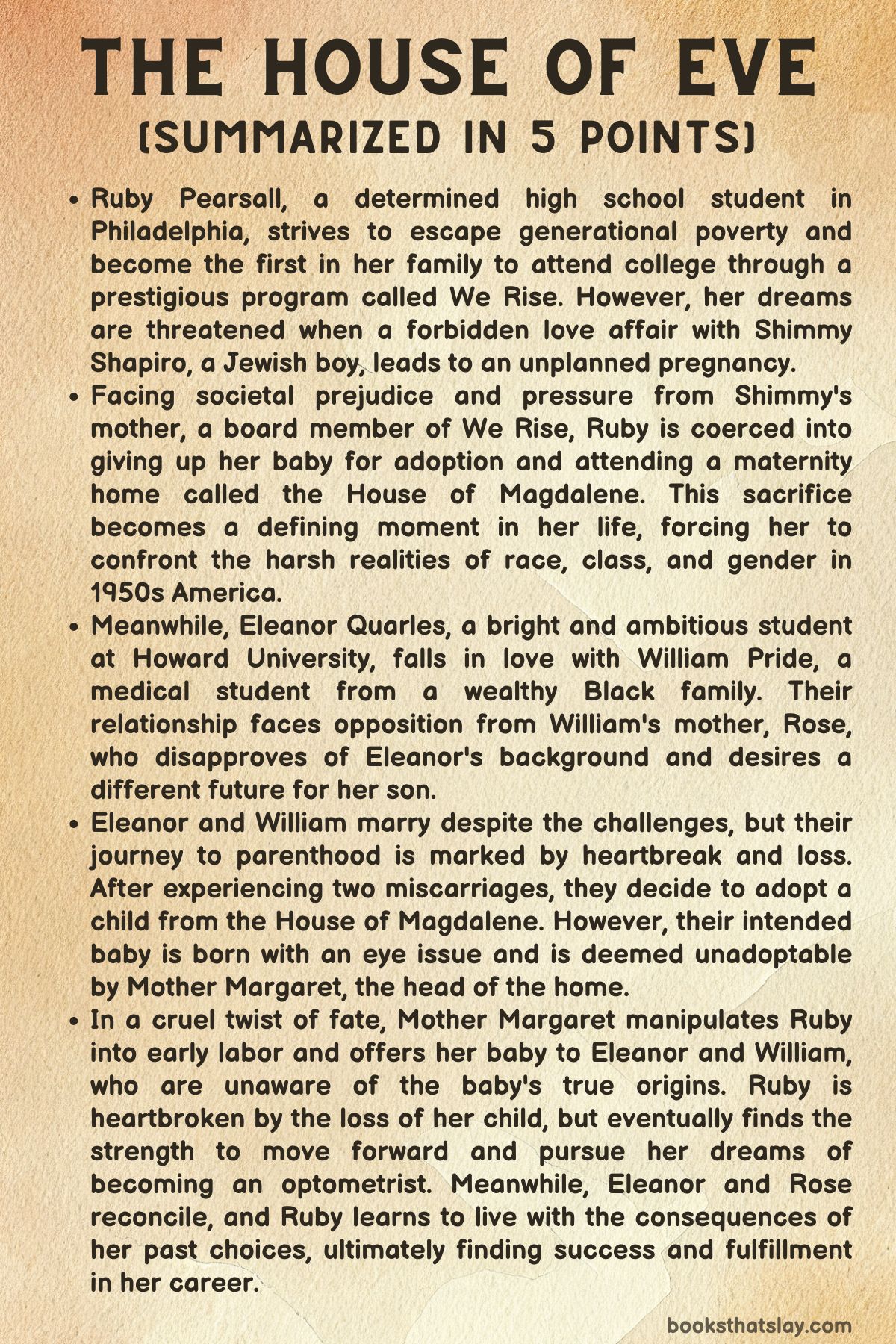
Summary
Ruby Pearsall is a teenager living in Philadelphia with her grandmother, mother, and cousin. She is ambitious, determined to escape poverty through education, and participates in the We Rise program, where only a few students will earn coveted scholarships.
Despite her dedication, Ruby faces constant obstacles—from her cousin’s irresponsibility to her mother’s neglect and outright hostility. When her mother’s boyfriend, Leap, tries to take advantage of her, Ruby is blamed and thrown out of her home.
Forced to live with her Aunt Marie, Ruby finds some stability but continues to feel the strain of pursuing her dreams while dealing with the daily realities of poverty and racial discrimination.
At Aunt Marie’s, Ruby discovers a love for painting and meets Shimmy Shapiro, the Jewish landlord’s son. Their growing connection is tender but fraught with danger, given the racial and cultural divisions of the time.
Despite warnings from Aunt Marie and open hostility from Shimmy’s community, Ruby finds herself drawn to him. Shimmy becomes both a source of support and a reminder of the barriers society has placed between them.
Ruby pushes forward with her schooling, excelling in the We Rise program while secretly nurturing her bond with Shimmy. But her journey takes a difficult turn when she becomes pregnant.
Shimmy’s mother intervenes, offering Ruby a cruel bargain: go to a home for unwed mothers in Washington, D.C., surrender her child for adoption, and in exchange secure her scholarship to Cheyney University. Ruby reluctantly accepts, believing she must sacrifice love and motherhood for her future.
Meanwhile, Eleanor Quarles is a sophomore at Howard University, ambitious yet insecure about her place in elite social circles. When she is rejected from Alpha Beta Chi, a prestigious sorority, she feels humiliated but presses on with her studies.
At the library where she works, she catches the attention of William Pride, a medical student from a wealthy and influential family. Their relationship blossoms, marked by dates, late-night conversations, and shared dreams.
But their love faces resistance: William’s mother, Rose, sees Eleanor as unworthy, while Greta Hepburn, William’s longtime acquaintance, tries to push Eleanor out of the picture. Despite these challenges, Eleanor and William marry, but their happiness is overshadowed by Eleanor’s struggles with repeated miscarriages.
Eleanor’s inability to carry a pregnancy to term becomes a central tension in her marriage. After another devastating loss, she and William are introduced to Mother Margaret, who runs a home for unwed mothers.
Mother Margaret offers them the opportunity to adopt discreetly from among the young women in her care, ensuring their reputations remain intact. Eleanor agrees, but insists the adoption be kept secret, maintaining the appearance that she herself carried the child.
Rose Pride inserts herself into the process, orchestrating Eleanor’s public appearances and shaping the adoption plan.
At the same time, Ruby enters the House of Magdalene, run by Mother Margaret. The home is strict and punishing, with rigid routines designed to instill shame and repentance in the girls.
Ruby forms connections with the other residents, especially Loretta, another expectant mother. Despite the camaraderie, the environment is harsh, and Ruby struggles with the emotional toll of her situation.
Eventually, she gives birth to a baby girl, whom she names Grace, but is forced to surrender her to adoption. The loss leaves Ruby devastated, but she returns to Philadelphia determined to focus on her education.
She pushes Shimmy away, convinced that her future lies in independence rather than forbidden love.
Eleanor and William, meanwhile, are presented with a baby girl at the House of Magdalene. Though Eleanor expected a boy, she accepts the child, whom they name Wilhelmina, or Willa.
Eleanor tries to settle into motherhood, but her doubts grow as she senses Rose’s involvement runs deeper than she admitted. She begins to suspect that William himself might have fathered the baby, though these fears are fueled more by secrecy and mistrust than fact.
Overwhelmed, Eleanor flees to her mother’s home in Ohio, where she confesses everything. Her mother counsels her to fight for her marriage and not let Rose dictate her future.
Rose herself later visits, admitting to orchestrating the adoption but insisting William is not Willa’s biological father. She pleads with Eleanor to protect her family and offers a token of peace.
Ultimately, Eleanor reconciles with William, choosing to focus on building their life together and raising Willa. Ruby, though marked by loss, secures her scholarship and pursues her dream of becoming an optometrist.
Thirteen years later, in 1964, Eleanor has established herself as an archivist, William has advanced in his medical career, and Willa is a spirited teenager. In a quiet but significant moment, Eleanor meets Ruby, now Dr. Ruby Pearsall, who has achieved her dream despite the hardships she endured.
Though neither woman speaks of it, there is an unspoken bond between them—the shared history of a child who once connected their lives.
The House of Eve is a story of ambition, sacrifice, and resilience. Through Ruby and Eleanor, it examines how women navigate love, loss, and the relentless pressures of race and class in mid-twentieth-century America.
Their journeys highlight the costs of survival but also the enduring strength required to carve out a future against the odds.
Characters
Ruby Pearsall
Ruby’s story in The House of Eve is one of resilience, ambition, and heartbreaking sacrifice. Growing up in Philadelphia in 1948, she dreams of becoming an optometrist despite the poverty, neglect, and betrayal she faces at home.
Ruby is constantly undermined by her cousin Fatty’s irresponsibility and her mother Inez’s cruelty, culminating in the devastating moment when Inez blames her for Leap’s assault and throws her out. Her refuge becomes Aunt Marie’s home, where she finds both stern guidance and encouragement.
Ruby’s bond with Shimmy Shapiro introduces a forbidden yet tender romance that reveals her longing for love and acceptance, though societal and racial barriers loom heavily over them. Ruby’s artistic pursuits and her perseverance in the We Rise program highlight her determination to rise above her circumstances.
However, her unplanned pregnancy and subsequent coerced adoption mark a turning point—she sacrifices her daughter Grace in exchange for a chance at education. This loss becomes a scar that defines her adulthood, even as she eventually realizes her dream of becoming a doctor.
Ruby embodies both the tragedy of constrained choice and the power of persistence against systemic injustice.
Eleanor Quarles
Eleanor’s arc in The House of Eve reflects a young woman’s struggle for belonging, recognition, and stability. A studious Howard University student from Ohio, Eleanor is ambitious yet plagued by insecurities about her background and her rejection from elite social circles.
Her relationship with William Pride brings her both joy and immense pressure, as she must navigate the class and color prejudices of his wealthy family. Eleanor’s work at the library under Dorothy Porter reveals her intellectual depth and passion for history, grounding her amidst the turbulence of romance and societal expectations.
The devastating miscarriages she endures, culminating in her secret adoption of Ruby’s child, expose her vulnerability and the harsh medical and social realities faced by women at the time. Eleanor is pragmatic and deeply human; her love for William and her eventual devotion to Willa keep her tethered, but she is often at the mercy of forces beyond her control—whether Rose Pride’s manipulation or societal conventions.
In later life, Eleanor’s professional success as an archivist reflects her resilience, though the haunting silence of her sacrifices never fully fades.
William Pride
William Pride serves as both a romantic hero and a symbol of privilege in The House of Eve. A medical student with charm, ambition, and sincerity, he offers Eleanor affection and a glimpse of a life filled with security and promise.
However, William is also shaped by the weight of his family’s expectations, especially those of his mother, Rose. While he clearly loves Eleanor, his deference to his mother’s influence and his secrecy surrounding their adoption arrangement highlight his flaws.
William is torn between protecting Eleanor and preserving his family’s legacy, and his choices often force Eleanor into situations where she feels powerless. Despite his shortcomings, his remorse and attempts at reconciliation reveal genuine care.
William embodies the complexities of a man who wants to break free of social conventions yet cannot entirely resist the pull of his privileged upbringing.
Rose Pride
Rose Pride is one of the most formidable figures in The House of Eve, embodying both the ruthlessness and protectiveness of a mother navigating the fragile intersection of race, class, and family reputation. As the matriarch of the Pride family, Rose is sharp, calculating, and deeply entrenched in respectability politics.
She orchestrates Eleanor’s adoption of Ruby’s baby with cold efficiency, ensuring secrecy and shaping appearances to preserve her family’s standing. Her harsh treatment of Eleanor, rooted in class prejudice and elitism within the Black community, makes her both antagonist and savior.
Yet Rose is not entirely devoid of vulnerability; her eventual candid conversation with Eleanor reveals a woman motivated by survival and maternal instinct, even as her methods are ruthless. She is both a villain in Eleanor’s eyes and a guardian of the Pride legacy, embodying the painful contradictions of generational power.
Aunt Marie
Aunt Marie is Ruby’s anchor amid chaos, providing her with discipline, shelter, and encouragement at her lowest moments. Unlike Ruby’s mother Inez, Aunt Marie is protective and unflinchingly honest, urging Ruby to prioritize education above fleeting romance.
Though stern, she shows deep compassion, comforting Ruby after racist encounters and supporting her during her most vulnerable experiences. Aunt Marie represents the pragmatic, nurturing figure who believes in Ruby’s potential even when Ruby herself falters.
She becomes a symbol of tough love and grounded wisdom, shaping Ruby’s perseverance and eventual success.
Shimmy Shapiro
Shimmy is Ruby’s forbidden love, a Jewish boy whose warmth, sincerity, and shared vulnerability create a rare safe space for her. Their relationship defies both racial and societal barriers, offering Ruby moments of joy, intellectual companionship, and tenderness.
Shimmy admires Ruby’s art, encourages her dreams, and dreams of a future with her. Yet the prejudices of the time make their bond precarious, culminating in the painful separation forced upon them.
Shimmy’s persistence and genuine love highlight what could have been, making his character a tragic counterpart to Ruby’s ambitions. His presence underscores both the hope of human connection and the crushing power of systemic barriers.
Inez
Inez, Ruby’s mother, is one of the most complex and tragic characters in The House of Eve. Hardened by her own experiences of abandonment and disillusionment in love, she projects bitterness onto Ruby, often blaming her for misfortunes and showing little maternal warmth.
Her relationship with Leap further alienates Ruby, as Inez prioritizes her own desires over her daughter’s safety. Yet Inez is not wholly unsympathetic; her confession about Ruby’s father reveals a woman scarred by betrayal, trapped in cycles of survival and disappointment.
In many ways, Inez reflects the generational wounds that Ruby is desperate to escape, representing the harsh realities of women limited by circumstance and poor choices.
Themes
Race and Social Barriers
In The House of Eve, the weight of race and its social consequences presses heavily on the lives of both Ruby and Eleanor. Ruby’s experience in Philadelphia demonstrates how systemic racism controls even the smallest aspects of daily life—where she can sit, whom she can befriend, and how society judges her aspirations.
Her friendship and eventual romance with Shimmy Shapiro reflect the difficulty of crossing racial lines, as both families and communities enforce divisions that make genuine connection dangerous. Eleanor, though navigating life within the relatively protected walls of Howard University, also confronts exclusion—her rejection from the sorority and her encounters with William’s mother, Rose, highlight the ways colorism and classism shape intraracial dynamics.
The distinction between lighter-skinned, affluent African Americans and darker-skinned, working-class individuals underscores how prejudice works not only across racial lines but within them. These barriers dictate opportunities, relationships, and social legitimacy, demonstrating that race is not a background detail but the central force shaping futures.
The novel insists on showing how deeply entrenched these structures are, creating an environment where love, ambition, and even motherhood become sites of conflict with the outside world.
Motherhood and Loss
Motherhood is depicted as both a source of empowerment and deep vulnerability. Ruby and Eleanor’s parallel experiences with pregnancy reveal how women’s bodies are policed, silenced, and commodified.
Ruby is forced into the Magdalene home, where her pregnancy becomes the justification for confinement, moral judgment, and ultimately the loss of her child. Eleanor, meanwhile, faces the repeated trauma of miscarriages and the desperation that leads her to adopt secretly, constructing an elaborate false pregnancy to protect her reputation and satisfy her husband’s family expectations.
In both storylines, motherhood is never private; it is managed by institutions, families, and religious figures who impose rules on women’s choices. The grief of losing children—Ruby’s Grace surrendered to adoption, Eleanor’s miscarriages, and her adoption of Willa under secrecy—illustrates how women’s autonomy is constantly undermined.
Yet, despite their grief, both women display resilience: Ruby returns to education, Eleanor builds a professional life. The theme of motherhood ultimately reveals the ways women reclaim dignity even when society reduces them to vessels for lineage, respectability, and appearances.
Ambition and Education
Education is positioned as the pathway to freedom, though it comes burdened with obstacles. Ruby’s dream of becoming an optometrist anchors her decisions, even as poverty, her family’s betrayal, and an unexpected pregnancy threaten her path.
Her commitment to the We Rise program is more than personal ambition; it represents her attempt to break generational cycles of hardship and claim a professional identity in a world that restricts Black women’s opportunities. Eleanor, on the other hand, pursues history and finds intellectual validation in her work with Dorothy Porter, yet her educational journey is also threatened by financial strain and the distractions of romance and societal expectations.
Both women’s stories highlight how access to education is fragile, requiring perseverance against systemic barriers. At the same time, education symbolizes more than a degree—it becomes the means of self-definition and a tool to resist the confinement of gender and race.
The novel suggests that for women like Ruby and Eleanor, education is not simply about personal success but about rewriting the narratives that society assigns to them.
Class, Colorism, and Respectability
The theme of class runs parallel to race, shaping how characters are perceived and accepted within their communities. Eleanor’s entrance into William Pride’s family exposes her to a world of affluence and social codes built on generations of respectability politics.
Rose Pride’s coldness reflects not only racial prejudice against darker skin but also disdain for Eleanor’s working-class origins. Her insistence on controlling the adoption and public perception of Eleanor’s “pregnancy” shows how class and reputation matter as much as lineage.
Similarly, Ruby’s relationship with Shimmy highlights not just interracial tension but also class disparity: while he is the son of a small business owner, she comes from instability and poverty. Their bond challenges both families’ sense of propriety and reveals how love is judged not only by race but also by social standing.
Respectability becomes its own oppressive system, demanding women conform to ideals of chastity, refinement, and moral purity, even as they are denied choices. This tension between individual desire and social expectation highlights the suffocating impact of class and colorism, showing how aspirations are often curtailed not by lack of ability but by the weight of external judgment.
Love, Sacrifice, and Secrecy
Throughout The House of Eve, love is both a saving force and a source of sacrifice. Ruby’s relationship with Shimmy offers genuine warmth and mutual respect, yet it demands impossible compromises in the face of racial and familial barriers.
Her choice to give up their child is portrayed as an act of sacrifice—choosing education and survival over personal desire. Eleanor’s love for William is complicated by secrecy, beginning with her hidden miscarriage and continuing through the adoption of Willa.
Their marriage endures not because it is free of pain but because of repeated negotiations, compromises, and the decision to protect love despite betrayal and manipulation. The secrecy surrounding both women’s children, however, lingers as a burden that shapes their futures.
Love in this novel is never presented as simple or purely fulfilling; it is always tested by the structures of society. Yet, the persistence of love, whether maternal, romantic, or communal, demonstrates resilience.
Even when secrecy and sacrifice are forced upon them, both Ruby and Eleanor insist on loving deeply, which becomes their quiet form of resistance against the forces trying to control their lives.