The Killer Question Summary, Characters and Themes
The Killer Question by Janice Hallett is a mystery told through messages, emails, and case documents. Dominic Eastwood wants to persuade a TV company to revisit the death of his aunt and uncle, Sue and Mal Eastwood, former police officers who later ran a remote riverside pub called The Case is Altered.
Dominic believes the public story missed key turns, and he feeds the material to a producer as if it were a show unfolding in real time. What begins as a quirky look at pub-quiz rivalries becomes a dark investigation into cheating, revenge, and a buried past that connects the Eastwoods’ policing days to a murder by the river.
Summary
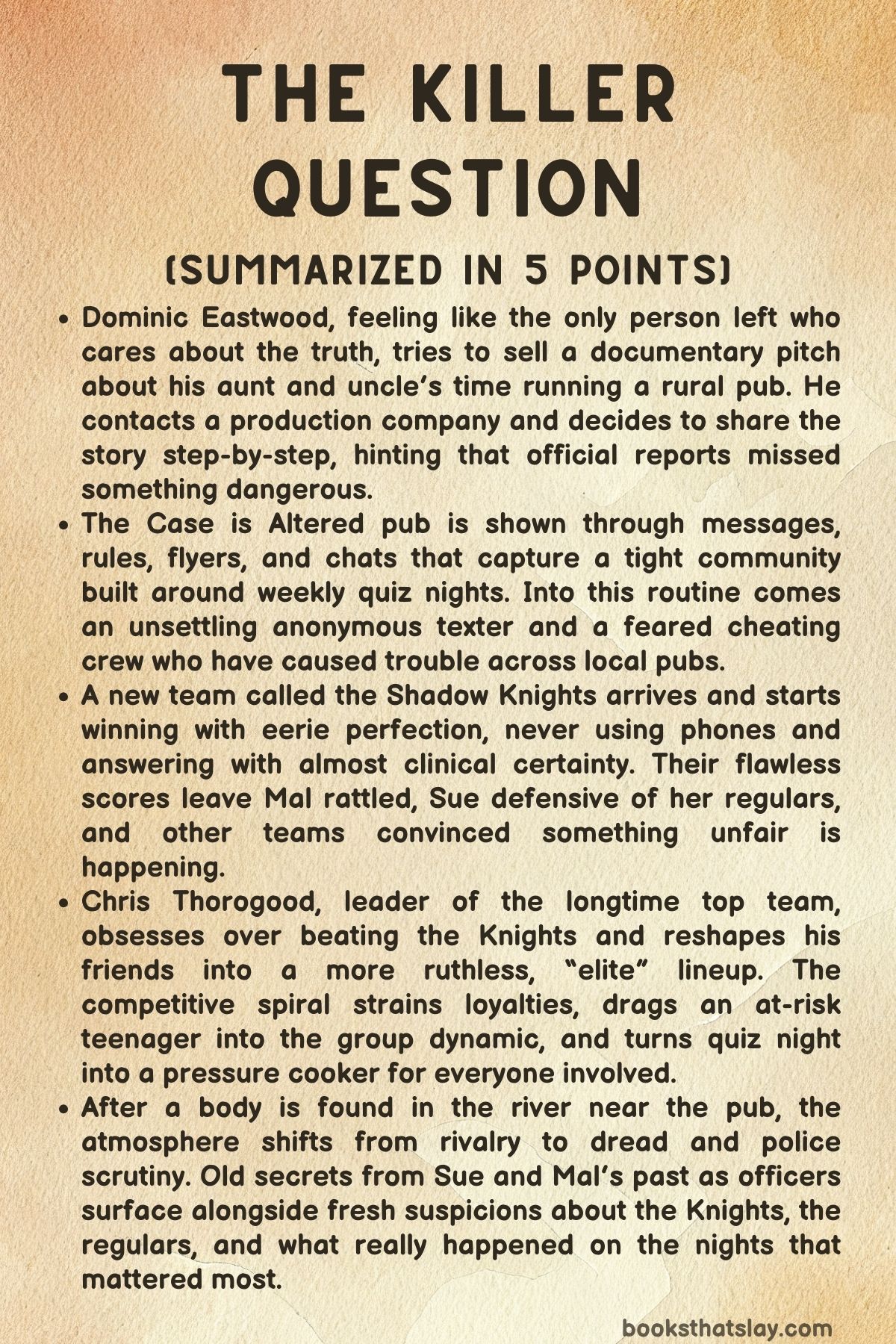
Dominic Eastwood contacts Netflix in October 2024 with a pitch for a true-crime documentary about his aunt and uncle, Sue and Mal Eastwood. He says the case is shocking and badly understood in the press, and that he has access to the full police file.
Netflix rejects him automatically, so he tries a smaller company, Reel Life Productions. A production assistant, Polly Baker, replies with cautious interest.
Dominic asks her not to research the case yet because the headlines are incomplete. Instead, he promises to send the story bit by bit so she experiences the surprises as a viewer would.
He begins by describing The Case is Altered, a decaying country pub on a quiet lane near the River Colne. Sue and Mal were landlords there from late 2017 to 2019.
Dominic had little contact with them due to family estrangement, but he paints them as dedicated hosts who turned the pub around with renovation and a popular weekly quiz night. He hints that learning too much about what happened can be dangerous.
The narrative shifts to records from September 2019, focusing on the pub quiz culture among local landlords tied to Ye Olde Goat Brewery. Sue and Mal follow strict rules: small entry fee, teams capped, no phones, and the quizmaster’s ruling final.
An unknown mobile number starts texting Sue about the quiz. Mal thinks the messages feel off and wants to involve PCSO Arthur McCoy, a local officer who knows the pub.
Sue sees it as harmless curiosity and replies politely. The number keeps asking for directions and the road name.
When Sue finally says it’s “Bell End,” the texter jokes about her being rude. Sue laughs it off; Mal doesn’t.
Around the same time, other pubs warn about a notorious cheating quiz team. In the brewery WhatsApp group, landlords swap stories of “The Cheats,” led by a thin man in a bright orange puffy jacket, nicknamed Satsuma Man, with several rough friends.
The Cheats have been thrown out elsewhere for phone use and intimidation. Sue is clear that if they come to The Case, she wants no sympathy for them.
On 2 September, the unknown number announces it is coming to the quiz. Sue sends a long, friendly message with directions and rules.
That night, the Cheats appear and are quickly disqualified for breaking the no-phone rule. Mal escorts them out and gets into a scuffle outside.
When Arthur McCoy arrives, the group has already gone. The regulars cheer Mal’s firmness, and landlords in the group chat congratulate Sue and Mal, though some warn that such punters can hold grudges.
Mal boasts about giving Satsuma Man a black eye.
A week later, the tone changes. The unknown number returns, now more articulate, and says it wants to bring a six-person team.
That night a new group arrives calling themselves the Shadow Knights. They are calm, nerdy, and unusually focused.
They don’t use phones, drink lightly, tip well, applaud Mal’s hosting, and win with a very high score. Their spokesman, who later identifies himself only as “The General,” texts Sue after the quiz with polite thanks and odd little facts about history and words.
Sue is curious and a bit flattered. Mal feels unsettled.
The Shadow Knights return on 16 September and achieve a perfect score. Mal is stunned.
He considers switching to much harder questions, but Sue refuses, arguing that ordinary teams will stop coming if the quiz becomes punishment. Chris Thorogood, leader of the pub’s long-standing top team, the Plucky Losers, is furious about losing their table and their pride.
Convinced the Knights must be cheating, he persuades Mal to give him their answer sheets. When he sees them, Chris is creeped out by how tidy they are: no hesitations, no corrections, every answer written cleanly.
Sue discovers Mal’s betrayal of one team’s privacy, explodes at him, and bans him from doing it again. Chris takes the neatness as proof of foul play.
Chris and his partner Lorraine decide the only way to beat the Knights is to rebuild their team into a specialist unit. They recruit Andrew, a council housing officer with political and science knowledge, and poach Ajay from another team, causing resentment.
They then cut a loyal member, Jim, calling him “dead wood,” and rename themselves the Sturdy Challengers. Chris also wants a younger player for pop culture, so Andrew awkwardly invites Fiona, a 19-year-old client living in temporary accommodation.
Fiona joins in clipped, guarded messages.
Mal, still rattled, tries to expose cheating by making the quiz far harder. On 23 September he adds obscure trivia, tricky formats, and a long flags round.
For the music round he secretly plays a fake track he composed and uploaded only that evening, hoping a song-ID app will fail. Everyone misses the fake track, but the Shadow Knights still dominate, missing only one point.
Their answer to the fake track seems like a sly message back, suggesting they knew what he was attempting. Mal starts to believe they aren’t using obvious tech.
Other teams suffer under the new difficulty. One team admits to quickly searching flags on a phone and withdraws in shame.
Mal warns that any phone use is cheating, no matter the reason. On 30 September he goes further, making the marathon round a full periodic table.
Chris accuses him of setting traps just to test the Knights. The Knights crush the night anyway, while the Challengers fall apart.
Sue tells Mal he’s damaging the pub for the sake of a private obsession.
Early the next morning, debris shifts near a burned-out pier on the river beside the pub. Police find a decomposing body pinned underwater by a sharpened metal spike.
The dead man is wearing an orange puffy jacket: Luke Goode, believed to be Satsuma Man. The Case is Altered becomes a police base.
Mal admits that on 2 September he fought with Luke while throwing out the Cheats, but insists he never saw him again and doesn’t know how he ended up dead.
By 4 November, the pub tries to continue as normal. The Shadow Knights don’t show up, and the regular teams enjoy a rare open contest.
The Sturdy Challengers win by a single point and celebrate in their group chat, while rival teams complain and gossip. Sue and Mal text the General, urging him to return.
He replies with more pedantic trivia and mentions seeing a man at another quiz who had once been jailed for conning elderly people at cashpoints, hinting at a wider underworld around quizzes and petty crime.
Soon Sue meets Stephanie, Luke’s partner, who arrives distraught. From her, Sue learns the Shadow Knights are rough sleepers and hostel residents who travel from quiz to quiz for money.
Even small winnings matter to them. Stephanie denies that they vandalised the pub or hold a grudge against the Eastwoods, but Sue can see how their presence could bring trouble.
The Shadow Knights visit another pub, Tom’s Bar, and ruin the night with their ruthlessly literal style. They argue about official answers and refuse to allow leniency for a dyslexic contestant, leaving the hosts shaken.
Back at The Case, local landlords debate how to handle such players, and Mal defends strict fairness.
The murder inquiry deepens. Arthur McCoy tells Mal the spike pinning Luke came from an old scarifier stored on pub land and had been sharpened into a weapon.
DNA on it belongs to a woman. Police re-interview Harrison Walker, a man seen heading toward the river that fatal night.
Harrison admits he went there for a Grindr meet-up that failed, and says he saw no one. He seems credible, but suspicion widens.
Intercut documents from 2014 reveal Sue and Mal’s earlier careers as police on Operation Honeyguide, a kidnapping case involving two girls, Chloe Cunningham and Beata Novak. Beata is found dead, Chloe missing.
Notes suggest Sue and Mal overstepped orders and, more chillingly, that they had once covered up a killing. Chloe’s father later uses that secret to blackmail them into helping with a desperate, risky payoff to the kidnappers.
The past is not dead; it is leverage.
After the 11 November quiz, where the Shadow Knights return and win again, Andrew grows worried about Fiona. He notices her vanishing for two rounds and fears she is tangled in something dangerous at the pub.
Fiona replies evasively. Dominic’s assembled files leave Polly — and the reader — with a widening sense that Luke’s death, the Shadow Knights’ odd perfection, Fiona’s fragility, and the Eastwoods’ old secret are all parts of one case, and that the real killer question is still waiting to be answered.
Characters
Dominic Eastwood
Dominic Eastwood emerges as the contemporary framing voice of The Killer Question, positioning himself as both investigator and storyteller. Estranged from Sue and Mal by family rifts he only half understands, he compensates with determination and a slightly theatrical need to control how the story is consumed.
His emails show a practiced pitchman’s instinct—hooking producers with promises of hidden twists—yet also a personal urgency: he wants to reassert ownership over a family tragedy and perhaps over his own place in it. Dominic’s insistence on revealing facts in “bite-sized chunks” suggests a manipulative streak wrapped in genuine grief, hinting that his narration may be unreliable, performative, or shaped by resentment.
The abandoned pub he trespasses into mirrors him: someone forcing entry into a locked past that may not want to be reopened.
Polly Baker
Polly Baker is the first outside-world filter Dominic meets, functioning as a cautious gatekeeper with professional instincts. Her reply is polite but pragmatic: she is interested only if the story can be corroborated through multiple perspectives, which signals a producer’s skepticism toward single-source narratives.
Polly’s role is small in the summaries, but her presence matters because she represents the ethical and structural pressures of true-crime storytelling—verification, access, and liability—standing in contrast to Dominic’s appetite for suspense over completeness. She is also a subtle mirror for the reader, being asked to experience revelations in the same staged way Dominic plans to stage them for an audience.
Sue Eastwood
Sue Eastwood is the emotional and social center of the pub’s world, blending warmth, stubborn optimism, and a dangerous habit of underestimating threats. As landlord and quiz co-host, she values community comfort over competitive purity, pushing back when Mal’s escalating difficulty damages regulars’ enjoyment.
Her texts reveal a personality that defaults to friendliness even when uneasy—she over-explains directions to a harassing stranger, reframes Luke Goode’s corpse as possible publicity, and repeatedly invites the Shadow Knights back despite their destabilizing effect. Yet Sue is not naïve; she enforces ethical boundaries, such as refusing to share a customer’s details and scolding Mal for handing over answer sheets.
The later revelation that she is an ex-police officer who once covered up a killing reframes her cheeriness as a practiced mask for someone who knows exactly how messy human motives can get.
Malcolm “Mal” Eastwood
Mal Eastwood is driven by pride, control, and a moral code that is both rigid and selectively flexible. He is the quiz architect who sees the event as craft and turf, reacting to perceived cheating with escalating tests that become as much about his ego as fairness.
Mal’s impulse toward confrontation shows early in his physical ejection of the Cheats and later in his covert fake-track trap, pointing to a man who prefers direct proof and personal action over bureaucratic process. At the same time he lies to protect the pub’s image with the brewery, suggesting he is willing to bend truth when it preserves autonomy.
His police background and hinted complicity in an earlier cover-up place a darker shadow under his present-day righteousness: the man obsessed with rules is also someone who once evaded them, and that contradiction makes him a plausible suspect as well as a tragic figure.
PCSO Arthur McCoy
Arthur McCoy functions as the story’s local law-and-order anchor, close enough to the pub world to be trusted but still representing official scrutiny. He is methodical and quietly observant, arriving after the Cheats incident, noting Mal’s statement, and later discovering the scarifier spike’s origin and female DNA trace.
Arthur’s handling of Harrison Walker shows him as a careful investigator rather than a bulldozer; he checks inconsistencies, listens to explanations, and updates Mal without theatricality. His presence steadily tightens the narrative noose around the pub, making him both protector and threat to the Eastwoods’ hidden past.
Warwick Roper
Warwick Roper, the brewery general manager, represents institutional reputation and commercial pragmatism. He is appalled by Mal’s ugly bike racks yet satisfied by their low cost, capturing his dual priorities of brand image and profit.
After Luke’s body is found, Roper’s main concern is notoriety and backlash, making him a pressure point on Sue’s more opportunistic instincts. He is not portrayed as cruel, but he is relentlessly managerial, and his reactions help show how fragile the pub’s survival is when public perception turns sour.
Chris Thorogood (“Thor’s Hammer”)
Chris Thorogood is the combustible engine of the quiz-team subplot, fueled by entitlement and competitive obsession. His fury at being displaced by the Shadow Knights transforms quickly into paranoia and a crusade against imagined cheating, and that desperation drives him into ethically murky territory—pressuring Mal for answer sheets and treating teammates as disposable tools.
Chris has charisma and leadership energy, but it curdles into arrogance: he believes the Plucky Losers’ table is a birthright and that losing must be unnatural. His recruiting spree and renaming of the team into the Sturdy Challengers reveal a man who treats community as hierarchy.
He is less a villain than an example of how pride plus insecurity can corrode friendship into strategy.
Lorraine
Lorraine is Chris’s chief partner in ambition, articulating the ruthless logic he sometimes blusters through. She is the one who actively pushes recruitment, frames Jim as “dead wood,” and sees revamping as necessary evolution rather than betrayal.
Lorraine’s practical, almost corporate approach to quizzing suggests she values winning as self-validation, and her willingness to cut friends implies a capacity for coldness that could extend beyond trivia. Still, in context she reads as someone swept up in competitive panic, illustrating how ordinary people become harsh when they feel threatened by an unbeatable force.
Rita
Rita is part of Chris’s inner circle and reflects the team’s loyalty culture. Her promise to arrive early and physically claim the table shows both commitment and a slightly childish territorial instinct, aligning her closely with Chris’s belief that status in the pub should be defended like property.
She does not dominate the narrative, but her eagerness supports the sense that the Challengers are a social clique with shared pride, not merely a group of harmless hobbyists.
Bailey
Bailey functions as another loyalist in the Sturdy Challengers orbit, but with an added hint of unease and perception. The later claim that Bailey “saw something” the night Luke died plants him as a potential witness or unreliable rumor-source; his experience becomes part of the pub’s folklore and a spark for supernatural framing by others.
Bailey’s role shows how peripheral people can become central through what they might have noticed.
Andrew
Andrew is a layered outsider pulled into the drama from civic life, carrying both knowledge value and moral anxiety. His miserable council job and willingness to join a quiz team for escape make him sympathetic, while his expertise in politics and current affairs turns him into a strategic asset.
Yet his discomfort about inviting Fiona—someone he knows through housing work—exposes his conscience, and his later worry about her disappearances suggests a protective instinct that contrasts sharply with Chris’s utilitarian approach. Andrew becomes the narrative’s ethical barometer inside the Challengers, sensing danger earlier than the rest.
Ajay
Ajay is the talented poach whose transfer dramatizes how competition fractures community. He brings specialist knowledge and youth that Chris craves, but his move creates resentment among his old cycling teammates and highlights Chris’s predatory recruitment style.
Ajay seems less ideologically invested than swept along by the promise of a stronger, more respected team, making him an example of how social ambition can override loyalty.
Jim
Jim represents the human cost of Chris and Lorraine’s obsession. Being labeled “dead wood” devastates him because the quiz team is clearly more than a pastime—it is identity and belonging.
His anger and hurt underline the cruelty of framing friendship as a roster to optimize. Jim’s sidelining also introduces a possible motive for bitterness toward the Challengers or the pub, a reminder that humiliation can ferment into later conflict.
Keith
Keith appears mainly as a member of the Sturdy Challengers lineup during their 4 November victory. His low narrative profile makes him a stabilizing background presence: a typical teammate swept into Chris’s orbit who helps show the team’s size and normality.
He is significant mostly as part of the social ecosystem that Chris reshapes.
Fiona
Fiona is one of the most morally charged characters, intersecting vulnerability, suspicion, and agency. A nineteen-year-old in temporary accommodation, she is recruited partly as a knowledge upgrade but also through Andrew’s uneasy professional proximity, placing her at the center of ethical tension.
Her clipped, evasive texts signal wariness and self-protection, while her quiet switching between teams suggests she does not feel safe in Chris’s controlling environment. Her mysterious disappearances during quiz rounds, along with Andrew’s alarm and the looming murder case, position Fiona as either endangered, complicit, or both.
She embodies how precarious people are often pulled into other people’s games, yet her guardedness hints she may be playing a game of her own.
“The General” (Shadow Knights spokesman)
The General is the Shadow Knights’ courteous mask and intellectual provocateur. His messages are elegant, pedantic, and amused by language history, suggesting a man who enjoys the performance of knowledge as much as possession of it.
He refuses to explain how the Knights know so much, which makes him unsettling: politeness becomes a form of dominance, a way to win without revealing vulnerability. His later remark about spotting an ex-con who exploited elderly cashpoint users shows that he watches people as carefully as questions, hinting at a moral code that is sharp but aloof.
The General feels like someone who has been socially marginalized yet reclaims power through perfect certainty.
The Shadow Knights (team as a collective)
As a group, the Shadow Knights function almost like an antagonist force: calm, silent, unbeatable, and socially disruptive. Their nerdy focus, lack of visible phones, light drinking, and precise answer sheets make them appear machine-like, provoking paranoia in others.
Yet their homelessness and reliance on prize money reveal them as desperate rather than sinister, and their literal, rule-bound approach to quizzing suggests they cling to certainty because life offers them so little. They embody an unsettling contradiction: victims of society who become villains in a small community simply by outclassing it.
Ed (Shadow Knights member)
Ed appears briefly as a rumored flirtation point with Fiona, which adds texture to the Knights as people rather than abstractions. The gossip implies he may be more socially engaged than the group’s general coldness suggests, and it also hints at how Fiona might be entangled with them personally, not merely competitively.
Luke Goode
Luke Goode is the dead man whose body catalyzes the murder narrative. At first he is only a stereotype in pub lore—Satsuma Man in an orange puffy jacket, leader of cheating troublemakers—but his death complicates that simple role.
He is both threat and victim: ejected violently by Mal, later found pinned under water by a spike from pub land. Luke’s identity as part of a rough-sleeping, prize-hunting quiz circuit makes him emblematic of the social underclass drifting through spaces that do not fully want them.
His murder forces the community to confront how easily disdain can slide into violence.
Stephanie
Stephanie is Luke Goode’s partner and the story’s doorway into the Shadow Knights’ real lives. Her arrival in tears and her blunt explanation of poverty strip away the pub regulars’ comfortable narrative that the Knights are just arrogant cheaters.
Stephanie’s denial of vandalism and insistence that small winnings matter for survival make her a humanizing witness, and her willingness to speak to Sue suggests a fragile trust between outsider and community.
Mimi
Mimi, co-owner of Tom’s Bar, appears through pub-landlord group chats as part of the collective defensive network against cheating teams. Her warnings and shared experiences help build the sense of a tight but gossip-driven rural trade culture, where stories spread fast and often shape reality.
Flo
Flo, Mimi’s partner at Tom’s Bar, shares Mimi’s role in the landlord chorus. Her presence underlines the cooperative vigilance of the pub circuit and sets up Tom’s Bar as a comparison point showing how the Shadow Knights poison atmosphere even when they do nothing overtly illegal.
Diddy
Diddy, landlord from The Brace of Pheasants, is another node in the regional pub web. His earlier refusal of the Cheats demonstrates that the cheating problem is widespread and that some landlords choose preemptive exclusion over Mal’s confrontational approach.
Con
Con, Diddy’s co-landlord, supports the same collective memory of the Cheats. Both Con and Diddy function as reinforcing witnesses to Mal’s story about the orange-anorak gang, making their shared recollections part of the evidence landscape.
Jojo
Jojo from Ami’s Manic Carrots is impulsive, gossipy, and socially anxious. Her desire to obtain a Shadow Knight member’s details for Rosie displays the pub’s matchmaking undercurrent, while her abrupt retreat when Sue suggests asking the father hints at embarrassment or fear of overstepping.
Jojo’s later anger about quiz points and Fiona’s usefulness shows her as someone who externalizes frustration, amplifying tensions rather than easing them.
Rosie
Rosie is absent except as the object of Jojo’s matchmaking. Her off-stage presence still matters because it shows how even a dominant, cold team like the Shadow Knights sparks desire and curiosity among locals, not just resentment.
Harrison Walker
Harrison is a minor but crucial figure because police attention lands on him as a possible witness or suspect. His explanation about going to the river for a Grindr date that failed frames him as socially isolated and a bit unlucky, and the fact that Arthur believes him positions Harrison as credible.
He illustrates how innocent private life can look suspicious under the floodlight of murder.
Linda
Linda is a long-running quiz regular who absorbs and redistributes the pub’s anxieties. Her messaging with Wind and Cloud shows her open to supernatural framing when rational explanations feel inadequate, and her recollection of the rough men ejected that night connects social rumor to investigative narrative.
Linda bridges the ordinary quiz world and the creeping dread after Luke’s death.
Joe
Joe is largely present through the team name “Linda & Joe & Friends,” suggesting a supportive partner embedded in the same social circle. His minor role emphasizes that many pub participants are couples or small friendship networks for whom the quiz is weekly ritual rather than battlefield.
Cloud
Cloud, a former police officer, gives the supernatural subplot a paradoxical legitimacy: he has institutional authority yet speaks of deeper evil. His stance implies that even trained, rational people can reach for metaphysical language to explain violence, and his past policing adds weight to the theme of hidden corruption that also haunts Sue and Mal.
Wind
Wind is the spiritualist whose claim of malevolent energy offers a competing lens to the murder case. His sensations about the waters and his statement that Bailey saw something create an atmosphere of dread and show how communities mythologize trauma.
Wind is less a factual source than a cultural force, shaping what people fear and therefore what they suspect.
Sid
Sid from Let’s Get Quizzical is earnest to the point of eccentricity. His celebratory email that veers into speculative philosophy about immortality and euthanasia lotteries portrays him as someone who uses quizzes as a springboard for big, unsettling ideas.
Sid adds tonal contrast: while others spiral into paranoia about cheating or murder, he spirals into futurist existentialism.
George
George is revealed as a quiet rule-breaker who googles flags during Mal’s tough marathon round. His immediate confession and withdrawal from results paint him as fundamentally decent, and his arc shows how pressure can tempt even ordinary, well-meaning contestants into cheating.
George’s episode also hardens Mal’s stance and contributes to the atmosphere that everyone is a potential offender.
Piers Cunningham
Piers Cunningham appears in the 2014 files as a desperate father willing to cross moral lines to save his abducted daughter. His offer to pay the Maddox Brothers and his blackmail of Sue and Mal show him as both victim and coercive threat.
Piers embodies the theme that love can become a lever of violence, forcing others into complicity, and his presence suggests the Eastwoods’ past crimes were not abstract but born from human extremity.
Parry
Parry is the senior officer on Operation Honeyguide, acting as institutional authority and moral pressure. His reprimand of Sue and Mal for freelancing at the abduction site paints him as strict and procedure-driven, a foil to their later willingness to bend rules.
He represents the official world the Eastwoods stepped outside of, and thus the standard against which their cover-up is measured.
Chloe Cunningham
Chloe Cunningham is the kidnapped girl at the heart of Operation Honeyguide. Even without direct presence, she functions as a catalyst for the Eastwoods’ moral collapse: her peril is what allows Piers to blackmail them, and her disappearance may be the wound that never closed, leaving a lingering debt of guilt that resurfaces in the 2019 murder.
Beata Novak
Beata Novak, the other abducted girl found dead, is the tragedy that sharpens the stakes of Honeyguide. Her death is a reminder of what failure costs and why desperation drives people to brutal solutions, setting a grim template that echoes later when a body surfaces in the river.
The Maddox Brothers
The Maddox Brothers are the criminal gang holding Chloe, a faceless but crucial force of coercion. They symbolize organized predation and make the moral universe of the book larger than pub squabbles: the Eastwoods have dealt with real monsters before, which complicates how we read their current fear and secrecy.
Darren Chester
Darren Chester is referenced as the debtor whose obligation ties into Piers’s ransom scheme. Though distant, he matters because his unpaid debt becomes the bargaining chip for Piers’s risky proposal, showing how one person’s criminal entanglements can ripple into another family’s catastrophe.
“The Cheats” / “The Goon Squad”
This roaming cheating team functions as a narrative foil to the Shadow Knights. Loud, aggressive, and stereotypically shady, they are easy for the community to label and hate, which makes Luke’s later death feel at first like rough justice.
Their notoriety also primes the pub world to see cheating everywhere, feeding Chris’s paranoia and Mal’s escalating traps. As a group they embody the fear of outsiders who break communal trust, but their role also exposes how quickly a community can build myths that justify violence.
Themes
Knowledge as Power and as a Weapon
The pub quiz at the heart of The Killer Question is not just a game night; it acts like a social battleground where knowledge decides who belongs, who leads, and who gets humiliated. The Shadow Knights’ flawless scores turn trivia into a kind of domination.
Their certainty isn’t merely impressive; it destabilizes everyone else’s sense of fairness and competence. Teams that once felt secure in routine suddenly feel exposed, and that exposure produces paranoia.
Chris’s slide from proud regular to obsessive rival shows how quickly “general knowledge” becomes personal identity. Losing to the Knights doesn’t just cost him a small cash prize; it makes him feel replaced in a space he believed was his.
That’s why he starts recruiting, cutting friends, assigning revision topics, and redesigning the team like a sports franchise. The theme presses on how competence can curdle into cruelty when it becomes the only way someone knows to measure their worth.
Mal’s response mirrors this in a different register. He is supposed to be an impartial quizmaster, but the Knights provoke him into escalating difficulty, almost like an arms race.
His fake-track trap and extreme marathons show knowledge being turned into surveillance and punishment. A quiz meant to unite a pub becomes a tool for testing, cornering, and exposing others.
The irony is that Mal’s efforts don’t reveal cheating; they reveal his insecurity and his readiness to sacrifice the wider community’s enjoyment to resolve a private vendetta. Even the lighter moments—arguments over rules, pedantic disputes at Tom’s Bar, the obsessive precision of the Knights’ answer sheets—underline that knowing things is never neutral here.
It makes people respected, feared, or resented. In a setting that pretends to be casual, knowledge behaves like authority, and authority generates conflict.
By tying a murder case to a knowledge contest, the story suggests that facts, when treated as trophies, can become dangerous objects—capable of inflaming ego, provoking violence, and justifying harm.
Social Precarity, Respectability, and the Fight to Stay Afloat
Money in The Killer Question matters precisely because it is small. The weekly winnings are modest, yet they trigger serious tensions because different characters live at very different distances from security.
For the Sturdy Challengers or the Spokespersons, quiz prizes are about pride, bragging rights, and habit. For the Shadow Knights, the same prizes are described as survival.
When Stephanie explains that her group quizzes across pubs for income because they are broke or homeless, the entire moral framing shifts. Their relentless competitiveness stops looking like showboating and starts looking like a strategy in a system that has no safety net.
This theme complicates easy judgments about cheating and fairness. A pub rule that feels like everyday etiquette to one crowd becomes an obstacle to food or shelter for another.
The Knights’ cold literalism, their refusal to grant “soft” points, and the way their presence kills atmosphere reflect the harshness of their own conditions. They can’t afford conviviality if conviviality costs them points.
Sue and Mal represent another layer of social precariousness: not poverty, but the fragile respectability of small-business landlords trying to keep a rural pub alive. Their pride in redecorating, in quiz nights as a “unique selling point,” and in pleasing the brewery signals how dependent they are on public reputation.
Sue’s initial instinct to treat the body discovery as publicity, and Roper’s warning about notoriety, reveal how much survival depends on narrative. A pub can thrive or die on rumor.
Even the debate over the ugly bike racks shows a constant anxiety about costs, oversight, and appearing competent to higher powers. Respectability is also policed within the community.
Chris’s ruthless pruning of his team echoes corporate logic entering a local hobby, showing how even leisure spaces absorb the pressure to optimize. Fiona’s presence highlights vulnerability too: a young woman in temporary accommodation who becomes a token of “diversity” for one team and a practical asset for another.
She is valued for what she can provide yet remains hard to read and easy to overlook. Across these threads, the story portrays a world where security is unstable, and where people respond to that instability by clinging to status, rules, and winnings.
The result is a community that looks cozy from the outside yet is structured by quiet desperation and sharp inequalities.
Control of the Story and the Unreliability of Truth
The framing device—Dominic emailing a production company and insisting on releasing the story in “bite-sized chunks”—establishes early that information is power and that whoever controls its flow controls meaning. Dominic doesn’t want Polly to look up public reporting because he believes it is incomplete, but he also wants her to experience events the way he chooses.
That tactic echoes the wider pattern in The Killer Question: characters constantly curate facts, hide context, and manipulate interpretation. The pub itself becomes a stage where partial truths circulate through texts, WhatsApp threads, and hearsay.
The mystery is not just what happened to Luke Goode, but how different versions of what happened are created and defended.
Sue and Mal are central to this theme because they are both storytellers and suspects. They present the Eastwood era of the pub as a revival tale—hardworking owners, community-minded, quiz nights thriving—yet their private messages show anxiety, small deceptions, and strategic omissions.
Mal lies about the bike racks to avoid brewery scrutiny. Sue minimizes harassment from the unknown texter.
Both try to shape how others see the pub, whether through friendly explanations, rule enforcement, or controlling what gets shared. Mal giving Chris the Shadow Knights’ sheets is a breach that creates a new narrative: Chris reads neat handwriting as proof of cheating, while Sue reads the same act as betrayal of fairness.
The same evidence produces opposite stories because the interpreters bring different needs to it.
The police material deepens the instability of truth. The discovery that a scarifier spike from pub land was sharpened into a weapon, and that a woman’s DNA appears on it, opens multiple competing accounts at once.
Then the 2014 Operation Honeyguide files reveal that Sue and Mal once took part in a cover-up killing, a secret later used to coerce them. That revelation destabilizes any clean moral reading of the present case.
It suggests that current events may be shaped by past lies, and that official records can be as compromised as pub gossip. Even supernatural talk from Wind and Cloud operates as a parallel narrative system, one that tries to explain evil through “energy” rather than evidence.
The story keeps asking what counts as truth when every channel—media pitches, group chats, police notes, private texts—filters reality through motive. Instead of a single hidden answer, the theme emphasizes the danger of believing that facts arrive unshaped.
In this world, truth is always delivered by someone, for some reason, in some order.
Community, Rivalry, and the Thin Line Between Belonging and Threat
Life around The Case is Altered looks like a tight-knit local ecosystem: landlords swapping jokes in a brewery WhatsApp, regular teams with long histories, friendly ribbing after quizzes, and shared rituals that give people a sense of place. Yet the same structures that create belonging also generate exclusion.
The unknown texter’s arrival, the Cheats’ reputation, and the Shadow Knights’ dominance show how quickly outsiders become feared. Community here is defined as much by who is not trusted as by who is welcomed.
The rules about phones, tables, and marking are not only about fairness; they are boundary markers. They say, “This is how we do things here.
” When the Shadow Knights ignore the social softness of quiz culture—staying seated, drinking lightly, refusing banter, leaving in silence—they violate the pub’s unwritten norms even while obeying the written ones. That makes them feel like a threat to the pub’s identity, not just to its leaderboard.
Chris embodies the way rivalry can corrode community from within. His need to reclaim a “rightful” table and his entitlement to victory turn a shared pastime into territorial conflict.
The decision to cut Jim as “dead wood” shows how group loyalty becomes conditional once status is at stake. Even alliances between pubs are fragile.
Landlords cheer Mal for giving a Cheat a black eye, but they also warn him about revenge, reminding us that solidarity coexists with fear. The group chats are full of support and humor, yet they also spread suspicion at high speed.
A single incident becomes a shared myth in hours, and myths harden into assumptions that shape real choices.
Mal and Sue’s marriage operates as a micro-community under stress. Sue prioritizes the pub’s atmosphere and the weaker teams’ enjoyment, while Mal pursues a personal contest with the Knights.
Their arguments show two incompatible ideas of what the community is for: shelter and continuity versus hierarchy and control. The murder investigation intensifies this pressure by bringing police, forensic teams, and media risk into the pub’s orbit.
A place meant to be a refuge becomes a crime scene. Sue’s impulse to treat the body discovery as potential trade, and Roper’s fear of notoriety, show that the community’s survival depends on staying “normal,” which murder makes impossible.
Even the river and boatyard setting adds to the sense of isolation: the pub is physically tucked away, making its social world feel self-contained and therefore more vulnerable to contamination when violence arrives. By tracing how a cozy network turns sharp-edged under strain, the theme argues that belonging is fragile.
Under enough fear or pride, the same people who laugh together will police each other, scapegoat newcomers, and justify harshness as self-defense.