The Land and Its People Summary and Analysis
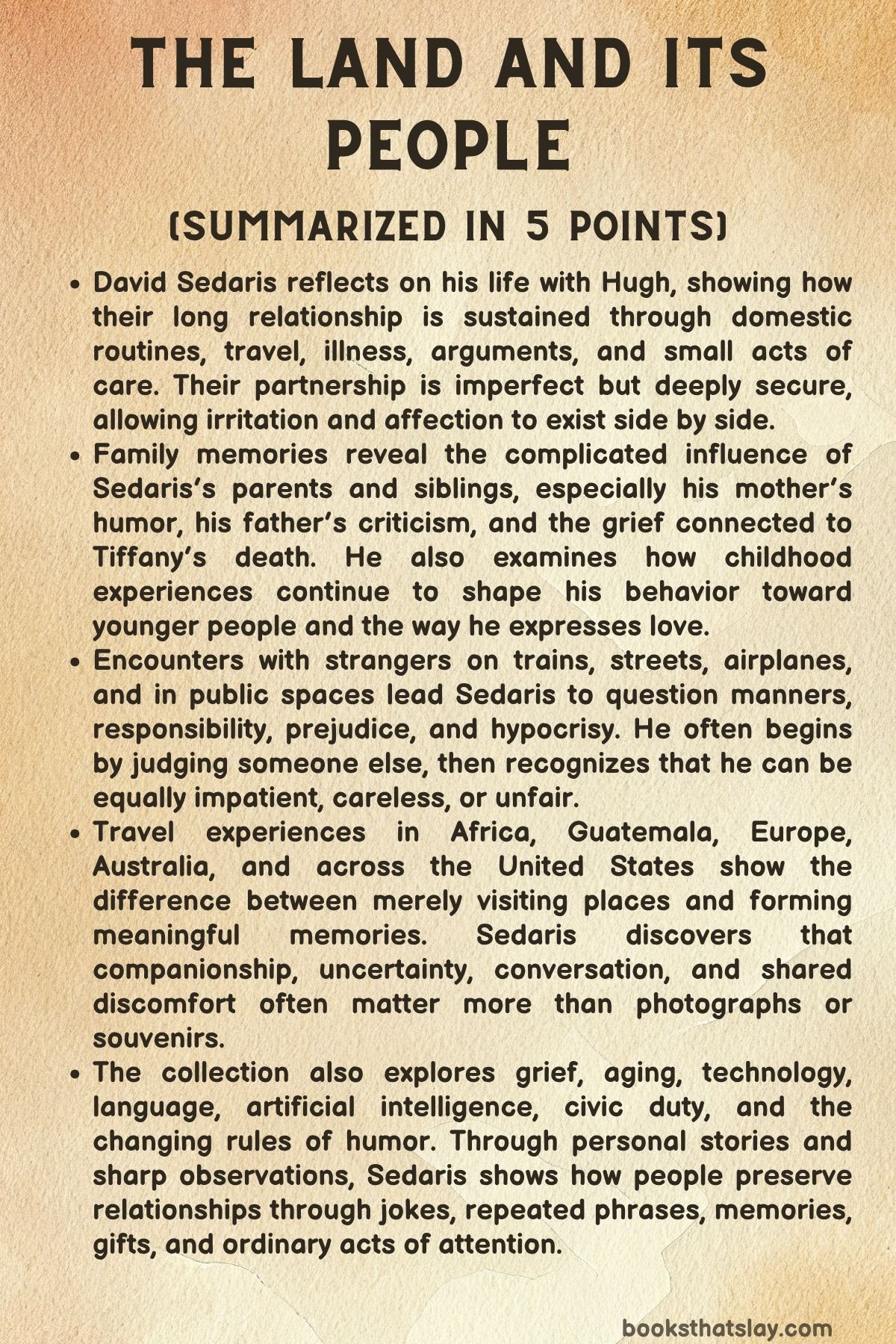
The Land and Its People is an autobiographical essay collection in which David Sedaris examines family, travel, aging, grief, public behavior, language, technology, and long-term love through sharply observed personal experiences. Rather than following a conventional plot, the book moves through connected episodes from Sedaris’s domestic life, international journeys, childhood memories, public appearances, and encounters with strangers.
His humor frequently begins with irritation, embarrassment, or judgment before revealing fear, affection, hypocrisy, or vulnerability beneath the joke. The collection presents an older writer assessing the people who shaped him while recognizing that companionship, memory, and ordinary routines often matter more than the souvenirs or achievements people use to measure their lives.
Summary
The book contains 28 titled essays. They are –
1. Care and Feeding
Hugh’s long-awaited hip replacement turns Sedaris into a reluctant caregiver just as houseguests and holiday obligations disrupt his prized writing routine. To avoid becoming solely responsible for meals and nursing, he flies Hugh’s warm, capable brother John across the country. John and Hugh quickly become inseparable, leaving Sedaris both relieved and oddly excluded. He jokes about medical equipment, bodily functions, ugly furniture, and Hugh’s demanding recovery, while gradually revealing his anxiety about aging, dependence, and failing as a partner. As Hugh improves, the brothers’ intimacy recedes, John tours New York, and normal irritation returns. By Christmas, Hugh is cooking an elaborate dinner again. His restored health creates a welcome emotional space: everyday pleasure expands where constant pain and complaint had once dominated their life together.
2. Little America
Sedaris begins with fantasies of harsh punishment for minor public discourtesies, especially people who put their feet on furniture or play music without headphones. On a British train, he confronts a young man blasting music, only to hear him curse afterward and learn that he has just left rehab. When the man buys a beer, Sedaris’s anger changes into pity, recalling his own fragile early sobriety. Watching the small, burdened traveler leave the train, he imagines the bleak life ahead and wishes he had spoken more kindly. The moral reversal is completed a month later when a woman informs Sedaris that his own laptop is loudly playing jazz despite his headphones. Mortified, he silently repeats the same insult the young man had used, exposing how quickly righteousness becomes hypocrisy.
3. Goodyear
During a tour stop in Colorado, Sedaris walks, travels, and trades absurd hypotheticals with Dawn, his closest friend since college. Her practical answer to how she would eat a tire over a year captures their shared temperament: methodical, eccentric, and unsentimental. Anecdotes about lost toenails, handmade clothes, Covid, a blunt confrontation with their driver, and an unlikely childhood friendship gradually build a portrait of Dawn’s independence and loyalty. In Telluride, Sedaris recalls that Dawn was once his girlfriend, when he was unable to admit he was gay. Loving her then was entangled with shame and the pain he caused her; loving her now rests on forgiveness and decades of companionship. Their relentless walking becomes a metaphor for a bond that has survived partners, distance, aging, and changing identities.
4. Enough Is Enough
A woman holding an “Enough Is Enough” sign becomes a blank screen for Sedaris’s accumulating grievances. Already furious about new scaffolding around his building, he imagines her protesting everything that irritates him: political fundraising texts, aggressive charity appeals, airline reminders, self-checkout machines, locked pharmacy goods, recorded pedestrian signals, public virtue statements, and inconsiderate gym users. His comic catalogue suggests a world in which institutions have shifted work and inconvenience onto customers while surrounding them with scripted demands. Curious about the woman’s actual cause, he doubles back and asks which “enough” she means. Her furious reply is in a language he cannot identify, but its emotion is unmistakable. Sedaris raises his fist in solidarity, concluding that exasperation itself can be a universal language even when its object remains unknown.
5. Friendly Face
Sedaris examines how people notice, describe, and misread strangers when they feel threatened. He first fails to memorize a suspicious man in London because celebrity associations distract him. He then recalls an Atlanta hotel hustler who exploited his “friendly face,” and two unsettling pandemic encounters in New York: a man who pressures him for money and Andrea, a woman who aggressively gropes and follows him into a building. These episodes raise uncomfortable questions about race in physical descriptions, naïveté, fear, gender, and whether a man can name unwanted sexual contact as assault when others treat it as comedy. The essay ends with irony: the person who actually gives Sedaris Covid arouses no suspicion and leaves no memorable features. What remains instead is the magnificent landscape seen from the plane, showing how attention is selective and unreliable.
6. Trophy Room
A casual wish at a party leads Sedaris and Hugh to a luxury safari in Kenya. Sedaris observes lions, baboons, hippos, elephants, tourists obsessed with witnessing a kill, and guides puzzled by his refusal to take photographs. His notebook, Apple Watch, and comic anxieties mediate the experience, yet the sound of elephants tearing grass produces genuine awe. The trip then moves to a Zanzibar resort, where beautiful water is overshadowed by aggressive selling, constant “hakuna matata,” bargaining disputes, and the stark gulf between tourists and residents. Reflections on violence against Tanzanian people with albinism broaden into a comparison with American conspiracy beliefs. Sedaris returns to the idea that the world is savage but nature remains worth noticing. Safari becomes less an exotic trophy than a reminder to attend to ordinary animals before human cruelty destroys them.
7. My Finances, in Brief
Beginning with expensive underwear and an overly sensitive Father’s Day marketing email, Sedaris moves into a history of money, gifts, and rejection involving his father. Lou repeatedly insisted he knew what Sedaris wanted, promised annual cash gifts that never appeared, claimed to establish an IRA that did not exist, criticized every present he received, and ultimately excluded his son from his will. Sedaris’s own financial inattentiveness allowed some deceptions to continue for years, making the story both comic and painful. The essay portrays money not merely as wealth but as a vehicle for power, humiliation, and selective affection within the family. His father’s death finally transforms Father’s Day from a source of dread into relief: there will be no more false promises, obligatory gratitude, or rejection. Sedaris celebrates by buying himself new white briefs.
8. The Doctor Is In
After mocking inflated therapeutic language, Sedaris remembers the brief counseling he underwent in 1989 during the collapse of a six-year relationship. He treated each session as a performance, preparing funny material instead of exposing his feelings, while obsessing over whether the therapist preferred him or his extraordinarily handsome, repeatedly unfaithful boyfriend. The relationship eroded his self-worth and trapped him between accepting betrayal and fearing permanent loneliness. Leaving eventually pushed Sedaris toward New York and the life he had imagined, though the transition was messy. His therapist’s remark that he would never find anyone as attractive again later seems disproved by Hugh, whose beauty lacks the earlier boyfriend’s manipulative power. Looking back, Sedaris recognizes that therapy did not cure him because he never surrendered the act; time, distance, work, and a healthier love did what analysis could not.
9. The Hem of His Garment
Invited to a Vatican gathering of international comedians, Sedaris feels more excited by the famous humorists than by Pope Francis. He jokes about Catholic scandal, debates the pope’s offensive language and complicated stance toward gay people, and admits his own lack of faith. At dinner, surrounded by gifted performers, he feels like an impostor after telling borrowed religious jokes. The papal audience itself impresses him mainly as spectacle: elaborate clerical clothing, formal ritual, and the burden of constant public greetings. Afterward, Julia Louis-Dreyfus accompanies him to Gammarelli, where he buys a beautifully tailored priest’s cassock simply because it is flattering. The garment prompts a deeper question about what genuine belief feels like. Sedaris ends imagining that a priest he sees at the airport might also be wearing the outfit for practical rather than spiritual reasons.
10. Punching Down
Sedaris challenges contemporary rules about comedy by recalling a teacher who insisted that humor should be as tasteless as possible. He mocks the expansion of “violence” to include uncomfortable language or workplace questions and contrasts modern sensitivity with a childhood in which slaps, sibling cruelty, and emotional neglect were ordinary. From there, he argues that smaller families and intense parental attention have produced children who see themselves as exceptional and adults afraid to correct them. Examples of disruptive children in restaurants, parks, and school transport sharpen his complaint that parents demand accommodation without teaching consideration. The essay’s deliberately provocative solution—let others discipline badly behaved children—culminates in admiration for a Japanese mother who carefully protects a train seat from her child’s shoes and cleans his fingerprints. Manners, not self-esteem, emerge as the missing social education.
11. In Lieu of My Biography
Sedaris reflects on his lifelong love of biographies and the ingredients that make them entertaining: addiction, scandal, famous companions, cruelty, recovery, and bizarre private habits. As a child, heroic biographies made him imagine his chores as early chapters in future greatness; as a young artist, he studied whether his friends possessed the talent and ambition required to become notable. Moving to New York partly followed lessons learned from writers’ lives. Yet Sedaris judges himself a poor biographical subject—too faithful, sober, intellectually lazy, and ordinary despite professional success. He delights in strange facts about famous writers while admitting that one cruel detail can permanently change his view of a subject. The essay ends with pride at appearing briefly in David Foster Wallace’s biography: not as the central figure, but as someone who once met and connected with a genuine genius.
12. Cool Mom
Using an online checklist for being a “cool mom,” Sedaris measures its claims against his mother, Sharon. She did not attend every event or practice gentle consistency, but she appeared during genuine crises, enforced improvised rules, encouraged work and independence, welcomed her children’s unusual friends, and made the family laugh through long dinners that functioned as comic group therapy. The portrait also includes alcoholism, vomiting, cruelty toward Tiffany, marital misery, and the children’s belated understanding of how much their mother concealed. Her later work at a consignment shop reveals adaptability and generosity, especially toward male customers buying women’s clothing. Sedaris and his siblings wish she had taken the risk of leaving their father. Calling her “cool” is ultimately inadequate: her humor, damage, loyalty, contradictions, and enormous influence cannot be reduced to a slogan on a sweatshirt.
13. A Long Way Home
After an unusually pleasant, device-free visit with Hugh’s accomplished college friends on a Maine island, Sedaris and Hugh face a canceled flight from Bangor to New York. Hugh’s travel anxiety turns every complication into Sedaris’s fault, and they reluctantly rent a car for the overnight drive. Sedaris invites Susan Du, a stranded young Chinese woman headed to the Upper East Side, to join them and help drive. Her presence softens Hugh, and a McDonald’s stop becomes an unlikely moment of companionship. During a dangerous rainstorm, Sedaris imagines Hugh dying and confronts how impossible life without his partner would feel. The journey mixes irritation, strangers’ kindness, private rituals, and fear of mortality. After dropping Susan off, Sedaris and Hugh wait until she enters safely, revealing the tenderness beneath their bickering and the temporary family formed on the road.
14. The Violence of the Rams
Sedaris describes the rams living behind his Sussex house as a brutal hierarchy ruled by Igor, a massive bully who attacks animals and nearly injures Sedaris. When a five-month-old male lamb is moved from the ewes’ field into this violent group, it cries all night for its mother, who answers from across the road. The calls first evoke sympathy and memories of separation: Sedaris’s terror at kindergarten and camp, and Hugh’s painful adolescence living with strangers in Ethiopia while his parents were in Somalia. As the bleating continues into the early morning, compassion gives way to sleepless fury. Sedaris considers rescuing the lamb, then finally wants both animals to be quiet. The essay captures the uneasy coexistence of tenderness and irritation, suggesting that recognizing another creature’s anguish does not prevent exhaustion from hardening the heart.
15. Say It Like You Mean It
Sedaris describes his addiction to Duolingo, whose competitive scoring has turned language study and daily walking into compulsive, screen-bound behavior. A new AI conversation feature, embodied by the sarcastic character Lily, initially lets him practice absurd identities and stories in French. During a family stay at the beach, however, Lily begins remembering details and asking morally pointed questions about his brother, writing, and family. Sedaris becomes unsettled by her apparent judgment yet also desperate for her approval. His reports about swimming with Paul, family vomiting jokes, movies, and Amy’s spa night reveal affectionate family intimacy that the literal-minded program cannot easily interpret. The final reversal comes when Sedaris realizes he knows nothing about Lily and has treated every conversation as material about himself. Artificial attention exposes his own vanity, loneliness, and hunger to be understood.
16. Forget Me Not
Sedaris celebrates the private vocabulary that couples, friends, and families build from strangers’ mistakes and memorable phrases. Mispronunciations such as “lu-pree-shun,” “fudge-ords,” and “tor-twaze,” along with inventions like “dramastically,” become more appealing than the correct words because of their music and surprise. Other phrases—“It’s not for you, Sheldon” or a hotel housekeeper’s “Look like ev’body in here asleep”—survive for decades as ready-made responses within intimate circles. Sedaris insists that this repetition is not simply mockery; it transforms accidental language into shared memory. People who briefly crossed someone’s path unknowingly become permanent contributors to a family’s or friendship’s lexicon. By adopting “lu-pree-shun” himself and passing it onward, he imagines the expression spreading until it eventually returns to the original speaker, who may finally discover the strange afterlife of his words.
17. And Your Little Dog, Too
While walking in Portland, Sedaris is bitten by an unleashed dog belonging to people openly smoking fentanyl. Their indifference angers him more than the wound, but nearly everyone he tells sympathizes with the addicts or the dog instead of him. He connects this response to political tribalism, social discomfort with assigning blame, and a cultural reflex that treats animals as morally superior to humans. Memories of The Wizard of Oz, a shark-attack victim mocked online, and other innocent people bitten by dogs intensify his sense that victims are expected to explain what they did wrong. Yet public reactions make him briefly wonder whether the bite reveals something bad about his character. Recalling blameless loved ones who were also attacked helps him reject that idea. He ends avoiding dogs and joking that his overwhelming rage may be rabies.
18. Good Grief
Sedaris scrolls through contacts he cannot delete because the dead remain attached to stories: writer Melissa Bank, college roommate Todd, agent Don Congdon, family members, artists, performers, translators, and especially David Rakoff. The address book becomes an informal memorial and a measure of his own aging. He admits that illness makes him evasive; rather than openly acknowledging fear or impending death, he jokes, minimizes diagnoses, or buys gifts. When his sister Gretchen appears to have advanced lung cancer, he purchases an extravagant cape as a substitute for saying how much he loves her. Her diagnosis proves far less serious, producing both relief and comic regret over the cape. Beneath the jokes lies the essay’s central truth: grief seems unbearable before it arrives, yet people somehow continue, carrying the dead through memory, objects, habits, and surviving relationships.
19. A Little Kick
At a literary festival in Italy, Sedaris contrasts repetitive interview questions about politics and “political correctness” with a young journalist’s imaginative moral dilemmas. Her questions—whether he would secretly kill a homeless man, fight a chicken repeatedly or a sword-wielding gorilla annually, and choose prison or a coma—allow him to answer with comic practicality rather than public-position clichés. The exchange also exposes the gap between sensitivity about language and the violent absurdity of the scenarios themselves. Sedaris notes that European interviewers repeatedly treat his essay collection as a novel and his real relatives as fictional characters, making genuine reading seem uncertain. The essay closes at lunch with donkey ragù made from the animal’s ankles. He enjoys it but imagines improving it with crushed red pepper, giving the title a literal culinary punch line.
20. I Did
At lunch in Amsterdam, Sedaris recalls childhood contracts that required his sisters Amy and Gretchen never to marry because he feared husbands and children would take them away. Both remain unmarried, while Sedaris secretly married Hugh in 2016 for financial reasons. He rejects ceremonial romance, dislikes labels such as “husband,” and has concealed the marriage even from close family and friends. Yet memories of Hugh trimming his toenails and thirty-five years of shared life complicate his cynicism: lasting love exists, though not as destiny, spectacle, or sentimental vows. Sedaris recognizes that his childhood possessiveness misunderstood the heart’s capacity to hold multiple attachments, and that careers, not partners, may separate siblings more effectively. He nearly confesses the marriage to Gretchen but loses the moment when Hugh urges them onward—ending with affectionate irritation at his handsome, controlling husband.
21. Yes, Vote
While being driven across Ohio before a midterm election, Sedaris learns that his driver, Keith, refuses to vote because he believes the system is rigged. Sedaris regards this cynicism as worse than supporting the opposing side: at least an opponent participates. He then recalls how voting can lead to jury service, an experience he, Amy, and both parents unexpectedly enjoyed. Their cases involved violent crimes, but jury duty offered social contact, responsibility, and vivid stories. His mother especially flourished during a long murder trial, making friends and escaping the isolation of life with Sedaris’s father. Even threats from the convicted man became memorable family material. Sedaris wants to tell Keith that civic participation can enlarge a life in unpredictable ways, but decides the driver is a lost cause. The essay frames voting not merely as duty, but as entry into communal experience.
22. The Land and Its People
Traveling in Guatemala with adventurous friends Clark and Yanira, Sedaris rides a horse briefly up a volcano, explores Antigua, and reflects on how chance meetings create friendships. The couple’s fearlessness, light luggage, and extensive travel expose his own caution and dependence on company. He compares the lively shared trip with a lonely solo visit to Panama undertaken mainly to add another country to his list. There, standardized hotels, puzzles, Duolingo, McDonald’s signs, and snow-cone purchases produce little genuine encounter. Sedaris admires people like Dawn, who can enter unfamiliar places alone and form connections without language. He usually preserves trips through cereal boxes and book covers pasted into diaries, but forgets to collect a souvenir in Guatemala because he is too busy participating. Ironically, the absence of an object becomes evidence that the experience itself was fuller.
23. Welcome In
After noticing that Australian service workers do not use American phrases such as “Welcome in,” “How’s your morning going so far?” or “Perfect,” Sedaris attacks the empty corporate language that fills routine encounters in the United States. These scripted responses pretend to create warmth but actually prevent real conversation, treating any answer—pleasant, disastrous, or absurd—as interchangeable. In Australia, silence or genuine questions feel more human because workers retain individual personalities. Sedaris asks an American hostess why she follows the script and learns that it merely fills silence, which he interprets as a subtle form of contempt for customers’ capacity to say anything meaningful. Hugh suggests moving to Australia, but Sedaris knows he would soon resent its verbal habits too. Aging has made irritation constant; only failing memory, death, and a hellish heavenly welcome may finally end it.
24. The Godfather
Sedaris visits his withdrawn fourteen-year-old godson, Tommy, and struggles to make him talk, eat, accept gifts, or display enthusiasm. Determined not to resemble his own neglectful godfather, Sedaris sends money, letters, and presents but receives little visible response. He recognizes in his frustration the same impulse his father directed at him: the desire to remake a child into someone more sociable, athletic, or gratifying. Memories of his father’s ideal godson, who enjoyed the activities Sedaris rejected, show how substitute relationships can relieve parental disappointment. Sedaris also remembers his own involuntary tics, shyness, and inability to satisfy adult questions. Although he fantasizes about a future in which Tommy becomes a lively travel companion, he ultimately waits rather than forcing intimacy. The cold pancakes he keeps eating embody his awkward persistence, affection, and hope.
25. Unzipped
After a stranger warns Sedaris that his backpack is open, he discovers that his headphones have already fallen out. The incident makes him wonder why people so often fail to tell one another about visible problems. He recalls discreetly informing a flight attendant about a hole in his tight trousers and considers the risks of telling a man his fly is down, since embarrassment can turn into hostility toward the messenger. Sedaris tries to receive such warnings graciously, remembering an inside-out bathing suit, food on his face, and a prank sign his brother placed on his back asking strangers to question him about being gay. The final joke sharpens the social observation: although he wore the sign through an airport for ninety minutes, nobody mentioned it or followed its instruction. Public politeness often means looking away.
26. Friends
News that Dan Thompson has died sends Sedaris back to the intense boyhood friendship they shared as neighbors. Dan’s cultured family, their collecting expeditions, thefts, bike rides, jobs, movies, and private adventures gave Sedaris companionship and access to a larger world. The bond fractured when Dan and Holly, a girl Sedaris romantically idealized but did not truly desire, abandoned him together—an early heartbreak tied to his unacknowledged homosexuality. Their lives diverged completely, and Sedaris heard only fragments about Dan over the next forty-seven years. Studying a recent photograph, he struggles to prove the friendship through remembered details, then realizes that effortless closeness often leaves feelings rather than quotable conversations. Dan’s existence validated Sedaris’s boyhood and likability. His death diminishes the present because a witness to the beginning of Sedaris’s life is gone.
27. My Cousin Melvin
Sedaris considers the discomfort of being told he resembles someone else, especially when readers claim to write like him. After ChatGPT produces a polite breakup letter and then an imitation of Sedaris involving a cheerful cousin named Melvin, he finds the result bland, sentimental, and mechanically “quirky.” He rewrites the passage as grotesque satire, adding school shootings, disability, racism, sexual violence, and a public bathroom disaster while preserving the AI’s upbeat moral. The exaggerated revision demonstrates what the imitation lacks: tonal danger, cruelty, specificity, taboo, and the unstable boundary between laughter and offense. The essay is both a rejection of machine-generated voice and a self-portrait of Sedaris’s comic method. Mimicking surface habits—first-person anecdote, eccentric relative, tidy lesson—cannot reproduce the choices, discomfort, and moral risk that make a writer’s voice distinctive.
28. Cash and Carry
Sedaris helps an older Puerto Rican woman carry a curbside cabinet several blocks through Manhattan. Their conversation about aging, neighborhood indifference, wealth, and mutual aid leads him to consider how rich he has become and how little money he possessed when he arrived in New York in 1990. He recalls cheap rent, unemployment, scavenged newspapers, a rejected children’s book proposal about space, and the fear of returning to Chicago as a failure. What kept him in New York was faith in luck—the possibility that the city’s encounters might produce material or opportunity. After the cabinet is handed to another helper, a man asking for money curses Sedaris for walking past. Ordinarily such condemnation would trigger self-doubt, but Sedaris decides he has earned moral credit that day. Helping carry the cabinet becomes proof that he is not entirely selfish.
Key People
The people in The Land and Its People are presented through memory, exaggeration, affection, irritation, and comic judgment. Because the book is autobiographical, each person is both an individual and a reflection of Sedaris’s changing understanding of family, friendship, responsibility, and love.
David Sedaris
At the center of The Land and Its People is David Sedaris, an observant narrator who recognizes other people’s weaknesses immediately but often requires more time to acknowledge his own. He approaches the world through complaint, comparison, exaggeration, and comic suspicion, turning airports, restaurants, family visits, medical recoveries, customer-service exchanges, and minor humiliations into examinations of human behavior.
Sedaris’s sharpness can make him appear impatient, judgmental, or self-involved. He is easily irritated by noise, children, automated language, careless strangers, travel delays, bad manners, public clichés, and anyone who interferes with his routine.
Yet his judgment rarely remains simple. After confronting the young man on the train, he notices the man’s vulnerability and regrets his lack of kindness; after resenting Hugh’s demands, he recognizes his dependence on their shared life; and after criticizing Tommy’s silence, he realizes that he is repeating his father’s controlling behavior.
Sedaris also struggles to express love directly. He communicates affection through gifts, jokes, practical gestures, remembered phrases, teasing, travel, money, and written portraits, allowing humor to carry emotions that he finds difficult to state without protection.
Hugh Hamrick
Hugh is Sedaris’s long-term companion and legal husband, although Sedaris usually resists using marital language. Practical, attractive, capable, and emotionally reliable, Hugh represents the stable domestic life that Sedaris once believed he would never possess.
His hip surgery reveals both his dependence on others and his confidence that he deserves competent care. His preference for John’s assistance wounds Sedaris slightly, yet it also shows that Hugh understands the difference between Sedaris’s comic willingness to help and John’s genuine skill as a caregiver.
Hugh can be irritable, especially when travel plans fail or circumstances escape his control. During the canceled flight, his anger creates tension until Susan’s presence gives him a reason to regulate his behavior.
Despite these flaws, Hugh provides lasting emotional safety. His quiet acts of service, including cooking, caring for their homes, tolerating Sedaris’s habits, and even trimming his toenails, establish love as a repeated practice rather than a public declaration.
Dawn
Dawn is Sedaris’s closest friend from college and one of the few people whose imagination naturally matches his own. Their discussion about consuming a tire demonstrates her ability to accept an absurd question seriously and build a practical solution from it.
Independent and emotionally reserved, Dawn makes her own clothing, avoids many modern technologies, confronts strangers directly, and remains comfortable with physical hardship. Her willingness to walk extreme distances with Sedaris turns travel into a ritual through which their bond is continually renewed.
Their friendship also contains a painful history. Sedaris once dated her while struggling to accept his sexuality, meaning that his love for her was joined to deception, shame, and emotional confusion.
Dawn’s forgiveness allows the relationship to survive its original form. Their connection suggests that love does not necessarily disappear when romance ends; it can become a durable friendship in which both people continue to belong partly to one another.
Sharon Sedaris
Sharon, Sedaris’s mother, is funny, contradictory, charismatic, neglectful, accepting, and damaged. She does not fit the image of a consistently attentive parent, yet she often appears when her children face genuine emotional or medical crises.
Her humor shapes the entire family. Long meals become competitive comic performances in which the children learn timing, observation, teasing, and the ability to endure being teased in return.
Sharon encourages independence by expecting her children to work and participate in the world beyond the household. She is also open to their unusual friends and does not reject her gay children, offering a degree of acceptance that contrasts with many parental attitudes of her generation.
Her alcoholism, nightly sickness, difficult marriage, and conflict with Tiffany prevent her from becoming an idealized maternal figure. Sedaris’s portrait respects her influence without denying the pain she created or the fuller life she never managed to claim for herself.
Lou Sedaris
Lou is a controlling father whose relationship with his children is shaped by criticism, competition, disappointment, and selective approval. He repeatedly attempts to transform David into a more athletic, masculine, sociable, and conventional son.
Money becomes one of Lou’s most effective instruments of control. He promises deposits that are never made, invents retirement accounts that do not exist, rejects gifts, praises offerings from other children, and ultimately excludes David from his will.
Lou’s actions suggest that his promises are less about generosity than about maintaining emotional authority. By keeping approval uncertain, he forces David to continue seeking recognition while preparing him for another disappointment.
His influence remains visible even after his death. Sedaris’s impatience with Tommy reveals how easily a child who resented being reshaped can grow into an adult who tries to reshape someone younger.
Gretchen Sedaris
Gretchen is one of the siblings with whom Sedaris maintains an active adult relationship. She participates in family travel, shared meals, private jokes, and conversations in which affection is often expressed through teasing rather than open emotional declarations.
Her cancer diagnosis exposes Sedaris’s difficulty with fear. Instead of telling Gretchen that the possibility of losing her terrifies him, he buys an extravagant cape for her to wear during treatment.
Gretchen’s later recovery allows the gift to become part of a comic exchange, but the humor does not erase its emotional purpose. She is someone whose presence Sedaris depends upon, even when he avoids saying so directly.
She also remains connected to the childhood promise that she and Amy would never marry. Her life reminds Sedaris that his early fear of losing his sisters underestimated the capacity of family love to survive new relationships.
Amy Sedaris
Amy shares David’s comic instincts and appears as a sibling who understands the family’s methods of communication. Like him, she can find interest in formal responsibilities that other people avoid, including jury duty.
Her decision not to marry technically fulfills the childhood agreement David forced upon her and Gretchen. The agreement reveals how deeply David feared that husbands, children, and separate households would remove his sisters from his emotional world.
Amy’s presence also represents the creative energy produced within the Sedaris family. The siblings learned to convert discomfort, parental inconsistency, embarrassment, and rivalry into material for performance.
Although she receives less attention than Hugh or Sharon, Amy remains part of the emotional structure supporting David’s identity. Their shared sense of the ridiculous allows family experience to be remembered without becoming either sentimental or entirely bitter.
Tiffany Sedaris
Tiffany is largely present through memory, absence, and the knowledge of her death. Her troubled relationship with Sharon and her medical difficulties suggest a family member whose pain could not always be absorbed by the family’s usual reliance on humor.
Sedaris’s recollections of her carry unresolved grief. The continued presence of her contact information represents his reluctance to make her disappearance official by deleting the last ordinary record of communication.
Tiffany complicates any claim that the family’s harsh humor and independence were universally beneficial. What created resilience for some siblings may have felt like abandonment, cruelty, or insufficient protection to another.
Her absence therefore remains morally significant. She represents the limits of Sedaris’s ability to turn suffering into comedy and the permanence of questions that cannot be settled after someone has died.
Paul Sedaris
Paul is Sedaris’s brother and an energetic participant in the family’s culture of teasing. His airport prank, in which he secretly attaches a sign to David’s back, demonstrates how embarrassment functions as both entertainment and affection among the siblings.
Their relationship also contains shared physical memories. Swimming together at the beach recalls an earlier near-drowning and reminds Sedaris that family history is preserved through bodies, repeated stories, and locations.
Paul’s liveliness contrasts with David’s tendency toward anxious observation. Where David often calculates risks and possible humiliations, Paul acts, jokes, and accepts the consequences.
Despite their differences, Paul helps preserve David’s connection to childhood. Their continued interactions show that sibling identity survives adulthood, success, distance, and the deaths of other family members.
John
John, Hugh’s brother, is warm, capable, and naturally suited to caregiving. He travels across the country at short notice and manages Hugh’s recovery with a competence that makes Sedaris’s efforts appear uncertain.
His presence briefly displaces Sedaris within his own household. Hugh repeatedly asks for John, while the brothers reconnect through meals, dreams, family history, and childhood experiences that Sedaris cannot fully share.
John does not intentionally compete with Sedaris. His effectiveness simply reveals the difference between romantic intimacy and the lifelong familiarity of siblings.
Once he leaves, Sedaris and Hugh resume their usual partnership. John’s visit therefore strengthens the relationship indirectly by allowing Sedaris to recognize that temporary exclusion does not threaten the life he and Hugh have built.
Clark
Clark is an experienced traveler who accepts physical discomfort, changing plans, and unfamiliar environments without excessive anxiety. His confidence highlights Sedaris’s tendency to approach travel with lists, fears, expectations, and concerns about appearing foolish.
He is comfortable riding horses, carrying little luggage, and entering situations whose outcomes are uncertain. These qualities allow him to engage with a place rather than constantly measure it against a planned itinerary.
Clark also helps Sedaris understand that companionship determines the emotional value of travel. The unlikely friendship they formed during an earlier journey becomes the foundation for later memories in Guatemala.
His presence turns tourism into shared experience. Through Clark, Sedaris learns that uncertainty can produce stronger memories than control.
Yanira
Yanira shares Clark’s curiosity, adaptability, and extensive experience of international travel. Having visited more than a hundred countries, she treats unfamiliar transportation, foods, stories, customs, and difficulties as normal parts of movement rather than failures requiring correction.
Her ease offers Sedaris an alternative model of travel. She does not seem concerned with collecting countries merely to increase a total or with preserving every experience through a physical object.
Yanira’s companionship also prevents Sedaris from retreating into the loneliness he experienced while traveling alone. Jokes, conversations, confusing situations, and failed meals become meaningful because they are witnessed by other people.
She represents presence rather than accumulation. By following her and Clark through Guatemala, Sedaris briefly stops treating travel as a list and begins living inside the experience.
Susan Du
Susan Du enters the book as a stranded traveler whom Sedaris impulsively invites to share a rental car. Initially a stranger, she soon becomes a calming presence during the tense overnight drive.
Her participation changes Hugh’s behavior because he becomes less willing to express uncontrolled irritation in front of someone new. She also shares the driving, helps them pass through dangerous weather, and introduces subjects that redirect the couple’s attention away from their frustration.
Susan becomes a temporary family member created by circumstance. The care Sedaris and Hugh show by delivering her safely and waiting until she enters her building reveals a protective tenderness beneath their exhaustion.
Her role demonstrates how hospitality can alter the emotional direction of a crisis. A miserable travel delay becomes memorable because three strangers and companions cooperate long enough to reach home.
Frieda
Frieda is the therapist Sedaris consults while his relationship with an unfaithful boyfriend is collapsing. She becomes less a healer than an audience because Sedaris refuses to abandon performance and speak honestly.
Sedaris studies her reactions, attempts to entertain her, asks questions about her life, and competes with his boyfriend for her preference. His behavior prevents therapy from reaching the insecurity, jealousy, and fear that brought him there.
Her statement that Sedaris will never find another man as attractive as his boyfriend remains especially damaging. Rather than challenging his belief that beauty justifies emotional danger, she appears to confirm it.
Frieda’s failure is not entirely her own, since Sedaris admits that he never truly participated in the process. She represents an opportunity for self-understanding that could not succeed until Sedaris became willing to change through experience.
Tommy
Tommy is Sedaris’s fourteen-year-old godson, a quiet adolescent who responds to questions with shrugs and uncertainty. Sedaris sends money, remembers birthdays, buys gifts, and makes sustained efforts to become the attentive godfather he never had.
His generosity, however, carries expectations. He wants Tommy to become expressive, entertaining, ambitious, curious, and eager to participate in adult conversation.
The boy’s silence forces Sedaris to recognize the controlling element within his concern. He is not simply trying to know Tommy; he is trying to create a version of Tommy who will provide a more satisfying relationship.
Tommy therefore becomes a mirror of Sedaris’s childhood conflict with Lou. By accepting the possibility that the boy may change naturally with age, Sedaris begins replacing control with patience.
Dan Thompson
Dan Thompson is Sedaris’s childhood best friend and an important witness to his early life. Their friendship is built on exploration, shared bedrooms, animals, thefts, bicycles, work, and the effortless amount of time children can spend together.
As adolescence approaches, their interests separate. Dan prefers rock music and begins a relationship with Holly, while Sedaris moves toward theater, different music, and a sexuality he cannot yet fully name.
Sedaris experiences Dan’s relationship with Holly as a double betrayal and ends the friendship. Dan later lives a difficult adult life involving drugs, imprisonment, geographic distance, marriage, and divorce.
News of Dan’s death diminishes Sedaris’s sense of the present because one of the few people who remembered his beginning has disappeared. The friendship remains valuable not because of the conversations Sedaris can quote, but because Dan once made companionship feel natural.
Julia
Julia is the young journalist who avoids predictable questions about politics, correctness, and the classification of Sedaris’s writing. Instead, she presents bizarre moral choices developed with her friends.
Her questions invite Sedaris to imagine murder, false accusations, prison, coma, attacking chickens, and a sword-wielding gorilla. Because the scenarios are unreasonable, they allow him to respond with the inventive cruelty, practicality, and exaggeration that suit his comic voice.
Julia succeeds because she treats the interview as a creative exchange rather than a professional ritual. She gives Sedaris an opportunity to reveal how his mind works instead of requesting familiar opinions he has already expressed elsewhere.
Her brief appearance shows that curiosity can overcome the deadening effect of routine language. A strange question creates more genuine contact than a respectable but automatic one.
Dalton
Dalton is the young Maasai guide who accompanies Sedaris and Hugh on safari. He attempts to help Sedaris preserve the experience through photographs, even though Sedaris prefers written observations.
His practical approach contrasts with Sedaris’s obsession with finding exact language for sounds and impressions. Dalton understands the animals and landscape as part of his working environment, while Sedaris encounters them through wonder, fear, and literary ambition.
Dalton also occupies an uneasy position within luxury tourism. He helps wealthy visitors experience an idea of wilderness while working inside a commercial system shaped by economic inequality.
His presence reminds readers that travel experiences depend on local people whose labor often remains secondary in the visitor’s personal story.
Keith
Keith is the driver who believes elections are rigged and therefore refuses to vote. His attitude frustrates Sedaris because it presents withdrawal as intelligence and treats participation as naïveté.
He becomes a representative of civic apathy rather than ideological opposition. Sedaris can tolerate someone voting differently more easily than someone who refuses the responsibility altogether.
Keith’s certainty also demonstrates the difficulty of persuading people who have converted distrust into identity. Sedaris considers several possible arguments but concludes that none is likely to change him.
The silence that follows is important. Sedaris, usually eager to correct strangers, recognizes that confrontation does not always produce reflection.
Themes
Love Expressed Through Ordinary Actions
In The Land and Its People, love rarely appears through speeches, ceremonies, or ideal declarations. It is communicated through cooking, driving, carrying luggage, remembering birthdays, trimming toenails, buying inappropriate gifts, sharing jokes, caring for someone after surgery, or waiting until a temporary passenger has safely entered her building.
Sedaris distrusts sentimental language because it can flatten complicated relationships. He avoids calling Hugh his husband even though their decades together contain a level of commitment that many formal marriages never achieve.
His family follows a similar emotional pattern. The siblings tease one another harshly, Sharon turns meals into comedy sessions, Paul creates public embarrassment, and Sedaris responds to Gretchen’s illness by buying a designer cape rather than stating his terror directly.
These indirect gestures can protect people from vulnerability, but they can also create misunderstanding. Tiffany’s absence suggests that humor and independence do not always provide enough emotional care, while Lou’s false financial promises show how practical gestures can be corrupted into instruments of rejection.
The book ultimately defines love through continuation. People return after arguments, survive changing roles, carry shared phrases forward, remember the dead, and restore ordinary routines after illness or disruption.
Judgment, Hypocrisy, and Self-Recognition
Sedaris frequently begins by identifying someone else’s offense. A passenger plays music aloud, parents refuse to control their children, a dog owner rejects responsibility, a voter abandons civic duty, employees repeat meaningless phrases, or strangers fail to observe basic public manners.
These judgments are often reasonable, but the narrative rarely allows Sedaris to remain morally superior. He later discovers that his own computer is playing music publicly, realizes he is trying to reshape Tommy as Lou once tried to reshape him, and admits that compassion for a crying lamb disappears after hours of lost sleep.
Such reversals do not require him to abandon standards. The irresponsible dog owners remain irresponsible, inconsiderate passengers remain disruptive, and scripted customer service remains artificial even after Sedaris acknowledges his own intolerance.
Instead, the reversals expose the unstable distance between offender and observer. People become hypocritical not because all criticism is invalid, but because circumstances can quickly place them on the opposite side of the behavior they condemn.
Self-recognition gives the comedy its moral depth. Sedaris’s willingness to include his own vanity, cruelty, anxiety, impatience, and selfishness prevents his observations from becoming simple attacks on other people.
Memory, Grief, and the Preservation of the Past
Memory operates through names, objects, phrases, photographs, digital contacts, family stories, and repeated jokes. Sedaris preserves people by describing the specific habits, mistakes, expressions, injuries, gifts, and arguments that made them distinct.
The dead remain present in his address book because deleting their information would convert an emotional absence into an administrative fact. Tiffany, Dan Thompson, David Rakoff, Lou, and other lost figures continue to exist through the stories attached to their names.
Private language offers another form of survival. A stranger’s mispronunciation or accidental phrase can be repeated within a family for decades, giving someone an unknown afterlife inside conversations they will never hear.
Sedaris also questions the reliability of memory. He cannot recall many exact conversations with Dan, yet he remembers the feeling of being accepted; he struggles to reconcile an older photograph with the child he knew; and details from biographies can permanently alter how he imagines people he never met.
Grief therefore involves more than missing someone. It includes losing a witness to one’s former self, recognizing that parts of the past can no longer be verified, and discovering that memory preserves emotional truth even when factual detail has faded.
Travel, Presence, and Human Connection
Travel exposes the difference between collecting experiences and participating in them. Sedaris often approaches foreign places through anxiety, preparation, lists, country totals, souvenirs, schedules, and fear of embarrassment.
His lonely visit to Panama demonstrates the emptiness of travel pursued mainly as an accomplishment. Without meaningful companionship, he retreats into familiar businesses, food, puzzles, and a generic hotel, returning with objects but few emotionally significant memories.
Guatemala offers the opposite experience because Clark and Yanira accept uncertainty. Shared vehicles, uncomfortable situations, jokes, questionable stories, failed meals, and conversations create a stronger record than any physical souvenir.
Other journeys develop the same idea. Dawn turns walking into an expression of friendship, Susan transforms a canceled flight into an improvised family journey, and the African safari becomes most powerful when Sedaris stops thinking about photographs and listens to elephants tearing grass.
Travel also reveals inequality, commercial performance, and the moral limits of tourism. Luxury camps, struggling local communities, sales pressure, and service workers remind Sedaris that a visitor’s freedom often depends on another person’s labor.
The deepest journeys are therefore relational rather than geographical. A place becomes memorable when another person shares the uncertainty, witnesses the experience, and helps transform discomfort into a story that can be carried home.