The Last Contract of Isako Summary, Characters and Themes
The Last Contract of Isako by Fonda Lee is a science-fiction novel about an aging professional enforcer whose final assignment forces her to question every rule that has shaped her life.
Set on Aquilo, a distant colony governed by a powerful corporation, the story follows Isthmus Isako as she investigates political corruption, hidden identities, illegal body transfers, and a conspiracy concerning humanity’s lost connection with Earth. Beneath its action and political intrigue, the novel examines loyalty, institutional obedience, personal identity, aging, sacrifice, and the cost of treating human beings as resources. It is ultimately about choosing life and moral responsibility over honor defined by an unjust system.
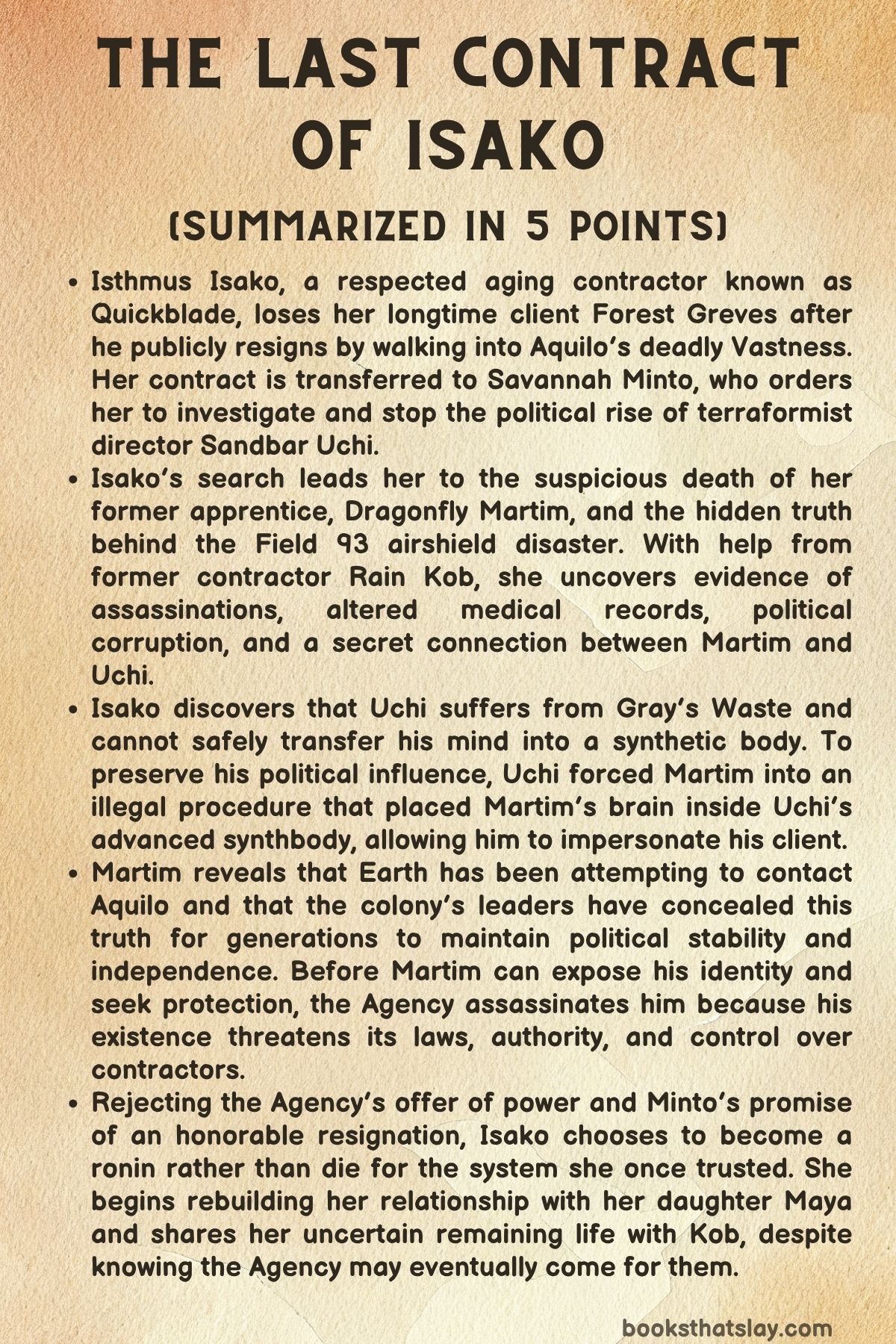
Summary
Isthmus Isako, known professionally as Quickblade, is a fifty-year-old atier, an elite contractor trained to advise, protect, dismiss, and kill on behalf of powerful Company clients. Following Astrocommunications’ defeat by Satellite Operations, she carries out the final dismissals of employees whose division has lost its political and economic war.
At a bar, a desperate employee named Wolf Wyatt attacks Isako with a concealed spike, apparently intending to die while killing a contractor he blames for his ruin. Isako reacts instinctively and kills him with her longknife, reinforcing her public reputation as a cold executioner even though she acted in self-defense.
She then dismisses Dew Loren, an older employee who has little chance of finding new work. Loren accepts a voluntary resignation package, agreeing to walk beyond Aquilo’s protective airshield and die so that his benefits can pass to his pregnant daughter, Tessa.
Isako’s client, Forest Greves, has lost control of Astrocommunications after failing to revive space exploration. Greves is a reunionist who believes Aquilo must reconnect with Earth and other human settlements, while the increasingly powerful terraformists want the colony to focus entirely on its own world.
Isako advises Greves to accept a demotion and patiently rebuild his influence under Savannah Minto, the elderly director of Satellite Operations. Greves appears to consider the advice, but he secretly makes another choice.
At Easthatch, Isako attends Loren’s final walk alongside relatives and former employees. Greves unexpectedly joins the resignees and broadcasts a public speech condemning the Company’s abandonment of space exploration.
He walks through the airshield and dies in the Vastness, turning his death into a political statement. Isako is devastated because he concealed his plan from her, preventing her from fulfilling her duty to protect him.
Greves’s death appears to leave Isako without a client, making her a ronin whose status, security, and future have disappeared. However, Savannah Minto reveals that Greves transferred Isako’s Exclusive contract to her shortly before his death.
Minto already employs Cloud Sherae, one of Isako’s former apprentices, and Company policy does not normally allow a director to retain two atiers. Sherae challenges Isako to a longknife contest, but Isako refuses to take the younger woman’s position and asks to resign instead.
Minto agrees to grant Isako a generous resignation package in thirty days. Until then, she orders Isako to investigate Sandbar Uchi, a leading terraformist director whose expected appointment to the Board could permanently weaken the reunionist cause.
Minto suspects that Uchi’s behavior has become unstable after recorporalization into a synthetic body. Isako must find information capable of stopping his confirmation, using any necessary method.
Although Isako wants to leave contract life, she cannot refuse without losing her reputation, financial benefits, and the inheritance intended for her daughter, Maya. She therefore accepts one final assignment.
Before beginning, Isako meets Maya for lunch. Maya was largely raised by the other adults in their communal household because Isako’s work required constant availability and frequently exposed her to violence.
Maya is preparing for a career in genetic archiving and hopes to build a future with her boyfriend, Silas. Isako intends to tell her that resignation will require her to walk into the Vastness, but she cannot bring herself to reveal the truth before Maya’s important interview.
To investigate Uchi, Isako must renew her Agency license. The examination tests strategy, finance, ethics, combat, and absolute loyalty to one’s client.
The final simulation forces Isako to throw herself onto a grenade and experience an artificial death. Although she passes, the test confirms that her reflexes, endurance, and joints are declining.
At Agency headquarters, Isako consults Ocean Constance, her former mentor, and encounters Marsh Elias, the feared Ronin Killer. She seeks information about Dragonfly Martim, another former apprentice who serves as Uchi’s atier but has recently disappeared.
Martim’s contract has been extended, yet no one at the Agency has heard from him. Isako searches his apartment and finds evidence that he left unexpectedly, including an injection pen labeled Sudexatrine 02 and a nightclub coaster containing a note about someone named Vincent.
Condor Anand, a politically gifted atier serving Northern Gas Production, intercepts Isako and offers her an enormous bribe to abandon the investigation. When she refuses, he warns that Minto has given her an impossible assignment and informs her that Martim is dead.
Official records confirm Martim’s death, but the Agency was never properly notified and no clear cause is listed. Isako obtains authority to investigate and learns that Martim had been attempting to locate survivors of the Field 93 airshield disaster.
At the nightclub Epic Vibe, Vincent admits that Martim regularly bought stimulants and sedatives. He says Martim was exhausted, frightened, and obsessed with suppressing information connected to Field 93, though Vincent denies providing the Sudexatrine.
When Isako follows Vincent outside, freelancers ambush her. She survives because Rain Kob, the legendary former atier known as Strikebreaker, intervenes and brings her to his apartment.
Kob has left the Agency and now survives as a freelancer during the limited grace period allowed to ronin. Isako considers his life a waste of great talent, but Kob values the freedom he has gained outside formal contracts.
He reveals that he knows Waterboy, the only surviving witness of Field 93. Isako visits the Old Warehouse, a community formed by people excluded from Company employment, and meets Waterboy.
Waterboy claims Southern Gas Production deliberately allowed the airshield disaster to occur so that Uchi could crush labor resistance. Six people survived, but five were later hunted down and killed, while Martim helped control the resulting evidence.
Waterboy wants to destroy Aquilo’s political and economic system through violent revolution. Isako distrusts him, but she recognizes that his testimony may help expose Uchi.
Kob joins Isako’s investigation, and their old professional partnership becomes personal and intimate. However, Isako notices that he suffers from tremors, migraines, and memory problems.
Kob visits memorials belonging to people whose deaths he helped arrange during his career. Unlike Isako, he no longer believes that following a client’s orders removes personal responsibility.
Their investigation of Martim’s remains reveals that River Thea, Uchi’s bodyguard, handled the body after an alleged drug overdose. Thea herself inhabits an advanced synthbody originally created for Uchi’s former wife, Fern Madison.
Isako and Kob confront Uchi, who claims Martim became addicted to drugs, was dismissed, and later died. His evasive answers and lack of grief convince Isako that he is concealing something greater.
After leaving Uchi’s territory, their vehicle is hijacked and four shadowcons attempt to kill them. Isako and Kob defeat the assassins but are badly injured.
While searching Kob’s apartment for medicine, Isako discovers Sudexatrine injection pens identical to the one found in Martim’s home. Kob admits that he has Gray’s Waste, a neurological disease that will gradually destroy his memory, coordination, and identity.
Sudexatrine can slow the illness but causes paranoia, aggression, and emotional instability. Isako initially assumes Martim also suffered from Gray’s Waste, potentially explaining his behavior and death.
Minto pressures Isako to produce results, so Isako plans to assassinate Uchi during a secret appointment at the Elite Renewal clinic. United Freelancers will create an explosive distraction while she enters the facility.
Kob refuses to help because he believes Isako is abandoning her judgment and becoming a shadowcon in everything but name. He reveals that his faith in the Code collapsed when he refused to kill the son of a man he had previously dismissed.
Isako insists that finishing the assignment is the only way to protect Maya’s future and preserve the meaning of her career. The two separate, each believing the other is making a destructive choice.
During the attack, Isako receives evidence that Martim never had Gray’s Waste. She fights through clinic security, defeats Thea without killing her, and enters a restricted medical room.
Inside, she discovers two versions of Sandbar Uchi. His original human body is preserved in cryostasis, while another Uchi occupies a synthetic body.
Believing one must be an impostor, Isako fires an illegal pistol into the cryostasis capsule. Her action mortally damages the original Uchi and forces the secret surrounding the second body into the open.
The narrative then reveals Martim’s path to this moment. Born into a low-status household, he became Uchi’s atier through intelligence, ambition, presentation, and his willingness to shape himself entirely around his client’s needs.
During the Field 93 crisis, Martim protected Uchi by managing communications, suppressing dissent, erasing evidence, and arranging the deaths of witnesses. He hired Kob to eliminate Elm Anders and six survivors, though Kob later refused to kill Waterboy.
Martim’s work consumed his health and personal life. He became dependent on stimulants and sedatives, lost contact with his family, and turned to Isako for help.
Instead of recognizing his distress, Isako told him to concentrate on serving his client. Martim interpreted her response as proof that weakness was unacceptable and returned to Uchi with greater determination.
While secretly obtaining political intelligence, Martim discovered evidence that Earth was sending signals to Aquilo. The colony had not been permanently abandoned, and the Great Silence could end.
Uchi believed renewed contact would destroy Aquilo’s independence and the terraformist project. He decided that he had to join the Board and prevent the truth from being disclosed.
Martim helped him defeat Greves politically and secure the nomination. Soon afterward, he discovered that Uchi suffered from Gray’s Waste and could not safely undergo normal recorporalization.
Uchi devised an illegal solution. Martim would be officially dismissed, transferred into Uchi’s advanced synthbody, and forced to impersonate him long enough to join the Board.
Uchi threatened to expose Martim’s drug use and destroy his career if he refused. Trapped by the Code, ambition, fear, and years of emotional dependence, Martim accepted.
After the procedure, Martim possessed Uchi’s appearance, authority, wealth, and physical strength, but he experienced severe psychological disorientation. He had to pretend that his original self had failed and disappeared.
Thea helped him manage the transformation because she understood what it meant to live in a body owned by another person. Martim later discovered that the real Uchi had not resigned but remained in cryostasis, intending to reclaim the synthetic body if his illness could ever be cured.
Uchi had also instructed Thea to kill Martim once he was no longer useful. Realizing that they had both been exploited, Martim and Thea formed an alliance against their client.
When Isako attacks the clinic, Martim is standing beside Uchi’s preserved body. Isako’s bullet destroys Uchi’s chance of returning, unknowingly freeing Martim from his client while creating a new crisis.
Kob arrives and rescues Isako and the apparent Uchi from the clinic. At Martim’s old apartment, the impostor reveals himself, and Isako learns the complete truth about the body transfer, Earth’s signals, and Uchi’s plan.
Isako cannot bring herself to kill her former apprentice or expose him as a political and scientific violation. Kob argues that Martim is now a ronin and therefore has the right to make his own choices rather than complete Uchi’s mission.
They decide that Martim should survive his confirmation hearing and then reveal himself privately to Minto. By cooperating politically with the reunionists, he could give Minto something more valuable than Uchi’s death and perhaps secure protection for himself and Thea.
Martim successfully completes the hearing by reproducing Uchi’s mannerisms and political authority. To help him escape afterward, Kob disguises himself as Uchi and enters the crowd as a decoy.
Isako leads Martim and Thea toward Minto’s vehicle but turns back because she refuses to abandon Kob. A surviving shadowcon attacks, forcing Thea to return.
After Isako kills the assassin, a rifle shot strikes Martim through the synthetic skull. Marsh Elias has assassinated him on behalf of the Agency.
Isako discovers that the Agency placed a transmitter in her badge during her licensing examination and monitored the entire investigation. Ocean Constance admits that the Partners used Isako to investigate Martim while maintaining their own secrecy.
The Agency killed Martim because his existence challenged the foundations of contractor law, synthetic-body ownership, and political authority. Constance then reveals that Aquilo’s rulers have known for centuries that communication with Earth is possible.
Aquilo’s isolation was a planned corporate experiment, and the Board periodically votes on whether to reveal the truth. Even many reunionist leaders have repeatedly supported continued silence to preserve Aquilo’s independence and social order.
Constance offers Isako a position among the Agency’s Partners, but Isako rejects her mentor and abandons her badge. She no longer believes that the institution’s Code represents morality or neutrality.
When Isako reports to Minto, she conceals Martim’s identity and allows the director to believe that Uchi was assassinated through a brilliant covert operation. Minto offers Isako either a new contract or the promised honorable resignation.
Isako refuses both. Having proved that she could complete the assignment, she realizes that she no longer wants to walk into the Vastness.
She voluntarily becomes a ronin and chooses to spend more time with Maya and Kob. Thea later loses her synthetic body when Fern Madison legally reclaims it, suggesting that Thea’s brain has been destroyed.
Aquilo continues as before. Uchi becomes a martyr, the Old Warehouse is demolished, United Freelancers is hunted, and the Great Silence remains in place.
Isako and Kob understand that their grace period is temporary and that Marsh Elias may eventually be sent to kill them. Nevertheless, they turn away from the Vastness and return to Tenacity, choosing food, companionship, uncertainty, and whatever life remains over a death demanded by the system.
Characters
Isthmus Isako
Isthmus Isako is the central character of The Last Contract of Isako, a legendary atier whose identity has been built almost entirely around professional discipline. Known as Quickblade, she has spent decades believing that skill, obedience, and acceptance of death are the foundations of an honorable life.
Her physical decline creates a conflict she initially refuses to acknowledge. She remains exceptionally dangerous, but licensing tests, injuries, slower reflexes, and chronic pain remind her that reputation cannot prevent aging.
Isako’s emotional restraint has also damaged her personal relationships. Her commitment to clients caused her to miss much of Maya’s childhood, contributed to the end of her marriage, and prevented her from developing an identity outside work.
At first, Isako considers resignation a worthy conclusion to her career. She wants to complete one final assignment, secure Maya’s financial future, write a respectable coda, and die with her professional reputation intact.
The investigation gradually exposes the moral emptiness beneath that idea of honor. She sees Martim destroyed by loyalty, Thea imprisoned in a body she does not own, Kob burdened by the people he killed, and freelancers treated as disposable once they no longer serve the Company.
Her deepest failure concerns Martim. When he once called her in distress, she repeated the Agency’s harsh values instead of offering care, and her later investigation becomes partly an effort to correct the consequences of that failure.
Isako’s final transformation occurs when she stops separating professional duty from personal responsibility. She refuses to kill Martim, rejects the Agency’s offer of power, turns down Minto’s contract, and declines the honorable resignation she once desired.
Choosing ronin life is not a simple escape. It leaves her without institutional protection and places her under the threat of Elias, but it is the first major decision she makes according to her own moral judgment rather than a client’s command.
Rain Kob
Rain Kob, formerly known as Strikebreaker, serves as both Isako’s emotional counterpart and a possible version of her future. Once one of Aquilo’s most respected contractors, he has already abandoned the Agency and begun confronting the human cost of his career.
Kob’s public reputation is based on strength, negotiation, and his ability to crush organized resistance. Inside the Old Warehouse, however, that reputation inspires fear because many residents remember him as an instrument used against workers and freelancers.
Unlike Isako, Kob no longer believes that the Code can absolve contractors of responsibility. He visits the memorials of people he dismissed, evicted, or helped kill, speaking to the dead and acknowledging that obedience does not erase personal guilt.
His refusal to kill Waterboy marked the collapse of his professional faith. By abandoning the assignment, he saved one life but lost the certainty that had made contractor work psychologically possible.
Kob’s Gray’s Waste adds urgency to his moral reckoning. He knows that his memory, coordination, and sense of self will deteriorate, so he wants to use his remaining time according to values he has chosen.
His relationship with Isako is based on equality rather than dependence. He understands her training and ambition, but he is willing to challenge her when she uses professional language to justify assassination.
Kob initially attempts to save Isako by persuading her to abandon Minto’s assignment. Later, he returns to help her because he recognizes that judgment, loyalty, and love cannot be reduced to rigid principles.
His final choice to become a decoy for Martim shows that he still possesses the courage associated with Strikebreaker, but he now uses that courage to protect a life rather than complete a killing contract. Living beside Isako as a ronin, he accepts uncertainty without pretending that redemption can erase the past.
Dragonfly Martim
Dragonfly Martim is one of the most tragic and psychologically complex figures in The Last Contract of Isako. His life demonstrates how ambition, insecurity, and institutional loyalty can gradually destroy a person who believes exceptional service will guarantee belonging.
Martim begins with social disadvantages and limited longknife talent. He compensates through intelligence, observation, style, political skill, and an extraordinary ability to anticipate what powerful people want.
Uchi selects him because Martim offers himself as someone who can be completely shaped around a client. That promise gives Martim the opportunity he desires, but it also means that his professional success depends on suppressing his independent identity.
During the Field 93 crisis, Martim proves highly capable. He manages operations, controls political damage, silences dissent, erases evidence, and arranges killings while convincing himself that every action protects Uchi and Aquilo’s future.
His dependence on stimulants and sedatives reflects more than physical exhaustion. The drugs allow him to maintain the impossible level of performance required by a relationship in which love, approval, employment, and identity have become inseparable.
Martim’s call to Isako is an unsuccessful attempt to escape that pressure. Her response confirms his belief that a worthy atier must endure alone, pushing him further into Uchi’s control.
The forced transfer into Uchi’s synthbody completes the destruction of Martim’s autonomy. He gains status, beauty, physical power, and political authority, but loses his face, body, name, and legal existence.
His inability to stop imitating Uchi shows how deeply client service has entered his mind. Even after learning that Uchi intended to kill him, Martim struggles to imagine a purpose separate from completing his client’s mission.
Kob’s argument that Martim is free because he has become a ronin offers him the possibility of moral independence. His assassination prevents that possibility from being fully tested, making his death a final demonstration of the Agency’s refusal to allow contractors to exist outside established categories.
Sandbar Uchi
Sandbar Uchi is an ambitious terraformist director who presents himself as a visionary defender of Aquilo’s independence. He believes that reconnection with Earth would weaken the colony, redirect resources, and allow a more powerful civilization to dominate Aquilo’s future.
His political concerns are not entirely irrational. Earth’s return could transform Aquilo in unpredictable ways, and Uchi genuinely believes terraforming represents the colony’s best chance for long-term survival.
However, his conviction becomes inseparable from personal ambition. He assumes that only he can protect Aquilo and therefore treats opposition, delay, or criticism as threats that justify manipulation and violence.
Uchi’s leadership depends on fear and emotional dependence. He praises Martim as irreplaceable, makes him feel specially chosen, and later uses the young atier’s crimes, ambitions, and insecurities to force him into an illegal body transfer.
His treatment of Thea follows the same pattern. Saving her life appears generous, but he places her in a body that he owns, forbids her from altering its appearance, and expects lifelong obedience in return.
Gray’s Waste intensifies Uchi’s desperation because it threatens both his identity and his political plans. Instead of accepting illness, succession, or mortality, he turns Martim into a temporary container for his authority.
His decision to remain in cryostasis reveals that he never truly intended Martim to inherit his position. Martim was only a replaceable instrument who could be eliminated once Uchi recovered.
Uchi’s death does not end his influence. He becomes a terraformist martyr, the Great Silence continues, and the political future he sought remains protected, showing that systems of power can preserve a leader’s objectives even after the individual is gone.
River Thea
River Thea is Uchi’s bodyguard and one of the clearest examples of how synthetic technology can preserve life while destroying personal freedom. After being severely injured while protecting Uchi, she is transferred into a body originally designed for Fern Madison.
The procedure saves her brain but leaves her dependent on Uchi for ownership, maintenance, and legal protection. She must inhabit the appearance of his former wife and is forbidden from changing it, making her body a reminder of someone else’s relationships and desires.
Thea initially defends Uchi and the Code because her survival depends on believing that obedience will protect her. She pressures Martim to accept the body transfer and later hires shadowcons to kill Isako and Kob.
Her violence is driven by fear rather than simple cruelty. If Martim’s identity is exposed, both contractors risk termination, confiscation of their bodies, and the destruction of their brains.
Once Thea discovers that Uchi intends to reclaim Martim’s body and order his death, her loyalty shifts. She recognizes that neither of them was saved out of love or gratitude; they were preserved because they remained useful.
Her bond with Martim is formed through shared displacement. Both have lost ownership of their bodies, both must perform identities chosen by Uchi, and both struggle to distinguish survival from service.
Thea attempts to protect Martim during the final escape and turns against the shadowcon she previously hired. Her later fate, losing the synthbody when Fern Madison legally reclaims it, confirms that the Company never recognizes her body as truly her own.
Savannah Minto
Savannah Minto is the ancient director of Satellite Operations and one of Aquilo’s most powerful political figures. Her luxurious indoor garden, artificial body, rare animals, and abundant resources demonstrate how far the ruling class is separated from ordinary scarcity.
Minto is intelligent, patient, and ruthlessly practical. She defeats Greves, absorbs his division, retains both Isako and Sherae temporarily, and uses Isako’s desire for honorable resignation to secure a dangerous political advantage.
She rarely treats people as complete individuals. Martim’s death matters to her only if it can weaken Uchi, while Isako’s declining career makes her useful as an expendable operative.
Minto’s methods differ from Uchi’s emotional domination, but both directors use contractors as extensions of political ambition. She avoids issuing explicit assassination orders while making it clear that Uchi’s confirmation must be prevented by any means necessary.
Her reunionist position does not make her morally superior to the terraformists. The Agency’s revelations indicate that even leaders sympathetic to reconnection have repeatedly supported continued secrecy.
Minto keeps her promises when doing so benefits her. She grants Isako the resignation package and offers her a new contract, but she never understands why Isako ultimately rejects both.
Forest Greves
Forest Greves is a reunionist director whose dream is to revive space exploration and restore communication with other human settlements. He represents hope, idealism, and political courage, but his final act also reveals the destructive consequences of turning personal sacrifice into public theater.
Greves cares about Isako and tries to protect her future by transferring her contract to Minto. However, he denies her the chance to advise or protect him by secretly planning his voluntary resignation.
His walk into the Vastness transforms him into a symbol of resistance. Yet for Isako, the act is an intimate betrayal because he excludes her from the most important decision of their twelve-year partnership.
Greves’s death drives the entire plot. His defeat allows Minto to control Isako, his political cause shapes the struggle over Earth, and his ignorance of the signals makes the hidden conspiracy especially painful.
Maya
Maya is Isako’s nineteen-year-old daughter and represents the ordinary personal life that Isako has repeatedly sacrificed for her career. She is intelligent, ambitious, and preparing for work in genetic archiving and biological restoration.
Although Maya loves her mother, their relationship contains distance created by years of absence. Other kithparents provided the daily stability that Isako’s profession prevented her from offering.
Maya’s future motivates many of Isako’s decisions. Isako initially accepts Minto’s final contract because she wants Maya to receive the large resignation bonus and enjoy financial security.
However, Maya also becomes one reason Isako ultimately chooses life. Calling her daughter and asking to meet for lunch marks the beginning of a more honest relationship based on presence rather than posthumous benefits.
Ocean Constance
Ocean Constance is Isako’s former mentor and a senior Agency Partner. Isako initially views her as a trusted guide who understands the burdens of contractor life.
Constance’s apparent concern conceals institutional calculation. The Agency uses Isako’s loyalty, her connection to Martim, and the transmitter hidden in her badge to conduct an investigation without openly assuming responsibility.
Her defense of Martim’s assassination reveals her priorities. She considers his existence too dangerous because it challenges legal identity, body ownership, client authority, and the stability of the political system.
Constance believes that managing dangerous truths is a form of necessary guardianship. Her offer of Partnership invites Isako to join the small group that controls secrets while maintaining the illusion of Agency neutrality.
Isako’s rejection represents a break not only with a mentor but with the entire moral tradition Constance embodies. Their final confrontation shows how institutions can transform care, education, and professional loyalty into tools of surveillance and control.
Cloud Sherae
Cloud Sherae is Isako’s former apprentice and Minto’s established atier. She has recently led Satellite Operations to victory, yet Isako’s arrival immediately awakens her insecurity.
Sherae challenges her mentor because contractor culture teaches her that value must be proven through competition. She assumes that Minto can retain only one atier and that survival requires defeating Isako physically or professionally.
Isako refuses to fight because Sherae has already earned her position. This refusal prevents the Agency’s competitive structure from turning mentor and apprentice into enemies.
Sherae’s later willingness to surrender her position shows how deeply she doubts herself when compared with Quickblade’s reputation. Isako’s final advice encourages her to trust her own abilities and reconsider the dangers of an Exclusive contract.
Marsh Elias
Marsh Elias is the Agency’s Ronin Killer, the contractor authorized to hunt and terminate those who violate institutional boundaries. His firearm distinguishes him from ordinary atiers and symbolizes the Agency’s willingness to ignore its own traditions when enforcing control.
Elias appears calm, professional, and almost impersonal. He does not behave like a sadistic killer, which makes him a more disturbing representation of institutional violence.
His assassination of Martim is precise and efficient. He kills a vulnerable person at the exact moment Martim might escape the identity imposed upon him.
Elias also watches Isako and Kob after they become ronin. His presence means their freedom exists only during a temporary grace period controlled by the same institution they rejected.
Condor Anand
Condor Anand, known as the Puppetmaster, is a politically skilled atier serving Tide Sullivan. He uses information, delay, bribery, and psychological pressure rather than relying primarily on physical force.
Anand recognizes that Minto has chosen Isako partly because she is expendable. His offer of a bribe is both an attempt to stop her and a warning that the political struggle extends beyond Uchi.
He appears to know more than he openly states, including the fact of Martim’s supposed death and Uchi’s unusual behavior. His communication with the Agency helps trigger the investigation that ultimately ends in Martim’s assassination.
Anand’s loyalty is directed toward preserving Northern Gas Production’s influence and the broader political order. He survives because he understands when to challenge ambition, when to support it, and when to pass dangerous information to more powerful institutions.
Waterboy
Waterboy is the only surviving witness of the Field 93 disaster and a leading figure within United Freelancers. His experiences have convinced him that Aquilo’s social system cannot be reformed through ordinary political methods.
He exposes the deliberate nature of the airshield failure and the systematic murder of survivors. His testimony gives Isako access to truths that the Company has erased.
Waterboy’s anger is justified, but his commitment to violent revolution makes him dangerous. He sees civilization as a structure that must be shattered rather than repaired, even if innocent people are harmed in the process.
His alliance with Isako is temporary and based on their shared opposition to Uchi. After the clinic attack fails to produce the expected political result, he quickly turns against her.
Crater
Crater is an expert research subcontractor who gathers medical, political, technological, and security information for Isako. His work helps uncover Martim’s death records, Uchi’s altered medical history, the Elite Renewal clinic’s defenses, and the absence of Gray’s Waste markers in Martim.
He operates outside the strict honor culture of atiers and evaluates risk primarily through survival and payment. When Isako’s plan becomes too dangerous, he withdraws rather than allowing professional pride to trap him.
Crater demonstrates that freelancers can possess highly valuable skills despite the Company’s portrayal of them as socially unnecessary. His information repeatedly advances the investigation, even though he refuses to sacrifice himself for it.
Dew Loren
Dew Loren is an aging Astrocommunications employee who accepts voluntary resignation after losing his position. He knows that his age makes new employment unlikely and chooses death so that his pregnant daughter can receive his resources.
Loren’s quiet acceptance contrasts with Wolf Wyatt’s violence and Greves’s dramatic protest. He does not treat his death as a political statement but as a final act of responsibility toward Tessa.
His walk into the Vastness remains in Isako’s memory because it represents both courage and the cruelty of a society that presents economically forced death as personal honor. His endurance during the walk also gives him a dignity that the dismissal system cannot completely erase.
Wolf Wyatt
Wolf Wyatt is one of the first people Isako dismisses after Astrocommunications’ defeat. Unlike Loren, he responds to hopelessness through rage and attacks Isako with a concealed weapon.
His death shows how contractors become visible targets for decisions made by distant directors and political systems. The people in the bar see Isako as an executioner because she represents the institution that has taken Wyatt’s livelihood.
Wyatt’s brief appearance establishes the hostility surrounding atiers. It also shows that Isako’s training allows her to kill before conscious judgment or compassion can intervene.
Vincent
Vincent is a freelancer who supplies controlled stimulants and sedatives. His relationship with Martim provides evidence of the young atier’s exhaustion, fear, and growing dependence.
Although he profits from illegal substances, Vincent is not presented as the source of Martim’s destruction. The demands of Uchi’s service create the conditions that make the drugs necessary.
Vincent’s fear during Isako’s questioning reveals how dangerous Martim’s secret has become. His disappearance from the nightclub suggests that freelancers survive by recognizing when powerful institutions are approaching.
Tide Sullivan
Tide Sullivan is the director of Northern Gas Production and an established leader within the terraformist movement. He publicly supports Uchi when political circumstances make that position useful.
Behind the alliance lies competition. Sullivan and Anand prefer to control the timing of Uchi’s advancement because the younger director threatens Northern Gas Production’s dominance.
After Uchi’s death, Sullivan benefits from the political vacuum and gains authority over a consolidated gas organization. His rise demonstrates that the removal of one ambitious leader does not fundamentally change the concentration of power.
Fern Madison
Fern Madison is Uchi’s former wife and the original intended owner of the synthetic body later given to Thea. Although she remains largely outside the central action, her legal claim determines Thea’s fate.
When Fern reclaims the body, Aquilo’s courts recognize property rights over Thea’s continued existence. The decision suggests that Fern’s entitlement to the artificial body outweighs Thea’s ownership of the life and consciousness inhabiting it.
Fern is not portrayed as personally responsible for the entire system, but her successful claim reveals how legal structures can turn identity and embodiment into transferable assets. Her appearance brings Thea’s story to a devastating conclusion.
Dr. Moth Lucan
Dr. Moth Lucan is the surgeon associated with Uchi’s illegal recorporalization and Martim’s transfer into the synthetic body. He views the procedure as a technological achievement capable of creating enormous wealth and professional prestige.
His enthusiasm allows him to overlook coercion, murder, identity theft, and the absence of informed consent. Scientific advancement becomes his preferred justification for serving powerful clients.
Lucan’s death at Isako’s hands removes a crucial witness and shows how far her mission has taken her from ordinary contractor rules. He is both an exploiter and another person destroyed by the secret he helped create.
Selene
Selene is a member of United Freelancers who assists with the clinic attack. She was once a respectable wageworker but lost her position and access to her child after being blamed for institutional failures.
Her transformation into a bomber illustrates how exclusion can radicalize ordinary people. When legal systems offer no path to justice, violence begins to appear like the only remaining form of influence.
Selene complicates Isako’s view of terrorists and freelancers. She is dangerous, but her anger grows from experiences produced by the Company rather than from senseless cruelty.
Peregrine Addison
Peregrine Addison is a temporary secretary whom Martim manipulates to obtain confidential Board documents. He approaches her under a false identity, earns her trust, spends the night with her, and steals information while she is vulnerable.
Addison is innocent of the political struggle surrounding Uchi. If the security breach were discovered, she could lose her career despite having no knowledge of Martim’s true identity.
Martim’s treatment of her shows how client service has corrupted his empathy. He feels guilty, but he still sacrifices her safety because professional success has become more important than another person’s future.
Elm Anders
Elm Anders is a Southern Gas Production subdirector blamed for failing to predict the Field 93 disaster. Uchi humiliates and dismisses him publicly when he threatens to expose the truth.
His accusation that Uchi is responsible for murder makes him a political danger. Martim later hires Kob to eliminate him, converting an employment dispute into an assassination.
Anders represents knowledgeable insiders who become disposable when their testimony threatens powerful leaders. His death also marks Martim’s movement from concealment into organized killing.
Fox Wilson
Fox Wilson is a longtime colleague of Uchi and one of the few people willing to challenge him. Uchi abruptly dismisses him after becoming increasingly unstable and secretive.
Martim recognizes the dismissal as both cruel and strategically foolish. Fox’s fate shows Martim that loyalty, history, and competence offer no protection when Uchi begins viewing disagreement as betrayal.
Although Fox has a limited role, his removal helps Martim recognize that he may also be discarded. The incident prepares him to investigate Uchi’s hidden illness.
Silas
Silas is Maya’s artistic boyfriend and part of the independent future she is building. Isako worries that he lacks practical ambition, but her judgment is influenced by a life spent measuring people according to professional usefulness.
Her discomfort with Silas also reflects her fear of losing Maya after already missing much of her childhood. Isako gradually recognizes that she has limited authority to control decisions made by a daughter whom others helped raise.
Silas represents a life guided by personal interest rather than institutional status. His presence quietly challenges Isako’s assumption that security and achievement must always be defined by Company standards.
Tessa Loren
Tessa is Dew Loren’s pregnant daughter and the intended beneficiary of his resignation package. Her grief at Easthatch exposes the personal suffering hidden beneath formal language about honor and resource transfer.
Loren’s decision is presented as an act of love toward Tessa, but her presence also shows that voluntary resignation harms the very people it supposedly protects. She receives material support only through the permanent loss of her father.
Tessa therefore represents future generations who inherit both resources and unresolved grief from Aquilo’s culture of sacrifice.
Themes
Professional Duty and Moral Responsibility
The Last Contract of Isako repeatedly challenges the belief that following orders protects individuals from guilt. The Code of Client Service teaches contractors to transfer moral responsibility upward, treating themselves as instruments rather than independent decision-makers.
Isako initially depends on this belief because it allows her to dismiss workers, use violence, and accept death without being overwhelmed by doubt. Kob eventually rejects the same defense after remembering the people whose suffering he directly caused.
Martim’s life demonstrates the most destructive result of unquestioning duty. Every crime begins as a practical response to a client’s needs, including evidence suppression, manipulation, assassination, illegal recorporalization, and the concealment of Earth’s signals.
The language of professionalism makes each step appear reasonable when considered separately. Only when the full pattern becomes visible does it become clear that the Code has converted obedience into a method for suppressing conscience.
The Agency claims neutrality while monitoring Isako and killing Martim to preserve social order. Its actions reveal that institutions often describe obedience as virtue because obedience protects existing power.
Isako’s transformation depends on accepting that judgment cannot be permanently surrendered. She finally acts according to her own understanding of right and wrong, even though doing so costs her status, wealth, protection, and honorable resignation.
Kob’s final approach offers no promise of moral purity. He cannot undo the deaths he caused, but he can acknowledge responsibility and use his remaining life to protect others.
Identity, Bodies, and Ownership
Synthetic bodies promise longer life, physical perfection, and freedom from biological weakness, yet the novel presents recorporalization as a source of profound legal and psychological danger. A person may survive physically while losing control over appearance, status, identity, and bodily ownership.
Thea awakens in a body designed to resemble Fern Madison. Uchi’s refusal to let her alter that appearance turns her existence into a continuation of his unresolved relationship with another woman.
Although Thea’s consciousness inhabits the body, the law treats it as property belonging to someone else. Her eventual removal confirms that legal ownership matters more than personal continuity.
Martim experiences an even greater destruction of identity. He gains Uchi’s face, height, strength, wealth, authority, and social position, but Dragonfly Martim officially ceases to exist.
His panic around mirrors, breathing, and bodily sensation reflects the difference between possessing functional memories and feeling at home within oneself. Performing Uchi’s personality gradually becomes both a survival strategy and a threat to Martim’s remaining individuality.
Uchi’s plan also reveals that identity can be treated as a political resource. Martim is expected to carry the director’s public identity until the original Uchi can reclaim the body, after which the apprentice will be destroyed.
The Agency considers Martim intolerable because he exposes the instability of categories such as client, contractor, person, property, and political office. Killing him allows the institution to avoid answering whether identity belongs to the brain, the body, the name, the contract, or the state.
Aging, Mortality, and the Choice to Live
Isako and Kob begin the story facing different forms of decline. Isako feels her reflexes slowing and believes honorable resignation will allow her to die before age damages her reputation.
Kob has Gray’s Waste and knows that his memory, coordination, and identity may gradually disappear. Unlike Isako, he has stepped outside institutional expectations because he wants some control over the end of his life.
Aquilo transforms death into an economic and professional obligation. Workers surrender their lives so benefits can pass to relatives, while contractors are trained to view self-sacrifice as the highest proof of loyalty.
The licensing simulation conditions atiers to experience death as peaceful and desirable. This makes resignation appear like personal fulfillment rather than a policy that removes people no longer considered useful.
Loren, Greves, Martim, Thea, and Uchi all face death through different relationships with power. Some accept it, some resist it, some use it politically, and others attempt to escape it by controlling another person’s body.
Isako’s refusal to resign is therefore a radical act. She does not suddenly become young, safe, or free from consequences, but she stops believing that usefulness should determine whether she deserves to remain alive.
The ending values temporary and imperfect life over ceremonial death. Food, companionship, family, pain, uncertainty, and limited time become more meaningful than a respected nameplace granted by an institution that benefits from sacrifice.
Power, Scarcity, and Institutional Control
Aquilo’s leaders justify inequality by presenting resources as dangerously limited. Ordinary workers must compete for employment and accept death when they become economically inconvenient, while directors live among rare plants, animals, luxury food, advanced medicine, and synthetic bodies.
This contrast suggests that scarcity is not merely a natural condition. It is organized and distributed in ways that protect those already holding power.
Freelancers are described as burdens, yet the Old Warehouse demonstrates their ability to build community, trade skills, and support one another without formal Company structures. Their exclusion serves political purposes because people without wages or legal protection can be blamed for wider social failures.
The Great Silence represents the largest exercise of institutional control. Aquilo’s rulers possess information that could change every citizen’s understanding of history, identity, and humanity’s future, but repeatedly choose secrecy in the name of stability.
Terraformists and reunionists publicly appear divided, yet both sides have participated in preserving the deception. Their conflict operates within boundaries established by a governing class that agrees ordinary people cannot be trusted with decisive knowledge.
The Agency maintains these boundaries through surveillance and targeted killing. Martim is eliminated not because his existence is inherently violent but because he exposes contradictions that could weaken contractor authority and political legitimacy.
Even revolutionary resistance can reproduce coercive patterns. Waterboy is willing to sacrifice others for his vision just as directors sacrifice employees for theirs.
The novel therefore presents power as a system sustained by controlled information, manufactured necessity, professional obedience, legal ownership, and the constant threat of exclusion or death.