The Last Mandarin Summary, Characters and Themes
The Last Mandarin by Louise Penny and Mellissa Fung is a political and technological thriller centered on Alice Li, a food blogger whose strained relationship with her famous dissident mother becomes inseparable from an international crisis.
After a mysterious worldwide alarm and the suspicious death of Alice’s friend Liam, hidden messages lead her into a conflict involving Chinese intelligence, American officials, artificial intelligence, and a revolutionary organization called Pangu. The novel combines family secrets, cyberwarfare, historical trauma, and political betrayal while examining how movements created for reform can be corrupted by secrecy, resentment, and unchecked power.
Summary
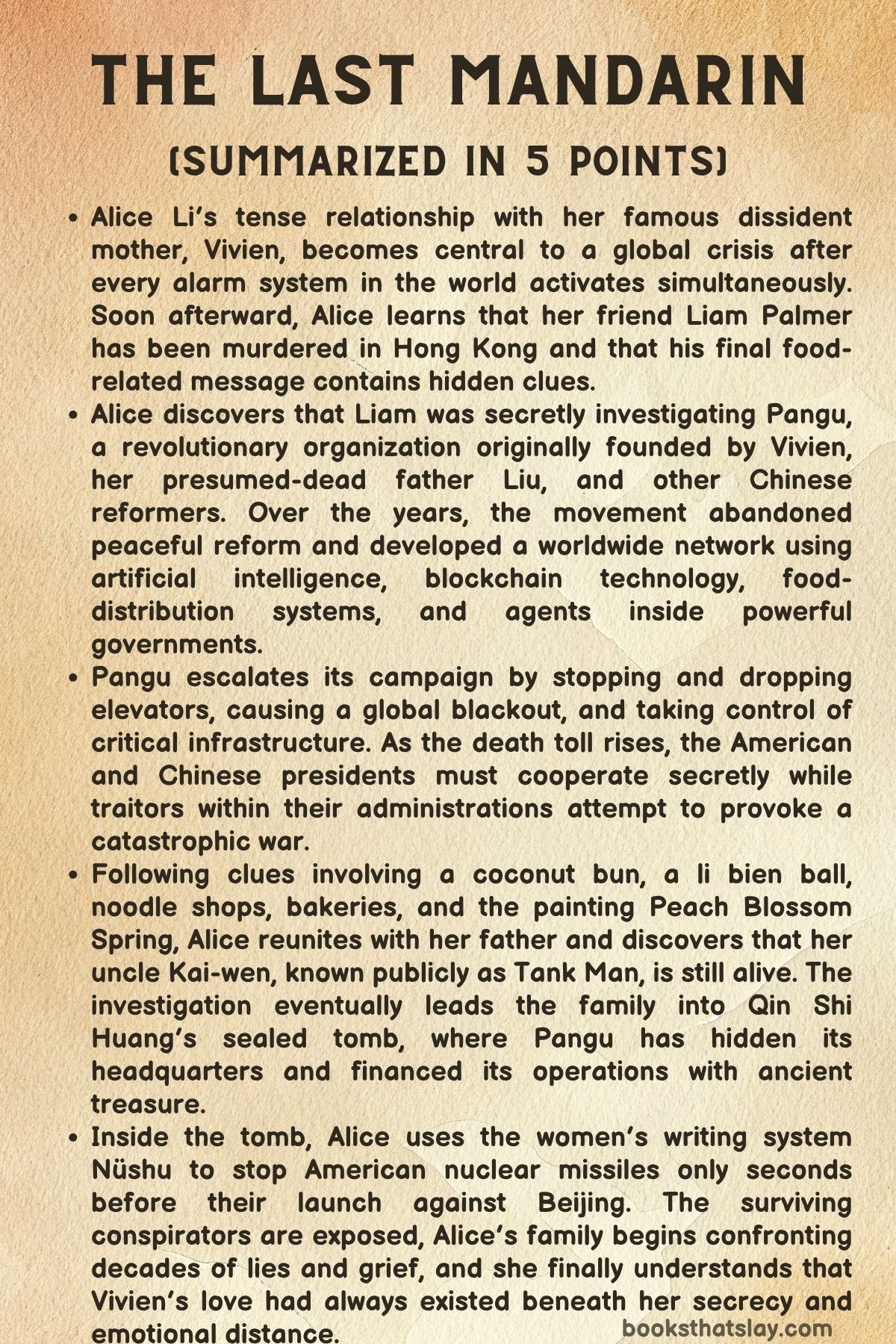
Twenty-six-year-old food blogger Alice Li meets her mother, Vivien Li, for brunch at an elegant Washington hotel. Vivien is an internationally admired Chinese dissident, but Alice experiences her less as a heroic public figure and more as a critical, emotionally distant parent who has overshadowed her throughout her life.
Their tense conversation turns to Liam Palmer, Alice’s former Columbia classmate and secret romantic interest. Liam works for Garnett Foods, frequently travels through Asia, and has recently sent Alice a photograph from Hong Kong’s Star Ferry with an oddly written message that appears to suggest a meeting.
Before Alice can determine its meaning, every telephone, alarm, siren, and security system around them activates simultaneously. The same phenomenon occurs across the world, creating mass panic, accidents, and confusion before ending as suddenly as it began.
Alice and Vivien are soon taken to the White House, where intelligence officials reveal that Liam has been found dead in Victoria Harbour. Although Hong Kong authorities classify his death as accidental, American intelligence believes he was murdered and that his final message to Alice contains concealed information.
The signal responsible for the alarms originated in China through malware planted inside technology distributed around the world. President Fraser Pardington and his advisers suspect the Chinese government, but Alice notices that whoever sent the signal made little attempt to hide its origin, suggesting that China may have been deliberately framed.
Vivien identifies two men near Liam in the photograph as agents linked to China’s Ministry of State Security. She also warns the officials about Double Dragon, a covert organization operating within Chinese intelligence, and about rumors that an unknown woman may soon replace aging MSS chief Wang Lai.
Vivien believes the alarms were intended to create fear rather than destruction. Their true purpose may be to prove that an unknown organization can control global systems whenever it chooses.
At home, Alice learns that Liam had secretly been recruited by American intelligence to contact Vivien’s sources in China. His position at Garnett Foods and his friendship with Alice gave him a believable reason to travel, but Vivien admits that Liam’s final trip to Hong Kong was not authorized.
Vivien also reveals that Tank Man, the unidentified protester who stood before military vehicles during the Tiananmen Square demonstrations, was her younger brother Kai-wen. She believes he was arrested and later killed after helping her escape China.
Alice travels to Columbia University to question Liam’s former classmates. During an informal gathering, she learns that Liam was once thought to have a shellfish allergy, although his recent food writing included many shellfish dishes.
Alice realizes that coconut milk, rather than shrimp, probably caused Liam’s earlier allergic reaction. The coconut bun he holds in his final photograph therefore becomes a clear signal because even touching it would have placed him in danger.
A mysterious word, Pangu, begins appearing in intelligence reports. In Chinese mythology, Pangu emerged from chaos and created the world, but his story also carries associations with destruction, death, and the violent creation of a new order.
Alice travels to Akron, Ohio, and visits Liam’s family. His mother Mary and adopted sister Mae confirm that he was severely allergic to coconut and reveal that he warned them to distrust strangers who appeared after his death.
They give Alice a parcel that Liam sent from Hong Kong. Inside is a badly painted li bien ball showing a mountain, a stream, trees, and several marks that initially resemble birds or stains.
Alice searches Liam’s condominium and his office at Garnett Foods. His office has been emptied by unidentified officials, but his colleague Barb provides a list of corporate accounts and identifies one of the men in the ferry photograph as a driver connected to Chinese intelligence.
Before Alice can leave the building, Vivien sends her an urgent warning to avoid elevators. Alice pulls Barb away just before their elevator freezes between floors as lifts across Türkiye and Europe begin stopping.
The failure spreads around the world. After keeping passengers trapped long enough for them to understand what may happen, the attackers cause elevators to fall, killing more than one hundred thousand people and leaving countless others injured.
Chinese President Chen Jiayang is as confused as the American government. The signal originated near Xi’an, his birthplace and political stronghold, while his own wife and grandchildren are trapped during the attack.
Chen’s longtime intelligence chief, Wang Lai, is suffering unexplained memory lapses and mental decline. As fear of Pangu spreads through China’s leadership, Chen begins to suspect that conspirators have spent decades entering the Communist Party and gaining control from within.
Vivien leaves the United States under a false identity and travels to China without informing Alice. She believes the answers lie in Xi’an, where she once visited the Terracotta Army with Liu Tongzheng, the husband Alice believes died years earlier.
Alice discovers a paper snake hidden inside the li bien ball after airport officers smash it. The message lists international companies, including several food-distribution businesses connected to Liam’s work.
Alice follows the clues to Hong Kong but is seized by an MSS-linked man from Liam’s photograph. Vivien is arrested in Xi’an and taken to the Terracotta Army excavation, where she is confronted by Liu, who is alive and deeply involved in Chinese intelligence.
Liu reveals that he and Vivien created the original Pangu when they were young revolutionaries. Their goal was to place reformers inside Chinese institutions so that peaceful political change could eventually occur from within.
Vivien believed Pangu had been disbanded after she became convinced that Liu betrayed Kai-wen. In reality, some members continued working independently, and decades of anger, technological development, and political frustration transformed the organization into a terrorist movement.
Alice is brought to Xi’an and is stunned to find her father alive. Her initial joy gives way to fury when she understands that Liu allowed her and her brother Kevin to mourn him for years.
Liu claims that Kai-wen is also alive and living in Taiwan. He privately warns Alice that Vivien may still control Pangu, while telling Vivien that he helped Kai-wen escape and never betrayed him.
Before the family can determine who is telling the truth, a worldwide blackout begins. Aircraft lose guidance, hospitals lose power, trains approach collisions, traffic systems fail, and returning electricity causes destructive surges and fires.
Liu helps Alice and Vivien escape from Xi’an and reach a ferry traveling toward Taiwan. Meanwhile, Director of National Intelligence Grant McAllister is revealed as a Pangu conspirator who destroys evidence and frames the injured Alan Zhou as the traitor inside the American government.
On the ferry, Vivien recognizes the image on the li bien ball as Peach Blossom Spring, a work associated with scholars who withdrew from corrupt political life. She concludes that the clue points toward Kai-wen and the National Palace Museum in Taipei.
Vivien also begins to suspect Paul, Kevin’s husband, because of his work in supply-chain technology and his unusual interest in her contacts. McAllister later murders Paul and stages the scene to make it appear that Kevin killed him before attempting suicide.
At the museum, Alice and Vivien follow Liam’s food references to a nearby noodle shop. There they find Ming-na, one of Vivien’s sources, and an elderly man who sings the original Pangu song.
The man is Kai-wen. Vivien’s brother survived Tiananmen Square, married Ming-na, and spent years operating an informal intelligence network through restaurants, bakeries, food stalls, and markets.
Vivien and Kai-wen confront their painful childhood history. Kai-wen once believed Vivien caused their parents’ deaths by reporting them during the Cultural Revolution, but she explains that their mother ordered her to do so because joining the Red Guard was the only way Vivien could save herself and her younger brother.
Kai-wen reveals that Liam visited him while investigating links between food distribution, blockchain technology, and adaptive predictive artificial intelligence. Liam believed that Pangu had created a decentralized system capable of learning, hiding itself, and controlling infrastructure across international supply chains.
The group traces Liam’s coconut bun to the Last Mandarin Bakery in Hong Kong. Its owner, Auntie Gugu, is Liu’s elderly aunt and a founding member of the original Pangu who has spent decades gathering intelligence from officials, businessmen, diplomats, and spies.
Auntie Gugu confirms that Liam met Liu at the bakery and learned that traitors had entered the inner circles of both the American and Chinese presidents. Liam was killed before he could safely report everything he had discovered.
Wang is assassinated before Chen can question him. At the same time, President Pardington realizes that McAllister has fabricated evidence against Alan, Vivien, and her family, but he pretends to trust him while secretly searching for proof.
Liam’s misspelled reference to Cheung Chau leads Alice, Vivien, Kai-wen, and Ming-na to the island. Auntie Gugu helps them escape approaching security agents and appears to sacrifice herself by remaining behind.
On Cheung Chau, the group finds Liu operating another intelligence site through a food stall. He stages their deaths with the assistance of Captain Hu, allowing them to disappear from official records.
Pangu’s final plan is soon uncovered. Its artificial intelligence has entered the missile systems aboard the USS Ronald Reagan and can launch American nuclear weapons at Beijing during the National People’s Congress, making the United States appear responsible for starting a nuclear war.
Pardington accuses McAllister of leading Pangu and orders his private chef, Chief Petty Officer Bahri, to arrest him. McAllister kills Bahri but is then shot by another armed conspirator, proving that the organization still has an agent near the President.
An autopsy reveals that Wang’s mental decline was caused by mercury poisoning. Alice connects the clue to historical accounts of rivers of mercury inside the sealed tomb of Qin Shi Huang near the Terracotta Army.
Alice becomes convinced that Pangu’s headquarters is hidden inside the emperor’s unopened tomb, a location protected for centuries by superstition, cultural reverence, and fear of disturbing the dead. She persuades Captain Hu to return to Xi’an.
The narrative then reveals that Auntie Gugu is the leader of the modern Pangu. After abandoning hopes for democratic reform, she became committed to destroying the Communist government and replacing it with an exclusionary nationalist order dominated by the Han majority.
Pangu secretly removed treasure from the emperor’s tomb to finance artificial-intelligence research, political corruption, and global infiltration. Believing Vivien’s group dead, Auntie Gugu prepares to complete the nuclear attack.
Alice, Vivien, Kai-wen, and Ming-na break into the tomb and discover a preserved underground city filled with terracotta figures, gold, jade, ancient weapons, human remains, and artificial celestial lights. The immense treasure explains how Pangu funded its operations without leaving ordinary financial records.
They find mercury-poisoned guards and follow a rough map toward the emperor’s palace. After crossing a river of mercury, Alice and Ming-na enter a Taoist temple containing Pangu’s servers and missile-control systems.
The command center uses Nüshu, a secret writing system historically developed by Chinese women. A childhood photograph showing a girl with embroidery contains the symbol needed to operate the system, but Alice initially cannot identify the correct key.
With seconds remaining before the missiles launch, Alice remembers that a passenger once pointed to the marks on the li bien ball and identified them as Nüshu. She recognizes the repeated symbol at the center of the embroidery and presses the corresponding key with only two seconds left.
The countdown stops, and the nuclear missiles become inactive. Vivien, Kai-wen, Ming-na, Captain Hu, and Alice escape through a hidden tunnel while surviving Pangu members are trapped inside the tomb.
Liu identifies the girl in the childhood photograph as Auntie Gugu. The Nüshu symbol used to start and stop the attacks means “woman,” and the same sign has been displayed openly at her bakery for decades.
Attention then turns to the second female leader inside the White House. Evidence initially points toward Secretary of Defense Joanne Clavelle, but Alice remembers that the embroidered scarf she noticed during the first meeting belonged to Chief of Staff Kathleen Wells.
Pardington stages Clavelle’s arrest so that Kathleen will believe she remains safe. Once investigators collect sufficient evidence, Kathleen is arrested for terrorism, murder, treason, and sedition.
Alice and her family confront Auntie Gugu, who calmly acknowledges her connection to Pangu. The movement founded to reform China has finally been exposed as an organization willing to murder civilians and risk global destruction in pursuit of its own authoritarian vision.
The surviving members of the Li family begin recovering from decades of deception. Kai-wen and Ming-na return to Taipei, Kevin survives Paul’s murder, and Liu prepares a family dinner in Georgetown.
Vivien asks for blueberry pancakes, symbolically accepting the personal freedom she once envied in Alice. Alice also learns that the comforting music she heard during childhood came not from her father, as she had always believed, but from Vivien, who had quietly watched over her even when she seemed emotionally absent.
Characters
Alice Li
Alice Li is the central investigator and emotional viewpoint of The Last Mandarin. She begins as a food blogger who feels insignificant beside her internationally admired mother, but the crisis gradually reveals that her observational ability, cultural knowledge, emotional intelligence, and familiarity with food make her uniquely suited to understand Liam’s clues.
Her strained relationship with Vivien has shaped much of her insecurity. Alice believes her mother judges her appearance, career, choices, and emotional needs, so she frequently responds with sarcasm, defiance, or withdrawal.
Liam’s death gives Alice a personal reason to enter the investigation. She does not possess formal intelligence training, yet she notices details that experienced officials overlook, including Liam’s coconut allergy, the deliberate spelling error, the meaning of his food references, and the importance of the li bien ornament.
Food becomes Alice’s method of reading human behavior. Restaurants, ingredients, recipes, bakeries, allergies, and distribution networks are not trivial interests but evidence that helps her understand a hidden global system.
Alice’s greatest development concerns courage and self-respect. During the first alarm, she fails to help a father and child trapped in an elevator, but later she repeatedly risks her life for strangers, relatives, and even Captain Hu.
Inside the emperor’s tomb, Alice becomes the group’s practical leader. She crosses the mercury river, interprets Nüshu, pursues the controller, and stops the nuclear launch when governments and intelligence agencies have failed.
Her final understanding of Vivien also changes her identity. By recognizing that her mother’s love was real but often hidden beneath trauma and political duty, Alice gains a more mature view of both her family and herself.
Vivien Li
Vivien Li stands at the political and emotional center of The Last Mandarin. Publicly, she is a celebrated dissident who survived political violence and devoted her life to opposing the Chinese Communist regime, but privately she is a guarded mother carrying guilt, grief, and secrets from childhood.
Her emotional distance is partly a survival mechanism. Experiences during the Cultural Revolution and Tiananmen Square taught her that trust creates vulnerability, secrecy protects lives, and affection can be exploited by political enemies.
Vivien’s greatest contradiction is that she fights authoritarian secrecy while using secrecy within her own family. She hides Liu’s survival, Kai-wen’s presumed death, Liam’s intelligence work, and her own role in founding Pangu.
Her relationship with Alice is damaged by criticism, competition, and unspoken resentment. Vivien envies Alice’s freedom while also dismissing the career and personal choices that represent that freedom.
The revelation about her parents explains much of her behavior. As a child, she obeyed her mother’s order to report the family to the Red Guard so that she could save herself and Kai-wen, but she has lived with the emotional weight of that decision ever since.
Vivien is intellectually formidable and politically perceptive. She understands that China may accept blame for an attack rather than admit weakness, recognizes the psychological design of the alarms, and sees that symbols such as Pangu carry meanings that Western officials cannot easily interpret.
Her eventual reconciliation with Alice does not erase her failures. Instead, it allows both women to understand that love can exist alongside neglect, pride, manipulation, and emotional silence.
Liu Tongzheng
Liu Tongzheng is Alice and Kevin’s father, Vivien’s former husband, a senior intelligence figure, and one of the founders of the original Pangu. His apparent return from death introduces one of the story’s deepest personal betrayals.
Liu presents himself as a patient strategist who believes reform requires working inside the system. He remains loyal to China as a nation while opposing both the Communist regime’s abuses and the modern Pangu’s violence.
His decision to disappear from his children’s lives is difficult to excuse. Although intelligence concerns and political danger partly explain his absence, Alice reasonably interprets his silence as evidence that his causes mattered more than his family.
Liu’s relationship with Vivien is defined by love, suspicion, political strategy, and incomplete truths. He allows her to believe he betrayed Kai-wen, apparently because maintaining the deception protected the fugitive and kept the wider network hidden.
He frequently uses emotional manipulation as an intelligence technique. His private warnings cause Alice and Vivien to suspect each other, making it uncertain whether he is protecting them, testing them, or directing them toward an outcome he has already planned.
Liu nevertheless proves essential to stopping the attacks. He helps the women escape Xi’an, protects them on Cheung Chau, investigates Wang’s poisoning, identifies Auntie Gugu, and provides the connection between the family’s past and Pangu’s present structure.
His return creates the possibility of reconciliation but not immediate forgiveness. Preparing dinner for the family at the end represents a small domestic act from a man who has spent most of his life choosing grand political strategies over ordinary intimacy.
Kai-wen
Kai-wen is Vivien’s younger brother and the man remembered internationally as Tank Man. His survival transforms a famous political image into a personal story of fear, sacrifice, resentment, and endurance.
For decades, Vivien believes he died in a labor camp after helping her escape. In reality, Liu arranged his departure to Taiwan, where Kai-wen built a life with Ming-na and continued gathering intelligence through food businesses.
Kai-wen’s relationship with Vivien is complicated by their childhood trauma. He long believes she betrayed their parents during the Cultural Revolution, while she believes she failed to protect him after Tiananmen Square.
Their reunion forces both siblings to reconsider the stories that shaped their lives. Vivien’s confession reveals that their mother ordered the betrayal as a desperate act of survival, while Kai-wen’s survival proves that Liu’s supposed treachery was also more complicated than it appeared.
Kai-wen is patient, observant, and naturally suspicious. His long experience with political deception leads him to test Liam before trusting him and to question whether Vivien may still control Pangu.
His informal intelligence network reflects his understanding of ordinary life. He recognizes that vendors, cooks, servers, and restaurant owners often hear information unavailable to diplomats and professional spies.
Kai-wen also represents the difference between symbolic heroism and human reality. The world remembers one brave moment before the tanks, but the novel shows the frightened, aging man who must live with the consequences of becoming a symbol.
Ming-na
Ming-na is Kai-wen’s wife, Vivien’s covert source, and an experienced member of the food-based intelligence network. She initially appears as a quiet restaurant owner, but her actions reveal discipline, courage, and considerable knowledge of underground operations.
Her partnership with Kai-wen is based on shared purpose and long-term trust. Together, they transform their noodle bar and connections across the food industry into a source of political information.
Ming-na remains calm when other characters are overwhelmed by family revelations. She helps interpret clues, supports the group’s travel, and balances the strong personalities of Alice, Vivien, Liu, and Kai-wen.
Inside the tomb, Ming-na becomes one of Alice’s most important allies. She recognizes the symbolic markers of the Four Perils, helps locate the Taoist temple, and charges into the Pangu command room with a pickaxe to draw attention away from Alice.
Her courage is practical rather than theatrical. She does not seek recognition, but repeatedly acts when action is necessary.
Ming-na also represents the hidden contribution of women to resistance movements. Like Nüshu itself, her work operates through overlooked spaces and relationships that official institutions fail to recognize.
Liam Palmer
Liam Palmer is absent for most of the story, yet his choices guide nearly every stage of the investigation. His murder transforms him from Alice’s possible romantic partner into the person whose final messages may prevent a global war.
Liam is remembered as intelligent, kind, awkward, curious, and passionate about food. These qualities make his position at Garnett Foods believable while also allowing him to move through international markets and distribution networks without appearing to be an intelligence operative.
His relationship with Alice contains both genuine affection and ethical uncertainty. He appears to care deeply for her, but his friendship with her also provides access to Vivien and helps support his cover.
Liam demonstrates exceptional care in constructing his final clues. The coconut bun, misspelled island name, food combinations, blog quotation, paper snake, corporate list, and li bien ball create several connected paths in case one message is intercepted.
His decision to send the material to Alice shows his faith in her abilities. He understands that she will notice food-related inconsistencies that intelligence officers may dismiss.
Liam’s death also exposes the moral cost of secret operations. He is recruited into a conflict involving forces far more powerful than he fully understands and becomes expendable to both governments and conspirators.
Auntie Gugu
Auntie Gugu is Liu’s elderly aunt, a founder of the original Pangu, the owner of the Last Mandarin Bakery, and the principal leader of the modern terrorist organization. Her apparent harmlessness is central to her power.
For decades, she gathers intelligence from officials, diplomats, criminals, businessmen, and spies who speak carelessly in front of an elderly bakery owner. Her social invisibility allows her to operate in plain sight.
Auntie Gugu was once committed to internal reform. Years of repression and disappointment, however, transform her desire for change into support for mass violence and an exclusionary nationalist state.
She rejects both the Communist system and democratic pluralism. Her intended new order would privilege the Han majority, remove foreign influence, and recreate an idealized version of ancient China.
Her willingness to sacrifice civilians distinguishes her from the other founders. The alarms, elevators, blackout, murders, and attempted nuclear attack are acceptable to her because she believes destruction is necessary for national rebirth.
Auntie Gugu is also a master of emotional deception. By appearing to sacrifice herself at the bakery, she ensures that Vivien’s group will defend her and remove her from suspicion.
Her character demonstrates how a revolutionary may become indistinguishable from the tyranny she opposes. She begins by resisting an oppressive state but ends by seeking absolute power through terror.
President Fraser Pardington
President Fraser Pardington is the American leader forced to respond to attacks that expose the vulnerability of modern infrastructure. His decisions are shaped by the competing pressures of national security, public anger, personal fear, and institutional betrayal.
The elevator crisis becomes personal when his son Tim is trapped. Pardington’s relief after Tim is saved is genuine, but the rescue damages his credibility because thousands of ordinary families lack the same access to government resources.
He initially leans toward blaming China and considering military retaliation. As evidence develops, he recognizes that attacking Chen may be exactly what Pangu wants.
Pardington’s most important quality is his ability to reconsider his assumptions. He eventually cooperates secretly with Chen, questions McAllister’s evidence, and understands that official intelligence may be compromised.
His trust in individuals becomes a dangerous weakness. McAllister and Kathleen both occupy positions close to him, while Clavelle is nearly destroyed by fabricated evidence.
Pardington shows political skill when he stages Clavelle’s arrest to deceive Kathleen. This tactic mirrors the conspirators’ methods, suggesting that defeating a secret organization sometimes requires leaders to adopt calculated deception themselves.
President Chen Jiayang
President Chen Jiayang is the authoritarian leader of China and one of Pangu’s intended victims. He represents a regime responsible for repression, yet his possible destruction would place millions of people in even greater danger.
Chen’s refusal to admit uncertainty reflects the weakness beneath authoritarian power. He would rather accept international blame than reveal that a faction inside China has escaped his control.
The attacks become personal because they originate near his birthplace, threaten his family, and involve officials within his own government. His suspicion of everyone around him grows as Wang deteriorates and Pangu operatives appear inside the presidential compound.
Chen understands political symbolism. He refuses to cancel the National People’s Congress or hide during the parade because public retreat would demonstrate weakness to the entire country.
His cooperation with Pardington is pragmatic rather than trusting. Each leader recognizes that the other may be the only person capable of preventing Pangu from provoking a war between their nations.
Chen remains morally complicated because stopping Pangu also preserves his oppressive government. The story does not present his survival as political justice, but as the less catastrophic outcome when compared with nuclear war and an extremist takeover.
Grant McAllister
Grant McAllister is the Director of National Intelligence and the principal Pangu operative within the American intelligence establishment. His senior position allows him to control evidence, shape presidential decisions, and eliminate people who threaten the organization.
He initially appears competent, cautious, and committed to national security. His authority gives his interpretations credibility, allowing him to direct suspicion toward China, Alan Zhou, Vivien, Liu, and Alice.
McAllister’s methods depend on institutional trust. He does not need to invent a complete false reality; he only needs to alter documents, remove files, exploit prejudice, and encourage officials to accept convenient conclusions.
His murder of Paul shows the extent of his ruthlessness. He kills an innocent man, drugs Kevin, and stages a domestic crime in order to discredit Vivien’s family.
McAllister also tries to frame Alan after the elevator crash. By accusing a dead or incapacitated colleague, he chooses a target who cannot effectively defend himself.
His downfall begins when his explanations become too convenient. Pardington notices that each new piece of evidence protects McAllister while transferring blame to someone who has already been silenced.
Kathleen Wells
Kathleen Wells is the White House Chief of Staff and the most highly placed female Pangu operative in the American administration. Her influence comes from proximity to the President rather than public command.
She presents herself as Pardington’s loyal adviser during the crisis. Because she manages information, access, schedules, and political responses, she can shape his decisions without appearing to lead them.
Kathleen’s embroidered Nüshu scarf is a subtle declaration of identity. It displays the organization’s symbol openly, relying on the assumption that almost no one around her can read it.
Her position reflects Pangu’s long strategy of placing members inside powerful institutions. She is not an external attacker but a trusted official who can use the government’s own procedures against it.
Kathleen also illustrates the importance of emotional influence in political betrayal. She comforts Pardington, directs his attention, and encourages particular interpretations while hiding her connection to the people murdering civilians.
Her exposure depends on Alice’s memory rather than conventional intelligence. This reinforces the idea that small personal observations can defeat systems built on secrecy and technological sophistication.
Wang Lai
Wang Lai is the aging chief of China’s Ministry of State Security and one of Pangu’s senior insiders. He has built an enormous intelligence empire but gradually loses control of his memory and behavior.
His mental deterioration initially resembles dementia. The autopsy later reveals mercury poisoning, suggesting that prolonged exposure inside the emperor’s tomb has damaged his mind.
Wang represents a conspirator who has become a liability to his own organization. His instability makes him unpredictable, so Pangu assassinates him before Chen can question him.
His history with Double Dragon, the United Front, and the MSS gives Pangu access to vast surveillance and political networks. He embodies the point where state repression and revolutionary conspiracy become difficult to separate.
The photograph of Auntie Gugu and the Nüshu markings connect him to the female leadership behind the organization. Even so, he is never its ultimate authority and remains expendable once his usefulness ends.
Joanne Clavelle
Joanne Clavelle is the American Secretary of Defense and one of the President’s most trusted advisers. Her control over military policy makes her a natural suspect once the nuclear systems aboard the USS Ronald Reagan are compromised.
Evidence connecting her to Pangu appears overwhelming. Messages, photographs, missile information, and her embroidered scarf seem to establish her guilt, but much of the evidence has been arranged by the real conspirators.
Clavelle becomes the final major person targeted by Pangu’s strategy of false accusation. Like Alan and Vivien, she is framed because her position makes the allegation believable.
Pardington’s decision to arrest her is a calculated performance. By allowing Kathleen to think the deception has succeeded, he gains time to uncover the truth.
Clavelle’s experience shows how quickly reputation and loyalty can be destroyed during a national emergency. Once fear becomes widespread, even trusted officials can be condemned before evidence is properly examined.
Alan Zhou
Alan Zhou directs the China Mission Center and initially resents Vivien’s superior information about Chinese affairs. His wounded pride pushes him to search highly protected Chinese archives for evidence that will discredit her.
Alan finds an image apparently showing a young Vivien aiming a weapon at Tank Man. Although he recognizes that the picture may be an artificial fabrication, he is still tempted to use it against her.
This decision makes him morally flawed without making him a traitor. His insecurity and professional jealousy create an opening that Pangu can later exploit.
After the elevator crash leaves him seriously injured, McAllister steals his files and arranges further harm. Alan is then blamed for crimes committed by the people targeting him.
His character warns against confusing personal weakness with political guilt. Alan behaves irresponsibly, but the evidence against him is manufactured precisely because others already consider him ambitious and resentful.
Kevin Li
Kevin Li is Alice’s brother and Vivien’s son. He remains outside much of the international investigation, but his experiences reveal the damage Pangu causes within the family.
Kevin is secretly married to Paul, suggesting that he has developed a private life partly beyond Vivien’s control. The secrecy may reflect fear of judgment, concerns about safety, or the family’s broader habit of withholding truth.
He initially receives only limited information about Liam, Pangu, and his mother’s disappearance. Alice tries to protect him, but the handwritten note she leaves behind allows the conspirators to trace Vivien’s movements.
Kevin becomes a direct victim when McAllister murders Paul and drugs him. The staged scene is designed to make Kevin appear responsible for his husband’s death and for his own attempted suicide.
His recovery at the end carries emotional importance. It confirms that the family’s survival does not remove its grief, particularly the loss of Paul and the destruction of Kevin’s sense of security.
Paul
Paul is Kevin’s husband and a professional working in supply-chain technology. His expertise, curiosity, and access to Vivien’s family make him appear suspicious once the investigation turns toward food distribution and blockchain systems.
Vivien suspects that Paul may be working for China or Pangu. This suspicion demonstrates how secrecy damages trust, because even a family member’s ordinary professional knowledge can be reinterpreted as evidence of betrayal.
Paul admits that McAllister asked him to search Vivien’s home. His cooperation may be misguided, but the story does not establish that he understands McAllister’s terrorist role.
McAllister murders him after he fails to locate the original Pangu documents. Paul’s death is then used to frame Kevin and strengthen the accusations against Vivien.
His fate shows how intelligence organizations turn ordinary relationships into vulnerabilities. Paul becomes useful to Pangu not because he is necessarily committed to its goals, but because his marriage, career, and access can all be exploited.
Mae Palmer
Mae Palmer is Liam’s adopted sister and one of the first people to recognize the danger surrounding his death. Her suspicion of Alice reflects the warnings Liam gave his family before leaving.
Mae initially fears that Alice may be an intelligence agent. She becomes cooperative only after Alice demonstrates knowledge of the murder and proves her connection to Vivien.
Her confirmation of Liam’s coconut allergy gives Alice the first firm evidence that the ferry photograph contains a deliberate signal. Mae also provides the parcel containing the li bien ball.
Mae’s protectiveness shows that Liam anticipated his death or disappearance. By leaving instructions with his family, he creates another route through which his findings can survive.
Mary Palmer
Mary Palmer is Liam’s mother and represents the private grief hidden beneath the international crisis. Her home, filled with photographs of Liam, allows Alice to see him as a son and brother rather than merely an intelligence asset.
Mary immediately notices the coconut bun in the photograph. Her reaction confirms that the object is so dangerous to Liam that he could not have held it casually.
Her warmth contrasts with the suspicion surrounding the investigation. Even while mourning, she helps Alice because she wants the truth about her son’s death.
Mary’s presence also reminds Alice of what has been lost. Liam’s murder eliminates not only a possible romantic future but an entire family’s expectations for his life.
Barb
Barb is Liam’s colleague at Garnett Foods and appears to have shared an intimate relationship with him. Her presence complicates Alice’s assumptions about Liam’s personal life and reminds her that she did not know everything about him.
Barb provides valuable information about Liam’s false travel plans, his corporate accounts, and the MSS-linked driver in the ferry photograph. She risks professional consequences by secretly giving Alice evidence.
Her terror during the elevator attack makes the global crisis immediate. Alice’s decision to pull Barb away from the lift marks an important change from her earlier hesitation during the hotel alarm.
Barb also helps expose how corporations can become intelligence pathways. Garnett Foods appears ordinary, but its accounts and distribution relationships connect Liam to Pangu’s international network.
Captain Hu
Captain Hu is an MSS officer whose role changes after Liu uses his authority to take command on Cheung Chau. He begins as part of the force searching for Alice and her family but becomes essential to their survival.
Hu obeys Liu’s order to stage the group’s deaths. His cooperation demonstrates the power of hierarchy within Chinese intelligence, but his later decisions show personal judgment rather than mere obedience.
When Alice identifies Qin Shi Huang’s tomb as Pangu’s headquarters, Hu initially resists changing course. He accepts her reasoning once she connects Wang’s mercury poisoning, Xi’an, and the timing of the final attack.
Hu later returns to help rescue the family and deliberately collapses the escape tunnel to trap Pangu’s guards. His actions place him among the story’s most important practical allies.
He also earns Alice’s loyalty. When the tunnel collapses on him, she risks her life to pull him free, completing her transformation from a frightened bystander into a person willing to act for others.
Themes
Technology, Control, and the Fragility of Modern Life
Across The Last Mandarin, technology offers convenience and connection while quietly creating opportunities for control. Pangu does not attack distant military installations first; it takes possession of alarms, elevators, electricity, transportation, supply chains, communication systems, hospital equipment, and nuclear weapons.
The attacks are frightening because they transform familiar objects into threats. A telephone, elevator, traffic light, aircraft, or electrical grid becomes dangerous once the public realizes that its operation depends on systems controlled by unknown people.
Adaptive predictive artificial intelligence increases this danger by learning from attempts to stop it. Combined with blockchain and decentralized supply networks, the system has no single obvious center that governments can easily destroy.
The plot also challenges the belief that technological sophistication guarantees security. The United States and China possess enormous intelligence systems, yet both governments are repeatedly surprised because their institutions depend on the same vulnerable infrastructure as ordinary citizens.
Human observation ultimately defeats the technological system. Alice recognizes allergies, food references, embroidery, symbols, memories, and emotional inconsistencies that computers and intelligence analysts overlook.
The final Nüshu character represents the limit of technological power. Pangu’s system may control missiles and global networks, but its operation still depends on culture, language, history, and a human being’s ability to understand meaning.
Family Secrets, Memory, and Emotional Inheritance
Alice’s family has been shaped by secrets long before the global attacks begin. Vivien hides her role in the Cultural Revolution, Liu’s survival, Kai-wen’s identity, the creation of Pangu, and the truth about Liam’s recruitment.
These deceptions are intended to protect people, movements, or political goals, but they also cause emotional damage. Alice grows up believing her father is dead, Vivien believes her brother was murdered, and Kai-wen believes his sister betrayed their parents.
Memory is repeatedly shown to be unreliable when separated from complete information. Alice remembers her father as the source of childhood music, Vivien remembers Liu as a traitor, and Kai-wen remembers Vivien as responsible for the family’s destruction.
Each memory contains genuine emotion but an inaccurate explanation. The later revelations do not make the suffering unreal; they show that people can build identities around conclusions formed from missing evidence.
The family’s political history also passes from one generation to another. Alice initially wants distance from Vivien’s causes, yet Liam’s murder and the attacks force her to inherit the unresolved consequences of her parents’ choices.
Reconciliation becomes possible only when the family begins replacing secrecy with testimony. Vivien explains her mother’s command, Liu reveals Kai-wen’s escape, and Alice speaks openly about the pain caused by her parents’ decisions.
Revolution, Extremism, and the Corruption of Ideals
The original Pangu begins as an attempt to create peaceful reform by placing principled people inside Chinese institutions. Its founders believe patience, education, and gradual influence can change the country without repeating the violence of earlier revolutions.
Over time, the movement separates from its founders and loses its moral limits. Members who have witnessed decades of repression begin treating compromise as weakness and civilian deaths as acceptable costs.
Auntie Gugu’s development represents this corruption most clearly. She once works for political reform but eventually decides that only catastrophic destruction can produce the society she wants.
Her desired order is not genuinely free. It would replace Communist authoritarianism with another system based on ethnic dominance, isolation, obedience, and concentrated power.
The novel therefore refuses to assume that resistance movements are automatically moral because their enemies are oppressive. Pangu correctly identifies abuses within the Chinese state, yet its willingness to murder civilians and trigger nuclear war makes it more dangerous than the regime it seeks to replace.
Vivien, Liu, and Kai-wen must confront their responsibility for creating the organization. Although they did not order the attacks, their secrecy and belief in hidden infiltration allowed later members to operate without public accountability.
The movement’s history demonstrates that political goals cannot justify every method. Once an organization treats human lives as tools, it begins reproducing the same cruelty it originally promised to end.
Food, Hidden Language, and Overlooked Forms of Knowledge
Food is more than Alice’s profession or a recurring feature of the setting. It becomes a language through which Liam communicates routes, warnings, identities, companies, allergies, locations, and relationships.
The coconut bun signals danger because Alice understands Liam’s body and eating history. Fish balls, wonton soup, noodle shops, bakery stamps, restaurant names, and corporate accounts become parts of an intelligence trail.
The food network succeeds because powerful people underestimate it. Officials speak freely around cooks, vendors, waiters, elderly shopkeepers, and market workers whom they consider politically insignificant.
This form of intelligence contrasts with surveillance systems and classified databases. It depends on listening, memory, trust, local knowledge, and daily contact with ordinary people.
Nüshu extends the same idea into language. Created by women excluded from formal education, it provides a method of communication hidden not through advanced encryption but through cultural ignorance.
Pangu uses this overlooked writing system to protect its command structure. Alice defeats it because she remembers a passenger’s comment, studies the marks on the ornament, and recognizes the repeated symbol in the embroidery.
Food and Nüshu both reveal that knowledge dismissed as domestic, feminine, informal, or ordinary may possess enormous political power. The people ignored by governments and institutions often see the truths that official systems are designed to miss.