The Last Page Summary, Characters and Themes
The Last Page by Katie Holt is a contemporary romance about inheritance, grief, community, and the unexpected ways a shared responsibility can unite two very different people.
Set around a beloved independent bookstore in New York City, the novel follows Carmella Sanchez and Henry Martin after the death of Leo Martin, the man who shaped both of their lives. Their conflict over the bookstore gradually becomes a partnership as they face financial disaster, unresolved family pain, and a growing attraction. Through its lively booksellers, neighborhood relationships, and literary setting, the story celebrates chosen families and the places that help people feel understood.
Summary
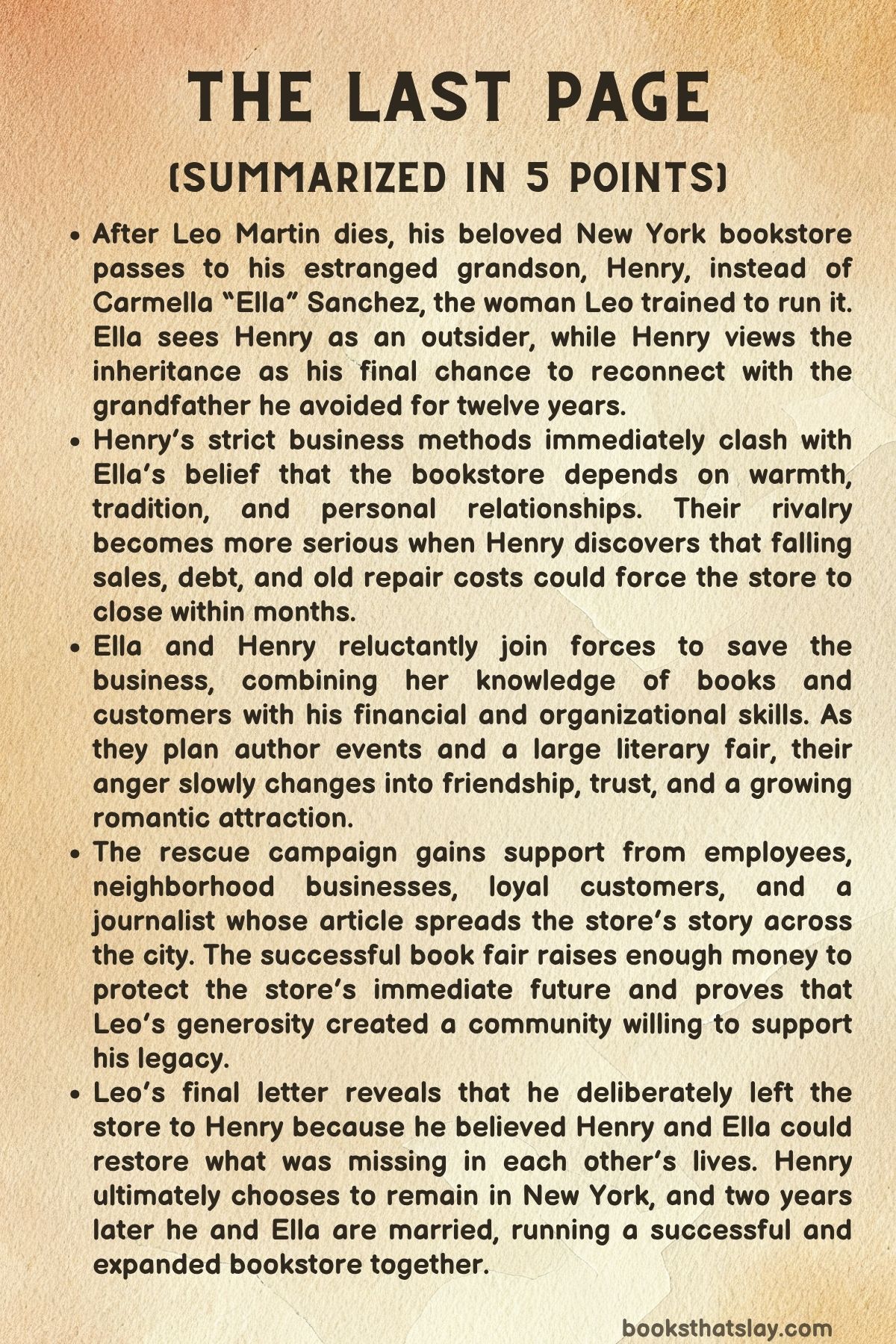
Leo Martin, the eighty-six-year-old owner of a famous West Village bookstore, dies after spending nearly five decades turning the shop into a refuge for readers. His talent was not simply selling books but understanding people, remembering their lives, and recommending stories that offered exactly what they needed.
Three months after his death, Carmella “Ella” Sanchez manages the store while waiting for confirmation that she has inherited it. Leo had known her since childhood, welcomed her family into his life, trained her in every part of bookselling, and repeatedly suggested that she would one day become the owner.
Ella’s confidence hides several serious problems. Sales are falling, the staff is worried about the store’s future, and her parents appear to be struggling financially, although they refuse to explain what is happening.
While travelling to Queens for her young brother Carlos’s birthday, Ella meets a handsome Southern stranger named Henry. After accidentally striking him when he touches her arm to ask for directions, she helps him navigate the subway and teases him about wanting to visit Times Square.
Their conversation is easy, playful, and full of immediate attraction, but they separate without exchanging contact information. Ella briefly imagines that New York might bring them together again, unaware of how disruptive their next meeting will be.
Henry soon arrives at the bookstore wearing a suit. Ella is delighted to recognize the subway stranger until he introduces himself as Henry Martin, Leo’s estranged grandson and the legal heir to the store.
Ella discovers that Leo’s lawyer sent her an email confirming the decision, but the message landed in her spam folder. She is crushed because Leo spent years preparing her for ownership, while Henry has been absent from his grandfather’s life for twelve years.
Henry explains that he did not know Leo was ill. He intends to stay in New York for about a month, review the business, and then manage it remotely from Tennessee.
Ella offers to buy the store or become Henry’s co-owner, but he refuses both proposals. He sees the bookstore as his final connection to Leo and believes his business experience will allow him to manage it without surrendering control.
Their professional disagreement quickly becomes personal. Ella regards Henry as an outsider who abandoned Leo, while Henry resents the fact that Ella shared the closeness with his grandfather that he lost.
The booksellers openly support Ella and treat Henry with suspicion. When he reorganizes schedules without understanding their personalities and specialties, the staff overwhelms him with complaints, demands, arguments, and exaggerated fears about working in unfamiliar sections.
Ella initially allows the resistance to continue because she hopes the staff will drive Henry back to Tennessee. Henry responds by imposing stricter rules, removing small benefits, issuing memos, and attempting to replace the bookstore’s informal culture with consistent procedures.
Although some of his changes are reasonable, the staff interprets them as attacks on the traditions Leo created. Ella also assumes that Henry is acting out of arrogance until she researches his career and discovers that he was a successful business consultant with a strong record of helping troubled companies.
Henry’s investigation reveals a crisis far worse than anyone expected. Leo’s handwritten accounts do not match the store’s electronic records, the business carries heavy debt, sales have been declining, and an old burst pipe created repair expenses that insurance never fully covered.
Even after eliminating bonuses, free coffee, space heaters, and other costs, the store has only a few months before it may be forced to close. Henry believes selling the property while it still has value may be the only responsible option.
When Ella learns the truth, she feels betrayed by Leo, who assured her that the store’s problems were manageable. Losing the business would mean losing the place that shaped her childhood, provided her career, connected her to Leo, and allowed her to support the people she loves.
She reacts by accusing Henry of pretending to care about his grandfather after years of absence. Henry is deeply wounded because his estrangement from Leo has always been a source of guilt.
At sixteen, Henry spent a summer in the bookstore while Leo repeatedly talked about passing the business to him. Still grieving his father’s death, Henry felt that Leo expected him to replace his father and accept a future he had never chosen.
Henry angrily rejected both the store and his grandfather. What began as a teenager’s demand for independence became a twelve-year separation because shame, depression, and fear prevented either man from repairing the relationship.
Despite Ella’s accusations, Henry agrees not to contact potential buyers immediately. Watching her perform a children’s storytime also shows him why Leo trusted her, since she possesses the same ability to make books feel personal and exciting.
Ella finally allows herself to admit that Leo’s death has left her overwhelmed. She has been supporting the staff, helping her parents, managing the store, and pretending to be strong without giving herself time to mourn.
Encouraged by her friend Julie, Ella decides that surrendering would dishonor everything Leo taught her. She approaches Henry with a binder full of rescue ideas, and he agrees to postpone any sale until August.
They establish a partnership based on honesty. Henry will explain the finances, while Ella will teach him how the bookstore truly operates and involve him in every attempt to save it.
Ella trains Henry in used-book purchasing, shelving, customer service, staff management, and Leo’s generous traditions. Henry points out inefficient practices, while Ella teaches him that trust and loyalty cannot always be measured through immediate profit.
Their hostility slowly becomes affectionate teasing. Henry asks Ella to create a reading list for him, and discussing books gives them a new way to communicate.
Reading also reconnects Henry with memories of the informal book club he once shared with Leo and his father. The experience hurts, but it allows him to recover a part of himself that disappeared after his family losses.
Ella decides to revive literary events at the store. Their first event, featuring married authors Rosie and Aiden Huntington, becomes chaotic because Joey oversells tickets, neglects the equipment, provides floor cushions instead of proper seating, and refuses to introduce the authors because of stage fright.
Although Henry also fears public speaking, he steps before the crowd and introduces himself as Leo’s grandson. He speaks honestly about grief, acknowledges the store’s difficulties, and publicly praises Ella’s importance.
The event succeeds despite its disorganization, proving that author programming can attract customers. Julie eventually accepts the role of events coordinator and begins planning talks, panels, book clubs, and drag storytime.
Ella and Henry soon realize that smaller events will not generate enough money. During an outing in Central Park, Ella overhears a child discussing a school book fair and proposes that the bookstore host an enormous literary fair of its own.
Her excitement causes her to tip their rowboat into the lake, but the idea survives. Over drinks, they begin designing a major event with authors, merchandise, games, themed activities, sponsorships, and ticket sales.
They tell the booksellers that the store is close to closing. Instead of leaving, the staff immediately offers to help, work additional hours, and participate in the fair without expecting raises.
The response moves Henry because it proves that the employees are more than coworkers. They are a difficult, argumentative, and deeply loyal family formed through their shared connection to Leo.
As Henry and Ella spend more time together, their attraction becomes impossible to ignore. Ella takes him to a Peruvian restaurant, introduces him to her culture, and listens as he discusses his father, his childhood, and his mother’s recent stroke.
Henry explains that his mother’s health is the main reason he plans to return to Tennessee. After losing his father and Leo, he is terrified of being far away if something happens to her.
When Ella becomes intoxicated, Henry takes her safely to Leo’s apartment. She comforts him by explaining that Leo never treated her as a replacement and continued telling loving stories about Henry throughout their years apart.
The following morning, their physical closeness leads to a passionate kiss. They admit that they like each other but agree to remain friends until after the fair because neither wants romance to interfere with the rescue effort.
Their agreement soon becomes difficult to maintain. They visit museums, cafés, comedy shows, parks, and neighborhood attractions together, behaving like a couple even while refusing to define their relationship.
Henry becomes increasingly capable as a bookseller. He learns the inventory, assists customers, understands the employees, and begins recognizing that the store offers him a sense of belonging he has not felt in years.
The neighborhood also joins the rescue effort. Adam, a Tennessee native who owns a hardware store, provides discounted building materials because Leo once supported his business and helped his daughter obtain inexpensive books.
Henry persuades Ella that accepting community assistance is not weakness. Many people want to help because Leo’s kindness affected their lives, and supporting the store allows them to return what he once gave them.
Journalist Isabel Claremont writes an article describing the danger facing the bookstore. She explains that Leo once helped her through loneliness as a teenager by recommending a novel that encouraged her to embrace New York.
The article presents Ella and Henry as the two people carrying Leo’s work forward. Ella supplies literary enthusiasm and energy, while Henry provides patience, discipline, and stability.
The story becomes widely shared, and a campaign to save the store spreads across social media. Customers post memories, sponsorships arrive, ticket sales increase, and the fair begins attracting citywide attention.
During preparations, Henry secretly uses his personal credit card when costs exceed the planned budget. He hides the decision because he does not want Ella to lose hope or place more debt on the business.
One night, while painting a ticket booth, they finally abandon their agreement to wait. Henry admits that he has wanted Ella since their subway meeting, and Ella accepts that avoiding love will not protect her from pain.
Their relationship becomes both emotionally and physically intimate. Henry later tells Ella about his lifelong depression, his tendency to isolate himself, and the thoughts that sometimes convince him happiness cannot last.
Ella responds with understanding rather than fear. She does not treat his depression as a defect, and her acceptance allows Henry to trust her more fully than he has trusted previous partners.
When Ella becomes ill while caring for her siblings, Henry travels to Queens and looks after the entire family. He prepares food, reads to Carlos, comforts Ella, and gains the approval of her protective siblings.
He also explains that returning to the store allowed him to make a free choice that he could not make as a teenager. He is no longer accepting Leo’s plan out of obligation but discovering that he genuinely values the work and community.
The book fair opens to an enormous crowd. The bookstore has been transformed with booths, music, activities, decorations, exclusive products, literary displays, and a memorial at Leo’s desk.
Numerous problems occur throughout the day. Merchandise sells out, crowds become difficult to control, Joey and Stewart argue before admitting their love, and Mabel mistakenly books a rock band instead of gentle jazz.
Jack unexpectedly saves the music crisis by taking the band’s guitar and performing jazz himself. Henry helps Ella understand that success does not require perfect control and that she does not have to carry every responsibility alone.
Ella discovers that the event falls on Henry’s birthday and that he secretly paid for supplies. Charlie also reveals that Henry wants to remain in New York but fears failing his mother.
After closing, the booksellers surprise Henry with cupcakes and a birthday celebration. He has always associated birthdays with the painful smallness of his biological family, but the staff proves that he now belongs to something larger.
Henry announces that the fair raised enough money to solve the immediate financial crisis. The store can continue operating, and the fair can become an annual event.
Although the business is safe, Ella and Henry must confront his planned departure. They confess their love, but Henry still believes he must return to Tennessee because he cannot risk abandoning his mother.
Ella’s mother advises her to stop treating love as a duty and carrying other people’s needs before her own. Soon afterward, Leo’s lawyer discovers a letter that Leo specifically left for Ella.
Leo explains that he genuinely intended Ella to own the store but deliberately left it to Henry in the hope of bringing his grandson home. He believed Ella could restore color and passion to Henry’s life, while Henry could help Ella carry responsibility and trust romantic love.
Leo hoped Henry would either give Ella the business or remain beside her. His final decision was therefore not a rejection of Ella but an attempt to reunite the people he considered his family.
As Henry prepares to leave, his mother confronts him. She refuses to let him sacrifice his happiness out of fear and explains that returning solely from obligation would repeat Leo’s mistake of allowing someone else to determine Henry’s future.
Ella and the booksellers organize an intervention at the store, presenting emotional and practical reasons for Henry to remain. Henry reveals that his mother has already released him from his sense of duty and announces that he is staying.
Two years later, the bookstore has become a major literary destination. The annual fair, public donations, a new coffee shop, and an expanded events space have secured its future.
Henry proposes to Ella in the New York City section, and they marry in the renovated event space. The store later begins hosting weddings, allowing Julie to become a wedding planner without leaving the community.
Leo’s legacy continues through a business that changes while preserving its central purpose. Henry and Ella remain partners in work and life, proving that the end of one chapter can create the beginning of another.
Characters
Carmella “Ella” Sanchez
Ella is the emotional and operational center of The Last Page. Her connection to the bookstore began in childhood, and almost every important stage of her life is associated with its shelves, employees, customers, and former owner.
Her devotion is both her greatest strength and her greatest vulnerability. She knows how to recommend books, motivate staff, create events, understand customers, and preserve the welcoming atmosphere Leo built, but she has difficulty imagining an identity that exists outside the store.
Ella is generous to the point of exhaustion. She quietly pays family bills, protects her siblings, manages the employees’ emotions, defends Leo’s legacy, and attempts to solve every crisis before anyone else recognizes it.
This tendency makes her capable, but it also encourages secrecy and emotional avoidance. She does not allow herself to mourn Leo because she believes grief would prevent her from taking care of everyone who depends on her.
Her initial hostility toward Henry comes from legitimate professional fear as well as personal hurt. She believes she earned ownership through years of loyalty and work, while Henry received it through blood despite being absent for more than a decade.
However, Ella gradually recognizes that her judgment of Henry is incomplete. Once she sees his grief, business ability, depression, family loyalty, and sincere desire to help, she stops treating him as an invader and begins accepting him as a partner.
Her romantic development is closely connected to her loss of control. Ella enjoys fictional romance but distrusts love in real life because emotional distance seems safer than uncertainty.
Henry challenges this belief by offering patience, consistency, and practical support. Through their relationship, Ella learns that depending on another person does not weaken her independence and that love can involve shared responsibility rather than additional burden.
Henry Martin
Henry begins the novel as an outsider carrying an inheritance he neither expected nor feels qualified to receive. His business clothing, corporate vocabulary, strict procedures, and lack of recent reading experience make him appear fundamentally unsuited to the bookstore’s informal culture.
Beneath that controlled exterior, Henry is deeply affected by grief and regret. His father’s death, estrangement from Leo, and fear following his mother’s stroke have convinced him that loving people creates unbearable risks.
His depression contributes to his isolation. He often avoids relationships and difficult conversations because his mind tells him that happiness will disappear or that repair is no longer possible.
Henry’s conflict with Leo began because he felt that his future had been chosen without his consent. As a teenager, he interpreted the bookstore inheritance as pressure to replace his father rather than an invitation to continue a family tradition.
His professional skills initially create conflict because he focuses on efficiency without understanding the emotional purpose of the store’s traditions. Yet his financial analysis exposes the crisis that everyone else has missed, making his practical discipline essential to survival.
Henry’s growth involves learning that belonging does not have to mean surrendering personal freedom. Once he chooses the bookstore for himself, his work there becomes an expression of agency rather than obligation.
His relationship with Ella brings tenderness, humor, literature, and companionship back into his life. He becomes more willing to speak publicly, accept community, discuss depression, and imagine a future shaped by hope rather than anticipated loss.
By remaining in New York, Henry does not reject his mother or Tennessee. He finally accepts that loving his family does not require sacrificing every other source of meaning and that he can care for people without allowing fear to control his decisions.
Leo Martin
Leo remains a powerful presence throughout The Last Page despite dying before the main events begin. His personality survives through the bookstore’s traditions, customer memories, neighborhood relationships, staff loyalty, and the emotional influence he had on Ella and Henry.
He understood books as tools for recognizing people. His recommendations mattered because he listened carefully, remembered personal details, and selected stories that helped customers feel less alone.
Leo’s love for Ella was parental and unconditional. He trained her, trusted her judgment, welcomed her family, and regarded her as a granddaughter regardless of their lack of a biological connection.
His relationship with Henry was more complicated. Leo genuinely loved his grandson and followed his achievements from afar, but his desire to preserve the family business caused him to pressure Henry before Henry was emotionally ready.
Leaving the store to Henry was both loving and manipulative. Leo correctly understood that Henry and Ella possessed complementary qualities, yet he once again arranged Henry’s future without giving him the opportunity to choose it directly.
The letter to Ella clarifies that Leo never considered her less deserving. Instead, he used the inheritance as a final attempt to bring Henry home and place the two people he loved in a situation where they might help each other.
Leo’s plan succeeds because his understanding of their emotional needs is accurate. However, the pain created by his secrecy also shows that good intentions do not remove the consequences of controlling other people’s choices.
Julie
Julie is Ella’s closest friend and one of the few people willing to challenge her self-destructive habits. She notices that Ella has not grieved Leo, recognizes the pressure she carries, and refuses to accept Ella’s claim that she can manage everything alone.
Her support is practical rather than passive. She encourages Ella to fight for the store, becomes events coordinator, and transforms literary programming into a meaningful part of the rescue campaign.
Julie initially resists the events position because she fears it will distract from her dream of becoming a wedding planner. Her concern reflects a broader anxiety about becoming permanently defined by the bookstore when she wants a career of her own.
Ella helps her recognize that bookstore events can provide useful experience rather than limit her future. Julie’s eventual success shows that remaining connected to a community does not require abandoning personal ambition.
She also serves as an observer of Ella and Henry’s relationship. Her teasing often reveals feelings Ella is unwilling to admit, but she does not pressure Ella into romance without acknowledging the emotional risks involved.
The later expansion into bookstore weddings allows Julie’s professional dream and her loyalty to the store to support each other. Her journey therefore parallels Henry’s realization that personal choice and family belonging can coexist.
Charlie
Charlie is Henry’s closest friend and an important source of emotional honesty. He knows Henry’s history of depression, isolation, grief, and avoidance, and he encourages him to confront the inheritance rather than dismiss it from a distance.
His humor provides relief during Henry’s difficult adjustment to New York. Charlie immediately recognizes Henry’s attraction to Ella and enjoys exposing the feelings Henry tries to hide.
More importantly, Charlie understands that Henry’s methodical behavior often conceals fear. He urges Henry to treat sorting Leo’s possessions as a conversation with his grandfather and to face the emotions connected to the objects.
Charlie also assists with the fair by offering advice on construction and planning. His involvement demonstrates that Henry’s life in Tennessee is not meaningless or empty, making Henry’s final decision more complex than simply choosing a better life over a worse one.
Although he reveals Henry’s secret spending and desire to stay, his disclosures are motivated by concern rather than betrayal. He wants Ella to understand the pressure Henry is carrying and recognizes that silence could damage both the relationship and the fair.
Lucía Sanchez
Lucía is a hardworking mother who values family loyalty and immediately protects Ella when Henry inherits the store. Her initial resentment toward him comes from watching Leo prepare her daughter for ownership and knowing how much Ella sacrificed for the business.
She is also proud, particularly when her family experiences financial trouble. Rather than asking Ella for help, Lucía works additional hours and tries to shield her children from the seriousness of the situation.
Her behavior helps explain Ella’s habit of carrying burdens privately. Ella has learned from her parents that love is expressed through sacrifice, work, and protection, even when those actions prevent honest communication.
Lucía eventually offers Ella essential advice about love and responsibility. She tells her daughter to stop anticipating every family need and to trust that relatives will ask for help when help is genuinely necessary.
This conversation gives Ella permission to pursue her own happiness. Lucía’s guidance shows that family support should allow growth rather than demand constant self-denial.
Ella’s Father
Ella’s father experiences unemployment as a threat to his role within the family. After losing his job, he begins driving for a rideshare service while avoiding direct conversations about the household’s financial condition.
His refusal to accept Ella’s money is partly based on pride, but it also reflects concern that she is already carrying too much. He does not want his adult daughter to become responsible for maintaining the entire household.
His belief that communities survive by helping one another inspires one of Ella’s most important fundraising decisions. She begins approaching neighborhood businesses for sponsorship instead of attempting to finance the fair entirely through the struggling bookstore.
This advice extends the novel’s understanding of family beyond relatives. Mutual support is presented not as charity but as an exchange built through years of trust, generosity, and shared history.
Carlos Sanchez
Carlos is Ella’s young brother and one of the clearest representations of her nurturing nature. She attends his birthday, cares for him when he is ill, reads with him, and treats his interests with seriousness even while facing major professional pressure.
His affection for Leo shows how completely the bookstore owner became part of the Sanchez family. Carlos participates in the family’s mourning practices even though he understands the loss differently from the adults.
He also accepts Henry quickly when Henry comes to Queens and cares for the sick family. Calling Henry Ella’s boyfriend allows the child to state openly what the adults are still avoiding.
Carlos’s presence reminds Ella and Henry that books, traditions, and communities are preserved by passing them to younger generations. His enjoyment of stories also reflects the continuing influence of Leo’s work.
Maya and Jorge Sanchez
Maya and Jorge represent the ordinary family responsibilities that remain present while Ella faces the extraordinary threat of losing the bookstore. Their school concerns, romantic disappointments, requests for money, and sibling conflicts continue regardless of her grief.
Maya’s need for a homecoming dress reveals the family’s financial crisis. Ella immediately pays for it because she does not want her sister to experience the consequences of their father’s unemployment.
Jorge’s heartbreak shows Ella acting as an emotional caretaker at home as well as at work. His protective warning to Henry also demonstrates that Ella’s siblings recognize how rarely she allows herself to become emotionally vulnerable.
Together, Maya and Jorge help make the Sanchez household feel active and believable. They are not merely dependents but members of a close family who challenge, frustrate, and support one another.
Henry’s Mother
Henry’s mother is compassionate, perceptive, and unwilling to let her son build his life around fear. She understands immediately that Ella matters to him and recognizes that Leo’s inheritance was probably deliberate rather than accidental.
Her stroke intensifies Henry’s fear of abandonment and loss. He convinces himself that returning to Tennessee is a moral responsibility, even after the bookstore and Ella become central to his happiness.
Instead of using his guilt to keep him close, she refuses to become the reason he abandons a meaningful future. She points out that Henry’s decision would repeat Leo’s mistake by allowing someone else’s life to determine his choices.
Her response is an act of mature parental love. She values continued closeness with Henry, but she also trusts her own independence and encourages him to create a life based on desire rather than fear.
Joey
Joey brings chaos, humor, trend awareness, and unexpected loyalty to the bookstore. He frequently manipulates schedules, avoids unwanted responsibilities, argues with Stewart, and treats the removal of birthday cupcakes as a serious violation of workplace culture.
His attempt to coordinate an author event is disastrous because enthusiasm cannot replace preparation. Overselling tickets, neglecting equipment, arranging inappropriate seating, and refusing to speak publicly expose his limitations.
However, Joey is not useless or uncaring. He understands popular culture, social excitement, and the emotional identity of the store, even when he lacks the discipline required to manage major events.
His relationship with Stewart develops through constant bickering and avoidance. Their eventual confession during the fair turns their comic conflict into a smaller example of characters learning to speak honestly before fear wastes more time.
Stewart
Stewart is defined partly through his partnership with Joey and partly through his resistance to change. His complaints about assignments, sections, and store policies contribute to the overwhelming reception Henry faces as a new owner.
Like many employees, Stewart initially treats Henry as a threat because loyalty to Ella and Leo determines his response. He is more comfortable with familiar routines than with the flexibility Henry expects from the staff.
His arguments with Joey conceal emotional attachment. Their inability to define their relationship mirrors the larger romantic tension between Ella and Henry, although Stewart and Joey express it in a more exaggerated and comic form.
By admitting his love during the fair, Stewart participates in the story’s movement from avoidance toward openness. His loyalty during the rescue effort also proves that his complaints do not cancel his commitment to the bookstore family.
Jack
Jack initially appears abrasive, disrespectful, and difficult to manage. His willingness to insult Ella makes him a test of both her authority and Henry’s understanding of workplace loyalty.
Ella responds by demanding an apology and making clear that affection does not excuse bad behavior. Henry’s support during this conflict shows that he is learning to respect her leadership rather than competing with it.
Jack later surprises Henry by defending him from a customer who looks down on retail work. He explains that longtime employees protect their own, signaling that Henry has gradually been accepted into the group.
His unexpected jazz performance during the fair also reveals hidden talent and adaptability. Jack demonstrates that difficult personalities can still make essential contributions when they feel responsible for the community around them.
Ameerah
Ameerah represents the practical loyalty of the staff. When Ella and Henry reveal the financial crisis, she is among the first to move the conversation away from panic and toward action.
By asking how the employees can help, she establishes the tone for the collective rescue effort. Her response confirms Henry’s growing understanding that the staff’s attachment is not merely resistance to authority.
Ameerah’s presence also supports Ella’s belief that the store is a family. Employees may argue and avoid unpleasant tasks, but they do not abandon one another when the institution itself is threatened.
Mabel
Mabel contributes to the store’s disorder through her strong opinions, demands for equal treatment, and imperfect event skills. Her painful microphone feedback during the author appearance and mistaken booking of a rock band create major complications.
However, her mistakes are not acts of indifference. She participates fully in the fair and wants the event to succeed, even when her judgment produces results far different from what was intended.
Mabel illustrates the difficulty Henry faces in managing people whose value cannot be measured through flawless performance. The bookstore survives partly because its unusual employees are permitted to contribute according to their individual strengths.
Ren
Ren appears as one of the employees who immediately supports the rescue plan. The willingness to volunteer additional labor without demanding raises or overtime reveals a strong emotional investment in the store’s survival.
Although Ren receives less individual attention than several other booksellers, the character helps establish the collective spirit of the staff. The employees are not simply protecting jobs but preserving relationships, memories, and a place where they feel accepted.
Ren’s participation reinforces the idea that community is built through repeated acts of commitment. The store’s future depends on many people whose contributions may be less visible than Ella’s or Henry’s but remain essential.
Isabel Claremont
Isabel is the journalist whose article transforms the rescue campaign from a neighborhood effort into a citywide cause. Her professional influence becomes effective because her relationship with the store is personal.
As a lonely teenager new to New York, she once received comfort and a carefully chosen book from Leo. That recommendation helped her reinterpret the city and understand that loneliness did not have to define her future.
Her article captures what financial reports cannot measure. She presents the store as a cultural and emotional institution whose loss would affect thousands of people, not merely its employees and owners.
Isabel also recognizes the complementary partnership between Henry and Ella. By describing how Leo’s qualities continue through them, she helps the public understand that supporting the store means supporting a living legacy rather than preserving a frozen monument.
Adam
Adam owns the neighborhood hardware store and represents the long-term effects of Leo’s generosity. Years earlier, Leo supported Adam’s new business and helped his daughter obtain affordable books.
When Adam learns about the fair, he provides a substantial discount on construction materials. His assistance is not presented as a favor to strangers but as repayment within an established relationship.
Adam’s Tennessee background also matters to Ella. His ability to miss home while loving New York offers evidence that Henry could build a life in the city without erasing his connection to Tennessee.
Through Adam, the novel demonstrates that generosity can create practical support years later. Leo’s community survives because the people he helped remember what he did and choose to continue the exchange.
Rosie and Aiden Huntington
Rosie and Aiden are the married authors invited to the store’s first major event after Leo’s death. Their appearance provides the setting for a chaotic but necessary test of the rescue strategy.
The disastrous planning surrounding their visit forces Henry to take the stage despite his fear of public speaking. His successful introduction becomes an early sign that he can represent the bookstore publicly and emotionally.
The couple’s event also proves that readers remain interested in gathering at the store. Even though Rosie and Aiden are not central to the larger conflict, their visit helps convert Ella’s idea about renewed programming into evidence that the business can attract new energy.
Emily Lickinson
Emily Lickinson, Leo’s elusive cat, provides humor and continuity within his apartment. Caring for her becomes one of Henry’s first responsibilities after returning to New York.
The cat also interrupts Henry and Ella’s first kiss, preventing the romantic scene from becoming overly serious. Her demanding presence connects domestic comedy with the grief surrounding Leo’s belongings and home.
Emily represents the small, ordinary responsibilities left behind after someone dies. Through feeding her, searching for her, and sharing space with her, Henry gradually becomes more comfortable living inside the life his grandfather once occupied.
Themes
Chosen Family and Belonging
Family in The Last Page is created through attention, loyalty, shared labor, and repeated acts of care rather than biological connection alone. Leo becomes a grandfather to Ella, joins the Sanchez family’s traditions, and treats employees and customers as people whose lives matter beyond their purchases.
Ella initially believes Henry’s biological relationship with Leo gives him an unfair advantage. Her pain is understandable, yet the story gradually shows that blood and choice are not opposing forms of family when both are supported by genuine love.
Henry’s inheritance brings him into conflict with people who already consider the bookstore their home. Over time, he earns belonging by listening, working beside them, protecting Ella, accepting their peculiarities, and committing himself to the store’s survival.
The booksellers’ response to the financial crisis demonstrates the strength of this chosen family. They argue constantly, resist authority, create avoidable disasters, and make ordinary management extremely difficult, but none of them abandons the group when it is threatened.
Henry’s birthday celebration completes his emotional acceptance into the community. What once reminded him of the smallness and losses within his biological family becomes evidence that his life now contains a wider circle of people who want to celebrate him.
Belonging is therefore presented as active rather than automatic. Characters become family by showing up, accepting responsibility, allowing others to help, and continuing to choose one another during moments of inconvenience, conflict, and fear.
Grief, Guilt, and Emotional Repair
Leo’s death creates the central crisis, but nearly every major character has been shaped by an earlier or continuing form of grief. Ella loses a grandfather figure and suppresses her mourning, while Henry carries the deaths of his father and grandfather alongside the regret of twelve years of silence.
Ella responds to loss by becoming more responsible. She manages the store, protects employees, supports her parents, and tries to prevent every possible failure because remaining active allows her to avoid confronting emotional pain.
Henry responds in the opposite way. Depression, shame, and fear encourage him to withdraw, delay reconciliation, and treat emotional distance as protection against further abandonment.
Their partnership exposes the limitations of both reactions. Ella cannot control grief through constant work, and Henry cannot escape it through isolation or geographical distance.
Repair does not occur through one apology or revelation. Henry reconnects with Leo gradually by reading old books, sorting possessions, learning about the store, listening to customer memories, and accepting evidence that his grandfather continued loving him.
Leo’s final letter offers explanation but does not erase the harm caused by secrecy and control. Instead, it gives Ella and Henry enough understanding to interpret the inheritance as an imperfect act of love rather than a simple rejection.
The story treats healing as the ability to build a future while continuing to carry loss. Leo remains absent, but the people he loved transform grief into relationships, traditions, and choices that allow his influence to continue.
Community, Generosity, and Independent Spaces
The bookstore survives because it has spent decades giving people more than commercial transactions. Leo’s recommendations, discounts, encouragement, conversations, and support created relationships that later become essential when the business faces closure.
The financial crisis initially appears to be a private failure that Ella should solve through determination. Henry helps her recognize that hiding the truth prevents the community from returning the care it once received.
Adam discounts construction materials because Leo supported his business. Isabel writes a major article because Leo helped her through loneliness, while customers purchase tickets and share personal memories because the store became part of their own histories.
These responses suggest that generosity creates a form of value that cannot be represented accurately in a conventional ledger. Leo’s practices sometimes contributed to financial inefficiency, but they also produced the loyalty that ultimately saves the business.
The rescue effort does not reject business discipline. Henry’s budgeting, financial analysis, cost control, and logistical planning are necessary, but they become effective only when combined with Ella’s understanding of relationships and community identity.
The bookstore matters because it offers personal recognition in a city that can feel anonymous. Its survival protects a physical place where strangers can become regulars, employees can become family, and readers can connect stories with real experiences.
The novel therefore defends independent cultural spaces without pretending that affection alone can sustain them. Survival requires responsible management, public participation, adaptation, and a willingness to translate emotional value into collective action.
Love, Responsibility, and Personal Choice
Ella and Henry both confuse love with obligation. Ella believes caring for people means anticipating every need and carrying every burden, while Henry believes loving his mother requires returning to Tennessee regardless of what he wants for himself.
Their choices are shaped by admirable loyalty, but the story shows how responsibility becomes damaging when it eliminates personal freedom. Love offered through sacrifice can become another form of control when people assume they know what others need without asking them.
Leo’s relationship with Henry provides the clearest warning. His desire to preserve the family business leads him to design Henry’s future, first during Henry’s adolescence and later through the inheritance.
Henry’s mother corrects this pattern by refusing to use vulnerability as a claim on his life. She values his presence but insists that he must not abandon happiness simply because he fears future regret.
Ella receives a similar lesson from Lucía. Her family does not want her to prevent every difficulty at the cost of her own emotional life, and accepting that truth allows Ella to ask Henry to stay.
The romance succeeds because neither character saves the other through complete self-sacrifice. Ella supports Henry’s mental health without trying to cure him, while Henry helps Ella carry responsibility without taking away her authority.
Their final partnership is based on continued choice. They remain connected to their families, preserve Leo’s work, manage the store together, and create a shared future because they freely choose those commitments rather than accepting them as unavoidable duties.