The Last Days of Marilyn Monroe Summary and Analysis
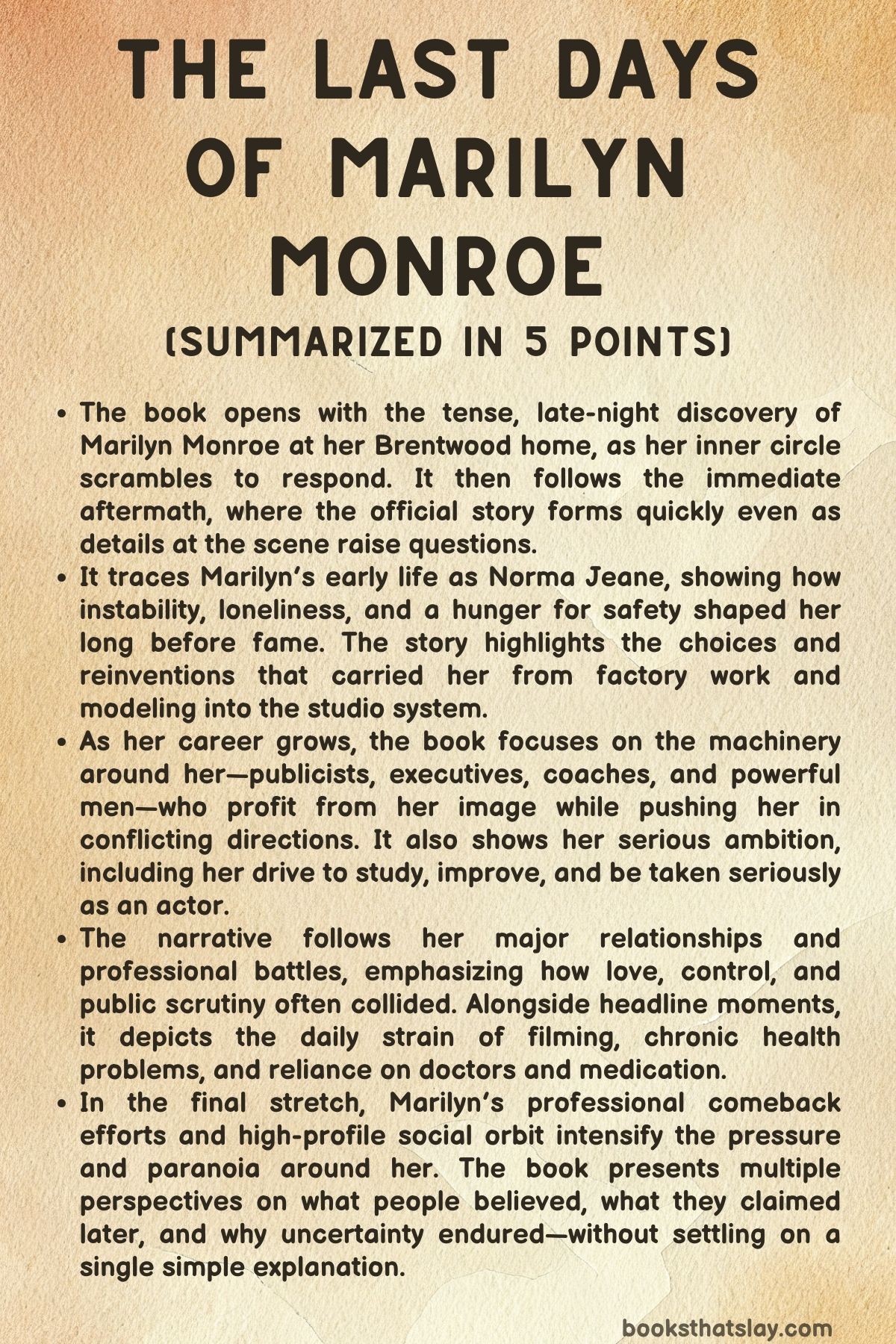
The Last Days of Marilyn Monroe by James Patterson is a dramatized true-crime style account of Marilyn Monroe’s life and death, built around the final hours in her Brentwood home and the long chain of events that led there. The story opens with the night she is found unresponsive, then moves backward through key moments: her childhood as Norma Jeane, her early marriage, her rise through modeling and the studio system, and the fame that brings both power and isolation.
As her career peaks, pressure from Hollywood, complicated relationships, and escalating dependence on medication tighten around her. The book follows the public myth and the private instability side by side, ending where it began: the shockwave after her death.
Summary
In the early hours of August 5, 1962, Marilyn Monroe’s housekeeper, Eunice Murray, wakes with a sharp, uneasy feeling inside Marilyn’s Brentwood house. The home is still half-settled, with boxes and scripts left out as if life hasn’t fully moved in yet.
Eunice notices something strange: the cord of Marilyn’s private phone is trapped under the bedroom door, and light shows beneath it. The door is locked, which feels wrong for Marilyn, who usually avoids locked doors unless she is with someone.
Eunice tries the handle repeatedly, then calls Marilyn’s psychiatrist, Dr. Ralph Greenson.
Greenson arrives quickly, rushes across the lawn, and forces his way in through a smashed bedroom window. Inside, Marilyn is on the bed, unclothed, with the phone receiver in her hand and the call left hanging.
There are pill bottles nearby, some open, with pills scattered. Greenson checks for a pulse and realizes she is gone.
He tells Eunice to contact Marilyn’s physician, Dr. Hyman Engelberg, and when Engelberg arrives, he confirms Marilyn is dead. The doctors argue about the medications and how Marilyn could have so many, including an empty bottle of Nembutal that Engelberg says he prescribed only days earlier.
Eventually, at 4:25 a.m., police are called.
Sergeant Jack Clemmons arrives close to 5 a.m. expecting a prank or a routine case, but the house is already tense.
Eunice gives a calm, rehearsed-sounding account of finding Marilyn because of the phone cord and the locked door. Inside the bedroom, Clemmons sees details that unsettle him.
Marilyn’s body is face-down under a sheet, one arm hanging off the bed, and the scene doesn’t look like what he expects. There is no water glass near the bed, which seems odd if someone swallowed a large number of pills.
He also questions why Marilyn would still be holding the phone instead of calling out for help in a house where Eunice is nearby.
Even as Clemmons is trying to control the scene, chaos arrives. A handyman shows up to repair the broken window as if the priority is cleanup rather than investigation.
Outside, reporters gather quickly, and the crowd grows until the house is ringed with cameras and lights. Marilyn’s publicist Pat Newcomb and her lawyer Mickey Rudin arrive, and the atmosphere turns into a frantic blend of grief, image-management, and panic.
A gossip columnist slips inside and manages to photograph Marilyn’s body before being forced out. When the mortuary team arrives, they bag pills as evidence and prepare Marilyn’s body for removal.
Marilyn is taken from the house while the story begins spreading beyond anyone’s control. Different people later offer versions of the night that do not line up neatly, and suspicion forms around what was done, what was moved, and what might have been concealed.
From there, the narrative steps back decades to show how Norma Jeane Mortenson became Marilyn Monroe. In 1939, Norma Jeane is a thirteen-year-old trying to survive adolescence while living under unstable guardianship arrangements.
Her mother is institutionalized, and her home life depends on adults whose circumstances can change suddenly. In school, she experiences a confusing shift: once ignored, she is now noticed because she is developing physically.
Attention from boys and strangers gives her a sense of power, but also exposes how quickly she can become an object in other people’s eyes.
Any sense of safety collapses when her guardian situation changes again. When Aunt Ana’s health declines and the household can no longer care for her, Norma Jeane is pushed back toward the threat of returning to an orphanage.
To prevent that, Grace Goddard arranges a solution that is less about love than logistics: Norma Jeane marries neighbor James Dougherty as soon as she turns sixteen. The marriage gives her a roof and a legal status, but not stability.
Dougherty’s work and later his time away at sea leave her lonely, and she feels trapped in a life that demands she be quiet, grateful, and ordinary.
During the war, Norma Jeane works at a factory, where an Army photographer, David Conover, notices her and takes photographs that change her path. Modeling begins as a job, then becomes a strategy for escape.
She trains, learns how to pose, how to sell an image, and how to reshape herself to match what the market wants. She changes her hair and presentation and starts appearing on magazine covers.
As Hollywood interest grows, she hears a blunt truth: studios prefer unmarried women. She chooses her career over the marriage that was never truly her choice, divorces Dougherty, and moves closer to the studio gates.
At 20th Century-Fox, she is brought to talent director Ben Lyon, who pushes for a name change that will fit the screen. Norma Jeane becomes Marilyn, and “Monroe” is added, completing the identity that will soon take over her life.
With the new name comes a carefully crafted backstory for public consumption—an edited narrative meant to protect her from shame and from the scrutiny that could follow the reality of her mother’s illness and her own childhood displacement.
Early Hollywood is a cycle of hope and humiliation. Marilyn wants roles, education, and respect, but the industry wants an image it can package.
She meets people who offer mentorship or companionship, like Bob Slatzer and Sid Skolsky, who encourage her curiosity and connect her to books, music, and ideas. At the same time, she learns how parties work in Hollywood: powerful men, vulnerable young women, and the unspoken transactions beneath the glitter.
At Joe Schenck’s gatherings she witnesses the proximity of entertainment, money, and criminal power, and she understands how quickly rumors can define a woman’s career regardless of what actually happens.
Marilyn gets small parts, then loses her contract, then fights her way back through training and relentless self-promotion. Columbia gives her a brief chance, but she is cornered by the studio chief and pressured sexually, making it clear that refusal has consequences.
When that deal ends, she is left with nothing stable again. In these years she attaches herself to figures who promise protection and advancement, including agent Johnny Hyde, who helps drive her career forward while becoming possessive.
His death leaves her shaken and guilty, and she experiences a dangerous pill incident that she insists was not an intentional act.
As her visibility rises, Marilyn becomes both a star and a battleground. She is celebrated publicly while being controlled privately by studios, contracts, and handlers.
She meets playwright Arthur Miller, drawn to the idea that someone might see her as more than a body on a poster. She also becomes known for sex appeal in ways she cannot fully steer, even as she tries to study acting seriously and develop real craft.
Her relationship with Joe DiMaggio begins with attraction to his steadiness, but the marriage becomes suffocating. She later describes criticism, isolation, and emotional coldness.
After the divorce, DiMaggio spirals into jealousy and attempts to monitor her, even rushing with friends to confront her and breaking into the wrong apartment. Marilyn’s anger grows—at DiMaggio, at the press, and at the studios that keep trying to trap her in roles she doesn’t want.
She flees to New York under a disguise and creates Marilyn Monroe Productions with Milton Greene, claiming a new identity as someone pursuing serious work and control. She studies at the Actors Studio, enters psychoanalysis, and tries to remake herself again—this time not for a studio, but for herself.
Her affair with Miller deepens under intense public attention, with gossip and politics adding danger because of his scrutiny by government investigators.
Marilyn wins a major contract victory with Fox, gaining higher pay and creative leverage. She returns to films with new seriousness, but the work is still grueling, and her dependence on coaching and repetition draws ridicule from colleagues who do not understand her anxiety and insecurity.
She marries Miller in 1956 after his divorce, converting to Judaism and attempting to build a stable home life. Yet their relationship is pressured by fame, his ambitions, her longing for children, and her health problems.
In London, while making The Prince and the Showgirl, she clashes with Laurence Olivier’s working style and suffers a miscarriage. The experience deepens her fear that she may never have the family she wants.
Over the next years, her body and mind take repeated blows: pregnancy losses, surgery, pain, and increasing reliance on pills and alcohol. During Some Like It Hot, she is late, forgets lines, and drives the production into delays, yet the final film is a triumph, proving her screen presence even when her private life is collapsing.
Her marriage to Miller frays, and The Misfits becomes another source of strain rather than rescue.
By 1961 and 1962, the story narrows toward her final stretch. She is hospitalized again, malnourished and sick, and undergoes gallbladder surgery.
Fox offers a comeback through Something’s Got to Give, but rewrites, illness, and absences trigger conflict, and the studio fires her publicly. When the project collapses without her, Fox begins to backtrack, and negotiations hint at a new deal—proof that the same system that punishes her also needs her.
At the same time, her personal world becomes more dangerous. Dr. Greenson’s involvement grows intense, and Eunice Murray appears in Marilyn’s home as a constant presence.
Marilyn becomes entangled with powerful men and political attention, including connections to the Kennedys and the paranoia such connections create. Her attempts to reach the president are blocked, humiliating her and leaving her furious.
She performs the famous birthday song to President Kennedy in May 1962, briefly reclaiming the spotlight, then returns to Hollywood where her health and mood continue to deteriorate.
In the last weeks, she is photographed in sessions that display both control and vulnerability, interviewed at home, and watched by authorities who consider her a risk because of her associations and what she claims to know. She becomes more volatile, makes frantic calls, drinks, takes pills, and talks about betrayal.
Reports place Bobby Kennedy and Peter Lawford at her house during a violent confrontation shortly before her death, centered on promises and her private notes.
Then the book returns to where it began: a locked door, a phone cord under it, a silent house, and the authorities arriving into a scene already being shaped by fear and reputation. Marilyn’s death is treated as an overdose, with the possibility of suicide, but questions remain because of inconsistent accounts, missing or disputed evidence, and rushed cleanup.
Afterward, people vanish from the public story, others distance themselves, and a small funeral is held. DiMaggio takes control of the final arrangements and keeps the Kennedys away.
Marilyn Monroe is buried, and the world is left arguing over what really happened, while the life behind the image—Norma Jeane’s long search for safety—ends in the same loneliness the book shows from the very start.
Key People
Marilyn Monroe
In The Last Days of Marilyn Monroe, Marilyn is presented as a woman living inside a relentless contradiction: she is simultaneously the most visible person in the room and the most unreachable. The narrative frames her as someone who built Marilyn Monroe as a role sturdy enough to survive Hollywood, while Norma Jeane remained porous, hungry for safety, and easily wounded by abandonment.
Her early life shapes that emotional architecture—unstable guardianship, poverty, and the recurring trauma of being passed along—so her later craving for control, affection, and legitimacy is never just “diva behavior,” but an old survival strategy that keeps colliding with fame’s machinery. As her career rises, she fights to be taken seriously, reading, studying, chasing craft, and negotiating power through her production company, yet she is repeatedly reduced to an image: a commodity, a fantasy, a problem to be managed.
The book also depicts her as medically and psychologically vulnerable in ways that compound each other—chronic pain, endometriosis-related complications, insomnia, dependence on pills and alcohol, and the isolating treadmill of public performance—so that her “lateness” and on-set struggles read as symptoms of a life being held together with fragile scaffolding. In her final months, Marilyn becomes increasingly trapped between powerful men, institutions, and narratives about her: studios calculating profits, publicists controlling headlines, law enforcement and federal scrutiny politicizing her associations, and intimate relationships turning into leverage.
By the end, her tragedy is not only the overdose itself, but the sense that everyone around her is interpreting her—star, liability, lover, patient, security risk—while fewer and fewer people are actually listening to her as a person.
Eunice Murray
Eunice is portrayed as both a practical presence in Marilyn’s home and an unsettling symbol of how Marilyn’s private life becomes mediated through others. Her role is pivotal because she is positioned at the threshold between the intimate and the official: she is the one who discovers the locked door, calls the psychiatrist, and becomes the first narrator of what happened inside the bedroom.
The summary casts her demeanor as composed to the point of eerie, repeating details in a flat, rehearsed-feeling way even as the scene grows chaotic and public, which makes her feel less like a grieving witness and more like someone who has learned what to say—or has been coached into a version of events. She also functions as a lightning rod for suspicion because she is not simply a household employee; she appears aligned with Dr. Greenson’s orbit, and Marilyn’s circle suspects she is monitoring visitors and reporting back.
That dynamic matters because it suggests Marilyn’s home—supposed to be her sanctuary—may have become another controlled environment where access to her is filtered and loyalty is ambiguous. By the aftermath, her disappearance from the story’s center reads like a narrative void: she is essential at the moment of discovery, then recedes while competing accounts harden, leaving her as one of the book’s most haunting “ordinary” figures whose ordinariness only amplifies the mystery.
Dr. Ralph Greenson
Dr. Greenson is depicted as a man who is ostensibly responsible for Marilyn’s care but who gradually becomes entangled in a form of control that blurs therapeutic boundaries. He enters the death scene as the decisive authority—rushing over, breaking the window, checking for a pulse, directing Eunice to call the physician—and that authority frames how the household reacts before police arrive.
The summary also paints him as emotionally shaken and possibly defensive, particularly in the argument over prescriptions and responsibility, which signals that he knows his decisions will be judged. What makes him especially complicated is the portrayal of his increasing involvement in Marilyn’s daily life: devoting extensive time to her, collecting material about her, translating omens in the home she buys, and installing Eunice as a housekeeper who seems accountable to him as much as to Marilyn.
Rather than a clean image of a doctor protecting a fragile patient, the narrative suggests a dynamic where Marilyn’s autonomy is being narrowed in the name of stability, turning treatment into supervision. His presence at the crucial moment—before law enforcement, before the coroner—also heightens suspicion because the earliest choices about the scene, the narrative, and the sequence of calls pass through his hands.
The result is a character who can be read two ways at once: a caregiver overwhelmed by a patient in crisis, and a gatekeeper whose closeness may have made the situation less safe, not more.
Dr. Hyman Engelberg
Dr. Engelberg appears as the medical professional who brings clinical confirmation to what Greenson fears, but the summary also makes him a conduit for moral and procedural tension. He confirms Marilyn’s death, identifies the drugs involved, and states he prescribed the Nembutal only days earlier after Marilyn begged for it, which immediately shifts the scene from tragedy to accountability.
He seems caught between professional duty and self-protection: he acknowledges the prescription and questions how she obtained so many bottles, yet the argument with Greenson reads like two men trying to distribute blame before outsiders fully enter the room. His suggestion about “decorum” and moving her body is especially telling because it introduces the idea that presentation matters even in death—an instinct that might be compassionate, but that also risks contaminating truth.
He also controls the moment when authorities are contacted, placing him at a key junction where medical reality becomes legal reality. Overall, Engelberg is portrayed less as a villain than as a man practicing medicine at the edge of celebrity culture, where patients plead, boundaries soften, and every decision becomes part of a future investigation.
Sergeant Jack Clemmons
Clemmons functions as the story’s skeptical eye—the grounded investigator arriving into a scene already shaped by powerful civilians. His instincts are triggered by small, practical inconsistencies: the staged-looking body position, the absence of a glass of water despite an alleged massive pill ingestion, the strange detail of the phone receiver in Marilyn’s hand, and the timing of the window repairman showing up as if the household is managing optics rather than preserving evidence.
He is not presented as a conspiracy theorist so much as a professional whose training tells him that the environment doesn’t behave the way a straightforward overdose usually does. His presence also highlights class and space: the bungalow feels smaller than expected for someone of Marilyn’s status, reinforcing the book’s theme that the myth of Marilyn dwarfs the reality of her lonely domestic life.
He is surrounded by doctors, lawyers, publicists, and a swelling press, which makes his job feel like trying to conduct a homicide inquiry inside a publicity hurricane. Clemmons’ significance is that he embodies the tension between institutional procedure and celebrity exceptionalism: even when police arrive, the story suggests the narrative is already in motion, and his doubts become one of the few anchors for readers who sense that the official version is too neat.
Maf (Marilyn’s dog)
Maf is a small presence with a large emotional function: a nonverbal witness whose distress underscores that something is wrong before any human admits it. The dog’s anxious barking from the guest house adds a raw, instinctive register to an otherwise controlled tableau of locked doors, phone cords, and measured explanations.
Maf represents the innocence of Marilyn’s private world—an attachment that is not transactional—so the animal’s panic reads like the home itself reacting to loss. In narratives about celebrity death, animals often become symbols of the life that continues after the cameras leave; here, Maf’s agitation amplifies the eeriness of the silent bedroom and makes Marilyn’s isolation feel more painful because even her companion is kept at a distance, outside the main house, unable to reach her.
Grace McKee Goddard
Grace is portrayed as a complicated guardian figure—part rescuer, part architect of Marilyn’s fate. She steps in after Gladys is institutionalized and tries to keep Norma Jeane out of the system, yet the solutions she offers are pragmatic in ways that can feel brutal, especially the arrangement of marriage as protection from returning to the orphanage.
Grace is also instrumental in the creation of the Marilyn persona, supplying the surname “Monroe” and shaping the narrative that will be told to the world, suggesting she understands that stories are currency and that a “clean” origin myth can be safer than the truth. She embodies the era’s limited options for women and girls: she is not painted as cruel so much as operating in a world where protection often looks like control.
Her influence is lasting because she sits at the intersection of care and construction—someone who tries to help, but whose interventions also reinforce the pattern that Marilyn’s life will be decided by arrangements made around her.
Auntie Ana Lower
Aunt Ana is depicted as one of the rare sources of genuine warmth and steadiness in Marilyn’s early life, which is why her decline and death echo so strongly later. Ana’s home offers a brief illusion of normalcy—school, routine, a sense of being kept—before illness forces Norma Jeane back into instability.
That brief stability becomes important because it gives Marilyn something to mourn for the rest of her life: evidence that safety existed, and that it can be taken away. When Marilyn grieves Ana later, the grief is not only for a person but for a version of life she almost had.
Ana’s presence also clarifies Marilyn’s adult hunger for domestic sanctuary—her longing for a home that is truly hers—because Ana’s home is one of the few places that ever felt remotely like that.
James Dougherty
Dougherty is portrayed as a decent, limited, era-appropriate husband who represents stability more than emotional understanding. He becomes the route out of the orphanage, which places an unfair symbolic weight on the marriage from the start: Norma Jeane is not just choosing a partner, she is choosing shelter.
Dougherty’s expectations—domesticity, eventual motherhood, a wife who fits the mold—clash with Norma Jeane’s emerging ambition and need for transformation. The long separations caused by war service intensify her loneliness and accelerate the shift from wife to aspirant star, because absence leaves space for reinvention.
He is not framed as a monster; he is framed as someone who cannot comprehend the scale of her hunger or the direction of her life. Their divorce becomes a defining early act of self-determination: she learns that cutting ties can be the price of becoming herself, but also that freedom often comes with guilt, public judgment, and the ache of leaving behind the nearest thing to “normal” she has had.
David Conover
Conover functions as the catalytic observer—the person who “sees” Norma Jeane in a way that converts her from worker to image. His photography is not merely artistic; it is a door that opens into modeling, training, and an industry that commodifies beauty.
He represents the first step in the chain where being looked at becomes a livelihood, and livelihood becomes identity. What’s significant is that his attention is framed as opportunity, but it also initiates the pattern where Norma Jeane’s body and presentation are negotiated assets.
Conover’s role highlights how Marilyn’s rise is not a single stroke of luck but a sequence of gatekeepers who translate her into something marketable—and how early that translation begins.
Emmeline Snively
Snively appears as the strict trainer who professionalizes Norma Jeane’s transformation, making her a disciplined product in a competitive marketplace. The modeling agency’s regimen—appearance changes, posture, posing, relentless booking—demonstrates that Marilyn’s glamour is manufactured through work, not magic.
Snively’s importance is that she introduces an institutional form of self-editing: hair, style, and persona become tools, and the body becomes a project. This discipline empowers Norma Jeane by giving her control over presentation, but it also deepens the split between self and image, because success is measured by how well she can perform a version of herself for others.
Snively is thus part mentor, part early architect of the pressure that will later crush Marilyn: the expectation that the performance never stops.
Sid Skolsky
Skolsky is portrayed as a streetwise mentor and manipulator of narratives who both helps Marilyn and teaches her how Hollywood stories work. He opens intellectual doors for her—books, learning, access—and also explains the brutal industry logic that punishes married women or inconvenient truths.
He is essential because he models a cynical but effective approach: control the story before the story controls you. At the same time, his world is the world of gossip, publicity plants, and image management, so even his support is tied to the machinery that objectifies her.
Skolsky’s care is practical—feeding her, pushing her back into motion when she collapses after professional rejection—suggesting he sees her fragility and tries to counter it with momentum. He embodies Hollywood’s paradoxical tenderness: people can help you sincerely while still profiting from the same system that harms you.
Ben Lyon
Ben Lyon is depicted as an industry gatekeeper who recognizes potential and then reshapes it into a sellable identity. He is the one who helps move her into Fox’s orbit and pushes the name change, crystallizing the idea that stardom requires a new self.
His influence is crucial because he formalizes the separation between Norma Jeane and Marilyn as a business decision, not a personal evolution. Lyon’s role shows how power operates politely in Hollywood: he is not described as predatory in the summary, but his decisions still determine who gets in and under what identity.
He represents the institutional hand that can lift someone out of obscurity while also taking ownership of how they are presented to the world.
Darryl F. Zanuck
Zanuck is portrayed as the embodiment of studio power: impatient with human complexity, focused on efficiency, cost, and control. His memos and complaints reduce Marilyn’s struggles to scheduling problems and financial overruns, revealing how little space the system has for illness, insecurity, or artistic process when profits are at stake.
He functions as a pressure source rather than a nuanced relationship figure; the conflict is structural, not sentimental. Yet the narrative also suggests he can be pragmatic when leverage shifts—when Marilyn’s box-office value rises and her production company gains negotiating power, the studio must accommodate her.
Zanuck’s significance is that he illustrates the cold arithmetic behind Marilyn’s life: she is valuable when she performs smoothly, disposable when she doesn’t, and always measured against budgets rather than personhood.
Charles Feldman
Feldman is portrayed as a politically savvy advocate who understands both Marilyn’s worth and how to argue for it within the studio’s language.He defends her work ethic and frames delays as part of filmmaking reality, positioning himself as someone who can translate Marilyn’s needs into negotiable terms. He also belongs to the glamorous social ecosystem that both validates and terrifies Marilyn, making him part of the world she wants acceptance from and must negotiate with.
Feldman’s role highlights that Marilyn’s survival often depends on intermediaries—people who can stand between her and the studio’s blunt force—yet that dependence also keeps her vulnerable, because intermediaries can withdraw, switch sides, or have their own agendas.
Billy Wilder
Wilder appears as a brilliant but unsentimental director whose creative demands collide with Marilyn’s fragility and method-driven process. The chaos on set—lateness, forgotten lines, endless takes—becomes legendary not because Wilder is incompetent, but because the mismatch between his efficiency and her psychological state creates friction that the production cannot absorb.
He represents an industry that can alchemize suffering into art: the film emerges spectacularly in editing even as Marilyn is exhausted and humiliated, including the sting of being excluded socially after the work is done. Wilder’s function in the narrative is to show how excellence and cruelty can coexist in filmmaking—how the final product can be celebrated while the person who helped create it is quietly punished for not being easier.
Natasha Lytess
Lytess is portrayed as the intense, controlling mentor who shapes Marilyn’s craft through discipline that borders on domination. She drills Marilyn in diction and demands submission, which can be read as rigorous training and also as an unhealthy dynamic that reinforces Marilyn’s dependence on authority figures.
Lytess helps Marilyn access serious acting tools, but the relationship is depicted as consuming, one more bond where Marilyn’s self-worth becomes tied to approval and instruction. The eventual replacement of Lytess with Paula Strasberg—and the abrupt severing via legal threats—frames Lytess as both foundational and disposable, mirroring Marilyn’s own pattern of attachments: intense closeness followed by harsh rupture.
She is important because she represents Marilyn’s aspiration to artistry and the painful reality that her pursuit of craft often arrives through relationships that are emotionally destabilizing.
Paula Strasberg
Paula Strasberg is portrayed as a later-stage acting anchor who becomes inseparable from Marilyn’s working life, sometimes to the resentment of others. Paula’s presence on set and her Method approach intensify conflicts with directors who want speed and authority, especially in environments like Olivier’s where classical discipline rules.
She functions as both support and dependency: a protective voice that helps Marilyn access emotion, and a constant presence that can undermine Marilyn’s confidence in her own instincts. The summary suggests that Marilyn leans on Paula heavily as anxiety and instability grow, which makes Paula a symbol of how Marilyn’s talent is entwined with fear—she can deliver extraordinary moments, but she often needs a human bridge to reach them.
Paula’s role also underscores Marilyn’s isolation: if you need one person beside you to do your job, it implies the job environment feels fundamentally unsafe.
Lee Strasberg
Lee Strasberg appears as the institutional gatekeeper to seriousness, granting Marilyn entry into the Actors Studio while also requiring psychoanalysis as part of the process.His importance lies in what he represents to Marilyn: legitimacy, artistic adulthood, and a community that values depth over glamour. Yet the requirement of analysis also foreshadows how Marilyn’s psyche becomes a site of professional management—therapy as a condition of craft, not purely care.
Lee’s influence is less about intimacy and more about status: he is the figure whose approval signals that Marilyn is not just a sex symbol, and that desire for that approval drives many of her decisions in New York.
Dr. Margaret Hohenberg
Dr. Hohenberg is portrayed as part of Marilyn’s New York reinvention, where psychological work is framed as both healing and professional necessity. Her sessions represent Marilyn’s attempt to stabilize, to understand herself, and to earn her place in serious artistic circles that treat introspection as discipline.
She is not shown as sensational or domineering in the summary; instead, she functions as a calm counterpoint to Hollywood chaos, suggesting that Marilyn is actively seeking tools to live differently. Her presence reinforces the theme that Marilyn knows something is wrong inside her long before the final tragedy, and that she tries repeatedly to fix it—through learning, therapy, religion, and work—even when the external pressures keep accelerating.
Arthur Miller
Miller is portrayed as both a profound emotional connection and a source of new forms of pain. He represents intellectual sanctuary and seriousness—the kind of love that seems to promise she can be valued beyond her body and image.
Their relationship is shaped by secrecy, public scandal, political scrutiny, and unequal comfort in the spotlight, making the marriage feel like a refuge that is constantly invaded. Miller also becomes linked to Marilyn’s shifting identity: her move into New York’s artistic world, her conversion to Judaism, her desire for children, and her attempt to build a life that is not dictated by studios.
Yet the summary suggests that the marriage frays under emotional strain, miscarriages, financial pressures, and the way Miller’s work and doubts intersect with Marilyn’s insecurity. He is not framed as a simple villain; he reads as a man who loves her yet cannot fully carry the responsibility of loving someone so publicly endangered and internally fragile.
His role is tragic because he embodies the hope that Marilyn can be “serious” and safe—and the reality that seriousness does not immunize a relationship against loneliness, power imbalance, or illness.
Joe DiMaggio
DiMaggio is portrayed as a figure of solidity and possessiveness, offering protection that can also become confinement. He begins as an antidote to Hollywood’s exploitative world: quiet, reserved, seemingly decent, a man whose attention feels stabilizing rather than predatory.
Yet the marriage is depicted as cold, critical, and isolating for Marilyn, and the divorce testimony frames him as someone who cannot accept her public identity without punishing her for it. His later actions—using a private investigator, rushing to an apartment with Sinatra, participating in aggressive attempts to monitor her—show how love can curdle into surveillance when mixed with jealousy and pride.
At the end, his role shifts again into mourning and guardianship: he takes charge of the funeral, excludes the Kennedys and the Rat Pack, and positions himself as the one person who will protect Marilyn’s dignity in death even if he failed to do so in life. DiMaggio thus becomes one of the book’s strongest embodiments of contradiction: tender in intention, harmful in execution, and ultimately the man who remains to grieve her when others vanish.
Frank Sinatra
Sinatra appears as a charismatic nexus of celebrity, influence, and danger-by-association. He is closely tied to DiMaggio’s rage and to the social world where mob rumors, political power, and Hollywood glamour mingle.
His presence amplifies volatility: when he is in the story, events tilt toward confrontation, impulsive group action, and the sense that private life can be stormed by famous men who believe the rules do not apply to them. He also functions as a symbol of reputational risk—concerns about his mob ties influence presidential travel decisions—which shows how Marilyn’s orbit is increasingly crowded with people whose power attracts scrutiny.
Sinatra’s character is less about interior emotion and more about atmosphere: he represents the loud, masculine, high-stakes world Marilyn is pulled into, where partying and menace sit side by side.
Peter Lawford
Lawford is portrayed as a social intermediary who connects Marilyn to the Kennedys and whose charm masks opportunism. He is the one who invites her into politically adjacent circles, manages access, and later delivers rejection in a way that devastates her, making him a messenger of power who can offer closeness and then enforce distance.
His involvement in the late-night dynamics around Marilyn—parties, phone calls, frantic management of what she might say or reveal—places him in the role of fixer, someone whose priority is containment rather than care. He also becomes part of the post-death scramble to remove incriminating items, suggesting that his loyalty is ultimately to the powerful network he serves.
Lawford’s importance is that he illustrates how Marilyn is used as both ornament and risk: welcomed when she is dazzling, managed when she becomes unpredictable, and silenced when she threatens the stability of men above her.
John F. Kennedy
Kennedy is portrayed less as a fully explored interior character and more as a gravitational center around which Marilyn’s final-month desperation intensifies. He represents the ultimate prestige attachment—proof that Marilyn’s allure reaches even the pinnacle of power—yet he also represents the ruthless asymmetry of power, because access to him can be granted, withdrawn, and blocked without explanation.
The story frames Marilyn’s pursuit of contact as increasingly futile as official barriers rise, turning the relationship from intoxicating to humiliating. Kennedy’s significance is not romantic so much as structural: he is a symbol of a world where Marilyn can be close enough to touch the myth but never close enough to be protected by it.
When the door closes, it closes absolutely, and Marilyn’s unraveling is portrayed as partly driven by that sudden, cold severance.
Robert F. Kennedy
Bobby is depicted as a figure whose proximity becomes dangerous because it mixes intimacy, political risk, and secrets. Marilyn’s belief that she has an “increasing relationship” with him—and her note-taking about conversations—turns him into more than a lover figure; he becomes a repository of information and a potential threat if she feels betrayed.
The summary’s emphasis on her fury, her threats to go public, and the alleged late-night confrontation about her diary position Bobby as someone with strong incentives to ensure she stays quiet, whether through persuasion, pressure, or severing contact. He therefore embodies the book’s theme of power’s fear: Marilyn is not merely a fragile star, she is a liability because she knows things, believes promises were made, and is emotionally volatile enough to expose them.
Bobby’s presence in the narrative escalates the stakes from personal tragedy to political shadow, making the final days feel less like an isolated overdose story and more like a collision between a vulnerable woman and a system that cannot tolerate unpredictability.
Jackie Kennedy
Jackie is portrayed as a brief but chilling point of contact—an embodiment of composure, status, and boundary enforcement. The moment Marilyn reaches her by phone is significant because it demonstrates how fully Marilyn has wandered into a world where even attempting contact is a transgression that will be met with controlled dismissal.
Jackie’s cool response functions as a reality check: Marilyn is not dealing with a lover’s spouse in a private drama; she is dealing with a public institution that protects itself through poise and distance. Though she is not deeply developed in the summary, her presence matters symbolically because it marks the point where Marilyn’s fantasy of closeness to power is confronted by power’s ability to remain untouched.
J. Edgar Hoover
Hoover appears as the embodiment of surveillance culture, transforming Marilyn’s friendships and offhand political talk into a file, a memo, a threat. His alarm at her associations and the framing of her as a “security concern” show how celebrity can become a political object: her relationships are no longer just gossip, they are interpreted as potential leaks or ideological contamination.
Hoover’s role intensifies paranoia in the narrative, because it suggests Marilyn is not only being watched by the press and studio insiders but also by federal machinery that does not care about her humanity. He is significant because he represents the era’s institutional coldness—where a vulnerable, medicated woman can be treated as a national risk simply for being connected to the wrong people.
Frederick Vanderbilt Field
Field is portrayed as a politically charged associate whose presence in Marilyn’s circle triggers institutional scrutiny. His significance lies less in his personality and more in his effect: because he is under surveillance, Marilyn’s proximity to him becomes reportable and alarming to Hoover.
Field illustrates how Marilyn’s desire to be around thinkers, activists, and “serious” people—part of her lifelong hunger for legitimacy—can backfire in the Cold War environment, where association itself is evidence. His character functions as a narrative switch that turns Marilyn’s personal life into a matter of state attention, tightening the net around her in the final stretch.
Inez Melson
Inez Melson is portrayed as a stabilizing professional witness—someone who translates Marilyn’s private suffering into credible testimony. Her corroboration during the divorce proceedings lends weight to Marilyn’s claims about isolation and criticism, which matters because Marilyn is often dismissed as emotional or unreliable.
Inez functions as a counterbalance to the chorus of men who define Marilyn for their own purposes; she is practical, businesslike, and present at a crucial legal moment where the truth has to be spoken plainly. Her role underscores how rare it is in the narrative for Marilyn’s account to be affirmed by someone with institutional credibility.
Mickey Rudin
Rudin appears as the legal operator moving in the immediate aftermath of Marilyn’s death, representing the protective, strategic response that surrounds celebrity crises. His arrival at the house signals that the situation is not treated as a simple personal tragedy but as an event with consequences—contracts, reputations, liability, and public narrative.
Rudin’s character is less about emotion and more about function: he embodies the rapid mobilization of professionals whose job is to manage fallout. His presence reinforces the sense that Marilyn’s death becomes a scene where truth and strategy compete from the first hour.
Pat Newcomb
Newcomb is portrayed as a gatekeeping publicist whose instincts are to shape perception immediately and protect the preferred storyline. She arrives early, insists it must have been an accident, and breaks down, blending genuine emotion with the urgency of damage control.
Later, she is positioned within the network that moves quickly after the death—leaving with the Lawfords and becoming associated with the removal of sensitive items—so she reads as someone whose loyalties may be divided between Marilyn and the powerful circle Marilyn has entered. Newcomb’s significance is that she embodies the professionalization of grief in celebrity culture: mourning happens, but it happens alongside messaging, containment, and strategic disappearance.
Norman Jeffries
Jeffries is a small character with an outsized signaling effect because his arrival suggests the household is already shifting into “maintenance mode” rather than “evidence mode.” The fact that he shows up with tools to fix the broken window while police are still processing the scene feels absurd, and that absurdity raises questions about who is making decisions and why. He functions as an indicator of the environment’s priorities: repair the visible damage, restore the house, move forward—actions that can be innocent but that also conveniently erase traces.
Jeffries matters because he illustrates how quickly a death scene can be treated like a PR problem to be cleaned up, not a truth to be preserved.
Guy Hockett and Don Hockett
The Hocketts are portrayed as professionals performing the final, intimate labor of moving Marilyn from person to body, from home to public event. They bag the drugs, cover her, cross her arms, strap her to the gurney, and wheel her out through flashbulbs and crowds, which makes them representatives of the grim bridge between private death and public spectacle.
Their actions are procedural, almost tender in their routine, yet the stained gurney and the chaotic crowd emphasize how undignified celebrity death can become despite attempts at decorum. They matter because they show the last stage of Marilyn’s loss of agency: even her exit from the house is managed, photographed, contested, and absorbed into myth.
Ben Siegel
Siegel appears as a glamorous menace at the edge of Marilyn’s early career world, symbolizing the proximity between Hollywood power and criminal power. His presence at Schenck’s party and the later news of his violent death create a chilling backdrop for Marilyn’s youthful social climbing.
He functions less as a developed personality and more as a warning sign: the rooms Marilyn enters are not only filled with opportunity but with people who operate by different rules and can disappear brutally. Siegel’s role reinforces how early Marilyn learns that visibility can be dangerous and that powerful men’s worlds are thrilling, exploitative, and sometimes lethal.
Joe Schenck
Schenck is portrayed as an archetype of studio-era patriarchal power: jovial, permissive, and quietly transactional. His parties are described as spaces where women circulate as entertainment and men measure influence through money, access, and sexual politics.
Marilyn’s careful calculation—buying the red gown, attending to be seen, trying to keep boundaries—shows how she navigates power without pretending it is romantic. Schenck’s significance is that he represents the reality behind the dream: advancement often depends on proximity to men like him, and even when he does not overtly “touch” her, the mere association produces rumors that shape her reputation.
He is part of the system that turns Marilyn’s body into a story others tell for her, regardless of what actually happens.
Harry Cohn
Cohn is depicted as an explicit coercive force—someone who uses his position to demand sexual compliance and threatens professional punishment. His behavior is not ambiguous: cornering Marilyn, pressuring her to model for him, pushing for an overnight on his yacht, implying consequences if she refuses.
He represents the bluntest version of what Marilyn faces throughout her career: power that believes access to a woman is part of the job. His presence matters because it strips away any remaining romance about the studio era and makes clear why Marilyn’s later insistence on creative control is not vanity—it is self-defense against an industry that treats women as property.
Johnny Hyde
Hyde is portrayed as the obsessive benefactor whose devotion accelerates Marilyn’s rise while tightening the emotional bind between them. He promises to make her a star, rearranges his life around her, buys her books, supports her materially, and pushes her toward major opportunities.
His repeated proposals and growing jealousy frame the relationship as both protective and possessive, and his failing health adds an almost gothic pressure: Marilyn becomes the center of a man’s last hope and last breath. His death leaves her flooded with guilt, grief, and instability, and the family’s rejection—taking back gifts, barring her from the funeral—turns love into humiliation.
Hyde matters because he exemplifies a recurring pattern in Marilyn’s life: men who elevate her, then make her responsible for their emotional survival, leaving her devastated when the bond collapses.
Milton Greene
Greene is portrayed as an ally who helps Marilyn transform from studio property into a professional with leverage. His partnership in forming Marilyn Monroe Productions is framed as a pivotal act of agency: Marilyn becomes president, pursues serious roles, crafts a new image, and negotiates a groundbreaking contract with real control.
Greene represents the most constructive version of collaboration in her story—someone who builds infrastructure around her talent rather than consuming her. The later rupture, where Miller pushes him out and he accepts a buyout, is significant because it shows how Marilyn’s alliances are vulnerable to intimate politics; her business independence is repeatedly reshaped by the men closest to her.
Greene matters because he symbolizes the path Marilyn might have stabilized into—an artist-businesswoman life—before illness, relationships, and institutional pressures pulled her back into chaos.
Laurence Olivier
Olivier is portrayed as a prestige counterpart who becomes an adversary because he cannot—or will not—adapt to Marilyn’s process and vulnerability. His classical discipline clashes with her Method dependence and lateness, and his dismissiveness wounds her, deepening paranoia and resentment.
He represents a form of elitism that Marilyn fears: the belief that she is not a “real” actress, only a phenomenon. The tension between them is not just personality; it is two acting philosophies and two power positions colliding, with Marilyn fighting for respect while already emotionally unstable.
Olivier matters because he exposes the cruelty of cultural hierarchy: even when Marilyn fights her way into serious work, she is still treated as an outsider who has to justify her existence every day on set.
Joshua Logan
Logan is portrayed as a director who becomes a witness to Marilyn’s emerging dramatic power, even amid chaos. The difficulty of filming is acknowledged—lateness, line problems, many takes—yet the edited result shocks the cast with how strong she is, and critics praise her growth.
Logan’s function is to show that Marilyn’s struggle is not evidence of emptiness; it coexists with real artistic evolution. He represents the possibility that a director can endure the turbulence and still capture the truth of what Marilyn can do, reinforcing the theme that her talent is not the myth—her talent is the part that is most real.
George Cukor
Cukor is portrayed as the established professional brought in to shepherd a comeback that becomes another arena of conflict. His project with Marilyn is loaded with expectations—Fox needs her, the contract demands fulfillment, the public wants redemption—but the production is plagued by rewrites, illness, absences, and mounting suspicion about substance use.
Cukor functions as a symbol of “classic Hollywood order,” the kind of director meant to steady a ship, only to find that Marilyn’s life is already sinking under forces far beyond filmmaking. His presence underscores how, by 1962, even experienced hands cannot make Marilyn’s world simple again.
Dean Martin
Dean Martin is portrayed as an unexpected point of leverage because his refusal to continue without Marilyn helps collapse the studio’s attempt to replace her. He represents the part of Hollywood that understands Marilyn’s unique draw in practical terms: without her, the project loses its point.
His stance matters because it briefly shifts power toward Marilyn, forcing the studio to reconsider and negotiate, and it shows that alliances in Hollywood can be transactional yet still consequential. Martin’s character functions as proof that Marilyn’s value remains immense even when she is medically and emotionally unraveling, which makes her final isolation feel even more bitter.
Elizabeth Taylor
Taylor appears as a compassionate peer—someone who recognizes Marilyn’s pain as real rather than as scandal or inconvenience. Her call offering sympathy and help stands out because it is not framed as image management or power play.
Taylor functions as a mirror: another famous woman navigating intense scrutiny, but one who, in this moment, responds with human solidarity. Her role is small yet emotionally important because it suggests that Marilyn is not completely alone—there are people who would help—yet the machinery around her and her own spiraling make sustained rescue difficult.
Fred Otash
Otash is portrayed as a shadowy operator who turns private life into recorded material, intensifying paranoia and the sense of being hunted. The mention of bugs in places connected to Marilyn and the Lawfords suggests that her world is penetrated not only by photographers and federal surveillance but also by underworld-style information gathering.
Otash matters because he reinforces the book’s atmosphere of inevitable exposure: in Marilyn’s orbit, secrets are not private; they are commodities, threats, and bargaining chips. His implied presence makes the final days feel claustrophobic, as if every conversation can be weaponized.
Frederick Vanderbilt Field’s wife
Field’s wife appears briefly as part of the politically charged social setting Marilyn enters, and her importance is largely contextual. She helps illustrate that Marilyn is not merely drifting through parties; she is engaging with couples and circles that talk politics, drink, and attract surveillance.
This character’s function is to normalize the setting—these are social worlds where Marilyn can feel intellectually included—while simultaneously showing how inclusion carries risk.
José Bolaños
Bolaños is portrayed as a late-stage romantic escape—someone who offers Marilyn novelty, attention, and a sense of being desired away from Hollywood’s familiar traps. The Mexico City romance arrives at a moment when Marilyn is craving freedom and playfulness, performing for the press with jokes while privately looking for intimacy.
He matters because he represents Marilyn’s repeated attempt to restart her emotional life through a new attachment, especially when older relationships become painful or politically complicated. Yet his presence also underscores how precarious her life has become: even her romances are monitored, reported, and folded into institutional suspicion, so escape is never purely escape.
Peter Levathes
Levathes is portrayed as a pragmatic studio figure who recognizes Marilyn’s value and can negotiate when the company’s earlier aggression backfires. His meeting with Marilyn—where she appears composed and businesslike—signals that she can still access her professional self when given a rational framework instead of humiliation.
His role matters because it shows the studio’s opportunism: the same institution that fires her publicly can pivot back when money and star power demand it. Levathes functions as a reminder that for Marilyn, stability is often conditional on what others need from her, not on what she needs for herself.
Richard Meryman
Meryman is portrayed as a journalist whose access turns Marilyn’s private reflection into public artifact. His interview at her home contributes to the late-period image of Marilyn as vulnerable, candid, and self-aware, which becomes part of how the world processes her even before she dies.
He matters because he represents the gentler face of exposure: not the paparazzi swarm, but the intimate profile that still extracts a person’s interior life for consumption. His presence reinforces the book’s theme that Marilyn can rarely exist without being documented.
Bert Stern
Stern is portrayed as an artist of celebrity erotics, capturing Marilyn in near-nude sessions that become both empowering and exploitative. In The Last Days of Marilyn Monroe, the shoot reads like a late-career crystallization of her dilemma: she can control the gaze in a studio setting, choose poses, and produce iconic work, yet the output still feeds a culture that reduces her to sexual myth.
Stern matters because these images become part of the final-Marilyn legend—beauty on the edge of collapse—so he functions as a curator of the tragic aesthetic that will outlive her.
George Barris
Barris is portrayed as another lens on Marilyn’s late fragility, photographing her at the beach in a setting that implies freedom and softness but is still performative. His role adds to the sense that even when Marilyn is outdoors, she is not unobserved; she is still being turned into imagery.
He matters less as an individual personality and more as part of the chorus of photographers documenting a woman who is disappearing in real time.
Allan Grant
Grant appears as part of the late-period documentation of Marilyn at home, reinforcing the theme that her private space is continually entered by the public through cameras. His function is to help build the “last chapter” visual archive that makes Marilyn’s final weeks feel simultaneously intimate and theatrical.
He matters because home—supposed refuge—becomes another stage.
Walter Winchell
Winchell is portrayed as the megaphone of public judgment, weaponizing Marilyn’s relationships by framing them through political suspicion and moral panic. His exposure of Marilyn’s affair with Miller is not treated as simple gossip; it is framed as politically loaded because of Miller’s scrutiny, which demonstrates how the press can escalate private life into public threat.
Winchell matters because he exemplifies how Marilyn’s world becomes unlivable: it is not enough to love someone; the love becomes a headline, the headline becomes a narrative, and the narrative becomes a cage.
Mara Scherbatoff
Mara is portrayed as a tragic byproduct of the media machine, killed in a crash caused by pursuit. Her death is a brutal illustration that the frenzy around Marilyn is not metaphorical—it has physical casualties.
Mara matters because her death externalizes what is happening to Marilyn internally: being chased, being hunted, being treated as an object worth endangering lives for. It also underlines the moral rot of the ecosystem: even death does not slow the chase; it simply adds another tragedy to the wake.
Themes
Power, Coercion, and the Business of Access
The narrative places Marilyn in environments where powerful men decide what she is worth, what she should do, and what she must tolerate to keep working. Hollywood parties, studio offices, and contract negotiations are not just settings; they are mechanisms for control.
Early on, she enters rooms where wealth and influence are displayed as casually as drinks, and she learns that invitations often carry expectations. The story’s depictions of studio bosses and gatekeepers emphasize a recurring imbalance: a young performer needing rent money and screen time is confronted by people who can grant or remove both with a signature.
That imbalance becomes sharper when coercion is made explicit—pressure to provide private companionship, threats tied to employment, and the constant suggestion that compliance is the practical path. Even when she avoids physical harm in a given moment, the emotional toll is clear because the situation trains her to treat her own boundaries as negotiable.
The theme is not limited to sexual pressure; it includes professional humiliation, surveillance, and the right others assume to manage her schedule, her scripts, her body, and even her medical decisions. Studios complain about time and cost, but the same system creates conditions that make reliability difficult: punishing workloads, public scrutiny, and a culture where vulnerability is exploited rather than protected.
When Marilyn tries to change the terms—forming a production company, demanding serious roles, seeking better pay—she is met with threats of suspension, replacement, and public blame. The power dynamic also appears in personal relationships that start with rescue and slide into ownership.
Men who promise stability often want obedience in return, and when obedience is not given, they respond with jealousy, monitoring, or sudden withdrawal. Even caretaking can become a form of authority when it reduces her agency.
The ending’s confusion—who called whom, who entered the house, what was removed, what was reported—fits this theme because it suggests that control persists beyond life, shaping the story told about her body and her choices. The Last Days of Marilyn Monroe keeps returning to a hard truth: access to Marilyn is treated as a commodity, and many of the people closest to her hold power because they control entry, information, money, medication, or reputation.
Isolation, Dependency, and the Search for Safety
Marilyn is surrounded by people almost constantly, yet the prevailing feeling is loneliness built from distrust. The story shows how her early experiences make safety feel temporary: caretakers change, homes change, money is uncertain, and love comes with conditions.
As fame grows, the isolation becomes more complex. She cannot move freely without being watched, photographed, or judged, which makes ordinary comfort—going outside, leaving a hospital, buying furniture—feel like a risk.
The result is a life where privacy becomes both precious and scarce, and where relationships are filtered through suspicion: is a friend loyal, is an assistant reporting to someone else, is a lover staying for affection or advantage? That uncertainty encourages dependency.
When a person offers structure—an agent, a spouse, a coach, a psychiatrist—the promise of steadiness is appealing, but it often comes at the cost of autonomy. The narrative repeatedly shows her wanting simple stability: a home, children, a partner who is kind, a small circle that protects rather than manages her.
Yet the people who claim to protect her often make her world narrower. Visitors are discouraged, phone calls are monitored or blocked, and decisions are redirected through intermediaries.
Even her new house, meant to be a refuge, is described as half unpacked, filled with scripts and boxes, symbolizing how “settling” never fully happens. Physical illness and exhaustion intensify the isolation because they limit her mobility and increase reliance on others for transport, scheduling, and daily functioning.
Public events then become paradoxical: she is adored by crowds but cannot rely on any one person in the crowd to help her when the lights go off. The theme reaches a bleak peak near the end when she is trying to reach people who once pursued her, only to find doors closing and calls unanswered.
Her anger and desperation are not portrayed as melodrama; they read like the fear of abandonment returning in adult form. The locked bedroom door on the final night becomes a concentrated image of this theme: a boundary that suggests both protection and imprisonment, with the phone cord trapped under it like a visual reminder that communication is present but ineffective.
The Last Days of Marilyn Monroe presents isolation not as a personality flaw, but as the cumulative outcome of fame, exploitation, illness, and repeated betrayals that make dependency feel necessary and intimacy feel dangerous.
Mental Health, Medication, and the Fragility of Care
The book’s account of Marilyn’s decline repeatedly connects emotional pain with clinical intervention, raising questions about what treatment means when the patient is also a celebrity under constant pressure. Therapy, psychoanalysis requirements, acting-coach authority, and physician decisions are shown as deeply entwined with her daily life, sometimes offering structure and sometimes tightening a net around her.
Medication becomes the most visible symbol of this: sleeping drugs, sedatives, bottles on nightstands, agreements between doctors that are broken, and the ongoing mystery of how so many prescriptions accumulate. The narrative does not treat pills as a simple moral failing.
Instead, it frames them as tools used to manage insomnia, anxiety, grief, physical pain, and performance demands in a world that rarely permits rest. When she is late, forgetful, or overwhelmed, the system responds by intensifying control—more oversight, more pressure, more blame—rather than addressing the conditions that keep producing collapse.
That loop makes medication feel less like healing and more like maintenance: keep her functional enough to work, quiet enough to endure, and presentable enough to be photographed. The theme becomes especially disturbing in the final hours, where the people who should provide clarity appear defensive, contradictory, and focused on responsibility.
The scene contains arguments about who prescribed what, why agreements were ignored, and how decorum is prioritized even while the facts are still unclear. Those choices create an atmosphere where care is mixed with self-protection.
The presence of therapy notes, missing tests, and destroyed tapes further complicates the idea of treatment, suggesting that clinical records can become liabilities once a powerful person dies. Mental health is also shown through Marilyn’s recurring fears—being watched, being replaced, being betrayed—and through her swings between determination and despair.
The story implies that her distress is not only internal; it is repeatedly triggered by rejection, surveillance, humiliations, miscarriages, and public harassment. When she seeks help, she enters relationships where the caregiver’s influence can become overwhelming, and where the line between support and control is hard to locate.
By the end, the question is not merely “did she take too many pills,” but “how did a network of professionals, friends, and institutions allow pill access, secrecy, and isolation to become normal.” The Last Days of Marilyn Monroe uses mental health and medication to show fragility in a broader sense: when a person’s life is treated as a product, even care can be shaped by reputation management and fear of consequences.
Public Scrutiny, Media Mythmaking, and the Theft of Privacy
The narrative consistently shows that Marilyn’s life is not fully hers because it is continuously translated into stories for mass consumption. Publicists invent origin myths, gossip columnists frame her relationships as scandal, reporters swarm her in moments of illness, and photographers chase her from hospital doors to private property.
The speed at which her death becomes a spectacle is a brutal example: newsmen appear at the gate almost immediately, flashbulbs erupt as a body is moved, and even impersonation occurs to get closer for a photograph. This theme emphasizes that the public does not merely observe; it participates in shaping events by creating incentives for secrecy, panic, and staged narratives.
Privacy is not simply invaded, it is actively purchased and sold—by magazines, studios, columnists, and opportunists who know her image has cash value. The effect on Marilyn is not abstract.
It changes her behavior: disguises and false names become necessary, movement requires planning, and trust becomes rare because anyone might turn into a storyteller. The book also shows mythmaking after the fact, where conflicting accounts multiply and the “truth” becomes another commodity.
The details surrounding the final night—who discovered her, when calls were made, why certain physical evidence is missing, why the scene feels arranged—illustrate how uncertainty fuels legend. In that environment, every gap becomes a narrative opportunity for someone with a motive: protect a reputation, sell a headline, push a political angle, or hide negligence.
The public’s hunger for a simple explanation, whether tragic accident or deliberate suicide or something darker, pressures authorities and insiders to offer clean conclusions even when the messiness remains. Meanwhile, Marilyn is repeatedly described as capable of becoming radiant in public even when she is struggling privately, which strengthens the myth that she is always performing, always seductive, always “fine.” That myth then makes her suffering easier to dismiss as drama.
The theme also critiques how institutions exploit the same dynamic: studios blame her publicly for production problems, then reverse course when money demands it, using the press as a weapon and then as a repair tool. The Last Days of Marilyn Monroe portrays media scrutiny as an engine that drives the plot itself—creating isolation, intensifying crises, and finally transforming death into a contested story where privacy is taken even at the last moment.
Politics, Secrecy, and the Peril of Being Close to Power
As Marilyn’s social circle expands beyond Hollywood into political territory, the stakes of association shift dramatically. Relationships and conversations that might be treated as gossip in an entertainment context become framed as security concerns when they involve surveillance, FBI memos, and the fear of embarrassing powerful institutions.
The narrative depicts a world where proximity to presidents, attorneys general, and politically monitored acquaintances changes how Marilyn is viewed: not just as a star, but as a potential risk, someone whose emotions, diary notes, and private knowledge could become leverage. The book shows secrecy operating on multiple levels.
There is the secrecy of affairs and invitations, the secrecy of surveillance and bugs placed by investigators, and the secrecy of official avoidance where calls are blocked and intermediaries deliver humiliating final messages. This theme is less about ideology and more about the machinery of reputation: powerful people minimize exposure, and the person left outside the protection circle becomes disposable.
Marilyn’s persistence—trying to reach someone who once welcomed her attention—turns from romantic longing into a political problem once it threatens public optics. The story suggests that her anger at being cut off is intensified by the belief that she has been promised things, told secrets, or encouraged to hope for a future that is now being erased.
Whether those beliefs are accurate matters less than the consequence: she feels cornered, betrayed, and dismissed by forces that operate without accountability to her. The resulting paranoia and agitation are portrayed as understandable reactions to mixed signals, sudden rejection, and the awareness that she is being watched.
The account of people rushing to remove items after her death, the hints about missing records, and the rapid shift to controlling the narrative align with the political theme because they imply that certain connections create a need for cleanup. Even the way friends and aides move in coordinated ways—leaving quickly, disappearing, advising removal of “incriminating” objects—fits a world where protection of powerful names outweighs protection of a vulnerable person.
The Last Days of Marilyn Monroe treats politics not as a background detail but as an escalator of danger: once Marilyn is close to state power, her personal crisis intersects with institutional fear, and secrecy becomes both a weapon and a shield used by others, never by her.