The Last Vampire Summary, Characters and Themes
The Last Vampire by Romina Garber is a YA gothic fantasy thriller set at an elite boarding school hidden inside a sprawling Victorian manor. Lorena Navarro arrives already famous-by-association—her mother is a viral parenting influencer—and already judged for a past scandal.
Huntington Academy promises discipline, privacy, and reinvention, but it quickly feels like the building is watching its students back. When Lorena and her friends break rules and discover a secret underground “library” and a coffin, Lorena’s life collides with something that should not exist anymore: a vampire who wakes up hungry, confused, and dangerous—and who becomes tied to her in ways neither of them understands.
Summary
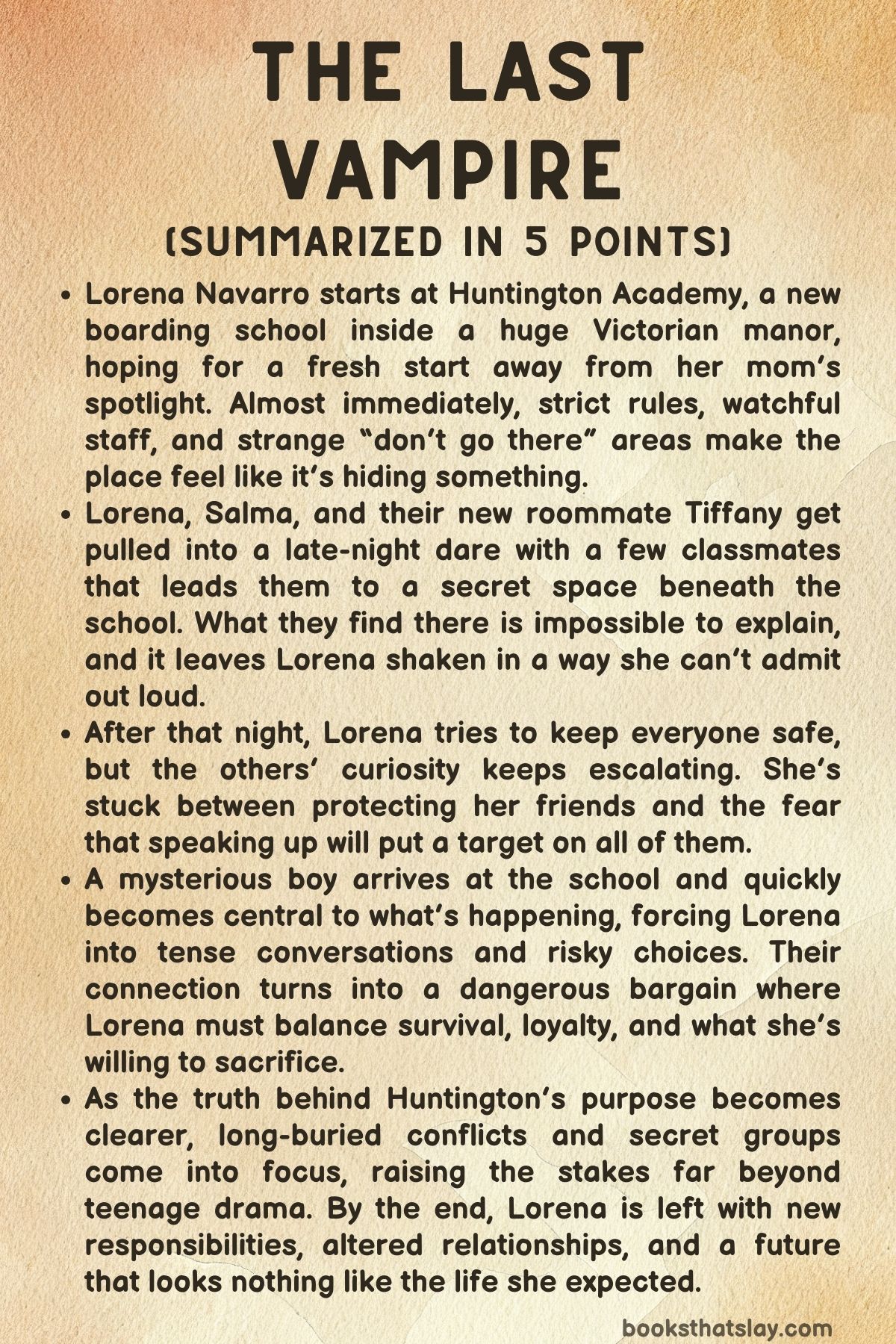
Lorena Navarro and her best friend, Salma Santos, arrive at Huntington Academy, a brand-new boarding school operating out of a huge Victorian manor deep in the woods. Lorena is dazzled by the estate’s beauty and its unsettling details—stone figures, long corridors, and the sense that parts of the building are sealed off on purpose.
Salma, who carries her grief loudly after losing her mother, jokes that she expected something scarier. Lorena’s own baggage follows her in: her mother Viviana is a celebrity parenting influencer, and other parents recognize Lorena immediately.
Lorena overhears adults whispering about an old video of her partying with a bong and beer, a public hit to Viviana’s image after her anti-cannabis activism.
The students are greeted by the school’s director, Minaro, a tall, commanding woman whose attention keeps snagging on Lorena. Minaro announces a major “temporary” inconvenience—no cell service or Wi-Fi due to construction issues—so students must use landlines near the administrative offices.
She also lays down the school’s real priority: stay out of roped-off areas, or get expelled. No exceptions.
Lorena and Salma are assigned to Tower Three, a penthouse-level dorm that feels too privileged to be random. In their room they meet Tiffany Carter, a flashy student who runs an up-and-coming investigative channel and treats the dorm like a set built for her.
She claims the best bed, unpacks a collage of famous anchors, and scans Lorena with the calm confidence of someone who knows how to turn a person into content. Later, in the bathroom, Lorena overhears other girls talking about feeling a strange “pull,” as if the school itself called to them.
At dinner, the group meets Trevor, a late-arriving athlete with thrill-seeker energy, and Zach, his camera-carrying friend. Zach recognizes Tiffany’s channel and is eager to collaborate.
Minaro repeats the curfew policy and three-strikes discipline system, then surprises Salma by approving her request to wear black—an all-black version of the uniform has already been delivered to her room. The gesture feels too prepared, as if the school anticipated her before she arrived.
That night, Trevor proposes exploring the forbidden sections after curfew. Lorena refuses at first, terrified of getting expelled and adding another scandal to her name.
Salma needles her about living under her mother’s control, and Tiffany goes for the soft spot: she admits she saved Lorena’s old party video and calls her a hypocrite. Salma snaps back and draws a hard line—Lorena is not a story to be mined.
Still, at 10:30 p.m. Lorena ends up following the others into a roped-off corridor marked “UNDER CONSTRUCTION.” They slip into a dusty hidden room and find a wardrobe built into the wall.
When Trevor opens it, the interior seems impossibly deep. He reaches in, climbs inside—and vanishes.
The others follow through a narrow passage and emerge in a bizarre underground space lit by glowing white wiring. It holds rows of pristine blank books, strange furniture designed for reading, and portraits of silver-eyed men dressed in old-fashioned clothes.
Salma discovers a coffin-shaped box marked with a cross-like symbol. When she tries to open it, Trevor panics and yells for her to stop—too late.
The coffin blasts open, and the group runs.
Lorena is grabbed by a pale young man with wild black hair and vintage clothing—the same face from one of the portraits. He clamps a hand over her mouth and fixates on the blood from her scraped palm.
His fangs show. He bites.
Lorena fights and briefly escapes, but the vampire forces her toward him with a mental command and pulls her throat into position. He drinks until, suddenly, he convulses as if her blood is poison.
That break gives Lorena just enough time to run. The group barely avoids being caught by Minaro and another staff member searching the halls.
Back in the dorm bathroom, Lorena sees the bite marks on her neck. She hides them, lies to Salma, and tells herself the attack was some kind of nightmare fed by stress and the weirdness of the basement.
But the next morning, the others press her for answers, and Zach reveals his footage from the underground chamber is unusable—every photo and video came out black. During the first day of classes, Lorena can’t focus.
In English class, she learns Minaro is also a teacher, and the assignment centers on 1800s novels. The combination of strict rules, gothic literature, and sealed-off rooms makes Lorena feel like the school is staging something.
When class ends, Lorena notices Trevor still has one of the green-covered books taken from the underground place.
At dinner, Trevor insists they should go back to the secret chamber to inspect the coffin and the books. Zach wants to know why his camera fails down there.
Salma wants to try a séance. Tiffany senses a story that could launch her channel.
Lorena refuses, urging them to report it instead. The others resist—no one wants to confess they broke the rules.
Salma suggests they vote in the morning, confident Lorena will lose.
Lorena tries to protect everyone anyway. She writes an anonymous note warning Minaro that someone violent is in the basement and that law enforcement should be involved.
Late at night she sneaks out to deliver it.
The story then shifts to the vampire: William, who woke in the coffin after a long death-sleep. Lorena’s blood revived him at first, then weakened him overnight, and he realizes something is wrong with her—wrong for him.
He roams the manor by day, stunned by the modern world and by lectures that reference centuries of history that don’t match what he knows. Searching for explanations, he finds no trace of vampires in books.
Humanity blames past mass deaths on the plague, not on him and his kind. Back in the underground chamber, he removes the portraits from the walls, afraid hunters are coming.
That night Lorena wakes and realizes Salma and Tiffany are missing—they tricked her and went back underground without her. As she panics and dresses to search, William appears outside her window.
He tells her he can’t compel her anymore because when he drank from her without killing her, she became his Familiar. He threatens that if she doesn’t come outside, he will wait and kill her friends when her blood runs out.
Terrified, Lorena climbs onto the ledge and follows.
William questions her in a secluded garden, demanding to know where the other vampires are and whether the Legion—a human group he fears—has returned. Lorena insists vampires aren’t real and suggests he might be from another reality.
William rejects that and decides she’s too risky to keep alive. He drinks from her neck again, pushing her to the edge.
Desperate, Lorena whispers “Library. Midnight,” implying she can give him information.
He spares her for one day.
Lorena wakes weak, barely remembering how she got back to bed. At breakfast she sees the others are exhausted too.
They admit the coffin was empty and name the chamber the “Library of Unwritten Books.” They vote to return again; everyone agrees except Lorena, who is cornered into joining the plan. Meanwhile Minaro announces every student must join an extracurricular, tightening the school’s control.
Lorena tries to get Salma to leave immediately, but Salma assumes Lorena is just overwhelmed. Then a staff member, Mr. Torres, grabs Lorena’s wrist and whispers “Medianoche,” warning her William is watching—proof that more adults know than they admit.
That night Lorena sets a trap of her own: she goes to the main library at midnight, hides her phone recording from an angle, and waits.
William arrives and forces her to use computers to search for evidence of the Legion and for erased events from his era. When nothing shows, Lorena argues that history can’t be wiped clean.
William insists it can, and that the Legion rewrote records and erased vampire authors from culture. He bites her again in frustration.
Lorena counters with the video she captured of him, threatening to expose him if he harms anyone. She demands he leave Huntington and never touch her friends.
William agrees—then he flips the board the next day.
Minaro introduces a new student: William Pride. William sits in uniform like he belongs there.
Lorena is horrified as her friends react with curiosity and attraction, not fear. William privately offers a “counteroffer”: he won’t kill her or her friends if she doesn’t release the video.
He admits he compelled Mateo (a staff member) to leave and Minaro to accept him. Then he asks Lorena to become his Familiar willingly, binding her to him as his shield and his guide.
Trapped, Lorena agrees.
William struggles with the modern world and becomes obsessed with confirming whether reality itself changed. He compels Minaro to organize a sudden field trip to Harvard so he can revisit the place tied to his human past.
On the bus he watches Twilight with intense focus, studying how humans imagine vampires now. At Harvard he pulls Lorena aside and reveals he hid something in the walls of Massachusetts Hall long ago, then tries to find it while she keeps watch.
The narrative widens. William is pulled into vampire politics when two vampires, Nate and Cisco, escort him toward Boston to meet Henry, a forger who can build him a modern identity.
Nate and Cisco act friendly, but they also monitor him. Henry greets William as “number fifty-four” and explains vampires survive by cycling identities and burying paper trails.
Henry creates William’s documents quickly—and hands over a new phone sealed for delivery to someone named Anne. William realizes powerful vampires are coordinating around him, and he doesn’t know why.
Back in the human world, Lorena’s friendships fracture. Salma shuts her out during break, blocks her, and only signals she’s alive through social posts.
At home, Lorena hides evidence: she transfers William’s video to a tiny USB drive and tapes it under a shelf plank. Her mother confronts her about Salma, revealing a past family rupture linked to Salma’s father.
Lorena refuses to give up her autonomy and refuses to blame Salma for choices Lorena made.
William finally meets Anne McIntyre in New York. Anne is polished, extremely wealthy, and frighteningly prepared.
She has set up William’s email, bank accounts, a massive monthly trust, and a financial system designed to keep him invisible. Anne explains she built wealth over decades and reveals the larger plan: vampires entered death-sleep because they couldn’t defeat the Legion.
Sleepers were meant to survive and rebuild later. Rebuilding requires “seeds” to be “watered,” meaning a Stoker—an extremely rare vampire capable of creating more vampires.
Anne hints that someone important is missing and that the group is still waiting. She flirts with William aggressively, but he refuses.
As she kisses him goodbye, William realizes his mind is pulling toward someone else—Lorena—leaving him shaken.
At Huntington, William disappears from daily life, and suspicion grows. Lorena starts believing Minaro may be tied to the Legion.
Salma returns with injuries and confronts Lorena for hiding the vampire, and they finally admit the truth through tears: Lorena kept quiet because William threatened to kill Salma if she spoke. The friendship doesn’t heal cleanly; Salma needs space, and Tiffany has stayed closer to Salma than to Lorena.
In New York, William discovers Nate’s hidden arsenal and a notebook called “The Manifest,” listing hundreds of vampire names—most marked as dead. Only fifty-four are left.
William’s name isn’t on the list, and Nate admits that makes them suspect William could be a Legion plant. Nate orders William to go to France alone to meet Leonardo the Bloody, also called Lenny.
As Huntington prepares an eighteenth-century “Time Period Day,” Lorena finds the green book marked with the Legion of Fire symbol and tries to unlock its blank pages. Nothing works until her blood touches the paper—then it forms a mark that shifts into rejection.
Lorena decides it needs William’s blood and, before dawn, sneaks out to chase answers.
In Paris, William meets Lenny in underground tunnels. Lenny is ancient, brutal, and openly obsessed with Stokers.
He explains he has spent a century capturing and studying them, draining and storing their blood in barrels, training himself to identify Stoker ancestry by taste. William realizes he isn’t dealing with an ally; he’s dealing with a predator with a long memory and a program.
Back at Huntington, Lorena helps Trevor with a secret mission: burn freshly printed newsletters that threaten to expose the vampire secret. Trevor claims the secret is tied to the Legion too, and he doesn’t trust students with it.
Lorena steals one copy anyway, keeping a piece of proof.
William rushes back toward Lorena as a trap closes. He discovers Minaro is not human and confronts her.
Minaro reveals she is a guardian bound to a spell made from spilled Stoker blood. William’s continued existence anchors magic that displaced vampires.
Now that humans no longer believe in vampires, the spell’s conditions have shifted. To bring the missing vampires back, all fifty-four must return together to the chamber where William woke and enter death-sleep again—duration unknown.
Minaro also admits Huntington’s students were selected for Stoker bloodlines, including Trevor’s. William faces a brutal choice: lead vampires back into sleep to restore what was lost, or stay and build a new generation by turning students.
Vampires gather, split into factions, and Leonardo challenges William. A violent duel follows, and William ultimately defeats Leonardo, refusing to burn him because he wants unity, not endless revenge.
But betrayal continues: Nate and Cisco move on their own agenda.
During Time Period Day, Tiffany and Zach try to film an “investigative” video in the underground chamber, naming Lorena and William and announcing vampires to the world. Nate and Cisco burst in, destroy the camera, and compel everyone to the floor—except Lorena.
Violence escalates. Trevor tries to intervene with a flamethrower.
Salma grabs it and fires, but Cisco disarms her and snaps her neck. The room goes silent in shock.
William arrives to find Salma dead and Lorena broken. He drinks Salma’s blood and realizes she is a Stoker.
In a desperate, rare act, he feeds Salma his blood to attempt a post-death turning. Salma’s body changes, showing the transformation is taking hold.
Nate and Cisco submit. William compels Trevor, Tiffany, and Zach to forget the truth, planting a cover story: vampires went into hibernation, Salma went home early, injuries were accidents, and nothing supernatural happened.
Lorena is left with the real memory, the real grief, and William’s goodbye. As he prepares to return to death-sleep, he cries tears of blood.
Lorena wakes in the nurse’s office beside the others living the implanted story. Minaro confirms William and the vampires are now in death-sleep, hidden until the spell breaks.
Then Salma appears—newly turned, stronger, emotionally dulled, and no longer sick. She explains she chose not to hibernate because she wasn’t part of the original spell, but she must vanish to avoid the Legion, living as if dead.
Lorena agrees to protect her by lying.
Before winter break, the remaining friends plan their next steps under the weight of missing truth. Trevor’s father arrives and introduces himself as Richard Cross, CEO of Blackfire Investments—imagery that echoes the Legion.
Lorena pockets his card and privately decides she may need to infiltrate the Legion using the evidence she has hidden.
Nine months later, on Lorena’s nineteenth birthday in Los Angeles, she is still with Tiffany, Zach, and Trevor, all delaying college to stay together. They build new lives—internships, investigations, and cautious loyalty.
A blank postcard with an ocean image arrives, and Lorena suspects Salma is still watching from the shadows. Then Lorena sees William again—alive—with amethyst eyes.
He tells her the spell broke, the vampires are back, and the world is about to change. He promises he won’t leave her unless she asks.
Lorena chooses him, knowing it means choosing the strange new future opening in front of them.
Characters
Lorena Navarro
Lorena is the emotional and moral center of The Last Vampire, a teenager caught between the highly managed life her mother curates and the chaos Huntington Academy unleashes. She arrives craving reinvention but quickly learns that freedom comes with consequences, and that her instincts—usually cautious, observant, and self-protective—won’t always save the people she loves.
Her scandal video and the gossip around it establish her as someone publicly defined by one “bad” moment, which makes her especially sensitive to manipulation, reputation games, and being watched. That sensitivity becomes survival-grade once William marks her as his Familiar: Lorena’s fear matures into strategy, and she starts thinking in contingencies—notes, recordings, leverage, hiding evidence, and choosing what truths to reveal or bury.
The central tension in her character is that she wants to act ethically, yet the world keeps rewarding secrecy and punishing honesty; by the end, she has evolved into someone willing to lie convincingly and plan long-term infiltration, not because she enjoys deception, but because she has accepted that truth alone is not power in the world she’s stumbled into.
Salma Santos
Salma functions as Lorena’s anchor and her accelerant in The Last Vampire—the friend who offers loyalty and blunt honesty, but also the one most likely to push a boundary just to see what’s on the other side. Her grief over her mother’s death gives her a rawness that explains both her impatience with caution and her hunger for meaning; Huntington feels “calling” to some students, and Salma is especially receptive to that kind of pull because she needs something to replace what she lost.
She is courageous in a way that borders on reckless, and she often frames risk as liberation, which puts her in direct conflict with Lorena’s instinct to prevent damage before it happens. What makes Salma tragic is that her boldness is also her love language—she wants experiences shared, not feared alone—and Lorena’s secrecy about William reads to her as betrayal rather than protection.
Her turning rewrites her identity in the cruelest way: she becomes physically stronger and free of illness, but emotionally dulled, forced into disappearance and isolation. In that shift, Salma embodies one of the book’s sharpest ideas: survival can be a kind of death, and transformation can cost the very tenderness that once made someone feel like themselves.
William Pride
William is both predator and displaced relic, a vampire who wakes into a world that has moved on so completely that even the cultural memory of vampires has been scrubbed or dissolved. His first interactions with Lorena are brutal and domineering—he treats her blood as entitlement, her fear as irrelevance—yet his power is immediately complicated by the fact that her blood harms him and his compulsion stops working once she becomes his Familiar.
That limitation forces William into something he hates: negotiation. He is intelligent, proud, and deeply suspicious, but he is also destabilized by modernity, by gaps in history, and by the realization that the old order he understood has been rearranged without his consent.
His relationship with Lorena becomes the book’s most volatile emotional engine because it mixes coercion, dependence, fascination, and genuine attachment; he tells himself he should kill her to remove the risk, yet his body reacts to her danger before his mind can justify it. Among vampires, William becomes a reluctant political figure—someone others watch as a test case, a potential threat, and a possible solution—until he is forced to choose between personal love and collective fate.
His final acts show the contradiction that defines him: he is capable of ferocity and mercy in the same breath, and even when he tries to control the story through compulsion and sacrifice, the part of him that still feels human surfaces in tears of blood.
Director Minaro
Director Minaro is the controlled face of authority, but her presence radiates a focus that feels less educational and more custodial, as if Huntington Academy exists to contain something rather than teach anyone. From the beginning, her attention repeatedly returns to Lorena, signaling that she is not just enforcing rules but monitoring variables—bloodlines, behaviors, and who is being pulled toward the school’s secrets.
Her strict no-technology environment isn’t just about discipline; it functions as containment, reducing the students’ ability to broadcast, verify, or escape through outside contact. The most important truth about Minaro is that she is not merely a gatekeeper but a constructed guardian tied to ancient magic—formed from Stoker blood and tasked with maintaining the conditions of a spell that displaced vampires.
Because of that, she becomes a character who represents system logic more than personal desire: she can appear protective, punitive, or indifferent depending on what keeps the spell intact. Her role is chilling because it reframes the school’s “selection” process as something closer to harvesting, and it turns adult authority into an instrument of supernatural infrastructure rather than care.
Tiffany Carter
Tiffany begins as an attention-seeking antagonist—flashy, status-conscious, and eager to treat other students as content—but she becomes more complicated as the story reveals what fuels her: hunger for visibility, credibility, and a career built on uncovering narratives before anyone else does. Her “Tiff Investigates” identity is not just a hobby; it’s her coping mechanism and her ambition, a way to turn social environments into puzzles she can control.
She weaponizes Lorena’s scandal video early, exposing a moral flaw that remains consistent: Tiffany believes information belongs to whoever finds it first, regardless of how it harms the person inside the story. At the same time, she isn’t purely cruel; she shows a capacity for empathy when Salma’s grief becomes undeniable, and later she commits to the idea of doing a “responsible” investigation even as she still leans on coercion and threats.
Tiffany’s arc is fundamentally about the ethics of exposure: she wants truth, but she also wants authorship of truth, and the book repeatedly punishes that impulse by showing how knowledge can get people killed when power is uneven.
Trevor
Trevor is the story’s reckless catalyst, the one who turns curiosity into action and dares everyone else to follow. He performs fearlessness like a sport, but underneath that performance is a sense of being pulled—toward forbidden corridors, toward green books, toward mysteries that feel personal even when he can’t explain why.
His attraction to the “Library of Unwritten Books” suggests a deeper connection than mere thrill-seeking, and his confession that he belongs to a real secret society reframes him as someone whose recklessness has context: he is trained, conditioned, or at least familiar with hidden structures of power. Trevor’s later decision to burn newsletters reveals a surprising moral seriousness—he understands that public exposure can be a weapon in the wrong hands and chooses destruction over disclosure, even if it makes him look guilty.
That act also shows how the supernatural conflict distorts teenage ethics: he’s willing to commit a dramatic, possibly criminal act because he believes secrecy is safer than truth. By the end, Trevor occupies an uneasy place between pawn and player, especially as his family connection hints that the systems surrounding the Legion may be closer to him than he realized.
Zach
Zach is the observer figure, a budding journalist whose camera becomes both a literal tool and a metaphor for the limits of evidence. He is less performative than Tiffany and less impulsive than Trevor, but he shares their belief that documenting reality grants protection and power.
The story undermines that belief repeatedly: the footage from the basement turns black, the camera can be smashed, files can be erased, and people can be compelled to forget. Zach’s arc is quietly unsettling because it shows how easily a truth-seeker can be neutralized when the opposition can edit perception itself.
He also serves as a social amplifier—his journalism begins to gain traction beyond the school—which raises the stakes by making the vampire secret not merely dangerous but potentially world-shifting if it goes public. In the end, Zach’s memory is rewritten along with the others, turning a character defined by recording into someone living inside an implanted narrative, a living example of how truth can be overwritten without leaving scars visible to anyone else.
Viviana Navarro
Viviana, Lorena’s mother, represents curated morality and performative control, a parent whose public brand becomes an extension of her child’s private life. Her influencer status means Lorena’s mistakes are never only teenage mistakes—they become PR crises—and the bong-and-beer video establishes the dynamic where Viviana’s values feel less like principles and more like marketing.
Viviana’s controlling tendencies aren’t portrayed as simple villainy; they come from fear, reputation management, and her own unresolved history, including the revelation of a past rupture involving her sister Elena and Diego. That backstory matters because it shows Viviana is not just policing Lorena; she’s replaying her own unfinished conflicts through her daughter’s friendships and choices.
To Lorena, Viviana symbolizes the kind of authority that claims it knows best while refusing to trust the person it controls, which is why Lorena’s push for autonomy becomes so fierce. Viviana’s role is crucial because she embodies a human version of the book’s larger theme: power decides what story is told, and the one living inside the story often has the least say.
Anne McIntyre
Anne is a modern vampire power broker, someone who has translated immortality into institutional dominance—wealth, legal infrastructure, surveillance through money, and social control that doesn’t require fangs. She is seductive not just romantically but systemically: she offers William stability, identity, resources, and an explanation of vampire survival strategies in the modern world.
Her flirtation is layered with calculation, and her kindness comes with an unspoken message that she can provide or withhold the tools required for existence. Anne’s worldview is pragmatic and long-term; she speaks in plans, seeds, and rebuilding, which positions her as someone who thinks of humans and vampires alike as pieces in a future arrangement.
She also introduces a key ideological divide: whether vampires should remain hidden and managed, or whether they should return to expansion through Stokers. Even when she appears intimate, her true intimacy is with control—she wants information, loyalty, and influence, and she knows how to make those desires look like generosity.
Nate
Nate operates as a disciplined, suspicious operative, someone who treats William less like an equal and more like a risk assessment that needs constant monitoring. He is sharp enough to behave like a human lie detector, asking questions in ways that box William into revealing inconsistencies, and his secrecy suggests he believes knowledge is safest when hoarded.
The discovery of guns and the manifest shows Nate’s readiness for violence and his acceptance of a world where hunters may need to be eliminated quietly. He represents a survivalist branch of vampire culture—paranoid, prepared, and willing to do ugly things to preserve the group.
His distrust of William is not irrational; it is built on the gap where William’s name should be, which Nate interprets as evidence of infiltration or manipulation. What makes Nate compelling is that his protectiveness is inseparable from coercion: even when he thinks he’s safeguarding vampire-kind, he is willing to control others, hide truths, and force outcomes.
Cisco
Cisco serves as Nate’s counterpart, softer at the edges and more prone to revealing emotion or personal detail before being cut off. Where Nate feels like strategy, Cisco feels like the human residue vampires can still carry—curiosity, impulsiveness, and the desire to connect.
Yet he remains fully capable of brutality, and his snapping of Salma’s neck is one of the story’s starkest reminders that “gentler” does not mean safe. That moment reframes Cisco from sidekick to enforcer: when the stakes peak, he acts decisively and catastrophically.
Cisco’s role highlights the terrifying normalcy of violence within their hidden society, especially when vampires believe their larger mission justifies immediate harm. He also embodies how group dynamics create moral diffusion—how someone can be complicit, even eager, when following a stronger personality’s lead.
Henry
Henry, the vampire forger, is a craftsman of legitimacy, someone whose power is not physical dominance but administrative invisibility. He understands that survival in the modern world requires papers, data trails, and identities that can withstand scrutiny, and he has built a livelihood around constructing those shields.
By calling William “number fifty-four,” he reduces him to a slot in a dwindling census, which captures the book’s idea that vampires have become an endangered, managed population. Henry is also a gatekeeper of secrets: he knows about “the plan,” recognizes timelines, and refuses to explain more than necessary, suggesting he has learned that information spreads danger.
He represents a quieter kind of menace—the way systems, not just monsters, determine whether someone exists safely. Without Henry, immortality is exposed; with him, immortality can hide in plain sight.
Leonardo the Bloody
Leonardo, also called Lenny, embodies ancient terror and ideological extremity. He is a vampire who treats science and cruelty as compatible, capturing and draining humans to refine his ability to detect Stoker ancestry by taste.
His “visionary” reputation is poisoned by how he pursues knowledge: he is not simply surviving; he is experimenting, collecting, and perfecting predation as methodology. Leonardo represents a version of vampire-kind unrestrained by treaty ethics or empathy, and his presence clarifies what William might become if love, guilt, and attachment were stripped away.
The duel between Leonardo and William is not just a power contest but a referendum on vampire identity—whether they rebuild through exploitation or choose sacrifice to restore the displaced. Leonardo’s defeat matters because it signals that brutality can be challenged within the vampire world, but it also leaves a lingering discomfort: a monster like him existed not as a lone aberration, but as a leader with followers.
Osorio
Osorio acts as the threshold guardian, the one who literally escorts William from the public world into the subterranean reality where Lenny operates. His role is defined by service and secrecy: he explains rules, enforces access, and normalizes the horror of what lies below by treating it as routine.
Osorio functions less as an individualized personality and more as proof that Lenny’s power has an ecosystem—helpers, logistics, hidden routes, and a functioning infrastructure of concealment. That matters because it shows vampire society isn’t merely scattered survivors; it can still organize, protect leaders, and maintain hidden spaces under major cities.
Osorio’s calmness in the face of imprisoned humans also underscores a chilling theme: atrocity becomes ordinary when it’s framed as necessary for the species.
Mr. Torres
Mr. Torres plays the role of the cryptic human warning system, an adult who seems to understand more than a normal staff member should and chooses selective intervention over full disclosure. His whispered “Medianoche” to Lorena suggests he is either connected to the supernatural network around Huntington or perceptive enough to recognize the patterns of danger.
Unlike Minaro, whose authority is structural, Torres’s influence is momentary and intimate—he doesn’t reshape the system, but he can nudge a student toward a choice that might keep her alive. His limited presence makes him feel like a leak in a sealed container: proof that the school’s control isn’t perfect and that some adults might resist or subvert what’s happening.
He adds tension because his warnings raise the question of who else knows, and whether silence is protection or complicity.
Fabiana
Fabiana appears at the story’s turning point as a vampire whose challenge helps push the duel’s momentum and exposes the fragile politics inside the returning group. Her significance lies less in backstory and more in function: she is part of the factional pressure that forces William to stop being only reactive and become decisive.
By stepping into the confrontation dynamic, she signals that the vampire community includes voices beyond the headline figures, and that loyalty is not automatic—even within a species fighting for survival. Fabiana’s presence reinforces that William’s leadership is contested and conditional, built in real time through action rather than inherited status.
In a narrative crowded with secrecy, she represents the raw, immediate reality of vampire society: if someone wants to steer the future, they do it in the open, with force, and under the gaze of others who are ready to choose sides.
Brooke
Brooke functions as social-world pressure, the kind of student who turns a peer’s embarrassment into small entertainment through selfies and viral references. Her interaction with Lorena about the party video is minor but revealing because it shows how Lorena can’t outrun her public narrative even in a secluded school without Wi-Fi.
Brooke’s casual mention of viral content demonstrates how reputation travels ahead of a person, shaping new relationships before they begin. She represents the normal teenage ecosystem continuing inside an abnormal supernatural container, which makes the horror sharper: even when vampires and rewritten history loom, ordinary cruelty and social currency still operate.
Brooke is important not for plot mechanics, but because she anchors the setting in adolescent reality—the place where humiliation, popularity, and exposure can feel life-ending even before the genuinely lethal threats arrive.
Cat
Cat, like Brooke, plays a small but pointed role as part of the peer chorus that mirrors Viviana’s public world inside Huntington. By participating in the selfie moment and the viral-video commentary, she reinforces how Lorena is treated as content rather than a person, a dynamic that later echoes in Tiffany’s investigative impulses.
Cat’s function is to show that surveillance isn’t only supernatural; it is social, constant, and often disguised as friendliness. Her presence also deepens Lorena’s isolation because it confirms that even new environments can reproduce the same judgments that drove Lorena’s desire for escape.
In that way, Cat contributes to the book’s theme that privacy is fragile, and that once a story about you exists, people will approach you through that story first.
Elena and Diego
Elena and Diego operate as offstage forces that shape the adult emotional landscape and explain why Viviana’s control is so entrenched. Their past rupture is a template for what Viviana fears repeating: trust betrayed, family divided, and relationships entangled with choices that feel irreversible.
Diego’s identity as Salma’s father makes the connection even more charged, tying Lorena’s best friendship to a generational wound that Lorena didn’t create but still inherits. Elena’s absence becomes meaningful because it represents the long shadow of unresolved conflict—proof that “family” can fracture permanently when control and blame harden into identity.
Even without appearing actively in the main school plot, they deepen the psychological realism by showing that Lorena’s struggle with autonomy is not only teenage rebellion; it is also the next chapter of an older story about agency, judgment, and who gets to decide what is best for whom.
Richard Cross
Richard Cross enters late but lands with the weight of a revelation, because his name and role suggest proximity to the Legion’s imagery and power structures. As Trevor’s father and CEO of Blackfire Investments, he reframes Trevor’s earlier “secret society” hints and implies that Trevor’s life has been orbiting something much larger than school punishment for recklessness.
Richard embodies institutional menace: he doesn’t need fangs or spells to be terrifying because finance, influence, and corporate legitimacy can conceal predatory agendas just as effectively as supernatural concealment. His brief appearance acts like a doorway to the next conflict, suggesting that the Legion is not only a mythic hunter group but possibly an embedded modern system with respectable fronts.
Themes
Public Image, Reputation, and the Cost of Being Seen
Lorena enters The Last Vampire already living inside an audience. Her mother’s career as a parenting influencer makes Lorena’s choices feel less like private mistakes and more like public events that can be packaged, judged, and used.
The old video of Lorena with a bong and beer isn’t treated as a teenage lapse; it becomes social currency for adults and students alike, a tool for gossip, leverage, and quiet punishment. At Huntington Academy, reputation is a kind of power system that decides who gets believed, who gets invited, who gets watched, and who becomes a convenient target.
The school’s rule-heavy atmosphere and the forced disconnect from Wi-Fi amplifies this because it removes easy escape routes while increasing surveillance through authority, rumor, and peer attention. Tiffany’s early hostility toward Lorena shows how quickly a reputation can be weaponized: she stores the scandal video, brings it up at the moment it will hurt most, and frames Lorena as morally inconsistent.
Later, that same impulse to document and broadcast becomes even more dangerous once the group touches the vampire secret, because the instinct to capture truth collides with the consequences of exposure. What starts as teenage “investigation” turns into a question of whether the truth should be published at all, and who gets to decide.
The story keeps returning to the idea that visibility is not neutral: being recorded can protect Lorena when she threatens William with the “cloud,” but it can also invite retaliation and manipulation. By the end, Lorena is no longer only a person being seen; she becomes someone who strategically manages what others see, hiding evidence, planting stories, and planning infiltration.
The theme isn’t about fame in a glamorous sense—it’s about how identity gets shaped under constant observation, and how survival sometimes demands controlling the narrative instead of simply telling the truth.
Control, Autonomy, and the Struggle to Choose for Yourself
The pressure on Lorena is not only supernatural; it’s social, parental, and institutional, with every layer trying to script her behavior. Huntington Academy presents itself as an elite opportunity, but its structure is built on restriction: no Wi-Fi, roped-off areas, strict curfews, and the looming threat of expulsion regardless of status.
That environment mirrors Lorena’s relationship with her mother, where “care” often feels like control dressed up as concern. Lorena’s fear of being expelled isn’t just fear of punishment; it reflects how little space she believes she has to make mistakes without consequences cascading into her mother’s public brand.
Salma challenges her to want freedom, but that freedom comes with a cost: belonging to a group that pushes boundaries can become another kind of control. Once William bites Lorena and the Familiar bond forms, autonomy becomes even more complicated.
William’s compulsion is an obvious violation, but the bond itself creates subtler forms of coercion, where Lorena’s body, safety, and choices are tied to what William wants and what he fears. Even when Lorena seems to “win” with the recording threat, William enters her world anyway, using influence over Minaro and the school as if the environment itself is a tool he can reshape.
Lorena then makes a decision that looks like consent—agreeing to be his Familiar—but it is shaped by constrained options and the knowledge that refusal may get her friends killed. The theme becomes sharper when Minaro presents William with a choice between restoring the old vampire world through death-sleep or staying to build something new by turning students.
That choice isn’t framed as purely moral; it is also about the right to decide what kind of future exists, and who is allowed to have one. Lorena’s arc shows autonomy as a practice rather than a one-time breakthrough.
She lies, withholds, bargains, and plans not because she enjoys deception, but because direct honesty often leads to danger or dismissal. By the end, her agency is hard-won: she chooses strategies over compliance, refuses to be managed by her mother’s expectations, and begins shaping a life where decisions are made for survival and purpose rather than to satisfy authority.
Friendship, Loyalty, and Betrayal Under Pressure
The bond between Lorena and Salma begins as a refuge: Salma is blunt, funny, and protective, and Lorena feels safer with her than with the adults who judge her. But The Last Vampire keeps testing how loyalty holds up when fear and secrecy enter the relationship.
The first major fracture appears when Lorena is bitten and hides it. Her silence is understandable—she’s terrified and unsure of reality—but secrecy changes the friendship’s balance.
Salma senses distance and responds by pushing harder, and when the group votes to return to the hidden basement, Lorena becomes isolated not just by fear but by being outnumbered. The situation worsens when Salma and Tiffany ditch Lorena to go back without her, a betrayal that is framed as curiosity and excitement but lands as abandonment.
The story repeatedly shows how friends can hurt each other without intending cruelty, especially when they believe the risk is manageable or when they want to avoid admitting wrongdoing. Tiffany’s trajectory complicates the theme further: she starts as antagonistic and status-obsessed, then shows empathy when Salma’s grief surfaces, then shifts again into someone willing to expose dangerous truths for a “responsible” story.
Her care and her ambition coexist, and the book refuses to simplify her into either ally or enemy. The friendship group becomes a pressure chamber where each person’s coping style—denial, investigation, confrontation, thrill-seeking—creates conflict.
Salma’s anger at Lorena over break isn’t only about vampires; it’s about being excluded from something real and life-threatening, which makes Lorena’s protection feel like condescension. The tragedy of Salma’s death and forced turning becomes the clearest proof that friendship in this story carries consequences that can permanently change bodies and futures.
After William compels the others to forget, Lorena is left holding the true memory alone, which turns friendship into something bittersweet: she still loves them, but she cannot fully share reality with them anymore. By the end, the remaining friends form a tight unit again, but it’s built on a shared decision to stay together rather than a shared understanding of everything that happened.
The theme ultimately treats loyalty as something fragile but persistent—something that can break, return in altered form, and still matter even when memory and truth are incomplete.
Power, Predation, and Consent in Unequal Bonds
William’s first appearances establish a brutal imbalance: he is stronger, older, experienced in violence, and able to invade the mind. The bite is not romantic; it is predatory, tied to hunger and control.
Even when Lorena escapes, his mental command pulls her back, and the story makes the violation clear through Lorena’s panic and exhaustion afterward. The Familiar bond adds another layer, because it links them in a way that can be interpreted as connection while still originating in harm.
William says he can’t compel her anymore, but he can still threaten her friends, stalk her, feed on her, and insert himself into her life through institutional manipulation. Lorena’s “agreement” to become his Familiar happens under fear and limited choices, which keeps consent complicated even when she appears to cooperate.
The theme doesn’t stop at vampire-human dynamics; it also appears in Anne’s flirtation and control of wealth, documents, and access, where desire blends with power and testing. Anne’s ability to set up a trust, decide who receives the phone, and isolate William from Nate and Cisco shows how influence in the modern world can be just as binding as supernatural force.
Lenny represents the theme’s darkest expression: he imprisons humans, drains them, studies them, and treats bloodlines as resources. His worldview turns people into containers of ancestry, which parallels how Huntington selects students for Stoker bloodlines, reducing teenagers to genetic value.
The climax pushes the theme into tragedy when Salma is killed and then turned. Her transformation saves her life, but it also removes something human in her emotional range, showing that “rescue” can come with a cost that wasn’t freely chosen in the moment.
William’s decision to compel the others to forget also fits here: it protects secrecy and survival, but it overrides personal autonomy and memory, a different form of violence that leaves Lorena carrying truth alone. The theme ultimately asks what it means to love or protect someone when power is uneven.
William’s tears of blood matter because they signal genuine feeling, yet the story refuses to pretend that emotion automatically cleanses harm. Power in The Last Vampire is repeatedly shown as something that must be handled with restraint, and when it isn’t, relationships become dangerous no matter how intense the attachment is.
Identity, Displacement, and Adapting to a Changed World
William’s awakening throws him into a world that has moved on without him, and his disorientation is more than culture shock—it’s the collapse of a framework that once made sense. He looks for vampire history and finds nothing, realizes human narratives replaced vampire-caused mass death with plague explanations, and discovers that even literature and authorship have been scrubbed.
His confusion becomes an identity crisis: if the world refuses your existence, what are you? This theme also plays out in Lorena’s life in a quieter way.
She is constantly being defined by external narratives—her mother’s brand, the scandal video, other students’ assumptions, Tiffany’s framing. Huntington Academy intensifies that by placing her in a role she didn’t fully choose, then surrounding her with privilege (the penthouse room) that makes her suspect even before she acts.
Both Lorena and William struggle with being assigned identities: Lorena as the influencer’s daughter or hypocrite, William as “William Pride” on paper or “number fifty-four” in vampire politics, or even as a possible Legion plant because his name isn’t on the manifest. The forging of documents and modern identity shows how survival requires performance: passports, bank accounts, emails, uniforms, and “normal” behavior.
Yet performance doesn’t erase internal fracture. William watches Twilight with intense focus, searching pop culture for meaning, while also resisting the idea that vampires could be reduced to a genre stereotype.
His discomfort in tight spaces, his sensitivity to being escorted, and his suspicion of Nate’s silence reveal how the modern world triggers paranoia and loss of control. Lorena’s displacement is emotional and social: after break, she returns to a school where her friendships are damaged, her secret is heavier, and her sense of belonging is unstable.
Even when the group later stays together in Los Angeles, it is still a life paused and rerouted by supernatural conflict. The final return of William after the spell breaks suggests that identity is not a static label but a shifting position in a world that can change the rules without warning.
Both characters end up living with dual realities: public masks and private truths, invented paperwork and buried histories, friendships built on partial memory and love built through fear, negotiation, and persistence.