The London Seance Society Summary, Characters and Themes
The London Seance Society by Sarah Penner is a gothic mystery set in the atmospheric world of Victorian spiritualism. Moving between Paris and London in 1873, the novel follows Lenna Wickes, a young woman mourning the murder of her sister, Evie.
Drawn into the world of séances through the mentorship of the enigmatic medium Vaudeline D’Allaire, Lenna seeks both answers and justice. What begins as a quest to contact her sister’s spirit unravels into a dangerous investigation of corruption within the London Séance Society. Blending intrigue, suspense, and elements of the supernatural, the story explores grief, deception, love, and the thin boundary between truth and illusion.
Summary
The novel opens in February 1873 at a château outside Paris, where Lenna Wickes assists the famous medium Vaudeline D’Allaire during a séance. Vaudeline, celebrated for contacting the spirits of murder victims, is attempting to summon a young woman’s ghost in the presence of grieving parents.
The atmosphere is eerie, but the séance produces little concrete proof, leaving Lenna skeptical. Though doubtful of spiritualism, Lenna has joined Vaudeline in hopes of contacting her sister Evie, recently murdered in London.
The ritual is interrupted when a messenger delivers a letter announcing the death of Mr. Volckman, president of the London Séance Society and friend to Vaudeline. The Society’s vice president, Mr. Morley, requests that she return to London to summon Volckman’s spirit and identify his killer.
Vaudeline, who left London after exposing fraudulent practices within the Society, reluctantly agrees. Lenna, still searching for answers about Evie’s death, chooses to accompany her.
In London, Morley wrestles with his grief and the Society’s failing reputation. Though once mentored by Volckman, Morley has long been insecure and troubled by rumors of fraud.
Flashbacks reveal his growing closeness with Evie, who disguised herself as a young man to attend his lectures. Her wit and curiosity intrigued him, and their relationship deepened into clandestine meetings.
Meanwhile, Lenna’s memories return to the morning of Evie’s death, when a quarrel separated them. Evie’s fascination with contacting spirits had clashed with Lenna’s rational outlook.
Regret and grief fuel Lenna’s commitment to the London journey, where she and Vaudeline hope to confront the Society and uncover the truth.
On their voyage to England, Lenna recalls finding suspicious items among Evie’s belongings, including phosphorus oil often used by fraudulent mediums. These discoveries plant doubts about her sister’s activities.
At the docks, Lenna notices that Morley wears a cap she once saw in Evie’s satchel, raising suspicion. He installs Vaudeline and Lenna secretly within the Society headquarters, warning them to avoid discovery.
As Lenna investigates further, she learns Evie had signed the Society’s visitor log months earlier, proving she had been inside despite its ban on women. Vaudeline reveals scars from a past séance, sharing her vulnerability, and her relationship with Lenna grows more intimate.
Yet secrecy and mistrust continue to shadow them.
The narrative shifts between Lenna and Morley’s perspectives, exposing his complicity in staged séances. He recalls orchestrating elaborate frauds with accomplices and disguises, manipulating grieving clients for profit.
Evie had become entangled in his schemes, first appearing eager to learn but secretly collecting evidence. When Lenna and Vaudeline investigate, they confirm Evie had attended a brothel séance in disguise and was seen taking notes.
This revelation devastates Lenna, who realizes her sister’s death may be linked to the Society’s corruption.
Confrontations with Morley reveal his evasiveness. A driver named Bennett privately warns Lenna that Morley lies and admits he saw Evie working with him.
He recalls the suspicious night of All Hallows’ Eve when Morley uncharacteristically dismissed him and drove the carriage himself. These details deepen Lenna’s belief that Morley was involved in Evie’s fate.
Soon after, Lenna discovers Evie’s missing notebook in Morley’s study. Inside are meticulous notes exposing the Society’s fraudulent practices.
Alongside it lies a letter from Vaudeline to Evie, urging her to infiltrate the Society to obtain incriminating evidence. This revelation shocks Lenna, as it suggests Vaudeline pushed Evie into danger.
She realizes her sister was not complicit in fraud but was a whistleblower trying to expose the Society. Both Morley and Vaudeline emerge as figures tied to the circumstances of Evie’s death.
The climax occurs in the Society’s cellar, where a séance is held to summon Volckman. Present are Vaudeline, Lenna, Morley, and Constable Beck.
During the ritual, Lenna is overtaken by her sister’s spirit, reliving Evie’s final moments. Through these visions, she learns that Evie confronted Volckman on All Hallows’ Eve.
Evie accused him of orchestrating schemes to manipulate widows and profit from arranged marriages. Their confrontation turned violent, and both were fatally wounded.
Morley’s role is also revealed: he lured Evie to the Society with a forged letter pretending to be from Vaudeline. Arriving to find her dying, he concealed her body and preserved Volckman’s incriminating portfolio for his own use.
He later planted explosives in the cellar where the séance is held, intending to silence anyone who might expose the truth.
As the séance intensifies, Lenna performs a dangerous incantation, transferring Evie’s spirit into Morley’s body. Evie torments him with illusions mirroring his own tricks, until Lenna ends the ritual, releasing both Evie and Volckman.
She, Vaudeline, and Beck escape just before the cellar explodes, killing Morley.
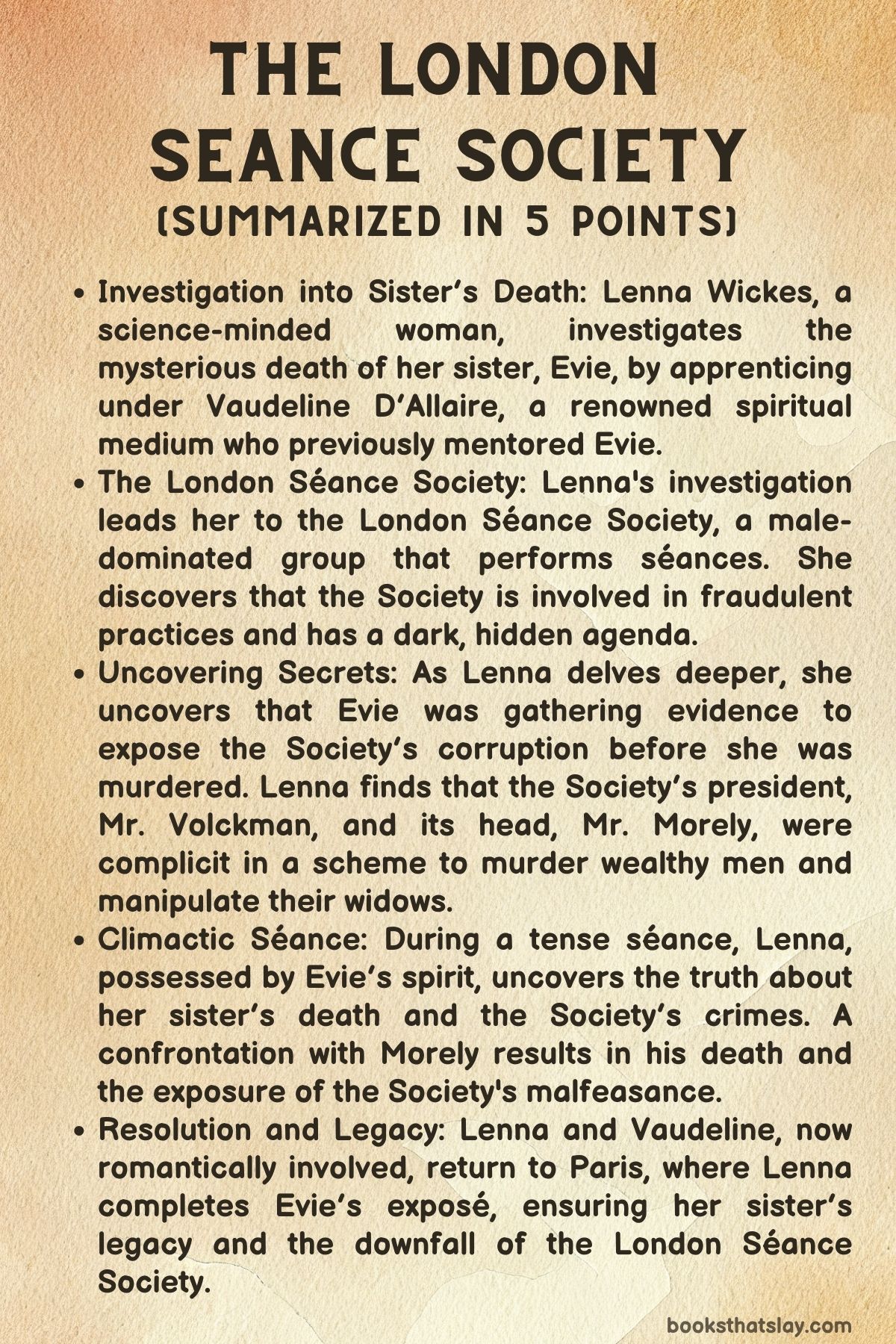
In the aftermath, Lenna finds a small token left by Evie, a symbol of forgiveness and love. Months later in Paris, Lenna and Vaudeline live together, preparing to publish an exposé that will dismantle the London Séance Society.
Using Evie’s notebook and Volckman’s portfolio, they commit themselves to honest séances and to honoring Evie’s sacrifice. Their relationship deepens into both a partnership and a mission for truth, while the corrupt spirits of Morley and Volckman remain trapped in torment.
Characters
Lenna Wickes
Lenna is the emotional heart of The London Seance Society, a character shaped by grief, skepticism, and an evolving sense of purpose. At the start, she embodies rationality and scientific curiosity, clashing with her late sister Evie’s openness to spiritualism.
Her disbelief in séances and the supernatural stems from her pragmatic nature, but the trauma of losing both Eloise Heslop and later Evie forces her into the world she once rejected. As an understudy to Vaudeline, she constantly balances doubt with desire for proof, driven by her need for closure and justice.
Lenna’s character arc transforms her from skeptic to believer, not through blind faith but through lived experience, as she encounters both fraudulent practices and genuine spiritual phenomena. Her personal relationships—especially the conflicted intimacy with Vaudeline and the haunting memories of Eloise—add depth to her character, showing her struggle between vulnerability and control.
By the end, Lenna emerges as both investigator and medium, her grief shaping her into someone who reclaims agency and honors her sister’s legacy.
Vaudeline D’Allaire
Vaudeline represents mystery, authority, and quiet vulnerability. She is introduced as a renowned medium, respected for her ability to summon murder victims’ spirits, yet she is also deeply human, burdened by guilt and loneliness.
Her departure from London underscores her moral conflict: while she abhors fraud, her profession constantly borders on the precarious edge between truth and deception. Her relationship with Lenna exposes her softer side, revealing a woman who has endured profound loss, including her lover Léon, yet still clings to a purpose rooted in justice.
Vaudeline is both mentor and potential betrayer, as her past decision to encourage Evie’s infiltration of the Society places her in a morally ambiguous light. Her power as a medium is undeniable, but her reliance on secrecy and manipulation complicates her role.
Ultimately, Vaudeline becomes a partner to Lenna in both exposé and affection, her character illustrating how strength often coexists with fragility.
Evie Wickes
Though dead at the story’s opening, Evie’s presence permeates the narrative, shaping the motives and destinies of others. Unlike her sister, she embraced spiritualism with fervor, her curiosity and daring leading her into dangerous entanglements with the London Séance Society.
Her relationship with Morley, built on seduction and deceit, reveals her intelligence and bravery—she knowingly played along with fraud while secretly gathering evidence against it. Her untimely death is tragic, yet her spirit lingers as both comfort and disruption, especially during séances when she possesses Lenna.
Evie’s complexity lies in her duality: she is both the reckless younger sister who quarreled with Lenna and the determined whistleblower who sacrificed her life for truth. Her legacy reshapes Lenna’s beliefs and exposes the Society’s corruption, ensuring she is remembered as more than a victim, but as a catalyst for justice.
Mr. Morley
Morley embodies ambition, insecurity, and moral decay. As vice president of the London Séance Society, he is plagued by feelings of inadequacy, stemming partly from his disfigurement and partly from his dependence on fraudulent practices to maintain authority.
His duplicity defines him: outwardly loyal to Volckman and the Society, yet inwardly orchestrating schemes to manipulate widows and suppress dissent. His relationship with Evie showcases his weaknesses—lust, vanity, and the ease with which he is deceived.
Despite glimpses of vulnerability, such as his longing for validation, Morley ultimately reveals himself as cruel, self-preserving, and complicit in both murder and corruption. His fate—trapped in torment after death—mirrors the emptiness of a life built on deception.
Morley’s character illustrates how unchecked ambition and insecurity can corrupt even a once-loyal disciple.
Mr. Volckman
Volckman serves as both idealist and hypocrite. As president of the London Séance Society, he is portrayed as a guardian of authenticity, demanding that fraudulent practices be rooted out.
Yet his hidden corruption—arranging coerced marriages, financial exploitation, and violent schemes—exposes his duplicity. His mentorship of Morley adds weight to his authority, but it also reveals how his ideals were compromised by ambition.
His death, entangled with Evie’s, symbolizes the destructive consequences of deceit within spiritualism. Though he initially appears a victim, his true role as perpetrator of fraud and violence redefines him as one of the novel’s central villains.
Constable Beck
Constable Beck provides a grounding presence amidst the novel’s chaos. As a representative of law and order, his role is to ensure safety during séances, but his trust in Vaudeline and later in Lenna positions him as an ally in their fight against the Society.
Though less emotionally complex than other characters, Beck’s reliability and pragmatism balance the uncertainty of the supernatural. His survival alongside Lenna and Vaudeline underscores his role as protector and witness, bridging the worlds of rational justice and spiritual truth.
Eloise Heslop
Eloise, though not alive during the events, casts a long shadow over Lenna’s emotional landscape. Her drowning alongside her father is a tragedy that haunts Lenna, shaping her guilt and influencing her quarrels with Evie.
The folded note marked with hearts becomes a recurring symbol of love, secrecy, and betrayal. Eloise represents the theme of lost chances and forbidden desire, as Lenna’s affection for her remains unresolved.
Though secondary to the main narrative, Eloise’s memory reinforces the interplay of grief and love that drives Lenna’s character.
Themes
Grief and the Search for Closure
Grief serves as the driving force for nearly every character in The London Seance Society, most centrally for Lenna Wickes, whose desperate longing to uncover the truth behind her sister Evie’s murder draws her into the world of séances and spiritualism she once disdained. Her mourning is complicated, not only by her loss but by the unresolved guilt she carries over their last quarrel and her inability to reconcile with Evie before her death.
This creates a tension between skepticism and belief: Lenna desires tangible proof that her sister’s spirit endures, yet she resists surrendering herself fully to the very practices that could bring her answers. Grief also emerges in Vaudeline, who carries her own past tragedies, and even in Morley, whose twisted devotion to preserving the Society masks an unspoken emptiness.
In each case, grief pushes the characters toward choices that blur morality, leading some to manipulation and others to revelation. The theme demonstrates how loss can simultaneously devastate and compel, serving as both a burden and a motivator.
It is not just about mourning the dead but about what one is willing to believe, deny, or risk in order to feel that death is not an absolute severing. By the end, Lenna’s grief evolves into a form of acceptance, as she honors Evie’s sacrifice and begins living not only with memory but with renewed purpose.
Grief, therefore, is not simply depicted as sorrow but as a transformative force that shapes identity, choices, and relationships.
Truth Versus Deception
The novel presents truth as an elusive commodity, entangled with layers of deception. The London Séance Society itself thrives on fraudulent séances, trick candles, and staged whispers, exploiting the grief of vulnerable people for profit.
At the same time, Vaudeline positions herself as a practitioner of authentic mediumship, though even she guards secrets and orchestrates circumstances that call her integrity into question. For Lenna, truth is both personal and external: she longs to know what truly happened to Evie and whether spirits can genuinely be contacted, yet she is repeatedly confronted with illusions, lies, and withheld confessions.
Morley embodies the theme most starkly, as his life is defined by duplicity—both in his professional fraud and in his personal manipulations of Evie and others. The narrative reveals how deception can appear seductive and self-justifying, allowing those within it to claim noble intentions even as they exploit others.
Yet truth, when uncovered, is often painful and destabilizing: Lenna must face that Vaudeline sent Evie into danger, and Morley must confront that Evie used him to expose corruption. The interplay between truth and lies underscores the difficulty of discerning authenticity in both supernatural and human realms.
The novel suggests that truth is rarely pure; it emerges through fragments, betrayals, and subjective interpretation. Ultimately, it is the characters’ willingness to confront uncomfortable truths—rather than cling to comforting illusions—that determines their growth or downfall.
Power, Gender, and Exclusion
Power dynamics within the novel are deeply tied to gender and social exclusion. The London Séance Society is presented as a male-dominated institution, guarding knowledge, exploiting widows, and enforcing exclusionary rules against women.
Yet, women such as Vaudeline, Lenna, and Evie find ways to infiltrate or subvert these structures, either by disguising themselves, by leveraging their supposed marginality, or by exposing corruption from within. Evie’s disguised appearances at lectures and séances highlight the limitations placed on women’s access to knowledge and authority, forcing her to maneuver through deception to gain entry.
Vaudeline, by contrast, establishes her reputation outside of the Society’s control, her independence marking her as both a threat and an anomaly in a patriarchal system. Lenna’s journey is shaped by her realization that her position as a woman often leaves her vulnerable, whether to manipulation by men or to dismissal of her intellect.
Yet the novel portrays these constraints as a crucible, compelling women to create their own channels of influence and agency. Even intimacy between women becomes a form of resistance, as Lenna and Vaudeline’s relationship challenges social norms and redefines power not as dominance but as mutual recognition.
This theme highlights how exclusion and suppression generate alternative forms of strength, suggesting that true power arises not from institutional authority but from solidarity, courage, and the refusal to remain silenced.
Love, Desire, and Betrayal
Romantic and emotional entanglements are central to the progression of the plot, particularly in how they are shaped by secrecy and betrayal. Lenna’s relationship with Vaudeline emerges from an undercurrent of longing, rooted in her earlier attraction to Eloise and heightened by her grief.
This desire is portrayed as both a source of strength—giving her courage to explore her identity—and a source of vulnerability, as trust becomes precarious when hidden truths emerge. Evie’s connection with Morley reveals another dimension of desire: one steeped in manipulation, power imbalance, and deception.
Their bond demonstrates how attraction can be weaponized, with Evie feigning affection to gain access to forbidden knowledge while Morley, blinded by his infatuation, is exploited in turn. Love here is not simple or redemptive; it is complicated by motives, lies, and conflicting loyalties.
Even familial love is presented through this lens, as Lenna’s devotion to her sister collides with her discovery of Evie’s secret life, forcing her to reconcile the sibling she mourned with the woman who lived dangerously and defiantly. The betrayals—whether intentional, as with Morley’s lies, or inadvertent, as with Vaudeline’s pushing Evie into peril—demonstrate how love can coexist with harm.
Ultimately, love in the novel is a double-edged force, capable of nurturing resilience and exposing raw wounds, showing how trust and betrayal often exist in close proximity.
Justice and Moral Responsibility
The pursuit of justice is a central thread running through The London Seance Society, though it is complicated by questions of morality and responsibility. Evie’s actions demonstrate a courageous, if dangerous, commitment to truth, as she risks her life infiltrating the Society to expose its corruption.
Lenna, meanwhile, struggles with what justice for her sister might mean: is it retribution against those responsible, the exposure of fraud, or the honoring of Evie’s work and sacrifice? Vaudeline is motivated by her sense of guilt over having involved Evie, but her pursuit of justice is tangled with personal vengeance and ambition, leaving her intentions suspect.
Morley’s understanding of justice is entirely self-serving; he frames his fraud as a means of preserving the Society and his own position, never acknowledging the harm inflicted on the vulnerable. The séance scenes themselves illustrate this moral tension, where spirits are summoned ostensibly to deliver truth and justice, yet often serve human agendas of power or deception.
Justice in the novel is not handed down from any clear authority but must be fought for, pieced together through fragmented revelations, and carried forward by survivors. By the conclusion, Lenna redefines justice not as punishment alone but as bearing witness, publishing the exposé, and ensuring that those exploited by the Society are remembered and protected.
The novel insists that justice is not only about retribution but also about accountability, truth-telling, and the responsibility to honor those silenced by corruption and violence.