The Marriage Method Summary, Characters and Themes
The Marriage Method by Mimi Matthews is a Victorian-set romance with a sharp mystery engine behind it. Penelope “Nell” Trewlove, a disciplined deputy headmistress from a secluded charity academy, arrives in London to shut down a journalist’s investigation into her school.
Miles Quincey, the editor asking uncomfortable questions, is already under pressure when one of his own writers turns up dead. A public misunderstanding forces Nell and Miles into an urgent, practical marriage—then pushes them into an alliance neither expected, as they chase missing girls, powerful men with hidden crimes, and the truth about Nell’s own origins. It’s the 2nd book in The Crinoline Academy series.
Summary
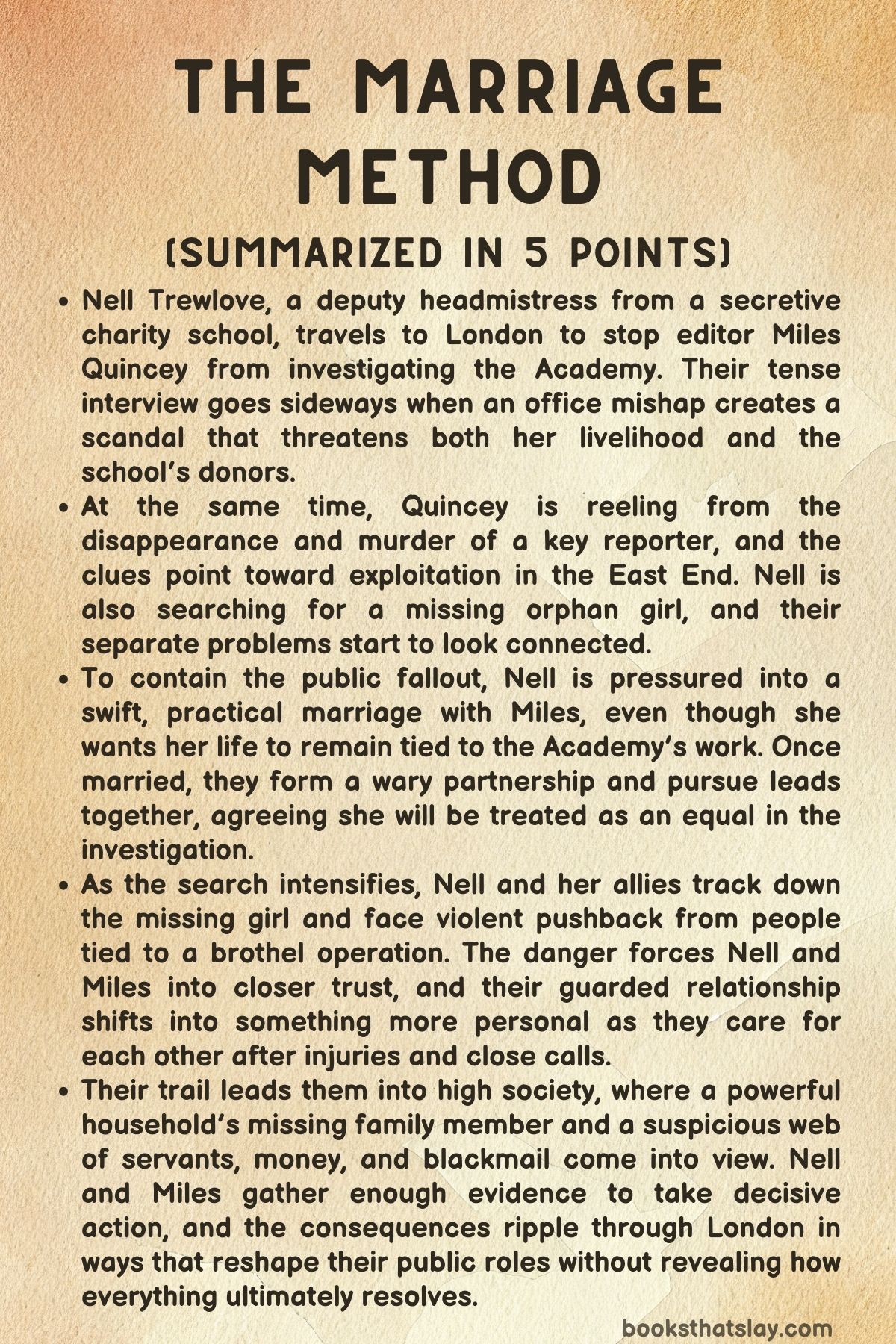
In August 1864, Penelope “Nell” Trewlove comes to London on orders from Miss Corvus, head of a secluded charity school near Epping Forest. The school’s reputation depends on secrecy, and Miles Quincey, editor of the London Courant, has been sending persistent letters demanding answers and threatening to visit.
Nell arrives in careful disguise, dressed as a widow to travel safely alone. She meets Miles in his newsroom office, where he immediately begins pressing her for details: what the academy truly trains its girls to do, whether it has political aims, and whether its founder has ties to a disgraced nobleman recently exposed by the Courant.
Miles is blunt and relentless; Nell is controlled and guarded. She refuses to feed his suspicions or hand him private histories of women who have already been harmed.
Their tense interview is interrupted by a commotion with the office cat, Shadow, who tangles in Nell’s crinoline and claws her. Miles rushes in to help, and in the scramble he ends up on the floor over her, lifting fabric and wrestling wire hoops to free the animal.
At the worst possible moment, Reverend Pettiman—an officious moralist connected to the academy’s parish council—walks in and witnesses the scene. He storms out, certain he has caught Nell in scandal.
Nell panics. Pettiman’s accusation could cost her the academy’s support and funding, and she knows his outrage is less about truth than about punishing women.
Miles insists their reputations are now tied together and escorts her to her women-only hotel in the East End. There, another crisis breaks: a delivered package meant for Miles is leaking blood.
Inside is a handkerchief marked with the initials “L.C.” and the severed tongue of Lawrence Cowgill, the Courant’s gossip columnist. Miles realizes Cowgill has been murdered and that someone wants the paper intimidated into silence.
Miles goes to Cowgill’s ransacked flat with his clerk Higgins and searches before involving the police. He finds a hidden notebook with fragmentary notes that point toward a railway depot, drugged tea, brothels, and a promised payment of five thousand pounds.
At the same time, Nell pursues her separate assignment: finding Flora Brent, a fourteen-year-old orphan who vanished while traveling to the academy. Nell meets a wary seamstress, Miss Jean, who confirms that some East End madams lure girls with promises of work, then incapacitate them with tainted tea.
Miss Jean reluctantly gives Nell several brothel names connected to such disappearances.
Nell returns to the academy and is met with disaster. Reverend Pettiman has already written to Miss Corvus, alleging disgraceful impropriety with Miles Quincey.
Miss Corvus, furious at the threat to donors and the school’s future, announces a solution that feels like a sentence: Nell must marry Miles to neutralize the scandal. Nell argues that her work—especially finding Flora—matters more than appearances, but Miss Corvus is firm.
If Nell refuses, the academy may lose support, and Nell may be dismissed anyway.
Miles follows Nell to the academy to confront the situation and protect his own standing. Facing each other at the gates and then in the grounds, they come to the same conclusion from different angles: a marriage of convenience is the cleanest way to stop Pettiman’s story from spreading.
Miles, surprisingly considerate, promises to respect Nell’s independence. He has already obtained a special license so they can marry at once.
Nell agrees, resigned but determined to keep her purpose intact.
They wed quickly in a small church, with little ceremony and no romantic display. On the train back toward London, Nell insists on continuing her search for Flora.
Miles connects her investigation with Cowgill’s last notes and insists on going with her; the missing girl and the murdered columnist may be part of the same criminal scheme. Together they visit brothels named by Miss Jean.
The visits confirm the danger but yield no immediate proof—only sharper hostility from those who sense Nell is not an easy victim.
Nell’s closest ally, Effie Royce—an academy-trained woman with access to fashionable circles—helps Nell prepare for deeper inquiry. Effie arranges dress fittings so Nell can move convincingly through high society as Miles’s wife, and she equips Nell with a new cane concealing a blade.
Nell’s composure cracks when she believes she has identified her mother, Lady Belwood, through scent and recognition. The discovery unsettles her sense of self and raises fresh questions about Miss Corvus’s long, secret work placing capable girls into powerful households.
Back in Whitechapel, Nell and Effie spot an opening: gossip at the market points to a “refined” girl working as a scullery maid for a widow, Mrs. Davenant. They confront the household and find the girl—Flora—who tries to flee.
Once reassured, Flora admits she lost her fare after a woman stole her money at the station, and she has been trying to survive and earn her way onward. Nell and Effie pull her out, but as they search for their carriage, Silas, an enforcer for one of the brothels, confronts them and tries to reclaim Flora.
A fight breaks out. Effie distracts him, Nell uses a parasol as a weapon, and Miss Jean arrives in time to knock Silas unconscious with a heavy bag.
Flora’s testimony draws the murder and the abductions together. Inspector Garrick interviews her at Miles’s house.
Flora recounts being approached at the station by Mrs. Pritchard, offered tea and cake, and waking locked in a room. She escaped and, in the process, freed a trapped man—Lawrence Cowgill—whose attempted escape ended in violence.
Miles is furious that Nell endangered herself again, but his anger gives way to care when he sees her injuries. When he realizes her shoulder is dislocated, he resets it despite her protests and stays by her as she recovers.
In the quiet aftermath, their marriage shifts from pure strategy toward genuine trust.
Their investigation points next to Lord Amstead, a baron hosting a shooting party at Northwick Hall. Cowgill’s notes reference a surname linked to Amstead’s missing sister, Jane Fawn-Purvis, who vanished months earlier.
At the house, Amstead grows tense whenever Jane is mentioned and deflects questions. Miles and Nell slip away to interview the housekeeper at a nearby lodge, Mrs. Virtue, who confirms Jane did not elope as rumored.
Jane left by train to London to see a solicitor in secret, afraid of her brother’s reaction, and then disappeared.
Returning to the estate, Nell is attacked in the stables by Mrs. Pritchard, razor at her throat. Innes, Amstead’s butler, appears—and Nell realizes the connection: Innes and Mrs. Pritchard are siblings.
Under pressure, Mrs. Pritchard confesses the scheme. Amstead arranged to stop Jane after she discovered he had poisoned their father with an overdose of morphia.
Innes offered Mrs. Pritchard five thousand pounds to dispose of Jane. Jane was met at the platform, drugged with tea, taken to the brothel, and later dumped in the Thames.
Cowgill traced the story and threatened publication; they drugged him, and when chaos followed, Mrs. Pritchard stabbed him. Flora was taken simply because she was young and profitable.
Nell frees herself using practiced technique and fights back, while Miles knocks out Innes. They bind both attackers and summon legal authorities.
Amstead tries to distance himself, but the testimony and arrests set the case in motion. Back in London, Miles publishes the story in a sustained series, forcing public attention onto crimes that wealth might otherwise bury.
A month later, with Amstead arrested and charged, Nell keeps her bond with the academy while building a real home with Miles. The dinner party they host is a careful performance of respectability, but in private, their partnership has become something sturdier than strategy: a shared life earned through danger, honesty, and choice.
Characters
Penelope “Nell” Trewlove
Nell is the emotional and moral center of The Marriage Method, a woman trained to survive in a world that punishes female vulnerability. Her choice to travel in widow’s mourning is not just a practical tactic but a window into her constant vigilance: she has learned that safety often requires performance, disguise, and control.
Raised first as an orphan student and later shaped into a deputy headmistress, she carries the Academy’s discipline in her body and habits, always scanning rooms, measuring exits, and managing how others read her. Yet beneath that careful restraint is a deeply protective spirit; her fiercest drive is not self-preservation but responsibility for girls like Flora, because she knows what it means to be left behind.
Nell’s arc is a negotiation between duty and selfhood: she agrees to marriage as a shield for the Academy’s survival, but she refuses to become small within it, insisting on partnership, equality, and continued purpose beyond the domestic role London expects of her.
Miles Quincey
Miles is defined by tension: principled yet ruthless when truth is at stake, guarded yet capable of startling tenderness. His background in poverty and his mother’s insistence on honesty shape his public mission as an editor who exposes corruption, but they also fuel his private fear of being compromised, manipulated, or made a fool.
He begins as a man trying to control damage—losing a reporter, facing backlash, being baited by scandal—yet the story steadily forces him into something more intimate and vulnerable. With Nell, he discovers a form of loyalty that is not merely ideological but personal; he becomes protective without patronizing (even when he slips, he corrects toward respect), and he learns to share authority rather than hoard it.
His competence is practical and kinetic—investigation, deduction, physical readiness, the ability to act decisively under threat—and that competence becomes part of the relationship’s foundation. The marriage that starts as reputational triage becomes, for him, a real bond precisely because Nell refuses to be managed and requires him to meet her as an equal.
Artemisia Corvus
Miss Corvus is both benefactor and strategist, a woman who has turned pain into infrastructure. The Academy she runs is not simply a school but an engine designed to protect and reposition endangered girls in a society built to consume them, and she enforces its secrecy with near-military severity.
Her leadership style is harsh because she operates in a high-stakes environment: donors can vanish, reputations can collapse overnight, and one scandal can destroy the refuge she has built. She shows genuine concern for Nell and the missing Flora, but she prioritizes institutional survival over individual preference, even when it costs Nell her autonomy.
The hints of her former identity and her connection to past injustice suggest a long memory and a purpose sharpened by betrayal; she is not motivated by sentimentality, but by a cold, determined idea of justice that often looks like sacrifice.
Effie Royce
Effie is Nell’s mirror and counterpart: equally capable, but more socially fluent and more willing to weaponize the tools of fashionable society. She moves through elite spaces with practiced ease, understands the power of clothing and presentation, and treats appearances as both camouflage and leverage.
At the same time, she is unromantic about danger; she anticipates violence, equips Nell with a concealed weapon, and acts quickly when confrontation erupts. Effie’s loyalty is pragmatic and fierce—she does not merely sympathize with Nell’s mission, she participates in it, physically intervenes to prevent escape, and helps extract Flora from exploitation.
Her connection to powerful households hints at the Academy’s deeper network and suggests that her personal history has trained her to be both charming and hard-edged, a woman who survives by mastering the rules of multiple worlds.
Gemma Sparrow
Gemma functions as the Academy’s spark and sentinel, a colleague whose “fiery” temperament signals how deeply she believes in the institution and the women within it. She is quick to react, quick to defend, and emotionally honest in a setting that often rewards secrecy.
By bringing urgent news to Nell and reflecting the collective anxiety about donors and scandal, Gemma helps show what the Academy costs its members: constant risk, constant scrutiny, and the knowledge that one woman’s tarnished reputation can endanger them all. Even when she is not at the center of the action, her presence reinforces that Nell is part of a sisterhood with real stakes and real bonds.
Reverend Pettiman
Pettiman is moralism with a pen: a man who confuses condemnation with virtue and turns women’s reputations into public property. His outrage is performative and opportunistic, focused less on truth than on punishment and control, and he represents how easily “respectability” becomes a weapon used against women who step outside narrow expectations.
He is not an investigative force like Miles; he is an enforcement mechanism for social power, threatening livelihoods and safety through insinuation. In the narrative, Pettiman’s function is catalytic: his willingness to believe the worst, and to broadcast it, creates the pressure that forces Nell into a marriage she did not choose, revealing how coercion can be dressed up as propriety.
Lawrence Cowgill
Cowgill is the story’s warning about curiosity in a corrupt world: a gossip columnist whose trade is information, leverage, and other people’s secrets. He is essential to the newspaper’s survival yet ultimately disposable to those who profit from silencing him.
His hidden notes show both his cunning and his fear; he anticipates being searched, conceals evidence, and leaves a trail of fragments that become the spine of Miles and Nell’s investigation. Cowgill’s fate—mutilation, intimidation, and murder—signals the seriousness of the criminal network they are facing and clarifies the stakes: this is not merely scandal but organized brutality backed by wealth.
Higgins
Higgins is the ordinary man caught in extraordinary events, a clerk who represents procedural caution and the instinct to involve lawful authority. He is not built for the moral grayness Miles inhabits, and his discomfort highlights Miles’s tendency toward unilateral action and risk.
Yet Higgins is also loyal and functional; he obeys, delivers urgent packages, manages doors, and becomes an unwilling witness to how quickly reputations can be imperiled. His role quietly underscores that institutions—newspapers included—run on people who do the unglamorous work while others chase big truths.
Inspector Garrick
Garrick is the novel’s grounded pressure of formal justice, a professional who understands evidence, timing, and the need to keep suspects alive to reach larger culprits. He is neither easily manipulated by Miles’s righteous anger nor dismissive of Nell’s testimony, which makes him a stabilizing presence in a plot full of impulsive risk.
Garrick’s warnings function as a moral boundary: he acknowledges the victims and the violence, but he insists that retaliation can destroy the case. Through him, the narrative emphasizes that justice is not only about knowing the truth—it is about proving it in a system that powerful men try to bend.
Gabriel
Gabriel appears as part of Miles’s support structure, someone trusted enough to be present during sensitive interviews and dangerous revelations. His role suggests that Miles is not entirely solitary; even when Miles is emotionally guarded, he maintains reliable alliances.
Gabriel’s presence helps validate Flora’s account and reinforces the seriousness of the investigation, while also showing that Miles’s household is becoming a working hub where private life and public danger collide.
Shadow
Shadow, the office cat, seems comic at first—a feral creature hiding in the newsroom—but becomes the accidental trigger for the reputational crisis that drives the marriage plot. The chaos of Shadow tangling in Nell’s crinoline creates a “compromising” tableau that Pettiman weaponizes, proving how random, bodily mishaps can be turned into moral accusations against women.
Shadow also reveals something gentle in both leads: Nell’s instinctive warmth toward animals and Miles’s willingness to risk bites and injury to help. In a story full of threat, Shadow is a small symbol of the domestic tenderness Miles and Nell slowly build.
Flora Brent
Flora is the clearest embodiment of what the Academy exists to prevent: a young girl vulnerable to grooming, deception, and trafficking disguised as opportunity. Her story is frighteningly practical—stolen fare, drugged tea, confinement—and her survival depends on quick thinking (hairpins, escape, improvising work) as much as it depends on Nell and Effie refusing to give up.
Flora’s testimony ties the personal to the political by linking a missing orphan to Cowgill’s murder and to the aristocratic conspiracy behind the brothel network. She is not only a victim; she is also a witness whose courage becomes pivotal evidence, and her recovery afterward offers a hard-won proof that intervention can change outcomes.
Miss Jean
Miss Jean is a working-class node of conscience and local knowledge, someone who understands the East End’s machinery of exploitation and the specific tactics used to trap girls. Initially cautious, she becomes increasingly brave—offering names, giving warnings, and ultimately intervening physically to save Nell, Effie, and Flora.
Her decisive act in the street shows that heroism in The Marriage Method is not limited to the titled or the institutionally powerful; it can come from someone carrying an iron in a bag who simply refuses to let violence win.
Mrs. Davenant
Mrs. Davenant occupies an uneasy moral middle ground: she benefits from hiring a “refined” girl cheaply, resists scrutiny, and prioritizes her household over the suspicious circumstances that delivered Flora to her doorstep. Whether she is merely defensive or knowingly complicit, she reflects the everyday respectability that allows exploitation to persist—people who may not commit the initial harm but who would rather not look too closely at how vulnerable girls appear in their kitchens.
Her reluctant payment of Flora’s wages becomes a small, telling moment: decency is extracted from her by pressure rather than offered freely.
Mrs. Marigold
Mrs. Marigold’s Hotel for Women represents a rare, fragile refuge in London, a space where women can exist without immediate male governance. While she remains mostly offstage, the hotel’s presence matters because it contrasts sharply with the predatory spaces elsewhere—newsrooms that scandalize, brothels that imprison, households that exploit.
The hotel is part of the broader theme that women’s safety often depends on networks and environments created by women, even within restrictive social systems.
Silas
Silas is violence made personal: the brothel’s enforcer whose job is intimidation, retrieval, and punishment. He embodies the physical threat that underpins the trafficking operation, the brute force required to turn drugging and confinement into a sustainable business.
His confrontation with Nell and Effie shows the danger of their investigation, and the injury he inflicts on Nell is not only bodily harm but a reminder that women’s courage is routinely met with men’s fists. Silas is also a liability to the larger conspirators—useful, but too crude to be trusted—making him the kind of disposable muscle that powerful people employ to keep their hands clean.
Mrs. Pritchard (Lily)
Mrs. Pritchard is a predator with grievances, furious at being disrupted but fundamentally motivated by profit and power over vulnerable bodies. She is not portrayed as an abstract villain; she has history, family ties, and a desperate survival instinct that turns quickly into murderous threat when her enterprise collapses.
Her kidnapping methods—charm, tea, confinement—show how exploitation often begins with manufactured kindness. The revelation that she is “Lily,” connected by blood to Innes, pulls her deeper into the aristocratic plot, exposing how crime can be interlaced with respectability.
Even when she confesses, she does so in the language of transactions—five thousand pounds, agreements honored, bodies disposed—revealing a worldview where human lives are inventory.
Baron Amstead
Amstead is the refined face of corruption: charming in public, ruthless in private, and skilled at turning family, servants, and social rituals into instruments of control. His evasiveness about his sister Jane and his sudden shift to cold hostility signal a man who senses threat and reacts by tightening the room around him.
The allegations against him—patricide through poisoning, suppression of evidence, orchestration of abduction and murder—position him as someone willing to annihilate even blood relations to protect title and comfort. He also represents a key theme of The Marriage Method: the true danger is not always the obvious criminal in the alley, but the gentleman in the dining room who can buy silence, arrange disappearances, and attempt to launder brutality through status.
Innes
Innes is the machinery of complicity, a servant who is not merely following orders but actively shaping outcomes. His connection to Mrs. Pritchard makes him a bridge between aristocratic household and criminal underworld, showing how secrets travel through corridors, stables, and letters as much as through drawing rooms.
He participates in planning, payment, and enforcement, and his attempt to manage Mrs. Pritchard during the attack reveals a man used to controlling chaos on behalf of power. Innes illustrates how hierarchy can breed a particular kind of ruthlessness: someone close enough to the elite to know their vulnerabilities, and hardened enough to do what they prefer not to do publicly.
Jane Fawn-Purvis
Jane is the story’s haunting absence, a woman whose disappearance becomes the central proof of the conspiracy’s reach. The fragments in Cowgill’s notes and the household’s evasions suggest she was intelligent, cautious, and brave enough to seek legal counsel when she suspected her brother’s crimes.
Her decision to travel alone signals both her fear of betrayal and her determination to act. Even though she is largely unseen, Jane’s role is vital: she turns the plot from sordid scandal into a matter of murder, inheritance, and systemic violence against women who know too much.
Lady Belwood
Lady Belwood embodies the cost of aristocratic survival for women: polished exterior, hidden damage, and choices constrained by reputation and power. As Nell’s mother, she represents the wound beneath Nell’s lifelong feeling of abandonment, yet their confrontation complicates simple blame.
The narrative suggests Belwood’s life required strategic cruelty—separation, secrecy, distance—because open acknowledgement could have destroyed them both. Her presence at Northwick Hall and her forceful insistence on Nell’s safety later show that whatever she did in the past, she is not indifferent in the present.
Lady Belwood becomes a living symbol of the novel’s recurring question: what does a woman do when the only available choices are all forms of loss?
Lady Upshott
Lady Upshott functions as the social ecosystem speaking aloud, a conduit for gossip that can mislead, conceal, or expose. Her story about Jane “eloping” shows how society smooths over danger with romantic narratives that protect men’s reputations and silence troubling questions.
Through her, the book highlights how rumor can be engineered—useful for aristocrats like Amstead—and how even casual chatter can become investigative material when Nell knows what to listen for.
Lady Summers
Lady Summers appears at the end among the carefully curated dinner guests, representing the world of respectability that Nell and Miles must manage now that their private lives have become public material. Her inclusion shows how reputation is both battlefield and currency: the same society that would punish scandal can also be made to witness, judge, and amplify truth when Miles publishes.
Lady Summers helps underline that victory is not only legal but social—who attends your table, who believes your story, and who decides you are acceptable.
Viscount Compton
Compton is a shadow of earlier wrongdoing whose downfall reverberates through the present. His exposure suggests a man protected by status until facts and strategic intervention finally rupture the façade.
Even when he is not directly in the main action, he matters because his collapse clarifies the Academy’s broader purpose: it does not merely shelter girls, it counters predatory power by collecting knowledge, building capability, and placing women where they can influence outcomes.
Elizabeth Wingard
Elizabeth Wingard is the implied origin story behind the Academy’s mission, a figure who may have been forced to reinvent herself after harm and return with a new identity and a plan. Whether she is directly Miss Corvus or closely tied to her, Elizabeth represents transformation from victim to architect, someone who refuses to let injustice be the final chapter.
Her rumored reinvention underscores a core idea in The Marriage Method: women can survive by rewriting their names, their positions, and the narratives imposed on them.
Mrs. Virtue
Mrs. Virtue is the keeper of domestic truth, a housekeeper who knows the difference between the story a family tells and what actually happened within its walls. Her refusal to fully state her suspicions while still guiding Miles and Nell toward the truth reveals someone navigating fear, loyalty, and conscience.
She validates that Jane did not elope and that Jane acted alone to seek legal help, turning vague suspicion into credible direction. Mrs. Virtue shows how servants can be both witnesses and targets in aristocratic scandals, holding knowledge that powerful people would rather bury.
Themes
Reputation, Respectability, and Social Control
Victorian respectability operates like a legal system that rarely needs courts because it is enforced through witnesses, whispers, and the threat of exclusion. In The Marriage Method, Nell’s choice to dress as a widow is not theatrical; it is a survival tactic shaped by public behavior toward women who travel alone.
The clothing functions as a social permit that reduces harassment, and it shows how “respect” is often granted only when a woman appears to be owned by grief, marriage, or propriety. The scandal in Miles’s office proves how thin the line is between safety and ruin: a random mishap with a cat becomes a story that Reverend Pettiman can weaponize, not because of what happened, but because of what he can claim happened.
His outrage is less about moral principle than about power, the kind that turns a woman’s reputation into leverage against institutions that depend on donors. Nell is not threatened with punishment for wrongdoing; she is threatened with punishment for creating a narrative opportunity.
That distinction matters, because it reveals a world in which appearance can override truth, and where reputational damage spreads faster than any correction. Miss Corvus’s demand for marriage extends this logic: she treats Nell not as a person with preferences but as a strategic asset whose “respectability” must be repaired to protect the Academy’s funding and legitimacy.
The result is a grim calculus in which Nell’s personal life becomes collateral for institutional survival. Miles is not immune to this system either; his paper has its own reputation to manage, and his professional standing can be undermined by the same moralistic public that consumes gossip.
The novel keeps showing how respectability is selectively applied—used to police women, to shield powerful men, and to create a convenient moral theater where the loudest accuser looks virtuous while doing harm.
Women’s Agency Under Constraint
The women in The Marriage Method live in a society that tries to narrow their choices, yet the story keeps returning to the practical intelligence required to act anyway. Nell’s discipline—watching exits, reading rooms, controlling language in interviews—comes from the Academy’s rules, but those rules are also a response to lived danger.
The Academy itself is framed by outsiders as suspicious because it trains girls to be capable, employable, and alert, which is exactly what threatens a culture that prefers female dependence. Effie’s role makes that clearer: she moves through fashionable spaces, arranges access to resources, and equips Nell with a cane that hides a blade, a literal symbol of hidden competence.
Even the decision to investigate brothels is an assertion of agency that carries severe risk; it puts Nell and Effie in contact with male violence, corrupt intermediaries, and a police system that can fail victims. The rescue of Flora is a turning point because it shows agency as care, not just defiance.
Nell does not pursue danger for excitement; she pursues it because nobody else will, and because she understands what disappearance means for a girl without protection. The confrontations in Whitechapel and later at Northwick Hall demonstrate that women’s agency in this world often requires physical readiness, emotional control, and the ability to navigate lies without losing the thread of truth.
Miss Corvus is an especially complex expression of agency: she builds an institution that quietly shifts women’s futures, but she also makes ruthless decisions, including forcing Nell into marriage to preserve the Academy. That choice can look like betrayal, yet it also reflects how women in positions of leadership sometimes adopt the same harsh logic used against them.
The story refuses easy categories of “victim” or “hero,” and instead shows a continuum of female strategy—some compassionate, some coercive, all shaped by a system that punishes women for being visible and punishes them again for being vulnerable.
Journalism, Truth, and the Ethics of Exposure
Miles’s profession is built on revealing secrets, but The Marriage Method treats “truth” as something that can liberate or destroy depending on motive and method. Miles is driven by a genuine commitment to uncovering wrongdoing, formed partly by his childhood poverty and his mother’s insistence on honesty.
At the same time, his paper survives on public appetite for scandal, and the missing gossip columnist is not just a colleague but a business crisis. This tension runs through his interrogation of Nell: he believes the Academy may be manipulating politics, and he expects that extracting private histories is justified by the public interest.
Nell challenges that assumption directly, arguing that forcing victims’ stories into print can serve voyeurism more than justice. The plot then complicates Miles’s position by giving journalism real stakes beyond reputation: Cowgill is murdered for what he learned, and his severed tongue is an unmistakable message about silencing speech.
It is not only a crime detail; it is a threat against the very idea that information should circulate. Miles’s investigation becomes an argument for responsible exposure: he must decide what to print, when to involve police, how to protect Nell, and how to avoid turning victims into collateral.
The novel also highlights how truth competes with social power. Amstead’s status allows him to circulate a false story about his sister’s “elopement,” and polite society repeats it because it is convenient.
In that setting, journalism is one of the few tools capable of challenging aristocratic control over narrative. Yet the story never pretends that publishing is automatically virtuous; it shows the risk that newspapers can amplify harm when they chase sensation.
Miles’s eventual decision to publish a series that drives public opinion against Amstead frames the press as a force that can succeed where law might hesitate, but it also raises questions about accountability: public outrage can be a blunt instrument, and the same crowd that condemns a murderer can also ruin a woman over a staged misunderstanding. By keeping Miles and Nell in constant debate about boundaries, the book turns journalism into a moral practice rather than a simple profession.
Class, Power, and Corruption
The conflict in The Marriage Method is not only about individual villains; it is about how class creates different rules for different people. Miles’s memories of the St. Giles slums and his hard-earned authority as editor place him outside the aristocratic circle even when he enters it.
Nell’s background as an orphan raised at the Academy places her in another vulnerable category: she has education and competence but lacks the protective web of family name. Against them stands the power of titled men, donors, and gatekeepers like Pettiman, who can convert social status into institutional pressure.
The Amstead storyline sharpens this theme by showing how a wealthy household can hide violence behind manners, servants, and carefully managed stories. Jane’s disappearance is treated as gossip instead of an emergency because the “elopement” explanation preserves the family’s public image and avoids scrutiny.
The scheme with the brothel exposes an ugly bridge between respectable estates and criminal markets: the same society that condemns vice relies on it as a disposal system for inconvenient problems. Mrs. Pritchard is not merely a criminal operator; she is also a service provider for powerful men who need secrets buried.
The use of morphia, drugged tea, bribes, and paid violence illustrates corruption as logistical, not chaotic: money buys silence, and fear keeps the machinery running. The police investigation exists, but it moves within the constraints of influence and evidence, which is why Nell and Miles repeatedly worry that the law may not fully hold Amstead.
The class theme also appears in the emotional texture of the marriage: Miles brings financial stability and social coverage, while Nell brings knowledge of hidden female networks and street-level realities that upper-class hosts pretend not to see. Their partnership suggests a counter-model to class hierarchy—one where competence matters more than pedigree.
Still, the book does not offer a fantasy of easy reform; it shows that challenging power requires both proof and pressure, and that the most dangerous enemies are often the ones whose authority makes their lies sound believable.
Identity, Secrecy, and Chosen Family
Personal identity in The Marriage Method is shaped by concealment, reinvention, and the longing to belong. Nell’s widow disguise is a small example, but the larger pattern is the Academy’s culture of guarded histories: girls arrive as orphans, names are protected, and pasts are treated as dangerous knowledge.
Miss Corvus herself is tied to an earlier identity, and the suggestion that she rebuilt her life after being wronged connects secrecy to survival. For Nell, secrecy cuts two ways.
It protects her from exploitation, yet it also prevents her from understanding her own origins, which becomes painfully clear when she suspects Lady Belwood is her mother. That recognition is not framed as a romantic reunion; it lands as a complicated confrontation with abandonment, social constraint, and the way privileged women can still be trapped by consequences.
Nell’s shift from anger to pity signals a broader point: identity is not just personal choice but also the outcome of social penalties. Miles’s story parallels this.
His mother’s out-of-wedlock pregnancy shaped his entire trajectory, marking him with stigma that he carries as both motivation and wound. When Nell and Miles share these histories, intimacy is built less on flirtation and more on shared understanding of loss and reputational threat.
The Academy sisters—Effie, Gemma, and the broader network—operate as chosen family, offering loyalty, tools, and solidarity that blood relatives cannot or will not provide. Flora’s rescue extends that idea: Nell becomes the adult she never had, refusing to accept that a powerless girl should simply disappear into the system.
Even the recurring presence of cats adds texture to this theme, emphasizing shelter, trust, and the gradual building of safety in a home. By the end, the couple’s social hosting is not just a performance; it is an attempt to create a stable place where the past is acknowledged but no longer controlling.
The theme suggests that secrecy may begin as armor, but healing requires selective revelation—to the right people, in the right conditions—so identity can become something lived rather than something managed.
Marriage as Contract, Protection, and Gradual Partnership
Marriage in The Marriage Method begins as damage control, and that origin shapes everything that follows. Nell’s forced engagement is a reminder that, in her world, marriage is a public instrument used to sanitize rumor and reassure donors, not necessarily a private commitment.
Miles approaches the wedding with similar practicality, treating it as a solution that contains fallout and stabilizes both reputations. The lack of romance in the ceremony is not a failure of feeling; it is a statement about the constraints pressing them into the arrangement.
Yet the story does not leave marriage in that cold space. It shows how a contract can become a relationship through repeated acts of respect, restraint, and trust.
Miles agrees to treat Nell as an equal in dangerous work, and Nell insists on being more than a protected object. Their bond grows in moments where consent and care are foregrounded: Miles stopping physical intimacy when Nell is under laudanum, staying by her side, resetting her shoulder with grim competence, and later buying a wedding band as a genuine marker of commitment.
Nell’s own shifts matter just as much. Her impulsive kiss is not just desire; it is a reaching for safety and recognition after years of controlled self-denial.
She also negotiates the marriage as a space where she can keep her mission, retain connection to the Academy, and pursue justice for the missing girls. The partnership becomes most convincing when it is tested by danger and disagreement—when they argue about risk, strategy, and boundaries, then return to the same purpose.
Even the social performances they host later show marriage as both shield and platform: the respectable household lets them influence perception, build alliances, and protect the people they care about. The novel’s view of marriage is neither cynical nor sentimental.
It treats it as a structure that can be oppressive when imposed, but potentially liberating when two people reshape it through mutual regard. In that sense, the “method” is not manipulation of society alone; it is the slow work of turning an imposed role into a chosen life.