The Me I Used to Be Summary, Characters and Themes
The Me I Used to Be by Kristan Higgins is a contemporary women’s fiction novel about friendship, loss, forgiveness, and the unexpected ways people rediscover themselves in middle age.
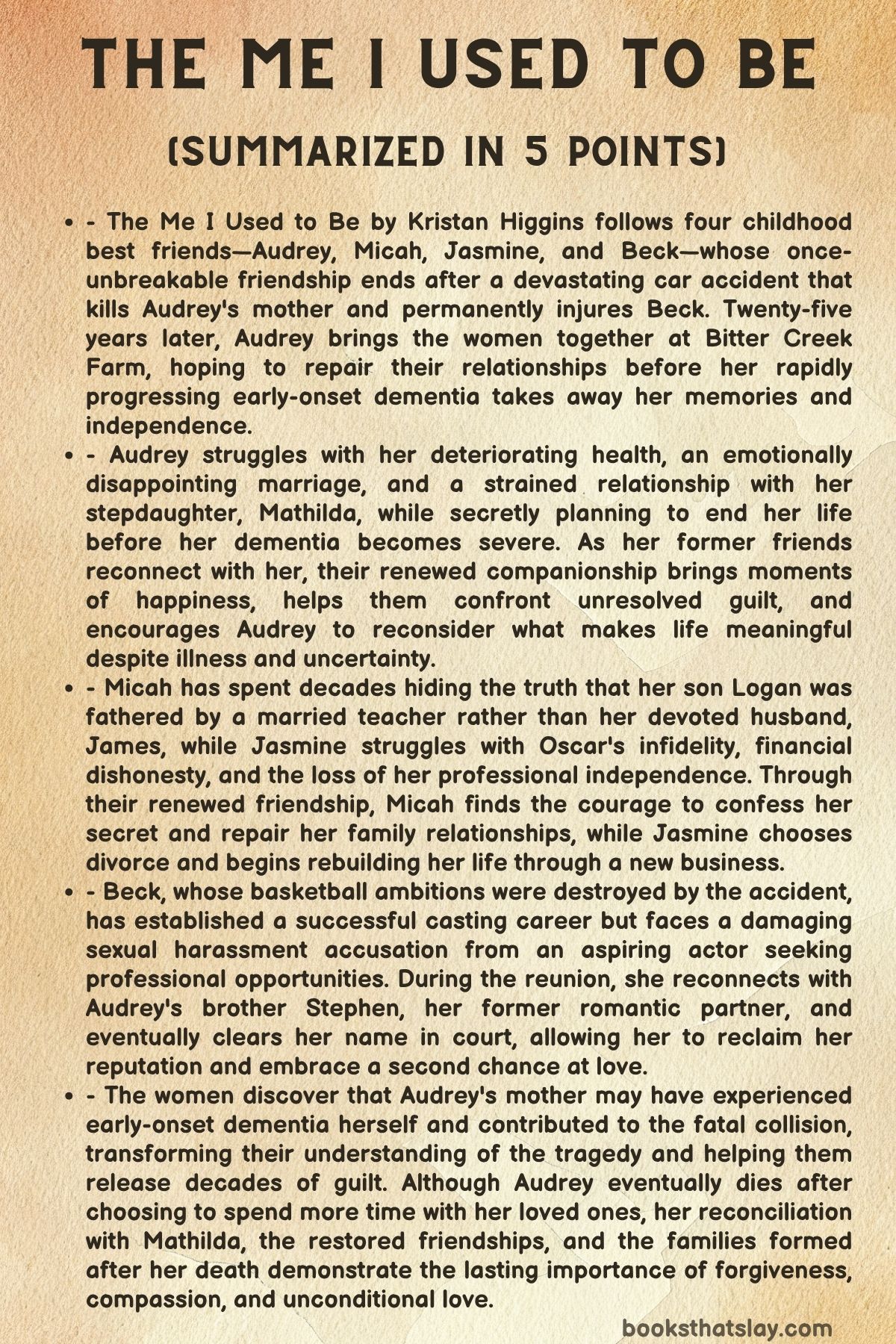
The story follows four women whose once-unbreakable teenage friendship ended after a devastating accident. Twenty-five years later, they reunite when one of them receives a life-changing medical diagnosis. Their reunion forces them to confront buried guilt, broken relationships, unhappy marriages, and the dreams they abandoned. Through their experiences, the novel examines the importance of human connection, the courage required to face painful truths, and the possibility of finding happiness even when life has become unrecognizable.
Summary
Twenty-five years ago, Audrey Wentworth, Micah Paulson, Jasmine Hahn, and Beck Morrow were inseparable teenage friends in Stafford, Vermont. Known as the Core Four, they believed their friendship would survive every challenge and continue throughout their adult lives.
Their individual personalities complemented one another, creating a close relationship built on mutual affection and shared experiences. Audrey was the privileged and generous daughter of a respected doctor, Micah was beautiful and entertaining, Jasmine was exceptionally intelligent and ambitious, and Beck was a talented basketball player with enormous athletic potential.
Audrey’s family home, Bitter Creek Farm, became their favorite gathering place, offering warmth and security that several of the girls lacked in their own households. Audrey’s mother, Dr. Kate, provided affection and guidance to all four, becoming especially important to Jasmine and Beck, whose relationships with their mothers were troubled.
The girls imagined attending one another’s weddings, raising children together, traveling, and remaining companions for the rest of their lives. However, their confidence disappeared when a terrible accident occurred shortly after their high school graduation.
On the night of a graduation party, Micah was supposed to remain sober and drive everyone home, but she became intoxicated. Audrey had smoked marijuana, Beck did not have a driver’s license, and Jasmine reluctantly took responsibility for driving despite her limited experience with a manual-transmission vehicle.
During their journey, the girls were involved in a devastating collision that left Beck severely injured and killed Audrey’s mother. Audrey discovered Dr. Kate’s body in the other vehicle, an experience that permanently changed her understanding of life and shattered the happiness she had previously taken for granted.
Beck survived after extensive medical treatment, but her damaged leg ended her dream of becoming a professional basketball player. Jasmine faced suspicion from police investigators, while Micah struggled with guilt over breaking her promise to remain sober.
Audrey withdrew from her friends as she attempted to process her mother’s death. The tragedy destroyed the Core Four, leaving each woman to build an adult life marked by loss, regret, and unresolved questions.
Twenty-five years later, Audrey lives at Bitter Creek Farm with her husband, Clay Joyce, and his teenage daughter, Mathilda, who prefers to be called Kylo. Although Audrey has returned to the home associated with her happiest memories, her marriage and family relationships have become deeply disappointing.
Clay, a widower whose first wife died of cancer, rarely provides the emotional support Audrey needs. Mathilda resents Audrey’s attempts to become a maternal figure, interpreting her kindness as an intrusion upon the memory of her biological mother.
Audrey also faces a far more serious crisis: she has been diagnosed with early-onset dementia. Her condition causes frightening episodes of confusion, memory loss, difficulty performing everyday activities, and an increasing inability to recognize familiar people.
Terrified of eventually losing her independence and identity, Audrey has secretly prepared to end her life before the illness becomes unbearable. Before carrying out this decision, however, she wants to fulfill one final wish by reuniting with her three childhood friends.
When Audrey invites Micah, Jasmine, and Beck to Bitter Creek Farm for their twenty-fifth high school reunion, each woman arrives carrying problems she has concealed from the others.
Micah remained in Stafford, married James Paulson, raised their son Logan, and took responsibility for Lola’s Bakery, the family business. Although she appears cheerful and generous, she feels trapped by expectations and haunted by the adventurous life she abandoned.
Her greatest concern involves Logan, who recently discovered that James is not his biological father. Years earlier, Micah became pregnant after a relationship with Robert Bates, a married substitute teacher, but allowed James to believe the child was his.
Jasmine lives in Greenwich, Connecticut, with her wealthy husband Oscar and their three daughters, Lydia, Lucy, and Lyra. Despite her impressive Princeton education and former financial career, she has become financially dependent on Oscar and increasingly unhappy with the social world surrounding their marriage.
She suspects Oscar is having an affair with a younger employee named Alyssa Cottington. Nevertheless, Jasmine fears confronting him because she believes maintaining financial security and a stable household is essential for her children.
Beck has become a successful casting director in New York after rebuilding her ambitions following the accident. Her professional reputation is threatened when Andy Ledfield, an aspiring actor she briefly dated, accuses her of using professional influence to obtain a sexual relationship.
Although Beck maintains that their relationship was consensual and that Andy began seeking career favors afterward, the accusation damages her professional connections. She also continues living with chronic leg pain and regrets surrounding relationships she lost.
The reunion begins awkwardly, particularly because Jasmine eventually married Oscar after he had previously dated Beck. Nevertheless, their shared history gradually overcomes the distance between them.
Audrey addresses the accident openly, and each woman acknowledges the guilt she has carried for decades. Audrey offers forgiveness, creating an opportunity for reconciliation that none of them expected.
When Audrey reveals her dementia diagnosis and her intention to end her life, her friends are devastated. Their immediate concern shifts from their personal difficulties to supporting the woman who once provided the emotional center of their friendship.
As the weekend progresses, the women begin sharing painful truths about their adult lives. Beck discusses her legal troubles, Jasmine admits that her marriage is collapsing, and Micah reveals that Logan has stopped speaking to her.
Their conversations remind them that successful appearances often conceal considerable suffering. They also begin recognizing how much their youthful friendship meant and how unnecessary some of their long separation may have been.
The reunion becomes especially meaningful when Stephen Wentworth, Audrey’s adopted younger brother, arrives. His unexpected appearance revives Beck’s memories of their former romantic relationship, which developed during their college years but ended because of circumstances and misunderstandings.
Stephen, now a physician, still cares deeply for Beck, while she realizes that her feelings for him never entirely disappeared. Their renewed connection offers the possibility of recovering a relationship that both have regretted losing.
Meanwhile, Audrey enjoys horseback riding, laughter, and familiar conversations with her friends. These experiences briefly restore her confidence and allow her to feel connected to the person she was before illness, grief, and disappointment altered her life.
At the formal high school reunion, Audrey encounters Derek Shields, the boy who gave her her first kiss on the night of the accident. Dancing with him awakens memories of youthful excitement, while the company of her friends provides another opportunity to experience happiness without thinking constantly about her disease.
However, Audrey becomes confused during the celebration and loses track of her surroundings. A man approaches and dances with her, making her feel unexpectedly safe, attractive, and romantically desired.
The following morning, she discovers that the mysterious man was actually Clay. Their intimate encounter reveals that affection still exists between them despite years of disappointment and emotional distance.
A further revelation transforms the friends’ understanding of their shared tragedy. Stephen explains that Dr. Kate may have been experiencing symptoms of early-onset dementia before the accident, affecting her behavior and judgment.
Evidence suggests that Dr. Kate’s own actions may have contributed to the collision, which investigators originally classified as a no-fault accident. The women realize that they have spent twenty-five years blaming themselves for an event whose circumstances were more complicated than they understood.
This discovery allows them to reconsider their guilt and begin releasing the emotional burdens that have shaped their adult lives.
After returning home, Jasmine finds the courage to confront Oscar about his affair and financial dishonesty. When he reveals that Alyssa is pregnant and their marriage is effectively over, Jasmine finally abandons her attempts to preserve their wealthy lifestyle at the expense of her happiness.
She begins divorce proceedings and eventually moves to New Haven, where she establishes a transportation business called Flex Kids Transportation. Although adjusting to single parenthood brings difficulties, she begins rebuilding her independence and reconnecting with the ambitions she sacrificed during her marriage.
Micah also confronts the secret surrounding Logan’s biological father. When she finally confesses everything to James, she discovers that he has suspected the truth for almost their entire relationship but never considered Logan anything other than his son.
James’s unconditional love allows Micah to understand that her family has been built on devotion rather than biological connection. Logan remains hurt by the deception, but honest conversations gradually repair their relationship.
Beck refuses to accept an unjust settlement in her harassment case and successfully defends herself in court. Her victory restores her professional reputation, while Stephen’s support encourages her to acknowledge the romantic feelings she has concealed for years.
Stephen and Beck eventually become engaged, giving them another opportunity to build the future they once imagined together.
At Bitter Creek Farm, Mathilda discovers Audrey’s journal and learns the truth about her worsening illness. Understanding her stepmother’s suffering transforms her attitude, and she gradually begins expressing the affection Audrey has wanted for years.
As dementia increasingly disrupts Audrey’s memory and independence, she prepares to carry out her original plan to end her life. Stephen, Micah, Jasmine, and Beck gather to support her, while Mathilda finally acknowledges Audrey as her mother.
Surrounded by the people she loves, Audrey recognizes that her life still contains meaningful experiences despite the suffering awaiting her. Instead of carrying out her plan that day, she chooses to continue living.
The story concludes two and a half years after the reunion, when Mathilda prepares to leave for college. Audrey has died on April 3, two years earlier, after spending her final months surrounded by family and friends.
Her final word was “lucky,” reflecting her enduring appreciation for the love she received.
Beck and Stephen are now married and have a daughter named Audrey Katherine Wentworth, with Mathilda serving as her godmother. Clay is preparing to marry Toni Francesco, while Stephen will inherit Bitter Creek Farm.
Mathilda chooses to attend Savannah College of Art and Design, where Audrey once studied, honoring the woman she came to recognize as her mother. As she prepares for her future, she understands that Audrey’s greatest legacy is the love that transformed the lives of everyone around her.
Characters
Audrey Wentworth Joyce
Audrey Wentworth Joyce is the emotional center of The Me I Used to Be, representing the struggle to preserve personal identity when illness, grief, and disappointment threaten everything that once defined a person. Her journey explores the relationship between memory, independence, love, and the desire to find meaning in a life that has become painfully different from what she expected.
Growing up at Bitter Creek Farm, Audrey enjoys a secure childhood surrounded by wealth, affection, and supportive parents. Her generosity makes her a natural leader among her friends, while her mother’s kindness influences her understanding of responsibility and human relationships.
The death of Dr. Kate destroys Audrey’s sense of security, leaving her emotionally isolated and uncertain about her future. Her separation from the Core Four reflects her inability to separate the accident from the people who survived it.
As an adult, Audrey hopes that marrying Clay and becoming Mathilda’s stepmother will recreate the loving household she lost. However, Clay’s emotional limitations and Mathilda’s hostility leave her feeling unwanted within the family she has tried so hard to build.
Her early-onset dementia intensifies these disappointments by threatening her independence, memories, and ability to recognize loved ones. Audrey’s decision to prepare for her own death arises from her terror of becoming helpless and losing control over her existence.
Nevertheless, her reunion with Micah, Jasmine, and Beck reveals that her value extends far beyond her cognitive abilities. Their affection reminds her that she has influenced others through kindness, loyalty, and the willingness to provide comfort during difficult circumstances.
Audrey’s eventual decision to continue living demonstrates a change in her understanding of courage. Rather than measuring dignity entirely through independence, she begins accepting that vulnerability and dependence can coexist with meaningful relationships.
Her reconciliation with Mathilda provides the maternal fulfillment she has long desired. Even as her memory deteriorates, her ability to love remains a defining part of her identity.
Audrey ultimately emerges as a character whose legacy is determined not by her achievements or the circumstances of her death, but by the relationships she nurtures and the affection that continues after she is gone.
Micah Paulson
Micah Paulson represents the emotional consequences of guilt, secrecy, and the pressure to live according to other people’s expectations. In The Me I Used to Be, her outwardly cheerful personality conceals insecurity, regret, and a persistent belief that she must compensate for mistakes made during adolescence.
As a teenager, Micah is admired for her beauty, humor, and lively personality. She dreams of exploring the world and escaping the limitations of Stafford, imagining an adulthood filled with independence and adventure.
Her relationship with Robert Bates, a married substitute teacher, dramatically changes her future. Although she initially feels flattered by his attention, his rejection of her pregnancy reveals the unequal power within their relationship.
Micah’s decision to conceal Logan’s biological parentage creates a secret that shapes her marriage and motherhood for more than two decades. She loves James and appreciates his devotion, but fears that revealing the truth will destroy the family they have created.
The graduation-night accident adds another layer of guilt because Micah failed to remain sober as the designated driver. She carries responsibility for that decision long after the circumstances of the collision become less certain.
As the owner of Lola’s Bakery, Micah dedicates herself to serving her community, supporting her family, and maintaining a friendly public image. Her generosity is genuine, yet it also reflects her desire to earn acceptance from people who have never forgotten her past.
Her strained relationship with Logan forces her to confront the consequences of withholding the truth. Through Jasmine’s encouragement and James’s unconditional love, she begins understanding that honesty offers a stronger foundation for family relationships than secrecy.
Micah’s development ultimately involves accepting the value of the life she has built without dismissing her unrealized dreams. She learns that forgiveness includes recognizing her own worth and allowing herself to pursue happiness beyond her responsibilities.
Jasmine Hahn
Jasmine Hahn is a highly intelligent and ambitious woman whose adult circumstances reveal the psychological consequences of childhood poverty and insecurity. Her role in The Me I Used to Be examines how the pursuit of safety can become a form of imprisonment when financial success replaces emotional independence.
Jasmine grows up in an unstable household marked by her mother’s addiction, cruelty, and neglect. Her friendship with Audrey introduces her to a different understanding of family, while Dr. Kate becomes an essential example of compassion and maternal responsibility.
Her academic achievements offer the possibility of escaping Stafford and constructing a more secure future. Attending Princeton represents not simply educational success but her determination to overcome the limitations imposed by her childhood.
However, her marriage to Oscar gradually undermines the independence she once worked to achieve. Although she enjoys wealth, social status, and a luxurious home, she sacrifices her professional ambitions and becomes increasingly dependent on her husband’s financial decisions.
Jasmine’s participation in Greenwich society further distances her from her authentic personality. Her relationships with Carmen and Michele are based on appearances, competition, and social approval rather than mutual affection.
Her greatest emotional conflict involves balancing her fear of financial insecurity against her awareness that her marriage is unhealthy. She remains committed to protecting her daughters, even when that commitment requires suppressing her own needs.
Reconnecting with the Core Four helps Jasmine recognize the difference between genuine friendship and relationships maintained for social advantage. Her conversations with Audrey and Micah remind her that emotional security cannot be purchased.
When Oscar admits his affair and plans to leave their marriage, Jasmine initially faces the future she has feared for years. Nevertheless, she chooses independence and begins rebuilding her professional identity through her transportation business.
Jasmine’s transformation demonstrates that overcoming childhood insecurity requires more than acquiring wealth. Her eventual freedom comes from trusting her abilities, accepting uncertainty, and creating a life defined by her own values.
Beck Morrow
Beck Morrow is a determined, independent woman whose character explores the lasting impact of physical trauma, lost ambitions, and romantic disappointment. In The Me I Used to Be, her development demonstrates how personal identity can survive the destruction of a dream, even when the emotional consequences remain unresolved.
During adolescence, Beck is an exceptionally talented basketball player who expects to pursue an athletic career. Her confidence and competitive personality make sports central to her understanding of herself.
The accident permanently damages her leg, ending her athletic ambitions and leaving her with chronic pain. The injury also forces her to confront a future she never imagined, creating a sense of loss that professional success cannot entirely erase.
Her emotionally distant mother provides limited comfort during her recovery, making Dr. Kate’s death particularly painful. Beck loses not only her athletic future but also an important maternal figure who had offered unconditional affection.
Despite these experiences, Beck rebuilds her life and establishes a distinguished career as a casting director. Her professional achievements reveal resilience, intelligence, and an ability to redirect her talents toward new opportunities.
Nevertheless, her romantic relationships remain complicated. Her separation from Stephen leaves unresolved feelings, while Jasmine’s subsequent marriage to Oscar reinforces her sense that meaningful relationships can disappear through unfortunate circumstances.
Andy Ledfield’s harassment accusation threatens the professional identity Beck has spent decades establishing. Her refusal to accept an unjust settlement reflects her determination to protect her integrity even when defending herself involves considerable risk.
The reunion with Stephen allows Beck to reconsider the emotional barriers she has maintained. His affection and encouragement remind her that independence does not require rejecting vulnerability or romantic commitment.
By the end of the novel, Beck has successfully defended her reputation and rekindled her relationship with Stephen. Her marriage to him represents not a return to adolescence but a mature willingness to accept happiness despite earlier disappointments.
Mathilda “Kylo” Joyce
Mathilda Joyce is among the characters who experience the greatest emotional development in The Me I Used to Be. Her transformation from a resentful teenager into a compassionate young woman illustrates how grief can distort family relationships and how understanding can create opportunities for reconciliation.
Mathilda loses her biological mother, Caroline, to cancer during childhood. Although her memories of Caroline are incomplete, the emotional significance of those memories makes her fiercely protective of her mother’s place in her life.
When Audrey marries Clay, Mathilda interprets her stepmother’s affection as an attempt to replace Caroline. She rejects Audrey’s maternal gestures, believing that accepting another mother would diminish her loyalty to the woman she lost.
Her decision to use the name Kylo reflects her desire for independence and control over her identity. She also resents being moved from Georgia to Vermont, viewing the relocation as another decision made without considering her feelings.
Mathilda’s friendship with Everest provides emotional stability and offers an alternative environment where she feels understood. However, observing Audrey with her childhood friends gradually challenges her assumption that her stepmother exists only in relation to the family.
After discovering Audrey’s diagnosis and private writings, Mathilda begins recognizing the extent of Audrey’s love and suffering. This knowledge transforms her behavior, encouraging her to offer affection rather than continued rejection.
Her decision to reclaim the name Mathilda symbolizes a more mature understanding of herself. She no longer needs hostility or rebellion to preserve her connection with Caroline.
When Mathilda finally acknowledges Audrey as her mother, she provides the acceptance Audrey has desired throughout their relationship. Their reconciliation becomes especially meaningful because it occurs during the final stage of Audrey’s illness.
In the epilogue, Mathilda demonstrates that Audrey’s influence continues shaping her choices. By attending Audrey’s former college and embracing her extended family, she honors a relationship that eventually became central to her identity.
Stephen Wentworth
Stephen Wentworth is Audrey’s adopted younger brother and one of the novel’s most compassionate supporting characters. His relationship with Audrey illustrates the enduring importance of sibling loyalty, while his romance with Beck explores the possibility of recovering love after years of separation.
Adopted by Dr. Kate and her husband, Stephen grows up in a supportive household where he develops a strong attachment to his family. His decision to become a physician reflects both his admiration for his adoptive mother and his desire to help others.
Stephen experiences the death of Dr. Kate as a profound personal loss. Despite this tragedy, he maintains his commitment to Audrey and remains concerned about her happiness throughout adulthood.
His earlier romantic relationship with Beck develops through their shared understanding of grief and emotional difficulty. Although they separate, he never entirely abandons his feelings for her.
When Stephen returns to Bitter Creek Farm, he immediately recognizes the suffering caused by Audrey’s illness and disappointing marriage. His willingness to challenge Clay’s behavior reflects his protective instincts.
Stephen also helps the Core Four reconsider the accident by revealing evidence that Dr. Kate may have been experiencing early dementia symptoms. His discovery provides an opportunity for the women to release some of the guilt they have carried for decades.
His greatest emotional challenge involves Audrey’s intention to end her life. He wants to respect her autonomy while simultaneously hoping that she will allow him to care for her.
Through his relationship with Beck and continued devotion to Audrey, Stephen represents a form of love grounded in reliability, compassion, and emotional honesty.
Clay Joyce
Clay Joyce is Audrey’s husband and Mathilda’s father, a man whose behavior reveals the consequences of emotional avoidance within family relationships. Although he is not entirely without affection, his inability to confront difficult situations contributes significantly to Audrey’s unhappiness.
After losing his first wife, Caroline, to cancer, Clay attempts to rebuild his life with Audrey. Their relationship initially offers both adults the possibility of companionship and renewed family stability.
However, Clay struggles to manage the tension between Audrey and Mathilda. Rather than addressing his daughter’s resentment, he frequently avoids confrontation, leaving Audrey responsible for repairing their strained relationship.
His diminishing professional ambition and unsuccessful hobbies further frustrate Audrey, who feels increasingly isolated within their marriage. His tendency to respond impatiently to ordinary difficulties becomes particularly damaging as her dementia advances.
The revelation that he has created a dating profile while Audrey remains alive exposes his discomfort with the responsibilities of her approaching decline. Nevertheless, the romantic encounter at the school reunion demonstrates that genuine affection still exists between them.
Clay’s character is therefore defined by contradictions rather than straightforward cruelty. He can provide comfort during moments of crisis, yet often fails to offer the consistent emotional support that a lasting partnership requires.
Dr. Kate Wentworth
Dr. Kate Wentworth is Audrey’s mother and the maternal figure whose influence extends across the entire novel. Although she dies before the main events of the story, her kindness and generosity continue shaping the emotional lives of the Core Four.
As a physician and devoted mother, Dr. Kate represents the security and affection that Audrey enjoys during childhood. Her willingness to welcome Jasmine, Micah, and Beck into her home allows the girls to experience genuine acceptance.
Her importance is especially evident in her relationship with Jasmine, whose own mother provides little stability or affection. Dr. Kate becomes an example of compassionate motherhood that Jasmine later attempts to recreate with her daughters.
Beck also benefits from her attention, particularly because her biological mother struggles to express emotional warmth.
Dr. Kate’s death destroys the friends’ shared sense of safety and becomes the central tragedy around which their adult lives develop. However, Stephen’s later discovery that she may have had early-onset dementia complicates the group’s understanding of the accident.
This revelation does not diminish her importance or kindness. Instead, it illustrates that even deeply admired people can experience vulnerabilities and limitations that others fail to recognize.
James Paulson
James Paulson is Micah’s husband and Logan’s father in every meaningful emotional sense. His character provides one of the novel’s clearest examples of unconditional family love.
During adolescence, James responds to Micah’s pregnancy with loyalty and responsibility, believing that he is the baby’s biological father. He remains committed to supporting her despite the difficulties surrounding her situation.
Over time, his patience and devotion transform Micah’s feelings from gratitude and dependence into genuine romantic affection. Their marriage develops through practical cooperation, shared responsibilities, and mutual commitment.
James’s most significant revelation occurs when Micah finally confesses Logan’s biological parentage. Rather than reacting with anger, he explains that he has suspected the truth for years but never allowed it to change his feelings toward Logan.
His response demonstrates emotional maturity and a firm belief that fatherhood is established through love and responsibility. James helps Micah recognize that their family has been real and meaningful despite the secret she feared would destroy it.
Logan Paulson
Logan Paulson is Micah’s adult son, whose discovery about his biological father forces the family to confront a long-concealed truth. His anger reflects the distress of realizing that an essential aspect of his personal history has been hidden.
For most of his life, Logan believes that James is his biological father. Learning about Robert Bates makes him question his mother’s honesty and the circumstances surrounding his birth.
His decision to stop communicating with Micah demonstrates both his emotional pain and his difficulty reconciling the truth with his childhood experiences.
Nevertheless, Logan remains closely attached to James, recognizing the stability and affection his father has always provided. His eventual willingness to discuss the situation allows the family to begin rebuilding trust.
Logan’s experience illustrates that discovering a painful truth can threaten personal identity without necessarily destroying established relationships. His reconciliation with his parents depends on acknowledging both the deception and the genuine love that surrounded him.
Oscar Hahn
Oscar Hahn is Jasmine’s wealthy husband and Beck’s former boyfriend. His character represents the dangers of financial control, emotional selfishness, and relationships based on social advantage.
Initially, Oscar appears to offer Jasmine the stability she has desired since childhood. His wealth, professional success, and promises of protection make marriage seem like an escape from poverty and insecurity.
Over time, however, their relationship becomes increasingly unequal. Oscar dismisses Jasmine’s ambitions, restricts her financial independence, and takes her domestic responsibilities for granted.
His affair with Alyssa Cottington exposes the extent of his disregard for Jasmine’s emotional well-being. When he reveals that Alyssa is pregnant, he makes clear that preserving their marriage is no longer important to him.
Oscar’s behavior ultimately forces Jasmine to confront her dependence and reclaim responsibility for her future. His role emphasizes how financial security can become destructive when accompanied by disrespect and emotional manipulation.
Robert Bates
Robert Bates is the married substitute teacher who becomes involved with Micah during her adolescence. His relationship with her reveals the unequal power dynamics that can exist between an adult authority figure and a young student.
Micah initially interprets Bates’s attention as evidence of her maturity and attractiveness. However, his behavior after discovering her pregnancy demonstrates that his primary concern is protecting himself.
He pressures Micah to terminate the pregnancy and refuses to provide the responsibility or emotional support she needs. His abandonment contributes to the secrecy that follows her into adulthood.
Bates’s influence extends far beyond the brief relationship itself. His actions indirectly affect Micah’s graduation-night decisions, her marriage, and Logan’s eventual struggle with his identity.
The novel presents his conduct as exploitative, encouraging Micah to reconsider the blame she has placed entirely upon herself.
Caroline Joyce
Caroline Joyce is Clay’s deceased first wife and Mathilda’s biological mother. Although she appears primarily through memories, her absence profoundly influences the relationships within Audrey’s household.
Mathilda remembers Caroline’s affection, physical presence, and the suffering caused by her cancer. These memories become essential parts of her emotional identity.
Because Mathilda associates loyalty with preserving Caroline’s memory, she initially rejects Audrey’s attempts to become a maternal figure. Caroline’s absence therefore creates a conflict that Audrey cannot resolve through kindness alone.
Importantly, Caroline herself is not responsible for the hostility between Audrey and Mathilda. Her role illustrates how unresolved grief can make accepting new relationships feel like betraying someone who has died.
Andy Ledfield
Andy Ledfield is the aspiring actor whose accusation against Beck threatens the career she has spent decades building. His character functions as a source of professional conflict and tests Beck’s determination to defend her integrity.
After meeting Beck at an industry gathering, Andy enters a consensual romantic relationship with her. He subsequently seeks professional assistance, expecting her influence to advance his acting ambitions.
When Beck refuses to recommend him for opportunities she believes he has not earned, Andy accuses her of sexual harassment and professional coercion.
His allegations damage Beck’s reputation, forcing her to choose between accepting a settlement and defending herself publicly.
During the trial, inconsistencies in Andy’s account weaken his credibility. His unsuccessful acting performance further exposes the gap between his ambitions and his abilities, contributing to Beck’s legal victory.
Ezra Rose
Ezra Rose is the attorney responsible for representing Beck during her harassment lawsuit. He provides practical legal guidance while helping her navigate the professional consequences of the accusations.
Initially, Ezra recommends settling the case because litigation could involve considerable risk and further publicity. His position reflects a pragmatic understanding of legal disputes and reputational damage.
However, when Beck decides to defend herself, he prepares a strategy that reveals contradictions in Andy’s testimony. His questioning ultimately helps establish weaknesses in the accusations.
Ezra’s role demonstrates the importance of competent professional assistance during a crisis. He also provides a contrast to Beck’s emotional response by approaching the conflict through evidence and legal procedure.
Toni Francesco
Toni Francesco is Audrey’s friend and a member of her social circle whose relationship with Audrey changes as dementia advances. Her character illustrates the difficulty of maintaining friendships when illness alters communication and behavior.
During a book-club gathering, Audrey struggles to remember Toni’s name and becomes increasingly frustrated with the other women’s reactions to her confusion.
Although Toni expresses concern, Audrey interprets some interactions as judgment or humiliation. Her decision to withdraw demonstrates how dementia can damage relationships even when affection remains.
Toni later visits Audrey as her condition worsens, suggesting continued concern despite their difficulties.
In the epilogue, Toni is preparing to marry Clay after Audrey’s death. Her future relationship with him represents the continuation of life among those Audrey leaves behind.
Derek Shields
Derek Shields is Audrey’s teenage romantic interest and the boy who gives her her first kiss on the night of the accident. His role connects Audrey’s happiest adolescent expectations with the tragedy that changed her life.
When Audrey encounters Derek at the twenty-fifth high school reunion, he remains attractive and expresses romantic interest in her. Their interaction briefly restores the excitement and confidence she experienced as a young woman.
Derek’s significance lies less in the possibility of a lasting romance than in what he represents. His attention reminds Audrey that she possesses an identity beyond illness, marriage, and family responsibility.
Through this encounter, Audrey experiences the pleasure of being desired and recognized as the person she once was.
Eve
Eve is Micah’s sister, whose professional success and extensive travels intensify Micah’s dissatisfaction with her own circumstances. Her character represents the comparisons that can develop between siblings whose lives take different directions.
Where Micah remains in Stafford and assumes responsibility for the family bakery, Eve pursues the adventurous lifestyle Micah once imagined for herself.
Eve’s comments during family gatherings emphasize the opportunities Micah has missed, often making her feel that domestic responsibilities have prevented her from achieving anything significant.
However, these comparisons eventually encourage Micah to reconsider what constitutes a successful life. She learns that her devotion to family and community has value even if her experiences differ from her sister’s.
Jade
Jade is Jasmine’s mother and one of the central sources of emotional insecurity in her childhood. Her addiction, instability, and cruel behavior create an environment in which Jasmine feels unsafe and unwanted.
Rather than providing encouragement, Jade frequently humiliates her daughter and dismisses the importance of people who treat Jasmine kindly.
Her hostility becomes particularly apparent after Dr. Kate’s death, when she makes offensive remarks about the woman who provided Jasmine with maternal support. Jasmine’s fierce reaction reveals how deeply she resents her mother’s behavior.
Jade serves as a contrast to Dr. Kate, demonstrating how motherhood can involve either emotional nourishment or lasting psychological harm.
Jasmine’s determination to provide a different childhood for her daughters is partly shaped by her rejection of Jade’s example.
Cash
Cash is Jasmine’s older brother, whose relationship with her reflects the difficulties of maintaining family connections after an unstable childhood. Although they share painful experiences, their adult lives initially develop separately.
When Cash is diagnosed with advanced cancer, he contacts Jasmine after years of distance. She responds by arranging treatment and care, demonstrating the loyalty that survives their separation.
During his final weeks, the siblings share memories and develop a closeness that was largely missing during childhood.
Cash’s death becomes especially important to Jasmine’s understanding of Audrey’s illness. She remembers that his final months contained meaningful opportunities for affection and reconciliation, influencing her belief that life can remain valuable even during severe physical decline.
Everest
Everest is Mathilda’s close friend and an important source of emotional stability during her adolescence. His companionship provides a sense of acceptance that she initially struggles to find within her own household.
Mathilda feels comfortable spending time with Everest and his family because they respect her chosen identity and allow her greater emotional freedom.
Their friendship gives her space to express frustrations about Audrey, Clay, and the move to Vermont.
Everest’s presence also becomes meaningful as Mathilda begins reconsidering her attitude toward her stepmother. Their relationship represents the importance of supportive friendships during periods of uncertainty and personal growth.
Lydia, Lucy, and Lyra Hahn
Lydia, Lucy, and Lyra are Jasmine and Oscar’s three daughters, whose happiness and security influence many of Jasmine’s decisions. Although they have distinct personalities, they collectively represent the family responsibilities that Jasmine places above her own ambitions.
Lydia is associated with athletic pursuits, particularly lacrosse, while Lucy enjoys reading and Lyra displays youthful affection.
Jasmine’s dedication to her daughters initially makes her reluctant to confront Oscar or leave their marriage. She fears that divorce will threaten their stability and financial security.
Following the reunion, Jasmine begins recognizing the importance of building genuine relationships with each daughter rather than concentrating primarily on their achievements and social appearances.
Their adjustment to their parents’ separation demonstrates that family stability can exist outside a wealthy or conventional household.
Carmen Guerre and Michele Taylor
Carmen Guerre and Michele Taylor are influential members of Jasmine’s wealthy Greenwich social circle. Their relationships with her reveal the superficial expectations and constant competition that characterize her adult social environment.
Both women place considerable importance on status, appearances, charitable activities, and maintaining influence within their community.
Jasmine feels pressured to satisfy their demands because she associates social acceptance with the financial security she worked so hard to obtain.
However, their companionship lacks the emotional honesty she once experienced with Audrey, Micah, and Beck.
Jasmine’s decision to ignore their demands after the reunion becomes an important sign of her growing independence. By rejecting their approval as a measure of her worth, she begins reclaiming her authentic identity.
Alyssa Cottington
Alyssa Cottington is the younger employee with whom Oscar conducts an extramarital affair. Her involvement exposes the weaknesses and dishonesty that have developed within Jasmine’s marriage.
Although Alyssa does not receive the same narrative attention as the central characters, her relationship with Oscar becomes a decisive turning point.
When Oscar reveals that Alyssa is pregnant, Jasmine realizes that the marriage she has attempted to preserve cannot continue on its existing terms.
Alyssa’s role therefore functions primarily as a catalyst for Jasmine’s transformation. The revelation forces Jasmine to stop protecting appearances and begin constructing an independent future.
Marjorie Fielding
Marjorie Fielding is a judgmental Stafford resident whose interactions with Micah illustrate the persistence of small-town gossip. She represents the social pressure that has followed Micah since adolescence.
Even after Micah becomes a respected business owner and active community member, Marjorie’s attitude reminds her that some people continue defining her through youthful mistakes.
These encounters reinforce Micah’s tendency to overcompensate through friendliness and public service.
Marjorie’s character demonstrates how external judgment can perpetuate feelings of shame long after the original circumstances have changed.
Themes
The Enduring Power of Friendship and Reconciliation
Friendship serves as the emotional foundation of The Me I Used to Be, shaping the lives of four women who discover that meaningful connections can survive extraordinary periods of separation. Their experiences demonstrate that relationships formed during youth can retain their importance even after people develop different personalities, responsibilities, and circumstances.
During adolescence, Audrey, Micah, Jasmine, and Beck enjoy a friendship characterized by acceptance and mutual protection. Their closeness allows them to confront personal difficulties together, particularly when their family circumstances create insecurity or emotional suffering.
The accident destroys this sense of unity because grief and guilt become associated with their shared history. Rather than supporting one another through the tragedy, the women separate and attempt to build lives independent of the memories they find painful.
However, their adult experiences reveal that professional success, wealth, and family responsibilities cannot entirely replace the emotional understanding they once shared.
When Audrey invites them to Bitter Creek Farm, their initial discomfort reflects the consequences of twenty-five years of silence. Their reunion requires them to acknowledge old wounds, confront misunderstandings, and recognize the suffering concealed behind their outwardly successful lives.
The gradual restoration of their friendship demonstrates that reconciliation does not require recovering the innocence of youth. Instead, it depends on accepting that people change, make mistakes, and sometimes need forgiveness.
Audrey’s illness gives their renewed connection greater urgency, but the benefits extend to all four women. By supporting one another, they regain confidence and begin confronting problems they previously considered impossible to resolve.
Their friendship ultimately becomes an enduring source of emotional security. Even after Audrey’s death, the remaining women continue honoring their shared past through the family and relationships they help preserve.
Guilt, Forgiveness, and the Burden of the Past
The consequences of guilt extend throughout the women’s adult lives, influencing their identities, relationships, and expectations of happiness. Each carries emotional responsibility for the accident, even though their individual actions and circumstances differ.
Micah blames herself for abandoning her responsibility as the designated driver. Jasmine remembers being behind the wheel during the collision, while Beck associates the tragedy with the destruction of her athletic ambitions.
Audrey experiences a different form of suffering because the accident takes her mother’s life. Her grief becomes inseparable from the circumstances involving her closest friends, making reconciliation emotionally difficult.
These feelings continue shaping the women long after they leave adolescence. Micah becomes excessively concerned with earning community approval, Jasmine seeks security through wealth, and Beck relies heavily on professional achievement to compensate for lost opportunities.
The revelation that Dr. Kate may have contributed to the collision changes their understanding of responsibility. Although it cannot reverse the tragedy, it challenges the belief that their youthful mistakes alone caused everything that followed.
This discovery reveals the danger of constructing an entire identity around incomplete knowledge of a painful event.
Forgiveness becomes possible when the women acknowledge both their mistakes and the limits of their responsibility. Their reunion allows them to recognize that continuing to punish themselves cannot restore what they lost.
Micah’s confession about Logan’s parentage provides another example of liberation through honesty. James’s response demonstrates that love can survive difficult revelations when relationships are grounded in genuine commitment.
The novel ultimately presents forgiveness as an active process rather than a simple emotional decision. It requires confronting uncomfortable truths, accepting human imperfection, and allowing the possibility that a meaningful future can exist beyond past suffering.
Memory, Identity, and the Meaning of a Life
Audrey’s dementia places the relationship between memory and personal identity at the center of The Me I Used to Be. Her illness raises difficult questions about whether people remain themselves when they lose the ability to remember their experiences, recognize loved ones, or perform familiar activities.
At the beginning of her illness, Audrey attempts to explain her cognitive difficulties through exhaustion, hormonal changes, and ordinary forgetfulness. These explanations reveal her reluctance to accept that something fundamental about her existence may be changing.
When her diagnosis becomes clear, she fears losing the independence that has helped define her adult identity. Simple tasks become unpredictable, and familiar places occasionally seem strange or threatening.
Her determination to prepare for death reflects her belief that dignity depends upon retaining control over her thoughts and actions.
However, the reactions of her loved ones challenge this understanding. Stephen, Mathilda, and the Core Four continue valuing Audrey even when she struggles to remember names, follow conversations, or understand familiar situations.
Her relationship with Mathilda becomes especially significant because emotional attachment survives periods of cognitive confusion. Audrey may temporarily forget her stepdaughter’s identity, yet she continues experiencing powerful affection for her.
These moments suggest that human identity extends beyond intellectual abilities and factual memory. Love, emotional recognition, personal influence, and relationships also contribute to the qualities through which individuals are understood.
Audrey’s decision not to end her life on the planned day reflects an important change in perspective. She recognizes that uncertainty and dependence do not necessarily eliminate opportunities for happiness.
The novel does not deny the suffering associated with progressive dementia. Instead, it emphasizes the complexity of determining what makes life meaningful and the importance of respecting the humanity of people whose cognitive abilities are declining.
Family, Unconditional Love, and Second Chances
Family relationships throughout the novel demonstrate that love cannot be reduced to biological connection, financial support, or conventional social roles. Genuine family bonds develop through care, loyalty, acceptance, and the willingness to remain present during difficult circumstances.
Audrey’s relationship with Mathilda provides one of the clearest examples of this idea. Although Audrey is not Mathilda’s biological mother, she consistently attempts to offer affection and emotional stability.
Mathilda initially rejects these efforts because she believes accepting Audrey would betray Caroline’s memory. Her hostility reveals how grief can make new relationships feel threatening, particularly when a child fears losing the emotional connection to a deceased parent.
Their eventual reconciliation demonstrates that loving another parental figure does not require abandoning the person who came before.
James and Logan’s relationship approaches the same idea from a different direction. James knows that Logan may not be his biological son, yet his devotion remains unchanged because he understands fatherhood as a continuing responsibility rather than a genetic fact.
Stephen’s adoption offers another example of family being created through affection and commitment. Dr. Kate’s love provides him with a secure childhood and influences the compassionate adult he becomes.
Second chances also appear through romantic relationships. Beck and Stephen rediscover their affection after decades of separation, recognizing that misunderstandings and unfortunate timing prevented them from building a future together.
Jasmine receives a different kind of second chance when she leaves Oscar and begins rebuilding her professional independence. Her transformation demonstrates that starting over can involve abandoning an unhealthy relationship rather than restoring it.
Audrey’s final months bring these ideas together as friends, relatives, and previously estranged loved ones gather around her. Their presence establishes that a meaningful family can include people connected through friendship, marriage, adoption, caregiving, and shared experiences.
The enduring impact of Audrey’s love becomes visible after her death, particularly through Mathilda’s choices and the relationships maintained by the surviving characters. The novel ultimately suggests that second chances are valuable because they allow people to express affection, repair damage, and create lasting connections while opportunities still remain.