The Mirror of Infinite Endings Summary, Characters and Themes
The Mirror of Infinite Endings (Once Upon a Broken Heart #3.5) by Stephanie Garber is a romantic fantasy novel that continues the story of Evangeline Fox and Jacks, the immortal Prince of Hearts, as they confront the uncertainty of their future together.
Set in a magical world where fairies, enchanted objects, and alternate realities can transform human lives, the book explores the meaning of lasting love and the consequences of trying to change destiny. When Evangeline encounters a mysterious mirror that offers glimpses of different lives, she must rediscover what truly matters to her. Meanwhile, Jacks faces a difficult decision about mortality, sacrifice, and the possibility of sharing eternity with the woman he loves.
Summary
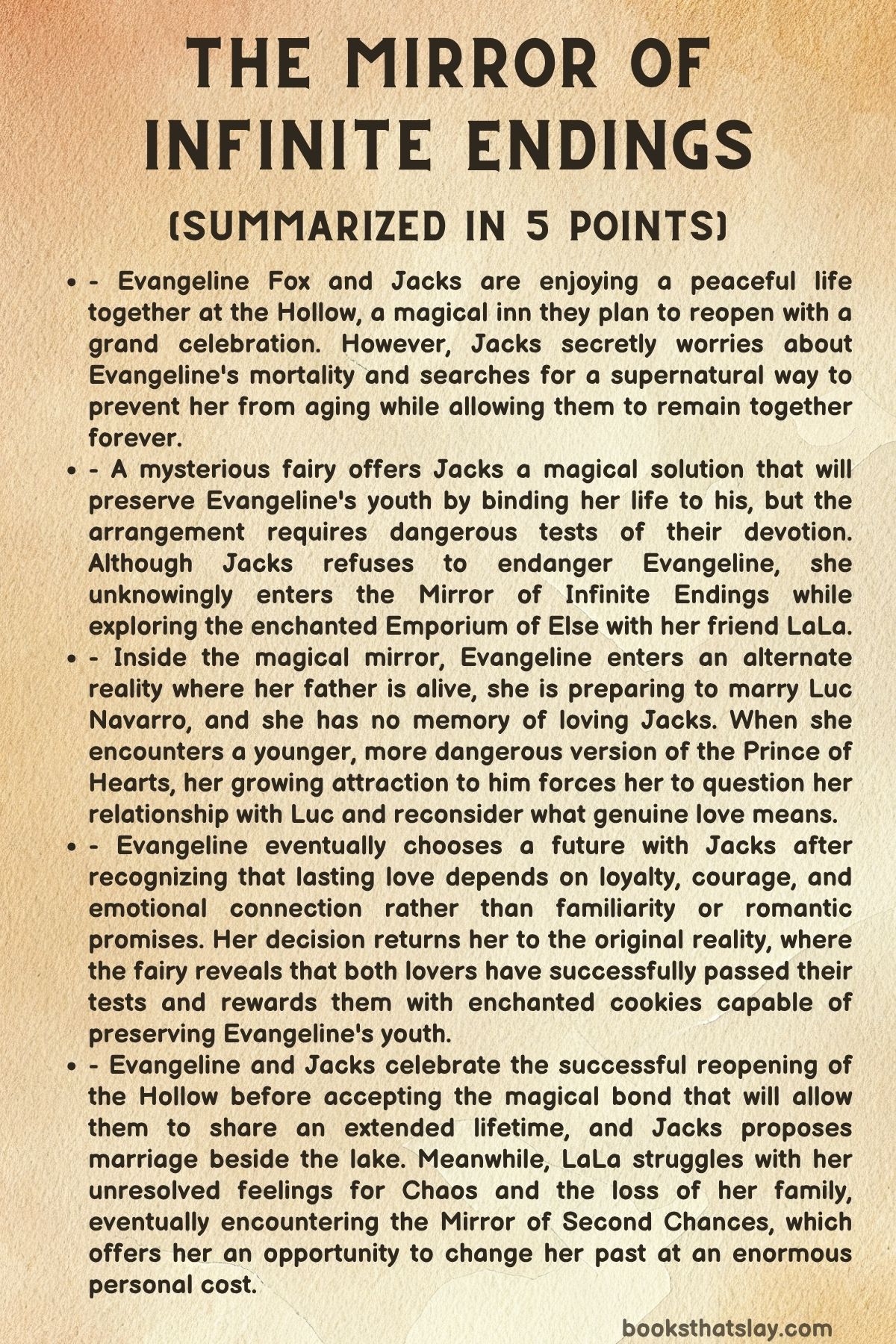
The story begins with an ancient legend from the Magnificent North, where fairies once lived alongside humans and supernatural forces shaped everyday existence. According to the legend, a fairy queen who refused to abandon the mortal world became the wind, and changes in its direction continued to signal extraordinary events long after humanity forgot the existence of the fae.
Years later, Evangeline Fox is enjoying a peaceful life with Jacks, the immortal Fate known as the Prince of Hearts, at the Hollow, an enchanted inn surrounded by the beautiful landscape of the North. After surviving dangerous adventures and finally acknowledging their love, the couple has chosen to settle in the magical establishment that once belonged to Jacks’s family.
Evangeline has devoted herself to transforming the Hollow into a welcoming destination for travelers and villagers. She is preparing for its grand reopening and an elaborate celebration called Happy Hollowfest, complete with homemade pies, festive decorations, magical attractions, and activities inspired by her father’s old curiosity shop.
Although she is happy with Jacks, certain uncertainties remain beneath their comfortable routine. Jacks is immortal, while Evangeline will eventually grow old and die, and neither has found the courage to discuss what this difference might mean for their relationship.
Unknown to Evangeline, Jacks has already begun searching for a solution. He has secretly contacted an acquaintance named Poison, hoping to discover a magical means of preserving Evangeline’s youth without transforming her into something other than human.
A letter from Poison reveals that a powerful supernatural visitor may be able to help, but the possibility involves considerable danger. Jacks deliberately destroys the correspondence with the assistance of Bruce, one of the Hollow’s small dragons, concealing his intentions from Evangeline because he fears upsetting her.
Their peaceful morning is disrupted when an unnatural whirlwind enters the tavern, scattering debris and leaving mysterious red berries behind. Evangeline also discovers that her treasured innkeeping guide has temporarily transformed into a book describing the ancient Age of Fae, including warnings about magical bargains and the dangers of trusting fairies.
Jacks reacts anxiously to these developments, but he refuses to explain his behavior. His concern becomes understandable when the narrative reveals that the whirlwind brought a fairy who initially appeared as a young girl before transforming into an adult woman.
The fairy offers Jacks the opportunity to bind Evangeline’s life to his own, preventing her from aging while preserving her humanity. However, their lives would become inseparable, meaning that the death of either partner would also result in the death of the other.
Although Jacks accepts this condition, he refuses to proceed when the fairy explains that obtaining the magic will require dangerous supernatural tests that Evangeline might not survive. His rejection appears to end the bargain, but the fairy has already prepared another means of drawing Evangeline into the ordeal.
Meanwhile, Evangeline welcomes her friend LaLa, the Fate known as the Unwed Bride, who has arrived to accompany her on a shopping expedition. Their conversation reveals LaLa’s growing uncertainty about Prince Dane, the man she spent centuries hoping to reclaim, and her complicated attraction to his vampire brother, Chaos.
During their preparations, the women discover an advertisement for the Emporium of Else, a mysterious establishment hidden in Merrywood Forest. Intrigued by its beautiful illustrations and promises of magical wonders, they decide to visit the shop without informing Jacks.
The Emporium proves even more extraordinary than expected, containing enchanted objects, confusing corridors, and magical creatures. After a small dragon steals her coin purse, Evangeline follows it into an isolated room containing an enormous antique mirror surrounded by supernatural mist.
The object identifies itself as the Mirror of Infinite Endings and promises visitors the opportunity to experience a day in an alternate version of their lives. When it shows Evangeline wearing a beautiful wedding dress, she becomes curious about the possibilities she might have experienced had her life followed a different path.
Despite initially resisting the temptation, Evangeline eventually touches the mirror and enters another reality. The transition alters her memories, leaving her convinced that she is living in Valenda and preparing to marry Luc Navarro, her former sweetheart.
In this alternate existence, Evangeline’s beloved father, Maximilian Fox, is still alive, and the wedding is scheduled to take place during the Sun Festival. Everything seems almost impossibly perfect, except for a mysterious golden hourglass on Evangeline’s wrist and the unsettling presence of a handsome stranger with blue eyes who carries a white apple.
The stranger is Jacks, although this version belongs to an earlier and more dangerous period of his existence. Evangeline does not remember their original relationship, yet she feels an immediate attraction to him that disturbs her confidence in the wedding she is about to celebrate.
The ceremony descends into chaos when Jacks distributes an enchanted drink that leaves the guests motionless. Evangeline discovers that her jealous stepsister, Marisol, approached him hoping to punish her through a dangerous bargain involving his potentially deadly kiss.
Determined to save her father and the other guests, Evangeline follows Jacks through the crowded streets of Valenda. Their confrontations reveal their opposing beliefs about hope and love, with Jacks dismissing optimism as foolish while Evangeline insists that hope gives people the strength to continue through uncertainty.
Their journey leads to Jacks’s gambling establishment, where Evangeline discovers his identity as the Prince of Hearts. After encountering Mistress Luck, another Fate, she learns that the golden hourglass represents a mysterious deadline, although she still does not understand the consequences of allowing its sand to run out.
Desperate to save her loved ones, Evangeline challenges Jacks to a game of blackjack. She agrees to risk a kiss from him if she loses, but she insists that he release the wedding guests regardless of the outcome, demonstrating her willingness to sacrifice herself for people she loves.
Although Jacks initially defeats her, he discovers that Luc taught her the rules incorrectly and offers another chance rather than exploiting her ignorance. The unexpected fairness of his response causes Evangeline to reconsider whether the dangerous Fate is as cruel as his reputation suggests.
Their encounter is interrupted by Donatella, a woman from Jacks’s romantic past who arrives seeking his help. Evangeline impulsively claims to be his fiancée, provoking a confrontation that exposes Jacks’s complicated emotional history and intensifies the attraction developing between them.
Eventually, Jacks reveals that the wedding guests were only temporarily enchanted and have already recovered. He urges Evangeline to leave him, warning that remaining close to him will bring destruction, but his unusual tenderness and his affectionate use of the name Little Fox suggest that their connection is stronger than either understands.
Outside the alternate reality, the real Jacks has discovered Evangeline’s disappearance after losing the magical connection that normally allows him to sense her presence. He reaches the Emporium with LaLa and Chaos and is horrified to discover Evangeline trapped inside the mirror, unable to remember their life together.
The fairy prevents Jacks from entering the enchanted world and warns that breaking the mirror would make Evangeline’s return impossible. He must watch helplessly as another version of himself becomes close to the woman he loves, knowing that the alternate Jacks has not yet developed the capacity for love that their shared experiences eventually gave him.
Back in Valenda, Evangeline returns to her father’s house, where Luc apologizes for abandoning her during the wedding crisis. Although the celebration can still proceed, she realizes that her feelings have changed and that her attachment to Luc lacks the certainty she once believed it possessed.
Her father encourages her to seek a North Star love, an enduring relationship capable of guiding her through fear, uncertainty, and hardship. His words help Evangeline recognize that genuine devotion must be demonstrated through choices and actions rather than romantic promises alone.
As the hourglass approaches its final moments, Evangeline discovers that the mirror now displays another reality in which she and Jacks are unmistakably in love. Trusting her feelings, she chooses that future instead of marrying Luc, unknowingly selecting the path back to her original life.
Evangeline emerges from the mirror into Jacks’s arms, and her memories gradually return. The fairy then reveals that both lovers have passed the supernatural tests: Jacks demonstrated his devotion by refusing to expose Evangeline to danger, while Evangeline proved the strength of their connection by falling in love with him again and choosing their shared reality.
The fairy presents them with two enchanted cookies shaped like the halves of a broken heart. These contain the magic needed to preserve Evangeline’s youth and bind her life to Jacks’s, finally offering a possible resolution to the fear they have both been carrying.
On their journey home, Jacks confesses everything about Poison, the fairy, and his secret attempts to overcome Evangeline’s mortality. Evangeline admits that she has worried about the same future, and their conversation strengthens their relationship by replacing secrecy with mutual understanding.
When they reach the Hollow, Evangeline discovers that Jacks has completed the festival preparations and arranged several surprises, including changes to the enchanted clock that celebrate her new identity as the inn’s owner. The following morning, the grand reopening becomes a tremendous success, attracting visitors from Merrywood Village, Valenda, and beyond.
Evangeline also learns that Jacks contacted the journalist Kutlass Knightlinger to help publicize the celebration. Their happiness is accompanied by another curious discovery: a Luckless Coin from the alternate Jacks has traveled back with her, suggesting that even the version of him she left behind might eventually seek her out.
That evening, Jacks leads Evangeline to a private picnic beside the lake, where they discuss the countless possible endings their lives might have followed. He reminds her that their love is meaningful not simply because fate brought them together, but because they repeatedly chose one another despite the difficulties they encountered.
Evangeline eats her enchanted cookie, accepting the promise of a future connected to Jacks’s life. He then reveals that he wants to marry her, assuring her that she can decide how and when the wedding takes place, and their story reaches a joyful resolution filled with possibilities.
However, the epilogue introduces a different uncertainty through LaLa, who remains troubled by the destruction of Merrywood and the loss of her family. Her renewed attraction to Chaos complicates her feelings about Dane, while memories of her childhood make the possibility of recovering her lost world increasingly difficult to resist.
At the celebration, LaLa encounters a mysterious young man who introduces her to the Mirror of Second Chances. Unlike the Mirror of Infinite Endings, this enchanted object can return someone to an earlier moment in their actual life, but doing so requires permanently surrendering their current existence and the memories acquired since that moment.
LaLa recognizes the terrible risks, yet the opportunity to save her family, restore Merrywood, and perhaps prevent Castor Valor’s transformation proves almost impossible to reject. The novel ends with her touching the enchanted glass, leaving her ultimate decision and its consequences unresolved.
Characters
Evangeline Fox
Evangeline Fox is the central protagonist of The Mirror of Infinite Endings, representing hope, compassion, emotional courage, and the belief that love can overcome circumstances that initially seem impossible. Having endured betrayal, heartbreak, and dangerous magical encounters, she has finally established a peaceful relationship with Jacks and begun creating a home that reflects her generous personality.
Her determination to reopen the Hollow illustrates her desire to develop an identity independent of her former royal associations. Rather than allowing her experiences with Prince Apollo to define her, she wants to become a respected innkeeper whose creativity and hospitality bring happiness to others.
Evangeline’s greatest challenge emerges when the magical mirror transports her into an alternate reality where she is preparing to marry Luc Navarro. Without memories of her relationship with Jacks, she must evaluate her feelings independently and determine what genuine devotion means to her.
Her willingness to risk a deadly kiss to save her family demonstrates her courage and selflessness, while her growing attraction to the alternate Jacks reveals the strength of their emotional connection. Even without remembering their shared history, she recognizes something meaningful in him.
Her father’s advice about North Star love eventually helps her understand that lasting relationships depend on loyalty, trust, and the willingness to remain together through uncertainty. By choosing the reality where she loves Jacks, Evangeline demonstrates that her feelings arise from genuine compatibility rather than supernatural manipulation.
Her decision to accept the enchanted cookie also reflects considerable personal growth. She no longer allows fear of an uncertain future to prevent her from embracing happiness, and she willingly accepts the responsibilities of sharing her life with an immortal partner.
Jacks, the Prince of Hearts
Jacks is the immortal Fate whose dangerous reputation conceals a deeply vulnerable individual shaped by loss, disappointment, and centuries of emotional isolation. His development in The Mirror of Infinite Endings centers on learning that genuine love requires trust, honesty, and respect for another person’s freedom to choose.
At the Hollow, Jacks appears dramatically different from the calculating figure associated with his earlier adventures. He enjoys ordinary moments with Evangeline, supports her plans for the inn, and finds satisfaction in helping her create the comfortable life she has always wanted.
Nevertheless, his happiness intensifies his fear of eventually losing her. Because he cannot imagine enduring immortality without Evangeline, he secretly seeks a supernatural solution to her mortality, believing that protecting their future justifies withholding important information from her.
His decision to reject the fairy’s dangerous tests demonstrates the depth of his transformation. Although he desperately wants Evangeline to live forever, he refuses to obtain that possibility at the cost of exposing her to unnecessary danger.
The appearance of his alternate self provides another perspective on his character. Watching a younger version of himself interact with Evangeline forces him to confront the person he once was, particularly his inability to recognize or express genuine affection.
Jacks’s eventual confession about the fairy represents an important step toward emotional openness. His proposal of marriage completes this development, showing that he has moved beyond viewing love as an inevitable source of suffering and has begun imagining a future built on shared decisions.
LaLa, the Unwed Bride
LaLa is one of the most emotionally complicated characters in The Mirror of Infinite Endings, serving as both Evangeline’s loyal friend and a woman struggling with centuries of unresolved grief. Although she possesses supernatural abilities as the Fate known as the Unwed Bride, her greatest difficulties arise from ordinary human experiences of loss, longing, and uncertainty.
Her friendship with Evangeline reveals her affectionate, energetic, and occasionally mischievous personality. She encourages Evangeline to enjoy life, accompanies her on adventures, and provides emotional support during situations involving dangerous magic.
However, LaLa’s cheerful appearance conceals profound sadness about the destruction of Merrywood and the deaths of people she loved. She remembers a childhood surrounded by family, celebration, and familiarity, making her present existence feel incomplete.
Her feelings for Prince Dane have also changed significantly. Although she spent centuries imagining their reunion, she realizes that recovering someone from the past does not necessarily restore the emotions that once existed.
Her attraction to Chaos creates further conflict because she recognizes the danger associated with his vampiric nature. She is drawn toward him despite knowing that their relationship might expose them both to emotional and physical suffering.
LaLa’s encounter with the Mirror of Second Chances brings her unresolved desires into focus. Her willingness to consider abandoning her current life demonstrates how powerfully grief can influence decisions, especially when supernatural forces offer the possibility of reversing irreversible losses.
Chaos, or Castor Valor
Chaos, formerly known as Castor Valor, is a tragic figure whose existence reflects the destructive consequences of supernatural transformation. Within The Mirror of Infinite Endings, he represents the tension between the person someone remembers being and the dangerous identity that circumstances have forced upon them.
His vampirism has altered his instincts and separated him from the humanity he once possessed. Although he retains memories of his earlier life, these memories cannot fully protect him from the violent hunger and emotional instability associated with his condition.
His relationship with Jacks demonstrates that he remains capable of friendship and loyalty. The two immortals understand forms of suffering that ordinary humans cannot easily comprehend, allowing them to communicate with unusual familiarity.
Chaos’s feelings for LaLa introduce a particularly painful conflict. He is jealous of Dane’s intention to marry her but remains constrained by an earlier vow that prevents him from revealing important information.
His encounters with LaLa show that his feelings are genuine, even when his instincts threaten to overwhelm his self-control. His decision to withdraw from an intimate moment reflects both his fear of hurting her and his inability to reconcile his desires with his dangerous nature.
The possibility that LaLa might use the Mirror of Second Chances to prevent his transformation adds another dimension to his character. His suffering becomes part of a larger question about whether changing the past can truly restore a person to the life they were meant to experience.
Prince Dane Vale
Prince Dane is an important figure in LaLa’s emotional history and a representative of the ancient Valor family, which has returned to power under the name Vale. His presence is particularly significant because LaLa once regarded their relationship as the foundation of her hopes for the future.
For centuries, LaLa believed that reuniting with Dane would restore the happiness she lost when Merrywood was destroyed. However, his return reveals that emotional connections cannot always survive the passage of time unchanged.
Dane’s intention to propose marriage demonstrates that he still sees a possible future with LaLa. Nevertheless, her uncertainty suggests that the relationship has become more complicated than the romantic ideal she preserved in her memories.
His position as Chaos’s brother also places him at the center of an unresolved emotional conflict. The rivalry between the brothers becomes increasingly significant because both are connected to LaLa’s past and present feelings.
Although Dane does not dominate the main narrative, he represents the difficulty of distinguishing remembered love from present affection. His role encourages readers to question whether loyalty to a former relationship should outweigh the reality of changing emotions.
Luc Navarro
Luc Navarro represents Evangeline’s former understanding of romantic happiness and the possibility of a life that might have unfolded differently. In the original reality, his tragic transformation into a vampire remains part of Evangeline’s painful past, while the alternate world presents him as the young man she is preparing to marry.
Initially, Luc appears affectionate and familiar, offering the security of a relationship rooted in Evangeline’s earlier experiences. Their wedding seems to promise the uncomplicated happiness she once imagined before her life became entangled with powerful supernatural beings.
However, his behavior during the magical disruption exposes weaknesses in their relationship. When Jacks enchants the wedding guests, Luc chooses to leave rather than remain beside Evangeline as she attempts to save her father and the others.
Although he later regrets this decision and apologizes, his initial response creates doubts that Evangeline cannot easily dismiss. His actions reveal a difference between the affection he expresses and the dependable companionship she increasingly desires.
Luc is not presented simply as an unsuitable or malicious person. Instead, he illustrates how youthful attachment and genuine compatibility can differ, particularly when difficult circumstances reveal contrasting expectations of love.
Marisol
Marisol is Evangeline’s stepsister, whose jealousy and resentment influence the disastrous events surrounding the alternate wedding. Her decision to approach Jacks for assistance reflects the destructive consequences of allowing personal grievances to determine one’s actions.
She seeks revenge against Evangeline through a magical bargain involving the Prince of Hearts and his dangerous kiss. Although she wants to cause suffering, she does not anticipate the full consequences of involving a powerful Fate in her plans.
When the wedding guests become motionless, Marisol is forced to confront the frightening results of her actions. Her alarm suggests that her resentment did not extend to a deliberate wish for widespread destruction.
Marisol’s role also reflects how jealousy can distort family relationships. Rather than addressing her grievances directly, she attempts to manipulate Evangeline’s happiness through supernatural intervention.
Her involvement reinforces the dangers of magical bargains, particularly when individuals underestimate the intentions and capabilities of the beings with whom they negotiate.
Maximilian Fox
Maximilian Fox, Evangeline’s father, is a powerful emotional presence despite appearing primarily within the alternate reality created by the mirror. His return gives Evangeline an opportunity to experience the love and security associated with her childhood.
As the former owner of a curiosity shop, Maximilian helped shape Evangeline’s fascination with extraordinary objects, romantic possibilities, and magical stories. His influence remains visible in her determination to create a welcoming environment at the Hollow.
During the alternate wedding, he offers his daughter thoughtful advice about the nature of lasting love. Rather than pressuring her to marry Luc, he emphasizes that she deserves a relationship capable of remaining dependable through uncertainty.
His description of North Star love becomes crucial to Evangeline’s decision about her future. He encourages her to recognize that romantic fulfillment requires more than excitement, familiarity, or the promise of a perfect celebration.
Maximilian’s significance lies in his unconditional support. Even in a reality that Evangeline ultimately leaves behind, his wisdom helps her make the choice that allows her to return to the life she truly wants.
Donatella
Donatella is a woman connected to Jacks’s romantic history whose appearance in the alternate reality exposes unresolved pain and complicated emotional attachments. She enters his gambling establishment in obvious distress, seeking assistance despite claiming to despise him.
Her insistence that she is engaged to Jacks creates an immediate confrontation with Evangeline, who impulsively makes the same claim. The encounter reveals how quickly Evangeline has developed feelings for the dangerous Fate.
Donatella’s anger and humiliation become especially apparent when Jacks dismisses the authenticity of their former relationship. His response suggests that their connection has been damaged by experiences neither can easily overcome.
Although she appears briefly, Donatella serves an important narrative purpose by revealing the emotional consequences of Jacks’s earlier relationships. She also demonstrates the difference between the alternate Jacks’s troubled romantic history and the genuine devotion he eventually develops for Evangeline in the original reality.
The Mysterious Fairy
The fairy is the supernatural figure responsible for the central magical ordeal in The Mirror of Infinite Endings. Her arrival at the Hollow introduces ancient fae magic into Evangeline and Jacks’s peaceful existence, transforming their private fears about mortality into a dangerous test of love.
She initially appears as a young girl before revealing her adult form, demonstrating the deceptive possibilities associated with her supernatural nature. Her knowledge of magical bargains enables her to offer Jacks an extraordinary solution to Evangeline’s aging.
However, her assistance is not unconditional. She insists that the lovers must complete dangerous tests and proceeds with the arrangement even after Jacks rejects the possibility of endangering Evangeline.
This behavior makes her morally ambiguous. Although her intervention eventually provides the couple with the future they desire, she manipulates circumstances and places Evangeline in a situation that could have resulted in permanent separation.
Her final revelation explains that the tests were designed to establish the strength of the couple’s devotion. She functions as both a threatening supernatural force and a catalyst for the emotional discoveries that allow Jacks and Evangeline to move forward together.
Poison
Poison is a mysterious acquaintance of Jacks whose assistance initiates the search for a magical solution to Evangeline’s mortality. Although he remains largely outside the direct action, his influence is essential because he connects Jacks with the fairy capable of offering the supernatural bargain.
His letter contains information about the proposed solution and the dangers surrounding it. The correspondence becomes a symbol of Jacks’s secrecy, especially when he deliberately destroys it to prevent Evangeline from discovering his plans.
Poison’s involvement demonstrates the extensive supernatural connections available to Jacks. It also suggests that even powerful immortals sometimes require assistance from beings whose abilities exceed their own.
His role is primarily that of an intermediary, but his contribution establishes the circumstances that lead to Evangeline’s encounter with the magical mirror.
The Mysterious Young Man at the Emporium
The unnamed young man associated with the Emporium of Else is an enigmatic figure whose appearances connect the novel’s two magical mirrors. Evangeline initially notices a handsome stranger with pointed ears at the establishment, raising the possibility that he belongs to the ancient fae.
His apparent familiarity with LaLa suggests that he possesses knowledge about her history that remains unexplained. His involvement with the Emporium’s magical objects also establishes him as someone who understands supernatural possibilities unavailable to ordinary visitors.
His most significant appearance occurs during the epilogue, when he introduces LaLa to the Mirror of Second Chances. He explains that the mirror can alter the course of a person’s actual life by allowing a return to an earlier moment.
However, he also reveals the terrible cost of using it. His calm presentation of this dangerous possibility makes him an unsettling figure, particularly because he offers LaLa the means to pursue a desire shaped by centuries of grief.
Bruce
Bruce is one of the small dragons living at the Hollow and provides warmth, humor, and companionship throughout the novel. His mischievous behavior contributes to the inn’s unusual domestic atmosphere, emphasizing that magical creatures have become part of Evangeline and Jacks’s everyday lives.
He is involved in the apparent destruction of Poison’s letter, although Jacks deliberately uses his dragon fire to conceal the correspondence. Bruce consequently becomes an unwitting participant in the secrecy surrounding the fairy’s arrival.
His attachment to Evangeline is also evident when he secretly follows her to the Emporium of Else. Although the establishment refuses to admit outside dragons, his determination to remain near her demonstrates his loyalty.
Bruce represents the affectionate and playful side of the Hollow, providing a contrast to the dangerous supernatural forces that threaten its peaceful existence.
Mistress Luck
Mistress Luck is a Fate whom Evangeline encounters inside the alternate Jacks’s gambling establishment. Her appearance introduces an additional supernatural perspective on the relationship between destiny, chance, and genuine love.
She recognizes that Evangeline possesses extraordinary good fortune because she has experienced a meaningful romantic connection. Her remarks suggest that love is a form of wealth more valuable than the riches and opportunities pursued by the gambling establishment’s patrons.
Mistress Luck also warns Evangeline about the golden hourglass on her wrist. Although she does not reveal everything about its significance, her warning emphasizes that Evangeline must act before her opportunity disappears.
Her brief role reinforces the urgency of Evangeline’s decision and highlights the difference between temporary luck and the lasting value of a relationship founded on mutual devotion.
Kutlass Knightlinger
Kutlass Knightlinger is the journalist responsible for publishing favorable coverage of the Hollow’s grand reopening. His involvement helps transform Evangeline’s carefully planned celebration into an event that attracts visitors from beyond the surrounding village.
Evangeline discovers that Jacks personally contacted Kutlass, revealing another example of his determination to support her ambitions. The publicity contributes to the festival’s success without diminishing the significance of her own preparations.
Kutlass represents the practical social world surrounding the novel’s supernatural events. Through his newspaper, information about the Hollow reaches ordinary people who might otherwise remain unaware of the establishment.
His presence also demonstrates how Jacks has learned to express affection through thoughtful actions rather than relying exclusively on dramatic supernatural gestures.
Prince Apollo
Prince Apollo is part of Evangeline’s troubled romantic history, and his earlier marriage to her continues to influence how she views relationships and public attention. Although he does not play an active role in the central events, the consequences of their association remain important.
Evangeline hopes that reopening the Hollow will allow her to escape the royal scandals attached to her name. Her desire to be recognized as an innkeeper rather than through her former marriage reflects her effort to reclaim control over her identity.
Apollo’s significance also becomes apparent when Evangeline considers marriage to Jacks. Her disastrous earlier experience makes the prospect of another wedding emotionally complicated, even though her current relationship is fundamentally different.
He consequently represents a past that Evangeline has survived and is determined not to repeat. Her eventual acceptance of Jacks’s proposal demonstrates her growing confidence in distinguishing painful memories from the possibilities of a healthier future.
Lyric Merrywood
Lyric Merrywood is LaLa’s brother and an important figure in her memories of the family she lost. Although he does not appear as an active participant in the main events, his absence contributes significantly to the emotional conflict that shapes the epilogue.
LaLa remembers the happiness of growing up in Merrywood, surrounded by relatives and familiar celebrations. Lyric represents the personal relationships destroyed when the village was devastated.
His importance becomes clearer when LaLa encounters the Mirror of Second Chances. The possibility of returning to the past offers her an opportunity not merely to revisit happy memories but potentially to preserve the lives of people she still loves.
Lyric’s role demonstrates that LaLa’s desire to alter history extends beyond romantic dissatisfaction. Her longing arises from a broader sense of family loss, making her temptation to enter the mirror understandable despite its devastating potential consequences.
Themes
Love, Choice, and the Meaning of Destiny
Love becomes meaningful through the decisions people make when circumstances are uncertain, rather than through guarantees of a predetermined happy ending. The Mirror of Infinite Endings explores this idea by placing Evangeline in an alternate reality where she must rediscover her connection with Jacks without the memories that originally brought them together.
The magical mirror removes the influence of their shared experiences, creating a situation in which Evangeline initially believes that Luc Navarro is her ideal romantic partner. However, her growing attraction to Jacks reveals that emotional compatibility cannot always be explained by familiarity or social expectations.
Her experiences also demonstrate that love requires more than powerful feelings. Luc’s decision to abandon the disrupted wedding contrasts with Evangeline’s determination to protect her family, forcing her to reconsider whether their relationship offers the reliability she desires.
Jacks undergoes a related transformation when he refuses the fairy’s dangerous bargain. Instead of pursuing his own happiness regardless of the consequences, he places Evangeline’s safety above his desire to keep her beside him forever.
The concept of North Star love provides a useful expression of the novel’s understanding of commitment. Maximilian Fox encourages his daughter to seek someone whose devotion remains steady even when circumstances become difficult.
By the conclusion, Evangeline and Jacks recognize that their relationship matters because they have repeatedly chosen to support, protect, and return to one another. Their happiness is therefore presented as the result of deliberate commitment rather than an unavoidable command of destiny.
The existence of countless possible endings does not diminish their love. Instead, it makes the particular future they choose together more valuable, demonstrating that meaningful relationships are created through continuing acts of trust and devotion.
Mortality, Immortality, and the Fear of Loss
The difference between Evangeline’s mortality and Jacks’s immortality creates a powerful conflict beneath their otherwise happy existence. Although they have overcome earlier dangers, the possibility of Evangeline eventually growing old while Jacks remains unchanged threatens the future they hope to share.
Jacks experiences this uncertainty as an approaching tragedy. His fear is intensified by the knowledge that immortality could force him to endure centuries without the woman who has restored happiness to his life.
His decision to contact Poison reflects both devotion and desperation. He wants to protect Evangeline from death, but his secrecy demonstrates how fear can encourage people to make decisions without considering the wishes of those they love.
The fairy’s offer appears to solve their problem, yet its conditions expose the limitations of supernatural power. Preserving Evangeline’s youth requires binding their lives together so completely that neither can survive the other’s death.
This arrangement transforms immortality from an individual privilege into a shared responsibility. Rather than promising absolute protection from loss, it requires both lovers to accept the possibility that their lives may end together.
Evangeline’s willingness to accept the enchanted cookie demonstrates her understanding that no relationship can eliminate uncertainty entirely. She recognizes that an extended lifetime with Jacks is valuable because of what they can experience together, not simply because it promises more years.
The novel ultimately distinguishes between fearing death and allowing that fear to control one’s existence. Jacks and Evangeline achieve greater peace when they openly discuss their concerns and agree on a future that respects both their desires.
Their decision suggests that love does not require freedom from every danger. It requires the courage to face an uncertain future together, recognizing that the quality of shared experiences matters as much as their duration.
Alternate Realities, Identity, and the Power of Memory
The Mirror of Infinite Endings creates a world where familiar circumstances have developed differently, forcing Evangeline to confront questions about identity and the experiences that shape human relationships. By removing her memories of Jacks, the mirror demonstrates how completely personal history influences an individual’s understanding of happiness.
In the alternate reality, Evangeline believes that marrying Luc will fulfill her romantic aspirations. Her father is alive, her childhood home remains familiar, and the circumstances surrounding her wedding appear to offer everything she once wanted.
However, the apparent perfection of this existence gradually becomes questionable. Her attraction to Jacks and her growing dissatisfaction with Luc reveal desires that do not entirely depend on the memories she has lost.
The alternate Jacks provides an equally revealing contrast. Although he shares the identity and supernatural abilities of the man Evangeline loves, he belongs to an earlier emotional stage and has not yet undergone the experiences that transformed him.
This distinction emphasizes that identity develops through choices, relationships, and personal change. The man Jacks becomes is not identical to the dangerous Fate he once was, even though both versions possess recognizable qualities.
The magical hourglass introduces another dimension by reminding Evangeline that opportunities for decision-making are limited. She cannot remain indefinitely between possible futures, and choosing one existence means relinquishing another.
Her ultimate return to the original reality demonstrates the relationship between memory and personal freedom. Although she initially chooses Jacks without remembering their history, recovering those memories allows her to understand the full significance of her decision.
The mysterious Luckless Coin that accompanies her home further complicates the boundaries between realities. It suggests that alternative lives are not necessarily meaningless illusions, and that different versions of the same individuals may continue pursuing their own possibilities.
Through these elements, the story suggests that identity is neither completely predetermined nor entirely independent of experience. People become who they are through the interaction of personal characteristics, remembered relationships, and the choices they make when confronted with uncertainty.
Regret, Second Chances, and the Difficulty of Letting Go
Regret shapes the decisions of several characters, particularly those whose supernatural existence has allowed them to carry painful memories across centuries. In The Mirror of Infinite Endings, the possibility of changing an earlier decision becomes both an extraordinary opportunity and a potentially destructive temptation.
LaLa embodies this conflict through her longing for the life she lost when Merrywood was destroyed. The deaths of her family members and the disappearance of her childhood world remain emotionally immediate despite the enormous passage of time.
Her reunion with Prince Dane initially seems capable of restoring some of that happiness. However, she discovers that recovering a person from the past does not necessarily recreate the feelings, circumstances, or identity associated with their former relationship.
Her attraction to Chaos further complicates her understanding of what she wants. She recognizes the danger he represents, yet she also remembers the person he was before his transformation and wonders whether another life might have allowed them a different future.
The Mirror of Second Chances transforms these regrets into a concrete possibility. It offers LaLa the opportunity to return to an earlier moment and potentially prevent the tragedies that shaped her existence.
However, the requirement that she abandon her current life and lose its memories introduces a devastating contradiction. Without remembering the mistakes she wishes to correct, she cannot be certain that her second attempt will produce a happier outcome.
The theme also appears in Evangeline’s alternate experience, although her response differs. She briefly encounters a life containing the father she has lost, yet she ultimately chooses to return to the future she has created with Jacks.
This contrast highlights two different responses to grief. Evangeline accepts that happiness in the present may require releasing an impossible past, while LaLa remains tempted to sacrifice everything she currently possesses for a chance to recover what was taken from her.
The unresolved ending refuses to offer an easy answer about whether changing history is wise. Instead, it emphasizes the difficult relationship between memory, loss, and hope, showing how the desire for a second chance can express both extraordinary love and an inability to accept irreversible change.