The Monsters We Make Summary, Characters and Themes
The Monsters We Make: Murder, Obsession, and the Rise of Criminal Profiling by Rachel Corbett is a thought-provoking exploration of how society constructs, studies, and perpetuates the idea of evil. Blending memoir, history, and investigative journalism, the book traces the evolution of criminal profiling and psychological experimentation through true stories—from intimate personal memories of violence to infamous cases like Ted Bundy and Ted Kaczynski.
Corbett examines how both science and storytelling attempt to rationalize human cruelty, revealing the thin boundary between understanding monsters and creating them. Through meticulous research and haunting reflection, she exposes the unsettling ways institutions, technology, and even empathy can turn into instruments of control.
Summary
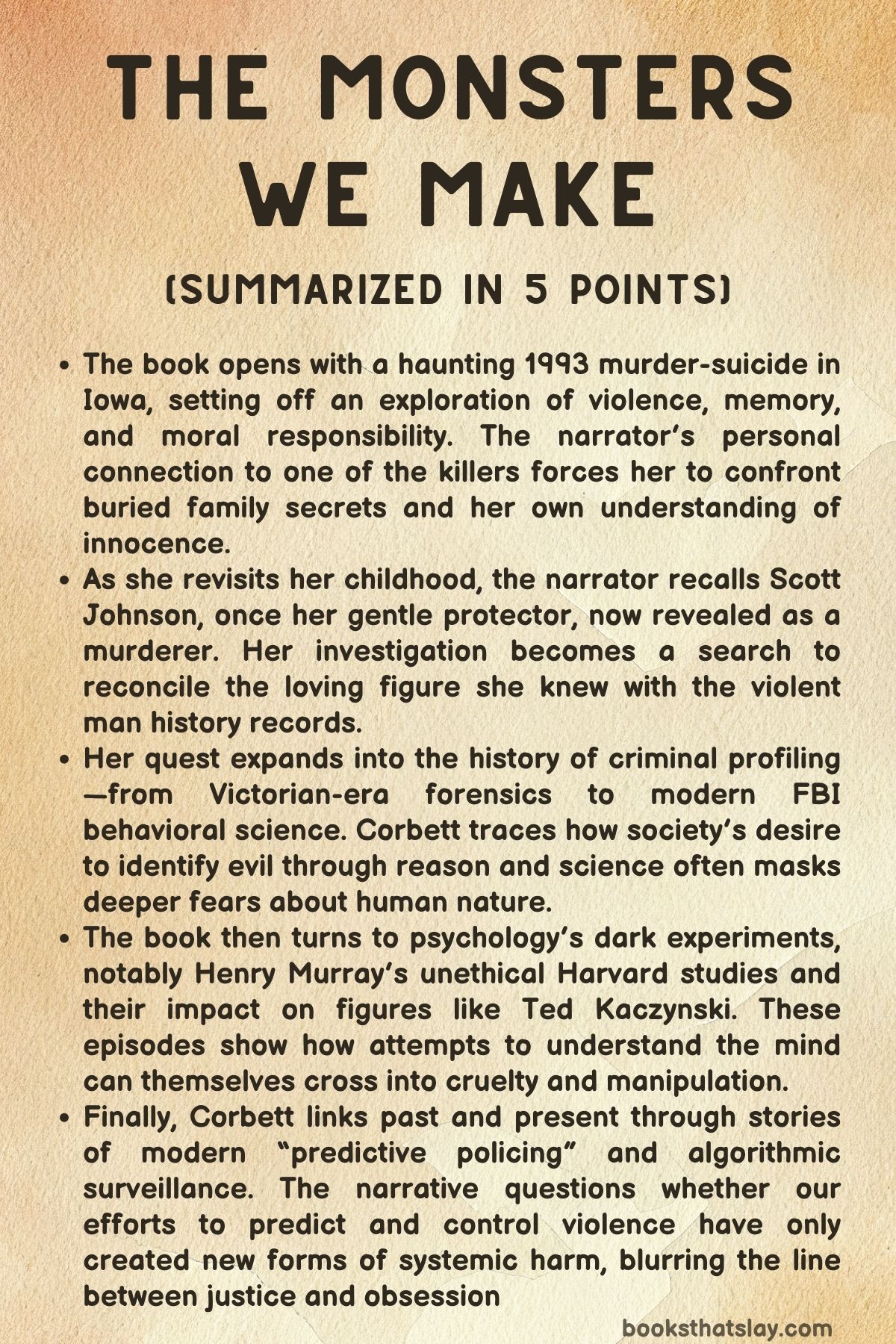
In The Monsters We Make, Rachel Corbett begins with a horrifying discovery in 1993 Vinton, Iowa, where police respond to a young boy’s desperate honking outside his home. Inside, they find his mother, Crystal Hawkins, dead from a gunshot wound, alongside her slain Doberman and her ex-boyfriend, Scott Johnson, who has taken his own life.
Declared a murder-suicide, the scene becomes another tragedy soon forgotten—except by the book’s narrator, who once knew Scott.
As a child, the narrator remembers Scott as her mother’s boyfriend—a quiet, kind welder who entered their lives after helping her mother retrieve a stolen bicycle. Her mother had recently separated from a violent husband, and Scott became both protector and caregiver.
When her father returned one night in a drunken rage, Scott nearly died defending them. After her father’s imprisonment, Scott stayed for years before drifting away.
Decades later, when the narrator stumbles upon his name in a newspaper archive connected to Crystal Hawkins’s murder, she realizes her family had concealed the full truth from her.
Haunted by the revelation, she begins piecing together Scott’s final days. The night before the murder-suicide, he had visited her family, bringing sentimental gifts: peacock feathers for her mother and his old Sega console for the children.
He told them he didn’t want to be alone and slept on their couch. The next morning, her mother noticed his dog locked in his car—a small but ominous sign.
Hours later, he would end two lives, including his own. As a child, the narrator only understood that Scott had shot himself.
As an adult, she confronts the unbearable complexity of loving someone capable of monstrous acts.
Her investigation leads her into the history and psychology of murder-suicide. Statistical patterns reveal that perpetrators are often men in emotional and financial crisis, acting out of control and despair.
Scott fit every element of the profile, yet the narrator cannot reconcile this analysis with her memories of him. Her search expands beyond the personal—into the origins of how societies have tried to understand evil.
She traces the roots of criminal profiling back to Victorian London, when forensic surgeon Thomas Bond created one of the first psychological sketches of a killer during the Jack the Ripper case in 1888. Around the same time, figures like Arthur Conan Doyle and “Our Society” of intellectuals were attempting to decode crime through emerging theories of psychology and logic.
Doyle’s Sherlock Holmes became the personification of rational investigation—a fictional model for real forensic ambition. However, the early science of profiling also birthed dangerous pseudosciences such as phrenology and physiognomy, which claimed that criminality could be read in physical features, reinforcing prejudices about class and race.
The idea that evil could be recognized by appearance persisted in cultural myths and literature, including tales like Dr. Jekyll and Mr. Hyde, reflecting the fear of hidden darkness within ordinary people.
Modern profiling evolved from these origins but never fully escaped their speculative nature. Corbett observes that profiling rarely solves crimes directly; instead, it serves as a psychological narrative that makes horror feel decipherable.
For her, studying Scott’s case becomes a form of self-protection—a way to manage fear by turning trauma into analysis. Through research and storytelling, she finds a method to impose order on chaos.
The book then shifts to explore the work of psychologist Henry Murray, whose influence shaped modern profiling and psychological warfare. After a career assessing leaders such as Adolf Hitler during World War II, Murray conducted notorious experiments at Harvard in the late 1950s and early 1960s.
Under the guise of studying stress, he subjected students to extreme psychological humiliation, forcing them to reveal personal beliefs only to be attacked with their own words. The goal was to test the limits of the human mind under pressure—methods later mirrored in CIA interrogation techniques.
Among Murray’s subjects was a reclusive mathematics prodigy named Ted Kaczynski, who would later become the Unabomber.
Corbett details how Murray’s disregard for ethics foreshadowed the dangers of scientific detachment. The experiments aimed to understand what creates “monsters” but instead helped create one.
Years later, Kaczynski would justify his violent anti-technology crusade through writings that echoed the trauma of his youth and his experience under Murray’s manipulation. His story underscores the book’s central theme: attempts to study or contain evil often reproduce it.
The narrative continues with psychiatrist Dorothy Lewis, who studied serial killers including Ted Bundy. In 1989, on the eve of Bundy’s execution, she sought not to exonerate him but to understand his psyche.
Lewis found patterns among violent offenders—neurological damage, psychosis, and histories of childhood abuse. Her work argued that violent crime stemmed less from moral corruption than from untreated trauma.
Her insights challenged the FBI’s Behavioral Science Unit, whose founders popularized profiling as a way to identify “types” of killers based on behavior. Bundy’s case, sensationalized by the media, helped establish profiling as both law enforcement tool and cultural mythology.
To the public, he became the archetype of evil disguised as charm; to Lewis, he was the product of deep psychological fracture.
Through these intersecting stories, Corbett examines how profiling transformed into both a science and an art form—part empirical, part narrative invention. While the FBI’s methods built public fascination with serial killers, they also reinforced the illusion that evil could be predicted, categorized, or prevented through data.
Lewis’s empathy toward offenders, by contrast, confronted society’s discomfort with compassion for the monstrous. Her career was shaped by her own brush with Henry Murray’s academic world, having narrowly escaped being one of his test subjects.
The book’s final section explores the modern extension of profiling into data-driven policing. In 2015 Florida, a man named Robert Jones and his son became targets of a predictive policing program that used algorithms to forecast criminal behavior.
Without warning, they were placed on secret watchlists, harassed by police, and repeatedly arrested without convictions. The system, designed to identify “at-risk” youth, functioned as institutionalized suspicion—an evolution of Murray’s and the FBI’s mindset, now powered by technology.
The program’s victims, stripped of agency, reflected the book’s thesis: when systems attempt to preempt evil, they risk manufacturing it.
By the end, Corbett connects the historical arc from Jack the Ripper to predictive policing, from Murray’s experiments to Kaczynski’s manifesto, revealing a continuum of human attempts to define, study, and control violence. Whether through criminology, psychology, or artificial intelligence, the quest to identify monsters often exposes our own need to separate ourselves from them.
The narrator’s personal reckoning with Scott Johnson’s crime becomes a mirror for this broader human impulse—to rationalize what frightens us, even when doing so blurs the boundary between understanding and creation.
In closing, The Monsters We Make suggests that the line between investigator and subject, profiler and killer, scientist and experiment, is far thinner than we wish to believe. The desire to comprehend darkness—to make sense of it through science, story, or surveillance—may itself be the most human, and the most dangerous, impulse of all.
Key People
Scott Johnson
Scott Johnson stands as the tragic center of The Monsters We Make, representing the unsettling intersection between tenderness and violence. Initially depicted through the narrator’s childhood memories, Scott appears as a kind and gentle man—protective, hardworking, and emotionally present.
His quiet melancholy and devotion to the narrator’s mother contrast sharply with the brutality of her abusive husband. For the young narrator, Scott embodies safety and compassion, a stabilizing force during a turbulent childhood.
Yet this perception collapses when, years later, she discovers that he murdered Crystal Hawkins and her dog before killing himself. Scott’s character becomes an enigma—how can a man capable of such affection commit an act of horror?
His story exposes the limitations of understanding evil through surface impressions and challenges the narrator’s—and society’s—belief in rational explanations for violence. Scott is both victim and perpetrator: shaped by emotional isolation, societal expectations of masculinity, and unaddressed despair.
In him, the book finds its first “monster”—not born evil but formed through pain and neglect.
Dorothy Lewis
Dorothy Lewis emerges as a foil to the narrator’s early understanding of crime. A psychiatrist who devoted her life to studying violent offenders, Lewis rejects the easy moral binaries that dominate public discourse.
To her, killers are not embodiments of evil but deeply damaged individuals—products of neurological injury, childhood trauma, and psychological fragmentation. Her empathy, often misinterpreted as naïveté, challenges the punitive systems that glorify retribution.
Lewis’s background—marked by her Jewish upbringing during the shadow of the Holocaust—imbues her work with moral urgency. She sees in the study of killers an attempt to prevent further atrocities rather than to excuse them.
Her path, however, is darkly intertwined with the legacy of Henry Murray, whose experiments she narrowly avoided. Through Lewis, the book contrasts scientific compassion with institutional cruelty, showing how empathy can itself be a form of resistance against dehumanization.
Henry Murray
Henry Murray represents the corrupted ideal of psychological inquiry. Once a celebrated academic, his wartime psychological profiling of Adolf Hitler and his later “stress experiments” at Harvard reveal an arrogance disguised as science.
Murray sought to understand human nature through control and manipulation, using humiliation as a tool to provoke breakdowns. His disregard for consent and emotional harm anticipates the moral blindness of modern institutions that prioritize knowledge over humanity.
The fact that one of his subjects, Ted Kaczynski, later became the Unabomber, transforms Murray from a pioneer into an unwitting creator of his own monster. In The Monsters We Make, he symbolizes the dangers of intellectual hubris—the belief that evil can be contained or understood through experimentation.
His work embodies the book’s warning: that the pursuit of understanding can itself become an act of violence when stripped of empathy.
Ted Kaczynski
Ted Kaczynski is portrayed as the culmination of the book’s exploration of the manufactured monster. A child prodigy turned domestic terrorist, his life traces the collapse of intellect into alienation.
The psychological damage inflicted during Murray’s experiments appears to have fractured his sense of identity, instilling paranoia and resentment. Yet Kaczynski’s self-image as a rational revolutionary contrasts sharply with the chaos of his crimes.
He represents both the failure of psychological science to heal and the success of its darker ambitions—to dissect, to dominate, to break. His manifesto against technological civilization reflects an eerie continuity with the trauma of his past: a rejection of systems of control even as he mirrors their logic.
In him, The Monsters We Make finds its most chilling insight—that monsters are not anomalies but extensions of the very institutions that claim to prevent them.
Robert and Bobby Jones
Robert Jones and his son Bobby bring The Monsters We Make into the present, showing how institutional profiling has evolved from psychological experiments to digital surveillance. Their persecution under Pasco County’s predictive policing program reveals a new kind of monster: systems that strip individuals of agency under the guise of public safety.
Robert’s futile attempts to protect his son echo the narrator’s own struggle for control over violence and fate. Bobby, meanwhile, becomes the latest victim of a cycle that criminalizes trauma before it even manifests.
Their story ties the book’s themes together—how science, law, and technology, when divorced from empathy, perpetuate the same cruelty they claim to prevent.
Crystal Hawkins
Though briefly depicted, Crystal Hawkins is the silent victim around whom the book’s central tragedy turns. Her death, initially reduced to a police statistic, becomes the catalyst for the narrator’s lifelong search for meaning.
Through her, The Monsters We Make exposes how victims of domestic violence are often erased by the narratives that prioritize understanding the perpetrator. Crystal’s forgotten presence, her unclaimed body, and her child’s silent removal from the scene symbolize society’s apathy toward women destroyed by male rage.
Her story lingers as the moral void at the heart of the book’s exploration of empathy and evil.
Themes
Violence and Its Inheritance
In The Monsters We Make, violence functions not only as an act but as a legacy that seeps across generations, relationships, and institutions. The story begins with the brutal murder-suicide of Crystal Hawkins and Scott Johnson, but the violence is never contained within that basement—it extends backward into the narrator’s childhood and forward into her adult reckoning.
Her mother’s abusive marriage, Scott’s earlier victimization at the hands of her father, and the systemic cruelty in the later stories all suggest that violence is cyclical and self-replicating. The narrator’s attempt to understand Scott’s final act becomes an exploration of how pain mutates when left unexamined.
Violence here is not sensationalized; it is domestic, familiar, and often unseen. It resides in gestures, silences, and institutions that normalize harm in the name of order.
The book situates this inheritance within a broader social pattern—linking personal brutality to cultural fascination with crime and punishment. Whether through FBI profiling, psychological experiments, or predictive policing, the story reveals how societies reproduce violence under the guise of understanding it.
The final account of Robert Jones and his son Bobby underscores this continuity: violence migrates from homes to data systems, from fists to algorithms, ensuring that even without visible blood, control and punishment persist. The monsters of the title are not aberrations but byproducts of this ongoing lineage of sanctioned harm.
The Search for Understanding Evil
Throughout the narrative, the desire to interpret evil becomes a driving force, shaping both individuals and institutions. From the narrator’s obsession with Scott Johnson’s motives to the historical evolution of criminal profiling, the book demonstrates humanity’s compulsion to categorize, explain, and contain malevolence.
This pursuit begins with early criminology’s attempt to read criminality from physical features, continues through Murray’s psychological experiments, and culminates in the FBI’s behavioral profiling of serial killers. Each method promises revelation yet often reflects the biases and fears of its era more than objective truth.
The narrator’s investigation mirrors this tension—her search for psychological explanations for Scott’s act serves both as inquiry and avoidance, protecting her from confronting the more immediate evil of her father’s abuse. Similarly, professionals like Dorothy Lewis and Henry Murray transform moral questions into scientific puzzles, trying to locate evil in trauma, neurology, or ideology.
Yet their efforts reveal the instability of such definitions; the line between inquiry and cruelty blurs when understanding becomes control. Evil, the book suggests, is less a pathology to diagnose than a mirror reflecting societal anxieties about freedom, responsibility, and empathy.
Science, Ethics, and the Dehumanization of Experimentation
A recurring strand in The Monsters We Make is the erosion of moral boundaries in the name of science and progress. Henry Murray’s Harvard experiments epitomize this theme, exposing how intellectual ambition can justify cruelty.
His “dyadic stress tests,” intended to study resilience, deliberately inflicted humiliation and trauma on students, stripping them of autonomy. The institutional complicity—Harvard’s silence, the CIA’s approval—demonstrates how easily ethical lines collapse when framed as research or national interest.
Ted Kaczynski’s transformation into the Unabomber emerges as a grotesque fulfillment of this logic: he becomes the unintended outcome of the system’s disregard for human vulnerability. The narrative contrasts Murray’s manipulative approach with Dorothy Lewis’s compassionate psychiatry, yet even her work faces ethical dilemmas about representing offenders’ suffering without excusing their crimes.
The book thus exposes the paradox of scientific detachment: the more researchers claim objectivity, the more their subjects become abstractions rather than people. Profiling, neurology, and data analytics all promise predictive clarity but often erase individual complexity.
In this sense, the dehumanization of experimentation becomes its own form of violence—cold, bureaucratic, and enduring.
The Myth of Rational Control
Across the interconnected narratives, the illusion of rational control repeatedly collapses. Whether through profiling serial killers, predicting criminal behavior with algorithms, or structuring experiments to manipulate human psychology, every attempt to impose order encounters chaos.
The narrator’s faith in research and documentation as tools to reclaim agency ultimately falters, revealing that knowledge does not heal the disorder it describes. The FBI’s Behavioral Science Unit constructs typologies that appear scientific but are often speculative; Murray’s testing regime assumes control over the psyche but unleashes unpredictable consequences.
Even modern predictive policing in Pasco County, with its reliance on data-driven forecasts, demonstrates how control becomes surveillance and how prevention becomes persecution. The system’s failure is not due to lack of intelligence but excess of faith in rationality—an insistence that human behavior can be measured, modeled, and managed.
The narrative dismantles this faith, showing that control is often a disguise for fear. By the end, the very institutions designed to protect society mirror the compulsions of the killers they study: both seek domination over uncertainty, and both are willing to sacrifice humanity to achieve it.
Trauma and the Fragmented Self
Trauma in The Monsters We Make operates as a shaping force that distorts identity and memory. The narrator’s recollections of Scott Johnson are fragmented, alternating between affection and horror, reflecting how trauma resists coherence.
Similarly, figures like Ted Bundy and Ted Kaczynski are portrayed not as singular villains but as fractured products of psychological wounding—abuse, isolation, and manipulation. Dorothy Lewis’s findings that violent offenders often share histories of brain damage and childhood trauma challenge the conventional divide between victim and perpetrator.
Yet the narrative also acknowledges the moral discomfort of this recognition: understanding trauma does not absolve harm, but it complicates judgment. The act of revisiting trauma—whether through investigation, psychiatry, or storytelling—becomes both a necessity and a danger.
Each attempt to narrate suffering risks re-enacting it, turning memory into obsession. For the narrator, the investigation into Scott’s crime becomes a means to process her own buried fear and grief, transforming the forensic into the personal.
Trauma, the book suggests, is less an event than an inheritance, shaping not only those who endure it but also those who attempt to interpret it.
Institutional Power and the Production of Monsters
The final sections of the book reveal how systems designed to identify or prevent deviance often end up creating it. From Murray’s laboratory to the FBI’s Behavioral Science Unit and finally to predictive policing programs, the mechanisms of surveillance and control evolve but retain the same logic: to define certain people as threats before they act.
In Pasco County’s algorithmic policing, this logic reaches its mechanized extreme—children are branded as potential offenders through data, stripped of innocence, and subjected to continuous punishment. The story of Robert and Bobby Jones exposes the continuity between psychological profiling and digital profiling, both relying on decontextualized metrics to justify intrusion.
Institutions, whether academic, governmental, or technological, manufacture “monsters” by enforcing narratives of danger and deviance. The book’s closing irony is that Bobby ends up in the same prison where Kaczynski dies, linking scientific and bureaucratic cruelty across decades.
The monsters we make, the title insists, are not born in isolation but cultivated by systems that confuse control with justice and curiosity with compassion. Through this recognition, the narrative invites readers to question not who the monsters are, but who creates them—and why society needs them to exist.