The Mountains We Call Home Summary, Characters and Themes
The Mountains We Call Home by Kim Michele Richardson is a historical novel about injustice, literacy, survival, and the right to belong. Set mainly in 1950s Kentucky, the story follows Cussy Mary Lovett after she and her husband Jackson are arrested for their interracial marriage.
Torn from home, separated from her child, and placed inside a brutal prison system, Cussy uses books as her only real tool of resistance. Her work as a librarian becomes a lifeline for neglected women, condemned prisoners, illiterate adults, and broken communities. The novel presents reading not as comfort alone, but as power, dignity, and a path back to freedom. It’s the 3rd book of the Book Woman of Troublesome Creek series, continuing Cussy Mary Lovett’s story in 1953 and beyond.
Summary
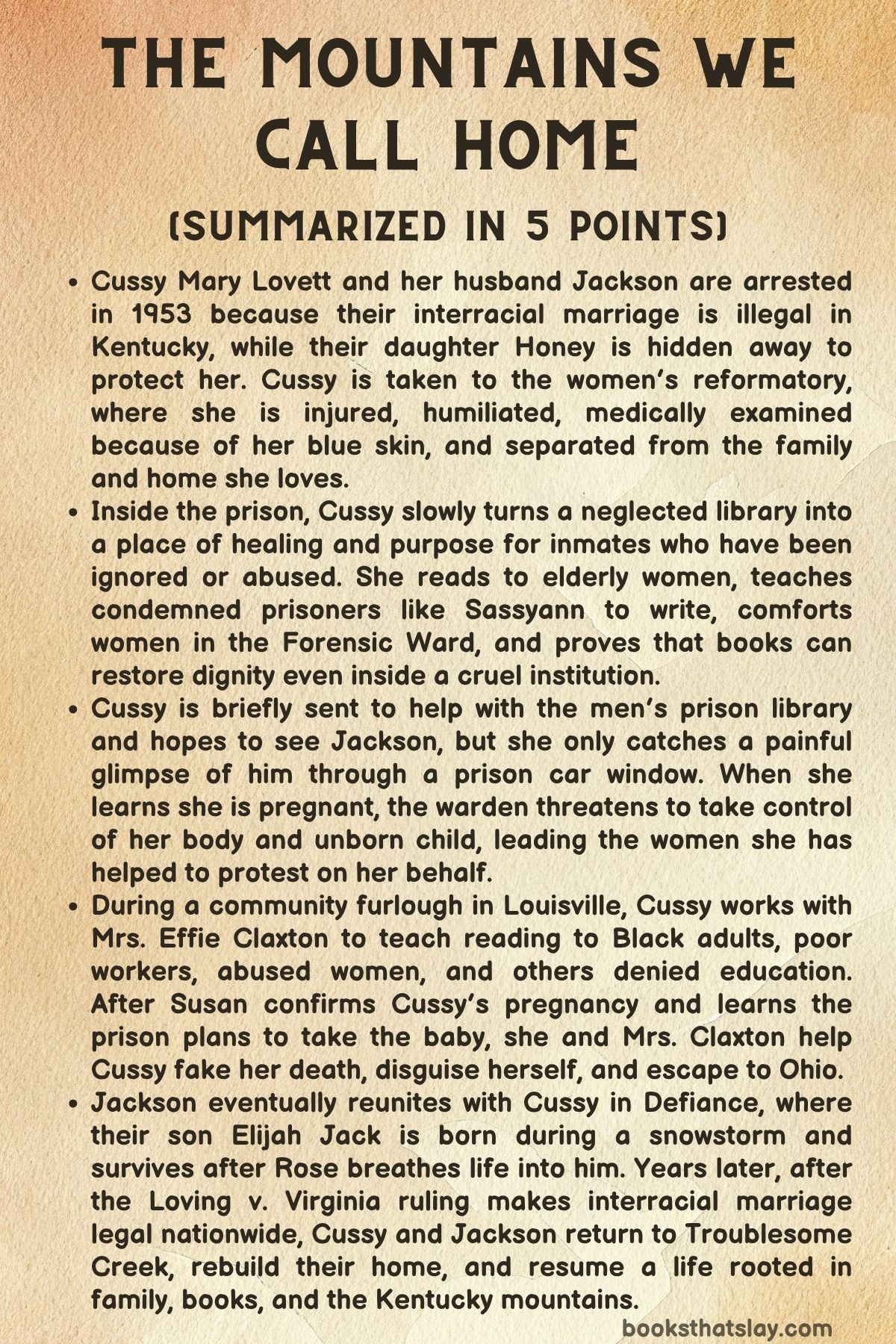
In 1953, Cussy Mary Lovett is living with her white husband, Jackson, and their daughter, Honey, in Troublesome Creek, Kentucky, when the law comes to destroy the life they have built. Their marriage is treated as a crime because Cussy is a blue-skinned woman from the Kentucky hills, marked by inherited methemoglobinemia and by racial prejudice.
Before the deputy reaches the house, Honey is hidden away for her own safety, but Cussy and Jackson are arrested. The arrest is violent and humiliating.
Cussy’s arm is broken, Jackson is beaten, and husband and wife are separated into nearby prisons, each left uncertain about the other’s condition.
Cussy is taken to the Kentucky State Reformatory for women, where she is first kept in the infirmary. Instead of being treated as a person in pain, she is stripped, examined, drugged, and studied as if her blue skin makes her a specimen rather than a woman.
The prison officials and medical staff look at her body with cold curiosity, and the experience reminds her that the world has always tried to reduce her to the color of her skin. When she is moved into the general prison population, she is assigned a cot beside Waldeen Parker, an older inmate who controls much of the kitchen work and understands how to survive inside prison walls.
Waldeen is rough, watchful, and practical, but she becomes one of Cussy’s earliest protectors. Cussy is sent to work in the kitchen and laundry, where her broken arm makes every task painful.
She is expected to do heavy labor despite her injury, and she is insulted when she cannot keep pace. The prison punishes weakness rather than helping it, and Cussy quickly learns that a mistake, even one caused by pain, can bring more cruelty.
Still, her habits from her old life remain. She notices waste, calculates food, manages supplies, and quietly proves that she is more capable than the guards and administrators expect.
Cussy asks Warden Sanders for the vacant prison librarian position, explaining that she once worked as a WPA Pack Horse librarian. At first, the warden dismisses her.
To Sanders, Cussy is only an inmate and an oddity, not someone worth trusting with responsibility. But Waldeen speaks up for her, pointing out Cussy’s arithmetic skills and the way she has improved kitchen management.
Cussy then describes her experience delivering books through the mountains, repairing and binding damaged volumes, gathering donated materials, and encouraging people to read. Sanders finally gives her the job, not because she values Cussy’s mission, but because the prison needs better literacy numbers to protect its funding.
The prison library Cussy inherits is neglected, underused, and nearly forgotten. She begins cleaning and organizing it, sending letters to request book donations and repairing what can be saved.
She receives help from Buttermilk Sullivan, a kind prisoner from the men’s prison who assists with the library work and brings her small pieces of comfort about Jackson. Through him, Cussy learns that her husband is alive, though still out of reach.
At first, the women do not come to the library. Many are suspicious, ashamed of not being able to read, too sick, or too beaten down by prison life to imagine that books could matter to them.
Instead of waiting, Cussy takes the books to them. She visits the Geriatric Ward and finds elderly women living in terrible neglect.
Some have bedsores, filthy bedding, and no sense that anyone still sees them as human. Marigold, one of the women, is suffering from wounds that have gone untreated, so Cussy cleans and tends them with honey.
She reads aloud, and slowly the women begin responding. The books offer them conversation, memory, and dignity.
They begin asking for more stories, and Cussy realizes that the library can reach the places in the prison that the officials have chosen to ignore.
Cussy then goes to Death Row, where she meets Sassyann Sipes, an older woman condemned for poisoning abusive husbands. Sassyann has lived a hard life, and although the law sees only her crimes, Cussy sees a woman shaped by violence, fear, and desperation.
Sassyann wants to learn enough letters to write to her sons before she dies. This request gives Cussy’s work a sharper urgency.
Reading and writing are not only education; for Sassyann, they are a last chance to leave behind words of love, apology, and proof that she existed beyond the prison’s judgment.
In the Forensic Ward, Cussy encounters women who are drugged, locked away, threatened with lobotomies, or treated as problems to be silenced. Among them are Emmeline and Odette, women whose suffering is controlled by medication and fear rather than care.
Cussy reads to them, and the change is gradual but visible. The women grow calmer.
The ward becomes easier to manage. Even Officer Holt, who has been cruel to Cussy, begins to understand that the library work is doing what punishment and force could not.
Books become a form of medicine that the prison never intended to provide.
As the library grows, its effects spread through the prison. Elderly women become strong enough to sew, attend classes, and take interest in life again.
Women from the Forensic Ward begin responding with less fear and confusion. Sassyann learns to form letters and move toward the message she wants to send her sons.
The guards, even those who dislike Cussy, begin to depend on her work because it keeps the wards calmer. The same institution that degraded her now needs her, and Cussy uses that narrow space of usefulness to keep serving the women around her.
Cussy is also sent to the men’s prison to help establish a library there. She hopes this will allow her to see Jackson, but each visit brings disappointment.
She teaches men to read and helps them write letters, including Daniel Presland, who secretly wants to send a love note to Arthur. Cussy protects the dignity of these prisoners by treating their words as important, even when the prison would rather erase their private hopes.
All the while, she searches each group for Jackson. He never appears during the library sessions, but one day, on the drive back to the women’s prison, she sees him through the window as he arrives with a work crew to paint the women’s library.
Their eyes meet only briefly through glass, and the moment is both a reunion and another kind of punishment.
Soon after, Cussy discovers she is pregnant. She had believed that the prison had already sterilized her, but Waldeen explains that the procedure had only been scheduled.
The news fills Cussy with fear as much as hope. She wants to tell Jackson and protect the child, but Regina, an inmate who envies Cussy’s position and resents the attention she receives, breaks into Cussy’s locker and finds the letter revealing the pregnancy.
Regina exposes her to Warden Sanders. Panicked, Cussy attacks Regina and is punished with isolation.
Warden Sanders responds with threats. She orders a physician to abort the baby and warns Cussy that women who resist can be “corrected” through harsher surgeries.
Cussy understands that the prison wants control not only over her labor and movement, but over her body and motherhood. Yet the women she has helped refuse to stay silent.
In Geriatrics, Forensics, and Death Row, prisoners begin a hunger strike to protest her punishment. Guards also demand the return of the Book Woman because without her, the wards become harder to control.
Sanders releases Cussy because the prison still needs her.
Regina, burdened by guilt and changed by her own growing love of books, asks Cussy for forgiveness. Cussy chooses Regina to help manage the prison library while she is sent on a community furlough to Louisville.
There, she stays with Reverend Claxton and his wife, Effie Claxton, a Black couple from eastern Kentucky. Their home gives Cussy a kind of warmth and respect she has rarely received from strangers.
Mrs. Claxton works at Louisville’s Western Library and runs a literacy program for Black adults who have been denied education, voting power, and social dignity.
Cussy joins Mrs. Claxton’s efforts. Alongside her, she canvasses neighborhoods and invites anyone who cannot read to attend free night classes.
They reach out to the poor, elderly people, abused wives, laborers, brothel workers, and others who have been shut out of learning. The first class is small, but the program grows.
Ministers spread the word, newspapers report on the work, and more people come to the library. Cussy teaches adults to trace letters, read family mail, sign their names, and move through the world with more confidence.
During this time, news arrives that Sassyann’s execution has gone terribly wrong. She survives the electric chair but is left ruined by the attempt to kill her.
The horror of it shakes Cussy deeply and reminds her that the prison’s cruelty has no real limit. As the date of her return approaches, she grows more desperate.
After an accident in the city, she is taken to a hospital where Susan, Mrs. Claxton’s nurse niece, confirms the pregnancy. Susan has studied Cussy’s condition with curiosity, but unlike the prison doctors, she treats Cussy as a person.
Cussy finally tells Susan and Mrs. Claxton the truth: the prison plans to take her baby, and she has no legal protection.
Susan and Mrs. Claxton decide to help her escape. Susan injects Cussy with methylene blue, temporarily changing the appearance of her skin so she can pass as white.
She also gives her forged papers under the name Angeline Moffit and falsifies medical records declaring Cussy dead. With a red wig, new clothes, and Mrs. Claxton at her side, Cussy walks past the hospital guard and leaves behind the identity the state is trying to imprison.
They drive toward Ohio using the Green Book for safety, though danger still follows them. A white man harasses them on the road, but they continue until they reach Defiance, where Mrs. Claxton’s sister Rose offers Cussy sanctuary.
Months later, Jackson reaches Cussy in Defiance. Honey remains in Kentucky, emancipated and connected to the world of books, while Cussy and Jackson live under false identities.
Their freedom is incomplete because they must hide, but they are together. In December, during a snowstorm, Rose delivers Cussy’s baby when no doctor can come.
The child, Elijah Jack Lovett, is born silent, and for a terrifying moment it seems he may not live. Rose breathes life into him, and the baby survives.
Fearing discovery, Jackson moves the family to Detroit. There, Cussy and Jackson raise Elijah Jack under assumed names while still longing for Kentucky.
Honey visits when she can, keeping the family bond alive across distance and secrecy. Years pass, and the world slowly changes.
In 1967, the Supreme Court’s Loving v. Virginia decision overturns laws against interracial marriage.
Jackson brings Cussy the news that their marriage can no longer be treated as a crime. At last, they can go home.
Cussy and Jackson return to Troublesome Creek and rebuild the Carter homestead. Cussy becomes head of the local library, continuing the work that has defined her life, while Honey drives the new bookmobile.
Their return is not a simple erasure of suffering, but it gives them back the land, memory, and belonging that were taken from them. The story closes with Cussy and Jackson honoring Junia’s grave and resting again in the mountains they were forced to leave, finally able to call their home their own.
Characters
Cussy Mary Lovett
Cussy Mary Lovett is the emotional and moral center of The Mountains We Call Home. She begins the book as a woman who has already survived isolation, poverty, prejudice, and public humiliation, but the arrest of her and Jackson forces her into an even harsher test.
Her blue skin makes her a target for legal, social, and medical cruelty, and the prison system tries to strip her of personhood by treating her as a curiosity, a criminal, and a body to be controlled. Yet Cussy’s deepest strength lies in the way she refuses to accept the prison’s definition of her.
She carries her identity as a librarian into every ward, using books to reach people who have been abandoned. Her compassion is active rather than sentimental: she cleans wounds, teaches letters, writes donation requests, restores broken books, and gives prisoners a reason to speak, listen, and hope.
Her pregnancy raises the stakes of her struggle because it turns survival into protection of the next generation. Cussy’s journey is not only about escape from prison; it is about reclaiming her body, her marriage, her motherhood, and her right to return home without shame.
Jackson Lovett
Jackson Lovett represents loyalty, endurance, and the quiet pain of forced separation. As Cussy’s white husband, he becomes a direct target of laws designed to punish their marriage, and his beating during the arrest shows the violence used to enforce those boundaries.
Much of his suffering happens at a distance from the reader’s immediate view, but that distance is important because Cussy experiences his absence as a daily wound. Jackson’s brief appearance through the prison car window is one of the most painful moments in the book because it gives the couple proof that they are both alive while denying them touch, speech, or safety.
He is not portrayed as a rescuer who simply arrives and solves everything; instead, he is a partner whose love survives helplessness, prison, hiding, and exile. When he joins Cussy in Defiance and later moves the family to Detroit, his choices are shaped by fear of discovery and the need to protect their child.
In The Mountains We Call Home, Jackson’s love is shown through constancy, patience, and the eventual decision to bring Cussy the news that they can finally return to Kentucky legally.
Honey Lovett
Honey Lovett is the child whose safety shapes many of the adults’ decisions. Hidden before the deputy reaches the house, she escapes the immediate arrest that destroys her parents’ home, but she does not escape the emotional consequences of it.
Her separation from Cussy and Jackson reflects how unjust laws harm not only the people directly accused, but entire families. Honey’s emancipation in Kentucky shows her unusual strength and independence, especially for someone so young.
Her connection to books also makes her an extension of Cussy’s legacy. While Cussy is imprisoned, exiled, and forced to live under a false name, Honey remains tied to the work of literacy and public service.
Later, her role with the bookmobile shows that she has inherited not only her mother’s love of reading but also her belief that books should travel to the people who need them. Honey’s visits during the Detroit years preserve family connection across distance, and her presence in the ending helps turn the return to Kentucky into a restoration of family, work, and place.
Waldeen Parker
Waldeen Parker is one of the most important figures in Cussy’s prison life because she understands survival within the institution better than almost anyone. As an older inmate who runs the kitchen, she carries authority that does not come from official power but from experience, usefulness, and reputation.
At first, she may seem hardened by prison, but her protection of Cussy reveals a practical kindness. She sees Cussy’s skills before the warden does and helps create the opportunity for Cussy to become librarian.
Waldeen’s support is not soft or decorative; it is strategic. She knows when to speak, what details matter to the administration, and how to help Cussy without exposing herself unnecessarily.
Her explanation that Cussy has not yet been sterilized is also crucial because it allows Cussy to understand the danger surrounding her pregnancy. Waldeen represents the forms of care that develop among women trapped in cruel systems.
She may not be able to free Cussy herself, but she helps her survive long enough to find a path out.
Warden Sanders
Warden Sanders is a figure of institutional power, and her cruelty is often hidden behind practical language. She does not value Cussy’s library work because it heals people or restores dignity; she values it because literacy numbers protect the prison’s funding and because calm wards make the institution easier to manage.
This makes her especially dangerous. She can appear reasonable when Cussy’s usefulness benefits the prison, but the moment Cussy’s pregnancy threatens the control Sanders wants to maintain, she becomes openly violent.
Her willingness to order an abortion and threaten harsher surgeries shows how deeply she believes the state has authority over imprisoned women’s bodies. Sanders does not need to hate every inmate personally to harm them; she harms them because the system gives her power and rewards control.
Her character exposes how cruelty can operate through paperwork, medical orders, punishments, and funding concerns as much as through physical violence.
Buttermilk Sullivan
Buttermilk Sullivan brings gentleness into a setting designed to erase it. As a prisoner from the men’s prison who helps Cussy rebuild the library, he becomes a bridge between the separated worlds of the men’s and women’s institutions.
His kindness matters because he treats Cussy as a colleague and a human being at a time when many others see her only as an inmate or curiosity. The messages he carries about Jackson give Cussy small but vital pieces of hope.
Buttermilk’s role also shows that prisoners are not defined only by their convictions or by the system’s view of them. He participates in the creation of something restorative, helping books move, shelves fill, and literacy work begin.
Though he is not the central figure, his presence strengthens the book’s belief that compassion can appear in unlikely places and that small acts of service can have lasting emotional weight.
Regina
Regina begins as one of Cussy’s antagonists inside the prison. Her resentment toward Cussy grows from envy, insecurity, and the shifting status Cussy gains through the library.
When Regina breaks into Cussy’s locker and exposes the pregnancy, her action places Cussy and the unborn child in immediate danger. This betrayal is severe because it gives the warden exactly the information needed to control Cussy’s body.
Yet Regina is not left as a simple villain. Her later guilt and request for forgiveness show that she is capable of change.
Books play a role in that change, giving her access to imagination, reflection, and self-knowledge. Cussy’s decision to let Regina help run the prison library is significant because it does not erase the harm Regina caused, but it recognizes the possibility of growth.
Regina’s arc shows how deprivation and jealousy can lead to cruelty, while literacy and trust can open a path toward responsibility.
Sassyann Sipes
Sassyann Sipes is one of the most tragic figures in the story. Condemned to die for poisoning abusive husbands, she forces the reader to confront the difference between legal guilt and moral context.
The law sees her as a murderer, but the book presents her life as one shaped by repeated abuse and limited choices. Her desire to learn letters before her execution gives her character great emotional force.
She does not ask for freedom, luxury, or public sympathy; she wants the ability to write to her sons. That desire makes literacy urgent and intimate.
For Sassyann, writing is a final act of motherhood and identity. The botched execution later exposes the brutality of a system that claims to deliver justice while producing horror.
Sassyann’s suffering leaves a deep mark on Cussy because it shows how little mercy exists for women already broken by violence before they enter prison.
Marigold
Marigold represents the neglected elderly women hidden away in the Geriatric Ward. Her wounds, loneliness, and poor care reveal the prison’s willingness to let vulnerable inmates disappear while still alive.
Cussy’s treatment of Marigold is one of the clearest examples of her hands-on compassion. By cleaning her wounds with honey and reading to her, Cussy restores a measure of dignity that the institution has denied.
Marigold’s improvement is not only physical; it signals the return of attention, choice, and connection. Through her, the book shows that people who appear forgotten may still respond powerfully when someone treats them as worthy of care.
Marigold also helps prove the value of Cussy’s library work. Her healing and renewed interest in books become evidence that reading can affect the body and spirit, especially when paired with human kindness.
Emmeline
Emmeline is one of the women in the Forensic Ward, a place where suffering is often managed through sedation, confinement, and threats of irreversible medical procedures. Her character reflects the danger faced by women whose pain or behavior is judged inconvenient rather than understood.
Cussy’s reading sessions offer Emmeline something the ward does not: steadiness without force. The calming effect of books on Emmeline and the other women challenges the prison’s assumption that control must come through drugs, locks, and fear.
Emmeline may not have a long independent arc, but her presence matters because she shows the human cost of a system that treats mental distress as a disciplinary problem. Through her, the story argues that attention, routine, and language can reach people who have been written off as unreachable.
Odette
Odette, like Emmeline, belongs to the group of women confined in the Forensic Ward. Her condition and treatment reveal the thin line between care and punishment inside the prison.
She is one of the women most vulnerable to being silenced by medical authority, and the threat of lobotomy hanging over the ward gives her situation a frightening seriousness. Cussy’s arrival with books changes the emotional atmosphere around Odette.
The reading does not magically cure anyone, but it gives the women a shared focus, a reason to listen, and a break from the fear that governs their days. Odette’s role helps show why Cussy’s library matters beyond formal literacy.
Stories can create calm, recognition, and a sense of being present in the world. For women like Odette, that presence is a form of resistance against erasure.
Officer Holt
Officer Holt begins as one of the cruel figures around Cussy, but his attitude changes when he witnesses the practical effect of her work. His shift is important because it is not based on sudden moral purity.
He begins defending Cussy’s work partly because it makes the wards easier to manage. Even so, that change shows how visible results can challenge prejudice.
Holt’s character demonstrates the complicated nature of institutional behavior. People within such systems may uphold cruelty out of habit, fear, or obedience, yet they can still be forced to recognize truth when it stands in front of them.
His defense of the library does not make him heroic, but it shows that Cussy’s work alters the prison environment strongly enough that even those who once mistreated her must acknowledge its value.
Reverend Claxton
Reverend Claxton offers Cussy a safer moral world than the one she has known inside the prison. As a Black man from eastern Kentucky living in Louisville, he understands danger, prejudice, and the importance of community protection.
His home with Mrs. Claxton becomes a place where Cussy is not treated as a spectacle. He is part of the network that allows literacy work to spread beyond the prison and into the wider city.
Though Mrs. Claxton takes the more active role in Cussy’s escape, Reverend Claxton’s presence helps create the atmosphere of trust that makes Cussy able to reveal the truth. He represents faith expressed through shelter, solidarity, and practical support rather than empty words.
Mrs. Effie Claxton
Mrs. Effie Claxton is one of the strongest forces of rescue and community care in the novel. At the Western Library in Louisville, she works to bring literacy to Black adults and other people denied education.
Her partnership with Cussy is built on shared purpose, but it also becomes deeply personal when she learns what the prison plans to do to Cussy and her baby. Mrs. Claxton’s warmth matters because Cussy is unused to receiving such generous treatment from people who could easily choose caution over risk.
She canvasses neighborhoods, teaches, organizes, protects, and eventually helps Cussy walk out of the hospital under a false identity. Her courage is practical and immediate.
She understands that saving Cussy requires action, not sympathy alone. Through Mrs. Claxton, the book honors women who build safety through libraries, kitchens, cars, forged plans, and brave decisions made under pressure.
Susan
Susan is a nurse whose medical curiosity about Cussy’s methemoglobinemia is sharply different from the cruelty Cussy experienced in prison. She wants to understand Cussy’s condition, but she does not reduce her to it.
This distinction is central to her character. Susan represents ethical care: knowledge joined with respect.
When she confirms Cussy’s pregnancy and hears the full danger, she chooses to use her medical position to protect rather than control. Her injection of methylene blue, forged papers, and falsified death records are risky acts that turn medical authority against the very system that planned to violate Cussy.
Susan’s role shows that science and medicine are not inherently cruel; their moral meaning depends on whether they are used to dominate vulnerable people or defend them.
Rose
Rose provides sanctuary when Cussy reaches Defiance, and her importance grows during Elijah Jack’s birth. As Mrs. Claxton’s sister, she belongs to the wider network of women who make survival possible.
Her home offers Cussy a place beyond the immediate reach of Kentucky authorities, but it is more than a hiding place. It becomes the setting where Cussy and Jackson reunite and where their child is born.
During the snowstorm, when no doctor can arrive, Rose delivers the baby herself. Her act of breathing life into Elijah Jack gives her a near-maternal significance in the family’s survival.
Rose represents the old, skilled, community-based care that steps in when official systems fail or threaten harm. Without her, Cussy’s escape would not become a future.
Elijah Jack Lovett
Elijah Jack Lovett is the child born from danger, secrecy, and fierce protection. Before his birth, he is treated by the prison as a problem to be eliminated or taken, but to Cussy and Jackson he represents love, continuity, and defiance.
His birth during a snowstorm, silent at first, creates a moment where hope nearly collapses. Rose’s effort to breathe life into him makes his survival feel hard-won.
Elijah Jack’s existence proves that the system did not succeed in controlling Cussy’s body or destroying her family. Though he is a child for most of the story rather than an active decision-maker, his presence shapes the family’s years in hiding and strengthens the meaning of their eventual return to Kentucky.
He is the living sign that Cussy and Jackson’s marriage endured beyond the law’s attempt to erase it.
Daniel Presland
Daniel Presland appears through Cussy’s work in the men’s prison, where he secretly asks for help sending a love note to Arthur. His character expands the book’s understanding of literacy by showing that writing is not only a tool for public rights or basic survival, but also for private truth.
Daniel’s request carries risk because his love exists in a place where exposure could bring punishment or shame. Cussy’s willingness to help him shows her respect for the emotional lives of prisoners whose desires the institution would prefer to deny.
Daniel’s brief role is meaningful because it reminds the reader that every inmate has hidden longings, relationships, and words they may not be able to speak aloud.
Arthur
Arthur is mostly seen through Daniel’s feelings, but his presence matters because he is the intended receiver of a secret message. He represents the unseen beloved, the person whose existence gives Daniel’s words urgency.
In a prison environment built on surveillance and control, the note to Arthur becomes an act of trust. Arthur’s role also shows how Cussy’s library work creates channels of human connection beyond official permission.
Even when characters have little freedom, language allows them to reach toward someone else. Arthur may remain at the edge of the plot, but he helps reveal one of the book’s quieter truths: love often survives in coded, careful, hidden forms when the world makes it unsafe.
Themes
Literacy as Dignity and Power
In The Mountains We Call Home, literacy is never treated as a simple classroom achievement. It is tied to dignity, memory, citizenship, motherhood, and survival.
Cussy understands this because she has spent her life carrying books to people who were denied access by poverty, geography, prejudice, or shame. Inside the prison, books reach women whom the institution has nearly erased.
Elderly inmates begin to heal when they are read to and treated as listeners with minds still alive. Sassyann’s effort to write to her sons before execution shows literacy as a final claim to love and identity.
In Louisville, the stakes widen further as adults learn to sign their names, read family letters, and prepare to vote. The ability to form letters becomes a way to stand in public and say, “I exist.” Cussy’s work shows that reading is not passive comfort.
It gives people tools to understand their lives, communicate across distance, resist humiliation, and enter spaces that once excluded them.
The Violence of Law and Institutions
The story exposes how law can be used to enforce cruelty while calling itself order. Cussy and Jackson’s marriage is punished not because it harms anyone, but because society has decided their union crosses racial boundaries it wants to preserve.
Their arrest begins with physical violence, but the deeper violence continues through prisons, medical examinations, forced separation, threatened sterilization, and the planned seizure of Cussy’s unborn child. Warden Sanders represents an institution that values control over justice and funding over human repair.
The prison does not merely confine people; it studies, disciplines, neglects, and reshapes them according to its needs. The botched execution of Sassyann makes this theme even harsher, showing a state powerful enough to kill yet careless enough to torture in the process.
The book does not present injustice as the work of one bad person alone. It shows harm moving through deputies, wardens, doctors, guards, paperwork, and laws, making cruelty appear official.
Women Protecting Women
Across the story, women survive because other women choose to act. Waldeen protects Cussy inside the prison with practical knowledge and hard-earned authority.
Cussy protects neglected prisoners by bringing them books, cleaning wounds, teaching letters, and refusing to let them remain unseen. The women in Geriatrics, Forensics, and Death Row answer that care with a hunger strike when Cussy is punished, proving that even the most powerless people can create collective pressure.
Later, Mrs. Claxton, Susan, and Rose form a chain of rescue that moves Cussy from danger to sanctuary. Each woman contributes something different: shelter, medical skill, forged records, transport, secrecy, courage, and birth care.
This theme is powerful because the protection is not romanticized as easy or safe. Every act carries risk.
Still, the women act because official systems have failed them or actively threatened them. Their solidarity becomes an alternative justice, one built from trust, shared labor, and the refusal to let another woman be destroyed alone.
Home, Exile, and the Right to Belong
Home in the novel is not only a house or a mountain place; it is the right to live openly with one’s family and history. Cussy and Jackson are forced from Troublesome Creek because the law refuses to recognize their marriage as legitimate.
Their later life in Defiance and Detroit gives them survival, but not full belonging. They must use false identities, hide their past, and raise Elijah Jack under the shadow of possible discovery.
This exile is especially painful because Cussy’s identity is tied to Kentucky’s mountains, its readers, its roads, and its buried memories. Honey’s continued work with books keeps one thread of home alive, but the family remains divided until the law changes.
The Loving v. Virginia decision becomes more than a legal milestone; it opens a door back to the land and life stolen from them.
Their return to Troublesome Creek, the rebuilding of the homestead, and the honoring of Junia’s grave show that home is restored through memory, work, family, and the freedom to belong without hiding.