The Mystic and the Missing Girl Summary, Characters and Themes
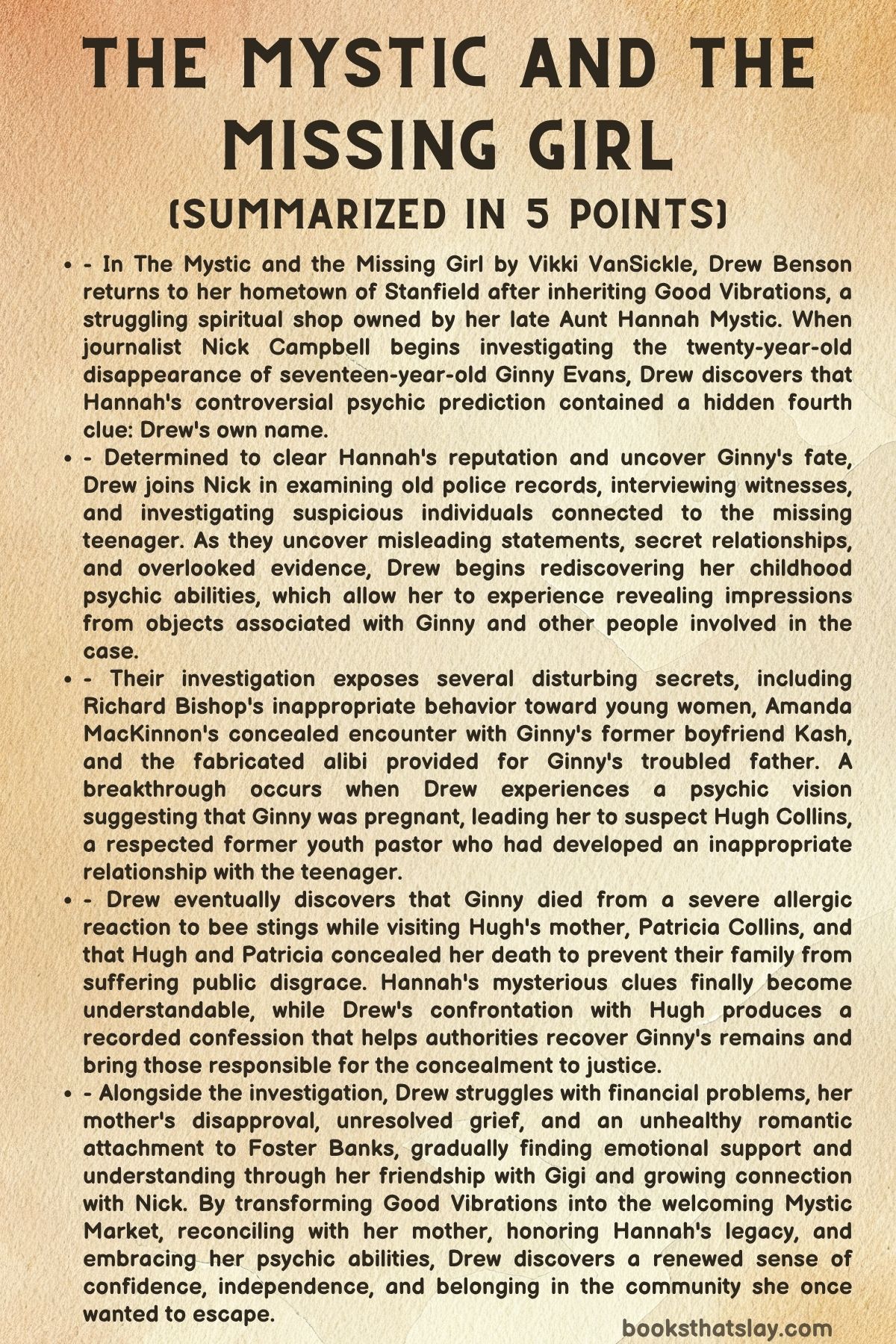
The Mystic and the Missing Girl by Vikki VanSickle is a mystery novel that combines a decades-old disappearance, psychic abilities, family relationships, and personal transformation.
The story follows Drew Benson, a woman who inherits her aunt’s struggling spiritual shop in the small town of Stanfield, Ontario. When a journalist begins investigating the disappearance of seventeen-year-old Ginny Evans, Drew discovers that her late aunt’s controversial psychic predictions may contain overlooked clues. As she investigates, Drew must confront painful childhood memories, complicated relationships, and her own unusual abilities. The novel examines grief, prejudice, personal identity, and the importance of discovering the truth, even when that truth challenges established beliefs.
Summary
Drew Benson returns to her hometown of Stanfield after inheriting Good Vibrations, a spiritual shop owned by her beloved Aunt Hannah Mystic, who died from breast cancer five months earlier. Although the inheritance provides Drew with a home and an opportunity to establish herself professionally, the business is struggling financially, and she feels uncomfortable returning to a community she once desperately wanted to escape.
Her difficulties intensify when someone vandalizes the shop window with the words “Justice for Ginny,” referring to Ginny Evans, a seventeen-year-old girl who disappeared nearly twenty years earlier. The incident reminds Drew of the hostility Hannah experienced after becoming involved in the original investigation.
Hannah had once been a television psychic who offered police three mysterious clues concerning Ginny’s disappearance: lake, saint, and gardenia. When investigators failed to solve the case, public opinion turned against Hannah, and revelations about her romantic relationship with a police officer further damaged her reputation.
Drew’s former high school classmate Nick Campbell, now a journalist with The Toronto Star, arrives at the shop seeking information about Hannah’s involvement. Nick hopes to investigate Ginny’s disappearance before its twentieth anniversary and believes Hannah’s private journals may contain information that was overlooked.
Initially, Drew refuses to cooperate because she fears another investigation will expose her aunt to renewed criticism. However, Nick suggests that solving Ginny’s disappearance might finally restore Hannah’s reputation, an argument that gradually changes Drew’s attitude.
Meanwhile, Drew struggles with pressure from Beverly Leach, the judgmental owner of the neighboring café, who repeatedly offers to purchase Good Vibrations. Drew’s mother, Caroline Benson, similarly encourages her to sell the property and pursue a more conventional career.
Drew’s closest friend, Gigi, encourages her to reconsider abandoning the shop. During an evening together, Drew performs a tarot reading that suggests new beginnings, meaningful partnerships, cooperation, and the necessity of overcoming personal fears.
Their conversation also reminds Drew of Hannah’s kindness toward others, particularly Gigi, who sought her guidance after losing her husband, Jamie. Remembering how Hannah once saved her life following a dangerous allergic reaction to bee stings, Drew becomes determined to protect her aunt’s legacy.
Drew begins examining Hannah’s journals and discovers that her aunt’s psychic impressions were often recorded as fragments, symbols, and disconnected words. While searching through the notebooks, she finds a purple journal containing the original predictions associated with Ginny’s disappearance.
Most disturbingly, the journal contains a fourth clue that was never made public: Drew’s own name.
The discovery terrifies Drew because she cannot remember having any meaningful connection with Ginny. She wonders whether Hannah deliberately concealed her name to protect her from something connected with the disappearance.
Determined to understand the mysterious connection, Drew agrees to assist Nick with his investigation, although she initially conceals the fourth clue.
Nick introduces her to several overlooked details, including allegations of violence within Ginny’s family, threatening telephone calls, problems involving her former boyfriend Kash, and suspicious encounters at the Saint, the restaurant where Ginny worked.
At Gruen’s Diner, they interview Charlene Wilson, who worked alongside Ginny. Charlene remembers an older customer nicknamed the Silver Bullet who displayed an uncomfortable interest in the teenager, as well as Ginny’s unexpected decision to leave work early on the evening she disappeared.
As Drew becomes increasingly involved, she begins reconsidering the psychic abilities she possessed during childhood. Hannah had taught her exercises designed to strengthen intuitive impressions, which Drew called glimmers, but public ridicule eventually caused her to abandon them.
During an evening at Gigi’s bar, Arbuckle’s, Drew explains her abilities to Nick and demonstrates them using his old leather keychain. She experiences a vivid impression of a lakeside gathering and correctly identifies Kash as the person who gave Nick the object.
Nick admits that he knew Kash through their earlier work together on canoe trips in northern Ontario. Although initially skeptical of Drew’s abilities, he agrees to help her examine Ginny’s locket, which remains in police custody.
At the police station, Officer Cobb, who had treated Hannah contemptuously during the original investigation, attempts to prevent their access to evidence. With assistance from a receptionist named Donna, Drew examines the necklace and notices a small flower resembling a gardenia among its decorative engravings.
When she touches the locket, Drew experiences a vision of Amanda MacKinnon, Ginny’s former best friend.
Her investigation of Amanda reveals that their friendship had become strained before Ginny disappeared. Kylie, another member of Ginny’s church community, claims Amanda was jealous of Ginny and secretly attracted to Kash.
Meanwhile, Nick investigates Ginny’s old internet conversations and discovers that she used the identities FieldGirl81 and TinyDancer. One online contact, MrBirdie69, appears particularly interested in her whereabouts and employment.
Nick connects this individual to Charlene’s description of the Silver Bullet and identifies him as Richard Bishop, the manager of a local golf course. Their interview reveals Richard’s disturbing attitude toward young women and his friendship with Officer Cobb.
Drew subsequently learns that Richard has continued harassing young female employees and that his wealthy father, Frank Bishop, arranged a private settlement to conceal one particularly serious complaint. Although Richard remains suspicious, the evidence does not establish his involvement in Ginny’s disappearance.
Drew also confronts Amanda at the salon where she works. After demonstrating her abilities through a vision involving Amanda’s Claddagh ring, Drew persuades her to reveal a secret she has concealed for twenty years.
Amanda admits that she was with Kash on the night Ginny disappeared and kissed him after finding him distressed about an argument with Ginny. Because Amanda had dyed her hair blond and resembled her friend, a witness mistakenly identified her as Ginny inside Kash’s car.
This revelation undermines an important assumption in the original investigation. Amanda’s silence resulted from shame, jealousy, and fear of public judgment rather than direct involvement in Ginny’s disappearance.
As Drew and Nick continue working together, their relationship develops beyond their former academic rivalry. Nick gradually recognizes Drew’s intelligence and determination, while Drew discovers that his professional confidence conceals frustrations and disappointments similar to her own.
Their growing connection contrasts with Drew’s repeated involvement with Foster Banks, a charming but unreliable lawyer who has treated her carelessly for years. Although Foster occasionally provides useful information, his unwillingness to offer emotional commitment forces Drew to reconsider their relationship.
The investigation becomes more complicated when someone smashes Good Vibrations’ front window. Drew temporarily closes the shop, and the disappearance of its newly adopted black kitten creates another source of anxiety.
Nevertheless, the setback inspires her to reconsider the business rather than abandon it. With encouragement from Gigi and George, her loyal employee, Drew begins transforming the shop into a collaborative marketplace featuring local artisans, spiritual merchandise, and professional tarot readings.
Meanwhile, Nick discovers that David Evans, Ginny’s father, had a fabricated alibi for the night his daughter disappeared. A criminal named Bill Sullivan paid Shane Anderson to claim that David had spent the evening with him.
When Drew and Nick interview Ginny’s mother, Susan Evans, they learn that David had been involved in criminal activities and struggled with financial problems, addiction, and anger. Susan also reveals that Hannah had once accurately described a private memory involving Ginny, convincing her that the psychic possessed genuine abilities.
During the visit, Drew secretly enters Ginny’s preserved bedroom and attempts to obtain another glimmer. Touching a small black purse produces an overwhelming sensation of distress and a vision of a positive pregnancy test.
Drew realizes that Ginny may have been pregnant when she disappeared, introducing a possible motive involving a concealed relationship.
The investigation subsequently turns toward Grace Assembly, the religious community where Ginny spent considerable time. Drew becomes especially interested in Hugh Collins, the former youth pastor who had previously expressed concerns about Ginny’s troubled home life.
Drew visits Hugh’s elderly mother, Patricia Collins, and notices several apparently insignificant details about her home. These include an overpowering floral fragrance, a carefully maintained garden, photographs of a family cottage, and Patricia’s unexpected reaction when Drew mentions her dangerous bee allergy.
The significance of these observations becomes clearer when Amanda visits the renovated shop to offer her handmade soaps for sale. One soap contains a gardenia fragrance that reminds Drew of Patricia’s house.
Suddenly, Hannah’s original clues begin making sense in a different way. Gardenia may refer to Patricia’s home, while saint may symbolize Hugh’s respected position as a religious leader rather than the restaurant where Ginny worked.
Drew suspects that Hugh engaged in a sexual relationship with Ginny and that her pregnancy threatened his reputation. Before she can fully discuss the theory with Nick, Hugh unexpectedly arrives at the shop.
Alarmed but determined to obtain answers, Drew offers Hugh a tarot reading and uses the cards to question him about Ginny. As she raises the possibility of a sexual relationship and pregnancy, his increasingly defensive responses strengthen her suspicions.
However, the appearance of the Nine of Pentacles makes Drew reconsider her interpretation. The card’s image of a prosperous woman in a garden reminds her of Patricia, whose devotion to her only son might have motivated her to conceal a scandal.
Drew accuses Patricia of involvement in Ginny’s death, and Hugh eventually admits that Ginny died in his mother’s garden.
According to Hugh, Ginny was pregnant with his child and wanted to marry him, but he feared the damage such a relationship would cause to his career. Ginny visited Patricia, where she suffered multiple bee stings and experienced a severe allergic reaction.
Patricia failed to recognize the urgency of Ginny’s condition and did not immediately summon medical assistance. By the time she returned with ordinary first-aid supplies, Ginny had stopped breathing.
Rather than report the death, Hugh and Patricia concealed what happened because an investigation would expose Ginny’s pregnancy and Hugh’s relationship with her.
Drew recognizes that the fourth clue, her own name, may refer to the potentially fatal bee allergy she shares with Ginny. Hannah’s prediction had therefore contained a personal connection that only Drew could fully understand.
When Hugh attempts to intimidate Drew, the missing kitten unexpectedly reappears and distracts him, allowing Drew to record part of their confrontation. Officer Cobb and Nick arrive shortly afterward and reveal that they have heard Hugh’s confession.
Nick recalls that the Collins family owned a cottage near Sally Lake, providing an explanation for Hannah’s remaining clue. Investigators subsequently recover Ginny’s remains, and Hugh and Patricia are charged with obstruction of justice.
Nick’s newspaper article reveals the circumstances of Ginny’s death while acknowledging the contributions of both Hannah and Drew.
With the mystery resolved, Drew prepares to reopen her redesigned business under the name Mystic Market. The successful Halloween celebration attracts customers, local vendors, friends, and community members who now recognize her abilities rather than ridicule them.
Security footage also identifies Beverly’s teenage employee, Connor, as the person responsible for smashing the shop window. Beverly apologizes and agrees to cover the expenses, while Drew chooses not to press charges.
The celebration includes a memorial ceremony honoring Hannah, during which Drew reconnects with her mother. A psychic impression involving an old charm reveals Hannah’s earlier prediction of Caroline’s pregnancy, helping mother and daughter understand their shared history.
Caroline admits that her opposition to Drew’s spiritual interests came partly from fear that her daughter would suffer the same cruelty Hannah experienced. Their reconciliation allows Drew to feel accepted without abandoning her independence.
Finally, Nick surprises Drew by attending the celebration and becoming her first official tarot client. He suggests that Hannah’s fourth clue may have predicted not simply Drew’s allergy but her eventual role in solving Ginny’s disappearance.
As Drew prepares to read his cards, she recognizes that the investigation has transformed her understanding of herself, her family, and her future, leaving her ready to embrace whatever possibilities come next.
Characters
Drew Benson
Drew Benson is the central protagonist of The Mystic and the Missing Girl, whose journey from uncertainty to self-acceptance gives the novel its emotional foundation. Having spent years trying to build a career outside Stanfield, she reluctantly returns after inheriting her aunt’s spiritual shop and discovers that establishing a meaningful life requires confronting memories she has deliberately avoided.
Drew possesses considerable intelligence, humor, determination, and emotional sensitivity, but her confidence is frequently undermined by self-doubt. Her complicated relationship with her mother, unresolved grief over Hannah’s death, and repeated romantic disappointments contribute to her uncertainty about her future.
Her decision to investigate Ginny Evans’s disappearance forces her to reconsider the psychic abilities she abandoned during adolescence. Although initially embarrassed by her intuitive experiences, she gradually recognizes that these abilities can help uncover information, provide comfort, and establish connections with others.
Drew’s relationship with Nick encourages her to trust someone who respects her intelligence and individuality. At the same time, her eventual rejection of Foster’s unreliable behavior represents an important development in her understanding of her emotional needs.
Her transformation of Good Vibrations into Mystic Market demonstrates that personal independence does not require rejecting one’s inheritance. By the novel’s conclusion, Drew has discovered a way to honor Hannah while establishing a future based on her own values, talents, and ambitions.
Hannah Mystic
Hannah Mystic, Drew’s deceased aunt, remains one of the most influential characters in The Mystic and the Missing Girl, despite appearing primarily through memories, journals, and accounts of her earlier life. A former television psychic and unconventional businesswoman, she represents independence, generosity, spiritual curiosity, and the courage to live differently from society’s expectations.
Hannah’s involvement in Ginny Evans’s disappearance damaged her public reputation because her predictions initially appeared unsuccessful. Her romantic relationship with police officer Cal Langford further complicated public perceptions, allowing speculation about her personal life to overshadow her attempts to help.
Her private journals reveal an intuitive process involving fragmented images, symbolic associations, and sensations rather than straightforward predictions. The eventual significance of her four clues suggests that her understanding extended beyond what investigators could interpret at the time.
Hannah also serves as a protective and nurturing influence in Drew’s childhood. Her quick response when Drew experienced a dangerous allergic reaction to bee stings established an emotional connection that Drew continued to cherish.
Through Gigi, Susan Evans, George, and other members of the community, the reader discovers that Hannah provided compassion and support to people experiencing grief, uncertainty, and personal difficulties. Her legacy ultimately becomes defined by these acts of kindness rather than the controversy that once surrounded her.
Nick Campbell
Nick Campbell is the investigative journalist whose arrival sets the central mystery of The Mystic and the Missing Girl in motion. Once Drew’s academically competitive classmate, he has developed into a thoughtful, persistent professional who hopes that investigating Ginny’s disappearance will allow him to pursue more meaningful journalism.
Nick approaches problems through research, witness statements, and verifiable evidence. His skepticism toward Drew’s psychic impressions creates disagreements between them, but his willingness to reconsider his assumptions demonstrates intellectual flexibility.
His own adolescence was marked by insecurity and bullying, particularly surrounding the humiliating nickname Obi. Revealing this experience allows Drew to understand that Nick’s apparent confidence concealed vulnerabilities she never recognized during their school years.
Nick’s friendship with Kash also influences his understanding of the consequences of irresponsible accusations. Having witnessed how suspicion damaged Kash’s life, he recognizes the importance of distinguishing convincing theories from proven facts.
His professional partnership with Drew gradually develops into mutual attraction and emotional trust. Rather than demanding that Drew abandon her unusual abilities, Nick learns to respect her experiences while maintaining his commitment to careful investigation.
Ginny Evans
Ginny Evans is the missing teenager whose disappearance shapes the events of The Mystic and the Missing Girl. Although she is absent from the present-day narrative, the investigation gradually reveals a complicated young woman whose private experiences differed considerably from the idealized image preserved by her community.
Ginny was a talented volleyball player, a capable student, and an active participant in religious activities. Her apparent achievements concealed family difficulties, emotional uncertainty, and the pressures associated with growing up in a conservative environment.
Her relationship with Kash had deteriorated before she disappeared, while her growing involvement with Grace Assembly brought her into close contact with Hugh Collins. The revelation that Hugh impregnated her exposes the dangerous imbalance between an admired adult religious leader and a seventeen-year-old girl who trusted him.
Ginny’s death from an allergic reaction is made especially tragic by the decisions taken afterward. Hugh and Patricia’s determination to avoid disgrace deprived her family of answers and transformed an accidental death into a prolonged public mystery.
The novel gradually restores Ginny’s individuality by examining her friendships, personal possessions, fears, and relationships. She emerges not merely as a missing person but as a teenager whose life deserved protection, whose experiences deserved understanding, and whose family deserved the truth.
Gigi
Gigi is Drew’s closest friend and one of the strongest sources of emotional support in The Mystic and the Missing Girl. Their friendship began during adolescence, when they developed a rebellious public image that concealed their sensitivity to other people’s judgments.
As the owner of Arbuckle’s, Gigi demonstrates professional determination and resilience. She opened the bar in memory of her late husband Jamie, although she continues to struggle with the grief caused by his unexpected death.
Gigi’s loyalty becomes particularly important when Drew considers selling Good Vibrations. Rather than dismissing her friend’s fears, she encourages Drew to recognize the possibilities offered by Hannah’s inheritance.
Her willingness to discuss spiritual traditions, participate in tarot readings, and accompany Drew during uncomfortable investigations reflects her open-minded personality. She also offers humor during difficult moments, helping Drew manage uncertainty without becoming overwhelmed.
Gigi represents the value of enduring friendship and the possibility of continuing to build a meaningful life after personal loss.
George
George is Hannah’s former employee and one of Drew’s most loyal companions during the difficult transition following her aunt’s death. They regard Good Vibrations as more than a workplace, viewing it as a community where unconventional interests and identities can be accepted.
George’s attachment to Hannah makes them initially uncomfortable with changes to the shop, particularly Drew’s decision to reconsider its original name. However, their enthusiasm for the new vendors and redesigned interior demonstrates a willingness to support meaningful change.
Their personal life also reveals emotional vulnerability, particularly when they struggle with the end of their relationship with Carlin. Drew’s compassionate tarot reading helps George understand that the end of a relationship can create space for personal growth.
George’s affection for the stray kitten and active participation in Hannah’s memorial further establish their caring personality. They represent loyalty, belonging, and the importance of community in sustaining a small business.
Caroline Benson
Caroline Benson, Drew’s mother, initially appears controlling, judgmental, and overly concerned with conventional definitions of success. Her repeated insistence that Drew sell Good Vibrations creates tension because Drew interprets these suggestions as evidence that her mother neither trusts nor respects her decisions.
Caroline’s complicated relationship with Hannah also influences her behavior. Having witnessed the humiliation her sister experienced during the Ginny Evans investigation, she fears that Drew’s growing interest in psychic practices will expose her to similar cruelty.
Her concern is further complicated by jealousy over Drew’s admiration for Hannah. Caroline sometimes feels that her daughter values her unconventional aunt more than the mother who raised her.
The revelation that Hannah accurately predicted Caroline’s pregnancy after years of fertility struggles provides a new perspective on their relationship. Caroline ultimately acknowledges her fears and expresses pride in Drew, demonstrating that parental love can coexist with insecurity, misunderstanding, and the difficulty of accepting a child’s independence.
Edward Benson
Edward Benson is Drew’s father, a successful lawyer whose professional achievements reflect the conventional stability valued by the Benson family. His retirement celebration highlights the social expectations that have shaped Drew’s upbringing.
Although Edward is less confrontational than Caroline, his professional circle connects several important individuals involved in the investigation. Through his legal connections, Drew encounters Frank Bishop and becomes more conscious of the influence wealthy families exercise in Stanfield.
Edward represents the established professional world against which Drew measures her unconventional ambitions. His relatively restrained presence also illustrates why Drew sometimes feels that her emotional concerns receive less attention than appearances and professional accomplishments.
Susan Evans
Susan Evans is Ginny’s mother, whose life has been permanently altered by her daughter’s disappearance. Her decision to preserve Ginny’s bedroom illustrates the difficulty of accepting a loss when the circumstances remain unknown.
Susan endured a troubled marriage marked by David’s anger, financial difficulties, and involvement in criminal activities. Nevertheless, she insists that he loved Ginny, demonstrating her reluctance to reduce a complicated relationship to its worst moments.
Her conversation with Drew also challenges the belief that Hannah was universally rejected by Ginny’s family. Susan remembers Hannah’s kindness, her refusal to accept payment, and her accurate description of a private memory involving Ginny.
Susan represents the suffering caused by unresolved loss and the emotional consequences of withholding the truth. The discovery of Ginny’s remains finally provides the factual answers that Susan had been denied for twenty years, although nothing can restore the years she spent searching for her daughter.
David Evans
David Evans is Ginny’s father, whose troubled personal history initially makes him a plausible suspect. His struggles with alcohol, debt, anger, and criminal associations suggest an unstable household in which Ginny may have felt frightened or emotionally unsupported.
The revelation that David obtained a false alibi increases suspicion surrounding his activities on the night Ginny disappeared. However, further investigation establishes that the deception was connected to illegal work involving Bill Sullivan rather than proving his responsibility for Ginny’s death.
David’s decision to take money from Ginny’s college savings illustrates how his personal problems affected his daughter. His later death from a drug overdose in 2014 leaves him unable to explain his choices publicly.
His character demonstrates how real wrongdoing can complicate an investigation without necessarily establishing responsibility for an unrelated tragedy.
Amanda MacKinnon
Amanda MacKinnon is Ginny’s former best friend, whose concealed memories provide an important breakthrough in the investigation. Her guarded personality initially makes her appear suspicious, particularly when Drew experiences a psychic impression connecting her to Ginny’s locket.
Amanda had secretly developed romantic feelings for Kash, creating jealousy and emotional tension within her friendship with Ginny. On the night Ginny disappeared, Amanda comforted Kash and kissed him, an encounter she later concealed out of shame.
Because Amanda resembled Ginny after dyeing her hair blond, a witness mistakenly identified her as Ginny inside Kash’s car. Her refusal to correct this misunderstanding contributed to years of suspicion and distorted the original investigation.
Amanda’s inability to leave Stanfield also reflects unresolved grief and guilt. Her relationship with Seamus deteriorated partly because she could not bring herself to move away from the place associated with Ginny’s disappearance.
Her eventual confession and participation in Mystic Market reveal a woman beginning to release herself from the emotional consequences of her past. Amanda’s development emphasizes that guilt can persist even when someone bears no responsibility for the central tragedy.
Kash
Kash is Ginny’s former boyfriend, whose argument with her shortly before her disappearance made him an important suspect. The discovery of Ginny’s damaged locket inside his car further intensified suspicion.
Despite having witnesses who supported his account of the evening, Kash experienced lasting damage to his reputation. Amanda later reveals that the person seen in his car was actually her, undermining one of the assumptions used against him.
The hostility directed toward Kash was also influenced by racial prejudice, as Amanda explicitly acknowledges when defending him. His experiences expose how public suspicion can be intensified by social bias rather than reliable evidence.
His friendship with Nick during their work on canoe trips provides the journalist with a more personal understanding of the case. Kash’s character represents the long-term consequences of wrongful suspicion and the difficulty of rebuilding a life after public condemnation.
Hugh Collins
Hugh Collins is the former youth pastor whose respected public identity conceals a deeply damaging secret. His position within Grace Assembly gave him access to young people seeking guidance, including Ginny Evans.
Hugh’s sexual relationship with Ginny represents an abuse of trust and an unequal relationship between an adult religious authority and a teenager. When Ginny became pregnant and wanted to marry him, Hugh feared that the situation would destroy his reputation and future career.
His actions following Ginny’s death reveal the extent of his moral failure. Rather than report what happened, he participated in concealing her death, allowing her family and the wider community to suffer for two decades.
Hugh attempts to rationalize his behavior by suggesting that secrecy protected Ginny from humiliation. This justification exposes his determination to preserve his own standing while presenting selfish decisions as acts of compassion.
His confrontations with Drew also reveal manipulation and intimidation beneath his polite exterior. Hugh represents the danger of confusing public respectability with genuine moral responsibility.
Patricia Collins
Patricia Collins is Hugh’s elderly mother, whose fierce devotion to her son becomes central to understanding Ginny’s death. Having struggled for years to conceive, Patricia regards Hugh as an especially precious child whose happiness and reputation must be protected.
Her carefully maintained garden initially appears to symbolize domestic comfort and ordinary family pride. However, it becomes the location where Ginny experiences a fatal allergic reaction after being stung by bees.
Patricia’s failure to recognize the severity of Ginny’s medical emergency leads to devastating consequences. Her subsequent participation in concealing the death demonstrates how the desire to protect a loved one can become morally destructive.
Her prayers for Ginny and Susan suggest the possibility of enduring guilt, although these expressions cannot undo the suffering caused by her silence. Patricia is especially significant because her seemingly gentle exterior contrasts with her willingness to sacrifice another family’s peace to preserve her son’s future.
Foster Banks
Foster Banks is a wealthy, attractive lawyer whose long-standing connection with Drew repeatedly creates emotional confusion. Having known her since adolescence, he understands how to attract her attention while avoiding serious emotional accountability.
His charm and occasional kindness make it difficult for Drew to reject him completely. Their relationship is complicated by his incomplete divorce, unreliable communication, and tendency to reappear whenever he wants companionship.
Foster also provides useful information through his legal connections, particularly regarding Richard Bishop’s misconduct and the private settlement arranged by Frank Bishop. His willingness to discuss the matter demonstrates that he is not entirely indifferent to Drew’s concerns.
Nevertheless, Foster consistently fails to provide the support and commitment Drew needs. His absence from the Mystic Market celebration eventually helps Drew recognize that physical attraction cannot compensate for emotional incompatibility.
Beverly Leach
Beverly Leach is the owner of Hot Bevvies, the café neighboring Hannah’s former shop. Her intrusive curiosity, religious conservatism, and disapproval of unconventional spirituality make her a persistent source of frustration for Drew.
Beverly’s repeated offers to purchase Good Vibrations also create uncertainty about her motives. Although she presents the proposal as a practical business arrangement, she would benefit financially from acquiring the building and expanding her café.
Her participation in the Ginny Evans Memorial Committee places her at the center of the town’s public attempts to commemorate the missing teenager. However, her habit of publicizing Drew’s connection to Hannah demonstrates limited sensitivity toward the pain caused by earlier accusations.
When Connor is identified as the person who smashed the shop window, Beverly apologizes and agrees to cover the expenses. Her response provides an opportunity for Drew to move beyond their long-standing antagonism, even though their differences have not entirely disappeared.
Connor Leach
Connor Leach is Beverly’s teenage employee, whose involvement in vandalizing Good Vibrations is revealed near the end of the novel. His actions contribute to Drew’s financial difficulties and intensify her fear that the hostility previously directed toward Hannah is returning.
The security footage identifying Connor demonstrates the practical importance of Drew’s decision to install a camera during the renovation. His exposure also clarifies responsibility for the smashed window rather than leaving Drew dependent on speculation.
Drew’s decision not to press charges reflects her growing confidence and willingness to move beyond resentment. Connor’s role emphasizes the destructive nature of intimidation and the possibility of responding to wrongdoing without perpetuating hostility.
Richard Bishop
Richard Bishop manages Stanfield Downs and becomes a significant suspect because of his inappropriate interest in Ginny before her disappearance. His identity connects the older restaurant customer called the Silver Bullet with the online contact known as MrBirdie69.
Richard uses his professional position to approach young female employees and make unwanted advances. Olivia’s account and Foster’s information about an earlier complaint establish a disturbing pattern of exploitation.
His friendship with Officer Cobb and the influence of his wealthy father raise questions about why his behavior escaped meaningful scrutiny. Although the investigation does not establish his responsibility for Ginny’s disappearance, it exposes serious misconduct that deserves attention independently of the mystery.
Richard represents entitlement, predatory behavior, and the confidence that can develop when influential individuals repeatedly avoid accountability.
Frank Bishop
Frank Bishop is Richard’s wealthy father and an influential figure in Stanfield’s golfing community. His primary function in the novel is to demonstrate how financial resources and social connections can protect privileged individuals from the consequences of their actions.
When allegations involving Richard threaten to become public, Frank arranges a private settlement rather than addressing the misconduct openly. His willingness to protect the family’s reputation comes at the expense of the young woman who experienced harassment.
Drew’s confrontation with Frank during her father’s retirement celebration exposes his dismissive attitude toward the allegations. His character reinforces the novel’s criticism of communities where social standing influences whose experiences are believed and whose interests receive protection.
Officer Cobb
Officer Cobb is a police officer whose involvement in the original Ginny Evans investigation left Drew with deeply unpleasant memories. His hostility toward Hannah and contempt for psychic practices contribute to Drew’s distrust of the authorities.
When Drew and Nick attempt to examine Ginny’s locket, Cobb initially obstructs their access and dismisses their investigative efforts. His friendship with Richard Bishop also raises concerns about possible bias within the original investigation.
Although the story does not establish that Cobb deliberately concealed evidence, his behavior demonstrates the dangers of allowing personal prejudice to influence professional judgment. His eventual arrival during Hugh’s confrontation with Drew places him in a position to participate in resolving a case that had long been associated with his earlier hostility.
Charlene Wilson
Charlene Wilson is the experienced waitress at Gruen’s Diner who previously worked with Ginny at the Saint. Her memories provide some of the investigation’s earliest useful evidence.
Charlene recalls an older customer who showed persistent, inappropriate interest in Ginny and identifies Richard Bishop as the man known as the Silver Bullet. She also remembers that Ginny unexpectedly left work early on the evening she disappeared.
Her information demonstrates the value of overlooked witnesses and seemingly ordinary observations. Charlene’s character highlights how investigative failures can occur when authorities do not take the concerns of witnesses seriously.
Kylie
Kylie is a former member of Ginny’s religious youth community who participates in the memorial committee. She remembers Ginny as an active and committed member of Grace Assembly, reflecting the strong public association between Ginny and her church.
Kylie’s comments about Amanda introduce the possibility that jealousy affected Ginny’s friendships. She claims Amanda exaggerated the closeness of their relationship and secretly wanted Kash for herself.
Her hostile reaction when she discovers Drew is Hannah’s niece also exposes the persistence of prejudice within the community. Kylie demonstrates how religious and social loyalties can shape memories, assumptions, and judgments long after an event has occurred.
Jamie
Jamie is Gigi’s deceased husband, whose unexpected death from an undiagnosed heart condition continues to influence her life. Together, they dreamed of opening a bar where Gigi could perform, a goal she eventually realizes by establishing Arbuckle’s.
Although the business succeeds, Gigi remains unable to perform on the stage Jamie built for her. This detail illustrates the emotional difficulty of pursuing shared dreams after losing the person with whom those dreams originated.
Jamie’s continuing presence through Gigi’s memories provides a parallel to Hannah’s influence on Drew. Both women must learn to carry forward the aspirations and values of loved ones without becoming permanently confined by grief.
Cal Langford
Cal Langford is the police officer whose romantic relationship with Hannah became a public scandal during the original investigation. Although he was not directly assigned to Ginny’s case, the exposure of their relationship encouraged accusations that Hannah had improperly influenced police work.
His connection with Hannah demonstrates how private relationships can become distorted through sensational publicity. The resulting controversy damaged reputations and distracted public attention from the actual investigation.
Cal’s role highlights the vulnerability of individuals whose personal lives are scrutinized through the expectations and prejudices of a small community.
Donna
Donna is the police station receptionist who helps Drew and Nick access Ginny’s locket despite Officer Cobb’s hostility. Her willingness to assist them provides an important contrast to Cobb’s dismissive attitude.
Although she occupies a relatively minor position in the story, her intervention enables Drew to experience the glimmer involving Amanda. Donna demonstrates how small acts of cooperation can become essential to discovering information that established authorities have overlooked.
Olivia
Olivia is a teenage employee at Stanfield Downs who describes Richard Bishop’s continuing pattern of inappropriate behavior. Her initial suspicion that Drew might be an undercover police officer reflects the uncomfortable atmosphere surrounding Richard’s treatment of young women.
Although Olivia attempts to minimize some incidents, her descriptions reveal that employees feel vulnerable to a man who controls their working conditions. Her willingness to speak with Drew helps establish that Richard’s misconduct extends beyond the events of twenty years earlier.
Olivia’s character illustrates the difficulty young employees face when confronting harassment by influential employers.
Alyssa
Alyssa is a former young employee of Stanfield Downs whose experience with Richard Bishop becomes the subject of legal action. Richard’s behavior toward her escalated into a sexually threatening encounter while she was working.
Frank Bishop’s intervention results in a settlement that prevents the allegations from receiving public attention. Although Alyssa does not occupy a major speaking role, her experience reveals the human cost of protecting a powerful family’s reputation.
Her circumstances reinforce the distinction between financial settlement and genuine accountability.
Bill Sullivan
Bill Sullivan, known as the Cottage Bandit, is a criminal associated with burglaries targeting vacation properties. His involvement becomes significant when Nick discovers that Sullivan arranged a false alibi for David Evans.
Sullivan’s connection with David initially raises the possibility that Ginny’s disappearance resulted from her father’s criminal activities. Although this theory proves unrelated to the circumstances of her death, it exposes additional secrets that complicated the original investigation.
His character demonstrates how overlapping criminal activity can obscure the truth and create misleading lines of suspicion.
Shane Anderson
Shane Anderson is the man who falsely claimed that David Evans spent the night of Ginny’s disappearance at his home. His statement initially provided an important alibi for David and affected the way investigators understood the timeline.
Nick eventually discovers that Shane was paid by Bill Sullivan to provide the fabricated account. This revelation forces Drew and Nick to reconsider whether David was involved in his daughter’s disappearance.
Shane’s role illustrates the consequences of dishonest testimony, particularly when an investigation already contains conflicting statements and incomplete evidence.
Seamus
Seamus is Amanda’s former romantic partner, whose relationship with her becomes significant through Drew’s psychic impression involving a Claddagh ring. The vision reveals a moment when Seamus expressed his hopes for a shared future and suggested that the ring might eventually be replaced by an engagement ring.
Their relationship ended after Seamus moved away for work and Amanda refused to leave Stanfield. Her decision reflects the unresolved guilt and emotional attachment that kept her connected to Ginny’s disappearance.
Seamus represents an opportunity for personal happiness that Amanda could not accept while she remained psychologically trapped by the past.
Carlin
Carlin is George’s former romantic partner, whose relationship with them has ended by the time Drew begins offering tarot guidance at Good Vibrations. Although Carlin appears primarily through George’s emotional experiences, the breakup provides an opportunity to explore disappointment and recovery.
Drew’s reading helps George recognize that the relationship’s ending does not eliminate the possibility of future happiness. Carlin’s role contributes to the novel’s recurring examination of transformation and the need to release relationships that no longer support personal growth.
Willow / Pixie
The small black kitten initially called Bones, then Willow, and finally Pixie provides companionship and unexpected happiness during Drew’s most difficult period at Good Vibrations. George quickly becomes attached to the animal, seeing her as a welcome addition to the shop.
Pixie’s disappearance after the vandalism creates additional anxiety, while her unexpected return during Drew’s confrontation with Hugh provides a crucial distraction. This intervention allows Drew to activate her phone recording and strengthens her determination to expose the truth.
The kitten also functions as a symbol of unexpected guidance, protection, and renewal. Her presence reinforces the comforting atmosphere Drew hopes to establish at Mystic Market.
Themes
Truth, Justice, and the Cost of Silence
The search for truth in The Mystic and the Missing Girl reveals how secrecy can transform a tragedy into decades of suffering. Ginny Evans dies from a severe allergic reaction, but Hugh and Patricia Collins choose to conceal her death because acknowledging the circumstances would expose Hugh’s sexual relationship with a teenager and threaten his reputation.
Their decision demonstrates that the consequences of dishonesty extend far beyond the people directly involved. Susan Evans spends twenty years without knowing what happened to her daughter, while Kash experiences damaging accusations and Hannah Mystic becomes the target of public condemnation.
Amanda’s silence illustrates a different form of concealment. Although she did not cause Ginny’s death, her fear of being judged for kissing Kash prevents her from correcting a mistaken identification that influences the investigation.
The novel distinguishes between guilt arising from wrongdoing and guilt associated with shame or perceived betrayal. Amanda eventually finds the courage to speak, while Hugh continues justifying his decisions even after the truth becomes impossible to deny.
Nick’s commitment to responsible journalism reinforces the importance of establishing facts rather than treating suspicion as proof. His investigations expose misleading testimony, neglected witnesses, and assumptions that authorities failed to examine adequately.
Drew’s involvement adds another dimension by demonstrating that truth may emerge through unexpected methods. Her psychic impressions become valuable when combined with research, questioning, and evidence.
Ultimately, justice requires more than identifying what happened to Ginny. It also involves acknowledging the suffering created by silence, correcting false accusations, and restoring dignity to people whose lives were damaged by an unresolved mystery.
Grief, Memory, and Emotional Healing
Grief shapes nearly every important relationship in the novel, influencing how characters understand their past and approach their futures. Drew’s return to Stanfield follows Hannah’s death, forcing her to confront not only the absence of a beloved relative but also her regrets about the years when she distanced herself from her aunt.
Hannah’s journals become a way for Drew to reconnect with someone she can no longer question directly. Through these writings, memories, and conversations with others, she gradually develops a more complete understanding of Hannah’s life.
Gigi’s experience presents another form of bereavement. Although she fulfills Jamie’s dream by opening Arbuckle’s, her inability to perform on the stage he built demonstrates that continuing a loved one’s ambitions does not automatically resolve the pain of losing them.
Susan Evans experiences a particularly difficult form of grief because she has no certainty about Ginny’s fate. By preserving her daughter’s bedroom, Susan maintains a physical connection to a life interrupted without explanation.
Amanda’s grief is complicated by guilt and emotional unfinished business. She remains in Stanfield partly because moving away feels like abandoning Ginny, allowing the disappearance to influence her relationships and personal choices.
The novel suggests that remembrance becomes healthier when it allows people to acknowledge loss without surrendering the possibility of change. Drew’s memorial celebration for Hannah creates an opportunity for the community to remember her generosity rather than the scandal associated with her name.
The Death tarot card expresses this idea through its symbolism of endings and transformation. Healing does not require forgetting those who have died, but it does involve learning how to live meaningfully while carrying their memories forward.
Intuition, Self-Acceptance, and Personal Identity
Drew’s struggle to accept her psychic abilities reflects the broader conflict between personal identity and social expectations in The Mystic and the Missing Girl. As a child, she welcomed Hannah’s intuitive exercises and trusted the unusual impressions she experienced, but the ridicule directed toward her aunt eventually made those abilities a source of embarrassment.
Her decision to suppress her glimmers represents a rejection of something deeply connected to her identity. She hopes that distancing herself from Hannah’s spiritual interests will protect her from judgment and allow her to establish a more conventional future.
Returning to Stanfield forces Drew to question whether this rejection has actually made her happier. Her unstable professional history, troubled relationship with Foster, and uncertainty about Good Vibrations suggest that fitting other people’s expectations has not provided the fulfillment she seeks.
The investigation gradually restores her confidence in her instincts. Each successful glimmer encourages her to recognize that intuition can offer meaningful information, even when its significance is not immediately apparent.
Nick’s skepticism creates a productive tension between intuitive knowledge and analytical reasoning. Their eventual cooperation suggests that different ways of understanding experiences need not be treated as mutually exclusive.
Drew’s transformation of Good Vibrations into Mystic Market represents the practical expression of her growing independence. Rather than copying Hannah’s life or rejecting her inheritance, she combines familiar spiritual traditions with her own ideas about business, community, and creativity.
Her reconciliation with Caroline completes another stage of this development. Drew learns that she can acknowledge her mother’s concerns without allowing those fears to determine her decisions.
By accepting both her abilities and her ambitions, Drew discovers that personal maturity involves choosing an authentic life rather than waiting for universal approval.
Power, Reputation, and Moral Responsibility
Social influence determines whose behavior receives scrutiny and whose actions are overlooked throughout the novel. Stanfield’s established families, religious leaders, and professional authorities exercise considerable power over public opinion, frequently protecting their own interests while exposing less influential individuals to criticism.
Hugh Collins embodies the dangers associated with unquestioned moral authority. His respected position as a youth pastor provides him with the trust of young members of his congregation, including Ginny, but he violates that trust through a sexual relationship with her.
His fear of public disgrace ultimately becomes more important to him than his responsibility toward Ginny and her family. By concealing her death, he preserves his reputation at the cost of another family’s emotional well-being.
Richard Bishop represents a similar misuse of authority in a professional setting. His position as an employer allows him to harass vulnerable young women, while Frank Bishop’s financial resources help prevent misconduct from receiving public scrutiny.
Officer Cobb’s treatment of Hannah and Drew also demonstrates how personal prejudice can influence people holding institutional authority. His dismissive behavior raises concerns about whether the original investigation treated unconventional individuals and uncomfortable evidence fairly.
Hannah’s experience provides a contrast to these influential men. Despite her generosity and sincere efforts to help, her spiritual beliefs and private romantic life become grounds for public humiliation.
The novel challenges the assumption that social standing, religious commitment, or professional success necessarily demonstrates moral integrity. Genuine responsibility is measured through actions, honesty, compassion, and a willingness to acknowledge harm.
Drew’s eventual success offers an alternative model of influence based on cooperation rather than control. By creating an inclusive marketplace and using her abilities to help others, she demonstrates that meaningful leadership can emerge from empathy, accountability, and respect for individual differences.