Trust Fall by Lynn Painter Summary, Characters and Themes
Trust Fall by Lynn Painter is a young adult romantic comedy that follows two teenagers from dramatically different backgrounds whose lives become connected through an unexpected inheritance.
Julia Lowell, a small-town girl adjusting to Manhattan’s privileged society, meets Damion Rutledge, a wealthy and rebellious student struggling with family expectations and personal loss. Their initial hostility gradually develops into an unexpected romance, complicated by secrets surrounding a valuable estate and a bitter family dispute. Through humor, misunderstandings, emotional discoveries, and difficult decisions, the novel explores trust, personal independence, social inequality, grief, and the courage required to love someone despite the possibility of being hurt.
Summary
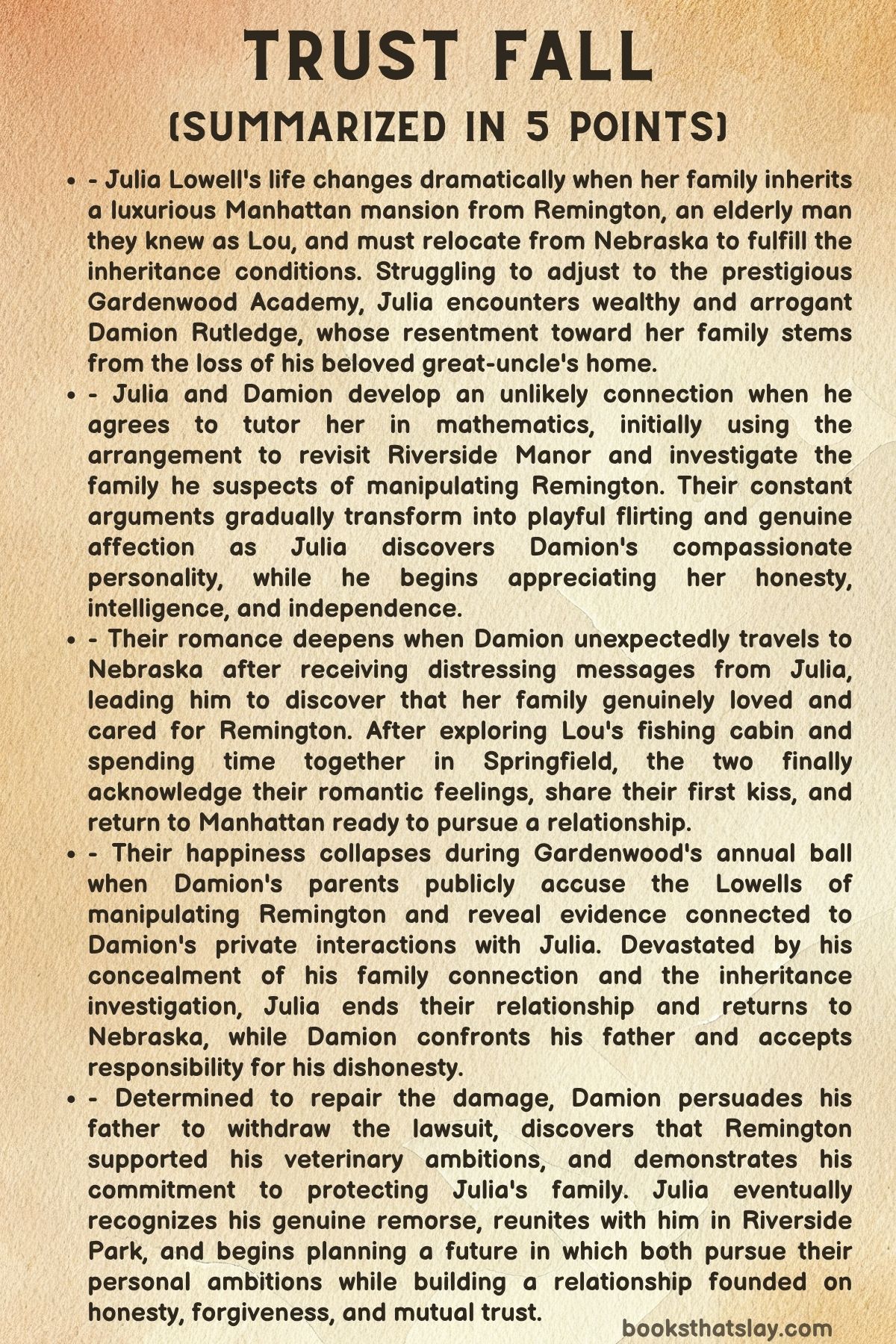
Julia Lowell’s ordinary life in Springfield, Nebraska, changes unexpectedly when Bernard Elizando arrives at her family’s home with astonishing news. A wealthy elderly man named Remington has died and left Julia’s parents, Clint and Shawna, a substantial inheritance, including Riverside Manor, a magnificent five-story mansion on Manhattan’s Upper West Side.
The inheritance comes with two unusual conditions: the entire Lowell family must live in the mansion for at least six months, and Julia and her twin brother, Liam, must attend the prestigious Gardenwood Academy. Although their parents initially hesitate, the family’s struggling grocery business and mounting financial difficulties make the opportunity impossible to ignore.
The Lowells eventually discover that Remington was actually Lou, an eccentric elderly customer who regularly ordered groceries from their store. They had developed a genuine friendship with him over the years without realizing that their ordinary customer possessed an enormous fortune.
Meanwhile, Damion Rutledge struggles with the death of his beloved great-uncle Remington, who had provided the emotional support missing from his relationship with his wealthy parents. Damion’s father, Quinn, is furious that most of Remington’s estate has gone to an unfamiliar Nebraska family and immediately begins investigating the possibility that the Lowells manipulated him.
Damion initially respects his uncle’s right to distribute his property as he wished, but his attitude changes when he discovers that Riverside Manor was included in the inheritance. The mansion holds his happiest childhood memories, making its loss feel like another painful separation from Remington.
When the Lowells arrive in Manhattan, Julia is overwhelmed by the grandeur of their new home and the unfamiliar world surrounding it. During a neighborhood outing, she loses a sentimental wallet belonging to her former boyfriend, Will, and confronts a handsome stranger whom she mistakenly believes has stolen it.
The stranger is Damion, who enjoys provoking her rather than immediately returning the wallet. Their confrontation turns hostile, and Damion becomes even angrier when he discovers that Julia belongs to the family occupying his uncle’s former home.
Julia’s transition to Gardenwood Academy proves equally difficult. Surrounded by wealthy students, elaborate social customs, and intimidating friendship groups, she feels painfully out of place, although Jasmine and Donovan offer her genuine companionship.
Her discomfort increases when she discovers that Damion attends the same academy and belongs to its influential social circle. His arrogant behavior reinforces her dislike, particularly when he deliberately walks over textbooks she has dropped instead of helping her.
Academically, Julia struggles with Gardenwood’s demanding mathematics curriculum. Damion, an exceptionally talented student, eventually agrees to tutor her in exchange for an unspecified future favor, creating an uneasy arrangement that requires them to spend considerable time together.
Initially, Damion accepts the position partly because it gives him access to Riverside Manor. Returning to the house allows him to revisit memories of Remington, although he continues suspecting that Julia’s family may have exploited his uncle’s generosity.
Nevertheless, their tutoring sessions gradually become enjoyable. Damion discovers that Julia is intelligent, funny, emotionally perceptive, and entirely different from the privileged students surrounding him, while Julia recognizes his remarkable patience as a teacher.
Their relationship develops through sarcastic text messages, unexpected gifts of baguettes, and increasingly personal conversations. Damion also begins protecting Julia from the cruel judgments of Gardenwood’s fashionable students, especially Coco Chattingham and her friends.
As Julia explores Manhattan, Damion introduces her to unfamiliar parts of the city, teaches her how to navigate the subway, and takes her to places that hold personal meaning for him. Julia discovers his affection for animals, his volunteer work at an animal shelter, and his ability to speak Italian, realizing that his rebellious reputation conceals considerable kindness.
Their growing attraction becomes increasingly obvious during Gardenwood’s elaborate social season. At one gathering, Damion intervenes when his father humiliates Julia over her uncertain academic future, publicly defending her intelligence even though he privately envies her freedom to choose her own path.
Damion’s parents expect him to attend Dartmouth and eventually join Rutledge Investments, but he secretly wants to become a veterinarian. Remington had encouraged this ambition, and his death leaves Damion uncertain about whether he possesses the courage to oppose his father.
The relationship takes a significant turn at Beckett’s birthday party, where Julia impulsively suggests that she and Damion need a private bedroom to irritate Coco. Their playful deception creates an unexpectedly intimate encounter, and they nearly kiss before being interrupted.
When embarrassing photographs and rumors spread throughout Gardenwood afterward, Damion publicly announces that Julia will accompany him to the annual ball. Although he presents the decision as repayment of the favor she owes him, his real motivation increasingly involves protecting her from humiliation.
Their emotional connection deepens when Julia achieves a passing score on a mathematics practice examination. During a walk through Riverside Park, Damion nearly kisses her, but Julia panics and runs away because her painful breakup with Will has left her terrified of trusting another boy.
Julia travels to Nebraska for her best friend Teanna’s birthday, hoping that familiar surroundings will help her understand her feelings. After encountering Will and his new girlfriend, Hannah, she becomes emotionally overwhelmed and accidentally sends several distressing messages to Damion instead of Liam.
Unable to contact her afterward, Damion becomes frightened and travels from Manhattan to Springfield. His unexpected arrival surprises Julia, who struggles to understand why someone supposedly indifferent to her would make such an extraordinary effort.
During their time together in Nebraska, Julia introduces Damion to her hometown and the family grocery store. There, he discovers a memorial display dedicated to Lou and realizes that the elderly customer his uncle had become was genuinely loved by the Lowells.
Julia also takes him to Lou’s fishing cabin, where Damion recognizes familiar objects and memories from Remington’s letters. The experience finally convinces him that the Lowells never manipulated his uncle and that Remington deliberately chose to reward their kindness.
Their growing intimacy culminates at a casual gathering in a cornfield, where Damion helps Julia face the discomfort of encountering Will. They share their first kiss, and Julia finally allows herself to acknowledge her feelings instead of retreating from them.
After returning to New York, their relationship becomes openly romantic. They spend increasing amounts of time together, and Julia begins feeling more confident at Gardenwood, while Damion experiences the freedom of being loved for himself rather than his family’s wealth or expectations.
However, Damion continues concealing a devastating secret: Remington was his great-uncle, and his parents are actively challenging the Lowell family’s inheritance. Although his suspicions have disappeared, his fear of losing Julia prevents him from revealing the truth.
At Gardenwood’s annual ball, held at the Cloisters, Julia appears in a spectacular red gown while Damion wears an unconventional white suit. Their affectionate dancing, including a dramatic movement Julia learned from Bernard, becomes an expression of their growing trust and willingness to embrace their feelings.
The evening ends disastrously when Quinn and Whitney Rutledge publicly accuse Julia’s parents of manipulating Remington and announce legal proceedings against the inheritance. Evidence presented during the confrontation includes photographs and information Damion collected while spending time with Julia.
Julia discovers his concealed relationship with Remington and believes he deliberately used their romance to gather information against her family. Although Damion insists that his father obtained the materials without his permission, Julia feels deeply betrayed and ends their relationship.
Devastated, Julia returns to Springfield and continues her Gardenwood education remotely while helping at the family grocery store. She finally tells her parents about the bullying she endured, and the school begins addressing the behavior of the students responsible.
Damion confronts his father, realizing that Quinn’s determination to reclaim Riverside Manor comes from pride and possessiveness rather than respect for Remington’s wishes. He also tries to apologize to Liam, gradually convincing Julia’s protective brother that his remorse is genuine.
Bernard subsequently visits Julia and explains the depth of Damion’s relationship with Remington. A separate conversation with Will helps her understand that her previous romance had become comfortable rather than fulfilling and that she must stop allowing fear to determine her future.
On Damion’s eighteenth birthday, Bernard delivers a letter Remington prepared before his death. The letter confirms that Remington knowingly left his estate to the Lowells because he admired their generosity, while also revealing that he established a separate educational trust to support Damion’s dream of veterinary medicine.
Determined to repair the damage, Damion confronts Quinn and demands that the lawsuit be withdrawn. He eventually agrees to a compromise involving business studies at Cornell alongside veterinary-related coursework, persuading his father to abandon the legal challenge.
Damion delivers the withdrawal documents to the Lowells without realizing that Julia is upstairs listening. When Liam questions his motivations, Damion admits that he made the sacrifice because he loves Julia, even though he believes she will never forgive him.
Moved by his actions, Julia follows Damion to his favorite bench in Riverside Park. They exchange sincere apologies, acknowledge their feelings, and reconcile, with Julia deciding that trusting him again is worth the emotional risk.
Several months later, their relationship remains strong despite the demands of school and family. Julia has been accepted to New York University to study literature and writing, while Damion is preparing for Cornell and has inherited Remington’s beloved Nebraska fishing cabin.
During a peaceful boating trip near the cabin, Julia celebrates another improvement in her mathematics results. As a cardinal appears nearby, reminding Damion of Remington’s continuing influence, the couple reflects on their unlikely journey from enemies to devoted partners and looks forward to building a future together.
Characters
Julia Lowell
Julia Lowell is the central female protagonist of Trust Fall, a teenager whose unexpected transition from small-town Nebraska to wealthy Manhattan challenges her confidence, relationships, and understanding of herself. Initially insecure and uncomfortable with social attention, Julia struggles to adjust to a world where family money, appearances, and influential connections determine a person’s social standing.
Her emotional difficulties are intensified by her breakup with Will, which has left her deeply afraid of romantic rejection. Although she is naturally intelligent, humorous, and compassionate, Julia frequently underestimates her abilities and allows the opinions of others to influence her decisions.
Her relationship with Damion becomes an important catalyst for personal growth. Through their arguments, tutoring sessions, and developing romance, she gradually learns to recognize genuine affection, defend her individuality, and pursue experiences outside her comfort zone.
Julia’s decision to return to Damion after his betrayal does not represent unquestioning forgiveness. Instead, it demonstrates her growing ability to distinguish between someone’s mistakes and their capacity to accept responsibility and change.
By the end of the novel, Julia has developed greater independence, improved academically, and begun exploring her interests in literature, writing, and the family business. Her character represents the difficult but rewarding transition from insecurity and emotional dependence toward confidence and self-determination.
Damion Rutledge
Damion Rutledge is the central male protagonist of Trust Fall, a wealthy, academically gifted teenager whose sarcastic personality conceals grief, emotional vulnerability, and resentment toward his controlling family. His privileged upbringing provides extraordinary opportunities but leaves him feeling powerless over the direction of his own life.
The death of his great-uncle Remington deeply affects Damion because Remington offered the unconditional acceptance missing from his relationship with his parents. His initial hostility toward Julia comes from the mistaken belief that her family manipulated his uncle into surrendering the home associated with his happiest memories.
Damion’s intelligence, humor, athletic ability, and confident appearance make him influential at Gardenwood Academy. However, his willingness to challenge social expectations, protect vulnerable people, and care for abandoned animals reveals a character fundamentally different from the privileged teenager he initially appears to be.
His relationship with Julia gradually forces him to confront his prejudices and recognize the consequences of his dishonesty. Although his feelings become genuine, his failure to reveal his connection to Remington creates the betrayal that nearly destroys their romance.
His greatest development occurs when he stops avoiding responsibility and challenges his father’s lawsuit. By sacrificing part of his educational independence to protect the Lowells, Damion demonstrates that love requires meaningful action rather than affectionate declarations alone.
Remington Rutledge (Lou)
Remington, affectionately known as Lou in Nebraska, is one of the most influential characters in Trust Fall, despite having died before the principal events unfold. His decisions establish the circumstances that bring the Lowell and Rutledge families into conflict while continuing to guide Damion’s emotional development.
Unlike the status-conscious members of his wealthy family, Remington values kindness, independence, curiosity, and genuine human connection. His friendship with the Lowells develops through ordinary grocery deliveries and shared experiences, allowing him to enjoy relationships unaffected by knowledge of his fortune.
For Damion, Remington serves as a substitute parental figure who encourages him to pursue veterinary medicine rather than submit to his father’s professional ambitions. His letters provide Damion with emotional reassurance and the confidence to consider a different future.
Remington’s inheritance decisions reveal his understanding of wealth as an opportunity to create happiness rather than reinforce social privilege. Leaving Riverside Manor to the Lowells and establishing a separate educational trust for Damion reflect his desire to support people according to their needs and values.
His lasting presence is represented by meaningful places, personal possessions, affectionate memories, and the cardinal appearing near his cabin. These details reinforce the idea that a person’s influence continues through the lives they have changed.
Bernard Elizando
Bernard Elizando is an important supporting character in Trust Fall, serving as the trusted representative of Remington’s estate and a guardian of his final wishes. His formal manner, discretion, and extensive knowledge of both families make him central to the inheritance arrangement.
Bernard understands Remington’s affection for the Lowells and recognizes that the unexpected inheritance reflects a deliberate, carefully considered decision. He helps the family adapt to their new circumstances while warning them about possible challenges from the Rutledges.
His relationship with Damion introduces an important moral conflict. Although Bernard knows about Damion’s connection to Riverside Manor, he initially allows the young man to manage the situation himself rather than immediately reveal everything to Julia.
Bernard’s greatest contribution comes through his efforts to encourage honesty and understanding without excusing wrongdoing. By explaining Damion’s relationship with Remington and delivering the deceased man’s birthday letter, he helps resolve the emotional and legal disputes threatening both families.
Liam Lowell
Liam Lowell is Julia’s twin brother and one of the most significant supporting characters in Trust Fall. Confident, outgoing, and socially adaptable, Liam responds to the move to Manhattan very differently from his sister.
He quickly develops friendships at Gardenwood Academy, particularly with Beckett, and approaches the school’s unfamiliar social environment with enthusiasm rather than fear. His contrasting personality emphasizes Julia’s difficulties with change and social judgment.
Despite his easygoing manner, Liam becomes fiercely protective whenever Julia is mistreated. His confrontation with Damion demonstrates his unwillingness to overlook behavior that threatens his sister’s emotional well-being.
Liam’s eventual decision to hear Damion’s explanation reveals his capacity for fairness and emotional maturity. By encouraging Julia to follow Damion after learning about the withdrawn lawsuit, he helps make their reconciliation possible.
Clint Lowell
Clint Lowell is Julia and Liam’s father, a practical and affectionate man whose financial struggles make Remington’s inheritance particularly meaningful. His grocery business has been experiencing serious difficulties, and the unexpected fortune offers his family an escape from mounting financial pressure.
Clint’s character reflects the values of ordinary family life that contrast with the calculated social behavior of Manhattan’s wealthy elite. He places importance on family traditions, maintaining close relationships, and providing emotional security for his children.
Although the inheritance introduces him to unfamiliar social responsibilities, Clint remains largely grounded in the values that shaped his life in Nebraska. His response to the Rutledges’ accusations highlights the vulnerability of decent people when confronted by opponents possessing greater financial and legal influence.
His willingness to support Julia’s remote education after her emotional breakdown demonstrates that her well-being matters more than maintaining appearances.
Shawna Lowell
Shawna Lowell is Julia’s mother, a warm and supportive figure who helps hold the family together during its extraordinary transition. Like Clint, she initially approaches the inheritance cautiously because accepting it requires disrupting their established lives.
Once the family arrives in Manhattan, Shawna becomes increasingly enthusiastic about participating in the neighborhood’s social customs. Her efforts to adapt provide moments of humor while also illustrating the pressure newcomers experience when entering an unfamiliar social class.
Shawna’s interactions with the prestigious social committee expose her to wealthy individuals who judge the Lowells without understanding their history. Nevertheless, she continues approaching others with the sincerity and friendliness that originally earned Remington’s affection.
Her most important role remains that of a concerned parent. When Julia experiences serious emotional distress, Shawna supports arrangements that allow her daughter to recover in a familiar environment.
Quinn Rutledge
Quinn Rutledge is Damion’s father and one of the principal antagonistic figures in the novel. As a powerful businessman associated with Rutledge Investments, he evaluates people and situations through the perspectives of status, control, financial influence, and family prestige.
Quinn expects Damion to attend Dartmouth and eventually join the family business, treating these ambitions as obligations rather than choices. His inability to recognize his son’s independent identity creates considerable emotional distance between them.
His determination to challenge Remington’s will exposes the darker consequences of entitlement. Instead of respecting his relative’s decisions, Quinn assumes that the Lowells must have obtained the inheritance dishonestly and uses his resources to pressure them.
Quinn’s decision to obtain information from Damion’s personal belongings also demonstrates his disregard for individual boundaries. He believes that protecting the family’s interests justifies actions that ultimately damage his son’s relationship and emotional security.
Although Quinn eventually withdraws the lawsuit and agrees to a compromise concerning Damion’s education, his transformation remains limited. His character illustrates how power can distort judgment when personal pride becomes more important than empathy and respect.
Whitney Rutledge
Whitney Rutledge is Damion’s mother, a wealthy socialite deeply invested in the expectations and traditions of Manhattan’s elite community. Her concern with appearances makes her an important representative of the social environment that both Damion and Julia struggle to navigate.
Whitney places considerable importance on Gardenwood’s annual season and her family’s responsibility for hosting its prestigious ball. She expects Damion to participate enthusiastically and even suggests Coco Chattingham as a suitable date because of the social advantages such a relationship could provide.
Her attitude toward Julia’s family is influenced by the assumption that wealth should remain within established social circles. Whitney finds it difficult to accept that Remington deliberately favored people without comparable financial or social standing.
Although she is not the primary architect of the inheritance lawsuit, she supports Quinn’s hostility toward the Lowells. Her character demonstrates how social ambition and concern for reputation can interfere with meaningful family relationships.
Beckett
Beckett is one of Damion’s closest friends and an influential student at Gardenwood Academy. Unlike many members of the school’s privileged social groups, he demonstrates genuine friendliness toward newcomers, including Liam and Julia.
His confidence and approachable personality help Liam establish himself socially, while his invitation to Julia to attend his birthday party creates an important turning point in her relationship with Damion. Beckett also provides a contrast to Damion’s rebellious approach to family expectations.
Although Beckett intends to attend Harvard and appears comfortable following his established educational path, he respects Damion’s desire to pursue something different. His friendship is characterized by teasing, honesty, and a willingness to offer practical assistance.
He also helps arrange the meeting between Damion and Liam after the inheritance dispute, showing that his loyalty extends beyond casual companionship. Through Beckett, the story presents a more positive example of friendship within an otherwise judgmental social environment.
Jasmine
Jasmine is among the first Gardenwood students to treat Julia with genuine kindness. Assigned to help her navigate the academy, Jasmine becomes an important source of information about the school’s complicated social structure and unwritten expectations.
Her friendliness provides Julia with some protection against the loneliness and insecurity produced by her unfamiliar surroundings. Rather than judging Julia for her background, Jasmine accepts her personality and helps her understand the behavior of their classmates.
Their friendship develops beyond its initial practical purpose into a relationship based on shared interests and mutual support. Jasmine’s assistance in preparing Julia for Beckett’s birthday celebration also helps her experience a greater sense of confidence and belonging.
Donovan
Donovan is another of Julia’s closest friends at Gardenwood Academy, offering humor, companionship, and encouragement during her difficult adjustment to Manhattan. Together with Jasmine, he provides a welcoming alternative to the school’s judgmental social hierarchy.
Donovan helps Julia understand Gardenwood’s traditions and enjoys discussing the developing relationship between her and Damion. His enthusiasm for the annual social season contrasts with Julia’s anxiety about its elaborate expectations.
His character contributes to Julia’s gradual recognition that not every wealthy student is superficial or unkind. Through his consistent friendship, Donovan demonstrates the importance of finding people who provide acceptance without demanding conformity.
Coco Chattingham
Coco Chattingham is one of Julia’s principal social antagonists and an influential member of Gardenwood’s fashionable elite. Her confidence, privileged upbringing, and concern with social superiority shape her dismissive treatment of students who do not belong to her established circle.
Coco repeatedly mocks Julia’s Nebraska background and reacts with jealousy when Damion begins paying attention to her. Her possessive attitude suggests that she regards romantic relationships partly as extensions of social status.
Her behavior contributes to Julia’s humiliation, particularly when embarrassing rumors and photographs circulate after Beckett’s birthday party. Coco’s willingness to dismiss cruelty as harmless entertainment demonstrates her limited understanding of the emotional damage caused by public humiliation.
Although the school’s intervention eventually encourages a more conciliatory response, the story does not establish a complete transformation in her personality. She primarily represents the destructive consequences of privilege combined with social insecurity.
Corbin Archington
Corbin Archington is an arrogant Gardenwood student whose offensive remarks expose the entitlement within Damion’s privileged social circle. He treats Julia disrespectfully and discusses her in ways that reduce her individuality to an object of gossip and amusement.
His behavior becomes especially important because it provokes Damion’s protective instincts. Damion’s anger toward Corbin demonstrates how dramatically his feelings for Julia have changed.
Corbin’s character also reinforces the distinction between financial privilege and personal character. His wealth and social position offer no indication of kindness, maturity, or respect for others.
Bella
Bella is a member of the fashionable student group that participates in Julia’s social humiliation. Although she receives less individual development than Coco, her willingness to join in mocking Julia reinforces the hostile atmosphere at Gardenwood.
Her behavior illustrates how cruelty can become normalized within a social group when members prioritize acceptance over independent judgment. Rather than challenging Coco’s treatment of Julia, Bella contributes to the pressure that makes school increasingly unbearable.
Her role emphasizes the importance of responsibility among bystanders and participants in collective bullying.
Chantel Chattingham
Chantel Chattingham belongs to the influential adult social circle surrounding Gardenwood’s prestigious families. Her presence at formal gatherings helps establish the environment of status-conscious relationships in which Julia’s parents must operate.
Through her interactions with Julia and the Rutledges, Chantel contributes to the atmosphere of adult judgment that parallels the students’ behavior at school. Conversations involving academic prospects, family background, and social standing demonstrate how deeply competitive expectations shape this community.
Although her individual motivations receive limited exploration, her character illustrates how the values governing privileged teenagers are often reinforced by the adults around them.
Lauren
Lauren is Julia’s cousin and a significant source of emotional support during her visits to Nebraska. Practical, affectionate, and perceptive, she understands Julia’s insecurities while encouraging her to become more independent.
Lauren helps Julia reconsider her assumptions about appearance and social acceptance when they search for a dress for Gardenwood’s annual ball. Rather than encouraging conformity, she suggests choosing something that reflects Julia’s personality.
Her interactions with Damion also provide an outside perspective on his feelings for Julia. Lauren recognizes that his unexpected journey to Springfield indicates genuine concern, even when both teenagers attempt to minimize their emotional involvement.
After Julia’s relationship with Damion develops, Lauren remains protective without becoming controlling. Her character emphasizes the importance of honest advice and supportive relationships during periods of personal uncertainty.
Teanna
Teanna is Julia’s best friend from Springfield and represents the familiarity and emotional security associated with her life before Manhattan. Their friendship remains important despite the geographic distance created by Julia’s move.
Teanna’s eighteenth birthday gives Julia an opportunity to return home during a particularly confusing stage of her relationship with Damion. Their time together allows Julia to reconnect with people who know her outside Gardenwood’s competitive social environment.
Teanna also participates in the casual Nebraska gathering where Julia and Damion finally acknowledge their attraction. Although she is not central to the romantic conflict, her presence reinforces the enduring importance of Julia’s hometown relationships.
Will Malone
Will Malone is Julia’s former boyfriend and an important influence on her emotional development. Their breakup leaves Julia struggling with rejection, uncertainty, and the fear that another romantic relationship will end in similar pain.
Will’s relationship with Hannah initially causes Julia considerable distress because it appears to confirm that he has moved on more easily than she has. However, the eventual conversation between Will and Julia reveals a more complicated situation than simple romantic betrayal.
Will acknowledges that his feelings for Hannah developed before his relationship with Julia had properly ended. He also recognizes that his connection with Julia may have continued partly because both had become comfortable with their shared history.
His observations help Julia understand that she had often allowed their relationship to shape her identity and future plans. Rather than functioning solely as an unfaithful former boyfriend, Will becomes an important part of Julia’s recognition that personal growth sometimes requires leaving familiar relationships behind.
Hannah
Hannah is Will’s new girlfriend and initially represents Julia’s lingering insecurity about her previous relationship. Her presence repeatedly reminds Julia of the rejection and uncertainty she experienced after Will moved on.
Although Hannah does not receive extensive independent characterization, she plays an important role in exposing Julia’s unresolved feelings. Seeing Hannah and Will together forces Julia to confront the difference between missing a particular person and missing the security of a familiar relationship.
Hannah is therefore less important as an individual antagonist than as a reminder of the past Julia must learn to accept.
Headmaster Green
Headmaster Green is the administrator responsible for overseeing Julia and Liam’s adjustment to Gardenwood Academy. He initially appears welcoming and arranges student guides to help the twins become familiar with their new educational environment.
He also recognizes Julia’s academic difficulties and helps establish the tutoring arrangement that brings her into closer contact with Damion. His involvement makes him an indirect contributor to the development of their relationship.
Later, Headmaster Green assists in arranging Julia’s remote education after her emotional breakdown. The school’s response to the bullying she reports illustrates both the importance of institutional intervention and the consequences of allowing harmful social behavior to continue unchallenged.
Addison
Addison is a supporting Gardenwood student who treats Julia with friendliness during Beckett’s birthday celebration. Although Addison does not occupy a central position in the story, the interaction provides a welcome contrast to the hostility Julia frequently experiences from influential classmates.
Addison’s presence helps Julia recognize that Gardenwood’s student population cannot be divided entirely into cruel insiders and isolated outsiders. The character contributes to the novel’s more balanced portrayal of friendship and social acceptance within privileged communities.
Lori
Lori is a woman Damion encounters during a subway journey with Julia and is connected to the animal shelter where he previously volunteered. Her familiarity with him reveals an important part of his life that Julia had not known existed.
Through Lori, Julia discovers that Damion has spent time helping abandoned animals, challenging her assumption that he is primarily selfish and arrogant. This encounter also foreshadows the revelation that his true ambition is to pursue veterinary medicine.
Although Lori’s appearance is brief, it is significant because it exposes Damion’s compassion through the testimony of someone outside his wealthy social circle.
Clank
Clank is the Lowell family’s beloved cat and a recurring source of warmth, humor, and companionship throughout the novel. Julia frequently spends time with Clank while exploring Riverside Park, making the animal part of the everyday routines that help her adjust to New York.
Clank’s immediate affection for Damion surprises Julia because she has been determined to regard him as an unpleasant person. Watching Damion interact gently with the cat challenges that impression and reveals a softer side of his personality.
Clank also reinforces the connection between Damion’s love of animals and his ambition to become a veterinarian. The animal’s presence provides small but meaningful moments of intimacy during the couple’s developing relationship.
Themes
Trust, Betrayal, and the Courage to Love
Trust develops through repeated experiences of honesty, vulnerability, and emotional reassurance rather than simply through romantic attraction. In Trust Fall, Julia’s relationship with Damion demonstrates how difficult it can be to trust another person when previous experiences have created lasting insecurity.
Julia’s breakup with Will leaves her frightened of becoming emotionally dependent on someone who might eventually reject her. This fear explains why she retreats when Damion first attempts to kiss her in Riverside Park, despite her growing affection for him.
Damion faces a different challenge because he has learned to hide his feelings and personal ambitions from parents who rarely respect his independence. His sarcastic behavior and deliberate teasing become methods of avoiding emotional exposure.
Their relationship initially develops through small acts of kindness, shared experiences, and gradual discoveries about each other’s personalities. These moments create genuine intimacy, but the relationship remains vulnerable because Damion has concealed important information about his connection to Remington.
The public revelation of his family’s lawsuit demonstrates how dishonesty can damage an otherwise sincere relationship. Although Damion did not intend for his father to exploit the information he collected, his failure to tell Julia the truth makes her feelings of betrayal understandable.
Their eventual reconciliation emphasizes the difference between forgiveness and ignoring wrongdoing. Damion must acknowledge his mistakes, confront his father, and take meaningful action to protect Julia’s family before she can consider trusting him again.
Julia’s decision to return to him represents emotional courage rather than complete certainty about the future. The novel suggests that love becomes meaningful when individuals accept vulnerability while remaining responsible for the trust placed in them.
Social Class, Privilege, and the Meaning of Wealth
The contrast between the Lowell and Rutledge families exposes competing attitudes toward money, social identity, and personal worth. Although both families eventually possess considerable financial resources, their approaches to relationships and responsibility remain dramatically different.
Julia enters Manhattan’s elite social environment with little understanding of its complicated hierarchy. Her Nebraska background, unfamiliarity with expensive fashions, and uncertainty about established traditions make her an easy target for classmates who associate social value with inherited privilege.
Gardenwood Academy becomes a concentrated example of these inequalities. Students such as Coco and Corbin use their privileged positions to establish social boundaries, while formal gatherings reinforce the expectation that young people should maintain their families’ reputations.
Quinn Rutledge demonstrates a particularly destructive form of entitlement. His assumption that Remington’s fortune should remain within the family prevents him from recognizing the legitimacy of the Lowells’ inheritance.
Remington offers an alternative understanding of wealth through his relationships and final decisions. Rather than rewarding people who already possess financial advantages, he leaves Riverside Manor to a family whose friendship brought happiness into his later years.
The Lowells’ generosity becomes especially significant because they treated Remington kindly without knowing he was wealthy. Their actions suggest that genuine compassion is most meaningful when it is not motivated by anticipated rewards.
The novel also challenges the assumption that wealth necessarily produces happiness. Damion enjoys extraordinary material comfort but lacks emotional freedom, while Julia’s family possesses stronger relationships despite its earlier financial struggles.
Ultimately, the story presents money as a resource whose value depends on how it is used. Wealth can become an instrument of control and exclusion, but it can also provide security, independence, and opportunities for people who genuinely need them.
Personal Identity, Freedom, and Family Expectations
Growing into adulthood requires distinguishing personal ambitions from the expectations imposed by family, society, and earlier relationships. Julia and Damion approach this challenge from different circumstances, yet both struggle to establish identities independent of other people’s opinions.
Damion’s future has effectively been planned by his father, who expects him to attend Dartmouth and eventually work at Rutledge Investments. Although this path promises wealth and professional security, it conflicts with Damion’s desire to become a veterinarian.
His rebellion initially appears through sarcasm, deliberate disregard for social conventions, and resistance to formal family obligations. However, these behaviors do not provide meaningful independence because Damion continues avoiding an honest confrontation about his ambitions.
Remington’s encouragement gives Damion an alternative model of adulthood based on individual choice and responsibility. His educational trust demonstrates that supporting someone does not require controlling the direction of their life.
Julia experiences a less restrictive but equally important struggle with identity. Her relationship with Will once provided a familiar vision of the future, and its collapse leaves her uncertain about what she genuinely wants.
Moving to Manhattan forces Julia to reconsider her assumptions about belonging, academic ability, and personal confidence. Her friendships, educational improvements, and developing interests gradually reveal possibilities that she had previously overlooked.
Their romantic relationship also helps both teenagers recognize their individual strengths. Damion discovers that he can be loved without conforming to his family’s standards, while Julia learns that she does not need universal social approval to feel confident.
The ending avoids presenting complete independence as a simple rejection of family. Damion accepts a negotiated educational compromise, and Julia remains connected to the family grocery business while preparing to study literature, suggesting that maturity involves making considered choices rather than escaping every obligation.
Grief, Found Family, and the Lasting Influence of Love
Remington’s death affects nearly every major relationship in Trust Fall, demonstrating how grief can influence decisions long after someone has died. His absence creates the inheritance conflict, shapes Damion’s initial resentment, and ultimately becomes the foundation for reconciliation between the families.
For Damion, Remington represented emotional safety and unconditional acceptance. His great-uncle listened to his ambitions, encouraged his independence, and offered a refuge from parents who frequently prioritized reputation and professional achievement.
Losing Riverside Manor therefore feels like losing more than valuable property. The house preserves memories of affection and freedom, making Damion’s hostility toward the Lowells understandable even though his suspicions are unjustified.
Remington’s friendship with the Lowell family introduces the concept of family formed through emotional connection rather than blood relationships. In Nebraska, he discovers companionship among people who welcome him into their lives without knowing his financial position.
The contrast between Remington’s biological relatives and the people he freely chooses to love becomes central to the inheritance dispute. Quinn believes family membership establishes a natural claim to Remington’s possessions, while Remington’s decisions demonstrate that affection and loyalty cannot be measured solely through ancestry.
The fishing cabin serves as an especially meaningful symbol of Remington’s continuing presence. When Damion visits it with Julia, he discovers that his uncle’s Nebraska life contained the same warmth, humor, and curiosity that characterized their own relationship.
Remington’s letters extend his influence beyond death by providing guidance at moments when Damion most needs reassurance. His educational trust and carefully considered inheritance reveal a desire to improve the futures of those he loved without making their choices for them.
The cardinal appearing near the cabin reinforces the comforting idea that meaningful relationships continue to influence people through memory and personal values. By the conclusion, Julia and Damion have transformed a shared experience of loss into an enduring relationship, demonstrating how grief can eventually lead toward acceptance, connection, and renewed hope.