The Name Game Summary, Characters and Themes
The Name Game by Beth O’Leary is a romantic comedy about mistaken identity, reinvention, and the messy honesty required to build a real life. Set on the remote Isle of Ormer, the book follows Aspen Denby and Oliver Brennon, two people who arrive at Bramblebay Farm Shop under the same false name: Charlie Jones.
What begins as a chaotic rivalry over one job and one cramped home becomes a story about grief, sobriety, family secrets, fertility, community, and love. The novel uses humor, awkward living arrangements, island gossip, and emotional revelations to show how both characters stop hiding and begin again.
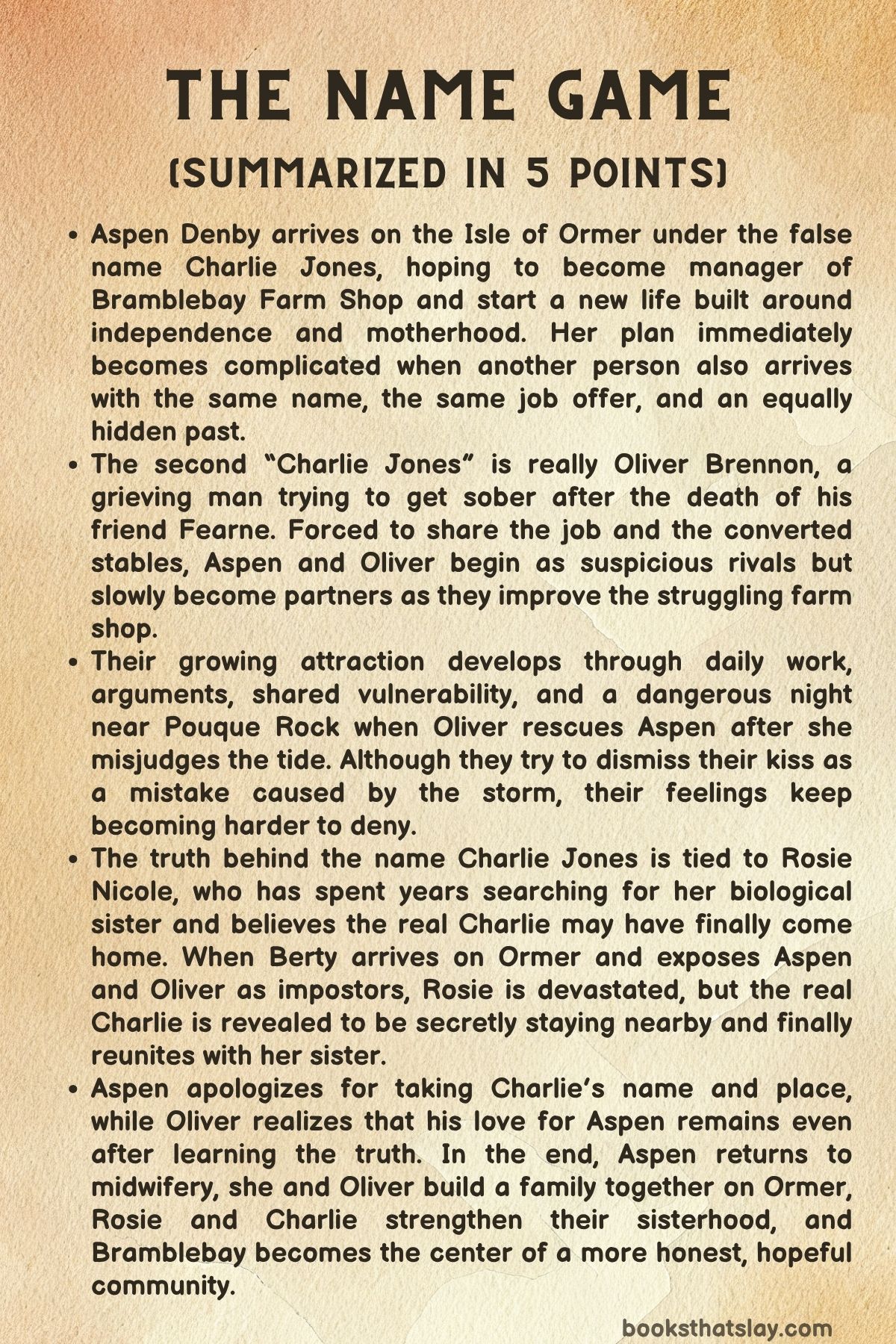
Summary
Aspen Denby arrives on the Isle of Ormer using the name Charlie Jones. She has come to take over as manager of Bramblebay Farm Shop, imagining that the island will give her the independent, settled life she has been trying to create.
Aspen wants a home of her own, a meaningful job, and the chance to have a baby without waiting for a partner. The journey to Ormer immediately tests that dream.
At the harbor, she is nearly struck by cargo, knocked aside by a rude man in a “CJ” cap, and left flustered before she has even reached her destination. She meets Red, a bright and friendly tour guide, and Rog, an odd-job man who helps her travel toward the Rue.
After a difficult ride on a tractor trailer, Aspen gets lost among cows, crawls through a hedge, tears her dress, scratches her legs, and finally reaches Bramblebay Farm Shop looking far less composed than she had hoped.
Inside the shop, Aspen receives a shock. The rude man from the harbor is already there, and he also says he is Charlie Jones.
He has the same job-offer letter she has, and he insists that the manager’s position belongs to him. Rosie Nicole, who runs Bramblebay with her wife Marly, is stunned to find two people claiming the same name and the same job.
Since neither Aspen nor the man will step aside, Rosie creates a temporary solution: they will share the job for two months on half pay. The housing arrangement becomes just as uncomfortable.
The converted stables were meant for one person, but both of them must live there together. To avoid confusion, Aspen continues going by Charlie, while the man starts using Jones.
Jones is really Oliver Brennon. He has come to Ormer because his life has fallen apart after the death of his friend Fearne in a biking accident.
Her death left him buried in grief, depression, and alcohol, and the island job is meant to be a chance to get sober and survive somewhere new. He writes emails to the real Charlie Jones, the woman who originally applied for the Bramblebay job.
Aspen is also hiding the truth. She is not Charlie Jones either.
She is a former midwife whose longing for motherhood has grown urgent, and her sister Brianna pushed her toward the job after learning that the real Charlie was not going to use it. Both Aspen and Oliver have arrived under false pretenses, each believing the other is the true impostor.
At first, Aspen and Oliver are enemies. They argue over the job, the stables, and control of the shop.
They suspect each other of dishonesty while carefully hiding their own lies. Marly distrusts them and is far less willing than Rosie to forgive the strange situation.
Rosie, however, senses that both newcomers are carrying hurt, even if she does not yet know the details. Aspen and Oliver meet the rest of the Bramblebay world: Rog, Galoshes, Red, and shy Toby, along with the island committee of local producers who have strong opinions about how the shop should be run.
Their first major committee meeting is a disaster. Galoshes humiliates Aspen, making her feel like an outsider who has no right to change anything.
Then a large pig invades the shop, throwing the meeting into chaos. In the commotion, Oliver acts quickly to protect Aspen, pinning her against the wall to shield her.
The physical closeness rattles them both. They are still rivals, but the moment proves that beneath Oliver’s sharpness is instinctive care, and beneath Aspen’s defensiveness is a woman who is frightened by how easily he can affect her.
As they continue working together, Aspen and Oliver slowly begin to improve Bramblebay Farm Shop. They clean, repaint, arrange displays, add clearer signs, plan coffee and biscuits, and try to make the shop more appealing to visitors without pushing away island regulars.
Their work forces them into close daily contact, and their rivalry begins to turn into a tense partnership. Galoshes resists many of their ideas, but Aspen gradually learns to stand up to her instead of shrinking back.
Oliver also starts building trust with Marly, who recognizes his struggle with alcohol because she is sober herself. Through Marly, Oliver receives the kind of direct understanding he cannot easily accept from others.
Aspen’s anxiety grows alongside her attraction to Oliver. She wants the island to be her clean start, but the life she is building rests on a stolen name.
She writes in her diary, tries to stay focused on her plan for motherhood, and worries that the truth will destroy everything. Oliver is also trying to avoid connection, but Ormer keeps pulling him into the community.
The farm shop, the local staff, Rosie’s kindness, Marly’s honesty, and Aspen’s presence all challenge his desire to remain detached.
Their feelings become impossible to ignore after Aspen misjudges the tide near Pouque Rock and gets stranded. Oliver runs after her in the rain, terrified and furious.
They argue intensely, take shelter near the lighthouse, and kiss. Afterward, they try to dismiss the kiss as “rain madness,” but both know something has changed.
They begin holding proper comanager meetings, communicate better, and start working as an actual team. Bramblebay improves, and their emotional bond deepens even as their secrets become more dangerous.
Other mysteries begin to surface around the farmhouse and the name Charlie Jones. Aspen catches Rog taking money from the till and assumes he is stealing.
Later, she learns the money is petty cash connected to B&B guests Rosie quietly shelters, revealing that the farm is part of a larger network of care. Oliver discovers Puffin room, an empty bedroom in the farmhouse that Rosie has kept ready for years.
Aspen later searches the room and finds a list of people named Charlie Jones. Neither Aspen nor Oliver understands why Rosie and Marly are so focused on that name.
The reason is tied to the real Charlie Jones. Charlie is adopted and has known through an ancestry app that Rosie Nicole is her biological sister.
Rosie has spent years searching for her unknown sibling, knowing only the name Charlie Jones. When the real Charlie applied for the Bramblebay job, Rosie believed she might finally be coming home.
But Charlie was grieving Fearne, struggling with alcohol, separated from her husband Berty, and not ready to meet Rosie. After Oliver discovered Charlie’s hidden alcohol stash, Charlie decided she needed sobriety before facing her birth family.
She gave the job offer to Oliver so he could take the fresh start in her place.
Aspen’s path to the false identity comes through Brianna. Aspen had dated Berty after his separation from Charlie, but the relationship ended when Berty admitted that he did not want children and still loved his wife.
Brianna, fiercely loyal to Aspen, learned that Charlie was not going to Ormer and urged Aspen to take the opportunity. Aspen, desperate for a new life and a chance to pursue motherhood, accepted.
This is how two impostors arrive on the island carrying identical letters and claiming the same future.
The truth explodes when Berty arrives on Ormer looking for Charlie. In front of much of the island, he recognizes both Oliver and Aspen and reveals that neither of them is Charlie Jones.
Rosie is crushed, Marly is furious, and the community realizes it has been deceived. Oliver admits that the real Charlie is secretly staying in Puffin room.
Rosie finally learns that her actual sister is in the farmhouse, and the two women meet. Charlie sees the room Rosie kept for her, the mural Toby painted, and the keepsake box containing a baby photo, a knitted hat, and a note from her birth mother.
The room proves that Rosie has wanted her for years and that Charlie was never unwanted.
Aspen apologizes to Charlie for stealing her name, her job, and her place. Charlie does not excuse the deception, but she gives Aspen practical tasks to make amends: give up the farm shop job, lend her hiking boots, and save a dance for Oliver.
Aspen chooses not to run from the island’s judgment. At the barn dance, she faces the people she deceived and accepts responsibility for what she has done.
Oliver, hurt by Aspen’s lie but still in love with her, struggles with what he now knows. A rumor leads him to believe Aspen is pregnant, though the rumor began because Aspen was protecting Red, who is actually pregnant by Toby.
Oliver chases Aspen to Windward Ridge and tells her that he knows and loves her anyway. Later, at the stables, Aspen explains the truth: she is not pregnant, but she has begun fertility treatment with a donor.
Oliver tells her he wants a family and would love her child no matter how that child comes into the world. They admit their love openly and choose a future together.
Aspen decides to return to midwifery and argues that Ormer needs proper maternity care. Her original dream changes but does not disappear; it becomes more honest.
In the future, Aspen and Oliver remain on Ormer with their daughters, Effie and Hunter. Bramblebay and the island community thrive.
Rosie and Charlie continue building their sisterhood, Berty and Charlie reunite, Marly and Rosie foster children, and Aspen finally has the full life she came to find: not a life built on a borrowed name, but one shaped by love, truth, work, and belonging.
Characters
Aspen Denby / Charlie Jones
Aspen Denby is the emotional center of The Name Game, a woman who arrives on Ormer with courage, desperation, and a lie all bound together. Her decision to use Charlie Jones’s name is wrong, but the book makes clear that it comes from fear rather than malice.
Aspen wants a stable home, meaningful work, and motherhood, and she has reached a point where she feels she must act boldly or lose the future she wants. Her background as a midwife shows her deep connection to birth, care, and family, but it also sharpens the pain of wanting a child while feeling unsupported by romantic relationships.
On Ormer, Aspen is often anxious and defensive, but she is also practical, determined, and capable of growth. Her clashes with Oliver and Galoshes force her to become more assertive, while her bond with the island teaches her that a new life cannot be built honestly if it begins with deception.
By the end of the book, Aspen’s strength lies not in pretending to be someone else, but in accepting her own name, her own mistakes, and her own future.
Oliver Brennon / Jones
Oliver Brennon begins the story guarded, rude, and emotionally closed off, but the book gradually reveals that his behavior is rooted in grief, guilt, depression, and addiction. Fearne’s death has left him unable to live normally, and his decision to take Charlie Jones’s job offer is part escape, part survival attempt.
Like Aspen, he is an impostor, but unlike Aspen, he is also trying to protect the real Charlie by giving her space to recover. Oliver’s journey on Ormer is closely tied to sobriety.
His bond with Marly matters because she understands recovery without romanticizing it, and she sees the work he is doing even when he tries to hide it. Oliver’s relationship with Aspen brings out his tenderness, protectiveness, humor, and desire for family.
His love for her becomes meaningful because it survives disappointment and truth. When he accepts Aspen’s fertility journey and says he would love her child however that child comes into the world, he shows that his recovery is not only about staying sober, but also about becoming capable of lasting love and responsibility.
Rosie Nicole
Rosie Nicole is warm, generous, and emotionally open, but her kindness is also shaped by a long private ache. She has spent years searching for her biological sibling, knowing only the name Charlie Jones, and this longing explains why she is so affected by the arrival of two people claiming that identity.
Rosie’s gentleness toward Aspen and Oliver is not foolishness; she senses pain in them and chooses compassion before suspicion. At the same time, her devastation when the truth comes out is completely justified.
The false Charlies have not only lied about employment; they have stepped into a space Rosie prepared for someone deeply important to her. Puffin room reveals the depth of Rosie’s hope.
The baby photo, knitted hat, note, and mural show that she has preserved a place for Charlie not as an idea, but as family. Rosie’s reunion with Charlie gives the book one of its strongest emotional resolutions.
She represents the kind of belonging Aspen wants and Oliver fears: patient, imperfect, but ready to welcome people home.
Marly
Marly is Rosie’s wife and one of the most grounded figures in the novel. Unlike Rosie, she does not immediately soften toward Aspen and Oliver, and her suspicion gives the story a necessary moral balance.
Marly understands that kindness must have limits when people are being dishonest, and her anger after the truth is revealed is not harshness but protection. She protects Rosie, the farm, and the trust of the island community.
Marly’s sobriety also makes her essential to Oliver’s development. She recognizes his struggle with alcohol because she has lived through her own version of it, and this allows her to speak to him with clarity rather than pity.
Her support is practical, unsentimental, and deeply valuable. Marly also shows a strong capacity for care through her life with Rosie, her role in Bramblebay, and the later decision to foster children.
She is not the loudest character, but she is one of the strongest anchors in The Name Game, keeping love connected to honesty and accountability.
The Real Charlie Jones
The real Charlie Jones is absent from much of the early action but becomes central to the truth behind the entire mistaken-identity situation. She is adopted, grieving Fearne, struggling with alcohol, separated from Berty, and emotionally unready to meet Rosie despite knowing Rosie is her biological sister.
Charlie’s decision not to go to Ormer is not simple avoidance; it reflects a woman who knows she is not stable enough to face a life-changing reunion. Giving the job offer to Oliver is both an act of care and a way of stepping away from pressure she cannot handle.
When Charlie finally enters Puffin room and sees what Rosie has kept for her, her story shifts from fear of rejection to acceptance of being wanted. Her reaction to Aspen is also revealing.
She does not erase the harm Aspen has done, but she gives Aspen a chance to make amends through action rather than empty apology. Charlie’s reunion with Rosie and renewed connection with Berty give her a path toward healing that is based on truth rather than escape.
Berty
Berty is important because his arrival forces the hidden truths into the open. Before he appears on Ormer, he is already connected to several emotional threads: he is Charlie’s estranged husband, Aspen’s former partner, and the man whose unresolved love for Charlie ended his relationship with Aspen.
His honesty with Aspen about not wanting children and still loving his wife causes her pain, but it also prevents their relationship from continuing under false hope. When Berty comes looking for Charlie, he unintentionally destroys the false identities that Aspen and Oliver have been using.
His presence exposes the deception publicly, but it also clears the way for Rosie to meet her real sister and for Aspen and Oliver to stop hiding. Berty’s reunion with Charlie suggests that his earlier love for her was not merely nostalgia.
He represents the unfinished past returning at exactly the moment when every lie must be answered.
Brianna
Brianna is Aspen’s sister and the person who helps set Aspen’s deception in motion. Her loyalty to Aspen is intense and protective, but it is also reckless.
She sees Aspen’s disappointment after Berty, her longing for motherhood, and her need for a fresh start, then pushes her toward the Bramblebay opportunity once she knows the real Charlie will not use it. Brianna’s choice comes from love for her sister, but the novel shows that loyalty can become dangerous when it ignores the rights and feelings of others.
She helps Aspen take a place that was never truly hers, and that decision causes harm to Rosie, Charlie, Oliver, and the island community. Still, Brianna is not presented as cruel.
She is a flawed supporter who wants Aspen to have the life she deserves but chooses the wrong way to help her get it. Her role adds moral complexity to Aspen’s decision because it shows how easily care can become permission for dishonesty.
Red
Red brings warmth, humor, and energy to Ormer, and she helps Aspen experience the island as a living community rather than just a place to hide. As a cheerful tour guide, she represents the open, social side of the island, but her own secret pregnancy shows that she is also managing private fears.
Red’s pregnancy by Toby becomes part of the misunderstanding that leads Oliver to believe Aspen is pregnant. Aspen’s decision to cover for Red reveals Aspen’s instinct to protect another woman’s privacy, even while her own lies are causing damage elsewhere.
Red also helps balance the story’s heavier material with friendliness and local color. Her relationship with Toby suggests a quieter kind of young love, one that is uncertain but sincere.
Through Red, the book connects Aspen’s concern with motherhood to the broader reality of women needing support, privacy, and care during pregnancy.
Toby
Toby is shy, gentle, and artistically important to the emotional life of Bramblebay. His mural in Puffin room becomes part of Rosie’s long act of love for Charlie, turning the room into more than a spare bedroom.
It becomes a visual promise that the lost sister has a place in the family. Toby’s relationship with Red also places him in a vulnerable position, especially once her pregnancy becomes part of the story’s confusion.
He is not as forceful as other island figures, but his quietness matters. Toby contributes through care, art, and emotional sincerity rather than confrontation.
His character shows how a community is built not only by loud leaders and dramatic choices, but also by people who make spaces feel safe, personal, and remembered.
Rog
Rog first appears as a helpful odd-job man, and later becomes part of a misunderstanding when Aspen sees him taking money from the till. Her assumption that he is stealing reflects how little she initially understands about Bramblebay’s hidden systems of care.
The truth, that the money is connected to guests Rosie quietly shelters, reveals Rog as someone participating in the farm’s wider compassion. He is practical, local, and woven into the daily functioning of the island.
Rog’s role also teaches Aspen that not everything strange is corrupt, and not every secret is selfish. Some secrets exist because people are protecting others.
Through Rog, the story contrasts Aspen’s self-protective lie with Rosie’s quiet generosity, helping Aspen understand that community depends on trust, context, and humility.
Galoshes
Galoshes is one of Aspen’s strongest early obstacles. She resists change, humiliates Aspen, and acts as though the shop belongs more to the old island order than to anyone trying to improve it.
Her hostility makes Aspen feel unwelcome and exposes the pressure Aspen faces as an outsider pretending to have authority she has not earned. Yet Galoshes also serves an important function in the story.
She represents the local resistance that any newcomer must navigate, especially when that newcomer arrives with secrets and big plans. Aspen’s growing ability to stand up to Galoshes marks one of her first steps toward confidence.
Galoshes is not simply a comic antagonist; she is a test of whether Aspen can claim space honestly, firmly, and with respect for the community she wants to join.
Fearne
Fearne’s death shapes Oliver’s inner life even though she is not present in the main action. Her biking accident leaves Oliver devastated, pushing him into depression and heavy drinking.
She is also connected to Charlie’s grief, making her loss part of the bond between Oliver and the real Charlie. Fearne functions as a reminder that the characters who arrive on Ormer are not only running toward new beginnings, but also away from pain they have not fully faced.
Oliver’s recovery cannot happen until he stops using distance, anger, and alcohol to avoid that grief. Fearne’s absence gives emotional weight to Oliver’s guarded nature and helps explain why the island’s gradual pull toward connection matters so much.
Her role is small in direct action but large in consequence.
Themes
Identity, Reinvention, and the Cost of a Borrowed Name
Aspen and Oliver both arrive on Ormer using the name Charlie Jones, and the false name gives them temporary access to lives they desperately need. For Aspen, the name offers a chance to become independent, start fertility treatment, and build the stable future she wants.
For Oliver, it offers distance from grief, drinking, and the wreckage of his old life. At first, the borrowed identity seems practical, almost like a loophole.
Yet the longer they stay, the more the false name becomes a moral problem. Rosie has attached years of hope to Charlie Jones, and Aspen and Oliver unknowingly step into a space prepared for a lost sister.
The Name Game shows that reinvention is not wrong, but it cannot depend on erasing another person’s truth. Aspen and Oliver do change their lives on Ormer, but only after the lie collapses.
Their real new beginning starts when they stop performing as Charlie Jones and face the consequences as themselves.
Honesty as the Foundation of Belonging
Ormer first appears to Aspen as a place where she can disappear into a new life, but the island turns out to be a place where secrets cannot stay private for long. The community is close, watchful, and sometimes intrusive, yet it also offers real care.
Bramblebay Farm Shop improves because Aspen and Oliver work hard, listen, and slowly begin to cooperate. Still, their contributions cannot erase the fact that they entered the community dishonestly.
Rosie’s pain after the truth comes out is so powerful because belonging has emotional rules as well as practical ones. The island can forgive mistakes, but forgiveness requires confession, accountability, and repair.
Aspen’s decision to attend the barn dance instead of running away marks an important shift in her character. She accepts that staying on Ormer means facing people as herself.
The theme becomes clear through her journey: belonging is not earned by being useful, charming, or needed. It is earned by being truthful enough to be known.
Grief, Sobriety, and Learning to Stay
Oliver’s story is shaped by the death of Fearne and by his attempt to get sober after grief has driven him toward alcohol and isolation. His move to Ormer is not a clean escape from pain; it is a difficult attempt to survive somewhere that does not yet know him.
The book treats recovery as daily work rather than a sudden transformation. Marly’s role is especially important because she understands sobriety from experience and gives Oliver support without turning him into a project.
The island also challenges him in quieter ways. He begins to care about the shop, trust Rosie and Marly, protect Aspen, and become part of the community even when closeness frightens him.
His love for Aspen matters because it does not rescue him from grief; instead, it shows that he is becoming able to stay present with another person. Recovery in the story is not only about avoiding alcohol.
It is about choosing connection, responsibility, and a future after loss.
Family, Motherhood, and Chosen Care
The story presents family as something biological, chosen, repaired, and created through care. Rosie’s search for Charlie shows the ache of lost blood connection, while Puffin room proves that love can exist for someone long before reunion.
Charlie’s discovery of the room, the keepsakes, and Rosie’s patience gives her a new understanding of her birth family: she was wanted, remembered, and waited for. Aspen’s longing for motherhood runs beside this story.
She does not want a child as an accessory to romance; she wants motherhood as a central part of her life, and she is willing to pursue fertility treatment with a donor. Oliver’s acceptance of her path expands the idea of family even further.
He loves Aspen without requiring her dream to change shape for him. Marly and Rosie fostering children also reinforces the book’s belief that care makes family real.
Across these relationships, family is not limited to one form. It is built through commitment, protection, truth, and the willingness to make room for someone.