The Night We Lost Him Summary, Characters and Themes
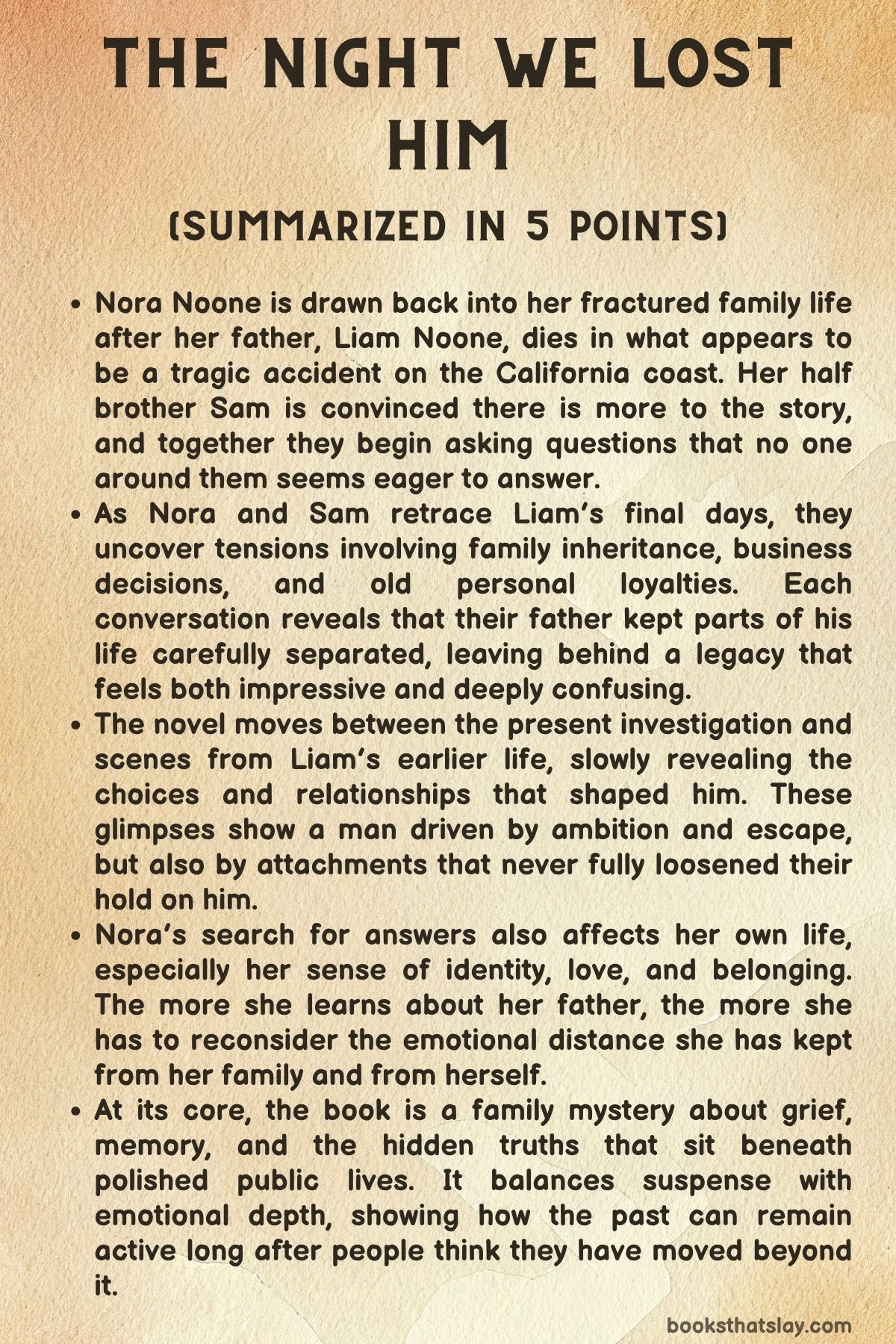
The Night We Lost Him by Laura Dave is a family mystery built around grief, inheritance, old love, and the stories people protect for decades. The novel follows Nora Noone after the sudden death of her estranged father, Liam, a powerful real estate developer whose fall from a cliff is first ruled accidental.
When her half brother Sam begins to suspect something is wrong, Nora is pulled into an investigation that forces her to look again at her father’s life, his marriages, his business, and the hidden bond that shaped him more than anyone knew. The book combines suspense with family drama and asks how well children can ever know their parents.
Summary
Liam Noone, a wealthy real estate developer, dies after falling from the cliffs near his coastal cottage in California, a place called Windbreak. The death is first treated as an accident, but from the beginning there are signs that the explanation may be too simple.
Liam had built a career creating luxury properties far from the Brooklyn childhood he wanted to escape, yet Windbreak remained the one small, private place he kept for himself for more than thirty years. In his final moment, he thinks not of his empire but of protecting his children.
After his death, his daughter Nora learns that Liam’s will has been changed. Most of his business is left to Sam and Tommy, his twin sons from his second marriage, while Windbreak is left to Nora.
She is surprised by the choice, especially because she had never been close to Liam. Nora has made her own career as an architect in Brooklyn and has always kept emotional distance from her father’s money and business world.
She is still carrying the pain of her mother’s recent death and has cut herself off from much of her family. Still, when Sam tells her he believes Liam was pushed, she agrees to travel with him to California and look into it.
At Windbreak, Nora and Sam meet the detective who handled the case. They discover several troubling facts.
Someone familiar with Liam’s security system could have entered the property without much trouble. There was also an unknown man seen on the beach that night by witnesses, but he was never identified or questioned.
These details are enough to convince Nora that Sam may be right. What first looked like grief-driven suspicion begins to feel like a real possibility.
As Nora and Sam start asking questions, they uncover confusion around Liam’s final months. Liam had apparently considered selling Noone Properties to Cece Salinger, a successful hotel magnate with a long history in his life.
Sam is stunned because he had worked closely in the company and knew nothing about such a major decision. Joe, Liam’s cousin and longtime business partner, confirms that sale papers were drafted but says Liam changed his mind.
Cece admits Liam contacted her the night he died, but she is guarded and refuses to explain everything. The more Nora and Sam ask, the clearer it becomes that many people close to Liam are withholding information.
Running alongside this present-day investigation is the story of Liam’s younger life. As a teenager in Brooklyn, he meets a girl named Cory, who becomes the great love of his life.
Their relationship is shaped by timing, ambition, and repeated separation. Liam leaves for Yale, determined to build a life larger than the one he was born into, while Cory makes choices that are practical rather than romantic.
Over the years they keep finding their way back to each other, even as marriages, careers, and distance make a full life together impossible. Liam marries other women.
Cory does too. Yet their connection never truly ends.
Back in the present, Nora’s own life starts to crack under the strain of the investigation. Her relationship with her fiancé Jack has already been unsettled by her emotional distance and her renewed contact with Elliot, a former love.
Jack, patient for a long time, finally decides to leave for California to help open a restaurant, making it clear that Nora must decide what she wants from her own life. This loss deepens Nora’s loneliness but also forces her to stop drifting.
Her father’s death is no longer just a mystery to solve. It becomes part of a larger reckoning with the choices people make when they avoid the truth.
Nora and Sam continue tracing Liam’s final connections. Liam’s phone is missing, his laptop cannot be found, and key company records are incomplete.
Grace, a senior executive at Noone Properties who died the year before, begins to stand out as central to the mystery. Her belongings were partly taken by Joe after her death, and even her husband, the famous photographer Paul Turner, acts uneasy when Nora and Sam ask questions.
Tommy, meanwhile, has been doing his own private digging, which adds tension between him and Sam. The brothers’ relationship is strained by rivalry, secrets, and different ideas about loyalty.
As the investigation widens, Nora starts seeing how much of her father’s life was hidden behind carefully separated roles: husband, father, employer, friend. She also starts understanding that the emotional truth of his life may not match the public version.
The breakthrough comes when Nora visits Liam’s childhood home and finds “Cory & Liam” carved into a closet. Later, while looking through old school materials, she discovers that Cory was actually Cordelia, and that Cordelia became Grace, the same Grace who later worked beside Liam for decades.
This revelation changes everything. Grace was not simply a trusted colleague.
She was Liam’s lifelong love. Joe finally explains the fuller story.
After Liam bought his company, he brought Grace into the business, giving her a role that used her intelligence and writing talent. Together they built Noone Properties into what it became.
He intended to leave the company to her, not because of business convenience but because she had helped create its vision. When Grace died, Liam was devastated.
Only then did he accept that the company should pass to his sons instead.
Other mysteries now fall into place. Liam’s possible sale to Cece had less to do with romance than with grief and uncertainty after Grace’s death.
Cece herself turns out to be involved not with Liam but with Joe. Windbreak, Joe says, had always been meant for Nora.
Liam believed Nora, with her eye for design and her independence, would know what to do with it.
Once Nora understands Grace’s importance, she also understands who was most likely at Windbreak that night. Grace’s husband, Paul Turner, had known about the lasting bond between Grace and Liam.
He had loved Grace deeply but always lived with the knowledge that some part of her belonged elsewhere. Nora and Sam confront him, and he confesses.
He had gone to Windbreak to scatter Grace’s ashes there, honoring her wish. Liam arrived unexpectedly.
The two men argued, emotions rose, and Paul shoved him. He insists he did not mean to kill Liam, but on the wet cliffside Liam lost his footing and fell.
Paul fled in panic, becoming the unidentified man seen by witnesses.
The confession brings the case to a close, but the ending of the novel is less about punishment than about understanding. Nora sees that the tragedy grew out of decades of compromise, longing, resentment, and unfinished love.
Liam had hurt people, but he had also carried private sorrow for years. Paul was responsible for Liam’s death, yet he too was broken by a life lived in the shadow of someone else’s connection.
Nora’s response is shaped more by empathy than rage.
In the aftermath, Sam reevaluates his own choices. He decides not to marry Morgan and leaves the family company to pursue work that suits him better.
Nora begins rebuilding her life with more honesty. She spends time at Windbreak and works on nearby design projects, making use of the gift her father left her.
She also realizes that she still loves Jack and seeks him out in California. Their reunion is cautious but hopeful, echoing the possibility that not every relationship damaged by silence is beyond repair.
By the end, Nora has solved her father’s death, but more importantly, she has come to see him as a full and flawed person rather than a distant, puzzling parent. The mystery opens a path not only to the truth of what happened on the cliff, but to the deeper truth of who Liam Noone was.
Characters
Nora Noone
Nora is the emotional center of the novel and the character through whom the reader most fully experiences grief, distance, and discovery. She begins as someone who has deliberately built a life apart from her father’s wealth and influence.
Her career as an architect matters because it reflects her need to make something with her own hands, on her own terms, rather than inherit a ready-made identity. At the start, she seems composed and capable, but that surface control hides deep isolation.
Her mother’s death has left her emotionally cut off, and her estrangement from much of her family is not rooted in simple bitterness so much as fatigue, hurt, and habit. She is someone who has survived by narrowing her world.
What makes Nora compelling is that her investigation into Liam’s death is also an investigation into herself. As she uncovers secrets about her father, she is forced to confront how little she allowed herself to know him and how much of her life has been shaped by avoidance.
She is observant, intelligent, and patient in ways that complement Sam’s more reactive energy. She notices small emotional shifts, guarded expressions, and contradictions in people’s stories.
That instinct makes her a strong investigator, but it also reveals her deeper gift: she can see structure inside emotional chaos. This suits her profession and her personality.
She does not rush to judgment, and even when she is hurt, she keeps trying to understand.
Her personal life adds another layer to her character. Her bond with Jack is threatened not by dramatic betrayal alone, but by her inability to remain fully present.
Her contact with Elliot shows that she is still drawn to unresolved emotional spaces, and that she is not always honest with herself about what she is doing. Nora is not written as flawless or morally neat.
She can be defensive, emotionally unavailable, and late to admit what she truly wants. That makes her growth more convincing.
By the end, she becomes someone more willing to choose connection instead of retreat. Her inheritance of Windbreak is meaningful not just as property, but as a sign that her father understood something essential about her.
In The Night We Lost Him, Nora becomes a fuller version of herself by learning that truth and love can exist inside complicated histories.
Liam Noone
Liam is the absent presence who shapes every part of the story. Though he dies before the main plot begins, he remains the most influential force in the novel because everyone around him is still living inside the consequences of his choices.
He is introduced as a man defined by escape. His ambition grows from a desire to get as far as possible from the insecurity and limits of his childhood.
That drive makes him successful, but it also creates the emotional pattern that governs his life: he builds, acquires, and manages, yet he keeps real intimacy divided into separate rooms. He maintains contact with former wives, children, friends, and lovers, but he does so through compartmentalization rather than true integration.
He wants to hold on to everyone without fully reconciling the costs.
Liam is not easy to judge because the novel presents him as both loving and damaging. He is capable of genuine care.
He remembers what matters to his children, believes in Nora’s talent, and has a strong long-term vision for the people and places he values. At the same time, he leaves behind confusion because he is never fully transparent.
He is the kind of man who can be kind without being entirely available, devoted without being straightforward, and loyal without being simple. His relationships with his former wives show this complexity.
He remains connected to them, but that continued closeness also suggests a refusal to let emotional chapters end cleanly.
His deepest emotional truth lies in his lifelong love for Cory, later known as Grace. That relationship explains the private side of him more clearly than anything else.
Grace represents the life he could never completely have and never completely leave behind. His decisions about the company, Windbreak, and even his final years only become legible once that bond is revealed.
Liam’s tragedy is that he spends much of his life trying to preserve multiple versions of love and duty at once. He is not a villain, but he leaves pain in his wake because he cannot make clean emotional choices.
His death matters as a mystery, but his life matters more as a study of how longing, ambition, and loyalty can coexist in one person without ever settling into peace.
Sam Noone
Sam begins as the force that sets the story in motion. He is the one who refuses to accept the official explanation of their father’s death, and his suspicion pushes Nora into the investigation.
At first, he can seem impulsive, sharp-edged, and difficult. He often enters conversations with anger already visible, and he is less controlled than Nora in both speech and emotion.
Yet this restlessness is part of what makes him believable. Sam is carrying grief, confusion, and resentment at the same time.
His role in the family business has tied him tightly to Liam’s world, so his father’s death is not just personal loss but also a rupture in identity. He has inherited responsibility without clarity.
One of the most interesting things about Sam is that his toughness often hides instability rather than confidence. He wants answers, but he also wants reassurance that his life has not been built on false assumptions.
The revelation that Liam nearly sold the company without telling him cuts deeply because it suggests that his closeness to his father may have had limits he did not want to see. His tension with Tommy points to old sibling rivalries, but it also shows a broader struggle over who understood their father best and who has the right to carry his legacy.
Sam’s anger is often the language of someone who feels shut out.
His romantic storyline adds depth to his character. His engagement to Morgan appears increasingly disconnected from his emotional reality, especially once it becomes clear that he has not moved on from Taylor.
This does not make him cruel so much as conflicted and immature in ways the novel recognizes without excusing. He is still trying to live up to a version of himself that does not fit anymore.
Over the course of the story, Sam becomes more open, more reflective, and more honest about what he actually wants. His decision not to marry Morgan and to leave the company suggests real growth.
He is a man stepping away from inherited expectation and toward a life that feels earned rather than assigned.
Tommy Noone
Tommy occupies a smaller part of the page, but he plays an important role in the emotional structure of the family. He is Sam’s twin and shares the same inheritance, yet he operates differently.
Where Sam is openly volatile, Tommy is more difficult to read. He keeps information close and seems to move quietly around the edges of the same mystery, conducting his own inquiries without offering explanations.
This makes him appear suspicious at first, but that impression is partly created by the fractured communication within the family. Tommy is less a hidden villain than another person shaped by Liam’s secretive style.
His relationship with Sam appears marked by affection that has curdled into distrust. The novel suggests years of comparison, competition, and unresolved tension between them.
They are bound not only by family but by the same professional inheritance, and that shared position seems to have intensified their differences rather than softened them. Tommy’s guardedness may look cold, but it can also be read as self-protection.
He does not perform his feelings as openly as Sam, and that allows others to misread him.
Tommy also contributes to the broader theme that no one in this family has been taught to speak plainly until crisis forces the issue. His search for answers about Cece and Paul shows that he was not passive.
He simply chose a different route, one that kept him distant from Sam and Nora. That distance means he never becomes the emotional center of the novel, but he remains significant as a mirror of what the family has become: connected by blood, separated by silence.
Grace Turner / Cory / Cordelia
Grace is the novel’s hidden axis. For much of the story, she seems to be a respected company executive whose death affected Liam deeply, but once her earlier identity as Cory is revealed, the entire emotional architecture of the novel changes.
She is not only Liam’s longtime colleague but the great love of his life, a woman who has moved through his story under different names and different social roles without ever losing her central importance. Her transformation from Cory to Grace also reflects the way people adapt themselves to survive disappointment, compromise, and time.
As a young woman, Cory is intelligent, ambitious, and emotionally clear-eyed. She understands both Liam’s hunger to escape his beginnings and her own need for a meaningful life.
Again and again, she refuses to become a romantic accessory to his ambition or to let their love automatically dictate her future. That self-possession gives her unusual strength.
She is not written as an idealized lost love; she is someone who makes difficult choices, often practical ones, and lives with their consequences. When illness, family obligation, and circumstance pull her away from her academic path, the loss is profound.
Her move into a more practical professional life carries a quiet sadness, because it shows how often talent is redirected by necessity.
As Grace, she becomes one of the architects of Liam’s company, helping shape the vision behind the business he publicly leads. This makes her important not only romantically but intellectually and creatively.
She is not the secret woman in the background of a powerful man’s life. She is a genuine partner in the making of his world.
At the same time, her relationship with Liam remains unfinished in a painful way. She loves him, but she never fully merges her life with his.
She seems to understand better than he does that love does not erase complication. Her refusal of his repeated proposals is not a rejection of feeling, but an acknowledgment that timing, structure, and reality matter.
Grace carries one of the novel’s deepest emotional truths: some relationships define a life even when they never become socially complete. Her death destabilizes Liam because it removes the person who knew him most completely.
It also sets the final tragedy in motion. She is, in many ways, the soul of the story.
Paul Turner
Paul is one of the most tragic characters because he is both guilty and deeply wounded. At first, he appears only as Grace’s famous photographer husband, a man with possible access to useful information.
His evasiveness makes him suspicious, but the full truth reveals a more painful emotional history. He loved Grace sincerely, perhaps with a kind of wholehearted devotion that Liam, for all his intensity, could never offer in a conventional form.
Yet Paul seems to have always known that part of Grace’s heart remained elsewhere. This makes him less simply jealous than chronically overshadowed.
His final confrontation with Liam at Windbreak carries the weight of years of humiliation, grief, and unresolved rivalry. He is not presented as a scheming murderer.
He is a man whose pain has been sharpened by bereavement and by the knowledge that even after all the years of marriage, the place Grace chose for her ashes belonged emotionally to Liam. That detail is devastating because it confirms the hierarchy Paul had likely feared all along.
His shove may be impulsive, but it comes from a long emotional buildup. The novel does not absolve him, yet it does allow room to see the human wreckage behind the act.
What makes Paul memorable is that his confession reshapes the tone of the mystery. The final answer is not about greed or a simple family conspiracy.
It is about accumulated emotional damage. Paul becomes the embodiment of how unbearable it can be to live beside a love story you cannot defeat.
His presence broadens the novel’s moral landscape, because he is both responsible and pitiable, both wrong and understandable in ways that make the ending more sorrowful than triumphant.
Jack
Jack represents steadiness, history, and the kind of love that asks for presence rather than drama. He and Nora share a long connection that reaches back to childhood, which gives their relationship an easy familiarity and emotional credibility.
He is caring, capable, and attentive, the kind of partner who offers support without making a spectacle of it. His willingness to listen to Nora, to hear about her father’s death, and even to offer to accompany her shows real devotion.
He is not indifferent or weak; he is patient.
What makes Jack effective as a character is that he eventually stops being patient in silence. He sees that Nora is emotionally somewhere else, divided between grief, family upheaval, and unresolved ties to Elliot.
Instead of turning cruel, he chooses distance. That decision gives him dignity.
He does not punish Nora, but he also does not remain available in a relationship where he is no longer being fully met. His departure to California is therefore not just a plot development.
It is the moment when the novel insists that kindness has limits and that emotional absence can be as destructive as open betrayal.
Jack’s importance lies in what he reveals about Nora. Through him, the story shows that love requires choice and clarity, not only history and affection.
When Nora later realizes how much she loves him and goes to find him, the reunion matters because Jack has not been written as a placeholder. He is someone worth choosing, and the narrative treats that choice seriously.
Elliot
Elliot functions as both a person and a pressure point in Nora’s life. He is tied to her past, to unresolved feeling, and to a version of intimacy that remains undefined enough to be tempting.
His calls and presence create tension not because he is overtly manipulative, but because he represents unfinished business. Nora’s inability to fully disengage from him reveals how vulnerable she is to relationships that remain suspended rather than settled.
He also has narrative importance because of his professional link to Grace and Liam. As Grace’s cardiologist, he knows more than he is comfortable sharing, and his guardedness contributes to the sense that many people around Liam’s life are constrained by private knowledge.
Elliot therefore operates on two levels: he complicates Nora’s romantic life, and he serves as another example of how secrecy shapes the story.
As a character, Elliot is less fully developed than Jack or Sam, but that relative vagueness suits his role. He is not meant to become Nora’s final emotional destination.
Instead, he reveals the danger of emotional drift. He is the person Nora turns toward when she has not yet decided what she truly wants, and that makes him important to her development even if he is not her future.
Cece Salinger
Cece is one of the novel’s most carefully misdirecting figures. She initially appears as a likely source of danger because she is linked to Liam’s past, to the possible sale of the company, and to unanswered calls on the night he died.
Her success as a hotel magnate also places her in a position of corporate and personal relevance. She is polished, self-contained, and selective in what she reveals, which naturally makes others suspicious.
Yet Cece’s role is less that of hidden villain than keeper of a separate strand of the past. She belongs to Liam’s old world of friendships, ambition, and unresolved loyalties.
Her evasiveness is real, but it comes more from discretion and emotional complexity than direct guilt. The eventual revelation that Joe, not Liam, is her romantic partner reduces the aura of scandal around her, but it does not make her unimportant.
Cece matters because she shows how easy it is for outsiders, and even children, to misunderstand long adult histories when they only see fragments.
She also helps deepen the idea that public success can conceal deeply private emotional arrangements. Cece is powerful, but she is not all-powerful.
She knows pieces of Liam’s life, not the whole of it. That limitation is essential.
The novel repeatedly shows that even those who seem central may still be partial witnesses.
Joe
Joe is one of the story’s most enigmatic adults, and for much of the novel he appears as a possible suspect, rival, or gatekeeper. As Liam’s cousin and longtime business associate, he stands close to both the family and the company, yet he shares information reluctantly.
His caginess gives him a slightly forbidding quality. He often seems to know more than he is willing to say, and that creates tension whenever Nora and Sam approach him.
What makes Joe interesting is that his secrecy is not driven by obvious self-interest alone. He belongs to an older generation of emotional management, one in which loyalty often means concealment.
He protects Liam’s story until he believes Nora and Sam are ready to hear it. That choice is frustrating, but it is also consistent with the world Liam built around himself.
Joe becomes a kind of guardian of buried truth.
Once he finally explains the history between Liam and Grace, his role shifts. He is no longer just an obstacle.
He becomes a witness to the life Liam could never fully explain to his children. His own romance with Cece, revealed later, also humanizes him.
It reminds the reader that people who appear secondary in family myths often have rich emotional lives of their own. Joe is important because he stands at the border between what the children think their father was and who he really was.
Morgan
The Night We Lost Him presents Morgan in a smaller but meaningful role as Sam’s fiancée. From the start, she is marked by a certain superficiality in Nora’s eyes, especially during their renovation meetings, where she seems distracted and disengaged.
This first impression is important because it reflects Nora’s skepticism, but it also hints that Morgan may not be deeply rooted in the life she is about to enter. Her relationship with Sam has moved quickly, and the novel gradually suggests that it lacks the emotional depth required to survive real pressure.
Morgan is not developed as a cruel or foolish figure. Rather, she represents misalignment.
She is part of the life Sam is trying to force into place while ignoring what he actually feels. In that sense, her character serves an important purpose.
She is not the problem in Sam’s life; she is evidence of it. His eventual decision not to marry her is less an indictment of Morgan than an acknowledgment that he has been moving in the wrong direction.
Taylor
Taylor is one of the clearest indicators of who Sam might have been in a different life. She is tied to the farm that reflects Noone Properties’ way of doing business, but she herself feels grounded, direct, and emotionally real in contrast to the more performative parts of Sam’s world.
Her interaction with Nora suggests both affection for Sam and caution about him. That complexity makes her feel authentic despite her limited page time.
Taylor matters because she shows that Sam’s deepest loss is not only his father. He has also lost a version of himself connected to sincerity and possibility.
Her recent marriage closes that chapter and forces Sam to confront what cannot be recovered by nostalgia. She is therefore less a romantic rival than a figure of emotional truth, someone who makes visible the gap between Sam’s present choices and his actual heart.
Inez
Inez, Liam’s third wife, appears briefly but leaves a strong impression because of her calm and her restraint. Even after the marriage ends, she remains in Liam’s orbit, which reinforces the pattern of his life: he rarely lets relationships disappear completely.
Inez seems to understand more than she says, and when Nora asks her about Liam’s romantic life, she chooses not to reveal it. That silence is frustrating, but it also feels compassionate.
She recognizes that some truths are painful and that Nora may not yet be ready to receive them.
Her character contributes to the novel’s portrayal of Liam as a man who inspired lasting attachment even when he could not offer emotional simplicity. Inez’s continued loyalty suggests that he was not merely selfish or charismatic, but genuinely significant to the people who loved him.
She stands as one more reminder that adult relationships often resist neat categories like success or failure.
Clark
Clark, the longtime property manager at Windbreak, is a quiet but useful character because he connects the private space of the cliff house to the larger mystery. He knows the rhythms of Liam’s visits and notices when something about the final night does not fit those patterns.
His guilt over not being involved that night gives him emotional credibility, and his half-spoken hesitations suggest that he sensed there were things about Liam’s life that others did not know.
Most importantly, Clark becomes one of the people who points Nora toward the truth about Cory. His memory that Liam only ever brought one woman other than his wives to Windbreak gives Nora the clue she needs to rethink the entire story.
He is not a dramatic figure, but he is a steady witness, someone whose value lies in memory and attention.
Kira
Kira, Tommy’s wife, is written with sharp edges. She is not warm to Nora and Sam, and her behavior creates immediate discomfort.
Her presence adds tension to the visit at Tommy’s home and suggests that this branch of the family is defensive, guarded, and perhaps resentful. Though she is not deeply explored, Kira helps define the atmosphere around Tommy.
She reflects a household where trust is scarce and outsiders, even family, are treated cautiously.
Her blunt question to Nora about pregnancy also shows how quickly women in the novel can be assessed through domestic expectations. Kira may come across as abrasive, but she also feels like someone shaped by pressures the novel does not fully unpack.
She remains peripheral, yet effective in sharpening the emotional environment of the family.
Themes
Grief as a Force That Distorts and Clarifies
Grief shapes nearly every major decision in the novel, but it is not presented as a single emotional condition. It appears instead as something unstable, capable of clouding judgment in one moment and exposing truth in the next.
Nora begins the story already altered by the death of her mother. That loss has not made her dramatic or openly broken; it has made her remote.
She has narrowed her emotional life and kept people at a distance, including members of her own family and even the man she loves. Her father’s death does not arrive in an emotionally empty space.
It lands on top of earlier sorrow, and that layering matters because it explains why she approaches the investigation with both reluctance and intensity. She is not simply curious about what happened.
She is already living inside the aftereffects of loss, and that makes her sensitive to all the things people say, avoid saying, and cannot admit even to themselves.
The same pattern appears in Sam, though it takes a different form. His grief is louder, more erratic, and tied to panic as much as sadness.
He is trying to understand not just how his father died, but what the death means for his own place in the family and in the company. Because of that, grief becomes entangled with insecurity, anger, and the fear that his closeness to Liam may have been more limited than he believed.
His reactions are often impulsive, but the novel treats that impulsiveness as part of mourning rather than as a separate flaw. In this story, grief rarely produces noble clarity right away.
It often first creates suspicion, confusion, and emotional misfire.
At the same time, grief is what finally strips away illusion. Liam’s devastation after Grace’s death helps explain his late-life choices, including the change to his will and his uncertainty about the future of the business.
Paul’s grief over Grace becomes even more dangerous, because it carries the humiliation of loving someone whose deepest attachment never fully belonged to him. His final confrontation with Liam is not driven by greed or calculation.
It comes from years of emotional injury sharpened by bereavement. What makes the treatment of grief especially strong is that it never appears clean or sentimental.
It damages relationships, exposes hidden loyalties, and forces people to face truths they would rather leave buried. In The Night We Lost Him, grief is not only what follows death.
It is also what reveals the shape of a life.
The Limits of How Well We Can Know Our Parents
One of the novel’s deepest concerns is the distance between the role a parent plays in a child’s life and the fuller person that parent actually is. Nora believes she understands Liam in broad terms at the start: he is a successful, emotionally compartmentalized man who moved through marriages and relationships without ever becoming fully knowable.
That understanding is not entirely wrong, but it is incomplete in ways that matter. As the story develops, Nora is forced to confront the unsettling truth that a child can spend decades with a parent’s public self and still remain almost entirely outside the central emotional story of that parent’s life.
Liam’s hidden bond with Grace changes the meaning of nearly everything Nora thought she knew about him, from his choices in business to the emotional logic behind his relationships.
This theme works because the novel does not reduce the problem to simple deception. Liam does keep secrets, but the larger issue is structural.
Parents often live in layered identities that children encounter only partially. Nora knows her father as an occasional presence, a wealthy developer, a man with former wives and separate households, someone both attentive and unavailable.
What she does not know is the scale of his longing, the seriousness of his connection to Grace, and the extent to which that connection shaped the business empire that seemed on the surface to be purely his own creation. The revelation is not just surprising plot information.
It is a correction to Nora’s emotional framework. She has to replace a flat portrait of Liam with one that includes contradiction, sacrifice, selfishness, tenderness, and regret.
The same tension appears in Sam and Tommy, though in a different register. Their closeness to Liam through the company gives them access to more of his professional life, but that access creates its own false confidence.
Sam especially thinks that working inside the business means he knows what mattered most to his father. The near-sale to Cece and the late changes to the will shake that belief badly.
The children of Liam each possess a piece of him, but none of them possesses the whole. That becomes one of the novel’s most painful recognitions.
Knowledge is fragmented by role. A daughter may know a father’s habits but not his first love.
A son may know his business instincts but not the emotional wound behind them. Even former wives and close colleagues hold only partial versions of the truth.
What gives this theme force is that the novel does not present full knowledge as finally attainable. Nora solves the immediate mystery and learns the central secret, but that does not mean she now has complete access to Liam.
Some part of every parent remains separate, formed before the child arrived and continuing beyond what the child can witness. The story accepts that limit without turning cynical.
Instead, it suggests that maturity lies in recognizing parents as whole people rather than demanding that their lives fit the simplified emotional logic children often impose on them.
Love That Persists Outside Official Structures
The novel is deeply interested in relationships that remain emotionally decisive even when they do not fit the expected form of commitment. Liam and Grace define this theme most strongly.
Their bond lasts across decades, marriages, career changes, distance, and repeated moments when a conventional life together appears almost possible and then slips away. What makes their relationship so striking is not just its duration, but its refusal to settle into a shape that the world can easily validate.
They are not each other’s socially recognized partner for most of the story, yet they remain the central love in each other’s lives. This creates a powerful tension between official structures and emotional truth.
Marriage, public identity, and shared households do matter in the novel, but they do not always tell the deepest story.
Grace understands this better than Liam does. He repeatedly tries to convert their connection into something more legible, more permanent in outward terms.
He proposes. He imagines a final shared life.
He wants Windbreak to become a home that seals what history never allowed them to stabilize. Grace resists not because the feeling is weak, but because she sees that emotion alone cannot erase the practical and moral complexity around them.
Her refusal is not a lack of love. It is a recognition that some relationships remain powerful precisely because they exist in a form that never becomes simple.
This gives the novel a mature and unsentimental view of romance. It does not suggest that real love always ends in marriage or domestic completion.
It suggests that love may remain central even when life never grants it a tidy public ending.
This theme extends beyond Liam and Grace. Nora’s relationship with Jack gains weight because it tests the difference between history and active commitment.
Shared past, affection, and familiarity are not enough on their own. Love has to be chosen in the present, not merely remembered.
Elliot, by contrast, represents the danger of emotionally suspended connection, the kind that remains open enough to disturb a current relationship without ever becoming fully honest itself. Sam’s ties to Morgan and Taylor show another version of the same problem.
Morgan reflects a socially acceptable future that looks correct from the outside, while Taylor represents a more genuine emotional bond that did not survive timing and circumstance. Again and again, the novel asks whether outward form and inner truth actually match.
What makes this theme especially effective is that it refuses romantic fantasy while still taking love seriously. The story does not claim that hidden or unresolved relationships are automatically more authentic than marriages.
Paul’s suffering is proof that emotional complexity can wound innocent people for years. Yet the novel also refuses to pretend that legitimacy and feeling are the same thing.
Love is shown as persistent, inconvenient, formative, and often resistant to the categories people build to contain it. The Night We Lost Him treats that reality with unusual steadiness.
It allows love to be beautiful, damaging, loyal, and unfinished all at once.
Inheritance, Legacy, and the Question of What Truly Gets Passed Down
Inheritance in the novel is not only about money, property, or control of a business. It is about values, emotional patterns, unfinished conflicts, and the burden of stepping into lives shaped by previous generations.
Liam’s will creates the immediate external problem: Sam and Tommy inherit the company, while Nora inherits Windbreak. At first these decisions look like strategic allocations of assets, and the characters respond to them in practical terms.
Sam worries about what the company inheritance means and why he was excluded from certain decisions. Nora is puzzled by receiving the cottage, especially because she never imagined herself central to her father’s estate.
But as the story develops, inheritance becomes more symbolic than financial. What Liam leaves each child reflects what he believes each is suited to carry, and those choices reveal his understanding of them in ways they did not expect.
The company represents formal legacy. It is the visible achievement, the empire, the family institution that sons are expected to continue.
Yet the novel gradually complicates that expectation. Liam had once imagined Grace as the true inheritor of the business because she had helped build its vision.
That fact alone challenges the idea that inheritance naturally follows bloodline or gendered family roles. It suggests instead that legacy belongs most truly to those who understand the spirit of what has been made.
Sam and Tommy are legitimate heirs in one sense, but they are also inheriting something that began in emotional and creative collaboration far older than they knew. This gives the company a ghosted quality.
It is both theirs and not fully theirs.
Windbreak carries a different kind of legacy. It is personal rather than corporate, intimate rather than public.
Nora’s inheritance of the cottage matters because it recognizes her not as a default child in the line of succession, but as someone whose sensibility fits the place. Liam’s decision suggests that he saw in Nora an ability to shape space with meaning, to preserve what matters without flattening it into commercial value.
In this way, the inheritance becomes almost a form of communication from a father who was never good at direct emotional expression. He cannot explain himself fully in life, but his choice of what to leave Nora becomes a last act of recognition.
The theme also operates psychologically. The children inherit Liam’s habits of silence, compartmentalization, and emotional deferral.
Sam, Tommy, and Nora all struggle in different ways to speak plainly about what they feel. Their relationships are marked by delay, avoidance, and partial disclosure, just as Liam’s life was.
The mystery therefore is not only about property transfer after death. It is about the transmission of emotional style across generations.
Part of Nora’s growth lies in deciding which inheritance to accept and which to resist. She takes Windbreak, but she does not have to take the family habit of distance.
Sam leaves the company because he recognizes that not every legacy needs to be continued simply because it is offered. This is where the theme becomes most interesting.
The novel argues that what is passed down is never neutral. Every inheritance asks for interpretation.
To receive something fully, a character must decide whether it is gift, burden, correction, or warning.