The Perfect Divorce Summary, Characters and Themes
The Perfect Divorce by Jeneva Rose is a psychological thriller, post the events of The Perfect Marriage, built around marriage, betrayal, revenge, and the careful control of public perception. The story follows Sarah Morgan, a lawyer whose first husband, Adam, was executed for murdering his pregnant mistress, and whose second husband, Bob, becomes trapped in a new storm of suspicion after his affair partner disappears
What begins as a brutal divorce story turns into a layered crime narrative about old secrets, false evidence, wrongful conviction, and the frightening ease with which a skilled manipulator can make the truth look like a lie.
Summary
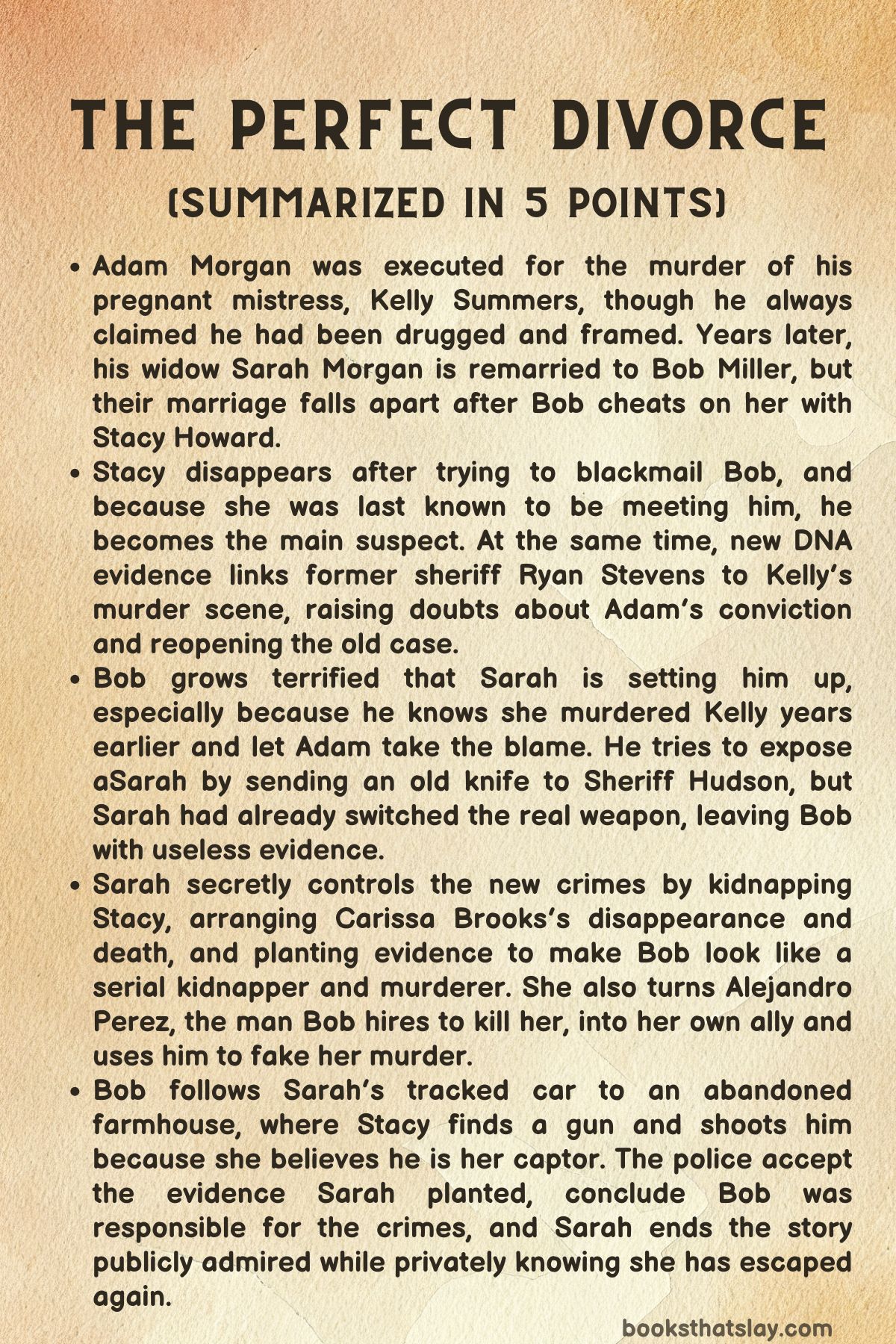
The Perfect Divorce opens through a documentary-style account of Adam Morgan, a man convicted and sentenced to death for the murder of Kelly Summers and her unborn child. Kelly was Adam’s mistress, and her body had been discovered in his lake house after she was stabbed repeatedly.
Adam insists he never killed her. According to him, both he and Kelly were drugged that night, and when he woke in darkness, he left without understanding what had happened.
He maintains that the police rushed the case, mishandled evidence, and ignored an unidentified DNA sample found at the scene. He also believes his wife, Sarah Morgan, still stands by him and knows he is innocent.
Years later, Adam is dead, executed for Kelly’s murder. Sarah is no longer the loyal wife fighting for him in court.
She has rebuilt her life and married Bob Miller, a lawyer who now becomes the next man at the center of her wrath. Sarah and Bob are in the middle of an ugly divorce after Bob cheats on her with a much younger woman named Stacy Howard.
Sarah wants the divorce finalized cleanly, wants custody of their daughter Summer, and wants Bob removed from the Morgan Foundation, her pro bono legal charity. Bob, however, refuses to accept the end of the marriage.
He pleads, threatens, apologizes, and tries to bargain his way back into Sarah’s life, but she remains cold and controlled.
At the same time, an unnamed woman wakes in a dark basement, chained to a pole. She has only a mattress, a bucket, and occasional food and water.
She does not know who took her, where she is, or what her captor wants. This woman is later revealed to be Stacy, the woman Bob slept with.
After their one-night stand, Stacy stole from him and tried to blackmail him by threatening to tell Sarah. When Stacy disappears, her roommate tells the police that Stacy had gone to meet Bob.
That makes Bob the obvious suspect, especially because his affair gives him a clear motive to silence her.
While Bob struggles under suspicion, another old case begins to reopen. Former sheriff Ryan Stevens is arrested after driving drunk and killing a woman named Jackie Clarke.
Sarah briefly represents him, but the arrest causes his DNA to be entered into CODIS. The result creates a shock: Ryan’s DNA matches the unknown sample from Kelly Summers’s murder scene.
This means Ryan had been sexually involved with Kelly during the original investigation, and the revelation raises the possibility that Adam was executed for a crime he did not commit. Sheriff Marcus Hudson, who now leads the department, reopens the case and begins looking into the corrupt and careless investigation that sent Adam to death row.
Ryan Stevens’s past catches up with him quickly. After the DNA match becomes public, he attempts suicide in custody and survives for a short time.
Before he can fully explain himself or expose more of the truth, he is murdered in his hospital bed by a disguised man. That man is later identified as Scott Summers, Kelly’s husband, who appears to have taken revenge after learning about Ryan’s connection to Kelly.
The reopened case becomes national news, and Sarah uses the renewed attention to present herself as Adam’s grieving widow and a woman still seeking justice for a terrible legal failure.
Bob becomes increasingly frightened of Sarah. He starts to believe she is behind Stacy’s disappearance and that she may be setting him up just as Adam was once set up.
His fear comes from knowledge he has carried for years. Kelly Summers was also Jenna Way, the woman Bob believed had murdered his brother Greg in Wisconsin.
Years before, Bob discovered Adam’s affair with Kelly/Jenna and showed the proof to Sarah, hoping to humiliate her and damage her standing at their law firm. Instead of collapsing, Sarah saw Bob’s desire for revenge and used the situation for her own purposes.
Sarah later murdered Kelly, and Adam was convicted for it. Bob knew the truth, or at least enough of it, and kept what he believed was the murder weapon as protection against Sarah.
Sarah continues to control the public image of the reopened case. Adam’s mother, Eleanor Rumple, accuses her of mishandling Adam’s defense and prepares lawsuits against the sheriff’s office.
Sarah decides to file a motion to reopen Adam’s case, not only because the evidence suggests he may have been wrongfully convicted, but because she wants to control the story before others can use it against her. She knows how to appear wounded, dignified, and determined.
In public, she becomes a symbol of justice. In private, she keeps tightening the trap around Bob.
The pressure on Bob increases when another woman, Carissa Brooks, disappears. Bob had gone to Carissa’s salon for a haircut, and his appointment was the last one in her book.
The salon is later found ransacked and bloody. This makes the pattern around him look worse: first Stacy disappears after being linked to Bob, and then Carissa vanishes after seeing him.
In the basement, Stacy hears another woman brought in and eventually learns that the new captive is Carissa. The two women speak in the dark.
Stacy admits that she has blackmailed men like Bob before, while Carissa panics and blames Stacy for involving them in this nightmare. Later, Carissa is taken upstairs, screams for Stacy to help her, and is apparently killed.
Bob and his lawyer Brad try to strike back at Sarah by using the old knife Bob kept from the Kelly case. They send it anonymously to Sheriff Hudson with a note claiming it belongs to Sarah.
Bob believes this will expose her as Kelly’s murderer. But Sarah has been ahead of him for years.
The knife Bob preserved is not the true murder weapon. Sarah had switched it long ago, and the blade Bob sends only contains pig’s blood.
His supposed insurance against her is useless. He has been carrying false leverage while Sarah has kept the real evidence hidden.
Bob also reveals that he has been tracking Sarah’s car, and his desperation pushes him toward a more dangerous plan. He hires Alejandro Perez, a man connected to the Morgan Foundation’s reform program, to kill Sarah.
Alejandro comes to Sarah’s house and sleeps with her, but when he tries to carry out Bob’s order, Sarah is ready. She already suspected that Alejandro was not who he claimed to be.
She holds him at gunpoint and forces him to confess. Alejandro reveals that Bob hired him years earlier to kill Jenna Way because she had dangerous information about him.
Alejandro failed in that earlier job: instead of killing Jenna, he accidentally killed Bob’s brother Greg and staged the scene to make Jenna look guilty. Bob’s entire revenge against Jenna had been based on a death that was caused by the man he hired.
Sarah turns Alejandro to her side by paying him. Together, they fake Sarah’s murder and send Bob bloody photos to make him believe Alejandro has completed the job.
Bob tries to create an alibi at a hotel bar, but his tracking app shows Sarah’s car traveling to an abandoned farmhouse. Panicked and suspicious, he follows the route.
At the farmhouse, Stacy finds a revolver with two bullets. When Bob enters the basement and sees her chained there, she believes he is her captor.
Terrified, she shoots him twice. Sheriff Hudson and the police arrive after hearing the gunshots and find Bob dead, Stacy alive, and evidence that appears to prove Bob kidnapped Stacy and Carissa.
The final truth is that Sarah arranged nearly everything. She kidnapped Stacy herself using drugs, planted messages on Stacy’s phone to make it look as if she had planned to meet Bob, and staged the evidence so the police would believe Bob was responsible.
She also arranged Carissa’s disappearance and death to strengthen the case against him. Once Bob is dead, Sarah pretends to grieve when Hudson and Olson tell her the news.
She knows the police will search Bob’s apartment and find the real Kelly Summers murder weapon, which she planted in his safe with Kelly’s blood and Bob’s fingerprints on it.
The authorities conclude that Bob killed Kelly, kidnapped Stacy and Carissa, and died when Stacy shot him in self-defense. Scott Summers remains wanted for Ryan Stevens’s murder, but the main cases appear solved.
A year later, Sarah gives a polished 60 Minutes interview. She presents herself as a woman who lost two husbands, fought for justice, won a major settlement, and reinvested her money into the Morgan Foundation.
In reality, she has escaped suspicion again, destroyed Bob, rewritten Adam’s legacy to suit her needs, and strengthened her public image as a compassionate reformer. The story ends with Sarah smiling, fully aware that the world has accepted the version of events she created.
Characters
Sarah Morgan
Sarah Morgan is the controlling force of the book, a woman whose calm surface hides a ruthless and highly strategic mind. She is a lawyer, widow, wife, mother, charity founder, public figure, and killer, and she understands how to use each role to protect herself.
Her greatest strength is her ability to read people and shape their expectations. She knows when to appear wounded, when to seem generous, when to act afraid, and when to let others destroy themselves by underestimating her.
In The Perfect Divorce, Sarah is not simply reacting to betrayal; she is designing a complete outcome in which Bob is punished, her own past crimes are buried, and her public reputation grows stronger. Her intelligence makes her dangerous because she rarely acts from panic.
Even when threatened, she thinks several moves ahead. Her treatment of Adam, Bob, Stacy, Carissa, and Alejandro shows that she sees people as pieces in a legal and emotional game.
Sarah’s most chilling quality is not that she kills, but that she can turn murder into a story of survival, grief, and justice.
Bob Miller
Bob Miller is Sarah’s second husband and the man whose life collapses under the weight of his own secrets, arrogance, and fear. He begins the story as an unfaithful husband trying to avoid the consequences of cheating, but he is far more than a weak spouse caught in a divorce.
Bob has a long history with Sarah and with Kelly Summers, whose former identity as Jenna Way connects him to the murder of his brother Greg. Bob believes he understands Sarah because he knows she killed Kelly, but he repeatedly misjudges how far ahead of him she is.
His attempt to use the old knife against her shows both his desperation and his false confidence. He thinks he has leverage, when in reality Sarah has already neutralized it.
Bob’s downfall comes from a combination of guilt, paranoia, and pride. He wants Sarah back, wants control over their divorce, wants revenge for the past, and wants to save himself from suspicion.
By the end, he becomes the perfect target because his affair, his lies, his tracking of Sarah, and his attempt to hire Alejandro make the case against him look believable.
Adam Morgan
Adam Morgan is central to the moral rot beneath the story, even though he is dead in the present timeline. He was convicted of murdering Kelly Summers and her unborn child, and he went to his execution insisting he was innocent.
Adam’s tragedy lies in the fact that he was both guilty of betrayal and innocent of the murder that killed him. His affair with Kelly gave prosecutors a simple motive and gave Sarah the opening she needed to frame him.
Adam’s faith that Sarah still believed in him adds a cruel emotional layer to the book because the reader later understands that Sarah was not his defender in any sincere sense. She allowed the legal system to destroy him while protecting herself.
Adam also represents the danger of a public story becoming stronger than the truth. Once the world believed he was the killer, every piece of evidence was interpreted through that assumption.
His execution becomes a permanent injustice, and even when the case is reopened, the truth is redirected again to serve Sarah’s needs.
Kelly Summers / Jenna Way
Kelly Summers, also known as Jenna Way, is the murdered woman whose death shapes both the past and present crimes. She is first presented through the scandal of her affair with Adam, but her background connects her to Bob’s private vendetta.
Bob believes Jenna murdered his brother Greg, which gives him a powerful emotional reason to hate her. The later revelation that Alejandro accidentally killed Greg while acting on Bob’s own orders changes the meaning of Kelly’s past entirely.
Kelly becomes a figure trapped by other people’s assumptions and revenge. To Adam, she was a mistress.
To Bob, she was the woman who destroyed his family. To Sarah, she was a threat and an opportunity.
Her murder is the original act that allows Sarah to reveal the full range of her manipulation. Kelly does not control the story told about her after death, and that lack of control becomes central to the book’s view of justice, media, and evidence.
Stacy Howard
Stacy Howard is Bob’s affair partner and one of Sarah’s living victims. At first, Stacy appears connected to the story through sex, theft, and blackmail.
She sleeps with Bob, steals from him, and threatens to expose him to Sarah, which makes her easy to dismiss as reckless or opportunistic. But once she is chained in the basement, her role changes.
She becomes a terrified captive trying to understand why she has been taken and how she can survive. Stacy’s flaws make Sarah’s frame-up more effective, because the police can believe she had a messy connection to Bob.
Her fear also makes the final basement scene possible. When Bob enters and Stacy finds the gun, she reacts from terror and from the belief that he is her captor.
In that moment, she becomes the weapon Sarah needs without knowing it. Stacy survives, but her survival is also part of Sarah’s plan, because her testimony helps complete the false picture of Bob as kidnapper and killer.
Carissa Brooks
Carissa Brooks is another victim used to make Bob look guilty. Her disappearance after Bob’s salon appointment creates a pattern that strengthens the police case against him.
Unlike Stacy, Carissa has no real connection to Bob’s deeper secrets or Sarah’s old crimes. That makes her fate especially disturbing because she is selected mainly for usefulness.
Sarah needs another woman to vanish after contact with Bob, and Carissa fits that purpose. In the basement, Carissa’s panic contrasts with Stacy’s guilt and survival instincts.
She blames Stacy for the danger they are in, which reflects how little either woman understands the true force controlling their situation. Carissa’s apparent death turns Sarah’s plan from a personal revenge scheme into something even colder.
Sarah is willing to sacrifice an uninvolved person simply to make her version of events more convincing.
Ryan Stevens
Ryan Stevens is the former sheriff whose DNA connects him to Kelly Summers and exposes the corruption of the original murder case. His arrest for killing Jackie Clarke while driving drunk leads to the CODIS match that changes the public understanding of Adam’s conviction.
Ryan’s involvement with Kelly during the original investigation suggests misconduct, hidden motives, and serious corruption. He represents the failure of law enforcement not only through possible evidence mishandling, but through personal compromise.
His suicide attempt shows the pressure of exposure, guilt, or fear, and his later murder prevents him from giving a full account of what happened. Ryan is important because his DNA gives Sarah a new opportunity.
The discovery could have led closer to the truth, but Sarah uses the reopened case to redirect suspicion and rebuild herself as the widow seeking justice.
Sheriff Marcus Hudson
Sheriff Marcus Hudson is the present-day law enforcement figure trying to untangle old lies and new crimes. He reopens Kelly Summers’s case after Ryan Stevens’s DNA match and approaches the investigation with more seriousness than the earlier authorities.
Hudson is not portrayed as careless, but he is still vulnerable to Sarah’s manipulation because she gives him a complete, believable story supported by planted evidence. His conclusion that Bob killed Kelly, kidnapped Stacy and Carissa, and died in self-defense is logical based on what he finds, but it is also exactly what Sarah designed him to believe.
Hudson’s role shows that even a determined investigator can be defeated when the evidence has been arranged by someone who understands the legal system from the inside. He is not foolish; he is working inside a reality Sarah has manufactured.
Scott Summers
Scott Summers is Kelly’s husband and the man later identified as Ryan Stevens’s killer. His act of revenge in the hospital is driven by rage after the truth about Ryan’s sexual connection to Kelly becomes public.
Scott represents a more direct and emotional form of violence than Sarah’s calculated style. He appears to act from grief, humiliation, and anger, and his choice to murder Ryan prevents the reopened case from developing naturally.
Scott’s actions add another layer of confusion to the investigation because his revenge makes the old case more chaotic. He is also useful to Sarah’s wider situation because his crime draws attention toward Ryan, Kelly, and the corruption around the old sheriff’s office, while Sarah continues positioning herself as someone wounded by the failures of others.
Eleanor Rumple
Eleanor Rumple, Adam’s mother, serves as one of the few characters openly willing to challenge Sarah’s public version of events. She accuses Sarah of mishandling Adam’s defense and prepares lawsuits after the new DNA evidence suggests Adam may have been wrongfully executed.
Eleanor’s grief is different from Sarah’s performance of grief because Eleanor has no need to turn Adam into a public brand. Her anger comes from the loss of her son and the suspicion that the people who should have saved him failed him.
In The Perfect Divorce, Eleanor helps increase the pressure on Sarah by making it harder for her to quietly control the reopened case. However, Sarah responds by moving faster and taking ownership of the public narrative before Eleanor or anyone else can damage her.
Alejandro Perez
Alejandro Perez is a hired killer whose past mistake reshapes the meaning of Bob’s entire revenge story. Bob once hired Alejandro to kill Jenna Way, but Alejandro accidentally killed Greg instead and staged the crime to make Jenna look responsible.
This revelation shows that Bob’s hatred of Jenna was built on a false belief caused by his own decision to use violence. In the present, Bob hires Alejandro again, this time to kill Sarah.
Alejandro’s willingness to switch sides after Sarah catches him shows that he is driven less by loyalty than survival and money. He is dangerous, but he is not as disciplined as Sarah.
Once Sarah controls him, he becomes another tool in her plan to fake her own murder and lure Bob toward the farmhouse. Alejandro’s role proves that Sarah can absorb even a threat against her and turn it into an advantage.
Brad
Brad is Bob’s lawyer and ally during the divorce and the later attempts to fight Sarah. He helps Bob use the knife as a weapon against her, but he does not understand that Sarah has already made that evidence useless.
Brad’s presence shows Bob’s attempt to use legal strategy against someone far better at manipulating the law and appearances. He is practical, but his advice operates within the limits of what Bob tells him and what Bob believes to be true.
Because Bob’s understanding of the evidence is flawed, Brad’s role becomes ineffective. He is part of Bob’s defensive structure, but that structure collapses because Sarah has been controlling the foundation of the story for years.
Summer
Summer is Sarah and Bob’s daughter, and though she is not a major active force in the crime plot, she matters because custody becomes one of the stakes in the divorce. Sarah’s demand for custody helps frame her conflict with Bob as a fight for family stability and protection.
Summer also strengthens Sarah’s public image as a mother trying to escape a dangerous man. The child’s presence adds emotional weight to the divorce, but it also shows how easily Sarah can use family roles as part of a larger strategy.
Summer is protected from much of the visible violence, yet her existence helps Sarah appear more sympathetic and makes Bob look more threatening when he resists the divorce.
Jackie Clarke
Jackie Clarke is the woman killed by Ryan Stevens in the drunk-driving incident that leads to his arrest. Her death is not explored as deeply as the central murders, but it is a crucial trigger for the plot.
Without Jackie’s death, Ryan’s DNA would not have entered CODIS, the unknown sample from Kelly’s body might have remained unexplained, and Adam’s case might not have reopened. Jackie’s role shows how one unrelated tragedy can expose buried crimes.
Her death also reveals how the justice system often uncovers truth through accident rather than design. She becomes part of the chain that gives Sarah a new opportunity to redirect the past.
Themes
Marriage as Power, Not Safety
Marriage in The Perfect Divorce is not shown as a secure emotional partnership but as a structure where secrets, leverage, money, reputation, and control are constantly negotiated. Sarah’s marriages to Adam and Bob both collapse under betrayal, but the deeper issue is not only infidelity.
Each marriage becomes a contest over who controls the story. Adam betrays Sarah with Kelly, but Sarah turns that betrayal into a murder frame that destroys him.
Bob cheats on Sarah with Stacy, but his greater mistake is believing that emotional history and hidden knowledge give him power over her. Divorce, in this context, is not simply the end of love; it is a legal battlefield where custody, public sympathy, charity work, old crimes, and future freedom all become weapons.
The story presents marriage as something that can protect appearances while hiding danger underneath. Sarah understands this better than anyone.
She knows that a wife, widow, and mother can be seen as sympathetic even when she is the person causing the harm.
The Fragility of Justice
Justice in the story depends heavily on evidence, but evidence is repeatedly mishandled, hidden, planted, or misunderstood. Adam’s conviction shows how quickly the legal system can settle on a convenient suspect when motive and public outrage align.
The unknown DNA from Kelly’s body should have raised deeper questions, yet it is ignored until years later, after Adam has already been executed. Ryan Stevens’s match exposes corruption and misconduct, but even that discovery does not lead to the full truth because Sarah redirects the investigation again.
The book presents justice as fragile because it relies not only on facts, but on who controls those facts and how they are arranged. Sheriff Hudson tries to solve the cases responsibly, but he receives a staged reality.
Bob appears guilty because Sarah understands what investigators need to see: motive, opportunity, physical evidence, witness fear, and a pattern of behavior. The result is disturbing because the final official answer looks complete while being almost entirely false.
Public Image and Performance
Sarah’s greatest weapon is not violence by itself, but performance. She knows how to appear composed in court, wounded in interviews, decisive in divorce proceedings, and noble through the Morgan Foundation.
Her public identity as a lawyer and reform advocate gives her moral cover, allowing people to see her as someone fighting for justice rather than someone bending justice to her will. The 60 Minutes interview at the end captures the full success of this performance.
Sarah presents herself as a woman who endured betrayal, wrongful conviction, death, and scandal, then turned her pain into public service. The audience sees resilience because that is what she gives them to see.
The theme is powerful because it shows how reputation can become stronger than truth. People believe Sarah not simply because she lies well, but because her lies fit the kind of story they already want: a wronged woman surviving loss and helping others.
Her image becomes a shield no evidence can easily pierce.
Revenge and the Creation of False Truths
Revenge drives several characters, but the story repeatedly shows that revenge is often built on incomplete or false beliefs. Bob’s hatred of Jenna Way comes from his belief that she murdered his brother Greg, but the truth is that Greg died because Bob hired Alejandro to kill Jenna and the plan went wrong.
Scott Summers kills Ryan Stevens after learning of Ryan’s connection to Kelly, acting from rage before the whole truth can emerge. Sarah’s revenge against Bob is the most controlled and destructive because she does not simply punish him; she rewrites his life so that he becomes guilty in the eyes of the world.
The story suggests that revenge does not merely answer pain. It creates new versions of reality that others are forced to live inside.
Bob thinks he is seeking justice for Greg, but he is chasing a lie created by his own choices. Sarah knows this and uses it.
By the end, revenge has replaced truth so completely that the official record becomes another crime scene.