The Plans I Have for You Summary, Characters and Themes
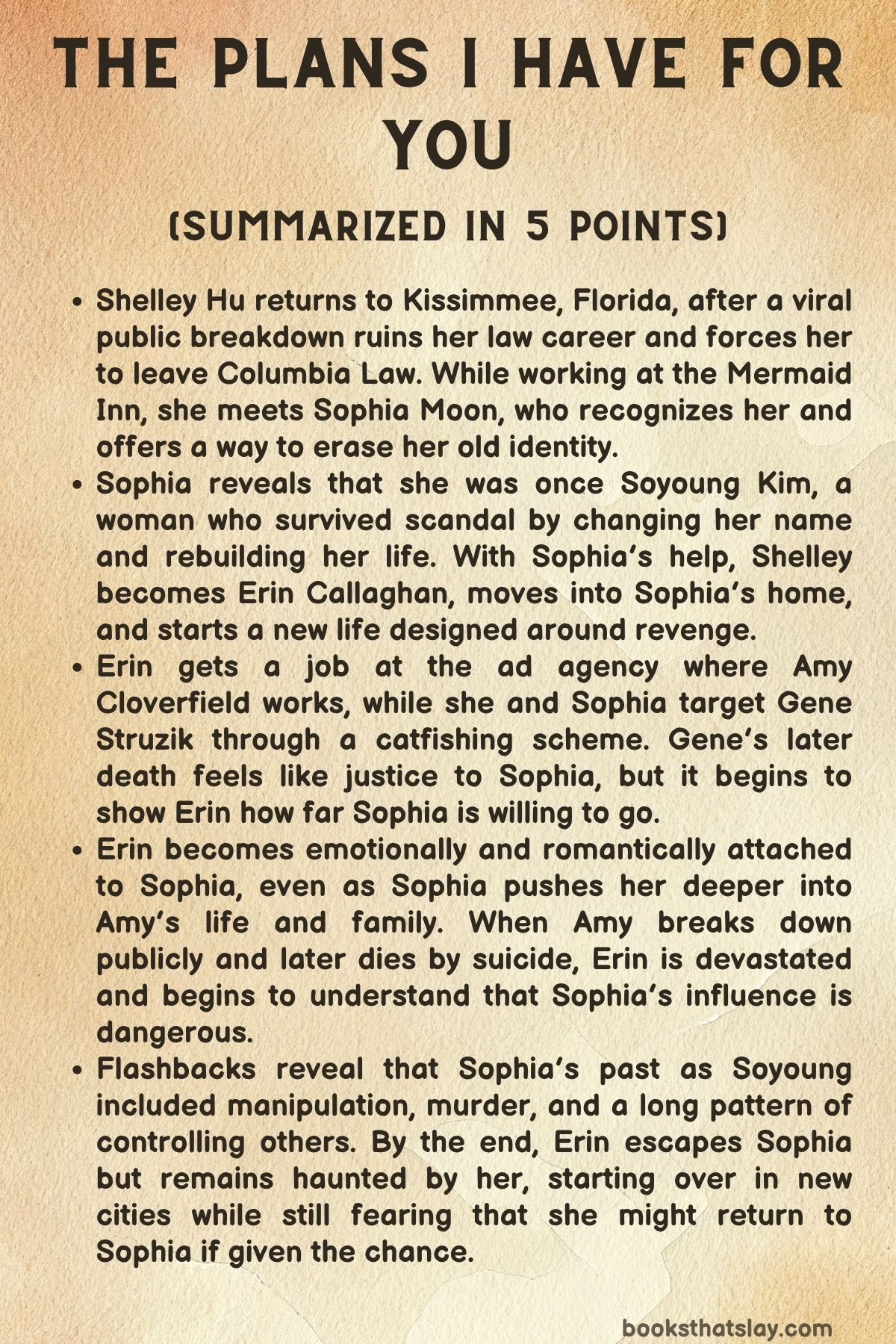
The Plans I Have for You by Lai Sanders is a dark psychological thriller about reinvention, shame, revenge, and the dangerous comfort of being seen by the wrong person. The book follows Shelley Hu, a former law student whose life falls apart after a viral public breakdown.
When she meets Sophia Moon, a woman with her own hidden past, Shelley is offered a chance to erase herself and begin again under a new name. What begins as a rescue soon becomes a trap, as Shelley is drawn into Sophia’s plans for punishment, control, and devotion. The novel explores how trauma can make someone vulnerable to manipulation, and how survival can blur into surrender.
Summary
In The Plans I Have for You, Shelley Hu returns to Kissimmee, Florida, at the end of 2016 after the life she had built in New York comes apart. She is working nights at the Mermaid Inn, a pirate-themed motel, trying to hide from the attention and shame that followed her public collapse.
Before coming home, Shelley had been a promising Columbia Law student with an internship at a law firm. That future ended after a work trip where her boss, Gene Struzik, harassed her.
The experience left her frightened, angry, and unstable. Soon after, she got into a confrontation on the subway with Amy Cloverfield, a white advertising executive.
A reporter named Auggie Flores filmed the scene, and the video spread online. The public judged Shelley without knowing what had led to the moment.
She lost her internship, left law school, and returned to her mother’s home in Florida.
Shelley’s mother believes their family is being haunted by a jinn, and her fear adds to the pressure Shelley already feels. Shelley is isolated, ashamed, and unsure how to move forward.
During one night shift at the motel, a guest named Sophia Moon recognizes her. Sophia does not treat Shelley like a stranger or a viral scandal.
Instead, she tells Shelley that she understands what it means to be publicly ruined. Sophia says she was once Soyoung Kim, known in the media as the “Cornell Hobo,” a Korean Chinese woman who pretended to be a student at Cornell and became infamous after the truth came out.
Sophia explains that she survived by remaking herself. She changed her name, built a new life, and left Soyoung behind.
She offers Shelley the same kind of escape. Sophia has also researched the people involved in Shelley’s downfall: Gene, Amy, and Auggie.
Shelley does not trust her at first, but after another painful fight with her mother and a failed attempt to drive out the supposed jinn, she reaches out to Sophia. This decision changes the direction of her life.
Shelley legally becomes Erin Callaghan and moves into Sophia’s home in Hoboken, where Sophia lives with her husband, Paul, and their young son, Ory.
Sophia begins reshaping Erin completely. She gives her a wig, glasses, new clothes, and a new way of speaking and carrying herself.
She trains Erin to become someone who can pass unnoticed in a different world. Erin learns graphic design and, with Sophia’s guidance, gets a job at Meek LeClerc, the advertising agency where Amy Cloverfield works.
The goal is not only to help Erin begin again but also to place her close to one of the women linked to her humiliation.
At the same time, Sophia helps Erin target Gene. Together they create a fake dating profile and lure him into exposing himself.
They gather evidence of his sexual behavior and send it anonymously to his wife and his law firm. For Erin, the plan feels like a way to reclaim power after being harmed and ignored.
When Gene later dies in a scuba-diving accident, Sophia presents it as a kind of victory. Erin is unsettled, but Sophia’s confidence makes it easier for her to accept the result as justice.
As Erin spends more time with Sophia, their bond becomes intense and unhealthy. Sophia offers attention, protection, and purpose, and Erin becomes dependent on her approval.
Their relationship turns romantic, but it is also marked by control. Sophia decides what Erin wears, how she behaves, and how she should understand the people around her.
Paul notices the danger. He distrusts Erin at first, but he also warns her that Sophia is not the savior she appears to be.
Erin does not know whether to believe him, because by then Sophia has become the center of her new life.
Erin’s next target is Amy Cloverfield. At Meek LeClerc, Erin gets close to Amy and begins learning about her life.
Amy has an adopted Chinese daughter named Lizzie, and Erin forms a bond with the girl. This relationship complicates Erin’s feelings.
Amy is not only the woman from the subway video; she is also a mother, a professional under pressure, and someone with vulnerabilities of her own. Sophia, however, pushes Erin to use what she learns.
She wants Erin to exploit Lizzie’s adoption story in a public setting where Amy will be humiliated.
The plan leads to a disastrous client presentation. Amy is confronted in a way that breaks through her polished public identity, and she collapses emotionally in front of others.
Erin sees the damage and is shaken by it. What had once seemed like revenge now feels cruel and irreversible.
Soon after, Amy jumps from the George Washington Bridge and dies. Erin is horrified and overwhelmed with guilt.
She wants to confess and accept responsibility, but Sophia refuses to let her see it that way. Sophia insists that Amy’s death is not Erin’s fault and treats it as another necessary punishment.
Running alongside Erin’s story is the history of Sophia’s earlier life as Soyoung Kim. At Cornell, Soyoung survived by pretending to belong.
She attached herself to lonely students, using their kindness and weaknesses to find shelter and stability. She became close to Lillian Pietrowski and Stella Cheung, and she also became involved with Paul.
Her life there was built on lies, but it was also shaped by desperation and the desire to become someone else.
Soyoung’s past grows darker through her encounters with Nathaniel, Stella’s controlling boyfriend. As her deception begins to fall apart and the people around her learn more of the truth, Soyoung becomes increasingly unstable.
She kills Nathaniel by drowning him in a bathtub. Later, at the gorge, she kills Stella as well, convincing herself that she is saving her.
These acts reveal that Sophia’s idea of protection has long been tied to possession and death. Paul eventually helps Soyoung escape, even after he learns what she has done.
His choice binds him to her permanently, and years later he remains trapped in a marriage shaped by fear, loyalty, resentment, and shared secrets.
By June 2017, Erin begins to understand that she cannot keep living under Sophia’s control. She plans to leave and return to Florida, hoping to separate herself from the woman who gave her a new identity but also pulled her into violence.
At Sophia’s art show, Erin sees Auggie Flores, the reporter who filmed the subway video. His presence makes her realize Sophia has brought him there on purpose.
Sophia is not finished. She has been arranging punishment for everyone she believes deserves it, and she wants Erin to stay with her as both partner and proof that her methods are right.
Erin asks about Casey, another woman Sophia once claimed to have helped. The question opens Erin’s eyes to a pattern.
Sophia does not simply rescue people. She chooses damaged women, remakes them, draws them close, and then tightens her control.
When they resist or become inconvenient, they may disappear, die, or be erased from the story Sophia tells about herself. Erin realizes she is not special in the way she hoped.
She is part of Sophia’s cycle.
Erin runs back to the house, where Paul confronts her. Paul understands Sophia’s danger better than anyone, because he has lived with it for years.
Instead of stopping Erin, he lets her go. He then faces Sophia in the garden.
Paul reveals that he kept Erin from staying and also sabotaged Sophia’s new job offer, ensuring that Sophia remains trapped with him rather than escaping into a fresh life with Erin. Their marriage is exposed as its own prison, built from old crimes and mutual punishment.
In the end, Erin does not go back to Florida. She flies to Phoenix and starts over once more, this time without Sophia directing her.
She gets a job and begins seeing a therapist, trying to understand what happened and what part of herself allowed Sophia in. Later, she moves to Chicago.
Even there, Sophia remains in her mind. Erin still fears her, but she also misses her.
Sitting by Lake Michigan, she imagines Sophia reaching out from the water. The image captures the lasting pull Sophia has over her.
Erin has escaped, but she knows the desire to be chosen, remade, and claimed has not fully left her. The book closes on that uneasy truth: freedom is possible, but it does not erase longing, guilt, or the dangerous wish to return to the person who once made escape feel like love.
Characters
Shelley Hu / Erin Callaghan
Shelley Hu is the central character of the The Plans I Have For You, and her journey is built around collapse, reinvention, guilt, and survival. At the beginning, she is a young woman whose life has been violently disrupted by public humiliation, workplace harassment, and the loss of the future she thought she was building.
Her return to Kissimmee shows how deeply she has retreated from the world after the viral video destroys her confidence and identity. Shelley is not simply embarrassed; she is emotionally shattered because the incident makes her feel exposed, powerless, and permanently defined by one moment.
Her name change to Erin Callaghan becomes more than a practical disguise. It represents her desperate wish to escape shame and become someone who cannot be recognized, judged, or hurt in the same way again.
As Erin, she becomes increasingly shaped by Sophia’s influence. Sophia gives her a new appearance, a new voice, and a new role to perform, and Erin accepts this transformation because it offers her the control she lost.
However, the new identity also makes her more vulnerable to manipulation. Erin’s need for protection turns into dependency, especially as her relationship with Sophia becomes romantic, obsessive, and morally dangerous.
She begins by wanting justice against the people who contributed to her downfall, but she slowly becomes involved in acts of revenge that exceed anything she originally intended. Her character is therefore marked by a painful conflict between victimhood and responsibility.
She has been genuinely harmed, but the book also forces her to confront the harm she helps cause.
Erin’s relationship with Amy and Lizzie reveals the most troubling parts of her transformation. By entering Amy’s workplace and using Lizzie’s adoption story as a weapon, Erin crosses a line between exposing injustice and exploiting another person’s vulnerability.
Amy’s death becomes a turning point because Erin can no longer pretend that Sophia’s plans are harmless or deserved. Her horror after Amy dies shows that she has not lost her conscience, even though she has allowed herself to be pulled into Sophia’s logic of punishment.
Erin’s eventual decision to flee Sophia is an act of self-preservation, but it is not a clean escape. In the epilogue, her new life in Phoenix and Chicago suggests growth, therapy, and movement forward, yet her lingering fear and longing for Sophia show that trauma does not disappear simply because she leaves.
Erin is one of the book’s most complex characters because she is both damaged and morally compromised, both a survivor and someone who must live with the consequences of what she helped set in motion.
Sophia Moon / Soyoung Kim
Sophia Moon, formerly Soyoung Kim, is the most dangerous and psychologically layered figure in the book. She presents herself to Shelley as proof that a person can escape public disgrace and rebuild completely, but her reinvention is founded on deception, violence, and control.
As Sophia, she appears elegant, capable, and almost magical in her ability to understand Shelley’s pain. She offers Shelley not only practical help but a new self, which makes her seem like a rescuer at first.
Yet her kindness is never simple. Sophia’s generosity is tied to possession, and her desire to help Erin becomes a desire to own her.
She recognizes Erin’s shame because she has lived through her own public disgrace, but instead of healing from it, she has turned reinvention into a method of domination.
The flashbacks to Soyoung’s life at Cornell reveal the origins of Sophia’s pattern. Soyoung survives by reading people carefully, finding their loneliness, and using it to secure shelter, affection, or protection.
Her deception as the “Cornell Hobo” is not only a scam but also a performance of belonging. She wants access to a world that excludes her, and she tries to enter it by becoming whatever others need her to be.
This makes her both pitiable and frightening. Her manipulation of Lillian, Stella, Paul, and others shows a person who is constantly calculating, but the emotional intensity beneath those calculations is real.
Soyoung wants love and safety, yet she destroys the people who threaten her fragile sense of control.
Sophia’s violence grows out of her belief that she understands what people deserve. She treats Gene’s death as a victory, pushes Erin toward destroying Amy, and seems to have a history of eliminating people who no longer fit her vision.
Her killings and manipulations are presented not as random cruelty but as a twisted moral system. She sees herself as a punisher, savior, and artist of other people’s lives.
This is why she is so dangerous: she can make revenge feel like justice and control feel like care. Her bond with Erin is especially disturbing because it contains genuine intimacy alongside coercion.
Sophia loves Erin in a way, but that love demands surrender. By the end, Sophia remains trapped with Paul, but she also continues to haunt Erin’s imagination, proving that her influence survives even after physical separation.
Paul
Paul is one of the most quietly disturbing characters in the book because his role shifts from lover and protector to jailer and accomplice. In the Cornell flashbacks, Paul is drawn to Soyoung and becomes emotionally bound to her even after discovering the truth about her actions.
His decision to help her escape shows the depth of his attachment, but it also reveals a willingness to participate in moral corruption. Paul is not innocent simply because Sophia is more openly dangerous.
He knows what she has done, chooses to remain connected to her, and builds a life around that knowledge. His loyalty is therefore inseparable from complicity.
In the later timeline, Paul appears trapped inside his marriage to Sophia. He distrusts Erin because he understands Sophia’s patterns and recognizes that Erin may become another person pulled into Sophia’s orbit.
His warnings to Erin are partly protective, but they are also self-interested. Paul does not simply want to save Erin; he also wants to maintain his own hold over Sophia.
His relationship with Sophia has become a struggle over confinement and possession. He cannot free himself from her, so he tries to keep her bound to him.
This makes him tragic, but not purely sympathetic.
Paul’s final confrontation with Sophia reveals how much resentment and control have shaped him. By stopping Erin from staying and sabotaging Sophia’s job offer, he ensures that Sophia remains trapped in the life they share.
This act mirrors Sophia’s own controlling behavior, suggesting that Paul has absorbed some of her darkness or perhaps always possessed his own version of it. He is a character defined by devotion turned poisonous.
His love for Sophia is not liberating or redemptive; it is possessive, fearful, and punitive. In the book, Paul shows how proximity to violence can deform a person until protection and imprisonment become difficult to separate.
Amy Cloverfield
Amy Cloverfield is one of the central figures connected to Shelley’s public downfall, but she is also more than an antagonist. As a white advertising executive, Amy represents a world of professional privilege, social confidence, and racial power that Shelley feels crushed by.
The confrontation on the 6 train becomes a defining event in Shelley’s life because Amy is part of the moment that turns Shelley’s private pain into public spectacle. From Shelley’s perspective, Amy becomes a symbol of humiliation and injustice, someone whose role in the viral incident cannot be forgotten.
However, the book complicates Amy by showing her as a mother and a person with her own vulnerabilities. Her adopted Chinese daughter, Lizzie, becomes the emotional point through which Erin enters Amy’s life and eventually helps destroy her.
Amy’s relationship with Lizzie exposes issues of race, adoption, identity, and guilt. She may be privileged and flawed, but she is not invulnerable.
Sophia’s plan succeeds because Amy has emotional wounds that can be targeted. The disastrous client presentation breaks her publicly in a way that mirrors Shelley’s own public breakdown, creating a cruel symmetry between the two women.
Amy’s death forces Erin to recognize the true cost of revenge. Until that moment, Amy may have seemed like someone who deserved exposure or punishment, but her suicide makes the consequences horrifyingly real.
Amy becomes a character through whom the book questions whether revenge can ever remain proportionate once it becomes organized around humiliation. She is not presented as blameless, but neither is she reduced to a villain.
Her tragedy lies in the fact that she becomes both a participant in Shelley’s trauma and a victim of Sophia and Erin’s retaliation.
Gene Struzik
Gene Struzik is the clearest example of predatory male power in the book. His harassment of Shelley during the work trip is one of the causes of her collapse, and his behavior reflects the entitlement of someone who believes his professional position protects him.
Gene’s actions are not only personally damaging to Shelley; they also expose the broader environment that allows men like him to act without immediate consequence. Shelley’s inability to receive justice through ordinary channels makes Sophia’s revenge plot feel tempting, because Gene seems to represent a system that will not punish itself.
The catfishing scheme against Gene reveals how easily his private misconduct can be uncovered. Erin and Sophia do not need to invent his ugliness; they draw it out and document it.
In that sense, Gene’s downfall comes from his own behavior. Yet the book does not let the revenge remain simple.
His later death in a scuba-diving accident, and Sophia’s reaction to it, show how revenge can slide from exposure into bloodthirsty satisfaction. Sophia treats his death as a victory, which reveals more about her moral worldview than about Gene himself.
Gene is not a deeply sympathetic character, but he is important because he helps explain why Shelley is vulnerable to Sophia’s influence. He is part of the original injury that makes Shelley feel powerless, violated, and unheard.
Through Gene, the book explores how institutional power, sexual harassment, and public shame can combine to destroy a young woman’s sense of safety. He is a catalyst for the story’s revenge structure, and his presence continues to shape Shelley long after he is physically absent.
Auggie Flores
Auggie Flores is the reporter who films Shelley’s breakdown, and his role in the book centers on spectatorship, media exposure, and the ethics of turning someone else’s pain into content. Unlike Gene, Auggie may not initially seem malicious in a direct personal way, but his action has devastating consequences.
By recording and circulating Shelley’s public argument, he helps transform a painful moment into a viral event. His camera becomes a weapon, even if he does not physically harm her.
For Shelley, Auggie represents the public gaze that traps her inside her worst moment.
Auggie’s importance grows near the end when Erin sees him at Sophia’s art show and realizes that Sophia has lured him there. This moment confirms that Sophia’s revenge has not ended with Gene and Amy.
Auggie is another person Sophia believes deserves punishment, and his presence reveals the larger pattern behind her actions. He is not merely a past figure from Shelley’s downfall; he becomes evidence of Sophia’s continuing need to punish anyone connected to Erin’s pain.
As a character, Auggie raises questions about responsibility in a digital world. He did not create Shelley’s suffering from nothing, but he amplified it and benefited from its visibility.
The book uses him to show how modern humiliation often depends on people who watch, record, share, and move on. Auggie may not carry the same obvious cruelty as Gene or the same emotional complexity as Amy, but his role is crucial because he helps make Shelley’s private collapse permanent in the eyes of the world.
Shelley’s Mother
Shelley’s mother represents family, cultural fear, spiritual interpretation, and the difficulty of returning home after failure. When Shelley comes back to Kissimmee, her mother does not fully understand what has happened to her in the language of law school, viral media, or workplace harassment.
Instead, she interprets the family’s suffering through the idea of a jinn haunting them. This belief may seem irrational from one perspective, but emotionally it reflects her attempt to explain pain that feels larger than ordinary cause and effect.
She senses that something destructive has attached itself to her daughter and their family, even if she names it differently.
Her relationship with Shelley is strained because home does not provide the comfort Shelley needs. The failed exorcism and their conflict push Shelley toward Sophia, which makes the mother an important indirect influence on the plot.
Shelley’s mother wants to protect her daughter, but her methods leave Shelley feeling misunderstood and trapped. This failure of communication creates the emotional opening Sophia exploits.
Sophia offers a language of reinvention and revenge, while Shelley’s mother offers a language of haunting and spiritual danger.
Even so, Shelley’s mother is not simply an obstacle. Her belief in haunting becomes symbolically meaningful because Shelley really is haunted, though not necessarily by a supernatural force.
She is haunted by shame, public exposure, sexual harassment, and later by Sophia herself. Shelley’s mother therefore gives the book one of its central emotional images: the idea that trauma can feel like a presence that follows a family, enters a home, and refuses to leave.
Lizzie
Lizzie, Amy’s adopted Chinese daughter, is one of the most vulnerable characters in the book because she becomes a tool in a conflict she did not create. Erin befriends Lizzie as part of her infiltration of Amy’s life, and this relationship carries emotional weight because Lizzie’s identity and adoption story are deeply personal.
Lizzie is not responsible for Amy’s actions or Shelley’s suffering, yet her life becomes the material Sophia pushes Erin to use against Amy. This makes Lizzie central to the moral horror of Erin’s revenge.
Lizzie also reflects Erin’s own unresolved feelings about race, belonging, and being seen. As a Chinese adoptee raised by a white mother, Lizzie likely occupies a complicated emotional position, especially in relation to identity and family.
Erin’s connection with her is therefore not entirely fake. There may be genuine tenderness in Erin’s attention to Lizzie, which makes the betrayal more painful.
Erin’s ability to care for Lizzie while still using her story shows how far she has been pulled into Sophia’s logic.
Through Lizzie, the book shows that revenge rarely harms only its intended target. Amy is the person Sophia and Erin aim to break, but Lizzie is also wounded by the exposure and exploitation of her private life.
Her character reminds the reader that children and dependents often bear the consequences of adult cruelty. Lizzie’s presence makes Erin’s guilt sharper because it is not only Amy who suffers.
An innocent child’s emotional world is also disturbed by the plan.
Lillian Pietrowski
Lillian Pietrowski belongs to Soyoung’s Cornell past and helps reveal how Soyoung survives through intimacy, performance, and manipulation. Lillian is one of the lonely students Soyoung befriends, and her loneliness makes her susceptible to Soyoung’s attention.
Soyoung understands that people who feel unseen are often eager to believe in someone who seems to need them or choose them. Lillian’s role therefore shows how Soyoung enters people’s lives not through force at first, but through emotional need.
Lillian is important because she helps establish Soyoung’s pattern before Sophia ever meets Shelley. The relationship suggests that Soyoung’s later methods are not sudden developments but part of a long history of reading people and adapting herself to them.
Lillian may offer shelter, friendship, or belonging, but Soyoung’s connection to her is built on concealment. This creates a painful imbalance because Lillian may believe she is participating in a real friendship while Soyoung is also using her.
At the same time, Lillian’s vulnerability does not make her foolish. Instead, it reveals how persuasive Soyoung can be and how easily ordinary kindness can be exploited by someone desperate enough to survive and manipulative enough to take advantage.
Lillian’s character gives the Cornell sections emotional texture because she shows the human cost of Soyoung’s deception before the violence escalates. She is part of the web of people who help Soyoung feel temporarily real, even as her lies make lasting connection impossible.
Stella Cheung
Stella Cheung is one of the most tragic figures in Soyoung’s past. As a student connected to Soyoung at Cornell, Stella becomes emotionally entangled in Soyoung’s world, but she is also trapped in a damaging relationship with Nathaniel.
Her presence allows the book to explore control from multiple angles. Nathaniel controls Stella, while Soyoung eventually convinces herself that killing Stella is an act of rescue.
Stella is therefore surrounded by people who claim power over her life, even when they believe they are acting out of love or protection.
Soyoung’s killing of Stella at the gorge is one of the clearest examples of her warped savior complex. She believes she is “saving” Stella, but this belief reveals the terrifying way Soyoung transforms care into violence.
Stella’s death shows that Soyoung cannot tolerate helplessness, abandonment, or emotional chaos without trying to impose a final solution. What makes the act especially disturbing is that Soyoung may genuinely feel grief and attachment.
Her violence does not come from indifference; it comes from a possessive and delusional form of care.
Stella’s character also foreshadows Sophia’s later treatment of Erin. Just as Soyoung believes she knows what is best for Stella, Sophia later believes she knows what Erin needs, who deserves punishment, and what kind of life Erin should live.
Stella becomes part of the book’s larger warning about people who mistake possession for love. Her tragedy lies in being denied full agency by both Nathaniel and Soyoung, making her one of the clearest victims of the story’s destructive forms of control.
Nathaniel
Nathaniel is Stella’s controlling boyfriend and one of the darkest figures in the Cornell timeline. His relationship with Stella shows a direct and recognizable form of domination.
He represents the kind of male control that limits, threatens, or consumes a woman’s autonomy. His presence intensifies Soyoung’s emotional instability because she sees him as a danger to Stella and perhaps as a symbol of everything she wants to destroy.
Soyoung’s murder of Nathaniel by drowning him in a bathtub marks a decisive step in her transformation from manipulator to killer. Nathaniel may be controlling and harmful, but Soyoung’s response reveals that she is willing to become judge and executioner.
His death is important because it gives physical form to a pattern that later continues under Sophia’s new identity. Once Soyoung crosses the boundary into murder, violence becomes part of her idea of justice and rescue.
As a character, Nathaniel is not designed to invite sympathy so much as to expose the danger of answering control with another form of control. He is oppressive toward Stella, but Soyoung’s killing of him does not free her in any healthy way.
Instead, it deepens her belief that she has the right to decide who should live, who should disappear, and who should be saved. Nathaniel’s role is therefore crucial in tracing the origin of Sophia’s later violence.
Casey
Casey is a shadowy but significant figure because she suggests that Sophia’s relationship with Erin is not unique. Sophia once claimed to have helped Casey, but Erin’s later questioning of what really happened to her reveals a pattern.
Casey becomes evidence that Sophia has done this before: found someone vulnerable, offered transformation or rescue, and then possibly destroyed or discarded her when she no longer fit Sophia’s desires.
Even though Casey is not as fully present as Erin or Stella, her absence is powerful. She functions as a warning hidden inside Sophia’s past.
The uncertainty surrounding her makes Sophia more frightening because it implies that there are other stories, other victims, and other reinventions buried beneath the polished surface of Sophia Moon. Casey’s importance lies in what she reveals about repetition.
Erin is not an exception in Sophia’s life; she may be the latest version of a familiar obsession.
Casey also helps Erin understand the danger she is in. Once Erin begins to question Casey’s fate, she sees that Sophia’s love follows a pattern of control, possession, and possible elimination.
Casey therefore becomes part of Erin’s awakening. She is not merely a minor figure from Sophia’s history, but a key to understanding Sophia’s true nature.
Her character deepens the book’s atmosphere of dread because she represents the unknown consequences of getting too close to Sophia.
Ory
Ory, Sophia and Paul’s son, represents the ordinary family life Sophia has constructed around extraordinary secrets. His presence makes Sophia’s household feel more real and more disturbing at the same time.
Sophia is not only a mysterious woman with a violent past; she is also a mother living in a domestic space with a husband and child. Ory’s existence shows how thoroughly Sophia has embedded herself in a new identity, creating a home that appears stable while being built over hidden crimes.
Ory is also important because he raises the emotional stakes of Sophia and Paul’s marriage. Their relationship is not just a private bond between two damaged adults; it is a family system in which a child exists alongside manipulation, secrecy, and fear.
Ory may not understand the full truth of his parents’ lives, but his presence makes their moral corruption more unsettling. The home that shelters Erin is also the home in which Ory is being raised, and that contrast adds quiet tension to the story.
As a character, Ory functions less through direct action and more through implication. He represents innocence living near danger.
His presence reminds the reader that Sophia and Paul’s choices do not exist in isolation. Their past and present create an environment that affects everyone around them, including a child who has no responsibility for their crimes.
In this way, Ory gives the book a domestic dimension, showing how violence can hide beneath the surface of family life.
Together, the characters in The Plans I Have for You form a dark network of shame, reinvention, revenge, and control. The story’s power comes from the way nearly every major character is either haunted by the past, trapped by another person, or tempted to transform pain into punishment.
Themes
Reinvention and the Fragility of Identity
In The Plans I Have for You, identity becomes something that can be rebuilt, performed, and erased, but never fully controlled. Shelley’s transformation into Erin is not only a change of name but a complete attempt to escape shame, public judgment, and personal failure.
Sophia teaches her that a new appearance, new skills, and a new personality can create a second life, yet this reinvention slowly becomes another kind of imprisonment. Erin’s new identity is built under Sophia’s direction, so it does not truly belong to her.
Instead of freeing her, the new self makes her dependent on the person who designed it. The novel shows that running from a damaged past can offer temporary protection, but it cannot remove guilt, fear, or memory.
Erin’s later move to Phoenix and Chicago suggests that starting over is possible, but the emotional traces of who she was and what she did continue to follow her.
Revenge and Moral Corruption
Revenge begins as a response to real harm, but it gradually becomes destructive because Sophia turns punishment into a personal mission. Gene, Amy, and Auggie are connected to Shelley’s downfall, and Sophia presents herself as someone who can deliver justice when institutions fail.
At first, Erin is drawn to this because her pain has gone unanswered, and revenge feels like a way to regain power. However, the acts of retaliation become increasingly cruel, especially when Amy’s daughter is used as a weapon.
The deaths that follow expose the danger of confusing justice with control. Sophia does not simply want accountability; she wants to decide who deserves to suffer and how far that suffering should go.
Erin’s horror after Amy’s death marks the moment when she understands that revenge has crossed into moral collapse. The novel presents revenge as emotionally tempting but spiritually poisonous, because it forces the victim to become tied to the violence of the person claiming to protect them.
Obsession, Dependency, and Manipulative Love
The relationship between Erin and Sophia is shaped by attraction, gratitude, fear, and control. Sophia offers Erin care at the exact moment when Erin feels rejected by the world, which makes her attention feel lifesaving.
She provides shelter, training, confidence, and a new future, but every gift comes with hidden ownership. Erin becomes emotionally dependent on Sophia because Sophia seems to understand her shame better than anyone else.
Their romantic connection deepens this dependency, making it harder for Erin to separate love from manipulation. Sophia’s affection is not generous; it demands loyalty, secrecy, and obedience.
Paul’s warnings reveal that this pattern has existed before, and Sophia’s past shows that she often mistakes possession for rescue. Erin’s struggle to leave becomes painful because she does not only fear Sophia; she also misses her.
The ending captures the lasting force of manipulative love, where even after escape, the desire to return can remain frighteningly alive.
Guilt, Memory, and the Inability to Escape the Past
Guilt operates as a force that cannot be removed through denial, disguise, or distance. Erin changes her name and location, but she cannot fully escape the memory of the viral video, the harm done to Amy, or her connection to Sophia’s crimes.
Sophia tries to convince her that responsibility can be avoided by shifting blame onto those who “deserved” punishment, yet Erin’s conscience resists this explanation. The past also traps Paul, whose earlier choices bind him to Sophia long after he understands what she is.
His life shows how guilt can become a form of captivity when a person keeps protecting the source of their own damage. The recurring pull of water in the ending suggests that memory remains dangerous and seductive, calling Erin back toward what she survived.
Even when she seeks therapy and builds a new life, she carries the fear that the past is not finished with her.