The Night We Met Summary, Characters and Themes
The Night We Met by Abby Jimenez is a contemporary romance about love that grows in the spaces where loyalty, timing, and need become complicated. The story follows Chris, a man grieving his mother and trying to remain loyal to his best friend, and Larissa, a woman exhausted by debt, family betrayal, unsafe work, and an unreliable boyfriend.
What begins as a reluctant favor becomes a connection built through small acts of care: breakfast, books, a rescued dog, and constant attention to Larissa’s severe nut allergy. The novel explores friendship, guilt, healing, and the painful courage it takes to choose the person who truly sees you. It’s the 2nd book of the Say You’ll Remember Me series, the first one being Say You’ll Remember Me itself.
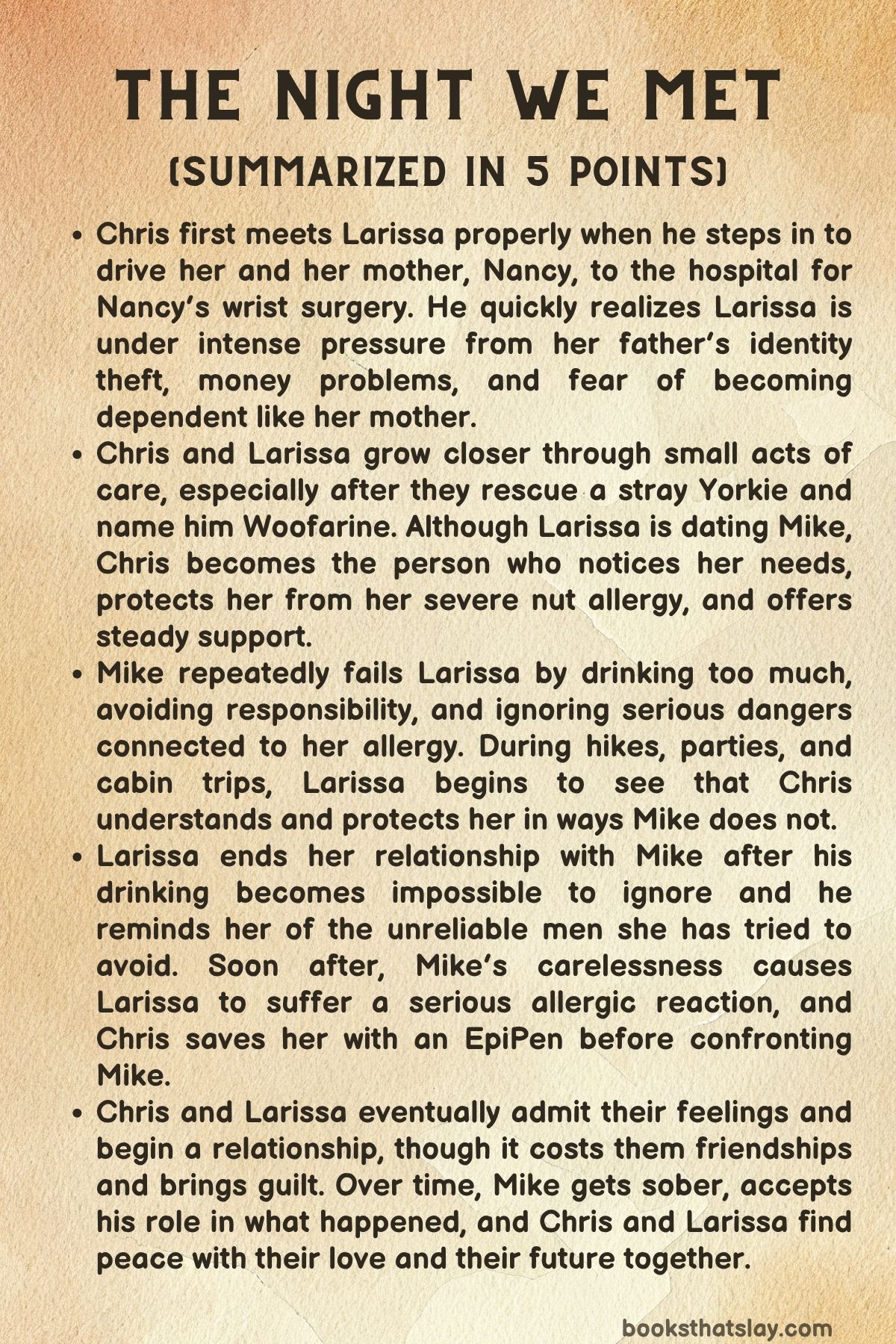
Summary
Chris’s morning begins before dawn with a call he does not want. His best friend, Mike, is too hungover to drive his girlfriend Larissa and her mother, Nancy, to the hospital for Nancy’s wrist surgery.
Mike asks Chris to step in, and Chris agrees with reluctance. At first, the errand seems simple: drive them, wait, and leave.
But once Chris meets Larissa properly, he realizes that her life is far more strained than Mike has let on.
Larissa is under intense pressure. Her father has stolen her identity, leaving her with damaged credit and financial chaos.
She is working constantly, trying to support herself and help her mother, while also dealing with the emotional weight of being betrayed by a parent. She is tired, embarrassed, and determined not to depend on anyone the way her mother once did.
Chris notices all of this almost immediately. Instead of dropping her off and disappearing, he stays with her at the hospital.
He takes her to breakfast, checks carefully that the café is safe for her severe nut allergy, and listens to her without judgment.
That morning changes the shape of their relationship. Larissa is still Mike’s girlfriend, but Chris becomes someone she can talk to.
They connect over bread, books, honesty, and the rare comfort of being understood without having to explain too much. Soon after, they find a dirty, neglected stray Yorkie.
Chris takes the dog in, and Larissa helps care for him. They name him Woofarine.
The dog becomes a reason for them to keep seeing each other through handoffs, texts, updates, and quiet visits. Their bond grows in ways neither of them fully admits at first.
Chris is also carrying grief. His mother has died, and he is still trying to live inside the absence she left behind.
Woofarine gives him comfort, routine, and a living creature to care for. Larissa’s presence adds something else: warmth, steadiness, and companionship he did not know he needed.
Yet Chris keeps reminding himself that Larissa belongs with Mike. Mike is his best friend, and Chris does not want to betray him.
The problem is that Mike keeps failing Larissa in ways Chris cannot ignore. Mike drinks too much, avoids responsibility, hides problems, and often leaves Chris to clean up the damage.
When Larissa’s car needs repairs, Mike only helps after Chris pressures him. When Larissa struggles with bills, she does whatever she can to stay afloat.
She donates plasma, cooks soup to sell, takes odd jobs, and works long hours. She is proud and scared, trying to survive without becoming trapped by dependence.
Chris sees the effort she puts into every day. He also sees that Mike often misses it.
Larissa begins to notice the difference too. Mike may be the boyfriend, but Chris is the one who remembers her allergy, checks ingredients, worries about unsafe food, and recognizes when she is overwhelmed.
This quiet attention matters to her because her allergy is not a small inconvenience; it is life-threatening. Mike often treats it casually or forgets the danger, while Chris treats it like her safety depends on him paying attention.
Their connection becomes more obvious during group events. Mike plans a hike and describes it as an easy loop because he once ran it.
Instead, Larissa and Chris end up walking eleven miles with little food and poor water. The situation is difficult, but they still enjoy being together.
The discomfort reveals how naturally they fit. They can talk, joke, endure inconvenience, and look after each other without making it feel like a burden.
At parties, gatherings, and cabin trips, Chris continues to protect Larissa in small but serious ways. He checks food, throws away unsafe items, asks questions, and stays alert.
Mike drinks, forgets, or minimizes the risk. Larissa cannot help comparing them.
Chris understands things Mike should understand. Chris is also becoming aware that his feelings are no longer simple friendship or concern.
He is falling in love with Larissa, and that knowledge frightens him.
To fight his feelings, Chris tries dating Heather. It does not work.
His thoughts remain with Larissa. He wants to be loyal to Mike, but loyalty becomes harder when Mike’s behavior keeps hurting her.
Chris feels trapped between the friend he has known for years and the woman he cannot stop caring for.
Larissa eventually moves in with Mike, hoping the relationship might become more stable. Instead, she finds him passed out drunk in his own vomit.
With Lexi’s help, she cleans him up, but the moment shakes her deeply. Mike reminds her of the unreliable men she promised herself she would avoid.
She has spent her life trying not to repeat her mother’s mistakes, and now she sees herself standing dangerously close to that pattern.
The breaking point comes during the Christmas cabin trip. Mike keeps drinking and behaving unpredictably.
Larissa confronts him and ends the relationship. She tells him that he needs to change, not for her, but for someone else in the future.
The breakup hurts, but it is also an act of self-preservation. She cannot keep waiting for Mike to become dependable while he keeps proving that he is not ready.
After Mike tells the guys about the breakup, the situation becomes even worse. Larissa has a serious allergic reaction because Mike failed to remove nuts from the cabin.
Chris acts fast and gives her an EpiPen. His fear turns into fury.
Mike’s carelessness could have killed her. Unable to contain his anger, Chris punches him.
The conflict between them finally becomes physical, but the real damage has been building for months.
Chris brings Larissa home and takes care of her. In the aftermath, they can no longer hide from what has been obvious between them.
Their feelings have been growing through every hospital wait, every dog handoff, every checked menu, every conversation, and every moment when Chris chose to show up. They do not immediately step into happiness.
There is guilt, fear, and the heavy knowledge that loving each other may cost Chris his friendships.
Larissa’s life becomes even harder when she loses her job at Donna’s. Mike’s mother retaliates after the breakup by adding nuts to the menu, making the restaurant unsafe for Larissa.
With her income threatened and her options limited, Larissa moves in with Chris temporarily. She begins working on her own graze-table business, trying to build something stable from the skills and determination she already has.
Living together places Chris and Larissa in a painful in-between space. They are clearly in love, but they are afraid of what acting on it will mean.
Larissa worries that she will ruin Chris’s friendships. Chris worries about betraying Mike, even after everything Mike has done.
The love between them feels natural, but the timing feels messy. Larissa tries to leave to spare Chris the cost of choosing her.
This time, Chris does not let fear make the decision. He kisses her, and they become a couple.
Their relationship brings joy, but not without consequences. Chris loses his friend group for a time, and both he and Larissa struggle with guilt and loneliness.
They love each other, but they also know their happiness came after pain, failure, and a breakup that hurt someone Chris once considered family. The story does not pretend that love erases the damage around it.
Instead, Chris and Larissa have to live with the discomfort of being happy while others are still healing.
Months later, Mike comes to Chris sober and back on his medication. He is clearer, steadier, and more honest than he has been before.
He admits that he failed Larissa. He also understands that his own behavior pushed Chris and Larissa together because he kept making Chris step in where he should have been present himself.
This conversation gives Chris some release from the guilt he has been carrying. Mike does not excuse what happened, but he recognizes his part in it.
Larissa also speaks with Mike, and they are able to part more peacefully. Their relationship was not right, but the ending no longer has to be only anger and blame.
Mike’s growth allows everyone to begin moving forward. Chris and Larissa eventually reconnect with the group during a fall outing, suggesting that some friendships may recover, even if they are changed.
In the final moments, Chris and Larissa stand together in a corn maze. Chris thinks about the future and understands that Larissa is not a temporary comfort or a mistake born from bad timing.
She is the person he wants beside him. He tells her that their love will leave the world better than it found it.
Larissa answers that it already has. Their ending is not built on perfection, but on care, honesty, and the choice to love someone fully after seeing how hard life has been for them.
Characters
Chris
Chris is one of the most emotionally grounded and quietly self-sacrificing characters in the book. At the beginning, he is pulled into Larissa’s life almost unwillingly when Mike asks him to drive Larissa and Nancy to the hospital.
What starts as an inconvenient favor becomes the first sign of Chris’s deeper nature: he is dependable even when he has no obligation to be. He notices what others miss, stays when it would be easier to leave, and shows care through action rather than dramatic declarations.
His attention to Larissa’s nut allergy, his willingness to remain at the hospital, and his thoughtful efforts to make her feel safe reveal that he is not merely kind, but emotionally attentive in a way Larissa desperately needs.
Chris’s character is also shaped by grief. The death of his mother leaves him with a quiet sadness, and Woofarine becomes an unexpected source of comfort for him.
His bond with the stray dog reflects his own need to rescue and be rescued. Through Woofarine, Chris begins to open himself to tenderness again, and Larissa becomes connected to that emotional healing.
Their shared care for the dog gives Chris a way to express affection without directly confronting feelings he believes he should not have. This makes his love for Larissa slow, restrained, and morally complicated because he is deeply aware that she is dating his best friend.
One of the most important aspects of Chris’s character is his loyalty, but the book also shows the painful limits of loyalty. He tries to protect Mike, cover for him, and stay away from Larissa because he believes friendship demands sacrifice.
Yet his loyalty to Mike comes into conflict with his growing awareness that Larissa is being neglected and endangered. Chris’s moral struggle is not simply about falling in love with someone unavailable; it is about realizing that silence and distance can also become forms of harm.
His eventual anger after Larissa’s allergic reaction shows how long he has been suppressing his fear, frustration, and love.
By the end of the story, Chris becomes a character who learns to choose honest love over guilt. His relationship with Larissa costs him social comfort, friendships, and peace of mind, but it also allows him to become more emotionally truthful.
He is not portrayed as perfect, because he hesitates, avoids confrontation, and allows guilt to delay happiness. Still, his deepest quality is steadiness.
Chris represents the kind of love that is built through presence, protection, patience, and emotional responsibility.
Larissa
Larissa is one of the most resilient and emotionally layered characters in the story. She is introduced as someone under enormous pressure, dealing with her mother’s surgery, financial instability, identity theft caused by her father, and the constant fear of becoming dependent or trapped.
Her life is marked by survival. She works constantly, donates plasma, cooks soup to sell, takes odd jobs, and pushes herself beyond exhaustion because she is determined not to repeat the helplessness she has seen in her family.
This makes Larissa both vulnerable and strong: she is overwhelmed, but she refuses to collapse.
Her relationship with Mike reveals her longing for security, but also her tendency to tolerate less than she deserves. Mike is officially her boyfriend, yet Chris is often the person who actually protects her, listens to her, and understands her needs.
Larissa slowly recognizes this difference, especially through the way Chris handles her severe allergy with seriousness while Mike repeatedly minimizes or forgets it. Her attraction to Chris grows not because of a sudden romantic spark alone, but because he represents safety, consideration, and emotional maturity.
For someone whose life has been shaped by unreliable people, Chris’s dependability becomes deeply meaningful.
Larissa’s fear of dependence is central to her character. She does not want to become like her mother, and she is frightened by the idea of needing anyone too much.
This makes her relationship with Chris complicated because he helps her in ways she both appreciates and fears. When she moves in with him temporarily, the emotional closeness between them becomes impossible to ignore, but Larissa also worries that their love will damage his friendships and create more pain.
Her instinct to leave is not a lack of love; it is an attempt to protect him from the consequences of choosing her.
By the end of the book, Larissa’s growth comes from allowing herself to accept love without seeing it as weakness. She learns that needing someone does not have to mean losing herself.
Her business ambitions, emotional honesty, and eventual peace with Mike show that she is not simply rescued by Chris; she actively rebuilds her life. Larissa is a character defined by endurance, but her journey is also about learning that survival is not the same as happiness.
Mike
Mike is one of the most flawed and conflicted characters in the novel. He begins as Chris’s best friend and Larissa’s boyfriend, but his actions repeatedly show immaturity, avoidance, and emotional irresponsibility.
He drinks too much, hides problems, forgets important responsibilities, and allows Chris to step in whenever things become difficult. His failures are especially serious because they affect Larissa’s safety and stability.
Mike does not always seem intentionally cruel, but his carelessness becomes damaging because he refuses to fully face the consequences of his behavior.
His relationship with Larissa exposes the gap between affection and responsibility. Mike may care about her, but he does not consistently protect her or understand the seriousness of her struggles.
His failure to manage the nut situation at the cabin nearly costs Larissa her life, making his negligence impossible to excuse. The book uses Mike to show that love without accountability can become dangerous.
He wants the benefits of a relationship without doing the emotional work required to be a reliable partner.
Mike’s alcoholism and problems with medication add complexity to his character. He is not written as a simple villain, because his later sobriety and self-awareness show that he is capable of growth.
However, the story does not use his struggles to erase the harm he causes. His behavior forces Larissa into fear and disappointment, and it places Chris in the painful position of constantly compensating for him.
Mike’s decline also reveals why Larissa eventually ends the relationship: she recognizes the pattern of unreliable men she promised herself she would avoid.
His later conversation with Chris is one of his most important moments because it shows maturity that he lacked earlier. By admitting that he failed Larissa and that his own behavior pushed Chris and Larissa together, Mike finally takes responsibility.
This does not undo the damage, but it allows emotional closure. Mike’s role in the story is tragic because he loses both a relationship and a friendship for a time, but his recovery suggests that accountability can still lead to personal growth.
Nancy
Nancy, Larissa’s mother, represents one of the major emotional pressures in Larissa’s life. Her wrist surgery is the event that brings Chris and Larissa together more directly, but Nancy’s importance goes beyond that moment.
She reflects the kind of dependence that Larissa fears for herself. Larissa’s worry over her mother is mixed with love, exhaustion, and anxiety about the future.
Through Nancy, the book shows how family responsibility can become emotionally and financially overwhelming.
Nancy’s presence helps explain Larissa’s fierce independence. Larissa is not simply ambitious or hardworking by nature; she is driven by the fear that if she stops moving, everything around her will collapse.
Caring for Nancy becomes one more responsibility in a life already filled with instability. This adds emotional weight to Larissa’s choices because her romantic life is never separate from her family burdens.
She is trying to love, work, survive, and care for someone else all at once.
Although Nancy is not as central as Chris, Larissa, or Mike, she plays an important supporting role in shaping Larissa’s worldview. Her situation makes Larissa more determined to avoid helplessness, but it also reveals Larissa’s compassion.
Larissa may fear becoming dependent like her mother, yet she does not abandon Nancy. This tension makes Larissa’s family life feel realistic and emotionally complicated.
Larissa’s Father
Larissa’s father is a damaging figure even though he is not physically present in much of the story. His theft of Larissa’s identity creates financial chaos and emotional betrayal, showing how deeply family can wound someone even from a distance.
His actions place Larissa in a state of crisis, forcing her to work constantly and live under the pressure of problems she did not create. He represents irresponsibility, exploitation, and the kind of selfishness that leaves others to clean up the damage.
His importance lies in the way he shapes Larissa’s distrust. Because someone who should have protected her instead harmed her, Larissa becomes determined not to rely on people who might fail her.
Her father’s betrayal helps explain why she is so guarded and why financial independence matters so much to her. For Larissa, money is not just practical; it is tied to safety, dignity, and control over her own life.
This character also deepens the contrast between Chris and the unreliable men around Larissa. Her father takes from her, Mike fails to show up for her, and Chris quietly supports her without demanding anything in return.
Through this contrast, the story highlights why Chris’s care feels so powerful to Larissa. Her father’s role is painful but necessary because it reveals the roots of her fear and the strength behind her resilience.
Woofarine
Woofarine is more than a stray dog in the book; he becomes a symbol of healing, connection, and unexpected love. When Chris and Larissa find him filthy and abandoned, their decision to care for him reflects their own hidden emotional needs.
Woofarine enters the story as something vulnerable that needs rescuing, but he also helps rescue Chris and Larissa from loneliness. His presence gives them a reason to keep meeting, texting, sharing responsibilities, and building intimacy in a way that feels natural.
For Chris, Woofarine becomes especially important because of his grief over his mother’s death. Caring for the dog gives him comfort, routine, and a place to put his tenderness.
For Larissa, helping with Woofarine allows her to experience warmth and partnership without immediately naming her feelings for Chris. The dog becomes a safe emotional bridge between them, letting their relationship grow through shared care rather than direct confession.
Woofarine also reflects one of the story’s larger ideas: love often begins through small acts of responsibility. Feeding him, cleaning him, handing him off, and worrying about him all become quiet expressions of affection between Chris and Larissa.
His role is gentle but meaningful because he helps reveal who the characters are when no one is watching. Chris and Larissa’s treatment of Woofarine shows their capacity for patience, loyalty, and tenderness.
Lexi
Lexi plays a supportive but important role in Larissa’s life. Her most notable moment comes when she helps Larissa after Larissa finds Mike passed out drunk in his own vomit.
This scene is emotionally significant because it shows Larissa confronting the reality of Mike’s instability, and Lexi’s presence gives her practical and emotional support during a humiliating and painful moment. Lexi helps Larissa face something that would have been even more isolating alone.
As a character, Lexi represents the importance of female support in a story dominated by romantic and friendship conflicts. Larissa often carries burdens quietly, so Lexi’s help matters because it interrupts that isolation.
She is not the central force in Larissa’s transformation, but she provides a reminder that Larissa is not completely alone outside of Chris and Mike. Her presence adds realism to Larissa’s world by showing that support can come from friendships as well as romance.
Lexi also helps highlight the seriousness of Mike’s behavior. The fact that Larissa needs help cleaning up after him makes the relationship feel less like a normal rough patch and more like a warning sign.
Through Lexi’s involvement, the story makes clear that Larissa’s discomfort is justified. Lexi functions as a witness to the kind of relationship Larissa must leave behind.
Heather
Heather’s role is brief but meaningful because she reveals Chris’s attempt to deny his feelings for Larissa. When Chris tries dating Heather, he is not truly moving forward; he is trying to force himself into an emotional direction that feels safer and more acceptable.
Heather becomes part of Chris’s struggle to remain loyal to Mike and avoid crossing a line. Her presence shows how hard Chris is trying to do what he thinks is right, even when his heart is elsewhere.
Heather also helps clarify the difference between genuine connection and emotional distraction. Chris may try to date her, but the relationship cannot compete with the depth of what he feels for Larissa.
This does not make Heather unimportant; instead, it shows that Chris’s feelings are not temporary or casual. His inability to make things work with Heather confirms that his bond with Larissa has already become central to his emotional life.
In the story, Heather functions as a mirror for Chris’s denial. Through her, readers see that Chris is not someone who rushes selfishly toward Larissa.
He tries to resist, redirect, and behave honorably. Heather’s role helps make his eventual choice of Larissa feel less impulsive and more like the result of a long emotional truth he can no longer avoid.
Donna
Donna is important because her restaurant gives Larissa employment and a sense of survival, but it also becomes a place where Larissa’s vulnerability is exposed. Larissa’s job matters because she is already under severe financial pressure, and losing it creates another crisis.
Donna’s workplace is not just a background setting; it is tied to Larissa’s independence, her ability to pay bills, and her attempt to stay afloat.
The conflict involving nuts at the restaurant shows how fragile Larissa’s security really is. Because of her severe allergy, safety is not optional for her.
When the restaurant becomes unsafe, Larissa loses more than a job; she loses one of the few structures helping her maintain control. This moment reinforces how easily other people’s choices can endanger her life and livelihood.
Donna’s role also connects to the larger social fallout after Larissa and Chris become a couple. The loss of Larissa’s job is not just a practical problem but a consequence of the emotional and social tensions surrounding Mike, his family, and the breakup.
Through Donna’s restaurant, the book shows how personal conflict can spill into work, money, and survival.
Mike’s Mother
Mike’s mother is a harsh and retaliatory figure in the story. Her decision to add nuts to the menu after Larissa’s breakup with Mike is deeply cruel because it targets Larissa’s most serious vulnerability.
This is not a minor act of disapproval; it makes Larissa’s workplace unsafe and contributes to her losing her job. Her behavior shows how family loyalty can become destructive when it ignores fairness and basic human safety.
She also reveals the social cost of Larissa and Chris’s relationship. Larissa is not only dealing with heartbreak, guilt, and financial stress; she is also punished by people connected to Mike.
Mike’s mother turns personal resentment into practical harm, making Larissa’s already difficult life even more unstable. Her actions deepen the reader’s sympathy for Larissa because they show how little protection Larissa has from people with power over her circumstances.
As a character, Mike’s mother functions as an example of misplaced blame. Instead of recognizing Mike’s failures, she directs anger toward Larissa.
This makes her an important part of the story’s moral landscape because she contrasts sharply with the accountability Mike eventually shows. Where Mike later admits his mistakes, his mother responds with punishment and resentment.
Themes
Love Expressed Through Care
Care becomes the clearest language of love in The Night We Met. Chris’s feelings are not shown first through dramatic declarations, but through repeated acts of attention that Larissa is not used to receiving.
He notices her exhaustion at the hospital, checks food for her nut allergy, stays when he could leave, and quietly protects her in social settings where others are careless. These actions matter because Larissa’s life has taught her that people often take from her, abandon her, or make her carry burdens alone.
Chris does the opposite: he reduces danger, creates safety, and makes her feel seen without demanding anything in return. This kind of love grows slowly because it is built on reliability rather than fantasy.
Larissa begins to understand that affection is not only about who claims to love her, but who pays attention when the consequences are serious. Through Chris, love is shown as patience, responsibility, and steady presence.
Responsibility and Emotional Maturity
Responsibility separates Chris from Mike throughout the story. Mike may have affection for Larissa, but he repeatedly avoids the duties that come with loving someone well.
His drinking, forgetfulness, and lack of accountability place others in difficult or dangerous situations, especially when Larissa’s allergy is involved. Chris, by contrast, often takes responsibility even when the problem is not directly his.
He drives Larissa and Nancy to the hospital, cares for Woofarine, pushes Mike to help with the car repair, and steps in when Larissa’s safety is threatened. This contrast is not only about romance; it is about emotional maturity.
The story shows that good intentions are not enough when someone’s actions repeatedly cause harm. Mike’s later sobriety and apology matter because he finally recognizes the damage caused by his failures.
Responsibility, therefore, is presented as the willingness to face consequences, change harmful patterns, and understand how one’s choices affect others.
Survival, Independence, and Fear of Dependence
Larissa’s struggle for independence is shaped by financial pressure, family damage, and fear of repeating her mother’s life. Her father’s identity theft leaves her trapped under debts she did not create, while her mother’s dependence on unreliable men becomes a warning she carries constantly.
Larissa works long hours, donates plasma, sells soup, takes odd jobs, and pushes herself beyond what is healthy because she believes needing help can become dangerous. Her independence is admirable, but it is also exhausting.
The story shows how survival can become a form of isolation when a person has been taught that dependence leads to betrayal. Chris challenges this belief not by controlling her or rescuing her in a way that weakens her, but by offering support that respects her strength.
Larissa’s growth comes from realizing that accepting care does not mean surrendering her independence. Trust becomes possible when help is given with respect rather than power.
Guilt, Loyalty, and the Cost of Choosing Happiness
Chris and Larissa’s relationship carries emotional weight because their love develops while Mike is still part of both their lives. Their happiness is not simple because it comes with guilt, damaged friendships, and the fear that choosing each other means betraying someone else.
Chris struggles deeply with loyalty to Mike, even as he knows that Larissa is not being loved with the care she deserves. Larissa also feels the burden of becoming the reason Chris loses his friend group.
This makes their romance more painful and realistic, because the story does not pretend that love automatically erases consequences. Their choice asks whether loyalty means staying silent in a harmful situation or being honest about what has already changed.
Mike’s later apology helps release some of that guilt because he admits his own role in pushing them together. The theme suggests that happiness can be morally complicated, but still worth choosing when it grows from truth rather than selfishness.