The Shock of the Light Summary, Characters and Themes
The Shock of the Light by Lori Inglis Hall is a historical novel about secrecy, war, loyalty, and the long shadow of unanswered questions. Set between pre-war Paris, wartime Britain and occupied France, and the early 2000s, the book follows Tessa Armstrong, a young woman whose private trauma is hidden before she is drawn into dangerous work for the Special Operations Executive.
Her twin brother, Theo, spends decades trying to understand her fate. Through Tessa’s story and a later investigation by a researcher named Edie, the novel examines courage, betrayal, family bonds, and the damage caused when truth is buried.
Summary
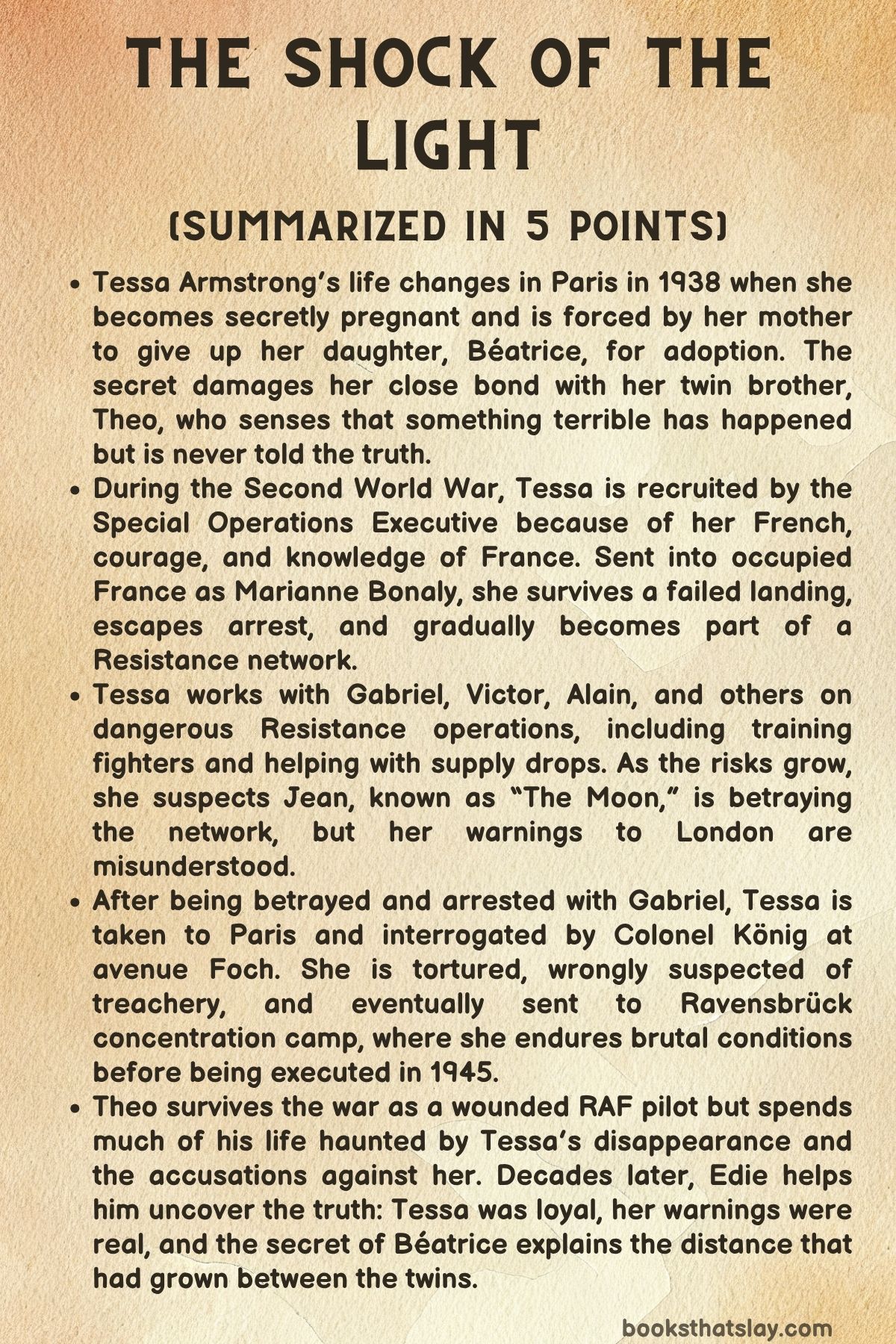
Tessa Armstrong’s story begins in Paris in 1938, when she is young, frightened, and secretly pregnant. Her life is quickly taken out of her hands.
Her mother decides that the pregnancy must be hidden from everyone, especially Tessa’s father and her twin brother, Theo. Tessa and Theo have always shared an unusually close bond, and keeping such a secret from him changes something essential between them.
Tessa gives birth to a daughter, Béatrice, but the child is taken away and adopted. Tessa returns to England carrying a grief she cannot explain.
Theo senses that something terrible has happened, but Tessa refuses, or is unable, to tell him the truth. Their closeness is damaged by silence, and Theo is left confused by the sister who has come back altered.
By 1942, Britain is deep in the Second World War, and Tessa is working in London. Ordinary wartime duties do not satisfy her.
She wants to do something that feels useful and direct. Through Michael, an old acquaintance, she is brought to the attention of the Special Operations Executive, the secret British organisation that sends agents into occupied Europe.
Tessa has qualities they need. She speaks French fluently, knows France well, and has the nerve to take risks.
She is accepted for training and given a cover connected to the First Aid Nursing Yeomanry.
Her training is demanding and dangerous. She learns how to handle weapons, use codes, survive questioning, work with resistance groups, and parachute into enemy territory.
She is prepared to operate under a new identity, Marianne Bonaly. The mission is perilous from the beginning, but Tessa is determined to go.
Behind her resolve lies not only patriotism but also a need to act, to prove herself, and perhaps to move beyond the private pain that has shaped her.
When Tessa is sent into occupied France, the operation fails almost immediately. The landing site has been compromised, and the reception party appears to have been attacked.
The other agents who arrived with her are probably dead or captured. Tessa misses the drop zone and lands in a tree, alone and disoriented.
She hides through the night and then tries to make her way across hostile countryside, knowing that the Germans are already searching for her.
Her danger increases almost at once. French police detain her, beat her, and question her.
Tessa understands that any mistake could expose her identity and lead to execution. She manages to escape during confusion at the police station, steals a coat and beret, and reaches Chez Emile, a contact point connected to the resistance network.
From there, she is passed to Agnès Roue, who hides her, cuts her hair, gives her a new appearance and identity, and helps her continue her journey.
Tessa eventually reaches a farm linked to the Resistance. There she meets Gabriel, a man who becomes important to her both as a fellow fighter and as someone she grows to love.
She joins local operations with Gabriel, Victor, Alain, and others. Her work includes helping with supply drops, training fighters, carrying messages, and supporting sabotage efforts.
She becomes part of a world where trust is essential but never certain. Every contact, every coded message, and every meeting could mean survival or death.
As Tessa becomes more involved, she begins to suspect that the network has been penetrated. A man known as Jean, or “The Moon,” appears increasingly suspicious.
Tessa tries to warn London through coded messages, using references to the “bad moon” to signal danger. Her warnings are not properly understood.
London’s confusion and the treachery inside the network place her and others in greater danger.
Tessa and Gabriel are later betrayed at her grandmother’s house by Madame Daunay. They are arrested by the Germans and taken into custody.
Tessa is brought to avenue Foch in Paris, the feared Gestapo headquarters. There, Colonel König interrogates her.
Tessa realises that the enemy knows too much and that the resistance network has been badly exposed. She also understands that Jean’s betrayal, combined with failures in London, has helped destroy the people she has worked with.
Tessa is imprisoned and tortured, but she does not betray her comrades. Eventually she is sent to Ravensbrück, the concentration camp where many women prisoners are held under brutal conditions.
Her story becomes one of endurance under extreme cruelty. She faces cold, hunger, exhaustion, and fear, while still holding on to memories of Theo, Gabriel, Béatrice, and the life that was taken from her piece by piece.
While Tessa is in France, Theo serves as an RAF pilot. On D-Day, his aircraft is hit, and he is badly injured.
He survives, but his body and mind are permanently affected. When he returns home, he learns that Tessa is missing.
His old bond with his sister, already strained by the secret from 1938, now becomes a source of torment. He cannot accept not knowing what happened to her.
Theo begins searching for answers. He questions officials, travels to Paris, and visits the Gestapo building where Tessa was held.
He meets Luc, one of Tessa’s former lovers, and tries to piece together her final known movements. After the war, he works around the Nuremberg trials, but even that historic setting cannot free him from his obsession with Tessa’s disappearance.
Rumours begin to circulate that Tessa may have betrayed her own network. For Theo, this accusation is almost unbearable.
He does not know whether to defend her, doubt her, or blame the institutions that sent her into danger and then abandoned her memory.
Decades pass. Theo continues living, but he never truly releases the past.
Tessa remains present in his mind, not as a settled memory but as an open wound. The unanswered questions around her fate shape his later years.
He grows old carrying grief, anger, and guilt, still haunted by the sister he could not protect and never fully understood.
In 2003, Edie, a young researcher, begins studying women who served as SOE agents. She becomes interested in Tessa Armstrong’s case and notices problems in the official record.
The files do not fully make sense. There are gaps, inconsistencies, and signs that Tessa may have been judged unfairly.
Edie contacts Theo, now elderly, and together they begin a new investigation into the truth.
Their search leads them to Michael and Emmeline Jones. They discover that the accusations against Tessa were built largely on unreliable claims made by Paul Aubert.
They also learn that the SOE had reasons to protect itself from scandal, especially where female agents were concerned. Edie recognises that Tessa’s messages about the “bad moon” were not proof of betrayal.
They were warnings about Jean. Tessa had seen the danger and tried to alert London, but her warnings had been misunderstood or mishandled.
Theo and Edie travel to Paris, where they meet Gabriel and Agnès. These meetings finally give Theo a clearer picture of his sister’s courage.
Gabriel confirms that Tessa was loyal, brave, and wrongly suspected. He also reveals the truth about Béatrice, the daughter Tessa was forced to give up before the war.
This revelation allows Theo to understand the change he saw in Tessa in 1938. Her distance had not been rejection.
It had been grief, shame, and enforced silence.
The final part returns to Tessa in Ravensbrück in 1945. She is weakened by hunger, cold, and harsh treatment, but she remains inwardly connected to the people she has loved.
She is eventually executed with other women. In her final moments, her thoughts return to Theo and their childhood together in the river.
The image restores the bond that secrecy, war, and death could not fully destroy. The Shock of the Light ends as a story of hidden truth brought back into view, and of a brother and sister whose connection survives through memory, even after history tries to erase one of them.
Characters
Tessa Armstrong
Tessa Armstrong is the central and most tragic figure in The Shock of the Light. She begins as a frightened young woman carrying a secret that is forced upon her by social shame and family control.
Her hidden pregnancy in Paris changes the course of her life, not only because she is separated from her daughter, Béatrice, but also because she is forced to return to England as someone who can no longer be open with the person closest to her, her twin brother Theo. This early wound shapes much of her character.
Tessa is not simply secretive by nature; she becomes guarded because the truth has been taken out of her hands. Her silence is painful because it damages the bond she values most, yet she is trapped by circumstances that make honesty almost impossible.
As the story moves into the war, Tessa’s restlessness reveals another side of her. She is courageous, intelligent, and unwilling to remain passive while the world is being torn apart.
Her recruitment into the Special Operations Executive gives her a way to transform private pain into public purpose. Her fluency in French, knowledge of France, boldness, and ability to adapt make her suitable for dangerous work, but her bravery is never presented as simple fearlessness.
She is afraid, often isolated, and repeatedly forced to improvise. Her landing in occupied France immediately tests her resilience, and her ability to survive after the failed mission shows her instinct for endurance.
Tessa’s character becomes especially powerful because she combines vulnerability with moral strength. She builds relationships with people such as Agnès and Gabriel, yet she never forgets the danger surrounding them.
Her growing suspicion of Jean shows her alertness and sense of responsibility. She tries to warn London, not to protect herself alone, but to protect the network and the people risking their lives around her.
Her later arrest, interrogation, imprisonment, and torture reveal the cruelty of the world she has entered, but they also reveal her loyalty. Even when official records later cast doubt on her, the deeper truth of the book shows her as a brave and wrongly suspected woman whose life is destroyed by betrayal, institutional failure, and war.
In her final moments, Tessa remains emotionally tied to Theo and to the childhood they shared. This ending makes her character deeply moving because it brings together the two great losses of her life: the daughter she was forced to surrender and the twin brother from whom she was separated by secrecy, war, and death.
Tessa is heroic, but the story does not turn her into an untouchable symbol. She remains human, wounded, loving, frightened, determined, and loyal until the end.
Theo Armstrong
Theo Armstrong is defined by love, loss, and the lifelong need to understand what happened to his sister. At the beginning of the story, his bond with Tessa is central to his identity.
They are twins, and their closeness is presented as something deeper than ordinary sibling affection. When Tessa returns from Paris changed and distant, Theo senses that something has been broken, but he does not know why.
His confusion is important because it shows how secrecy harms not only the person who carries it but also the people who love them. Theo is not angry because Tessa has changed; he is wounded because he cannot reach her.
During the war, Theo’s role as an RAF pilot places him in a different but equally dangerous form of service. His injuries on D-Day transform him physically and emotionally.
He survives, but survival does not bring peace. His trauma and disability deepen his sense of helplessness, especially once he learns that Tessa is missing in France.
Theo becomes a character driven by grief and unfinished questions. His search for the truth is not simply curiosity; it is an attempt to restore his connection with Tessa and to repair the silence that separated them.
Theo’s later life is marked by persistence. He confronts officials, travels to Paris, visits places connected to Tessa’s imprisonment, and continues searching even when the answers are painful or incomplete.
The rumours that Tessa may have betrayed her network torment him because they threaten the image of the sister he loved. Yet Theo’s loyalty does not disappear.
Even when faced with uncertainty, he cannot fully believe that Tessa was a traitor. His grief is mixed with anger, guilt, and devotion, making him one of the most emotionally complex figures in the story.
In old age, Theo’s meeting with Edie allows him finally to approach the truth. Through the investigation, he learns not only that Tessa was wrongly suspected, but also that she had a daughter before the war.
This revelation changes his understanding of the distance that once grew between them. Theo’s character arc is therefore one of delayed recognition.
He spends much of his life trying to solve the mystery of Tessa’s disappearance, but what he ultimately discovers is the full humanity of his sister: her suffering, her courage, her love, and the secret burden she was forced to carry.
Edie
Edie serves as the modern investigator who reopens Tessa’s buried story in 2003. She represents a later generation trying to understand the sacrifices of women whose wartime service was misunderstood, ignored, or distorted.
Her interest in women agents of the SOE is not presented as casual research. She is attentive, determined, and morally alert, especially when she notices irregularities in Tessa’s official files.
Edie’s importance lies in her refusal to accept the easy version of history.
Her role in the book is both investigative and restorative. By contacting Theo and working with him, Edie helps reconnect the past with the present.
She brings fresh eyes to a case that has been clouded by grief, institutional secrecy, and false accusation. Her interpretation of Tessa’s coded warnings about the “bad moon” is especially important because it shifts the meaning of the evidence.
What had been used to suggest betrayal is revealed to be an attempt to warn others about Jean. Edie therefore becomes a character who restores truth through careful reading and moral patience.
Edie also helps Theo face what he has carried for decades. She does not replace Tessa, but she becomes a companion in the search for Tessa’s truth.
Her presence allows the story to examine how historical memory is recovered, especially when official records are incomplete or unjust. Edie’s character shows that the past does not remain buried forever when someone is willing to question it honestly.
Gabriel
Gabriel is one of the most important figures in Tessa’s life in occupied France. He is connected to the Resistance and becomes both a comrade and a source of emotional closeness for her.
His relationship with Tessa develops in an atmosphere of danger, which makes their bond intense and fragile. He sees her not as an outsider playing at heroism, but as someone brave, capable, and deeply committed to the work.
Gabriel’s significance grows because he survives to bear witness. In the later investigation, he confirms Tessa’s loyalty and courage, helping to correct the false suspicions that surrounded her name.
His testimony matters because he knew her in the field, under pressure, and in moments when loyalty was tested. Through Gabriel, the story shows that personal memory can challenge official distortion.
He is also the character who reveals the hidden truth about Béatrice. This makes him central not only to the wartime plot but also to the emotional truth of Tessa’s earlier life.
Gabriel helps Theo understand that Tessa’s silence after Paris was not coldness or rejection, but the result of trauma and forced separation from her child. His character therefore carries both love and witness.
He preserves the truth of Tessa when institutions fail to do so.
Agnès Roue
Agnès Roue is a protective and practical figure who helps Tessa survive after her mission goes wrong. She shelters Tessa, cuts her hair, gives her a new identity, and helps her move forward through occupied France.
Agnès represents the quiet courage of civilians who risk their lives without the formal recognition often given to soldiers or agents. Her bravery is not dramatic in the obvious sense, but it is essential.
Agnès’s role also shows the importance of women’s networks during wartime. She understands danger, secrecy, disguise, and movement.
Her help allows Tessa to continue after an almost disastrous beginning. She acts quickly and decisively, suggesting that she is experienced, disciplined, and emotionally strong.
In a world where betrayal is always possible, Agnès offers Tessa a rare form of trust.
In the later part of the story, Agnès helps confirm the truth of Tessa’s courage. Like Gabriel, she becomes a living connection to the past.
Her character reminds the reader that resistance work depended not only on grand missions but also on shelter, clothing, false identities, food, and the willingness of ordinary people to endanger themselves for others.
Béatrice
Béatrice is Tessa’s daughter, though she is absent from much of the action. Her importance lies in what she represents: the hidden wound at the centre of Tessa’s life.
Tessa’s pregnancy and forced separation from Béatrice shape her emotional distance from Theo and explain the change in her after Paris. Béatrice is not simply a lost child in the background; she is the secret that alters family relationships and deepens the tragedy of Tessa’s life.
As a character, Béatrice functions through absence. She shows how decisions made by others can permanently affect a woman’s life.
Tessa does not freely choose to give her daughter away; she is pressured by a world that values reputation over truth and control over compassion. Béatrice’s adoption becomes one of the earliest acts of loss in the story, and that loss echoes through everything that follows.
When Gabriel later reveals Béatrice’s existence, the truth changes Theo’s understanding of Tessa. He finally sees that his sister’s distance was rooted in grief.
Béatrice’s role therefore becomes crucial to the emotional resolution of the book. She represents the private tragedy beneath the public heroism, reminding the reader that before Tessa became an agent, she was a young mother whose child was taken from her life.
Tessa’s Mother
Tessa’s mother is a controlling figure whose decisions have lasting consequences. When Tessa becomes pregnant in Paris, her mother arranges for the pregnancy to be hidden and insists that Tessa’s father and Theo must never know.
Her actions are shaped by fear of scandal, social judgment, and family reputation. She may believe she is protecting the family, but the result is emotional damage that lasts for decades.
Her character reflects the pressures placed on women before and during the period of the war. She enforces the very rules that harm her daughter, showing how social shame can be maintained within families as much as by society at large.
Her insistence on secrecy isolates Tessa from Theo and forces Tessa to carry grief without support. This makes her one of the most consequential figures in Tessa’s early life, even though she is not part of the wartime action.
Tessa’s mother is not presented as a villain in the simple sense, but her choices are deeply damaging. She values silence over healing and appearance over emotional truth.
Through her, the story shows how family authority can become another form of imprisonment.
Tessa’s Father
Tessa’s father remains important mainly because of what he is not allowed to know. He is kept ignorant of Tessa’s pregnancy and the birth of Béatrice, which shows how completely the secret is controlled by Tessa’s mother.
His absence from the truth helps create the emotional isolation surrounding Tessa. He belongs to the family structure, but he is excluded from one of the most important events in his daughter’s life.
His character also highlights the secrecy that defines the Armstrong family after Paris. Because he does not know what happened, he cannot intervene, comfort, or challenge the decisions made around Tessa.
His lack of knowledge is part of the tragedy. The story uses him to show how silence spreads through a family, affecting even those who are not directly responsible for it.
Michael
Michael is the old acquaintance who helps bring Tessa into the world of the Special Operations Executive. His role is important because he becomes the bridge between Tessa’s restless dissatisfaction with ordinary war work and the dangerous mission that defines the rest of her life.
He recognizes qualities in Tessa that the SOE can use: her French, her knowledge of France, her confidence, and her willingness to take risks.
Michael’s character also becomes significant in the later investigation. When Edie and Theo speak to him, he helps reveal the institutional forces that shaped the false suspicion against Tessa.
He is connected not only to Tessa’s recruitment but also to the way her story was later handled. Through him, the book explores how wartime organizations could use people when they were useful and fail them when the truth became inconvenient.
Michael is therefore a morally complicated figure. He is not necessarily portrayed as cruel, but he is part of a system that places Tessa in danger and later allows doubt to gather around her name.
His presence raises questions about responsibility, loyalty, and the cost of secret war.
Jean, Known as “The Moon”
Jean, known as “The Moon,” is one of the most dangerous figures in the story because he represents betrayal from within. Tessa suspects that he may be compromised, and her attempts to warn London about the “bad moon” become central to the misunderstanding that later damages her reputation.
Jean’s danger lies not only in what he does, but in the confusion he creates. His treachery turns trust into a weapon.
As a character, Jean shows how resistance networks could be destroyed from the inside. The enemy is not always easily visible; sometimes danger comes through someone who appears to belong to the same cause.
Tessa’s awareness of Jean’s threat proves her intelligence and loyalty, but the failure of others to understand her warnings contributes to disaster. Jean therefore becomes a key figure in both the operational collapse and the later false accusations.
His nickname adds symbolic weight. The moon can suggest reflected light, uncertainty, and changing appearances, all of which suit a character associated with hidden betrayal.
Jean’s role darkens the story because he helps show that courage alone is not enough when institutions fail to listen and traitors are allowed to operate.
Victor
Victor is part of the Resistance world that Tessa enters after reaching the farm. He works alongside Gabriel, Alain, and others in the local operations.
His role helps build the sense of a wider network of people committed to resisting occupation. Although he is not as emotionally central as Gabriel or Theo, he contributes to the collective danger and discipline of the resistance effort.
Victor’s character represents the practical side of underground war. The work involves training fighters, assisting with drops, organizing movements, and trusting people under conditions where a single mistake can be fatal.
Through characters like Victor, the story shows that Tessa’s mission is not isolated heroism. It depends on a group of people whose courage is shared, risky, and often unrecognized.
Alain
Alain, like Victor, belongs to the Resistance network that Tessa joins in France. He helps represent the ordinary but dangerous work of local resistance members.
His presence adds depth to the world around Tessa, showing that she becomes part of a larger struggle rather than acting alone. The network requires cooperation, secrecy, and discipline, and Alain’s role contributes to that atmosphere.
Alain’s character also helps reveal the stakes of betrayal. In a network where every person depends on the silence and loyalty of others, one compromised member can endanger many lives.
Alain therefore matters not only as an individual but as part of the fragile human chain that Tessa tries to protect. His presence strengthens the book’s portrayal of resistance as collective courage under constant threat.
Madame Daunay
Madame Daunay is a figure of betrayal. She betrays Tessa and Gabriel at Tessa’s grandmother’s house, leading to their arrest by the Germans.
Her role is brief but devastating because it turns a place associated with family and memory into a place of danger. The betrayal is especially painful because it occurs in a setting where Tessa might have expected some connection to safety or belonging.
Madame Daunay’s character shows how occupation corrupts social trust. In wartime, homes, neighbours, and familiar places can become dangerous.
Her betrayal pushes Tessa into the hands of the Germans and sets in motion the interrogation, imprisonment, and suffering that follow. She is important because she marks one of the decisive turning points in Tessa’s fate.
Colonel König
Colonel König represents the brutal machinery of Nazi interrogation and control. At avenue Foch in Paris, he interrogates Tessa and becomes the face of the German system that seeks to break her.
His power comes from violence, fear, and psychological pressure. He is not merely an individual antagonist; he embodies the cruelty of an occupying regime.
His scenes with Tessa are important because they reveal both his ruthlessness and her strength. Through König, the story shows the terrifying imbalance between prisoner and interrogator.
Tessa is isolated, physically vulnerable, and aware that the network has been penetrated, yet she remains morally separate from the system trying to destroy her. König’s role intensifies the danger and makes clear the cost of resistance work when capture occurs.
As a character, König also contributes to the later uncertainty surrounding Tessa’s reputation. The conditions under which prisoners were interrogated, tortured, and manipulated make any simple judgment about captured agents morally suspect.
His presence reminds the reader that truth under occupation was often deliberately twisted by those in power.
Luc
Luc is Tessa’s former lover and part of the hidden emotional history that Theo later tries to understand. His importance comes through Theo’s search after Tessa disappears.
By meeting Luc, Theo moves closer to the parts of Tessa’s life that had been kept from him. Luc represents the Paris past that Theo never fully knew and the emotional world Tessa was forced to conceal.
Luc’s character helps expand Tessa beyond her role as sister and agent. Through him, the reader is reminded that she had desires, relationships, and personal experiences before the war consumed her.
He is connected to the period in which Tessa became pregnant, and therefore to the secret that changed her relationship with Theo. Luc matters because he belongs to the private life that was hidden beneath the official story of wartime service.
Emmeline Jones
Emmeline Jones is connected to the later investigation into Tessa’s case. When Edie and Theo speak to her, she helps reveal how Tessa came to be accused and how the SOE sought to avoid scandal involving female agents.
Her role is important because she provides insight into the institutional handling of Tessa’s reputation.
Emmeline’s character helps expose the gendered injustice at the heart of the accusation. Tessa’s story is not damaged only by Jean’s betrayal or Paul Aubert’s claims; it is also damaged by an organization more concerned with protecting itself than defending the truth.
Emmeline helps Edie and Theo see how official narratives can be shaped by fear, embarrassment, and prejudice.
Paul Aubert
Paul Aubert is significant because his claims contribute to the accusations against Tessa. He represents the danger of false or misleading testimony, especially when institutions are willing to accept such claims for their own convenience.
His role in the story is damaging because his words help turn suspicion toward a woman who had tried to warn others.
Paul’s character shows how reputations can be destroyed after the fact. Tessa is not alive to defend herself, and the official record becomes vulnerable to distortion.
His claims are important not because they reveal the truth, but because they show how easily truth can be buried when the wrong story serves powerful interests. Through Paul Aubert, The Shock of the Light examines the injustice of postwar judgment and the fragility of historical memory.
Tessa’s Grandmother
Tessa’s grandmother is important through the house associated with her, where Tessa and Gabriel are betrayed. Even if she is not developed as fully as other characters, her connection to the setting matters.
The grandmother’s house should suggest family, inheritance, and refuge, but it becomes the place where danger closes in.
Her role is therefore symbolic as well as personal. The use of a family-linked space for betrayal shows how war invades private memory and turns familiar places into sites of fear.
Through this connection, the story deepens the tragedy of Tessa’s arrest by placing it near the emotional world of family history.
Themes
Secrecy and Its Lasting Damage
Secrecy shapes Tessa’s life long before her work in occupied France begins. Her hidden pregnancy is not treated as a personal crisis that she is allowed to face openly, but as a family problem to be erased.
Her mother’s decision to conceal the truth from Tessa’s father and Theo creates a silence that separates Tessa from the person who once knew her best. Theo senses that something has changed, yet he is denied the explanation that might have helped him understand her pain.
This private wound follows Tessa into the war, where secrecy becomes part of survival, but also part of danger. False names, coded messages, hidden contacts, and buried records protect people for a time, yet they also allow betrayal and misunderstanding to grow.
After Tessa disappears, official secrecy becomes another form of cruelty, leaving Theo with rumours instead of truth. In The Shock of the Light, secrets are not just hidden facts; they are forces that damage love, distort memory, and delay justice for decades.
Courage Under Extreme Pressure
Tessa’s courage is shown not as fearlessness, but as the ability to act while frightened, isolated, and often physically vulnerable. From the moment her mission goes wrong, she is forced to rely on quick judgement rather than preparation.
She survives a failed landing, police detention, violence, interrogation, and pursuit, yet she keeps moving toward her duty. Her bravery is practical and repeated: she changes identities, accepts help without becoming careless, trains resistance fighters, sends warnings, and continues working even after realising the network may be compromised.
The same courage appears in quieter ways too. She builds trust with Gabriel and others despite knowing that closeness can become a weakness in wartime.
Even when captured, she refuses to become the traitor others later imagine her to be. Her strength is not presented as glorious or simple.
It is costly, lonely, and often unseen. The final image of her endurance shows that courage can exist even when escape is impossible, because dignity and loyalty remain choices.
The Bond Between Twins
Tessa and Theo’s relationship gives the story much of its emotional weight because their closeness is tested by forces neither of them fully controls. As twins, they begin with a bond that feels instinctive, rooted in childhood, shared memory, and a deep sense of belonging to one another.
Tessa’s forced silence after Béatrice’s birth creates the first real break between them. Theo does not stop loving her, but he can no longer reach her in the way he once could.
During the war, their separation becomes physical as well as emotional: she works in occupied France while he serves in the air. Both are damaged by war, yet Theo survives to carry the burden of not knowing whether she lived, died, betrayed others, or was betrayed herself.
His lifelong search is an act of loyalty to the sister he never stopped trying to understand. Their connection remains powerful because even at the end, Tessa’s thoughts return to Theo and their childhood, suggesting that love can survive silence, distance, and death.
Misjudgement, Reputation, and Delayed Truth
Tessa’s story shows how easily a person’s reputation can be damaged when institutions protect themselves instead of seeking truth. After her disappearance, the accusations against her depend on weak claims, misread evidence, and the convenience of blaming someone who cannot defend herself.
Her warnings about the “bad moon” are treated with suspicion, even though they were attempts to expose danger within the network. The official desire to avoid scandal, especially around female agents, allows doubt to settle over her name for years.
This theme is especially powerful because the injustice does not end with Tessa’s death. Theo is left to suffer under uncertainty, while Edie must later question records that appear factual but are shaped by fear, bias, and self-protection.
The investigation in 2003 reveals that truth often survives in fragments: memories, coded messages, testimonies, and contradictions in files. The restoration of Tessa’s loyalty does not undo what happened to her, but it matters because it gives back the dignity that false judgement tried to take away.