The Secret Lives of Murderers’ Wives Summary, Characters and Themes
The Secret Lives of Murderers’ Wives by Elizabeth Arnott is a crime thriller about women forced to live in the shadow of men who committed terrible crimes. The story follows Beverley Lightfoot, the former wife of an imprisoned serial killer, as she tries to rebuild her life in 1960s Los Angeles.
When a new series of murders begins, Beverley and her friends Margot and Elsie use their painful pasts to notice what the police miss. The novel mixes murder investigation, social judgment, friendship, and survival, showing how women blamed for men’s violence can reclaim their voices.
Summary
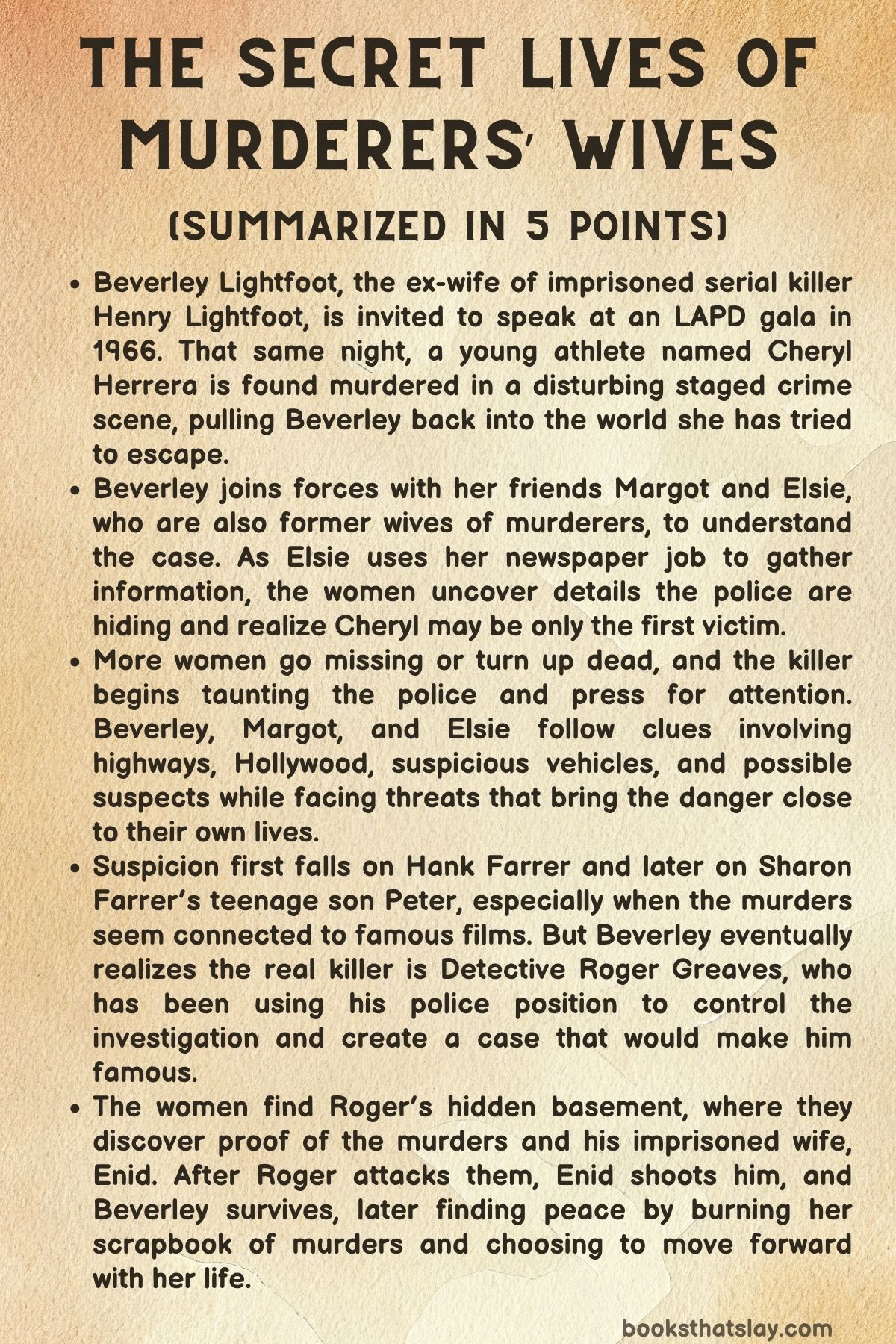
Beverley Lightfoot has spent years trying to survive the shame attached to her former husband, Henry Lightfoot, a serial killer known as the Heatwave Killer. By 1966, Henry is in prison, but his crimes still define how other people see Beverley.
She is not treated as a woman who was deceived and hurt, but as someone who should have known what her husband was. When she is invited to speak at a Los Angeles Police Department gala, she is anxious and humiliated by the attention.
Standing before officers and guests, she speaks about the pain of having been married to a murderer and the burden carried by women left behind after such crimes.
That same night, a new murder interrupts the event. Police are called away after the body of a young woman is discovered.
Beverley later learns that the victim is Cheryl Herrera, a college athlete. Cheryl has been strangled, dressed in a blond wig, and left with an arrow through one eye.
The staging of the body is strange and theatrical, and the details trouble Beverley. She has spent too long near the aftermath of murder to dismiss anything as random.
Beverley is not alone in her understanding of this world. Her closest friends, Margot and Elsie, are also former wives of killers.
Margot was once married to Stephen, a politician who murdered people behind his respectable public image. Elsie was married to Albert, a teacher who killed women.
The three women are bound together by public blame, private trauma, and the knowledge that charming men can hide monstrous lives. When Cheryl’s murder becomes a subject of gossip and police statements, the women begin discussing what does not seem right.
Elsie works at a newspaper, though she is treated as little more than an assistant despite her intelligence. She uses her position to gather information, helped by Patti Fowler, a new reporter who takes her seriously.
Together they learn that Cheryl was not a prostitute, even though police comments suggest she might have been. They also discover that Cheryl’s bracelet is missing.
These details matter because they show the investigation is already being shaped by assumptions about women, reputation, and class.
Soon another young woman is found dead. Emily Roswell, a cheerleader, is discovered in a lake with the words “love” and “hate” marked on her hands.
The crime seems staged, like Cheryl’s, but in a different style. Beverley has another source of information: she is secretly involved with Detective Roger Greaves.
Their affair gives her access to police talk, but it also places her in a difficult position. When she questions Roger, she realizes the police are keeping back important details.
A missing model, Diane Howard Murray, becomes a possible third victim. Margot uses her contacts and her knowledge of Hollywood circles to ask questions about Diane’s disappearance.
As the women compare the cases, they notice that the crime locations appear to cluster around Berryview and connect through nearby highways. The pattern suggests planning, movement, and familiarity with the area.
Beverley also visits Henry in prison, not because she wants to return to him emotionally, but because she hopes his understanding of killers might help her see what the new murderer is doing. Henry remains manipulative and unsettling, yet Beverley is willing to face him if it might help save another woman.
The killer soon begins seeking attention. He sends a letter to the police and newspapers naming Cheryl, Emily, and Diane, while threatening to kill again unless his crimes receive more coverage.
The murders are not only acts of violence; they are performances meant to force the public to watch. This confirms the women’s fear that the killer wants fame as much as death.
Despite the danger, Beverley, Margot, and Elsie continue investigating. Elsie and Patti trace a logo connected to a suspicious van, while Margot gathers information from people who knew Diane or moved in the same entertainment circles.
Beverley becomes a target herself. Threats arrive at her home, including a slaughtered pig left as a warning.
The message is clear: someone knows she is involved and wants to frighten her into silence.
Then another girl, Sarah Gunn, goes missing. Sarah is later found hanging from a hook near her family’s home, not far from Beverley’s house.
The closeness of the crime makes the danger feel personal. Beverley can no longer pretend she is only watching from the edges.
The murderer is near, bold, and aware of the women’s actions.
Suspicion turns toward Hank Farrer, a violent mechanic. His wife, Sharon, contacts Beverley because she fears her husband and believes he may be connected to the crimes.
Sharon reveals troubling evidence that seems to link Hank to one of the victims. The women learn that Hank has used prostitutes and has a history of violent behavior.
His anger, access, and suspicious movements make him appear to fit the profile they have built.
Beverley, Margot, and Elsie stake out Hank’s garage, hoping to find proof. Instead, Hank catches them and threatens them with a gun.
The encounter is terrifying and confirms that Hank is dangerous, but danger alone does not make him the killer. When another victim, Kate McKenzie, is found murdered, the timing forces the women to reconsider.
Hank may be abusive and frightening, but he may not be responsible for the staged murders.
The investigation shifts after Beverley studies a crime-scene photograph and notices a camera strap she recognizes from Sharon Farrer’s house. At first, this points the women toward Sharon’s teenage son, Peter.
Peter loves movies, and the murders seem to echo famous films. The blond wig, the markings, the staged bodies, and the dramatic symbols all suggest someone copying cinema.
The women begin to believe Peter may be recreating scenes from films through real murders.
They go to warn Sharon, thinking her son may be the killer. During the conversation, however, Beverley begins to understand that their theory is wrong.
The evidence does not fully belong to Peter. Someone else has been using the film references, the planted clues, and the police investigation itself to guide suspicion away from the truth.
The real killer is Detective Roger Greaves. Roger has used his position inside the police department to shape the case from the beginning.
He knows what evidence will be found, what details will be hidden, and how suspicion can be directed. His motive is not only murder but recognition.
He wants to become the detective who solves a famous case, gaining admiration by secretly creating the crimes himself. The murders are his route to importance.
Beverley and the others go to Roger’s house and discover a hidden basement. Inside, they find plans, newspaper clippings, and proof that Roger has been organizing the murders and manipulating the investigation.
They also find Enid, Roger’s wife, imprisoned and restrained. Like Beverley, Margot, and Elsie, Enid has been trapped by a murderer, but in her case the horror is still happening inside her own home.
Roger returns and attacks the women. Beverley is badly wounded in the struggle, but Enid manages to get Roger’s gun.
She shoots him, ending his control and stopping the murders. The moment belongs not to the police system Roger corrupted, but to the women he underestimated.
Beverley survives and recovers in the hospital. Enid later gives a public statement in which she refuses to let Roger become the center of the story.
She condemns him and insists that the murdered women should not be reduced to props in his hunger for fame. Her words challenge the same public habit that has harmed Beverley, Margot, and Elsie: the habit of focusing on killers while judging or forgetting the women around them.
Six months later, Beverley returns home. Margot, Elsie, Enid, and Chris Appleton remain close, forming a circle of support built from truth rather than shame.
Beverley is finally ready to release the guilt and fear that have ruled her life since Henry’s crimes. She burns her scrapbook of murders, a record of the darkness she has carried for too long.
By destroying it, she chooses a future not controlled by Henry, Roger, or the public’s judgment. The story ends with Beverley beginning to move forward, no longer defined only as a murderer’s wife, but as a survivor with her own life ahead.
Characters
The Secret Lives of Murderers’ Wives presents its characters through guilt, fear, public judgment, and the struggle to reclaim identity after being connected to violence. The main characters are not treated simply as observers of crime but as people shaped by shame, survival, anger, intelligence, and the need to be seen beyond the men who damaged their lives.
Beverley Lightfoot
Beverley Lightfoot is the emotional center of the book and one of its most deeply conflicted characters. As the ex-wife of Henry Lightfoot, the imprisoned “Heatwave Killer,” she lives under the shadow of a crime she did not commit but is constantly forced to answer for.
Her public appearance at the LAPD gala reveals how heavily shame and fear have shaped her life. She is nervous not because she is guilty, but because society has made her feel guilty by association.
Beverley’s character shows how the wife of a murderer can become trapped in someone else’s story, judged for what she failed to know, failed to stop, or failed to understand.
At the same time, Beverley is not weak or passive. Her involvement in the investigation shows her gradual movement from fear to action.
She is observant, emotionally intelligent, and capable of noticing gaps that the police either ignore or conceal. Her relationship with Detective Roger Greaves makes her especially vulnerable because she wants comfort and connection, yet that same relationship places her close to danger.
Her secret affair with Roger also reflects her loneliness and her desire to feel wanted after years of being defined by Henry’s crimes.
Beverley’s visits to Henry in prison show her willingness to confront painful parts of her past if doing so might help save others. She is frightened by violence, but she does not turn away from it when young women keep dying.
By the end of the story, Beverley becomes a survivor in more than one sense. Her decision to burn the scrapbook of murders represents her refusal to keep living as a prisoner of other people’s brutality.
She begins the book as a woman haunted by a killer’s name and ends as someone ready to reclaim her own life.
Henry Lightfoot
Henry Lightfoot is a disturbing presence in the book even though he is imprisoned for most of the story. As the “Heatwave Killer,” he represents the original source of Beverley’s shame and trauma.
His crimes continue to shape her life long after their marriage has ended, proving that a murderer’s damage does not stop with the victims alone. Henry’s existence in the story shows how violence spreads outward, affecting families, reputations, identities, and futures.
Henry is also important because he understands the psychology of killers. Beverley visits him not out of affection but because she hopes his knowledge of murderous patterns can help her understand the new crimes.
This makes him both repulsive and useful. He is a man whose mind may contain insight, but that insight comes from monstrous experience.
His role adds moral discomfort to the book because the women must sometimes look toward darkness in order to fight darkness.
Margot
Margot is one of Beverley’s closest friends and an important part of the group of former wives who refuse to remain silent. She was married to Stephen, a politician and murderer, which gives her a particular understanding of public image, deception, and reputation.
Margot’s past suggests that she knows how charming and respectable men can hide evil behind status and social power. This makes her especially valuable when the investigation moves into Hollywood and social circles where appearances matter.
Margot is practical, socially aware, and courageous in a quieter way. She is willing to ask questions and gather information, even when doing so places her near uncomfortable truths.
Her friendship with Beverley and Elsie gives the book one of its strongest emotional foundations. The three women are connected not because they are defined by their former husbands, but because they understand a type of judgment that outsiders cannot fully grasp.
Margot’s presence shows how friendship can become a form of resistance against shame.
Elsie
Elsie is sharp, determined, and perhaps the most investigative-minded of the three central women. She works at a newspaper but is treated as an assistant rather than being respected for her intelligence.
This professional dismissal mirrors the broader way women in the book are underestimated. Elsie uses the limited access she has to gather information, proving that even when institutions refuse to value her properly, she can still influence the search for truth.
Her work with Patti Fowler is especially important because it allows hidden details to surface. Elsie helps challenge the police’s careless implication that Cheryl Herrera was a prostitute and discovers that Cheryl’s missing bracelet may matter.
Her character represents persistence against both sexism and institutional arrogance. Elsie is not content to accept official explanations, especially when those explanations insult or erase the murdered women.
She brings moral clarity to the investigation by insisting that the victims deserve accuracy, dignity, and attention.
Stephen
Stephen, Margot’s former husband, functions mainly as part of Margot’s painful history, but his presence matters because he represents respectable evil. As a politician and killer, Stephen shows that violence is not always attached to obvious outsiders or social rejects.
It can hide behind power, polish, ambition, and public trust. His background helps explain Margot’s skepticism toward appearances and her ability to see danger behind charm.
Although Stephen is not central to the active investigation, he expands the book’s exploration of what it means to have been married to a murderer. Margot’s connection to him shows that the wives of killers are often forced to live with public suspicion even when they were deceived themselves.
Stephen’s role reminds the reader that status can protect dangerous men and that women close to them may become collateral damage in the aftermath.
Albert
Albert, Elsie’s former husband, is another figure from the past whose crimes continue to shape the present. As a teacher who murdered women, he represents the horror of ordinary respectability turning monstrous.
Like Stephen and Henry, Albert shows that murderers are not always immediately recognizable as villains. They may occupy trusted roles and move through everyday life without revealing what they truly are.
Albert’s role is important because it explains Elsie’s emotional background and her sensitivity to how women are treated after death. Having been connected to a man who murdered women, Elsie understands how easily female victims can be reduced to gossip, scandal, or police categories.
Albert’s history strengthens Elsie’s determination to look beyond easy assumptions and to help uncover the truth.
Cheryl Herrera
Cheryl Herrera is the first victim whose murder pulls the women into the investigation. She is a college track athlete, and that detail is important because it challenges the dismissive way the police initially frame her.
Cheryl is not simply a body found at a crime scene; she is a young woman with discipline, strength, and a life that was violently interrupted. The attempt to imply she was a prostitute shows how quickly institutions can damage a victim’s reputation when it suits their narrative.
Cheryl’s murder is staged with disturbing theatricality, including the blond wig and the arrow through her eye. These details reveal that the killer is not only violent but also obsessed with symbolism and performance.
Cheryl’s missing bracelet becomes a sign that small details matter and that the women’s attention may reveal what official investigators overlook. In the book, Cheryl represents both the vulnerability of young women and the importance of restoring dignity to victims after death.
Emily Roswell
Emily Roswell is another young victim whose murder deepens the sense that the killer is creating scenes rather than simply committing crimes. As a cheerleader found dead in a lake with “love” and “hate” marked on her hands, Emily becomes part of the killer’s pattern of turning women into staged images.
Her death confirms that Cheryl’s murder was not isolated and that the killer is deliberately constructing a public identity through violence.
Emily’s character matters even though she is seen mostly through the aftermath of her death. She represents the kind of young woman society might easily romanticize in life and sensationalize in death.
The markings on her hands suggest that the killer is using cultural references and dramatic symbols to control how people interpret his crimes. Through Emily, the story shows the cruelty of reducing a person to an image and the urgency of seeing the victim beyond the spectacle.
Diane Howard Murray
Diane Howard Murray, the missing model who becomes a possible third victim, adds another layer to the killer’s pattern and to the investigation. Her connection to Hollywood and modeling allows Margot to use her social knowledge and contacts to search for information.
Diane’s disappearance shows how women in glamorous or public-facing spaces can still be isolated, vulnerable, and dismissed when danger surrounds them.
Diane’s role also helps the women recognize that the crimes may be connected by more than geography. Her life and disappearance point toward performance, image, and the way women are looked at by others.
Because the killer is later revealed to be drawing inspiration from famous films, Diane’s connection to visual culture becomes especially meaningful. She is not only another victim but also part of the murderer’s attempt to turn real women into scenes from his imagination.
Patti Fowler
Patti Fowler is a new reporter who becomes an important ally to Elsie. She represents the possibility of women supporting each other inside institutions that often limit them.
Unlike those who dismiss Elsie as merely an assistant, Patti recognizes the value of information and collaboration. Their partnership helps uncover important details about Cheryl and pushes back against the lazy assumptions being spread about the victim.
Patti’s character brings energy and professional curiosity to the investigation. She is not one of the murderers’ wives, but she becomes connected to their search for truth because she is willing to listen and act.
Her role shows that justice often depends on people who are willing to question official stories, especially when those stories are shaped by prejudice or convenience. Patti strengthens the book’s focus on women using intelligence and persistence to challenge male-controlled systems.
Roger Greaves
Roger Greaves is one of the most deceptive and dangerous characters in The Secret Lives of Murderers’ Wives. At first, he appears to be a detective connected to the investigation and to Beverley through their secret affair.
His position gives him authority, access, and the appearance of trustworthiness. Because Beverley is emotionally vulnerable, Roger’s closeness to her seems personal before it is revealed to be manipulative and horrifying.
Roger’s true motive makes him especially chilling. He creates murders so that he can become famous as the detective who solves them.
This reveals a deep hunger for recognition and control. He does not kill from impulse alone; he plans, stages, manipulates evidence, and uses police knowledge to mislead others.
His crimes are acts of vanity as much as violence. He wants to control the story, the investigation, the victims, and even the people trying to expose him.
His imprisonment of Enid reveals the full extent of his cruelty at home as well as in public. Roger is not only a murderer but also an abuser who traps and silences his own wife.
His betrayal is particularly painful because Beverley believed he offered safety after Henry. Instead, he becomes another reminder that evil can hide behind intimacy, authority, and charm.
Roger’s downfall comes because the women he underestimated are more perceptive and courageous than he imagined.
Sarah Gunn
Sarah Gunn’s disappearance and murder bring the danger terrifyingly close to Beverley’s home. Her death intensifies the emotional stakes because it shows that the killer is not distant or abstract.
He is moving through spaces the characters know, threatening the fragile sense of safety they have tried to build. Sarah’s body being found near her family’s house makes the crime feel especially intimate and cruel.
Sarah’s role in the book emphasizes the killer’s escalation and his desire to frighten not only the public but also the women investigating him. Her death marks a point where the investigation becomes even more personal for Beverley.
Like the other victims, Sarah deserves to be seen as more than a clue in a pattern. Her murder reinforces the moral urgency of stopping a killer who treats young women as props in his performance.
Hank Farrer
Hank Farrer is presented as a violent and suspicious figure, making him an understandable suspect. As a mechanic with dangerous behavior, a history of using prostitutes, and apparent connections to evidence, he embodies the kind of man people can easily imagine as a murderer.
His aggression toward the women when they stake out his garage makes him even more threatening. He is clearly capable of intimidation and violence.
However, Hank’s role also shows how suspicion can be shaped by surface-level assumptions. He is frightening, abusive, and morally ugly, but that does not automatically make him the killer behind the staged murders.
The fact that another victim is found after the women suspect him forces them to reconsider the case more carefully. Hank remains an important character because he shows that the presence of one dangerous man can distract from another, especially when the real killer knows how to plant evidence and manipulate attention.
Sharon Farrer
Sharon Farrer is a significant character because her fear of Hank pushes the investigation in a new direction. By contacting Beverley, she reveals both desperation and courage.
She knows her husband is dangerous, and her willingness to share information suggests that she has been living under threat. Sharon’s character reflects another form of trapped womanhood in the book, different from Beverley’s, Margot’s, and Elsie’s but still shaped by male violence.
At first, Sharon appears mainly as a frightened wife trying to expose her husband. Later, the discovery of the camera strap in her house shifts suspicion toward her family and especially toward Peter.
This makes Sharon’s home a place of uncertainty, where fear, secrecy, and possible evidence overlap. Her character helps the story explore how abuse can create confusion around guilt and innocence.
She is not the murderer, but her life with Hank places her close to danger and makes her part of the investigation’s most misleading turn.
Peter Farrer
Peter Farrer becomes a suspect because of his interest in movies and the realization that the murders echo famous films. His love of cinema seems to connect him to the killer’s theatrical staging of bodies, and for a time the women believe he may be transforming film images into real violence.
This suspicion makes him important because he helps reveal the pattern behind the murders, even though he is not ultimately responsible.
Peter’s role shows how easily clues can point toward the wrong person when they are interpreted through fear. His interest in movies is unusual enough to seem suspicious once the women understand the cinematic references, but it does not prove guilt.
The suspicion around Peter also shows how Roger’s manipulation works. By creating misleading connections and planting evidence, Roger turns attention toward others while protecting himself.
Peter is therefore less a villain than a false answer that brings the women closer to the truth.
Kate McKenzie
Kate McKenzie’s murder is important because it breaks the women’s growing belief that Hank Farrer may be the killer. Her death forces them to recognize that their theory is incomplete and that the murderer is still active.
In this way, Kate becomes a turning point in the investigation. Her death is tragic not only because another young woman is killed, but because it proves how dangerous it is to settle too quickly on a suspect.
Kate’s role also reinforces the killer’s control over timing and fear. Each new murder pushes the police, the newspapers, and the women into greater panic.
Kate becomes part of the pattern of women whose lives are taken so that Roger can build a false legend around himself. Her character, like the other victims, matters because the story insists that these women should not be remembered only as evidence.
They are the human cost of Roger’s ambition.
Enid Greaves
Enid Greaves is one of the most powerful late-revealed characters in the book. As Roger’s wife, she first seems hidden from the central action, but her imprisonment reveals the private horror behind Roger’s public role.
Enid has been restrained, silenced, and controlled by the man who presents himself as a detective and protector. Her condition exposes Roger’s brutality in its most personal form.
Enid’s act of shooting Roger is a major moment of resistance and survival. She is not merely rescued; she becomes the person who stops him when he attacks the women.
Her later public statement is equally important because she refuses to let Roger dominate the story after death. By condemning him and honoring the women he killed, Enid claims a voice that he tried to take from her.
Her character represents survival after captivity and the courage to speak truth against a man who built his identity on lies.
Chris Appleton
Chris Appleton appears near the end as part of Beverley’s new circle of safety and recovery. Although Chris is not central to the investigation, the character’s presence matters because the ending is not only about solving murders but also about rebuilding life afterward.
Chris helps suggest that Beverley is no longer isolated in fear and shame. She has people nearby, and that nearness matters.
Chris’s role is quiet but hopeful. After so much violence, suspicion, and betrayal, the presence of supportive figures around Beverley shows that healing is possible through community.
Chris belongs to the calmer future Beverley is beginning to choose. The character helps complete the emotional movement of the story from secrecy and terror toward openness, support, and renewal.
Themes
Guilt and Public Judgment
Beverley’s life is shaped by a crime she did not commit but is still forced to carry. Her marriage to Henry has turned her into a public symbol of shame, as though being close to a murderer makes her morally responsible for his actions.
In The Secret Lives of Murderers’ Wives, this burden is shown through her fear of speaking publicly, her anxiety about being recognized, and her need to explain herself before people who have already decided what she represents. The same struggle is reflected in Margot and Elsie, who also live under the shadow of their former husbands’ violence.
Society treats them less as survivors and more as suspicious extensions of the men they once loved. This theme becomes powerful because the women must fight not only a killer but also the belief that their identities are permanently damaged.
Beverley’s final act of burning her scrapbook shows her refusal to remain trapped inside other people’s judgment.
Female Friendship and Shared Survival
The bond between Beverley, Margot, and Elsie becomes a source of strength in a world that often dismisses them. Each woman understands the others’ shame, fear, and anger because they have all lived through similar public disgrace.
Their friendship is not built on simple comfort; it becomes active, practical, and brave. They share information, challenge police assumptions, follow leads, and protect one another even when the danger grows personal.
Elsie uses her newspaper position to uncover hidden details, Margot uses her social connections to gather information, and Beverley uses her painful knowledge of criminal behavior to interpret what others miss. Together, they form a kind of unofficial investigative team that succeeds because they trust patterns of fear and control that men in authority overlook.
Their friendship allows them to move from isolation into purpose. By the end, their survival is collective, not individual, showing that shared pain can become shared power.
Power, Control, and Male Violence
The murders expose how violence often grows from a desire for control, recognition, and dominance. The killer does not simply take lives; he arranges bodies, manipulates evidence, threatens the press, and tries to control the story told about his crimes.
Roger’s role as a detective makes this theme even darker because he uses authority as a shield. He knows how investigations work, how evidence is read, and how public fear can be shaped.
His crimes are not random outbursts but planned acts meant to make him appear important. This mirrors the pasts of Henry, Stephen, and Albert, whose violence also left women to suffer the consequences.
The story suggests that male violence is not limited to physical harm; it also appears in lies, intimidation, professional power, and the silencing of women. Roger’s imprisonment of Enid makes this especially clear, as his private cruelty reflects the same need for control behind the public murders.
Reclaiming Identity After Trauma
Beverley’s journey is centered on the painful process of becoming more than the worst thing connected to her past. At the beginning, she is still living as Henry’s ex-wife, defined by fear, guilt, and the public memory of his crimes.
Her scrapbook shows how deeply murder has shaped her sense of self; she collects and studies violence as if she cannot fully escape it. Yet her investigation gradually changes her relationship with the past.
Instead of being passive, ashamed, or silent, she begins using her experience to protect others and expose the truth. This does not erase her trauma, but it gives her a new form of agency.
Enid’s public statement also supports this theme because she refuses to let Roger’s name become more important than the women he killed. The ending, with Beverley burning the scrapbook, represents release.
She is not forgetting what happened; she is choosing not to live under its control anymore.