The Water Women Summary, Characters and Themes
The Water Women by Bonnie Blaylock is a multigenerational historical novel about women, memory, survival, and inherited craft. Set largely on Sant’Antioco, Sardinia, it follows a Jewish family of byssus workers, women who harvest sea silk from giant mollusks and transform it into rare golden cloth.
Through Allegra, Zaneta, Mira, and Daniella, the novel traces how war, antisemitism, violence, motherhood, and silence shape one family across decades. At its heart, The Water Women is about what women preserve, what they hide to survive, and how love can finally loosen the hold of the past.
Summary
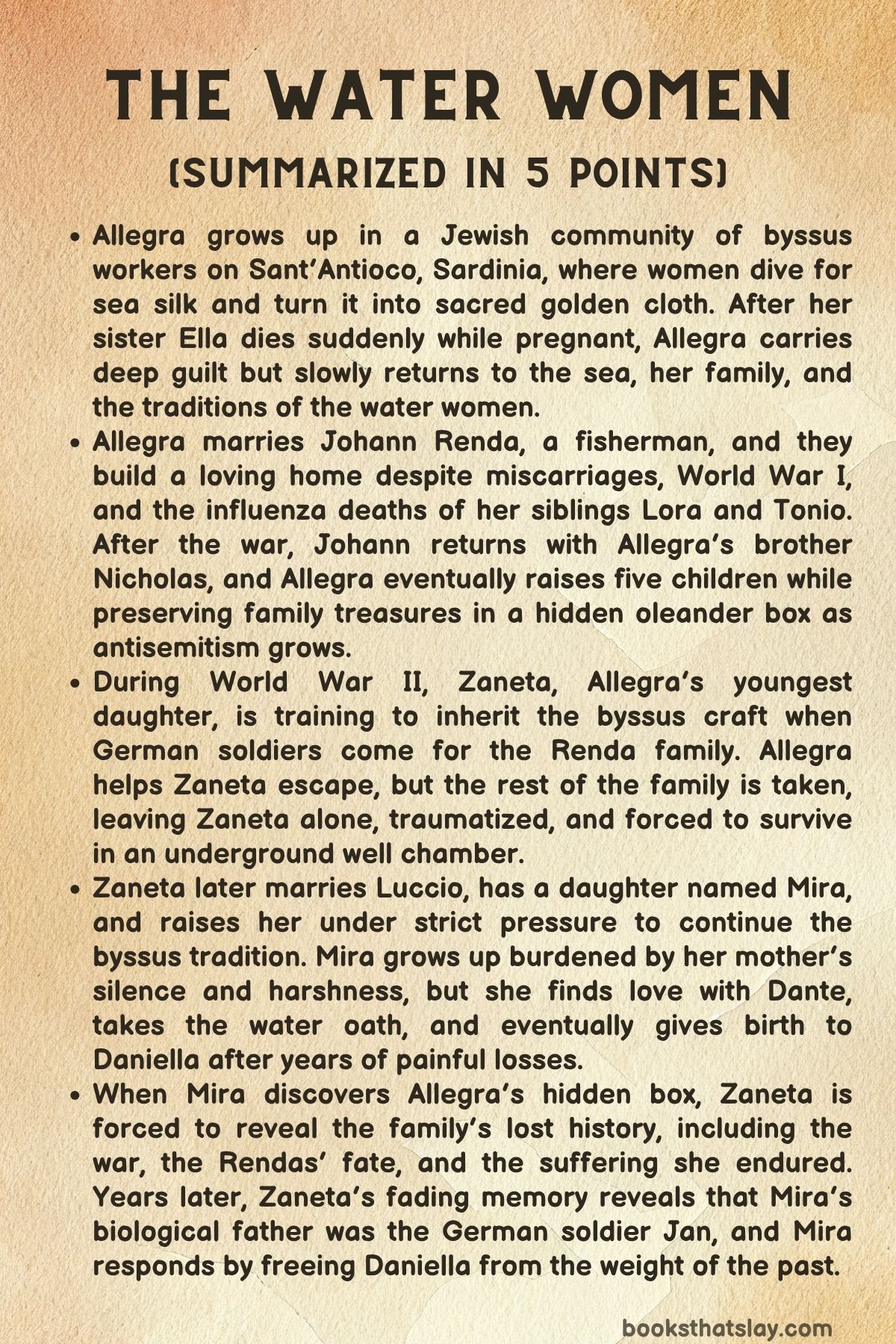
Allegra grows up on Sant’Antioco, an island off Sardinia, in a Jewish community where women are bound to the sea through the ancient work of byssus. The women dive for the filaments of giant mollusks, clean and prepare the strands, and weave them into golden cloth believed to carry sacred meaning.
Allegra feels deeply connected to this world. The sea, the craft, and the women who came before her give her a sense of identity and purpose.
She sees byssus not only as work but as a sacred inheritance passed from mother to daughter.
Her sister Ella does not share the same devotion. Ella marries and begins to pull away from the demands and expectations of the byssus tradition.
Allegra cannot understand this rejection, and the sisters argue in the market. Soon after, Ella collapses and dies while pregnant.
Her death leaves Allegra crushed by grief and guilt. She wonders whether their final disagreement somehow marked the end of Ella’s life, even though she knows she could not have caused it.
For a time, sorrow distances her from the rhythms that once sustained her. Slowly, she returns to the sea, to the loom, and to her family, carrying Ella’s memory with her.
A year later, Allegra meets Johann Renda, a fisherman who has recently arrived from near Cagliari. Johann is steady, kind, and drawn to Allegra’s strength.
Their relationship grows into love, and they marry, building a modest life shaped by the sea. Allegra hopes for children, but she suffers miscarriages, each loss deepening her fear that motherhood may never come to her.
Then World War I reaches into their lives. Johann is called to serve, and Allegra is left behind to wait, work, and worry.
Letters become her lifeline. She continues weaving byssus, but the uncertainty of war weighs on her.
While Johann is away, another disaster strikes. The influenza epidemic reaches the family and takes Allegra’s sister Lora and her brother Tonio.
These losses leave the household broken and grieving. Allegra has already known death too closely, and now she must face it again while her husband is absent and the world around her feels unstable.
When the war ends, Johann returns, and with him comes Allegra’s brother Nicholas, whose survival is an unexpected mercy. The reunion offers relief after years of fear, though the family has been changed by all it has lost.
In time, Allegra and Johann have five children: Lev, Avi, Marta, Dahlia, and Zaneta. Their home becomes full of movement, noise, and hope.
Allegra’s daughters begin learning the byssus work, and Allegra continues the tradition she inherited. The family’s life is rooted in the sea, the Jewish community, and the craft that links the women across generations.
Yet danger begins to gather again. Fascism and antisemitism grow stronger, and Allegra senses that the things most precious to her family may not be safe.
She hides an oleander box in a sea cave. Inside it, she places heirlooms, tools, letters, photos, and byssus treasures, preserving the family’s history in secret.
During World War II, the story turns to Zaneta, Allegra’s youngest daughter. At thirteen, she is training as a water woman and learning the skill, patience, and discipline required by byssus.
She is still a child, but the world around her is becoming dangerous. Fascism spreads through the village, and antisemitic laws and violence threaten the Renda family.
Her brothers leave under false papers and are drawn into the war. The family tries to keep going, but the danger can no longer be avoided.
German soldiers eventually come for the Rendas. Allegra acts quickly to save Zaneta, helping her escape while the rest of the family is taken away.
Zaneta is forced to leave behind her parents, siblings, home, and childhood in a single terrible moment. She hides alone in an ancient underground Nuragic well chamber on the plains.
The hiding place keeps her out of sight, but it is dark, lonely, and frightening. She has little food, little comfort, and no certainty that anyone she loves is still alive.
A German soldier named Jan discovers her hiding place. Instead of turning her in, he forces himself into her hidden world, taking food and shelter from her.
His presence makes the chamber even more dangerous. He steals byssus pieces from Allegra’s hidden box, treating sacred family objects as things he can claim.
Later, he attacks Zaneta. During the struggle, he falls into the dry well and dies.
Zaneta survives, but survival comes at a terrible cost. She is sick with malaria, starving, traumatized, and alone, carrying fear and shame she cannot yet name.
Luccio, a young fisherman who had once cared about her, finds Zaneta and helps her recover. He too has suffered losses during the war, and their shared grief creates a bond.
They marry quickly, seeking safety and a future after destruction. Zaneta gives birth to a daughter, Mira.
Though Luccio raises Mira as his own child, Zaneta keeps buried the truth of what happened in the well and the identity of Mira’s biological father. Her silence becomes part of the family’s inheritance.
Mira grows up under Zaneta’s strict control. Zaneta sees her as the last daughter who can inherit the byssus craft, and she trains her with harsh discipline.
Mira learns the sacred work, but the teaching is heavy with pressure rather than tenderness. Zaneta refuses to speak about her past, leaving Mira to grow up surrounded by rules, silence, and duty.
Mira longs for love and freedom, but she also feels the pull of the sea and the responsibility of being a water woman.
Mira falls in love with Dante Barone, a gentle teacher who offers her kindness and steadiness. She takes the water oath, marries Dante, and continues the byssus work.
Like Allegra before her, Mira struggles with infertility and repeated losses. Each failed pregnancy deepens her pain and fear.
At last, during the 1968 earthquake, she gives birth to Daniella. The timing of Daniella’s birth, amid shaking earth and fear, marks her arrival as both fragile and powerful.
Mira becomes a mother, and she tries to raise Daniella with more warmth than she herself received from Zaneta.
Even so, Mira remains torn between motherhood and the demands of byssus. The craft is sacred, but it also carries the weight of expectation, grief, and family history.
Years later, Mira discovers Allegra’s hidden oleander box in a cave. When she brings it to Zaneta, the box breaks open the past that Zaneta has spent decades trying to bury.
The objects inside force Zaneta to speak about Allegra, Johann, the Renda family, the war, and the destruction that shaped her life. For Mira, the box gives form to a history she has always sensed but never fully known.
Later, police discover human remains and a small loom in the old well. The discovery stirs gossip in the village and threatens to expose the secret Zaneta has carried for most of her life.
In 1994, Dante is injured in an accident, and Daniella returns home. Around the same time, Zaneta’s memory begins to fail.
In her confusion, she reveals the truth: Luccio is not Mira’s biological father. Jan, the German soldier who attacked Zaneta, was Mira’s father.
The revelation reshapes Mira’s understanding of her mother. She realizes that Zaneta’s severity, silence, and fear were rooted in trauma she had never been able to share.
The truth is painful, but it also allows Mira to see Luccio more clearly. Biology does not define the love he gave her.
She assures him that he is still her true father, the man who raised her and protected her.
Mira then turns toward Daniella with a different kind of inheritance. She sends her byssus pieces and a mirror, along with a note telling her she is loved and free to be herself.
Daniella is not bound to repeat the pain, silence, or duty that shaped the women before her. Through this act, Mira honors the craft while loosening its hold.
The family’s past cannot be erased, but it can be faced, named, and transformed into something gentler for the next generation.
Characters
The Water Women presents its characters through inheritance, grief, survival, silence, and the complicated burden of family tradition. The characters are shaped not only by personal choices but also by war, antisemitism, gender expectations, motherhood, memory, and the sacred craft of byssus weaving.
Allegra
Allegra is one of the central figures in The Water Women, and her character is built around devotion, endurance, and inherited responsibility. She grows up deeply connected to the sea, to the Jewish community of water women, and to the ancient craft of harvesting and weaving byssus.
For Allegra, the work is not simply a skill or family occupation; it is a spiritual inheritance that links her to generations of women before her. This makes her passionate, disciplined, and proud, but it also makes her struggle when others, especially her sister Ella, seem to step away from the tradition.
Allegra’s frustration with Ella reveals how strongly she believes in duty, but Ella’s sudden death leaves Allegra wounded by guilt. That guilt becomes part of her emotional life, shaping her grief and making her return to the sea and weaving feel like both healing and penance.
As a wife and mother, Allegra becomes a figure of quiet strength. She suffers miscarriages, waits through Johann’s absence during war, survives family loss during the influenza epidemic, and later faces the rising danger of fascism and antisemitism.
Her decision to hide the oleander box shows her foresight and love for future generations. Most importantly, her final act of helping Zaneta escape reveals her courage as a mother.
Allegra represents the protective power of tradition, but also the pain of watching a beloved world be destroyed.
Ella
Ella is important because she shows the tension between personal independence and inherited duty. Unlike Allegra, Ella begins to pull away from the byssus tradition after marriage, and this frustrates Allegra because the craft has sacred meaning within their family and community.
Ella’s choice does not necessarily make her careless or disloyal; rather, it suggests that she wants a life shaped by marriage and her own path instead of being fully defined by the sea and the old ways. Her death while pregnant makes her character especially tragic because her story is cut short before she can fully become who she might have been.
Ella’s collapse after the argument in the market becomes a permanent wound for Allegra, not because Allegra caused her death, but because grief often attaches itself to the last harsh moment shared with someone loved. Ella’s role in the book is brief but powerful.
She represents the fragility of life, the emotional cost of unresolved conflict, and the way family guilt can last long after the person at the center of it is gone.
Lora
Lora’s character is connected to the larger pattern of family loss that shapes Allegra’s life. Her death during the influenza epidemic shows how suffering in the story does not come only from war or persecution, but also from illness and sudden historical disaster.
Lora stands as part of the family structure that once surrounds Allegra with familiarity, kinship, and continuity. When Lora dies, the loss weakens that structure and deepens the sense that Allegra’s world is being steadily stripped away.
Although Lora is not developed as extensively as Allegra or Zaneta, her importance lies in what her absence creates. She becomes part of the emotional weight carried by the surviving family, especially Allegra, who must keep living and working while grief keeps returning in new forms.
Lora represents the ordinary loved ones whose deaths change a family forever even when history remembers only larger public tragedies.
Tonio
Tonio’s role in the book is tied to the devastation caused by the influenza epidemic and the repeated losses endured by Allegra’s family. As Allegra’s brother, he belongs to the world of her childhood and early family identity.
His death, along with Lora’s, makes the family’s grief feel cumulative rather than isolated. Tonio is significant because he helps show how Allegra’s life is marked by repeated separations from the people who anchor her.
The loss of a brother also broadens the emotional scope of the story beyond the women of the byssus tradition, reminding the reader that the whole family is vulnerable to forces beyond their control. Tonio represents the quiet, painful disappearance of family members whose presence may have once seemed permanent.
Through him, the book shows how survival often means continuing after one’s original family has been deeply broken.
Johann Renda
Johann Renda is a loving and stabilizing presence in Allegra’s life. When he arrives as a fisherman from near Cagliari, he brings the possibility of renewal after Allegra’s grief over Ella.
His relationship with Allegra is tender and grounded in the rhythms of the sea, work, marriage, and family. Johann is not presented as a dramatic hero in the traditional sense, but his steadiness gives Allegra a life in which love can grow despite hardship.
His service in World War I introduces separation and fear into their marriage, and Allegra’s waiting for his letters shows how deeply his absence affects her. His return after the war, especially with Nicholas, feels like a rare moment of restoration in a story filled with loss.
As a father, Johann helps build the Renda family into a thriving household before the violence of World War II destroys it. His character represents devotion, resilience, and the fragile safety of domestic happiness.
Because the family’s later destruction is so severe, Johann’s earlier presence becomes even more meaningful as a symbol of the home that Zaneta loses.
Nicholas
Nicholas is important because his return with Johann after World War I brings relief and surprise to Allegra’s family. His presence suggests survival against expectation, and his return helps restore part of the family after years of anxiety and loss.
Nicholas represents the uncertainty of wartime separation, when families do not know who will come back and who will be lost forever. Although he is not one of the most central characters, his role matters because he briefly reverses the pattern of disappearance that defines much of the book.
Through Nicholas, the story allows a moment of reunion before later historical violence becomes even more destructive. His character reminds the reader that survival itself can feel miraculous in a family repeatedly touched by war, illness, and fear.
Lev
Lev, one of Allegra and Johann’s sons, belongs to the generation born into a family that briefly flourishes between the devastations of two wars. His childhood is connected to family continuity, the sea, and the life Allegra and Johann build together.
When Fascism and antisemitism spread, Lev’s life is redirected by danger rather than personal choice. His departure under false papers shows how young people are forced into secrecy, risk, and separation during persecution.
Lev’s role helps show the destruction of ordinary family futures. He is not simply a son who leaves home; he is part of a generation whose identity and safety are threatened by political hatred.
Through Lev, the book shows how war breaks families before it physically reaches their homes, forcing parents and children to make impossible decisions in the hope of survival.
Avi
Avi, like Lev, represents the sons of the Renda family whose lives are overtaken by war and antisemitic danger. His departure under false papers reflects the desperate measures required to survive in a world that has turned hostile to Jewish families.
Avi’s character is important because he shows how the family’s children inherit not only love and tradition, but also the dangers attached to their identity. His leaving adds to the emotional unraveling of the household, especially for Allegra and Zaneta, because each departure makes the family feel less whole.
Avi also reflects the uncertainty of wartime fate. Once the sons are pulled away from home, their lives become part of a larger conflict that the family cannot control.
His character helps emphasize one of the book’s central tragedies: children who should have inherited a peaceful family life instead inherit fear, disguise, and separation.
Marta
Marta is one of Allegra and Johann’s daughters and is part of the female line connected to byssus work. Her character represents the continuation of women’s knowledge through practice, observation, and inheritance.
Along with Dahlia and Zaneta, Marta learns the craft in a household where the sea and weaving are central to identity. Her importance lies in her place within the chain of daughters who might carry the tradition forward.
Because the family is later shattered, Marta also becomes part of what is lost: not only a person, but a possible future for the craft and the family line. Marta’s character helps show that cultural inheritance depends on living bodies, mothers, daughters, sisters, and daily teaching.
When violence destroys a family, it also threatens the survival of memory, skill, and sacred work.
Dahlia
Dahlia is another of Allegra’s daughters, and her role is closely connected to the shared female inheritance of the family. Like Marta and Zaneta, she belongs to the world of byssus, sea knowledge, and women’s labor.
Dahlia’s presence helps create the sense of a full family life before war tears it apart. She is part of the warmth and promise of Allegra’s motherhood, and her connection to the craft shows how the tradition is meant to pass through many hands rather than rest on one person alone.
Her significance grows through contrast with what happens later. After the family is taken, Zaneta becomes the isolated survivor, and the tradition narrows painfully onto one remaining daughter.
Dahlia therefore represents both continuity and loss. She is one of the figures who makes the destruction of the Renda family feel not abstract, but intimate and deeply personal.
Zaneta
Zaneta is one of the most tragic and psychologically complex figures in the book. As a child, she is trained as a water woman and grows up under the powerful influence of Allegra, the sea, and the byssus tradition.
At thirteen, she is still young enough to need protection, but history forces her into a brutal survival story. When German soldiers come for her family, Allegra’s decision to help Zaneta escape saves her life but also leaves her alone with an unbearable burden.
Zaneta survives in the underground Nuragic well chamber through fear, hunger, illness, and trauma. Her encounter with Jan permanently scars her, especially because he violates the sanctity of the hidden family box by stealing byssus pieces and later attacks her.
His death in the well allows Zaneta to survive physically, but not emotionally untouched. After Luccio rescues her, she builds a new life, yet her silence becomes a form of self-protection that harms those closest to her.
As a mother, Zaneta is strict, controlling, and harsh with Mira, not because she lacks love, but because love has become entangled with fear, duty, and trauma. She tries to preserve the byssus tradition, but she passes it on through pressure rather than tenderness.
Her failing memory later releases the truth she spent decades hiding: Mira is Jan’s biological child. Zaneta’s character shows how trauma can turn survival into secrecy, and secrecy into generational pain.
She is both victim and wound-bearer, a woman who preserves the family line while also passing down the suffering she cannot speak aloud.
Jan
Jan is the most threatening and morally disturbing character in the story. As a German soldier, he represents the invading violence of war, fascism, and antisemitic persecution, but his role becomes even more intimate and horrifying when he discovers Zaneta’s hiding place.
His forced sharing of food and shelter with her creates a tense and unequal relationship because Zaneta is a starving, frightened child while he has the power of an armed occupier. His theft of byssus pieces from Allegra’s hidden box is symbolically important because he does not merely threaten Zaneta’s body; he also violates her family’s sacred inheritance.
The byssus pieces carry memory, women’s work, and spiritual value, and Jan treats them as objects to take. His later attack on Zaneta marks him as a source of lasting trauma.
His death in the dry well is both a moment of survival for Zaneta and a grim reversal, as the hiding place that protected her becomes the place where he dies. Jan’s character is not developed to invite sympathy; instead, he functions as a human embodiment of predation, occupation, and the violence that leaves consequences long after the war itself has ended.
Luccio
Luccio is a compassionate and grounding figure in Zaneta’s life after her survival in the well. As a young fisherman who once cared about her, he represents a possible return to human kindness after extreme isolation and violence.
When he finds Zaneta sick, starving, and traumatized, his care helps bring her back into the world of the living. Luccio also carries his own losses from the war, which makes his bond with Zaneta partly rooted in shared damage.
Their quick marriage can be seen as an attempt to create safety, family, and stability after catastrophe. Later, his role as Mira’s father becomes emotionally significant because biology is not what defines his fatherhood.
When Mira learns that Jan was her biological father, she still affirms Luccio as her true father, and this confirms the moral difference between the man who caused trauma and the man who offered love. Luccio’s character represents chosen family, quiet loyalty, and the healing power of care that does not demand full explanations.
He cannot erase Zaneta’s past, but he gives her and Mira a life that would otherwise have been impossible.
Mira
Mira is a deeply important character because she stands at the center of generational inheritance and generational pain. She grows up as Zaneta’s daughter, but her childhood is shaped by strict control, silence, and the heavy expectation that she must carry on the byssus tradition.
Unlike Zaneta, who was formed by direct wartime trauma, Mira is formed by the aftereffects of trauma she does not understand. Her mother’s harshness burdens her, yet it also binds her to the craft.
Mira’s love for Dante Barone gives her a gentler emotional world, and her decision to take the water oath and continue the work shows that she does not reject her inheritance, even though it has cost her. Her struggles with infertility and repeated losses deepen her character because motherhood becomes something she longs for but cannot easily reach.
When Daniella is finally born during the earthquake, Mira’s life changes, and she tries to raise her daughter with more tenderness than she received. This choice is crucial because Mira does not simply repeat Zaneta’s severity.
She carries pain, but she also tries to transform it. Her discovery of Allegra’s hidden oleander box makes her a bridge between the buried past and the living present.
When she learns the truth about Jan, she responds not with hatred toward Luccio or total collapse, but with painful understanding. Mira’s final act of sending Daniella byssus pieces and a mirror with a message of love and freedom shows her growth.
She honors tradition while refusing to make it a prison.
Dante Barone
Dante Barone is a kind and stabilizing presence in Mira’s life. As a teacher, he is associated with patience, thoughtfulness, and a world beyond the strict demands of Zaneta’s household.
His love for Mira gives her emotional support as she carries the weight of the byssus tradition and struggles with infertility. Dante does not appear to compete with the craft or demand that Mira abandon it; instead, he becomes part of the life she builds while continuing her inherited work.
His accident later in the story brings Daniella home and helps create the circumstances under which buried truths begin to surface. Dante’s importance lies in his gentleness and steadiness.
In a story marked by men who leave for war, men who harm, and men who are lost, Dante represents a more nurturing form of masculinity. He helps Mira experience love as partnership rather than control, and his presence supports her attempt to become a different kind of mother from Zaneta.
Daniella
Daniella represents the future of the family and the possibility of freedom from inherited pain. Born during the 1968 earthquake, she enters the story at a moment of upheaval, which symbolically connects her life to both rupture and renewal.
As Mira’s daughter, Daniella inherits a family history shaped by byssus, war, silence, trauma, and survival, but Mira does not want her to be trapped by it. Daniella’s return home after Dante’s accident places her near the family’s unresolved past, but her character is most important because of what Mira ultimately gives her: love without bondage.
The byssus pieces and mirror Mira sends her are deeply symbolic. The byssus connects Daniella to the women before her, while the mirror asks her to see herself clearly and freely.
Mira’s note tells Daniella that she is loved and not required to repeat the past. Daniella therefore represents a new relationship to inheritance.
She can receive memory without being consumed by duty, and she can belong to the family line without losing herself inside it.
Themes
Women, Inheritance, and the Burden of Tradition
In The Water Women, byssus is more than a craft; it is a form of memory, duty, identity, and survival passed through generations of women. Allegra sees the sea silk tradition as a sacred bond with her ancestors, so Ella’s distance from it feels like a rejection of family history itself.
Later, Zaneta treats the tradition not only as inheritance but as obligation, placing its full weight on Mira. This shows how cultural legacy can preserve people, but it can also become painful when love is replaced by control.
The women inherit skill, beauty, discipline, and belonging, yet they also inherit grief, silence, and expectation. Mira’s relationship with Daniella marks a change in this pattern.
She still values the byssus, but she refuses to make her daughter feel trapped by it. Through this shift, the story suggests that tradition remains meaningful only when it leaves room for choice, tenderness, and personal freedom.
Grief, Guilt, and Emotional Survival
Loss shapes nearly every generation, but the characters survive it in different ways. Allegra carries guilt after Ella’s death because their final interaction was marked by anger, making grief feel unfinished and personal.
Her later miscarriages, Johann’s absence during war, and the deaths of Lora and Tonio deepen her sorrow, yet she continues working, loving, and raising children. Zaneta’s grief is more violent and hidden.
She loses her family, her safety, and her childhood, then seals the pain inside herself for decades. Her harshness toward Mira comes from trauma that has never been spoken aloud.
Mira also suffers repeated losses through infertility, but she responds with more emotional openness than her mother could offer. The story presents survival not as simple strength, but as the difficult act of continuing after pain has changed a person.
It also shows that grief left unspoken can pass silently from parent to child.
War, Antisemitism, and the Destruction of Home
War enters the family’s life not only through armies and violence, but through fear, separation, secrecy, and the collapse of ordinary safety. The rising antisemitism turns a rooted Jewish community into a target, forcing Allegra to hide precious family objects before the danger fully arrives.
The sea, the home, the loom, and the family traditions once create a world of belonging, but Fascism breaks that world apart. The removal of the Renda family shows how political hatred destroys private lives, not in abstract terms, but through parents, children, siblings, and homes torn away from one another.
Zaneta’s escape saves her life, yet survival leaves her isolated, traumatized, and burdened with memories no child should carry. The later discovery of remains in the well shows that history may be buried, but it does not disappear.
The past remains present in bodies, objects, silence, and the emotional damage carried by later generations.
Silence, Truth, and Freedom from the Past
Silence protects the characters at first, but over time it becomes another form of harm. Zaneta refuses to speak about what happened to her, and this silence shapes Mira’s childhood through strictness, fear, and emotional distance.
Mira grows up feeling the pressure of duties she does not fully understand because the truth behind them has been hidden. The oleander box becomes a symbol of buried history: it holds proof of love, loss, ancestry, and violence that the family has been unable to face.
When the box returns, memory begins to break through the silence. Zaneta’s final revelation about Mira’s biological father is painful, but it also allows Mira to understand the source of her mother’s suffering.
Instead of passing that pain forward, Mira gives Daniella love and freedom. The ending suggests that truth cannot undo trauma, but it can stop the past from controlling the future.