The Valley of Vengeful Ghosts Summary, Characters and Themes
The Valley of Vengeful Ghosts by Kim Fu is a psychological horror story about grief, trauma, debt, and the terrifying loneliness of starting over without the person who once controlled your life. At its center is Eleanor Fan, a therapist still reeling from the death of her mother, Lele.
When Eleanor buys an isolated model home in an unfinished development, the house becomes both shelter and trap. As rain, rot, memory, and haunting visions close in, Eleanor is forced to confront the damage left by her mother’s care, her own guilt, and the question of whether survival is possible when every support has vanished.
Summary
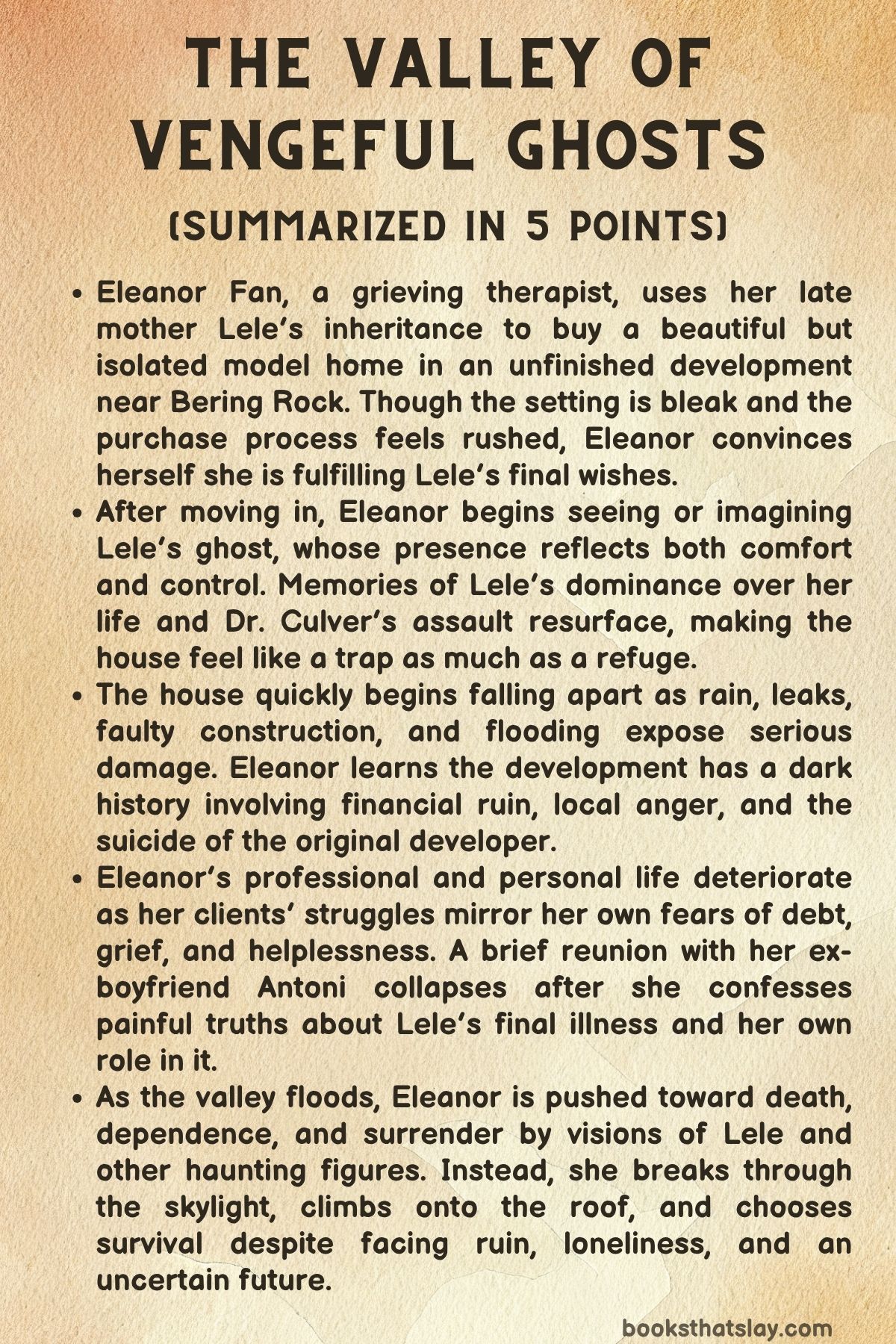
Eleanor Fan is a therapist living in the long shadow of her mother Lele’s death. Lele died the year before, but her presence still guides Eleanor’s life in a way that feels less like memory and more like command.
Before dying, Lele told Eleanor to use her inheritance for a down payment on a home, and Eleanor follows that instruction even though the process exhausts and unsettles her. She has been outbid several times and feels increasingly desperate to secure something, anything, that will prove she is moving forward.
A realtor named Matt shows her a modern model home outside the small town of Bering Rock. The house is beautiful, sleek, and almost unreal in its perfection, but it stands in a failed development surrounded by mud, empty foundations, forest, and another completed house across the road.
The area feels unfinished and abandoned, as if the future that was planned for it never arrived. Eleanor notices the isolation and the bleakness, yet the house itself overwhelms her.
It seems like the kind of place a better, stronger version of herself could inhabit. Against her own uncertainty, she makes a bold offer with no contingencies.
Matt moves fast, guiding Eleanor through paperwork with a pressure that leaves little room for thought. Eleanor signs documents she barely understands, swept forward by the belief that she is fulfilling Lele’s last wish.
That night, she meets Teddy, her former mentor, and speaks about Lele’s death. The conversation opens older wounds as well, especially the memory of Dr. Culver, the professor who assaulted her in graduate school.
After that trauma, Lele stepped in and took charge of Eleanor’s life completely. She managed Eleanor’s money, career, apartment, meals, and choices.
What may have looked like care also became control, and Eleanor was left with little practice making decisions for herself.
The next morning, Matt tells Eleanor that her offer has been accepted. She hands over the earnest money and moves ahead, more obedient than joyful.
The house becomes hers, but ownership does not bring confidence. She moves in slowly, bringing only a few belongings and setting up her online therapy practice there.
Almost immediately, the house reveals its practical problems. There are no curtains, the internet is unreliable, and the open design makes her feel exposed.
Instead of a safe new beginning, the house feels like a stage where she can be watched from every direction.
On her first night, Eleanor sees or dreams Lele lying beside her in bed. The experience is intimate, frightening, and confusing.
Soon Lele appears more often. Sometimes she is silent; sometimes she speaks.
Her voice seems to come from outside Eleanor and from within her at the same time. Eleanor cannot tell whether she is being haunted by a ghost, by grief, or by the version of herself that still expects Lele to make every decision.
These appearances unsettle her, but they also carry the familiarity of a relationship she has not truly escaped.
Heavy rain begins, and the house starts breaking down. Water leaks through windows, the front lock jams, the kitchen fan rattles, and the unfinished development turns into a mess of mud and standing water.
Eleanor goes into Bering Rock and learns from a grocery cashier named Stella that the development has an ugly history. The original developer ruined people financially, then hid in the other completed house when angry townsmen came after him.
He killed himself there. The story stains the place with anger, failure, and betrayal.
Eleanor begins to understand that her beautiful house is part of a larger collapse.
Her sense of vulnerability grows when a locksmith named Richie comes to fix the front lock. He is frightening, intrusive, and clearly aware that she is alone.
He overcharges her and intimidates her, turning a simple repair into a reminder that the house offers little protection. Eleanor tries to regain control by hiring help, but each attempt to solve a problem uncovers something worse.
A contractor named Kurt inspects the property and finds poor construction, missing weatherproofing, leaking windows, a faulty shower draining into the ceiling, and serious water damage. The cost of repairs is enormous.
Eleanor realizes she has bought not a dream home but a financial disaster.
As the house decays, Eleanor’s work also begins to suffer. Her clients speak about debt, grief, parenting, anxiety, helplessness, and the fear that life can fall apart faster than anyone can repair it.
Their problems echo her own so closely that therapy becomes harder to perform. She is sleep-deprived, cold, and increasingly unstable.
The house, the weather, and her memories create a mental space where past and present blur. Lele appears.
Dr. Culver returns in distorted recollections. The dead developer’s story seems to press against her own.
Richie’s threat lingers. Eleanor is surrounded by figures of harm, judgment, dependence, and failure.
In the middle of this crisis, Eleanor reconnects with her ex-boyfriend Antoni, who is caring for his mother, Frannie. Antoni represents a possible escape from the house and from the life Eleanor has chosen so badly.
She spends the night with him and imagines moving in, letting him become the answer to her fear. But the hope collapses when she confesses something about Lele’s final illness.
Near the end, Eleanor helped withhold and manage Lele’s medication according to Lele’s wishes, a choice that caused Lele terrible suffering. Eleanor carries guilt and confusion over whether she honored her mother or failed her.
Antoni recoils from the confession and tells her to leave. Eleanor returns to Bering Rock more alone than before.
The rain keeps falling, and the land around the development begins to give way. The house floods from below and above.
Water enters the rooms, the damage spreads, and the place becomes less like a home than a sinking container for everything Eleanor has avoided. Her hallucinations intensify.
She relives the assault by Culver, imagines the developer’s suicide, and sees alternate versions of Lele’s illness in which Eleanor becomes the competent caretaker she wishes she had been. These visions force her to face not only what happened but also the stories she has told herself about who she was and what she should have done.
At one point, Eleanor finds the developer’s hidden gun. In a moment of despair, she nearly repeats his death, placing the weapon under her chin.
The act brings her close to surrendering to the same ruin that claimed him. But she survives the moment.
That survival is not triumphant or clean; it is simply a pause, a refusal that happens before she fully understands it.
The flooding worsens until the first floor fills with water and the danger rises toward the bedroom. Eleanor understands that no one is coming.
Matt will not rescue her. Antoni will not rescue her.
Lele cannot rescue her, and perhaps never truly did. Lele’s ghost mocks and urges her, keeping alive the old pattern in which Eleanor waits for her mother’s force to decide the next step.
But the situation leaves no room for obedience. Eleanor must act.
She gets a ladder, takes a hammer, and breaks through the skylight. The glass cuts her hands, but she climbs out onto the roof.
Outside, the valley has become a filthy lake. Her car is partly submerged.
The other house and the trees barely rise above the water. The world she bought into has collapsed completely, and there is no easy future waiting beyond the roofline.
Lele’s ghost offers her a hand, tempting Eleanor toward surrender, death, memory, and dependence. But Eleanor recognizes something crucial: she has already saved herself.
She escaped through the skylight by her own action, not by Lele’s control or anyone else’s rescue. The house is ruined, her finances are wrecked, and she may face homelessness, loneliness, and debt.
Yet she has chosen movement over surrender. In the end, Eleanor does not receive comfort or certainty.
She receives the bare possibility of continuing, and for the first time, that possibility belongs to her.
Characters
Eleanor Fan
Eleanor Fan is the central character of The Valley of Vengeful Ghosts, and the book follows her emotional, psychological, and physical collapse as she tries to build a new life after her mother’s death. She is a grieving therapist, which makes her situation especially complex because she spends her professional life helping others name their fears, manage their anxieties, and survive emotional crises, while she herself is unable to face the full truth of her own grief and trauma.
Eleanor’s decision to buy the model home is not simply a practical choice but an act of obedience to Lele’s final command. Even after her mother’s death, Eleanor continues to live under Lele’s control, treating the inheritance and the instruction to buy property as if they are sacred orders she must fulfill.
Her attraction to the house shows her longing for beauty, stability, adulthood, and independence, but her reckless offer and careless signing of documents also reveal how unprepared she is to make decisions without someone directing her.
Eleanor’s character is shaped by years of dependency, trauma, and emotional paralysis. Her past assault by Dr. Culver left her vulnerable and destabilized, but Lele’s response to that trauma created another form of imprisonment.
Instead of helping Eleanor regain agency, Lele took over her money, career, living arrangements, meals, and daily choices. As a result, Eleanor enters the new house physically alone but emotionally still entangled with her mother.
The ghostly appearances of Lele can be read as hauntings, hallucinations, memories, or projections of Eleanor’s own divided mind, but they always reveal how deeply Lele’s voice has become part of Eleanor’s inner life. Eleanor is not only haunted by the dead; she is haunted by the habits of helplessness that the living created in her.
As the house fails, Eleanor’s inner world breaks down alongside it. The leaking windows, flooding land, jammed lock, faulty shower, and hidden structural damage mirror her own emotional damage, which has been covered over rather than repaired.
Her therapy clients reflect pieces of her own crisis, including debt, grief, helplessness, anxiety, and fear of collapse. Because Eleanor is a therapist, the book creates a painful irony: she can recognize suffering in others, but she cannot easily rescue herself.
Her profession does not protect her from denial, and her intelligence does not free her from fear. She understands emotional pain in theory, yet she repeatedly avoids taking decisive action in her own life until the danger becomes unavoidable.
Eleanor’s confession to Antoni reveals one of the deepest sources of her guilt. Near the end of Lele’s illness, Eleanor participated in withholding and managing Lele’s medication according to her mother’s wishes, but the result was terrible suffering.
This memory complicates Eleanor’s grief because she is not only mourning Lele; she is also judging herself for what she did and failed to do. Her desire to move in with Antoni shows her temptation to replace one dependency with another.
When Antoni recoils and sends her away, Eleanor loses the fantasy that someone else will absorb her crisis. Her return to the house marks her descent into a more extreme confrontation with abandonment, guilt, and survival.
By the end of the story, Eleanor becomes a character defined not by healing but by the beginning of agency. Her climb through the skylight is the most important expression of her transformation.
She does not fix the house, escape debt, restore her career, or solve her grief. Instead, she performs one clear act of self-rescue.
When Lele’s ghost offers her a hand, Eleanor faces the temptation to surrender to death, memory, and dependence. Her refusal does not make her life suddenly hopeful in a simple way, but it proves that she can act without Lele.
Eleanor’s ending is powerful because she remains ruined, frightened, and alone, yet she chooses the possibility of continuing. In that choice, she becomes more than a victim of haunting; she becomes someone who has saved herself once and may be able to do so again.
Lele
Lele is one of the most powerful presences in the book, even though she is already dead when the main action unfolds. She is Eleanor’s mother, and her influence survives through money, memory, guilt, command, and ghostly visitation.
Lele’s instruction that Eleanor use the inheritance for a down payment becomes the force that pushes Eleanor into buying the house. This makes Lele’s control feel active even after death.
She does not merely belong to Eleanor’s past; she continues to shape Eleanor’s choices in the present. Her haunting presence suggests that the dead can remain powerful when the living have not separated themselves from them emotionally.
Lele is a complicated maternal figure because her care is inseparable from control. After Eleanor was assaulted by Dr. Culver, Lele stepped in and managed almost every aspect of her daughter’s life.
On one level, this can be seen as a mother trying to protect a wounded child. On another level, it prevents Eleanor from rebuilding independence.
Lele’s care becomes suffocating because it replaces Eleanor’s agency rather than restoring it. She organizes Eleanor’s money, career, apartment, food, and decisions, turning Eleanor into someone who survives through obedience.
This makes Lele both loving and damaging, both protector and captor.
As a ghost or hallucinated figure, Lele often speaks in a voice that seems partly Eleanor’s own. This detail makes her especially important as a psychological character.
Lele is not only an external haunting; she has become internalized. Eleanor hears her mother’s judgment, mockery, instruction, and pressure from within herself.
Lele’s ghost represents grief, dependency, shame, and the inherited voice of control. Her appearances force Eleanor to confront the fact that she has not fully lived as a separate person.
Even the house, bought because of Lele’s command, becomes a physical extension of that control.
Lele’s illness and death also complicate her role. Eleanor’s memory of managing or withholding medication according to Lele’s wishes reveals that Lele’s control extended even into dying.
She demanded a form of obedience that left Eleanor with lasting guilt. This makes Lele’s suffering morally difficult for Eleanor to process.
Eleanor is haunted not only by losing her mother but by the fear that she failed her mother, harmed her mother, or lacked the courage to care for her properly. Lele therefore becomes a figure through whom the book explores how love can become obligation, and how obligation can become a lifelong wound.
At the end, Lele’s ghost offers Eleanor a hand, tempting her toward surrender. This moment captures Lele’s final symbolic function.
She represents the comfort of giving up responsibility, the pull of death, and the familiar safety of dependence. Eleanor’s refusal of Lele is not a rejection of love but a rejection of being ruled by the dead.
Lele remains tragic because she loved Eleanor in a way that also weakened her. Her character shows how a parent can save a child from one danger while preparing her poorly for every danger that follows.
Matt
Matt is the realtor who introduces Eleanor to the model home and helps set the disastrous purchase in motion. He appears professional and efficient, but his actions suggest haste, pressure, and self-interest.
He shows Eleanor a beautiful modern house in an unfinished and unsettling development, then rushes her through the process of making an aggressive offer without contingencies. Matt’s role in the book is important because he represents the polished surface of real estate, salesmanship, and adult decision-making.
He presents the house as an opportunity, but he does not meaningfully protect Eleanor from its risks.
Matt’s character is not developed through emotional depth as much as through function. He is part of the machinery that allows Eleanor’s vulnerability to be exploited.
He does not need to be openly cruel to cause harm. His danger lies in his smoothness and speed.
Eleanor is grieving, isolated, and desperate to fulfill Lele’s final instruction, and Matt benefits from her urgency. By guiding her quickly through paperwork she barely reads, he becomes one of the first figures in the story to show how easily Eleanor can be pushed into decisions when she lacks confidence and support.
Matt also helps establish the book’s distrust of appearances. The house looks striking and beautiful, and Matt’s professional manner supports that illusion.
Yet beneath the attractive presentation are hidden defects, legal and financial dangers, and the physical instability of the land itself. Matt therefore belongs to the same world as the house’s glass, clean lines, and modern surfaces.
He helps sell the fantasy of stability while concealing, ignoring, or minimizing the rot underneath. His character shows how ordinary professional systems can become predatory when they meet a person too wounded to resist them.
Teddy
Teddy is Eleanor’s former mentor, and his presence connects Eleanor’s present crisis to her academic and professional past. When Eleanor meets him after making the offer on the house, their conversation brings back memories of Lele’s death and Dr. Culver’s assault.
Teddy functions as a reminder that Eleanor once belonged to a world of training, ambition, and professional formation before trauma redirected her life. He is associated with the earlier version of Eleanor who was a graduate student, a developing therapist, and a person with a future that had not yet been narrowed by fear.
Teddy’s role is subtle but meaningful because he allows the book to reveal Eleanor’s history indirectly. Through him, the reader sees how Eleanor’s grief over Lele is tangled with older wounds.
His presence makes it clear that Eleanor’s breakdown is not caused only by the bad house. The house becomes the place where several unresolved histories converge.
Teddy draws attention to the fact that Eleanor’s life has been shaped by institutions, mentors, professors, and professional hierarchies, not only by family. He belongs to the world that should have helped Eleanor become independent, but that world is also connected to the abuse of power represented by Dr. Culver.
As a mentor figure, Teddy contrasts with Lele. Lele took control of Eleanor’s life through intimate family authority, while Teddy represents a more formal kind of guidance.
Yet neither form of guidance fully saves Eleanor. Teddy listens and evokes memory, but he does not become a rescuer.
His character helps reinforce one of the story’s central truths: Eleanor’s survival cannot finally come from mentors, parents, lovers, professionals, or authority figures. They may shape her, wound her, or witness her pain, but the decisive action must come from Eleanor herself.
Dr. Culver
Dr. Culver is one of the darkest figures in the book because he represents violation, institutional power, and the origin of Eleanor’s long collapse into dependency. As a professor who assaulted Eleanor in graduate school, he used his position of authority against someone vulnerable within an academic hierarchy.
His character is not important because of frequent direct action in the present, but because the memory of him continues to distort Eleanor’s life. He is one of the ghosts that haunts her even though he is not necessarily dead.
In this story, haunting is not limited to supernatural figures; it also includes trauma that remains active in the body and mind.
Culver’s assault changes the course of Eleanor’s relationship with Lele. After the assault, Lele takes over Eleanor’s life, and this response becomes another kind of captivity.
Culver therefore damages Eleanor both directly and indirectly. His violence creates the conditions under which Eleanor loses independence to her mother’s control.
The book uses him to show how trauma can spread beyond the original event, reshaping relationships, careers, habits, and self-image. Eleanor’s inability to trust her own judgment in the present is partly rooted in the way Culver’s abuse shattered her sense of safety and authority over herself.
Culver also appears in Eleanor’s hallucinations and distorted memories as the house floods and her mind deteriorates. This shows that he remains part of her internal landscape.
He is not simply remembered; he is re-experienced. His presence merges with the collapsing house, the dead developer, Richie’s intimidation, and Lele’s ghostly control, creating a network of male threat, parental dominance, and psychological terror.
Culver’s character reveals that Eleanor’s crisis is not irrational. Her fear has a history.
The danger she senses in the house is intensified by older dangers that were never fully faced or healed.
Stella
Stella, the grocery cashier in Bering Rock, serves as a local voice of warning and history. She tells Eleanor about the original developer, the financial ruin he caused, and his suicide in the other completed house.
Through Stella, Eleanor learns that the development is not merely unfinished but cursed by greed, anger, failure, and death. Stella’s importance lies in the way she connects Eleanor’s private crisis to the larger history of the town.
The house is not an isolated mistake; it is part of a broader pattern of exploitation and collapse.
Stella also contrasts with Eleanor because she belongs to Bering Rock in a way Eleanor does not. Eleanor is an outsider who has bought into the development’s illusion, while Stella knows the local story behind that illusion.
Her knowledge gives the setting a social and moral depth. The mud, abandoned foundations, and empty roads are not just atmospheric details; they are signs of real harm done to real people.
Stella helps reveal that the land around Eleanor’s house carries resentment before Eleanor ever arrives.
Although Stella does not become a rescuer, her role is still important. She offers information, and information briefly gives Eleanor a clearer view of what she has entered.
However, Eleanor’s situation is already too advanced for knowledge alone to save her. Stella’s character shows that warnings often come after the trap has closed.
She also adds to the book’s atmosphere of local suspicion, suggesting that Eleanor has moved into a place where everyone knows more than she does and where the past is still alive beneath the surface.
Richie
Richie is one of the most openly threatening characters in the story. As the locksmith who repairs Eleanor’s jammed lock, he enters her home under the appearance of providing help, but he quickly becomes intimidating.
He overcharges her, frightens her, and makes it clear that she is isolated and vulnerable. Richie’s presence turns a practical household problem into a moment of personal danger.
The broken lock already suggests that Eleanor’s home cannot protect her, and Richie deepens that fear by showing that even the people who come to fix things may become threats.
Richie’s character is disturbing because he understands Eleanor’s helplessness. He recognizes that she is alone in an unfinished development, without nearby support, and dependent on his service.
His intimidation is not just physical but psychological. He forces Eleanor to feel the imbalance between them.
In this way, he becomes another figure who exposes the false promise of the house. Eleanor bought the property in search of security, but Richie’s visit proves that the house has made her more exposed than ever.
Richie also echoes the earlier male threat represented by Dr. Culver. While Culver belongs to Eleanor’s academic past and abused institutional authority, Richie belongs to her present environment and uses practical power.
Both men make Eleanor feel trapped, watched, and unable to defend herself. Richie’s role in the book is therefore larger than his brief appearance might suggest.
He is one of the living figures who joins the dead and imagined figures in Eleanor’s haunting. He helps turn the house into a place where every encounter becomes a reminder of danger.
Kurt
Kurt is the contractor who reveals the full extent of the house’s physical defects. His character brings practical reality into a story increasingly shaped by hallucination, grief, and dread.
Through Kurt, Eleanor learns that the house has bad construction, missing weatherproofing, leaking windows, a faulty shower, and serious water damage. He is important because he confirms that Eleanor’s fear is not only psychological.
The house really is failing. Its beauty has hidden serious structural problems, and the cost of repair is overwhelming.
Kurt functions as a truth-teller, though not in a comforting way. Unlike Matt, who helps sell the house’s illusion, Kurt exposes what lies beneath the surface.
His discoveries transform Eleanor’s anxiety into financial and practical catastrophe. Every repair reveals something worse, which mirrors Eleanor’s emotional condition.
Just as the house cannot be fixed with one simple repair, Eleanor’s life cannot be healed by one decision, one relationship, or one act of denial. Kurt’s findings make the house a physical symbol of accumulated damage.
Kurt’s role also emphasizes Eleanor’s helplessness within systems she does not understand. She is a therapist, not a builder, lawyer, or engineer.
She depends on others to interpret the house for her, and those interpretations arrive too late. Kurt does not exploit her in the same way Matt or Richie does, but his presence still increases her despair because he reveals the scale of what she has inherited.
His character shows that truth can be necessary and devastating at the same time.
Antoni
Antoni is Eleanor’s ex-boyfriend and one of the figures who briefly seems to offer escape from the house. His life is also shaped by caretaking because he is caring for his mother, Frannie.
This makes him an important mirror for Eleanor. Both characters are connected to ill or dependent mothers, but Antoni appears more grounded in his role than Eleanor feels in hers.
When Eleanor reconnects with him, she imagines the possibility of leaving the house behind and moving into a life where someone else might hold her together.
Antoni represents comfort, intimacy, and the temptation of rescue. Eleanor’s night with him allows her to imagine a return to human warmth after the cold, wet isolation of the house.
However, this possibility collapses when she confesses what happened near the end of Lele’s illness. Antoni’s recoil is painful because it denies Eleanor the absolution she may have been seeking.
He cannot absorb the moral weight of her confession, and he cannot become the safe refuge she wants him to be.
Antoni’s reaction makes him a complicated character rather than a simple villain. His rejection wounds Eleanor, but it also forces her to confront the fact that she cannot escape herself by entering someone else’s home or life.
He has his own burdens, especially through Frannie, and he is not emotionally able or willing to take on Eleanor’s crisis. In the structure of the story, Antoni’s refusal becomes necessary because it strips away Eleanor’s fantasy of being saved by romantic attachment.
After leaving him, Eleanor must return to the house and eventually face survival alone.
Frannie
Frannie is Antoni’s mother, and although she is not as central as Eleanor or Lele, she plays an important symbolic role. She is another mother whose illness or dependence shapes the life of an adult child.
Through Frannie, the book creates a parallel between Antoni and Eleanor. Both are connected to maternal care, obligation, and the emotional demands of aging or illness.
Frannie’s presence helps show that caregiving is not unique to Eleanor’s life, but Eleanor’s experience of it has been especially tangled with guilt, control, and trauma.
Frannie also helps define Antoni’s character. His responsibility toward her makes him seem mature, burdened, and tied to a life that already contains emotional weight.
This is part of why Eleanor’s hope of escaping into his home is fragile. Antoni is not empty or available in the way Eleanor imagines; he is already committed to caring for someone else.
Frannie’s presence therefore blocks the fantasy that Antoni can become Eleanor’s replacement caretaker.
As a quiet figure in the story, Frannie deepens the book’s exploration of mothers and adult children. Lele dominates Eleanor even after death, while Frannie shapes Antoni’s life through need and care.
The comparison makes Eleanor’s relationship with Lele seem even more extreme. Frannie’s role reminds the reader that caring for a parent can be difficult without becoming destructive.
Through her, the story shows different versions of family duty and the emotional pressure created when love, illness, and responsibility become inseparable.
Themes
Grief and the Power of the Dead Over the Living
Eleanor’s grief does not remain a quiet feeling inside her; it shapes her choices, her home, her money, and even her sense of self. In The Valley of Vengeful Ghosts, Lele’s death has not freed Eleanor from her mother’s authority.
Instead, the inheritance becomes a final command, pushing Eleanor into buying a house she does not truly understand or feel prepared to own. Lele’s appearances show how grief can preserve a relationship in a painful form, especially when love has long been mixed with control.
Eleanor misses her mother, but she also remains trapped by her mother’s voice, judgment, and expectations. The haunting is therefore emotional as much as supernatural.
Lele’s ghost represents the way the dead can continue to govern the living when unresolved guilt, dependence, and regret remain. Eleanor’s struggle is not simply to survive the flood, but to separate mourning from obedience and memory from possession.
The False Promise of Independence
The house initially appears to offer Eleanor adulthood, stability, and a future built from her mother’s inheritance. Yet almost immediately, it becomes a sign of how fragile independence can be when it is built on pressure, fear, and poor judgment.
Eleanor signs documents she barely reads, ignores obvious warning signs, and accepts isolation because the house seems beautiful and because buying it feels like fulfilling Lele’s command. Once she moves in, every practical problem reveals how unprepared she is to live alone in this space.
The broken lock, leaking windows, bad construction, weak internet, and flooding all turn ownership into entrapment. Her supposed independence becomes another version of helplessness, especially when men like Matt, Richie, and Kurt expose how little control she has over money, safety, and repairs.
The theme shows that independence cannot come only from owning property or escaping another person’s home. Eleanor must learn to act for herself internally before any house can represent freedom.
Trauma, Memory, and Distorted Reality
Eleanor’s past trauma does not stay in the past; it returns through hallucinations, dreams, bodily fear, and repeated moments of paralysis. Her memories of Dr. Culver’s assault, Lele’s illness, and her own failures as a daughter blur with the dangers of the present until the house seems to contain every unresolved wound.
The broken home becomes a physical version of her mental state: leaking, unstable, exposed, and impossible to repair without facing deeper damage. Her clients’ problems also reflect parts of her own fear, making her professional role harder to maintain.
She is trained to help others manage pain, but she cannot fully organize her own. As the rain worsens, reality becomes less reliable because Eleanor’s mind is under extreme pressure.
The ghosts and visions reveal how trauma can distort time, making old violence feel immediate and unfinished. Her survival depends on recognizing that these memories are powerful, but they do not have to decide her final action.
Survival Through Self-Recognition
Eleanor’s final act of survival matters because it does not erase her losses or solve her practical problems. By the end, she still faces debt, homelessness, loneliness, and the collapse of the dream she tried to build.
What changes is her understanding of herself. Throughout the story, she waits for someone else to guide, rescue, approve, or condemn her: Lele, Antoni, repairmen, professionals, or even the imagined dead.
In the flood, that pattern breaks. No one comes, and the house that was meant to shelter her becomes a trap.
When Eleanor climbs through the skylight, cutting herself and forcing her way out, she proves that she is capable of action even while terrified. Lele’s ghost offering a hand becomes the final temptation to surrender to dependence, memory, and death.
Eleanor’s refusal is not a triumphant victory, but it is a beginning. She chooses uncertainty over surrender, which makes survival an act of self-recognition rather than escape alone.