The Quitters Club Summary, Characters and Themes
The Quitters Club by Jessica Strawser is a contemporary novel about four longtime friends reaching a point where the lives they have carefully maintained no longer feel sustainable.
Marie, Lucy, Brooke, and Collins reunite at forty carrying very different disappointments: a strained marriage, a collapsing writing career, years of infertility, and grief after a husband’s death. What begins as a reunion becomes a shared experiment in giving themselves permission to stop pursuing lives that are hurting them. The book examines the difficult boundary between perseverance and self-destruction, showing that quitting can sometimes be an act of courage, while staying can require equal strength.
Summary
Marie Welling arrives in Savannah for a fortieth-birthday reunion with her three closest college friends, Collins, Lucy, and Brooke. Their arrival plans immediately fall apart, but the disorder feels familiar to Marie, whose own life has become increasingly difficult to manage despite her professional expertise in teaching women how to establish boundaries.
Marie is a professor at Ohio University and the primary organizer of life for her sons, Connor and Wade. Her marriage to Kyle has become dominated by unequal responsibilities, commuting problems, and the quiet assumption that Marie will accommodate everyone else, leaving her increasingly unsure whether she still wants the marriage.
The reunion soon becomes more serious than the friends expected. Lucy reveals that she wants to abandon professional writing after years of disappointing sales, unstable income, shrinking freelance opportunities, and constant pressure to promote herself, even though becoming a novelist had once been her defining ambition.
Brooke confesses that she is exhausted after years of infertility treatments. Her latest embryo transfer has failed, and continuing would mean beginning another physically and emotionally demanding round of treatment, forcing her to question whether determination has become an excuse for continuing something that is destroying her happiness.
Collins carries a different burden. Her husband, celebrated stained-glass artist Sullivan Hartley, died in a studio fire, and she has remained emotionally suspended around his memory, managing his artistic estate while struggling to imagine an identity that is not defined by widowhood.
The four friends create an informal pact they call the Quitters Club. Lucy will stop chasing another publishing contract, Brooke will reconsider fertility treatment, Marie will temporarily leave the family home with her sons rather than continue absorbing the consequences of Kyle’s choices, and Collins will attempt to stop withdrawing from life.
Back in Chicago, Lucy makes her decision public by publishing an essay explaining why she is leaving professional writing. She dismantles her online author infrastructure and gives Collins control of her passwords so she cannot easily change her mind, believing that only a decisive break will free her from the cycle that has made writing miserable.
Brooke tells Mitch that she wants to stop fertility treatment, expecting resistance or grief. Instead, he supports her immediately, and the couple begin imagining a future that is not organized around children, eventually deciding to sell their Colorado home, reduce their possessions, leave their established routines, and travel internationally.
Marie moves with Connor and Wade into Collins’s Athens home. The new arrangement quickly reveals something uncomfortable: Marie and her sons are happier with shorter commutes, increased support, and freedom from the constant logistical strain that defined their old household.
Lucy explores an MBA as a route toward financial stability and meets Enzo, an admissions counselor who convinces her that Ohio University offers a more practical program than the expensive Chicago school she is considering. Their conversation also develops into a romantic connection, complicating Lucy’s decision to leave Chicago.
As the friends begin changing their lives, Collins struggles to identify what moving forward actually means for her. She announces that she will attend a singles’ ski retreat over the holidays, an unusual choice for someone who dislikes both skiing and winter, but she presents it as proof that she is attempting to participate in life again.
Marie briefly reconnects romantically with Kyle, but their renewed affection does not solve their deeper conflict. When she asks for structural changes involving careers, commuting, parenting, and responsibility, Kyle feels blindsided, while Marie realizes that what he considered “happy enough” had required her to remain consistently unhappy.
Then the friends receive terrifying news. Collins has suffered a catastrophic skiing accident and is transferred to a major trauma center with extensive injuries, including fractures, internal trauma, and brain swelling severe enough to require a medically induced coma.
The circumstances surrounding the fall are unsettling because Collins had barely participated in the retreat. She had gone skiing alone at night despite her inexperience, and witnesses saw her disappear over a ledge away from the ordinary slope, raising questions about whether the accident happened exactly as everyone assumes.
Collins eventually regains consciousness, but her recovery brings another devastating discovery. Trauma scans reveal stage-three lung cancer, even though she has never smoked, and her injuries complicate treatment because her body must recover enough to tolerate cancer therapy.
Meanwhile, Brooke discovers that she is naturally pregnant only weeks after ending fertility treatment. Instead of uncomplicated happiness, she experiences shock and fear because she and Mitch have already sold their home, abandoned their former lifestyle, and prepared for open-ended international travel.
Brooke encourages Mitch to begin their European journey without her while she remains in Ohio for prenatal care and to support Collins. Watching him leave creates another insecurity: she begins worrying that Mitch may discover he prefers the freer life they imagined without her or the baby.
Lucy begins her MBA and unexpectedly discovers that the essay announcing her departure from writing has gone viral. Students recognize her, readers begin buying her older novels, and the author who felt invisible while desperately pursuing recognition becomes widely visible only after declaring that she has stopped pursuing it.
Publishing soon comes calling again. Lucy’s former publisher offers her another novel with an advance far larger than her previous deals, forcing her to reconsider whether returning would betray everything she wrote about burnout or whether quitting successfully created the boundaries necessary for her to approach writing differently.
Concerns about Collins also grow. Travis, her neighbor and Sullivan’s former friend, reveals that he and Collins had slept together shortly before the friends’ reunion, but Collins withdrew afterward because moving toward another relationship felt like betraying Sullivan.
Brooke later confronts Collins about the mountain. Collins does not admit intentionally hurting herself, but she acknowledges therapy, guilt surrounding Sullivan, fear about her own identity, and the difficulty of accepting that the life she loved ended without her choosing to leave it.
Marie and Lucy meanwhile make a serious mistake by retrieving fire-damaged objects from Sullivan’s old studio despite Collins explicitly refusing them. One object connects Sullivan with his estranged daughter Sara, who reveals that she rejected an opportunity to reconcile with her father before he died and has directed much of her guilt toward Collins ever since.
Sara wants to repair the damage and possibly help with Sullivan’s estate, but when Collins discovers that Marie disregarded her instructions regarding the recovered objects, years of frustration erupt. Collins accuses the women of hiding behind the Quitters Club rather than honestly confronting their changing circumstances, and the friends exchange equally painful criticisms.
Lucy, Brooke, and Collins eventually declare themselves finished with the original pact. Their rebellion forces Marie to recognize that she has also used the friends’ crises to delay a decision about Kyle.
A classroom experience finally clarifies Marie’s marriage for her. Watching an example of a woman whose achievement is interrupted because everyone automatically expects her to handle another small family responsibility, Marie understands that her problem with Kyle is not merely scheduling but the repeated absence of support where support should naturally exist.
Marie decides to end the marriage. Kyle later acknowledges some of his failures and begins taking responsibility as a coparent, but Marie realizes that appreciating his growth does not require remaining married to him.
Brooke and Mitch also reach a new understanding. Mitch unexpectedly returns from Europe after arranging a job in London, explaining that traveling showed him he still wants adventure but does not want it without Brooke, while Brooke has independently discovered that parenthood does not necessarily require abandoning their international ambitions.
They choose the baby, their marriage, and a more flexible version of the adventurous life they had started creating.
Lucy similarly stops treating her choices as mutually exclusive. With Enzo’s encouragement, she recognizes that she can combine writing, business, communication, education, and financial stability instead of choosing one identity forever.
That realization leads Lucy and Marie toward a multimedia venture built around quitting and boundary-setting. Rather than forcing Marie to abandon academia or Lucy to return to her old publishing life, the project allows both women to expand their existing skills in new directions.
Collins gradually begins releasing herself from Sullivan’s legacy. She allows Sara to become involved in managing the artistic estate, chooses not to return permanently to the Athens house saturated with traumatic memories, and begins imagining an independent life connected to the arts without existing primarily as Sullivan’s widow.
The women reorganize their lives around one another rather than assuming that independence means separation. Brooke and Mitch temporarily live close to Collins during treatment, Lucy continues school and her emerging professional work, Marie establishes a new home with Connor and Wade, and Collins slowly moves toward physical and emotional recovery.
Two years later, Collins lives in Saugatuck, Michigan, near the beach. Her treatment has progressed well enough for doctors to discuss her future without fixed limits, she has established a new professional and personal identity, and her friendships remain central to the life she has rebuilt.
Only then is the truth about the skiing accident revealed. Collins deliberately went over the wrong side of the mountain during a moment of complete surrender, although she had not planned suicide beforehand; paradoxically, the injuries led doctors to discover her cancer early enough for treatment.
Collins chooses not to tell her friends because she knows they would blame themselves for missing warning signs, when she believes their renewed friendship ultimately helped her survive. As Marie, Lucy, Brooke, their partners, and their children arrive for another reunion, Collins understands that wrong turns do not necessarily mean arriving too late, and that the essential lesson was never simply learning when to quit but learning which parts of life deserve to be kept.
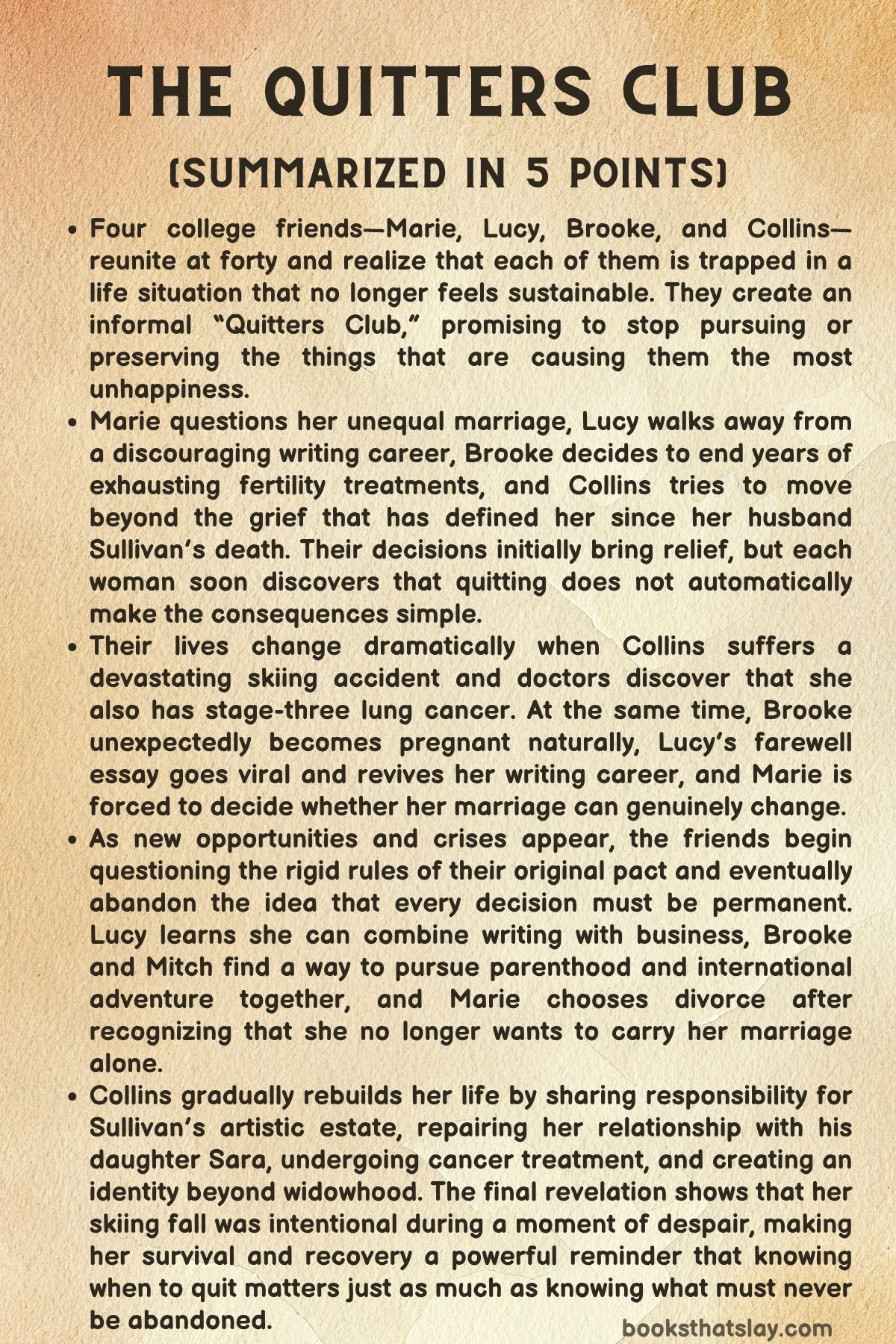
Characters
Marie Welling
Marie is one of the clearest examples of the difference between intellectual knowledge and lived practice. She teaches students about boundaries and saying no, yet her own marriage has trained her to absorb inconvenience, organize family life, adjust her career, manage the children, and repeatedly accept that Kyle’s professional priorities will come first.
Her development in The Quitters Club comes from recognizing that her unhappiness does not require a dramatic betrayal to be legitimate. Kyle is not presented as monstrous, which makes Marie’s decision harder because she must accept that a marriage can end through accumulated loneliness, imbalance, and emotional absence rather than one unforgivable event.
Marie is also an instinctive caretaker, and that strength frequently becomes a weakness. During Collins’s medical crisis, she throws herself into helping, partly out of love and partly because helping someone else allows her to delay confronting her own unresolved situation.
Her final decision demonstrates an important change in how she understands responsibility. She stops measuring success by keeping the existing structure intact and begins measuring it by whether that structure actually allows the people inside it to live well.
Lucy Mayer
Lucy begins the novel believing that quitting professional writing requires rejecting an identity she has spent most of her life building. Years of disappointing sales and unstable income have convinced her that continuing means accepting an endless cycle of hope, rejection, promotion, and financial anxiety.
Her impulsiveness is both a strength and a flaw. Publishing her farewell essay and locking herself out of her accounts gives her the clean break she believes she needs, but her later uncertainty shows that decisive action does not automatically produce a simple answer.
Lucy’s unexpected success after quitting creates one of the book’s sharpest ironies. Recognition arrives only when she stops trying to obtain it, forcing her to determine whether changing her mind would represent weakness or whether healthy boundaries can include renegotiation.
Her relationship with Enzo is important because he does not demand that she choose between identities. Through him, her MBA, Marie’s class, and her renewed relationship with writing, Lucy learns that a career change does not need to erase everything that came before it.
Brooke
Brooke has spent years treating motherhood as a fixed destination that must be reached regardless of cost. Fertility treatment gradually consumes her time, body, finances, marriage, social life, and imagination, yet stopping feels frightening because she interprets persistence as proof of how deeply she wants a child.
Her decision to quit treatment creates genuine freedom before creating an unexpected complication. By selling the house and imagining an international life with Mitch, Brooke learns that childlessness does not have to mean an incomplete marriage or an inferior future.
The natural pregnancy therefore destabilizes rather than resolves her conflict. She discovers that wanting motherhood for years does not guarantee instant happiness when pregnancy arrives, particularly after she has finally developed a different vision of herself.
Brooke becomes more emotionally mature when she allows apparently conflicting desires to coexist. She can want her child, want Mitch, want travel, fear motherhood, miss her old freedom, and still become a committed parent without treating any one of those emotions as evidence that the others are false.
Collins
Collins is the darkest and most psychologically complicated member of the four friends. Sullivan’s death does not simply leave her grieving; it removes the identity, partnership, professional role, future, and emotional structure around which her adult life had been organized.
Throughout The Quitters Club, Collins struggles because the thing she wants to leave was never something she chose. Marie can leave a marriage, Lucy can stop pursuing publishing, and Brooke can end fertility treatment, but Collins cannot quit the event that already ended her former life.
Her management of Sullivan’s estate becomes both devotion and imprisonment. She believes preserving his work is an obligation, yet that responsibility keeps her life organized around a dead man and prevents her from developing a separate future.
Her encounter with Travis exposes the depth of that conflict because attraction feels less like possibility than betrayal. The eventual revelation that she deliberately went over the mountain shows how close grief brought her to surrender, while her later recovery demonstrates why survival should not be romanticized as automatic transformation.
Collins rebuilds herself slowly through medical treatment, friendship, reconciliation with Sara, relinquishing control of Sullivan’s estate, and choosing a new home. Her final independence matters because she does not erase Sullivan from her life; she learns to preserve love without allowing loss to remain the sole definition of who she is.
Kyle
Kyle is not written as an obvious villain, which makes his role in Marie’s conflict more effective. He loves his family and eventually shows genuine concern, yet for much of the story he treats his own job, location, schedule, and convenience as fixed conditions while viewing Marie’s needs as variables that can be adjusted.
His repeated responses reveal the invisible privilege built into the marriage. Even when he agrees to counseling, his immediate instinct is to arrange it around his work, demonstrating how difficult it is for him to recognize assumptions that Marie has experienced as burdens for years.
Kyle does develop by the end. His defense of Marie when their sons react to the divorce and his willingness to seek counseling for himself suggest that losing the marriage finally forces him to listen differently.
That development does not reverse Marie’s decision, and this is central to his characterization. Personal growth can be genuine without arriving early enough to preserve every relationship damaged before it began.
Mitch
Mitch initially appears to be the supportive partner beside Brooke’s infertility struggle, but his character gains significance once treatment ends. His immediate acceptance of Brooke’s desire to stop demonstrates that he has understood the physical cost of their attempts and has deliberately avoided pressuring her in either direction.
The old container filled with things Brooke denied herself during treatment reveals how long Mitch has privately recognized that the process was consuming them. His readiness for Plan B therefore does not emerge suddenly; it represents relief that they can finally imagine a life outside fertility schedules.
His European trip briefly creates emotional distance because Brooke sees him enjoying the freedom she cannot share. Yet Mitch’s eventual London plan proves that his excitement about travel does not mean he wants independence from his marriage.
Mitch ultimately represents adaptation rather than sacrifice. He refuses the assumption that parenthood, marriage, and adventure must eliminate one another and instead looks for a structure capable of containing all three.
Enzo
Enzo enters Lucy’s life through what initially appears to be a practical conversation about graduate school. His refusal to simply sell her an expensive MBA immediately establishes him as someone willing to question the obvious path and help Lucy think beyond the decision she believes she must make.
That same quality defines their romantic relationship. Enzo does not treat Lucy’s former writing career as either a failure or a destiny, and he does not pressure her to return to it merely because he admires her work.
His most important contribution is helping Lucy reject binary thinking. By suggesting that her communication and writing abilities can strengthen a business career rather than compete with it, he gives language to the broader lesson Lucy has gradually been discovering herself.
Travis
Travis represents the possibility of emotional life after Sullivan, which is precisely why Collins finds him frightening. Because he knew Sullivan, any relationship with him feels connected to the life Collins believes she must protect, making attraction almost impossible for her to separate from guilt.
Their brief sexual relationship reveals that Collins is capable of wanting intimacy again even when she cannot emotionally tolerate what that desire means. Travis’s concern after she withdraws also shows that people outside the central friendship group sometimes recognize signs of Collins’s distress that her oldest friends miss.
Importantly, Travis does not become Collins’s romantic reward for recovering. Their eventual friendship allows the story to treat healing as independent from finding a replacement partner.
Sullivan Hartley
Although Sullivan is dead before the central events, his presence shapes much of Collins’s life and several other relationships. As a successful stained-glass artist, husband, father, and complicated family figure, he leaves behind not only memories but an artistic estate that becomes a source of duty and conflict.
Sullivan is remembered lovingly by Collins but less comfortably by Sara, whose estrangement from him reveals his failures as a father. These different memories prevent him from becoming an idealized dead husband who exists only through Collins’s devotion.
His influence gradually becomes healthier when Collins and Sara divide memory from obligation. Sullivan can remain important without continuing to determine how both women organize the rest of their lives.
Sara
Sara initially appears antagonistic because of the hostile messages she sends Collins concerning Sullivan’s artistic estate. Her later confession radically changes the meaning of that hostility by revealing that much of it comes from guilt over rejecting Sullivan’s attempt at reconciliation shortly before his death.
Sara demonstrates how regret can be redirected toward someone easier to blame. Collins becomes the target because admitting anger at herself and grief over a lost opportunity is far more painful.
Her eventual reconciliation with Collins becomes important for both women. By participating in Sullivan’s legacy while also developing a relationship with Collins outside the conflict, Sara helps transform the estate from a burden one widow must carry into a shared responsibility.
Connor
Connor experiences the consequences of Marie and Kyle’s separation from the perspective of an older child who is aware of social judgment. Gossip from classmates makes him long for a supposedly normal family even though he privately admits that daily life has actually improved.
His frustration highlights the gap between external appearances and internal reality. Connor does not necessarily want the old household back; he wants freedom from having to explain why his family looks different.
His interactions with Brooke also show the importance of adults allowing children to express contradictory feelings. He can be angry about the separation while simultaneously preferring many aspects of the new arrangement.
Wade
Wade is younger and often more direct than the adults surrounding him. His simple observations expose realities Marie has spent years rationalizing, particularly when he points out that Kyle often missed family experiences even when they all lived together.
His statement that “extra” work is simply normal for Marie captures the imbalance of his parents’ marriage with unusual clarity. Because he has grown up watching Marie constantly accommodate everyone, what adults describe as sacrifice has become ordinary in his understanding of motherhood.
Wade also demonstrates that children can form meaningful attachments to chosen communities. His affection for Collins and Lucy as additional maternal figures shows that family stability can come from a network rather than a single conventional household.
Delia
Delia, Lucy’s literary agent, represents the professional publishing system Lucy is attempting to leave. Her concern about the viral quitting essay is understandable from an industry perspective because public declarations can affect future opportunities, yet her response also shows how strongly publishing encourages writers to preserve hypothetical possibilities even when doing so damages them emotionally.
Later, Delia becomes part of Lucy’s reconsideration rather than merely an obstacle. She challenges the idea that the essay constitutes a permanent promise and argues that Lucy can acknowledge what hurt her without refusing improved conditions forever.
Through Delia, the novel distinguishes hypocrisy from changed circumstances. Revising a decision after gaining new information does not automatically invalidate the truth of the original decision.
Dr. York
Dr. York provides Brooke with a perspective that differs from both her anxious thinking and the expectations surrounding motherhood. Rather than treating pregnancy as a command to abandon everything else, she encourages Brooke to imagine parenthood as one component of a meaningful life.
Her recommendation of an international community for traveling families becomes practically important because it gives Brooke examples of people who have rejected the assumption that stability requires permanent geographic rootedness. Dr. York therefore functions as a source of realistic reassurance rather than idealized optimism.
Evie
Evie has a relatively small role but contributes significantly to the mystery surrounding Collins’s guilt. As the owner of the property where Sullivan’s studio burned, she repeatedly attempts to return salvaged possessions that Collins refuses to confront.
Her comments challenge Collins’s private belief that she bears responsibility for Sullivan’s death. By emphasizing that Sullivan made his own decisions about studio safety, Evie introduces an outside perspective that questions the guilt Collins has treated as unquestionable truth.
Paige
Paige helps Lucy reinterpret her professional history. Instead of seeing Lucy’s abandoned writing career as an embarrassment within an MBA program, she recognizes it as valuable experience involving self-employment, career disruption, communication, and reinvention.
Inviting Lucy to participate in a Chicago business symposium encourages Lucy to see that changing careers does not erase the usefulness of what came before. Paige therefore reinforces the idea that failure and experience can sometimes describe the same events from different perspectives.
Themes
Quitting, Persistence, and the Right to Change
The central question is not whether quitting is good or perseverance is good, because the same action can protect one person and damage another. The Quitters Club repeatedly places its characters in situations where cultural admiration for persistence has prevented them from asking whether the original goal still deserves the cost.
Lucy continues chasing publication because stopping appears to invalidate years of work, Brooke continues fertility treatment because the next attempt could theoretically succeed, and Marie continues accommodating her marriage because nothing dramatic seems bad enough to justify leaving. Collins reverses the pattern because her challenge is not quitting an active pursuit but learning to keep living after circumstances have already taken her former life away.
The story also rejects the idea that quitting must be permanent to count. Lucy can leave publishing, recover her relationship with writing, and later reconsider professional opportunities without making the original decision dishonest.
What matters is the ability to reassess circumstances without allowing past effort to dictate every future choice. Healthy decision-making therefore becomes less about proving consistency and more about recognizing when circumstances, needs, values, and available options have changed.
Identity Beyond Roles and Expectations
Each woman begins with an identity attached to a role that has gradually become restrictive. Marie is the competent mother and wife who makes everything work, Lucy is the struggling novelist who refuses to surrender, Brooke is the future mother who must keep trying, and Collins is Sullivan’s widow and guardian of his artistic legacy.
Their conflicts become more difficult because abandoning an expectation can feel like abandoning the self. Brooke does not merely fear stopping fertility treatment; she fears discovering who she is if motherhood is no longer her organizing ambition.
Collins faces the most extreme version of this problem because widowhood leaves her living inside an identity defined by someone who is no longer present. Giving Sara responsibility for Sullivan’s estate becomes meaningful because it creates room for Collins to remain someone who loved him without spending the rest of her life functioning primarily on his behalf.
Lucy eventually reaches a similar conclusion professionally. She can possess the mind and instincts of a writer while also becoming a business student, entrepreneur, partner, and something she has not yet named.
Identity therefore becomes flexible rather than singular. The characters grow when they stop asking which one role is their real self and begin accepting that adulthood may require carrying several versions of the self at once.
Friendship as an Active Form of Family
The friendship among Marie, Lucy, Brooke, and Collins begins as something they assume has survived time naturally. Collins’s accident exposes the limitations of that assumption because the women discover that loving someone for decades does not mean they automatically know everything happening inside that person’s life.
Travis knows about Collins’s attempt at intimacy, her friends have missed the depth of her despair, and even their well-intentioned actions sometimes cross boundaries. Retrieving objects from Sullivan’s studio without Collins’s permission becomes a powerful example of how care can become controlling when friends decide they understand another person’s needs better than she does.
Yet the friendship survives precisely because it is eventually treated as something that requires correction, apology, forgiveness, and effort. The women hurt one another, challenge one another, temporarily abandon their shared pact, and still choose to remain present.
The hospital crisis also gives Marie an experience of shared responsibility that contrasts sharply with her marriage. For once she does not have to manage every task alone because her friends distribute the practical and emotional work among themselves.
Their bond ultimately becomes a chosen family structure. They alter housing, travel, caregiving, careers, and future plans partly to remain available to one another, demonstrating that friendship can carry obligations and forms of devotion traditionally associated only with relatives or spouses.
Accepting Uncertainty Without Treating It as Failure
Nearly every character begins by trying to secure a predictable future. Brooke and Mitch design their house and lifestyle around children, Lucy imagines professional recognition as proof that years of writing were worthwhile, Marie maintains a marriage because keeping a family together appears safer than disrupting it, and Collins preserves Sullivan’s world because moving forward feels like abandoning what she lost.
Their plans repeatedly fail, but those failures create possibilities that rigid certainty had hidden. Brooke’s supposedly permanent decision to stop trying for children is followed by pregnancy, yet even that long-desired development does not restore the future she originally imagined.
Lucy quits writing and unexpectedly becomes more successful, but the success does not return her neatly to her former career. Marie loses her marriage and faces uncertainty as a divorced mother while simultaneously gaining a home and a more sustainable family structure.
Collins survives an action she immediately regrets, and the medical consequences reveal cancer that might otherwise have remained undetected until much later. The novel does not suggest that terrible events secretly happen for good reasons; instead, it shows people creating meaning after circumstances refuse to follow their plans.
By the end, uncertainty is no longer something the characters must eliminate before acting. They learn to make choices without guarantees, revise those choices when necessary, and continue building lives whose value does not depend on everything unfolding according to the original design.